Experimental Nuclear physics
Course Instructor: Dr. Waseem Ahmad
Presentation On: Coulomb Barrier
presented by: Mehak Tariq
Ghazi University DG Khan
Coulomb Barrier
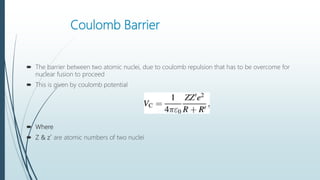
 The barrier between two atomic nuclei, due to coulomb repulsion that has to be overcome for
nuclear fusion to proceed
 This is given by coulomb potential
 Where
 Z & z` are atomic numbers of two nuclei
Coulomb Barrier
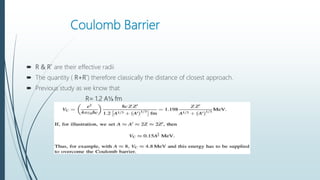
 R & R` are their effective radii
 The quantity ( R+R`) therefore classically the distance of closest approach.
 Previous study as we know that
R= 1.2 A⅓ fm
Coulomb Barrier
 This is relatively small amount of energy to supply by simply colliding two accelerated beams of
light nuclei but in practice nearly all the particles would be elastically scattered
 The only particle way is to heat a confined mixture of the nuclei to supply enough thermal
energy to overcome the coulomb barrier
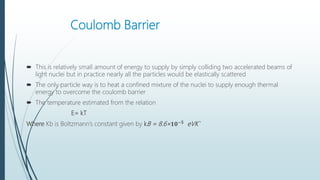
 The temperature estimated from the relation
E= kT
Where Kb is Boltzmann’s constant given by kB = 8.6× 𝟏𝟎−𝟓
eVK`
Coulomb Barrier
 Fusion actually occurs at low temperature than this estimate due to a combination of two
reasons
 First & most important is the phenomenon of quantum tunneling, which means that the full
height of the coulomb barrier does not have to be overcome.
 Second reason that fusion occurs at low temperature then expected is that a collection of nuclei
at a given mean temperature.
Thanks for listening to me..

Coulomb barrier

  • 1.
    Experimental Nuclear physics CourseInstructor: Dr. Waseem Ahmad Presentation On: Coulomb Barrier presented by: Mehak Tariq Ghazi University DG Khan
  • 2.
    Coulomb Barrier  Thebarrier between two atomic nuclei, due to coulomb repulsion that has to be overcome for nuclear fusion to proceed  This is given by coulomb potential  Where  Z & z` are atomic numbers of two nuclei
  • 3.
    Coulomb Barrier  R& R` are their effective radii  The quantity ( R+R`) therefore classically the distance of closest approach.  Previous study as we know that R= 1.2 A⅓ fm
  • 4.
    Coulomb Barrier  Thisis relatively small amount of energy to supply by simply colliding two accelerated beams of light nuclei but in practice nearly all the particles would be elastically scattered  The only particle way is to heat a confined mixture of the nuclei to supply enough thermal energy to overcome the coulomb barrier  The temperature estimated from the relation E= kT Where Kb is Boltzmann’s constant given by kB = 8.6× 𝟏𝟎−𝟓 eVK`
  • 5.
    Coulomb Barrier  Fusionactually occurs at low temperature than this estimate due to a combination of two reasons  First & most important is the phenomenon of quantum tunneling, which means that the full height of the coulomb barrier does not have to be overcome.  Second reason that fusion occurs at low temperature then expected is that a collection of nuclei at a given mean temperature.
  • 6.