Kaggle Otto Challenge
How we achieved 85th out of 3,514 and what we learnt
Eugene Yan & Wang Weimin
Kaggle: A platform for predictive modeling competitions
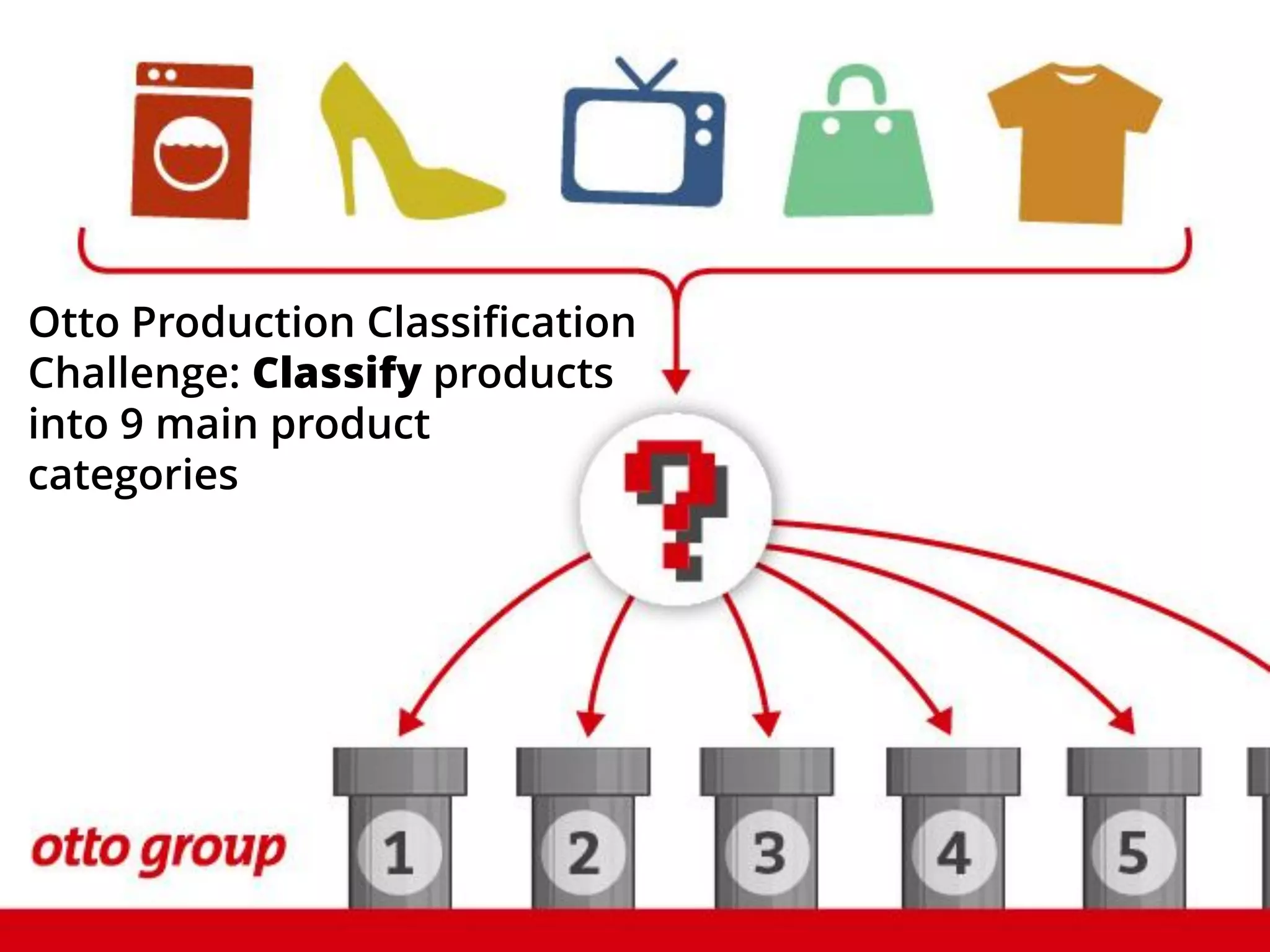
Otto Production Classification
Challenge: Classify products
into 9 main product
categories
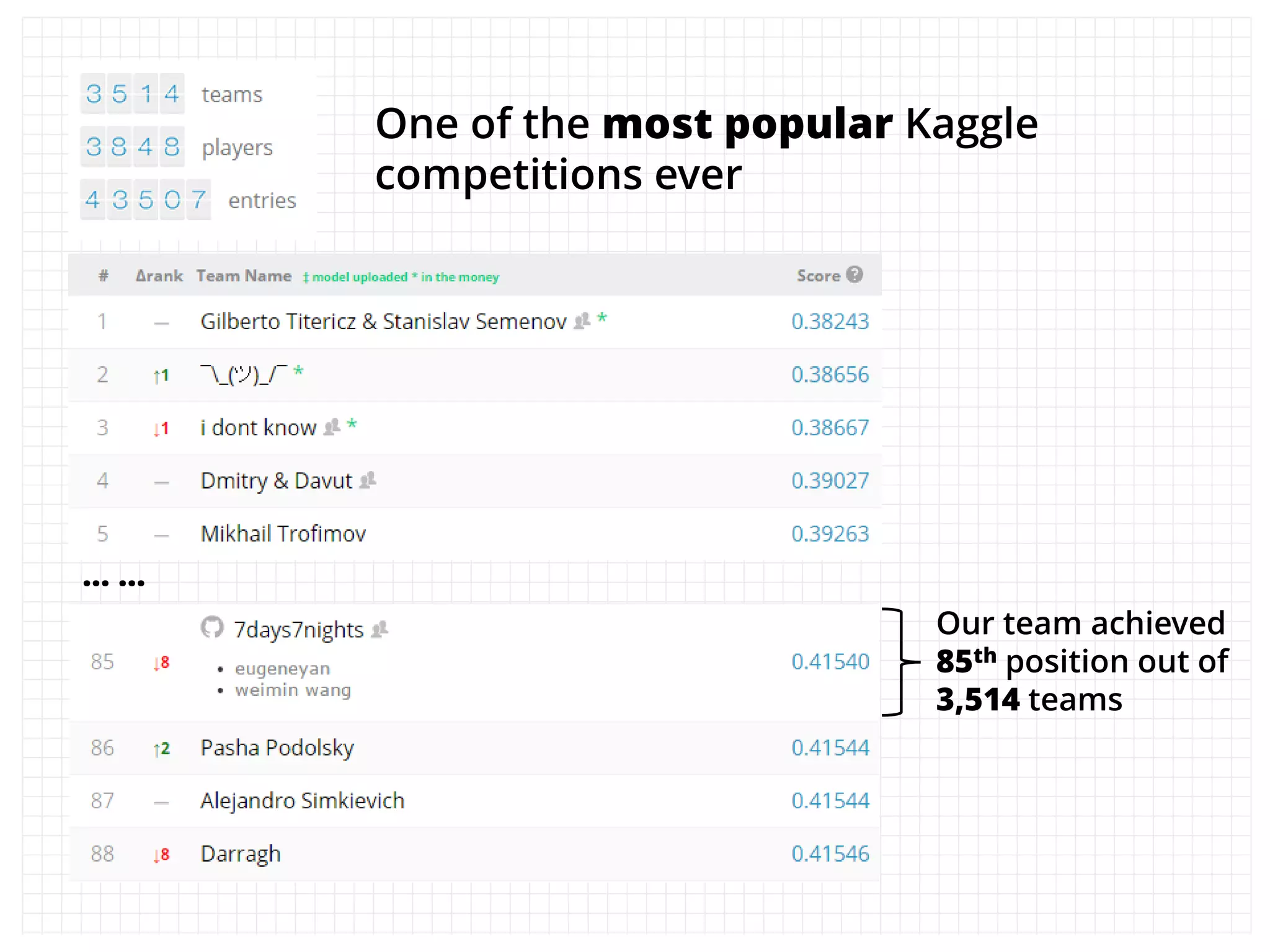
One of the most popular Kaggle
competitions ever
… …
Our team achieved
85th position out of
3,514 teams
… …
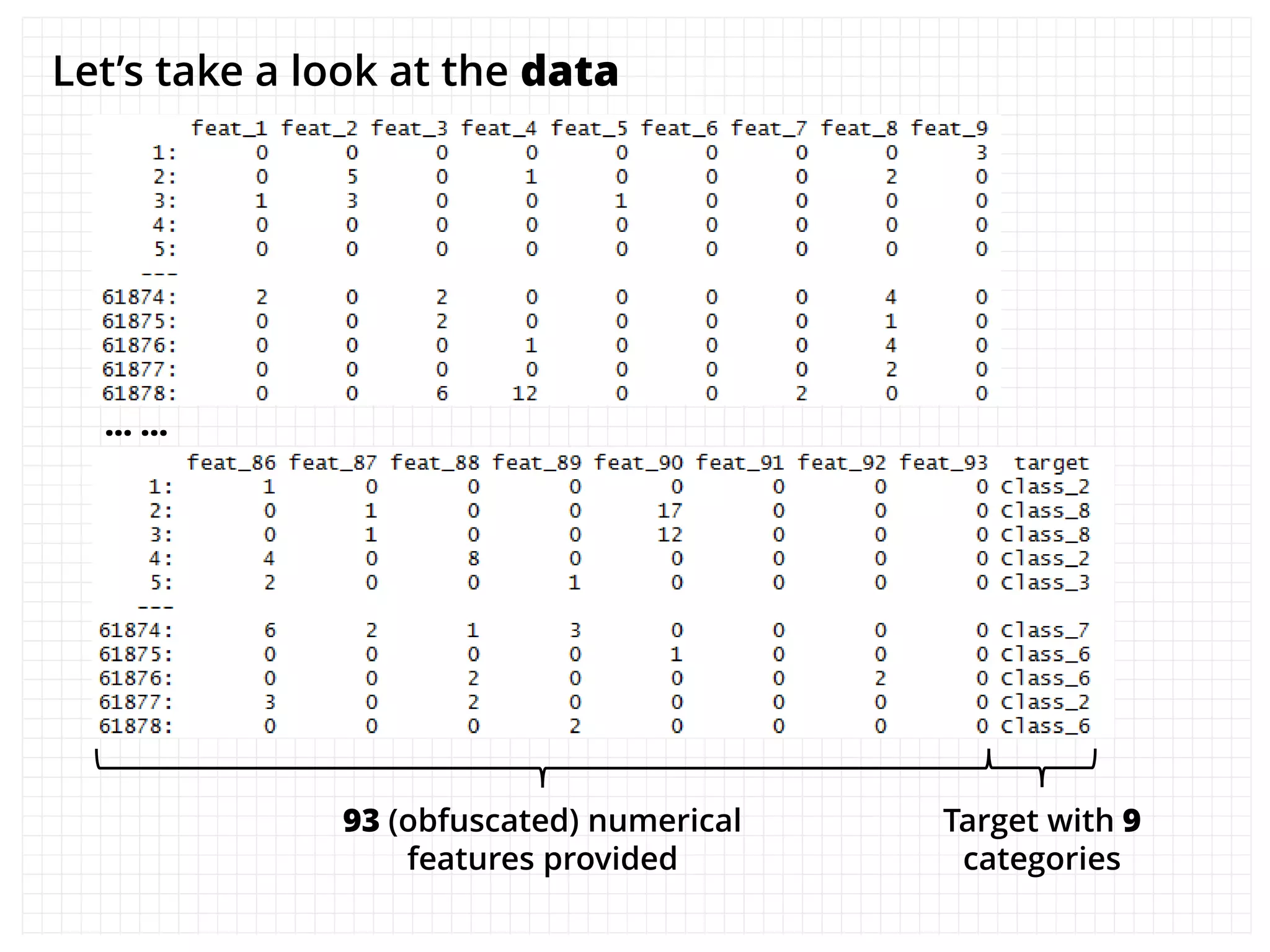
93 (obfuscated) numerical
features provided
Target with 9
categories
Let’s take a look at the data
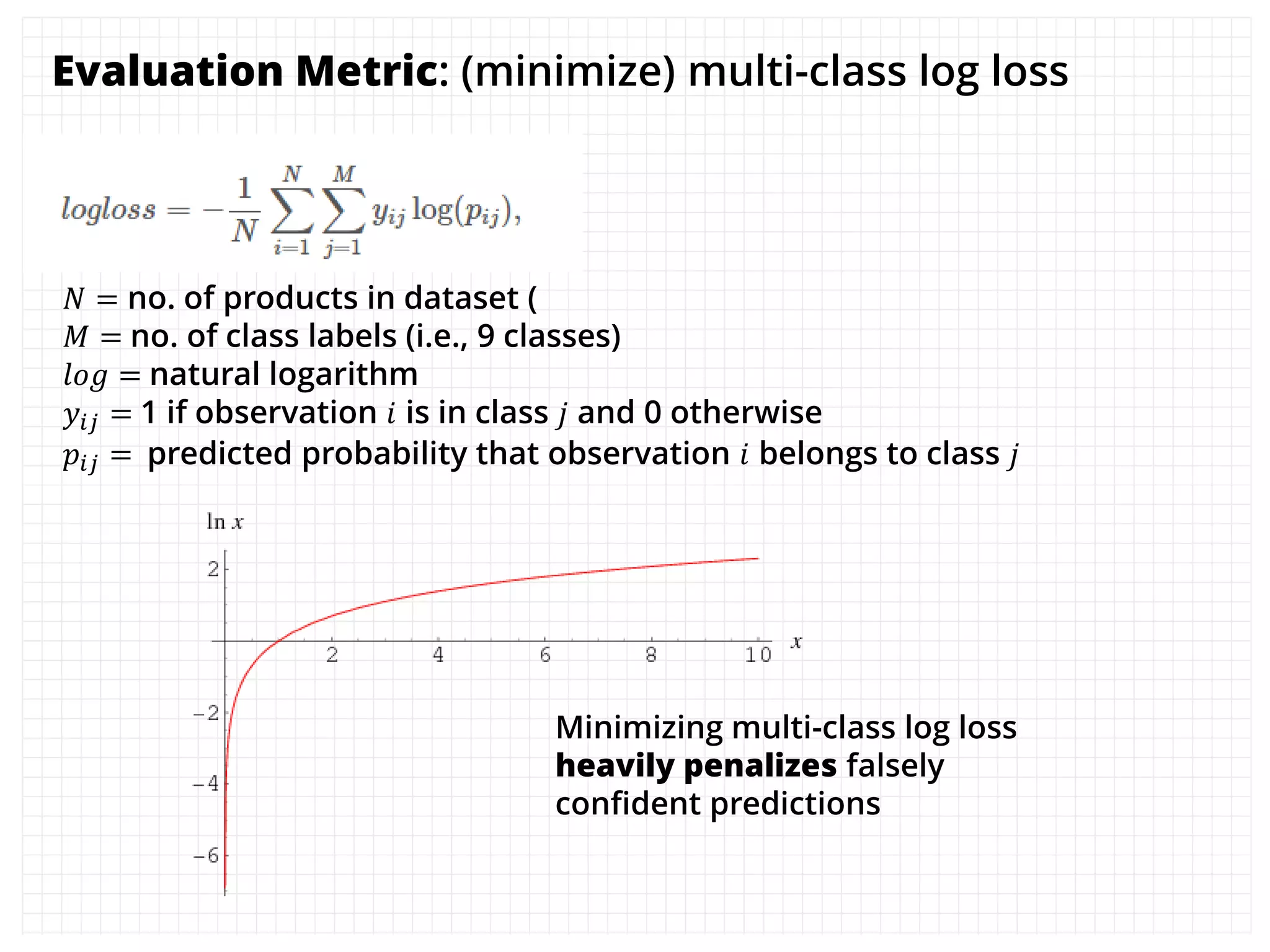
Evaluation Metric: (minimize) multi-class log loss
𝑁 = no. of products in dataset (
𝑀 = no. of class labels (i.e., 9 classes)
𝑙𝑜𝑔 = natural logarithm
𝑦𝑖𝑗 = 1 if observation 𝑖 is in class 𝑗 and 0 otherwise
𝑝𝑖𝑗 = predicted probability that observation 𝑖 belongs to class 𝑗
Minimizing multi-class log loss
heavily penalizes falsely
confident predictions
Validation (two
main approaches)
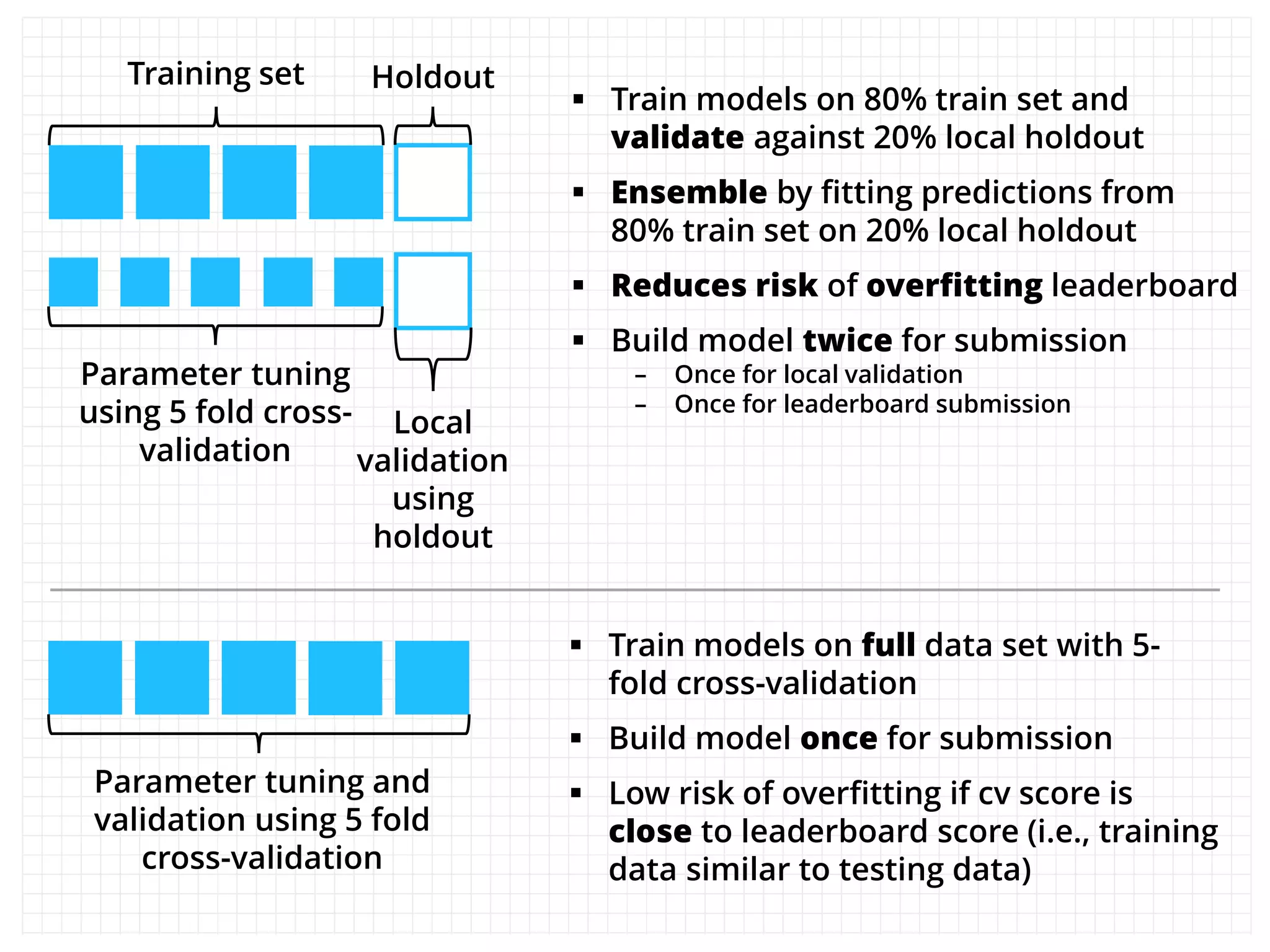
Training set Holdout
Parameter tuning
using 5 fold cross-
validation
Local
validation
using
holdout
 Train models on 80% train set and
validate against 20% local holdout
 Ensemble by fitting predictions from
80% train set on 20% local holdout
 Reduces risk of overfitting leaderboard
 Build model twice for submission
– Once for local validation
– Once for leaderboard submission
Parameter tuning and
validation using 5 fold
cross-validation
 Train models on full data set with 5-
fold cross-validation
 Build model once for submission
 Low risk of overfitting if cv score is
close to leaderboard score (i.e., training
data similar to testing data)
Feature
Engineering
Do we need all 93 features?
Can we reduce noise to
reveal more of the signal?
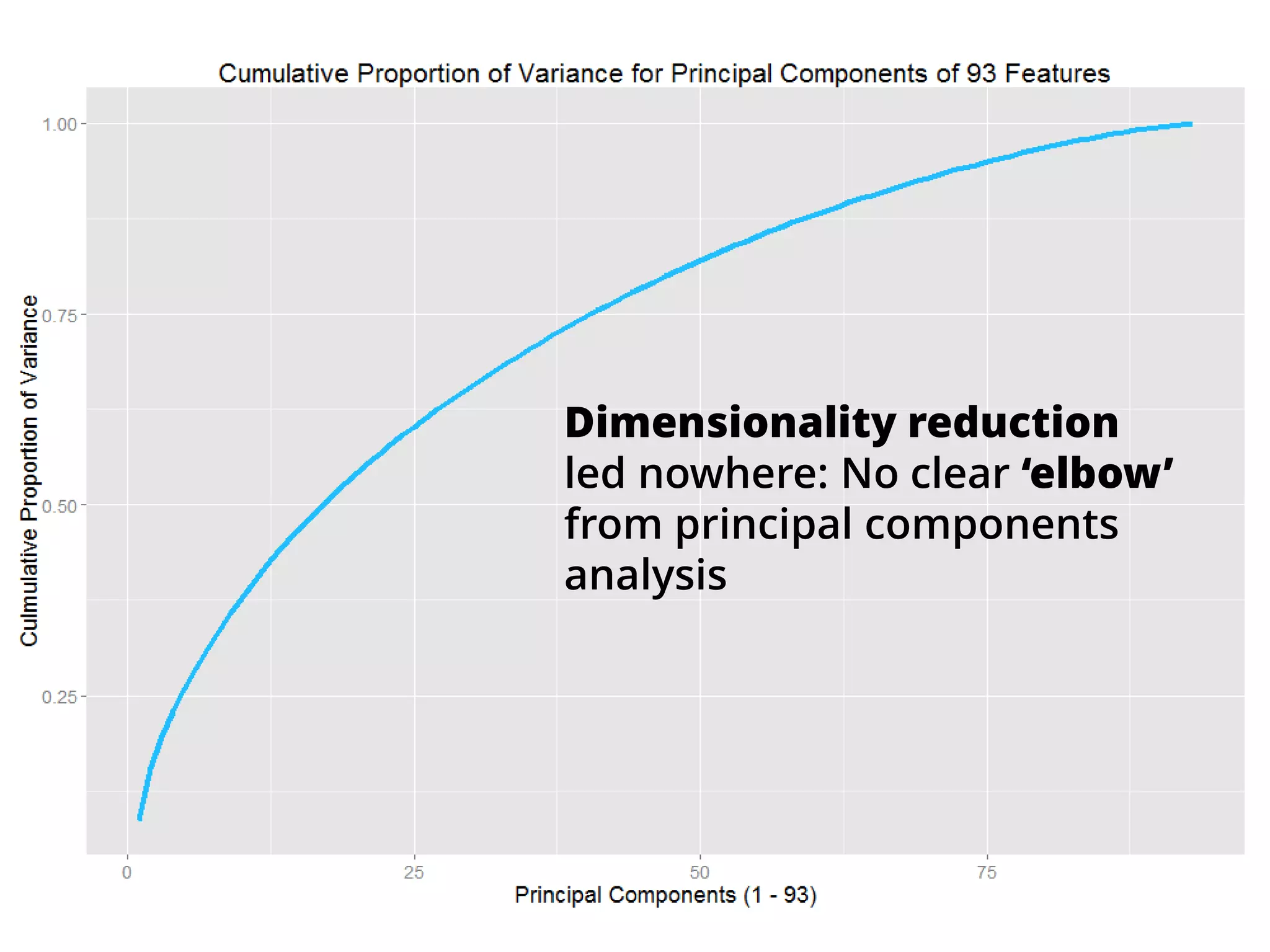
Dimensionality reduction
led nowhere: No clear ‘elbow’
from principal components
analysis
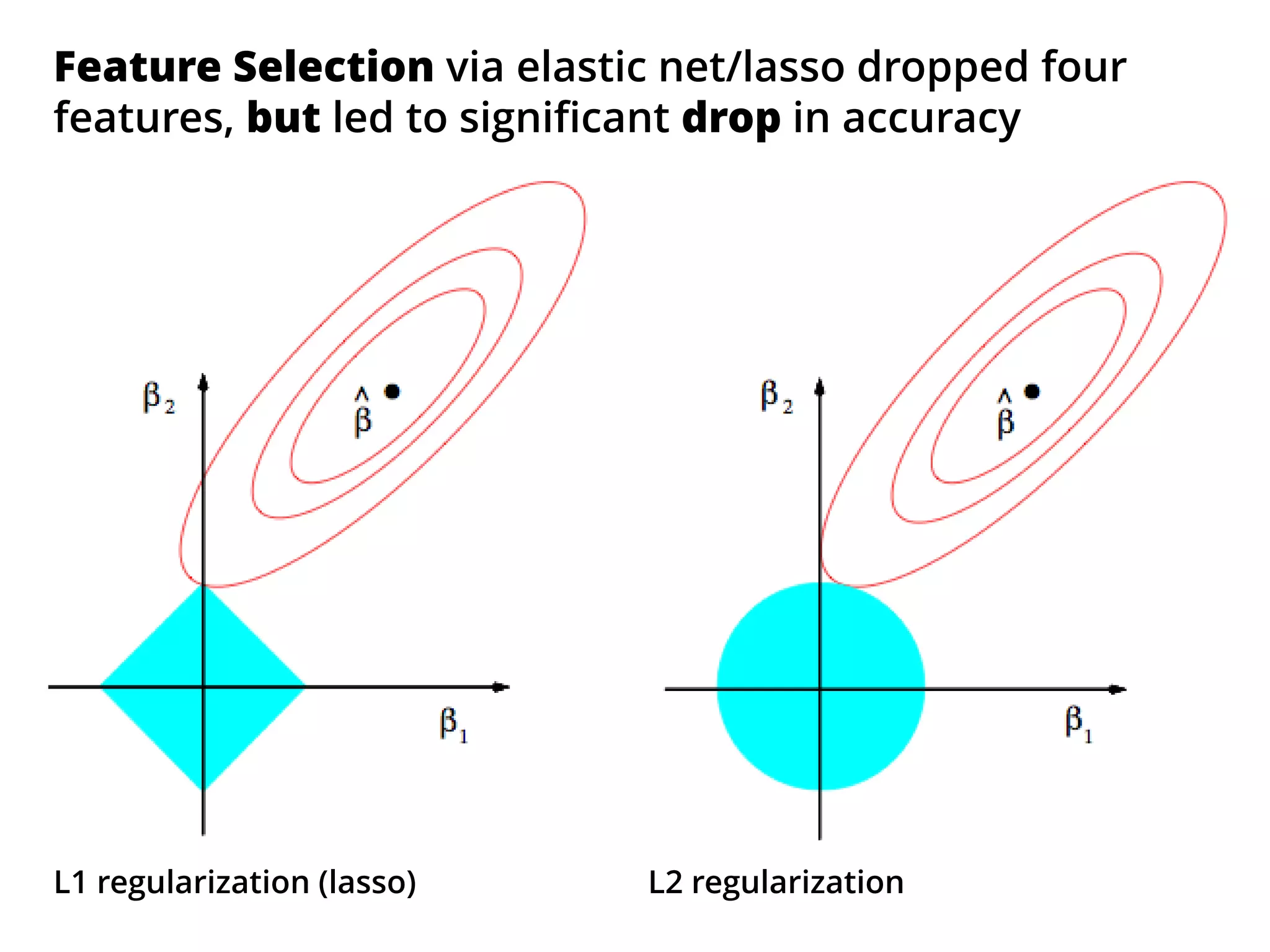
L1 regularization (lasso) L2 regularization
Feature Selection via elastic net/lasso dropped four
features, but led to significant drop in accuracy
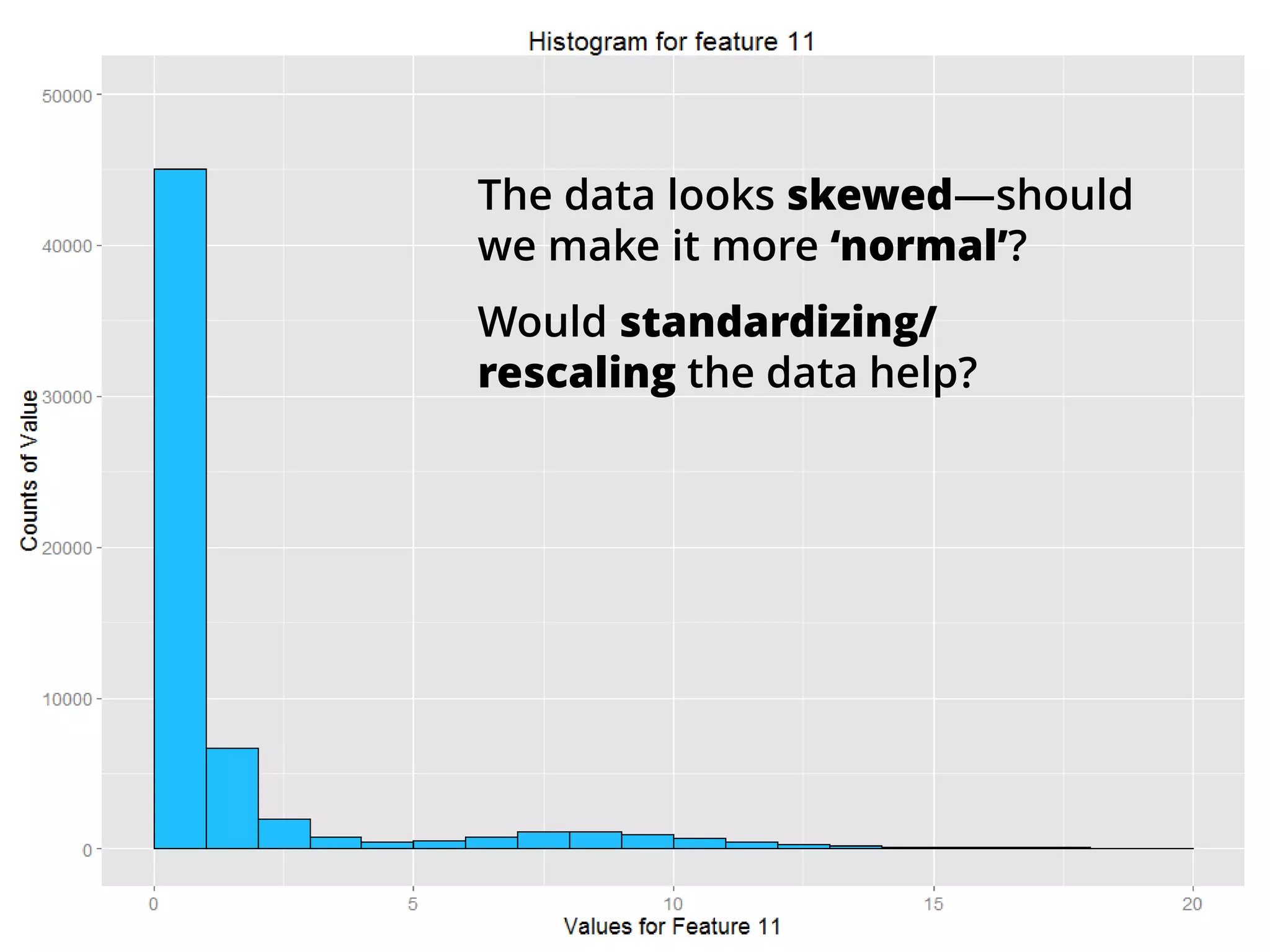
The data looks is very skewed—
should we make it more ‘normal’?
Would standardizing/ rescaling
the data help?
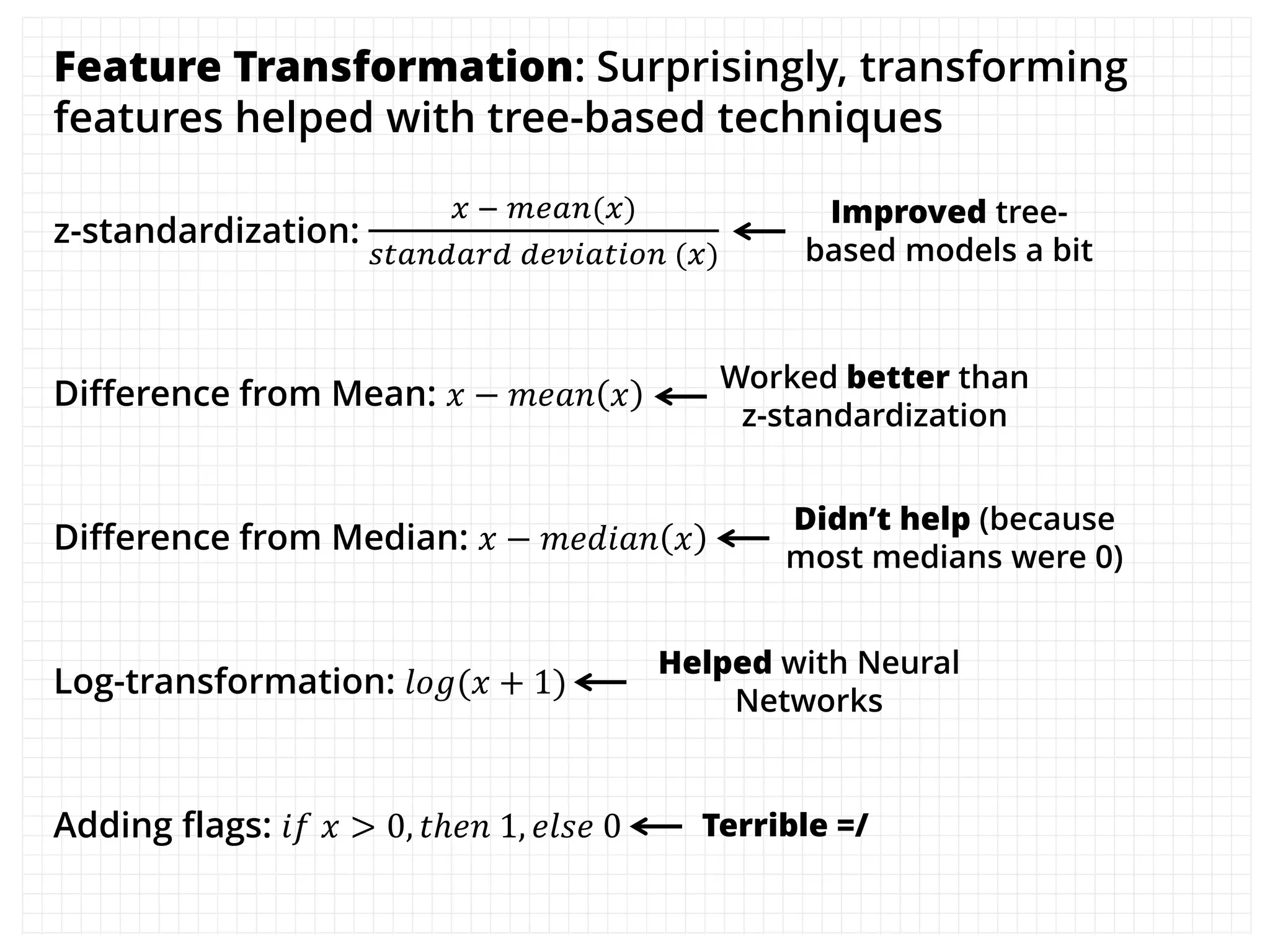
Feature Transformation: Surprisingly, transforming
features helped with tree-based techniques
z-standardization:
𝑥 − 𝑚𝑒𝑎𝑛(𝑥)
𝑠𝑡𝑎𝑛𝑑𝑎𝑟𝑑 𝑑𝑒𝑣𝑖𝑎𝑡𝑖𝑜𝑛 (𝑥)
Difference from Mean: 𝑥 − 𝑚𝑒𝑎𝑛 𝑥
Difference from Median: 𝑥 − 𝑚𝑒𝑑𝑖𝑎𝑛 𝑥
Log-transformation: 𝑙𝑜𝑔(𝑥 + 1)
Adding flags: 𝑖𝑓 𝑥 > 0, 𝑡ℎ𝑒𝑛 1, 𝑒𝑙𝑠𝑒 0
Improved tree-
based models a bit
Worked better than
z-standardization
Didn’t help (because
most medians were 0)
Helped with Neural
Networks
Terrible =/
Though models like GBM and
Neural Nets can approximate
deep interactions, we can help
find patterns and explicitly define:
 Complex features (e.g., week on
week increase)
 Interactions (e.g., ratios, sums,
differences)
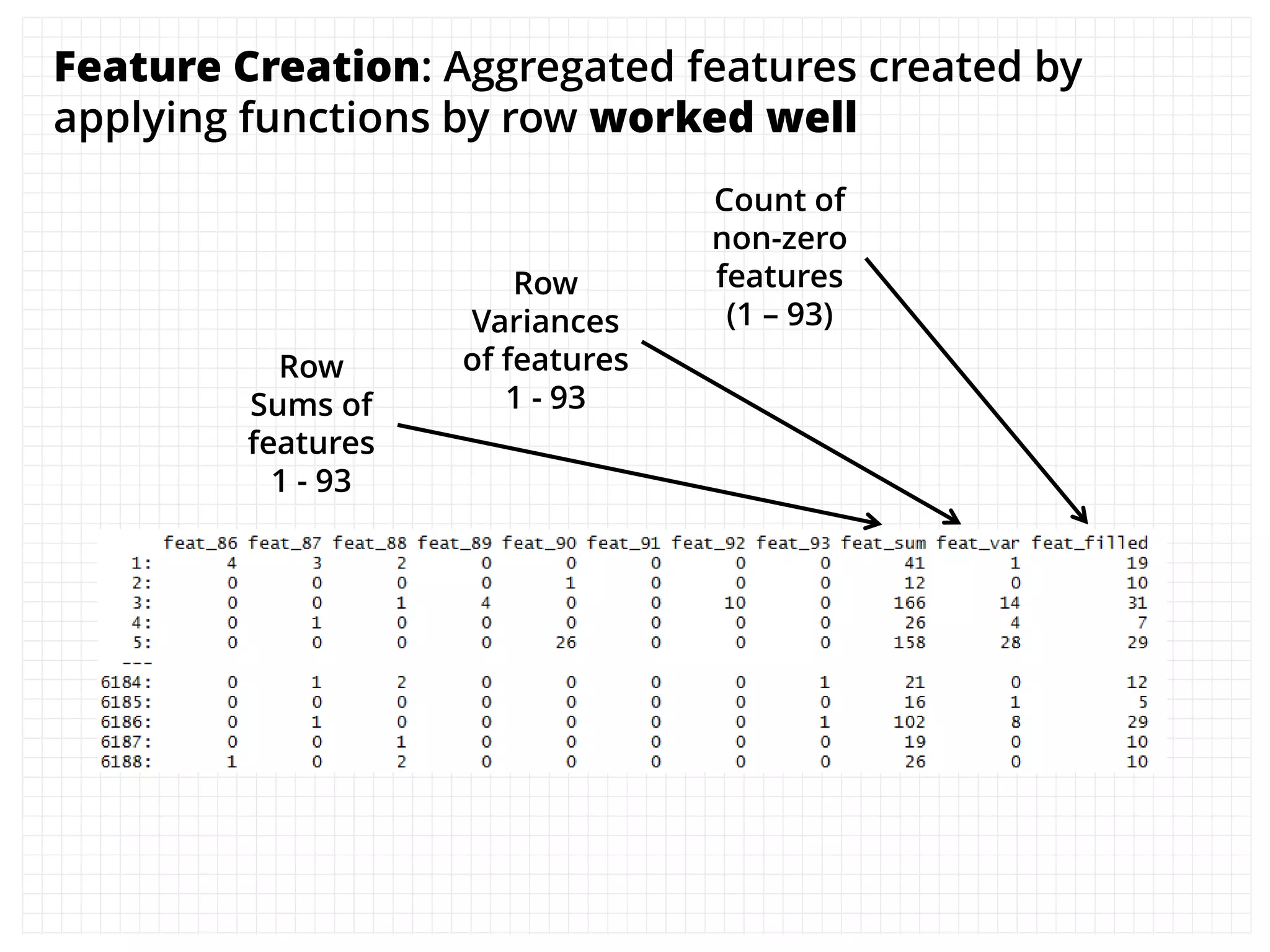
Feature Creation: Aggregated features created by
applying functions by row worked well
Row
Sums of
features
1 - 93
Row
Variances
of features
1 - 93
Count of
non-zero
features
(1 – 93)
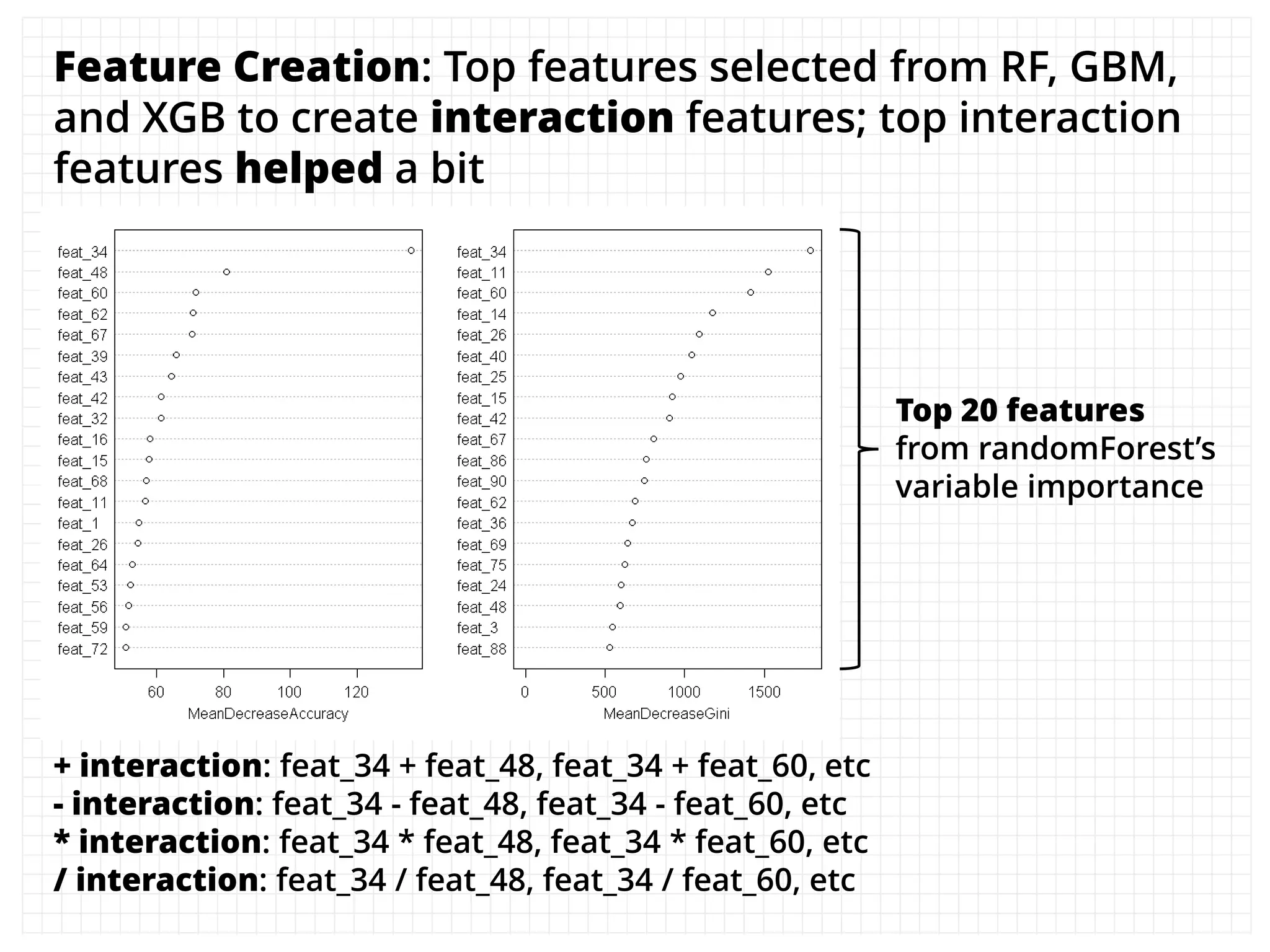
Feature Creation: Top features selected from RF, GBM,
and XGB to create interaction features; top interaction
features helped a bit
+ interaction: feat_34 + feat_48, feat_34 + feat_60, etc
- interaction: feat_34 - feat_48, feat_34 - feat_60, etc
* interaction: feat_34 * feat_48, feat_34 * feat_60, etc
/ interaction: feat_34 / feat_48, feat_34 / feat_60, etc
Top 20 features
from randomForest’s
variable importance
Tree-based Models
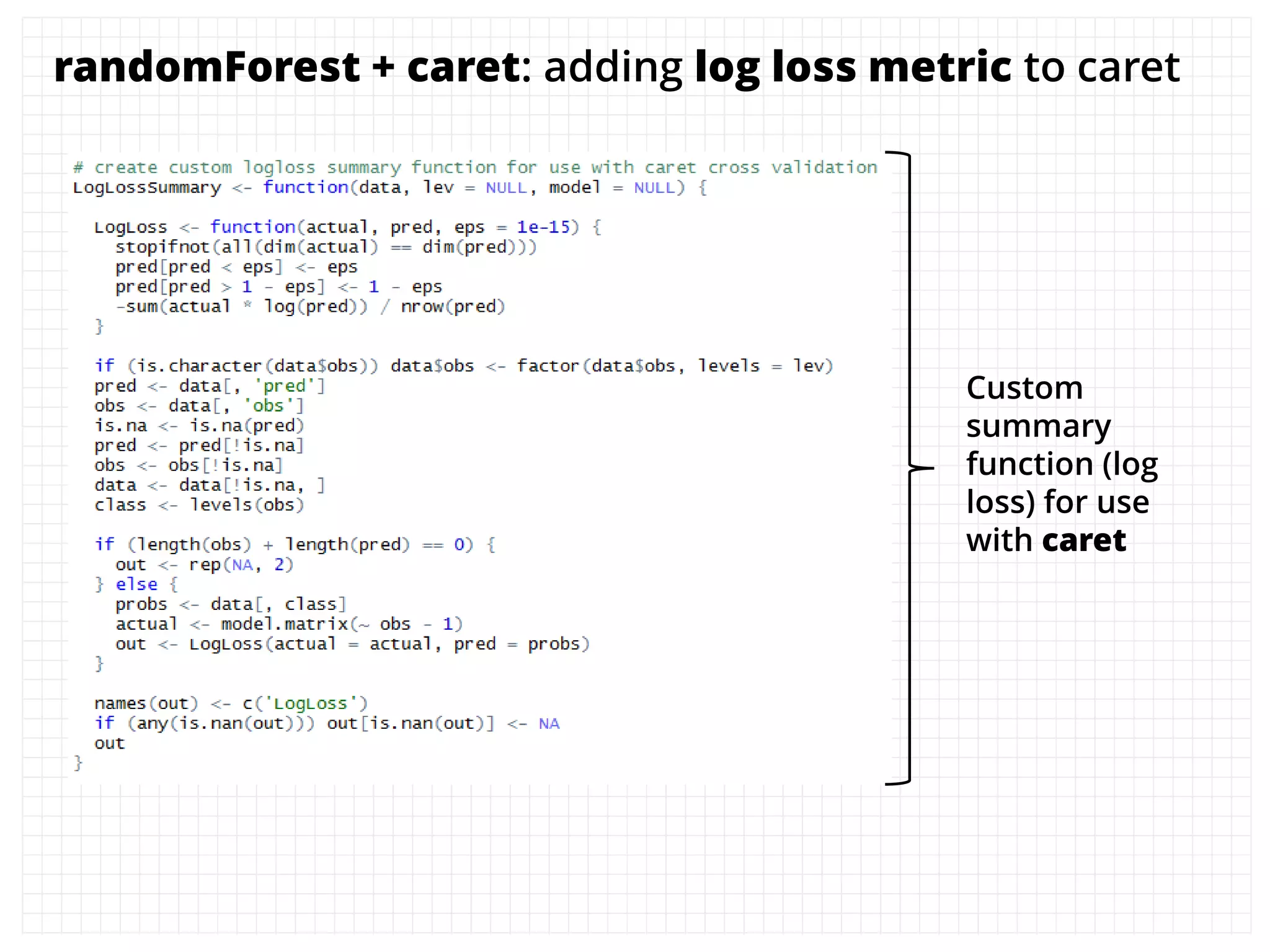
R’s caret: adding custom log loss metric
Custom
summary
function (log
loss) for use
with caret
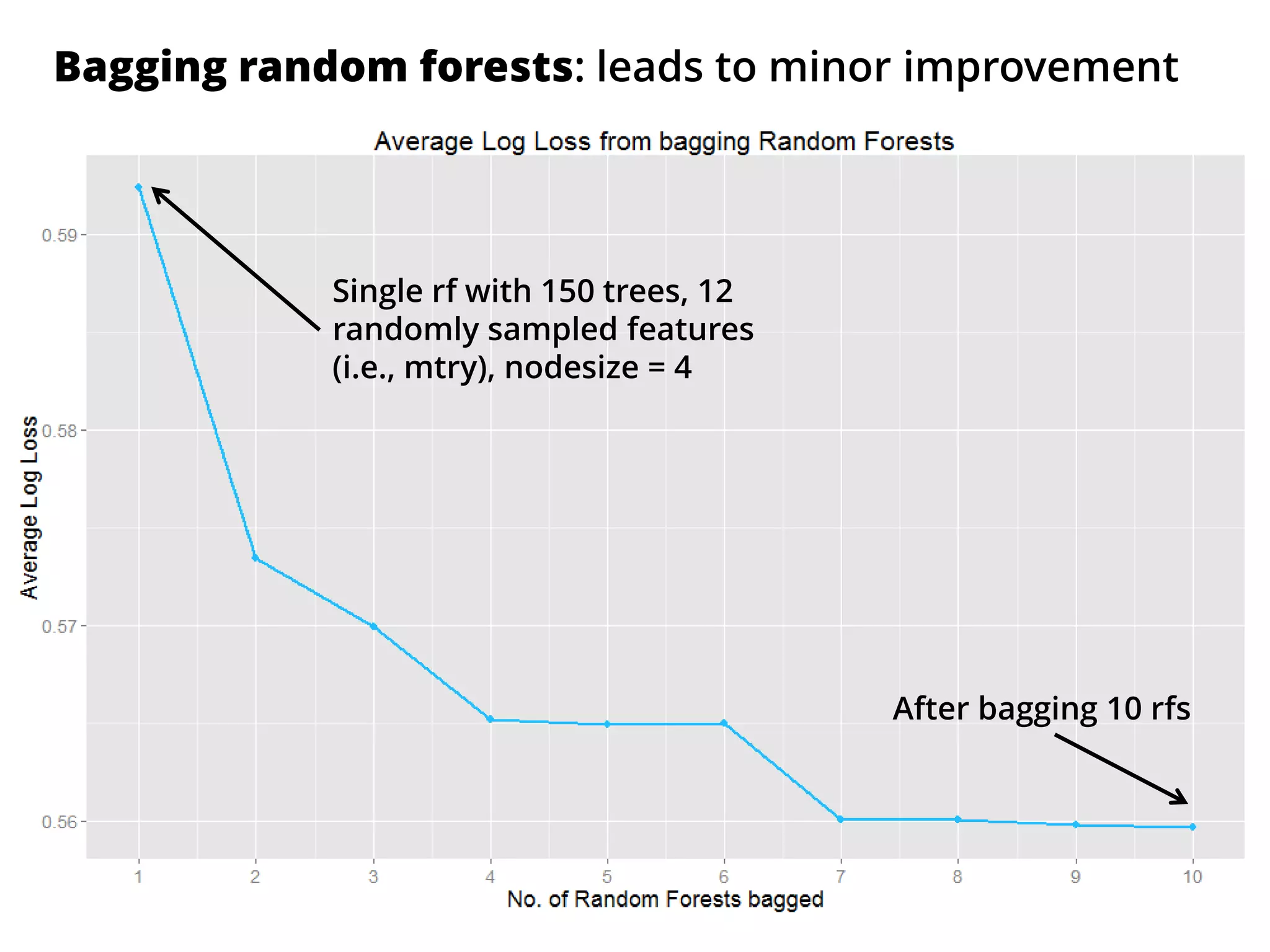
Bagging random forests: leads to minor improvement
Single rf with 150 trees, 12
randomly sampled features
(i.e., mtry), nodesize = 4
After bagging 10 rfs
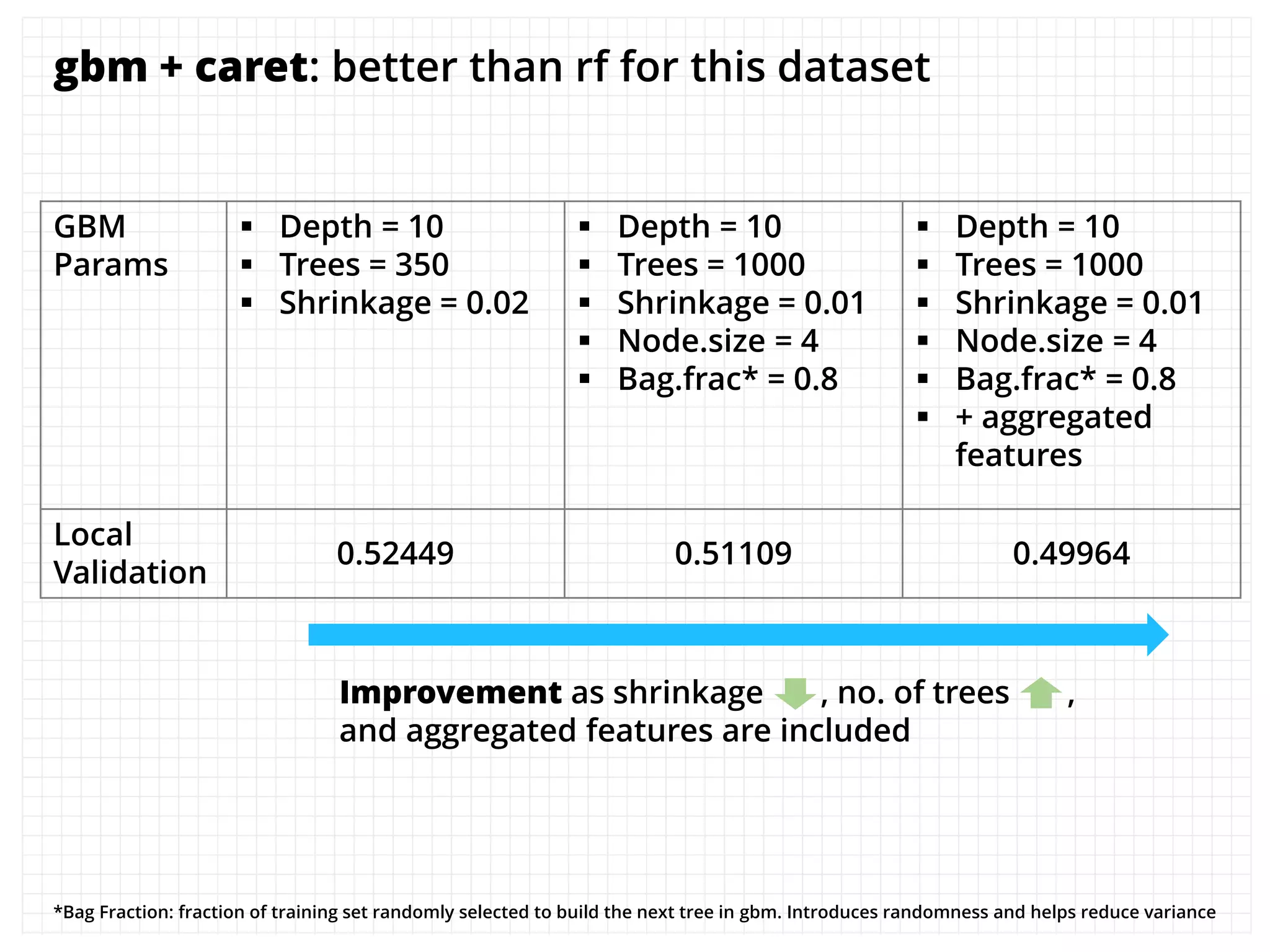
gbm + caret: better than rf for this dataset
GBM
Params
 Depth = 10
 Trees = 350
 Shrinkage = 0.02
 Depth = 10
 Trees = 1000
 Shrinkage = 0.01
 Node.size = 4
 Bag.frac* = 0.8
 Depth = 10
 Trees = 1000
 Shrinkage = 0.01
 Node.size = 4
 Bag.frac* = 0.8
 + aggregated
features
Local
Validation
0.52449 0.51109 0.49964
Improvement as shrinkage , no. of trees ,
and aggregated features are included
*Bag Fraction: fraction of training set randomly selected to build the next tree in gbm. Introduces randomness and helps reduce variance
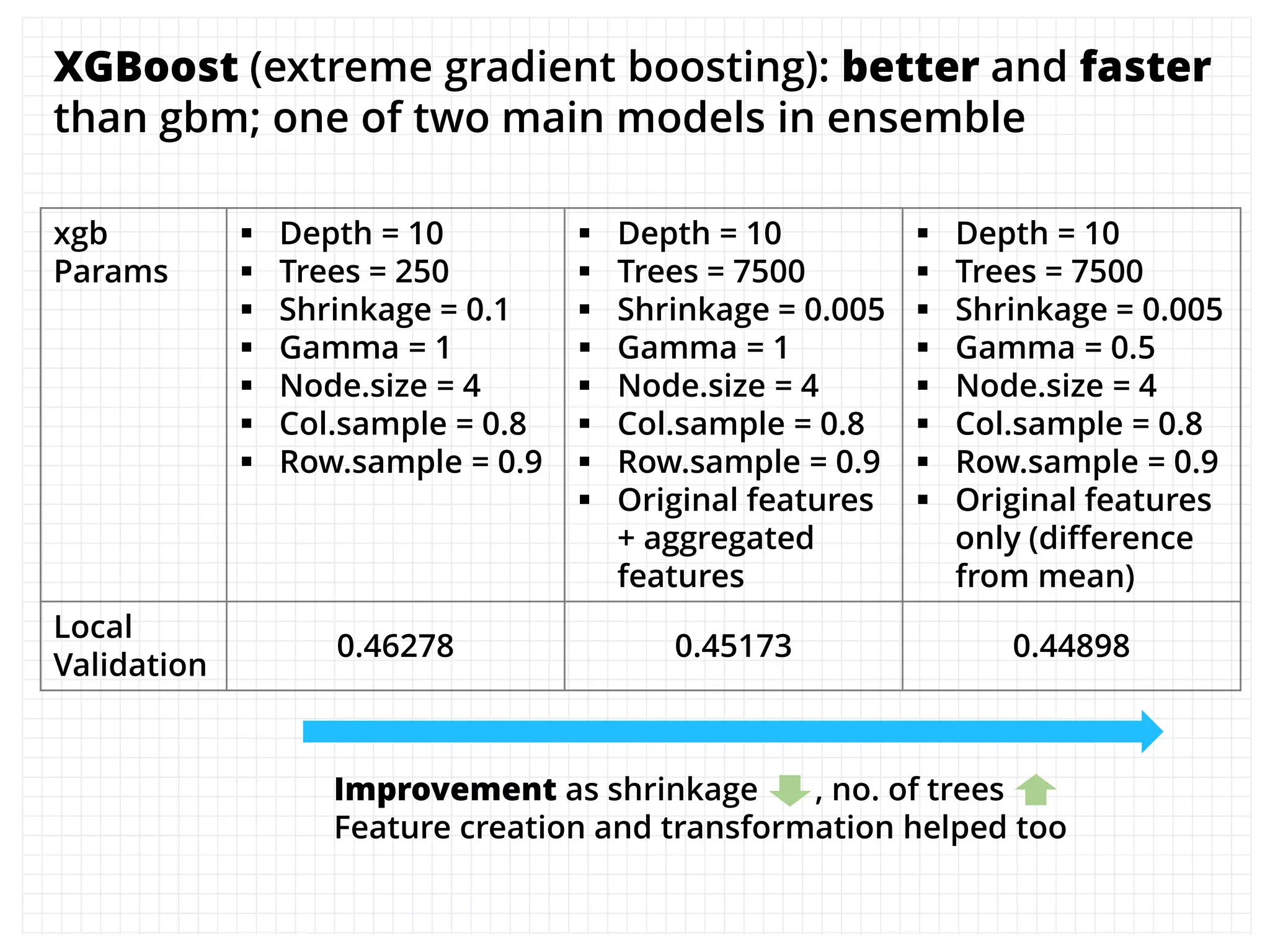
XGBoost (extreme gradient boosting): better and faster
than gbm; one of two main models in ensemble
xgb
Params
 Depth = 10
 Trees = 250
 Shrinkage = 0.1
 Gamma = 1
 Node.size = 4
 Col.sample = 0.8
 Row.sample = 0.9
 Depth = 10
 Trees = 7500
 Shrinkage = 0.005
 Gamma = 1
 Node.size = 4
 Col.sample = 0.8
 Row.sample = 0.9
 Original features
+ aggregated
features
 Depth = 10
 Trees = 7500
 Shrinkage = 0.005
 Gamma = 0.5
 Node.size = 4
 Col.sample = 0.8
 Row.sample = 0.9
 Original features
only (difference
from mean)
Local
Validation
0.46278 0.45173 0.44898
Improvement as shrinkage , no. of trees
Feature creation and transformation helped too
Neural Networks
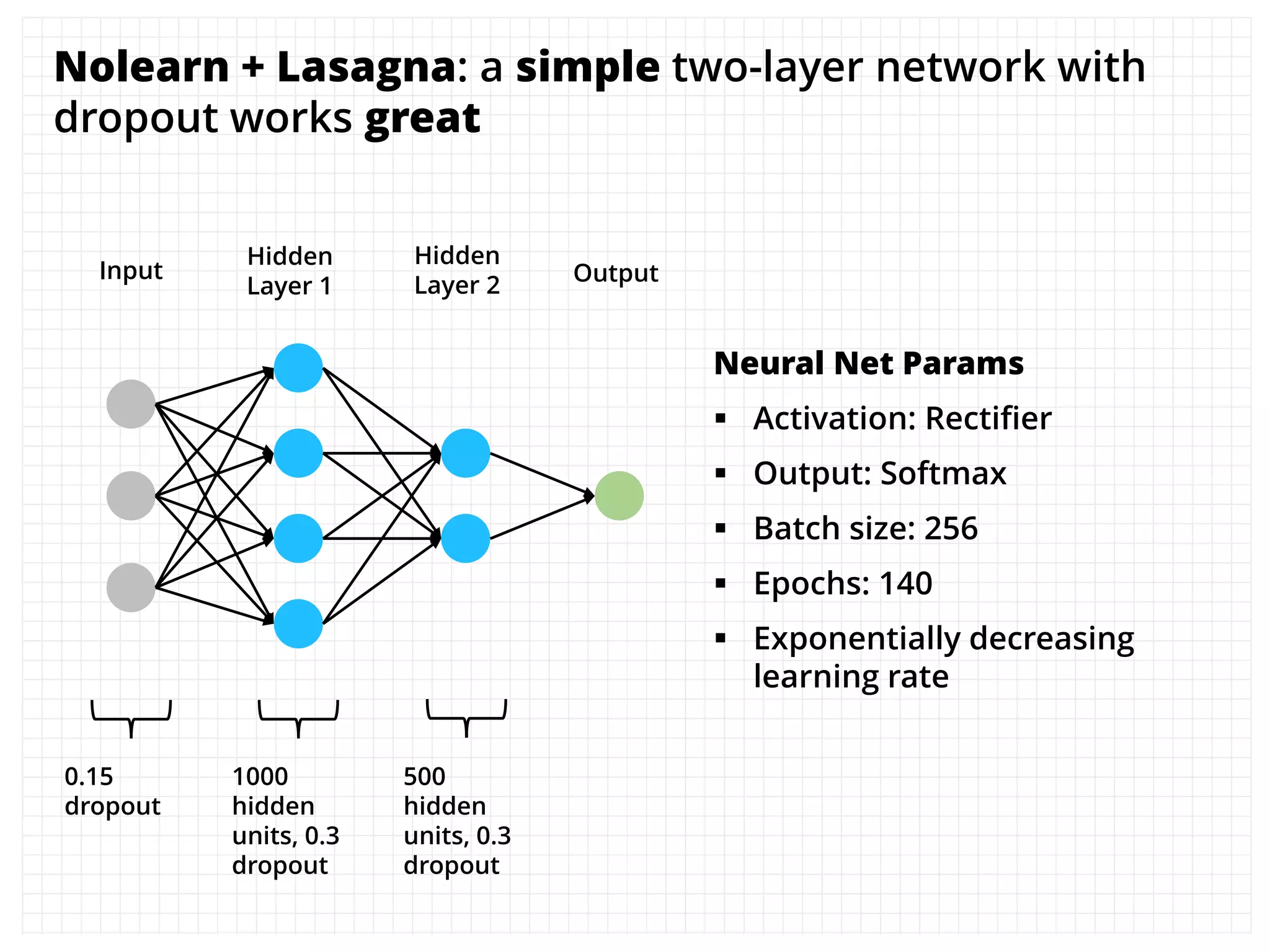
Nolearn + Lasagna: a simple two-layer network with
dropout works great
0.15
dropout
1000
hidden
units, 0.3
dropout
500
hidden
units, 0.3
dropout
Neural Net Params
 Activation: Rectifier
 Output: Softmax
 Batch size: 256
 Epochs: 140
 Exponentially decreasing
learning rate
Input
Hidden
Layer 1
Hidden
Layer 2 Output
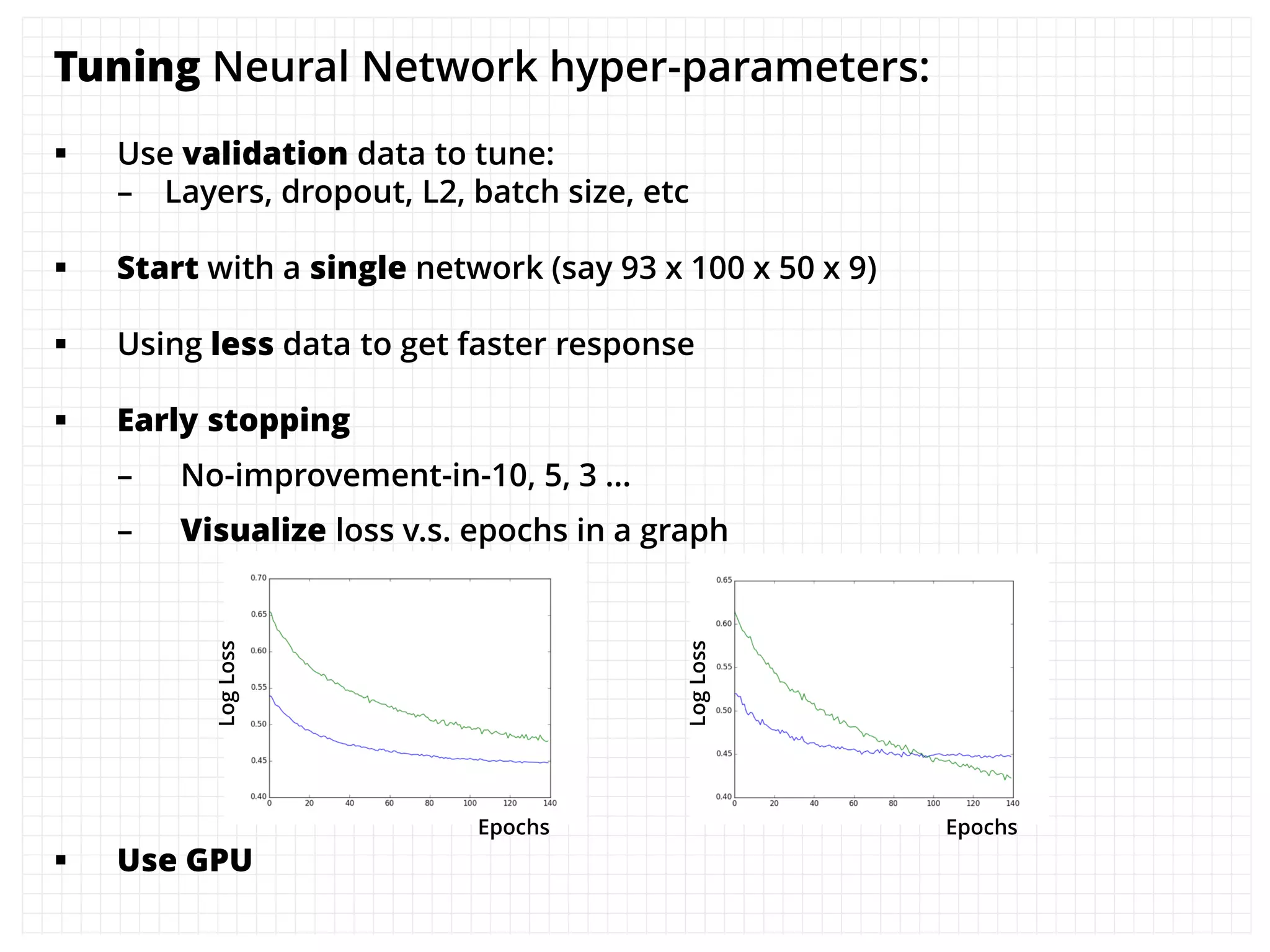
Tuning Neural Network hyper-parameters:
 Use validation data to tune:
– Layers, dropout, L2, batch size, etc
 Start with a single network (say 93 x 100 x 50 x 9)
 Using less data to get faster response
 Early stopping
– No-improvement-in-10, 5, 3 …
– Visualize loss v.s. epochs in a graph
 Use GPU
LogLoss
Epochs
LogLoss
Epochs
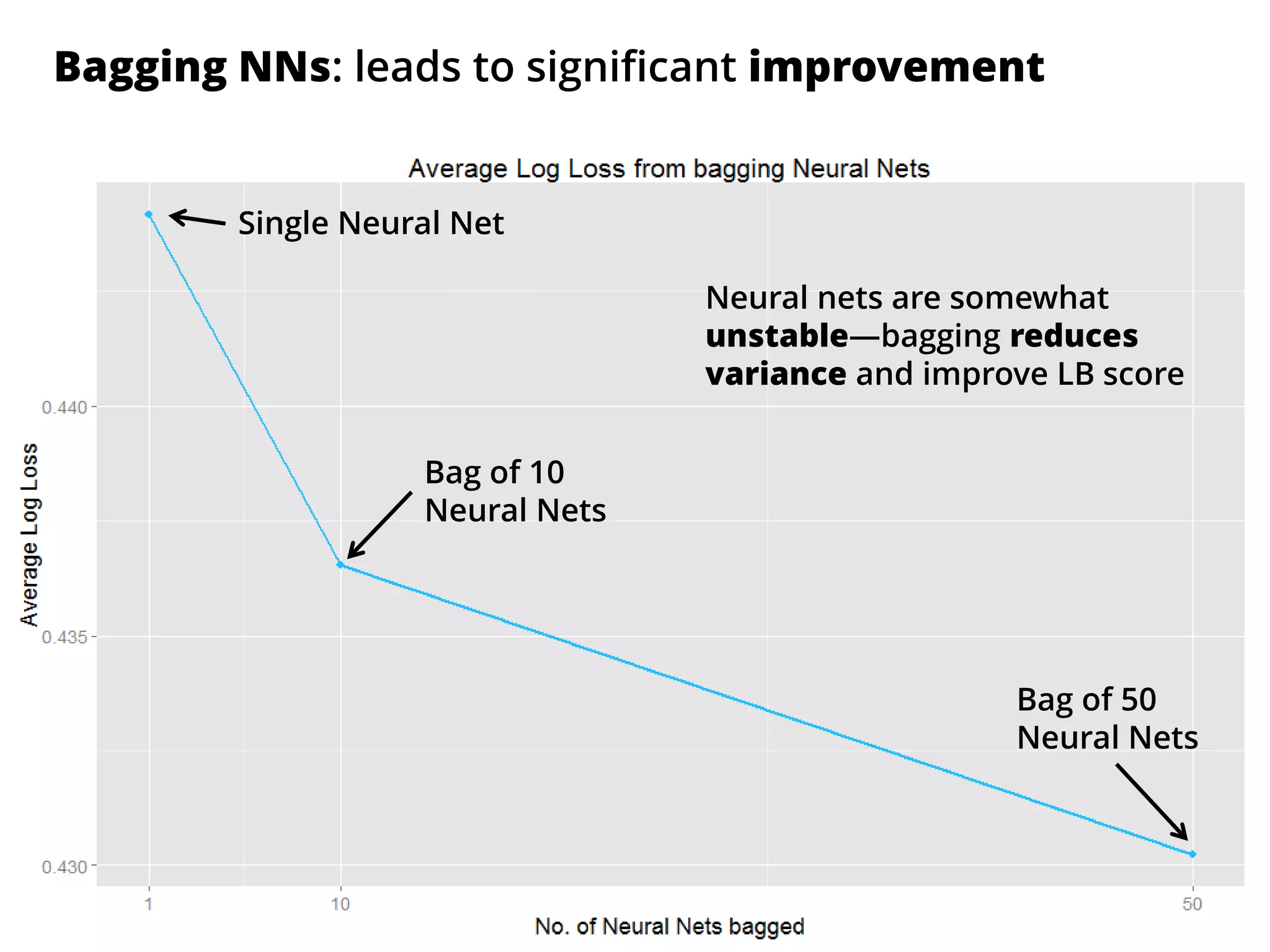
Bagging NNs: leads to significant improvement
Single Neural Net
Bag of 10
Neural Nets
Bag of 50
Neural Nets
Neural nets are somewhat
unstable—bagging reduces
variance and improve LB score
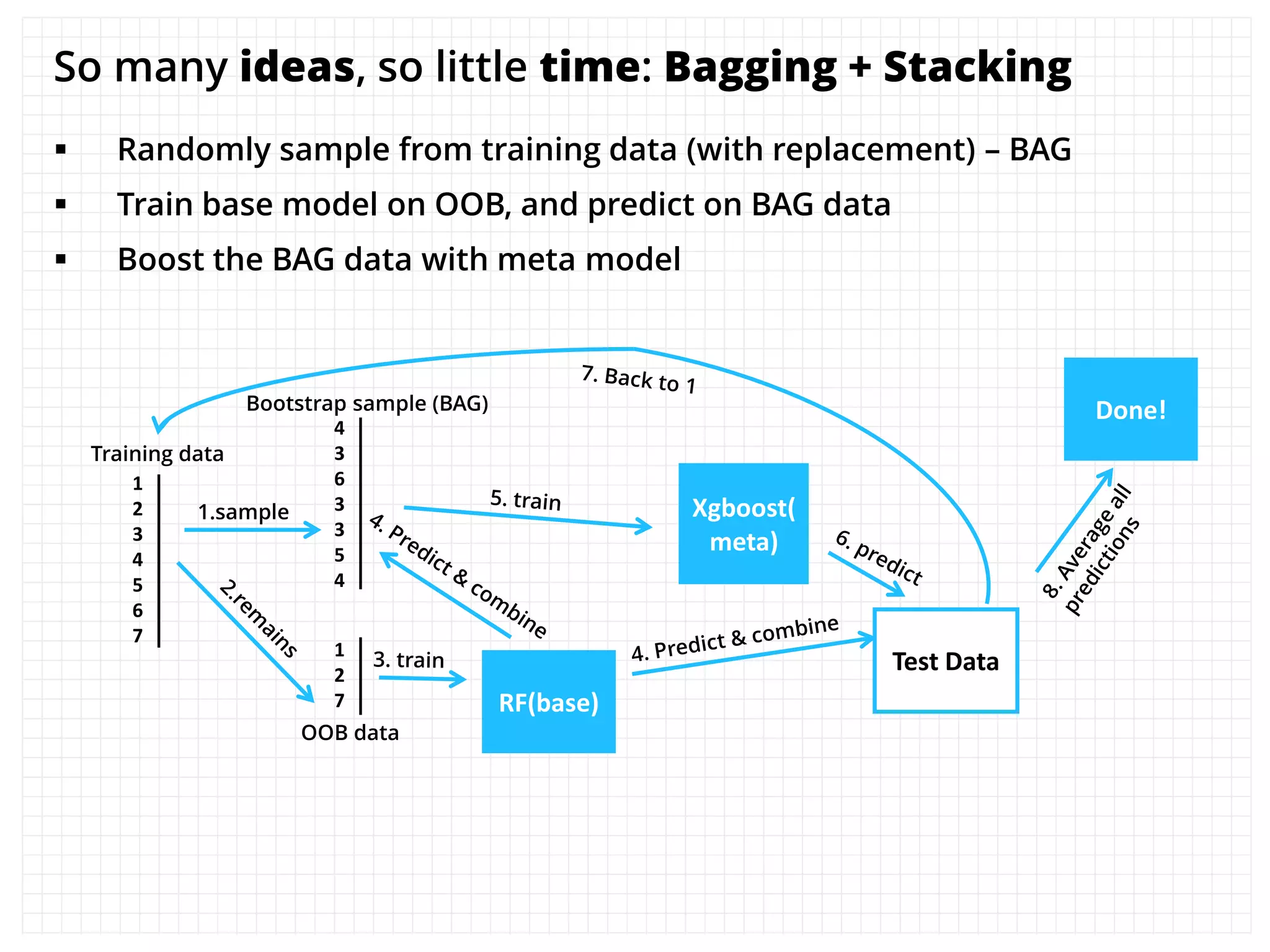
So many ideas, so little time: Bagging + Stacking
 Randomly sample from training data (with replacement) – BAG
 Train base model on OOB, and predict on BAG data
 Boost the BAG data with meta model
1
2
3
4
5
6
7
Training data
4
3
6
3
3
5
4
1
2
7
Bootstrap sample (BAG)
OOB data
1.sample Xgboost(
meta)
RF(base)
Test Data
Done!
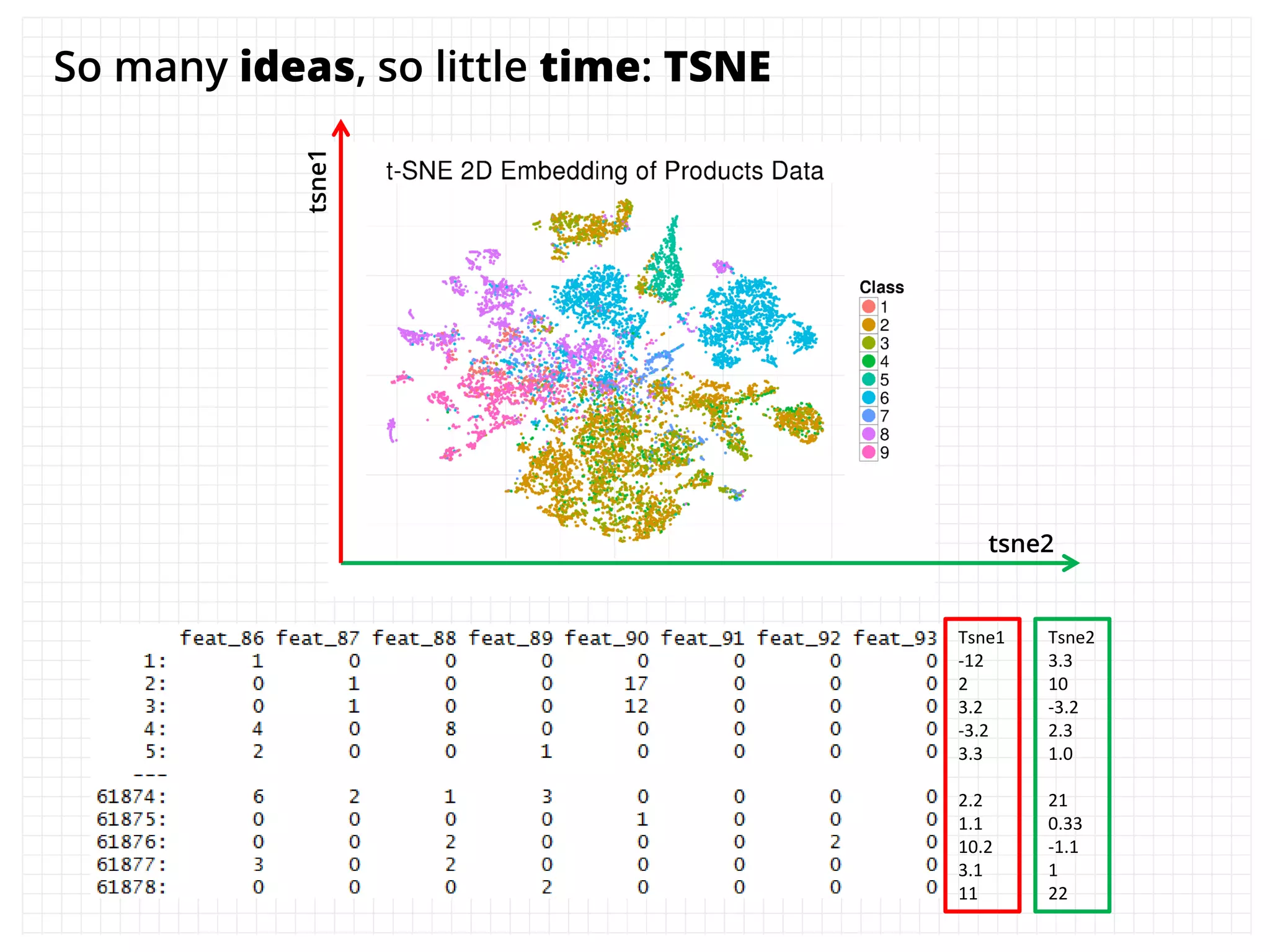
So many ideas, so little time: TSNE
tsne1
tsne2
Tsne1
-12
2
3.2
-3.2
3.3
2.2
1.1
10.2
3.1
11
Tsne2
3.3
10
-3.2
2.3
1.0
21
0.33
-1.1
1
22
Ensemble our models
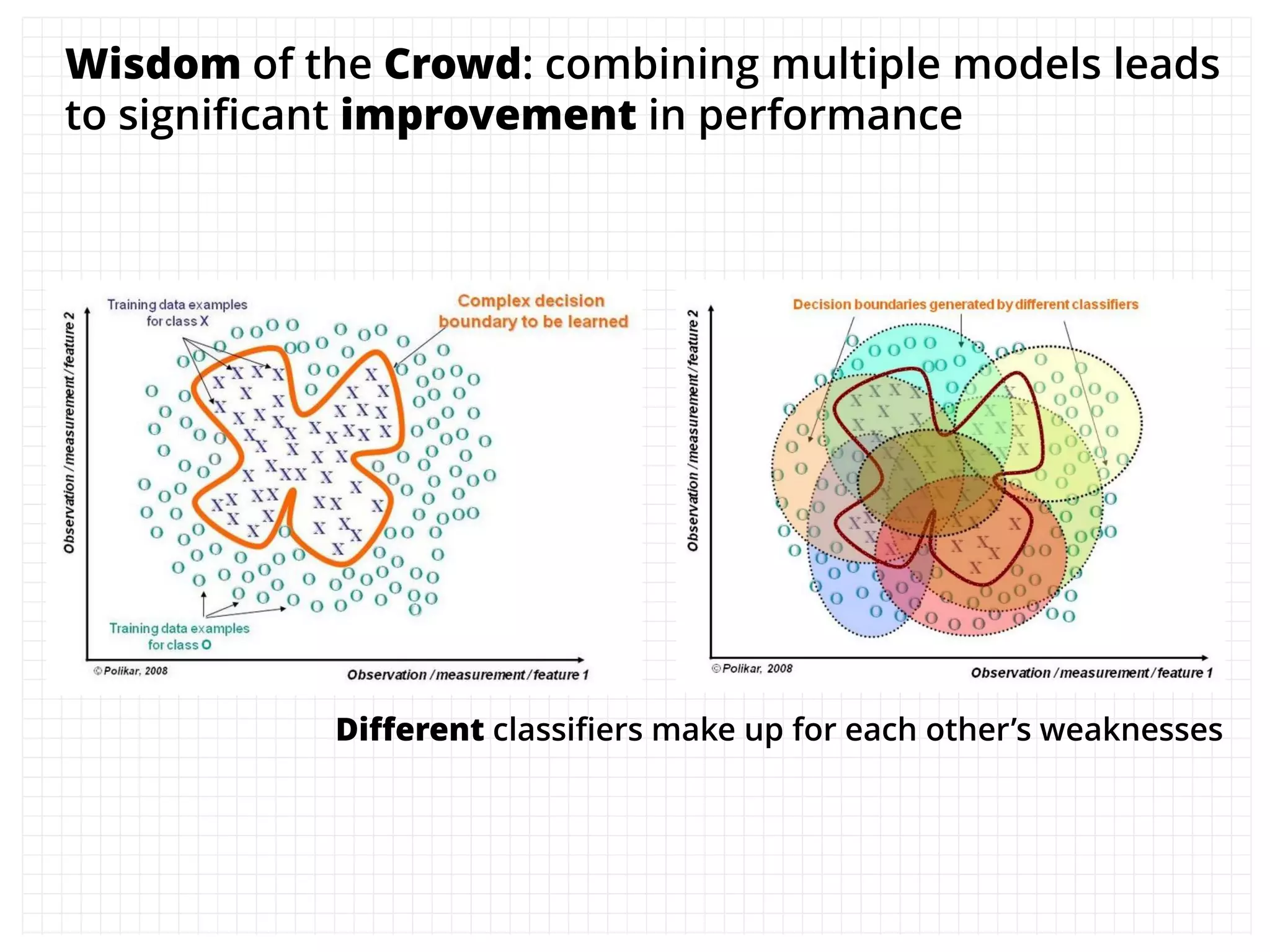
Wisdom of the Crowd: combining multiple models leads
to significant improvement in performance
Different classifiers make up for each other’s weaknesses
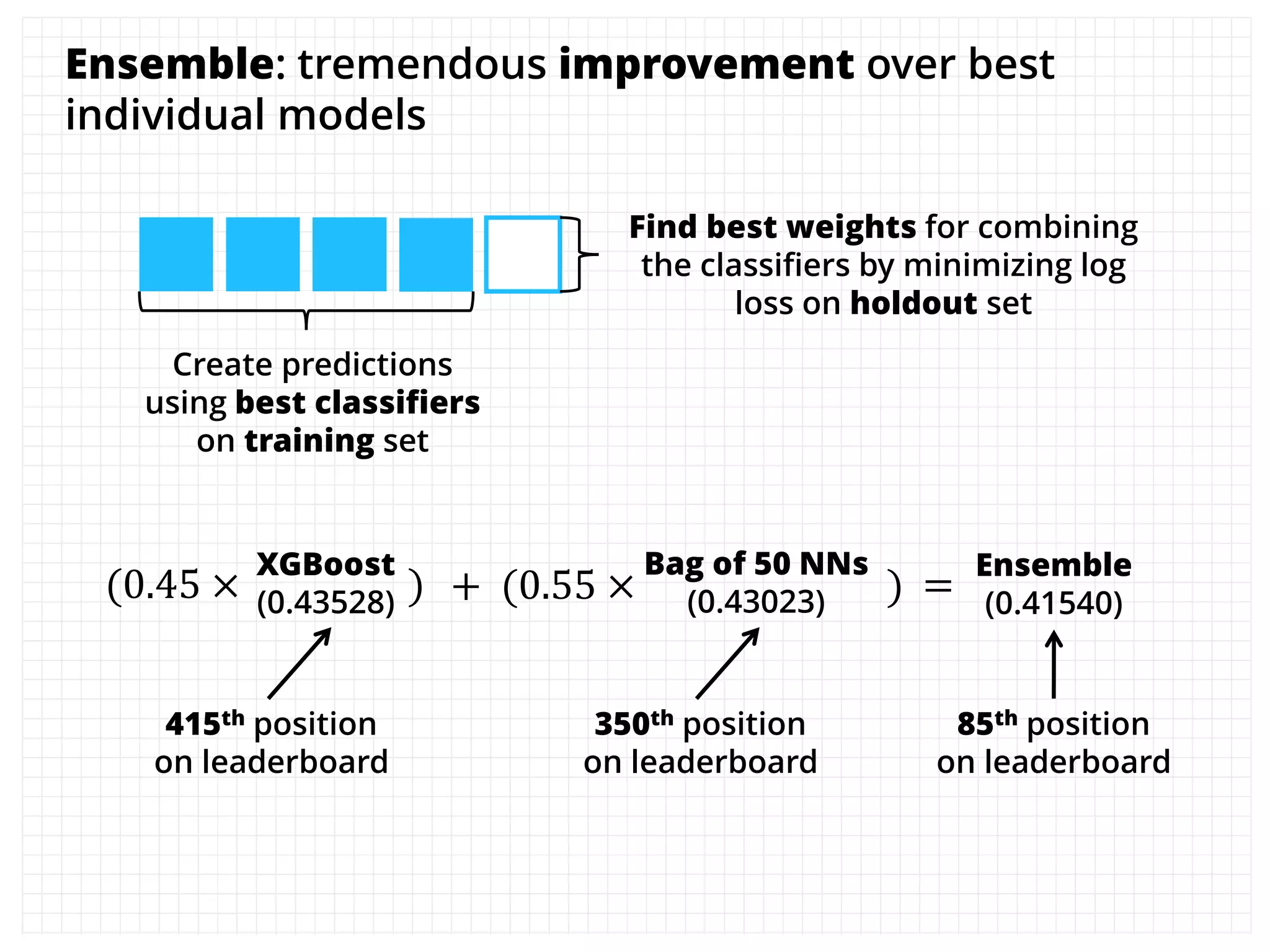
Ensemble: how do we combine to minimize log loss
over multiple models?
Create predictions
using best classifiers
on training set
 Find best weights for combining
the classifiers by minimizing log
loss on holdout set
 Our approach:
– Append various predictions
– Minimize overall log loss using
scipy.optimize.minimize
 Competition Metric: the
goal is to minimize log loss
– How to do this over
multiple models?
– Voting? Averaging?
Ensemble: great improvement over best individual
models, though we shouldn’t throw in everything
XGBoost
(0.43528)
Bag of 50 NNs
(0.43023)
Ensemble
(0.41540)
(0.45 × ) + (0.55 × ) =
415th position
on leaderboard
350th position
on leaderboard
85th position
on leaderboard
Our final ensemble
0.445 × XGBoost
0.545 × =Bag of 110 NNs
0.01 × Bag of 10 RFs
Ensemble
(0.41542)
+
+
Another ensemble we tried:
Sometimes, more ≠ better!
Ideas we didn’t have
time to implement
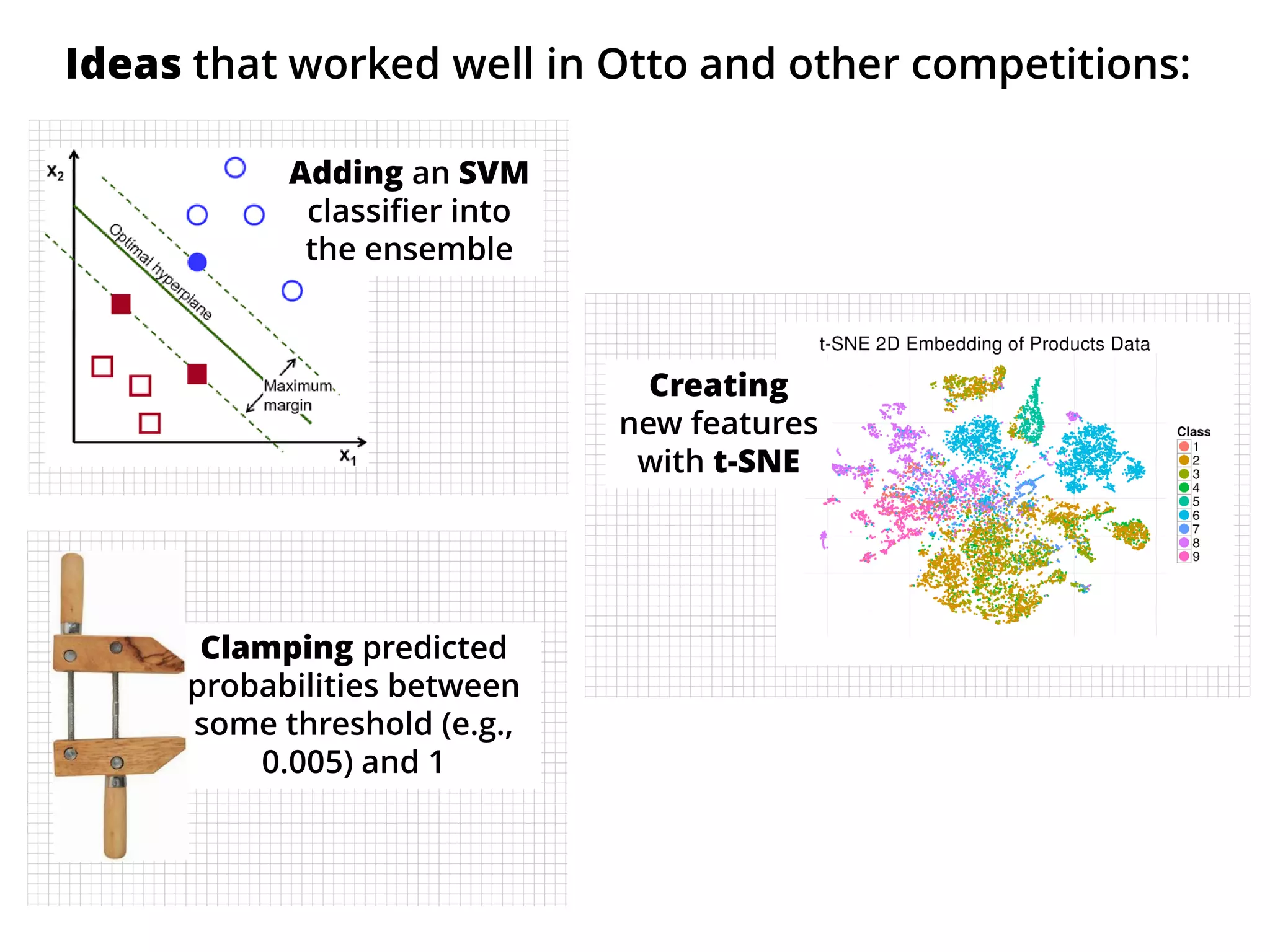
Ideas that worked well in Otto and other competitions:
Clamping predicted
probabilities between
some threshold (e.g.,
0.005) and 1
Adding an SVM
classifier into
the ensemble
Creating
new features
with t-SNE
Top Solutions
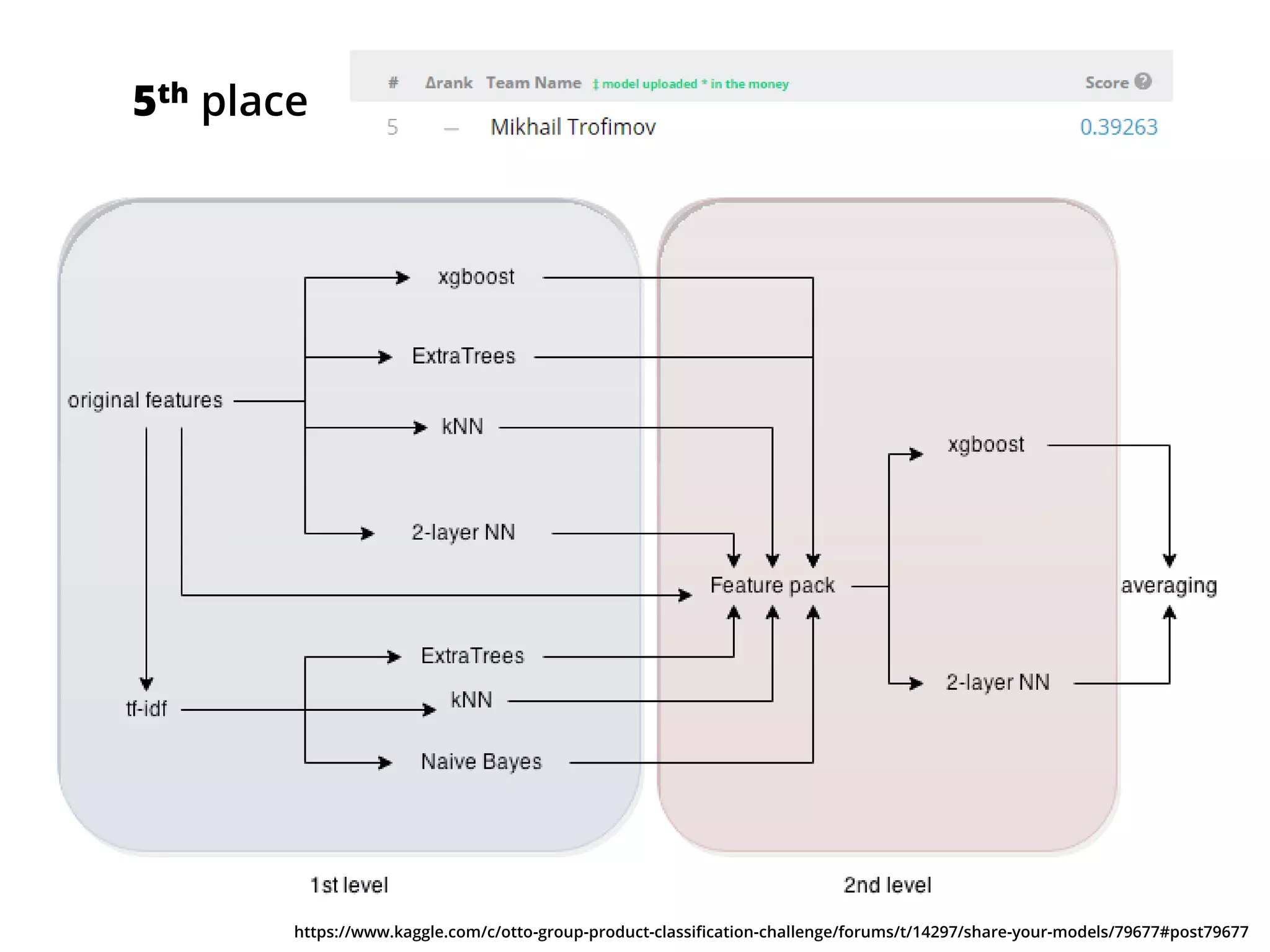
5th place
https://www.kaggle.com/c/otto-group-product-classification-challenge/forums/t/14297/share-your-models/79677#post79677
 Use TF-IDF to transform raw features
 Create new features by fitting models on raw and TF-IDF features
 Combine created features with original features
 Bag XGBoost and 2-layer NN 30 times and average predictions
2nd place
http://blog.kaggle.com/2015/06/09/otto-product-classification-winners-interview-2nd-place-alexander-guschin/
 Level 0: Split the data into two groups, Raw and TF-IDF
 Level 1: Create metafeature using different models
– Split data into k folds, training k models on k-1 parts and predict
on the 1 part left aside for each k-1 group
 Level 2: Train metaclassifier with features and metafeatures and
average/ensemble
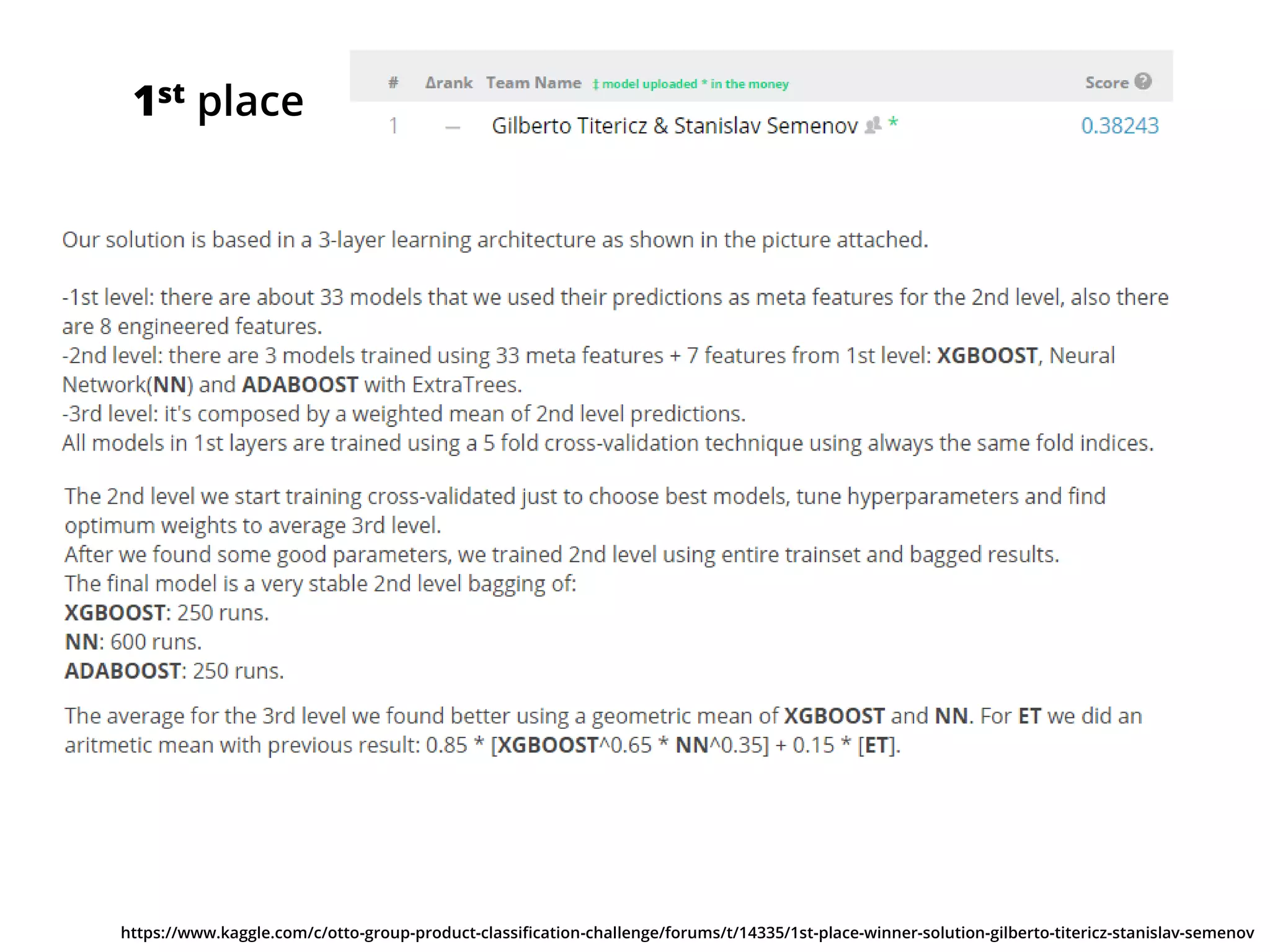
1st place
https://www.kaggle.com/c/otto-group-product-classification-challenge/forums/t/14335/1st-place-winner-solution-gilberto-titericz-stanislav-semenov
What’s a suggested
framework for
Kaggle?
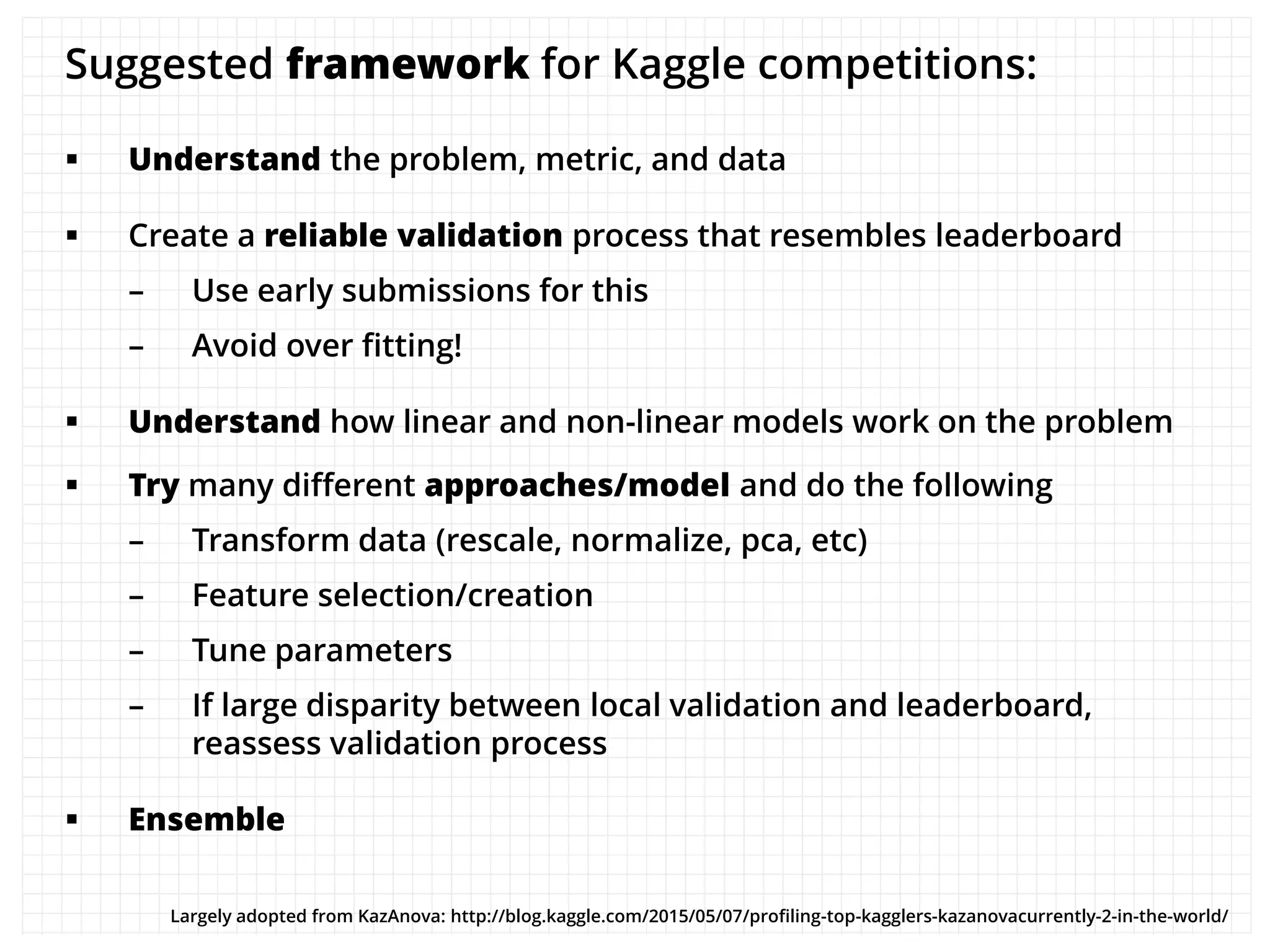
Suggested framework for Kaggle competitions:
 Understand the problem, metric, and data
 Create a reliable validation process that resembles leaderboard
– Use early submissions for this
– Avoid over fitting!
 Understand how linear and non-linear models work on the problem
 Try many different approaches/model and do the following
– Transform data (rescale, normalize, pca, etc)
– Feature selection/creation
– Tune parameters
– If large disparity between local validation and leaderboard,
reassess validation process
 Ensemble
Largely adopted from KazAnova: http://blog.kaggle.com/2015/05/07/profiling-top-kagglers-kazanovacurrently-2-in-the-world/
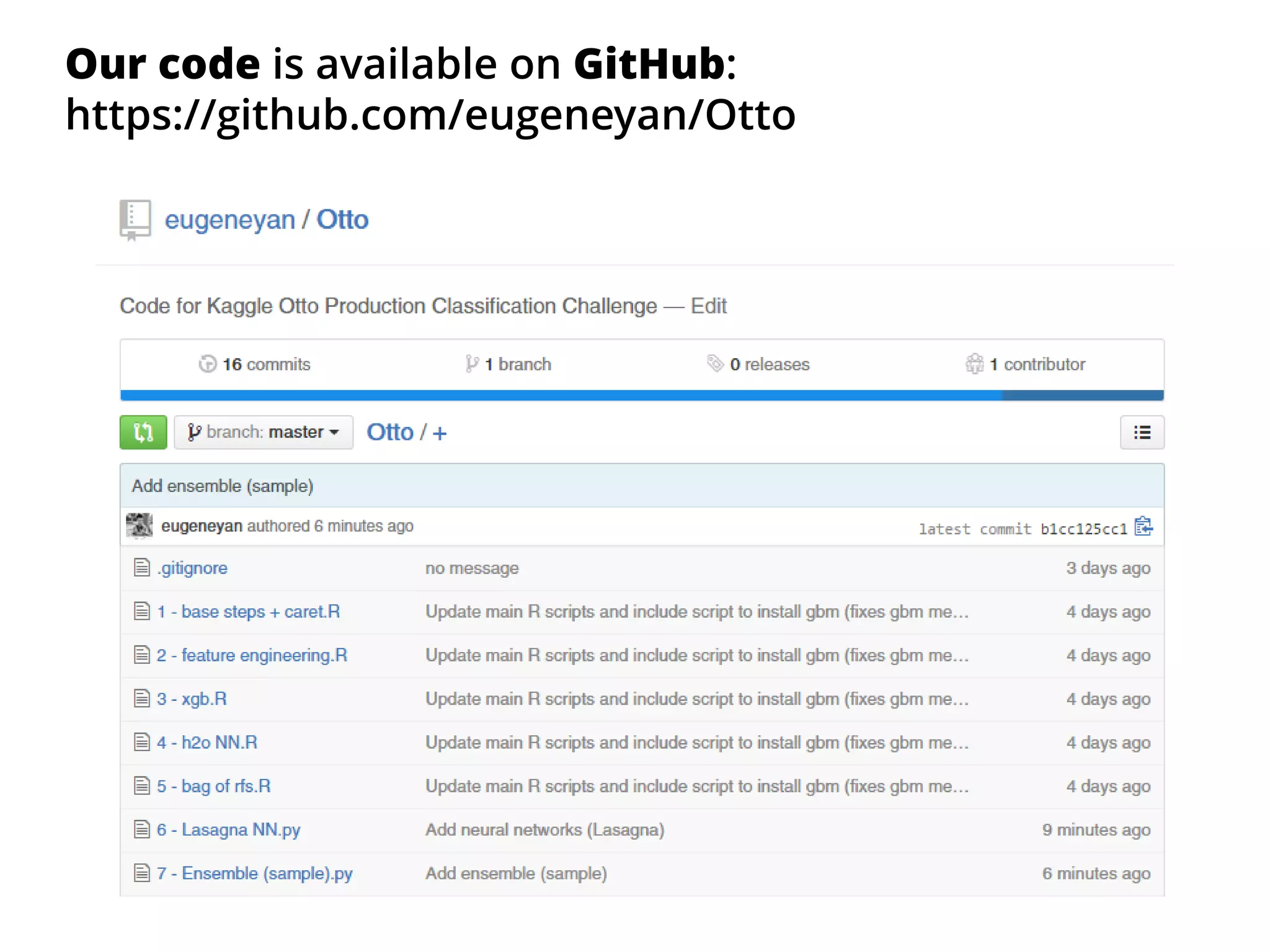
Our code is available on GitHub:
https://github.com/eugeneyan/Otto
Thank you!
Eugene Yan
eugeneyanziyou@gmail.com
Wang Weimin
wangweimin888@yahoo.com
&

Kaggle Otto Challenge: How we achieved 85th out of 3,514 and what we learnt

  • 1.
    Kaggle Otto Challenge Howwe achieved 85th out of 3,514 and what we learnt Eugene Yan & Wang Weimin
  • 2.
    Kaggle: A platformfor predictive modeling competitions
  • 3.
    Otto Production Classification Challenge:Classify products into 9 main product categories
  • 4.
    One of themost popular Kaggle competitions ever … … Our team achieved 85th position out of 3,514 teams
  • 5.
    … … 93 (obfuscated)numerical features provided Target with 9 categories Let’s take a look at the data
  • 6.
    Evaluation Metric: (minimize)multi-class log loss 𝑁 = no. of products in dataset ( 𝑀 = no. of class labels (i.e., 9 classes) 𝑙𝑜𝑔 = natural logarithm 𝑦𝑖𝑗 = 1 if observation 𝑖 is in class 𝑗 and 0 otherwise 𝑝𝑖𝑗 = predicted probability that observation 𝑖 belongs to class 𝑗 Minimizing multi-class log loss heavily penalizes falsely confident predictions
  • 7.
  • 8.
    Training set Holdout Parametertuning using 5 fold cross- validation Local validation using holdout  Train models on 80% train set and validate against 20% local holdout  Ensemble by fitting predictions from 80% train set on 20% local holdout  Reduces risk of overfitting leaderboard  Build model twice for submission – Once for local validation – Once for leaderboard submission Parameter tuning and validation using 5 fold cross-validation  Train models on full data set with 5- fold cross-validation  Build model once for submission  Low risk of overfitting if cv score is close to leaderboard score (i.e., training data similar to testing data)
  • 9.
  • 10.
    Do we needall 93 features? Can we reduce noise to reveal more of the signal?
  • 11.
    Dimensionality reduction led nowhere:No clear ‘elbow’ from principal components analysis
  • 12.
    L1 regularization (lasso)L2 regularization Feature Selection via elastic net/lasso dropped four features, but led to significant drop in accuracy
  • 13.
    The data looksis very skewed— should we make it more ‘normal’? Would standardizing/ rescaling the data help?
  • 14.
    Feature Transformation: Surprisingly,transforming features helped with tree-based techniques z-standardization: 𝑥 − 𝑚𝑒𝑎𝑛(𝑥) 𝑠𝑡𝑎𝑛𝑑𝑎𝑟𝑑 𝑑𝑒𝑣𝑖𝑎𝑡𝑖𝑜𝑛 (𝑥) Difference from Mean: 𝑥 − 𝑚𝑒𝑎𝑛 𝑥 Difference from Median: 𝑥 − 𝑚𝑒𝑑𝑖𝑎𝑛 𝑥 Log-transformation: 𝑙𝑜𝑔(𝑥 + 1) Adding flags: 𝑖𝑓 𝑥 > 0, 𝑡ℎ𝑒𝑛 1, 𝑒𝑙𝑠𝑒 0 Improved tree- based models a bit Worked better than z-standardization Didn’t help (because most medians were 0) Helped with Neural Networks Terrible =/
  • 15.
    Though models likeGBM and Neural Nets can approximate deep interactions, we can help find patterns and explicitly define:  Complex features (e.g., week on week increase)  Interactions (e.g., ratios, sums, differences)
  • 16.
    Feature Creation: Aggregatedfeatures created by applying functions by row worked well Row Sums of features 1 - 93 Row Variances of features 1 - 93 Count of non-zero features (1 – 93)
  • 17.
    Feature Creation: Topfeatures selected from RF, GBM, and XGB to create interaction features; top interaction features helped a bit + interaction: feat_34 + feat_48, feat_34 + feat_60, etc - interaction: feat_34 - feat_48, feat_34 - feat_60, etc * interaction: feat_34 * feat_48, feat_34 * feat_60, etc / interaction: feat_34 / feat_48, feat_34 / feat_60, etc Top 20 features from randomForest’s variable importance
  • 18.
  • 19.
    R’s caret: addingcustom log loss metric Custom summary function (log loss) for use with caret
  • 20.
    Bagging random forests:leads to minor improvement Single rf with 150 trees, 12 randomly sampled features (i.e., mtry), nodesize = 4 After bagging 10 rfs
  • 21.
    gbm + caret:better than rf for this dataset GBM Params  Depth = 10  Trees = 350  Shrinkage = 0.02  Depth = 10  Trees = 1000  Shrinkage = 0.01  Node.size = 4  Bag.frac* = 0.8  Depth = 10  Trees = 1000  Shrinkage = 0.01  Node.size = 4  Bag.frac* = 0.8  + aggregated features Local Validation 0.52449 0.51109 0.49964 Improvement as shrinkage , no. of trees , and aggregated features are included *Bag Fraction: fraction of training set randomly selected to build the next tree in gbm. Introduces randomness and helps reduce variance
  • 22.
    XGBoost (extreme gradientboosting): better and faster than gbm; one of two main models in ensemble xgb Params  Depth = 10  Trees = 250  Shrinkage = 0.1  Gamma = 1  Node.size = 4  Col.sample = 0.8  Row.sample = 0.9  Depth = 10  Trees = 7500  Shrinkage = 0.005  Gamma = 1  Node.size = 4  Col.sample = 0.8  Row.sample = 0.9  Original features + aggregated features  Depth = 10  Trees = 7500  Shrinkage = 0.005  Gamma = 0.5  Node.size = 4  Col.sample = 0.8  Row.sample = 0.9  Original features only (difference from mean) Local Validation 0.46278 0.45173 0.44898 Improvement as shrinkage , no. of trees Feature creation and transformation helped too
  • 23.
  • 24.
    Nolearn + Lasagna:a simple two-layer network with dropout works great 0.15 dropout 1000 hidden units, 0.3 dropout 500 hidden units, 0.3 dropout Neural Net Params  Activation: Rectifier  Output: Softmax  Batch size: 256  Epochs: 140  Exponentially decreasing learning rate Input Hidden Layer 1 Hidden Layer 2 Output
  • 25.
    Tuning Neural Networkhyper-parameters:  Use validation data to tune: – Layers, dropout, L2, batch size, etc  Start with a single network (say 93 x 100 x 50 x 9)  Using less data to get faster response  Early stopping – No-improvement-in-10, 5, 3 … – Visualize loss v.s. epochs in a graph  Use GPU LogLoss Epochs LogLoss Epochs
  • 26.
    Bagging NNs: leadsto significant improvement Single Neural Net Bag of 10 Neural Nets Bag of 50 Neural Nets Neural nets are somewhat unstable—bagging reduces variance and improve LB score
  • 27.
    So many ideas,so little time: Bagging + Stacking  Randomly sample from training data (with replacement) – BAG  Train base model on OOB, and predict on BAG data  Boost the BAG data with meta model 1 2 3 4 5 6 7 Training data 4 3 6 3 3 5 4 1 2 7 Bootstrap sample (BAG) OOB data 1.sample Xgboost( meta) RF(base) Test Data Done!
  • 28.
    So many ideas,so little time: TSNE tsne1 tsne2 Tsne1 -12 2 3.2 -3.2 3.3 2.2 1.1 10.2 3.1 11 Tsne2 3.3 10 -3.2 2.3 1.0 21 0.33 -1.1 1 22
  • 29.
  • 30.
    Wisdom of theCrowd: combining multiple models leads to significant improvement in performance Different classifiers make up for each other’s weaknesses
  • 31.
    Ensemble: how dowe combine to minimize log loss over multiple models? Create predictions using best classifiers on training set  Find best weights for combining the classifiers by minimizing log loss on holdout set  Our approach: – Append various predictions – Minimize overall log loss using scipy.optimize.minimize  Competition Metric: the goal is to minimize log loss – How to do this over multiple models? – Voting? Averaging?
  • 32.
    Ensemble: great improvementover best individual models, though we shouldn’t throw in everything XGBoost (0.43528) Bag of 50 NNs (0.43023) Ensemble (0.41540) (0.45 × ) + (0.55 × ) = 415th position on leaderboard 350th position on leaderboard 85th position on leaderboard Our final ensemble 0.445 × XGBoost 0.545 × =Bag of 110 NNs 0.01 × Bag of 10 RFs Ensemble (0.41542) + + Another ensemble we tried: Sometimes, more ≠ better!
  • 33.
    Ideas we didn’thave time to implement
  • 34.
    Ideas that workedwell in Otto and other competitions: Clamping predicted probabilities between some threshold (e.g., 0.005) and 1 Adding an SVM classifier into the ensemble Creating new features with t-SNE
  • 35.
  • 36.
    5th place https://www.kaggle.com/c/otto-group-product-classification-challenge/forums/t/14297/share-your-models/79677#post79677  UseTF-IDF to transform raw features  Create new features by fitting models on raw and TF-IDF features  Combine created features with original features  Bag XGBoost and 2-layer NN 30 times and average predictions
  • 37.
    2nd place http://blog.kaggle.com/2015/06/09/otto-product-classification-winners-interview-2nd-place-alexander-guschin/  Level0: Split the data into two groups, Raw and TF-IDF  Level 1: Create metafeature using different models – Split data into k folds, training k models on k-1 parts and predict on the 1 part left aside for each k-1 group  Level 2: Train metaclassifier with features and metafeatures and average/ensemble
  • 38.
  • 39.
  • 40.
    Suggested framework forKaggle competitions:  Understand the problem, metric, and data  Create a reliable validation process that resembles leaderboard – Use early submissions for this – Avoid over fitting!  Understand how linear and non-linear models work on the problem  Try many different approaches/model and do the following – Transform data (rescale, normalize, pca, etc) – Feature selection/creation – Tune parameters – If large disparity between local validation and leaderboard, reassess validation process  Ensemble Largely adopted from KazAnova: http://blog.kaggle.com/2015/05/07/profiling-top-kagglers-kazanovacurrently-2-in-the-world/
  • 41.
    Our code isavailable on GitHub: https://github.com/eugeneyan/Otto
  • 42.