Navier Stokes Equation its Analytical
and Numerical Solution
Parallel Flow in Channel
Presented By: Mushahid Yasin
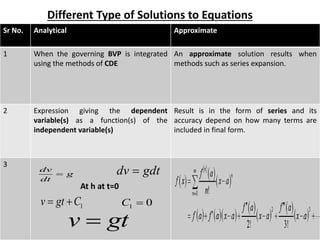
Sr No. Analytical Approximate
1 When the governing BVP is integrated
using the methods of CDE
An approximate solution results when
methods such as series expansion.
2 Expression giving the dependent
variable(s) as a function(s) of the
independent variable(s)
Result is in the form of series and its
accuracy depend on how many terms are
included in final form.
3
At h at t=0
Different Type of Solutions to Equations
dv
g
dt
 dv gdt

1
v gt C
  1 0
C 
v gt

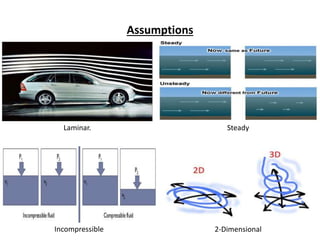
Assumptions
Laminar. Steady
Incompressible 2-Dimensional
Parallel Flow in Channel
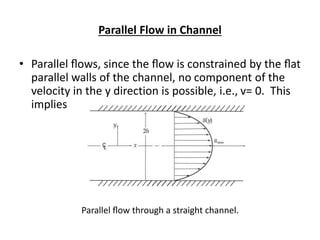
• Parallel flows, since the flow is constrained by the flat
parallel walls of the channel, no component of the
velocity in the y direction is possible, i.e., v= 0. This
implies
Parallel flow through a straight channel.
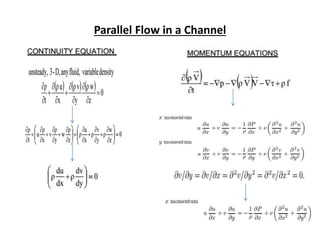
Parallel Flow in a Channel
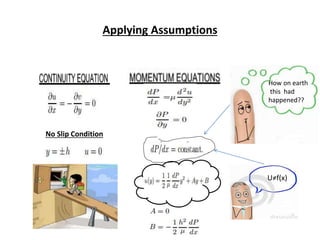
Applying Assumptions
How on earth
this had
happened??
U≠f(x)
No Slip Condition
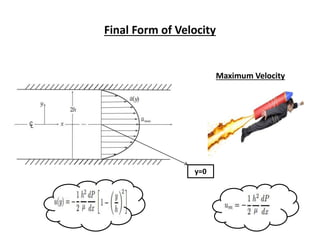
Final Form of Velocity
Maximum Velocity
y=0
Numerical Solution
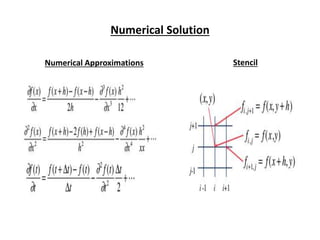
Numerical Approximations Stencil
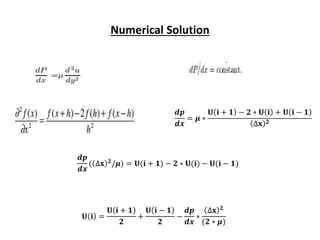
Numerical Solution
𝒅𝒑
𝒅𝒙
= 𝝁 ∗
𝐔 𝐢 + 𝟏 − 𝟐 ∗ 𝐔 𝐢 + 𝐔 𝐢 − 𝟏
∆𝐱 𝟐
𝒅𝒑
𝒅𝒙
( ∆𝐱 𝟐
/𝝁) = 𝐔(𝐢 + 𝟏) − 𝟐 ∗ 𝐔(𝐢) − 𝐔(𝐢 − 𝟏)
𝐔 𝐢 =
𝐔 𝐢 + 𝟏
𝟐
+
𝐔 𝐢 − 𝟏
𝟐
−
𝒅𝒑
𝒅𝒙
∗
∆𝐱 𝟐
(𝟐 ∗ 𝝁)
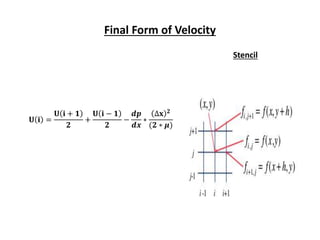
Final Form of Velocity
Stencil
𝐔 𝐢 =
𝐔 𝐢 + 𝟏
𝟐
+
𝐔 𝐢 − 𝟏
𝟐
−
𝒅𝒑
𝒅𝒙
∗
∆𝐱 𝟐
(𝟐 ∗ 𝝁)
Navier Stokes Equation its Analytical and Numerical Solution.pptx

Navier Stokes Equation its Analytical and Numerical Solution.pptx

  • 1.
    Navier Stokes Equationits Analytical and Numerical Solution Parallel Flow in Channel Presented By: Mushahid Yasin
  • 2.
    Sr No. AnalyticalApproximate 1 When the governing BVP is integrated using the methods of CDE An approximate solution results when methods such as series expansion. 2 Expression giving the dependent variable(s) as a function(s) of the independent variable(s) Result is in the form of series and its accuracy depend on how many terms are included in final form. 3 At h at t=0 Different Type of Solutions to Equations dv g dt  dv gdt  1 v gt C   1 0 C  v gt 
  • 4.
  • 5.
    Parallel Flow inChannel • Parallel flows, since the flow is constrained by the flat parallel walls of the channel, no component of the velocity in the y direction is possible, i.e., v= 0. This implies Parallel flow through a straight channel.
  • 6.
  • 7.
    Applying Assumptions How onearth this had happened?? U≠f(x) No Slip Condition
  • 8.
    Final Form ofVelocity Maximum Velocity y=0
  • 9.
  • 10.
    Numerical Solution 𝒅𝒑 𝒅𝒙 = 𝝁∗ 𝐔 𝐢 + 𝟏 − 𝟐 ∗ 𝐔 𝐢 + 𝐔 𝐢 − 𝟏 ∆𝐱 𝟐 𝒅𝒑 𝒅𝒙 ( ∆𝐱 𝟐 /𝝁) = 𝐔(𝐢 + 𝟏) − 𝟐 ∗ 𝐔(𝐢) − 𝐔(𝐢 − 𝟏) 𝐔 𝐢 = 𝐔 𝐢 + 𝟏 𝟐 + 𝐔 𝐢 − 𝟏 𝟐 − 𝒅𝒑 𝒅𝒙 ∗ ∆𝐱 𝟐 (𝟐 ∗ 𝝁)
  • 11.
    Final Form ofVelocity Stencil 𝐔 𝐢 = 𝐔 𝐢 + 𝟏 𝟐 + 𝐔 𝐢 − 𝟏 𝟐 − 𝒅𝒑 𝒅𝒙 ∗ ∆𝐱 𝟐 (𝟐 ∗ 𝝁)

Editor's Notes

  • #3 CDE=Classical Differential Equations BVP=Boundary Value Problem
  • #5 Possibility of having analytical solutions to If non-linear convective terms vanish naturally.