SOP Writing and Document Control
for the Research Laboratory
Zahra Shajani Yi, PhD NRCC
Assistant Professor of Pathology, Microbiology and Immunology
Vanderbilt University School of Medicine
Associate Directory of Clinical Chemistry
Medical Director of Esoteric Chemistry
Vanderbilt University Medical Center
Objectives
1) Understand the difference between Research and
Development and Operations and that they require
different tools
2) Understand what is a Standard Operating Procedure
(SOP) and how it impacts operations
3) Most importantly, determine if an SOP will be useful to
your Core Facility
Outline
1) Different goals require different tools
a) Differences between Research and Clinical Laboratories
b) Differences between Research and Development and
Clinical Operations
2) Standard Operating Procedures (SOP)
a) When and why one should use a SOP
b) Components of a SOP
c) Maintaining a SOP
My Background
• Scientist
– Trained as a chemist and biophysical chemist
– Transitioned into molecular biology
– Currently faculty at VU and an associate medical director of
clinical laboratories at VUMC
• Research for about 15 years
– Undergraduate (2 years)
– PhD (6 years)
– Post-doctoral Fellow (4 years)
– Clinical Fellow (2 years)
– Medical Director (>1 year)
My Background
• Not an operations person
• Believed that it stifled creativity
• Lab reports were once written like philosophy essays
• My procedures were minimal in detail at times. I
relied on my memory a lot day to day.
• Now I understand that research and development
and clinical operations need some different tools
Some Difference
Research Laboratory
• Hypothesis-driven
research
• More flexible with time
• Creativity is important
• Variation and
Optimization is welcome
• End-User: PI and yourself
Clinical/Core Laboratory
• Patients/clinical trials
• Time constraints
• Need consistency
• Reproducible
• Regulatory component
• End User—patient or
clinician
Different styles of learning
My Background
• Wide range of techniques
– Crystal Growth
– RNA preparation and purification
– Ribosome Preparation
– Agarose Gel
– Acrylamide Gels
– NMR
– Mass Spectrometry
How do you learn new skills/techniques?
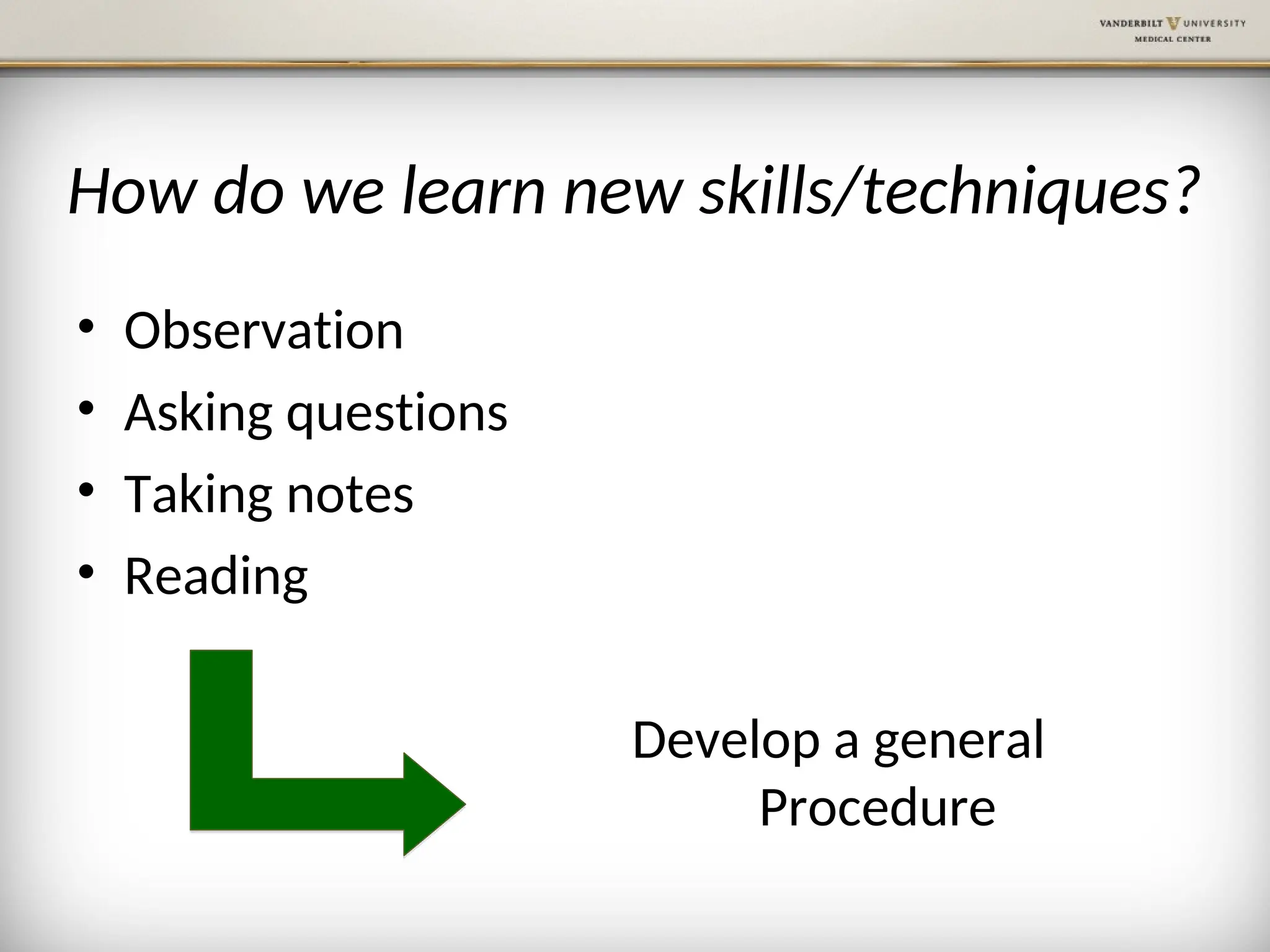
How do we learn new skills/techniques?
• Observation
• Asking questions
• Taking notes
• Reading
How do we learn new skills/techniques?
• Observation
• Asking questions
• Taking notes
• Reading
Develop a general
Procedure
That discovery is part of the process
• “Could have completed by 5 ½ years of PhD work in
< 6 months time-wise if I had known at the beginning
what I knew at the end”
• But discovery is part of the training
How do we teach others?
• Research trainees
– Supply articles
– Ask questions to demonstrate understanding
– Have them observe and make their own procedure
• Current trainees (residents and fellows):
– Supply articles
– Quizzes to demonstrate understanding
– Projects and case studies
How do we teach others?
• Why did I not just give them my makeshift
procedure?
– Giving a procedure tells them how to do things, but not
why
– I feel that making those cognitive connections on how to
synthesize information is as important if not more then
the research findings
Transitioning to the Clinical World:
Accuracy and Reproducibility
• As scientists we strive for the best and “good
enough” is usually not acceptable
• That does not change in a core laboratory, but the
role of a core is different then of a research
laboratory
– Now performing a service
– Other researchers/clinical trials will depend on the result
• Results need to be Accurate and Reproducible
How to minimize variation?
• Crystal Growth
• Mass spectrometry
– Grad students would often play around with buffer conditions and
elution programs
– All had slightly different results
– If we did that for drug confirmations, what would happen?
• Molecular Genetics
– Variant calling
• Running gels
– Different buffer or voltage changes mobility
Consistent Processes allow for
effective troubleshooting
• Troubleshooting: We’ve all had to do it!
– Reagent?
– Instrument?
– Operator?
– Consistency allows for troubleshooting and traceability
– Examples
• Mishandling material
Accuracy, Consistency and
Reproducibility in a Core Facility
• On a small scale accuracy, consistency and
reproducibility are easier
– Less operators
• Developer often knows the intricacies of the system
• Recall: a large proportion of scientific studies cannot
be reproduced by other operators
• Why?
Scaling Up
• Even the best idea can fail if it cannot be successfully
operationalized and scaled
– Engineering (Chip manufacturers, wi-fi)
– Manufacturing (Tesla Model 3)
– Consumer Electronics (iPhone)
– Clinical Assays (Biomarkers and Automation)
Why do start-ups with great ideas fail?
Transitioning to Clinical World:
Scalability
• To grow the laboratory, process must be scalable
• How to ensure consistency and reliability when there
are multiple operators?
Standard Operating Procedures (SOP)
What is an SOP?
• Standard Operating Procedure (SOP): is a set
of step-by-step instructions compiled by an
organization to help workers carry out complex
routine operations. SOPs aim to achieve
efficiency, quality output and uniformity of
performance, while reducing
miscommunication…
https://en.wikipedia.org/wiki/Standard_operating_procedure
SOP
An SOP helps ensure that results are
reproducible between operators and over time,
allows for operations to be scaled up and that
the procedure is executed in a consistent way.
Why create an SOP?
• Reproducibility and Consistency
– Reduce Variability
– Never want to be dependent on one person
• Improves Communication
• Scale
– Think of all the research you have done
– Imagine scaling it up 2x. 10x. 100x
Components of a SOP
1. Purpose or Principle
2. Scope
3. Specimen
4. Supplies and Reagents
5. Safety
6. Equipment, Maintenance and Calibration
7. Quality Control
8. Stepwise Procedure
9. Expected Values, Result Reporting and Interpretation
10. Procedure Notes
11. Procedure Limitations
12. References
Nothing is too obvious to be included!
1. Purpose or Principle
• Describe what the test is used for
• Can be brief or very descriptive
• We often describe what the analyte is used for
2. Scope
• Where is the SOP used
• Who is to use it
• Sometime include test principle
3. Specimen
• Human, animals or synthetic
• Blood, Urine, Body Fluid
• Sample volume
4. Supplies and Regents
• Self-explanatory
• Keep in mind that if you are very detailed, you will
have to update if there are any changes
5. Safety
• Protective gear required?
• Special Handling?
6. Equipment, Maintenance and
Calibration
• Should be as detailed as possible to ensure
consistency
• Ex: How often should instrument be calibrated?
• How should material be handled?
7. Quality Control (QC)
• Can be combined into 6
• Should describe how often QC is used and how it is
handled
8. Stepwise Procedure
• Should be as detailed as possible to ensure
consistency
9. Expected Values, Results Reporting
and Interpretations
• Important for ensuring that results are reported correctly
• Reference Range
• Lists any flags or exceptions
10. Procedure Notes
• Can describe how to troubleshooting
• Any misc issues.
• Validation information?
11. Procedure Limitations
• Sensitivity, Specificity and Interferences
12. References
• Important to verify that information in procedure is
correct
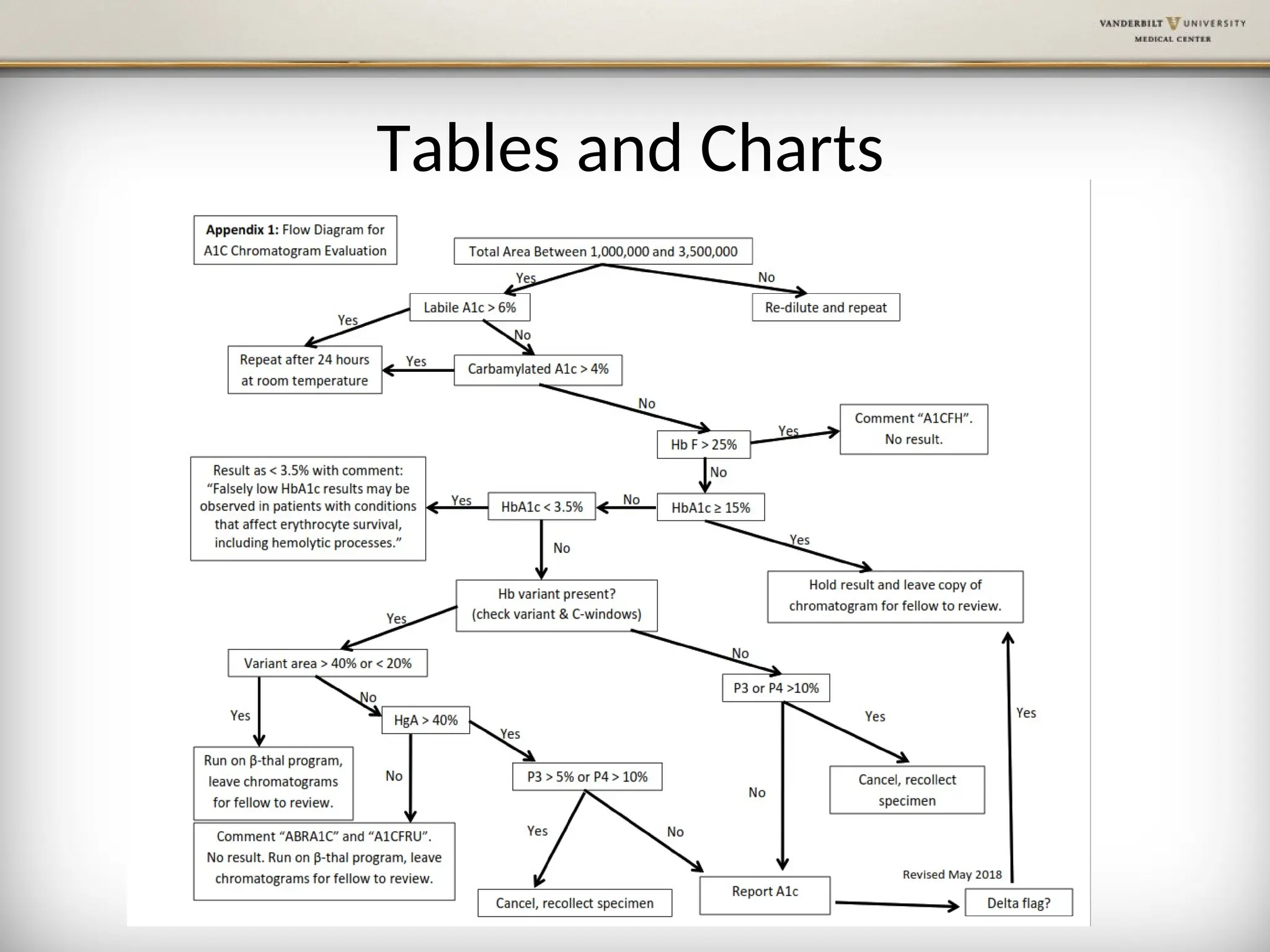
Tables and Charts are helpful
Scenario: Clinical Laboratory Section
– Within 9 months, new supervisor, 50% new staff and new
medical director
– Historically section relied heavily on one person, and word of
mouth training.
– SOP was out of date and no one used it
– Post-it notes everywhere
– Hand-written changes, undated
– Lack of consistency
– “We have always done it this way?”
Scenario: Updating an out of date SOP
• How would you start?
Scenario: Updating an out of date SOP
• How would you start?
• Assign a lead to each area
• Have the person who knows the procedure the best work
on it
• Person in charge of updating policy and training
• After updating policy have a second
technologist/operator read through and make comments
• Only follow procedure
Maintaining an SOP
• Make updates as needed
• Spot check as needed
• Make sure every change is communicated
1. Meeting to verbally highlight the new changes
2. Employees have read new policy
Tables and Charts
Some Document Control Platforms
• PolicyTech (VUMC)
• Manual Method—upload PDF documents
• MediaLab
• OnBase
• Master Control
• Things to remember: must Date and Sign!
Summary
1) Research and Development and Operations
require different tools
2) A SOP can help with communication and
establishing consistency in processes
3) Many different methods to develop and maintain
SOP
SOP and Processes
• Caution against perfection: “Don’t let the perfect get
in the way of the good”
– Vitamin D
• A “perfect test” is not perfect if it cannot be used

Zahra Yi- Shared Resource SOP.final_version.ppt

  • 1.
    SOP Writing andDocument Control for the Research Laboratory Zahra Shajani Yi, PhD NRCC Assistant Professor of Pathology, Microbiology and Immunology Vanderbilt University School of Medicine Associate Directory of Clinical Chemistry Medical Director of Esoteric Chemistry Vanderbilt University Medical Center
  • 2.
    Objectives 1) Understand thedifference between Research and Development and Operations and that they require different tools 2) Understand what is a Standard Operating Procedure (SOP) and how it impacts operations 3) Most importantly, determine if an SOP will be useful to your Core Facility
  • 3.
    Outline 1) Different goalsrequire different tools a) Differences between Research and Clinical Laboratories b) Differences between Research and Development and Clinical Operations 2) Standard Operating Procedures (SOP) a) When and why one should use a SOP b) Components of a SOP c) Maintaining a SOP
  • 4.
    My Background • Scientist –Trained as a chemist and biophysical chemist – Transitioned into molecular biology – Currently faculty at VU and an associate medical director of clinical laboratories at VUMC • Research for about 15 years – Undergraduate (2 years) – PhD (6 years) – Post-doctoral Fellow (4 years) – Clinical Fellow (2 years) – Medical Director (>1 year)
  • 5.
    My Background • Notan operations person • Believed that it stifled creativity • Lab reports were once written like philosophy essays • My procedures were minimal in detail at times. I relied on my memory a lot day to day. • Now I understand that research and development and clinical operations need some different tools
  • 6.
    Some Difference Research Laboratory •Hypothesis-driven research • More flexible with time • Creativity is important • Variation and Optimization is welcome • End-User: PI and yourself Clinical/Core Laboratory • Patients/clinical trials • Time constraints • Need consistency • Reproducible • Regulatory component • End User—patient or clinician Different styles of learning
  • 7.
    My Background • Widerange of techniques – Crystal Growth – RNA preparation and purification – Ribosome Preparation – Agarose Gel – Acrylamide Gels – NMR – Mass Spectrometry How do you learn new skills/techniques?
  • 8.
    How do welearn new skills/techniques? • Observation • Asking questions • Taking notes • Reading
  • 9.
    How do welearn new skills/techniques? • Observation • Asking questions • Taking notes • Reading Develop a general Procedure
  • 10.
    That discovery ispart of the process • “Could have completed by 5 ½ years of PhD work in < 6 months time-wise if I had known at the beginning what I knew at the end” • But discovery is part of the training
  • 11.
    How do weteach others? • Research trainees – Supply articles – Ask questions to demonstrate understanding – Have them observe and make their own procedure • Current trainees (residents and fellows): – Supply articles – Quizzes to demonstrate understanding – Projects and case studies
  • 12.
    How do weteach others? • Why did I not just give them my makeshift procedure? – Giving a procedure tells them how to do things, but not why – I feel that making those cognitive connections on how to synthesize information is as important if not more then the research findings
  • 13.
    Transitioning to theClinical World: Accuracy and Reproducibility • As scientists we strive for the best and “good enough” is usually not acceptable • That does not change in a core laboratory, but the role of a core is different then of a research laboratory – Now performing a service – Other researchers/clinical trials will depend on the result • Results need to be Accurate and Reproducible
  • 14.
    How to minimizevariation? • Crystal Growth • Mass spectrometry – Grad students would often play around with buffer conditions and elution programs – All had slightly different results – If we did that for drug confirmations, what would happen? • Molecular Genetics – Variant calling • Running gels – Different buffer or voltage changes mobility
  • 15.
    Consistent Processes allowfor effective troubleshooting • Troubleshooting: We’ve all had to do it! – Reagent? – Instrument? – Operator? – Consistency allows for troubleshooting and traceability – Examples • Mishandling material
  • 16.
    Accuracy, Consistency and Reproducibilityin a Core Facility • On a small scale accuracy, consistency and reproducibility are easier – Less operators • Developer often knows the intricacies of the system • Recall: a large proportion of scientific studies cannot be reproduced by other operators • Why?
  • 17.
    Scaling Up • Eventhe best idea can fail if it cannot be successfully operationalized and scaled – Engineering (Chip manufacturers, wi-fi) – Manufacturing (Tesla Model 3) – Consumer Electronics (iPhone) – Clinical Assays (Biomarkers and Automation) Why do start-ups with great ideas fail?
  • 18.
    Transitioning to ClinicalWorld: Scalability • To grow the laboratory, process must be scalable • How to ensure consistency and reliability when there are multiple operators?
  • 19.
  • 20.
    What is anSOP? • Standard Operating Procedure (SOP): is a set of step-by-step instructions compiled by an organization to help workers carry out complex routine operations. SOPs aim to achieve efficiency, quality output and uniformity of performance, while reducing miscommunication… https://en.wikipedia.org/wiki/Standard_operating_procedure
  • 21.
    SOP An SOP helpsensure that results are reproducible between operators and over time, allows for operations to be scaled up and that the procedure is executed in a consistent way.
  • 22.
    Why create anSOP? • Reproducibility and Consistency – Reduce Variability – Never want to be dependent on one person • Improves Communication • Scale – Think of all the research you have done – Imagine scaling it up 2x. 10x. 100x
  • 23.
    Components of aSOP 1. Purpose or Principle 2. Scope 3. Specimen 4. Supplies and Reagents 5. Safety 6. Equipment, Maintenance and Calibration 7. Quality Control 8. Stepwise Procedure 9. Expected Values, Result Reporting and Interpretation 10. Procedure Notes 11. Procedure Limitations 12. References Nothing is too obvious to be included!
  • 24.
    1. Purpose orPrinciple • Describe what the test is used for • Can be brief or very descriptive • We often describe what the analyte is used for 2. Scope • Where is the SOP used • Who is to use it • Sometime include test principle
  • 25.
    3. Specimen • Human,animals or synthetic • Blood, Urine, Body Fluid • Sample volume 4. Supplies and Regents • Self-explanatory • Keep in mind that if you are very detailed, you will have to update if there are any changes
  • 26.
    5. Safety • Protectivegear required? • Special Handling? 6. Equipment, Maintenance and Calibration • Should be as detailed as possible to ensure consistency • Ex: How often should instrument be calibrated? • How should material be handled?
  • 27.
    7. Quality Control(QC) • Can be combined into 6 • Should describe how often QC is used and how it is handled 8. Stepwise Procedure • Should be as detailed as possible to ensure consistency
  • 28.
    9. Expected Values,Results Reporting and Interpretations • Important for ensuring that results are reported correctly • Reference Range • Lists any flags or exceptions 10. Procedure Notes • Can describe how to troubleshooting • Any misc issues. • Validation information?
  • 29.
    11. Procedure Limitations •Sensitivity, Specificity and Interferences 12. References • Important to verify that information in procedure is correct
  • 30.
    Tables and Chartsare helpful
  • 31.
    Scenario: Clinical LaboratorySection – Within 9 months, new supervisor, 50% new staff and new medical director – Historically section relied heavily on one person, and word of mouth training. – SOP was out of date and no one used it – Post-it notes everywhere – Hand-written changes, undated – Lack of consistency – “We have always done it this way?”
  • 32.
    Scenario: Updating anout of date SOP • How would you start?
  • 33.
    Scenario: Updating anout of date SOP • How would you start? • Assign a lead to each area • Have the person who knows the procedure the best work on it • Person in charge of updating policy and training • After updating policy have a second technologist/operator read through and make comments • Only follow procedure
  • 34.
    Maintaining an SOP •Make updates as needed • Spot check as needed • Make sure every change is communicated 1. Meeting to verbally highlight the new changes 2. Employees have read new policy
  • 35.
  • 36.
    Some Document ControlPlatforms • PolicyTech (VUMC) • Manual Method—upload PDF documents • MediaLab • OnBase • Master Control • Things to remember: must Date and Sign!
  • 37.
    Summary 1) Research andDevelopment and Operations require different tools 2) A SOP can help with communication and establishing consistency in processes 3) Many different methods to develop and maintain SOP
  • 38.
    SOP and Processes •Caution against perfection: “Don’t let the perfect get in the way of the good” – Vitamin D • A “perfect test” is not perfect if it cannot be used

Editor's Notes

  • #8 Thinking back—how did I learn?
  • #9 Thinking back—how did I learn?
  • #10 Explain Discovery—how to put al that i
  • #15 Give examples
  • #16 Discuss the why
  • #17 Most sensitive biomarkers are of no use in the clinical lab if they cannot be operationalized and scale.
  • #32 Out of date SOP’s. A lot of things “we’ve always done it this way”