• NATURE OF STAFFING
• STAFFING AS A MANAGEMENT FUNCTION
• IMPORTANCE OF STAFFING
DEFINITION OF STAFFING
KINDS OF STAFFING
STAFFING PROCESS
- Is a process through which capable employees
are recruited, selected, properly trained, effectively
developed, rightfully rewarded and their joint efforts are
harmoniously.
- Is a managerial function that takes people with
necessary skills into the organization and develops them
into precious organizational resource.
DEFINITION
NATURE OF STAFFING
1. It is a significant function of management
2. It is an important part of management process
3. It is continuous activity function of management
4. It is concerned with human resources of an organization
5. It is separate from physical factors, because it is complicated
and sensitive function
6. It deals with the maximum utilization of human resources like
direction, coordination and control.
STAFFING AS MANAGEMENT FUNCTION
- Committed to acquiring, training,
appraising, and compensating employees.
1. All managers are human resource managers.
2. Employees are more important assets than
buildings or equipment; good employees give a
company the competitive edge.
3. Human resource management is a matching
process therefore; it must match the needs of the
organization with the needs of the employee.
3 PRINCIPLES TO BE UNDERSTOOD BY ALL MANAGERS
IMPORTANCE OF STAFFING
1. Filling the organizational positions
2. Making possible discovery of able
staff for challenges
3. Guaranteeing utmost productivity
4. Developing personnel for shouldering
greater responsibilities
5. Meeting upcoming requirements of talented
people
6. Satisfying job owing to correct placement
7. Utilizing of human resources most favorably
8. Supplying information concerning transfer,
promotion, recruitment, death, demotions, ic.
9. Retaining professionalism among personnel
KINDS OF STAFFING
1. SHORT- TERM STAFFING
2. LONG- TERM STAFFING
3. SUCCESSION STAFFING
4. STRATEGIC STAFFING
SHORT- TERM STAFFING
- Centers on the urgent needs of the
company
LONG- TERM STAFFING
- Engages taking a practical approach to
company’s staffing needs
- Covers at least one year
SUCCESSION PLANNING
- ALLOWS YOU TO COMPLETELY
COMPREHEND THE DUTIES AND
RESPONSIBILITIES OF YOUR MANAGEMENT
STAFF SO YOU CAN TRAIN INSIDE CANDIDATE TO
BE READY TO STEP INTO PROMOTION RIGHT
AWAY SHOULD MANAGEMENT TURNOVER TAKES
PLACE.STRATEGIC- STAFFING
- INVOLVES A COMBINATION OF SHORT-
TERM, LONG- TERM AND SUCCESSION
PLANNING
WHY IS STRATEGIC STAFFING
PLANS ARE IMPORTANT?
1. Competitive Advantage
2. Executive Development
3. Legal Consideration
4. Cost Efficiency
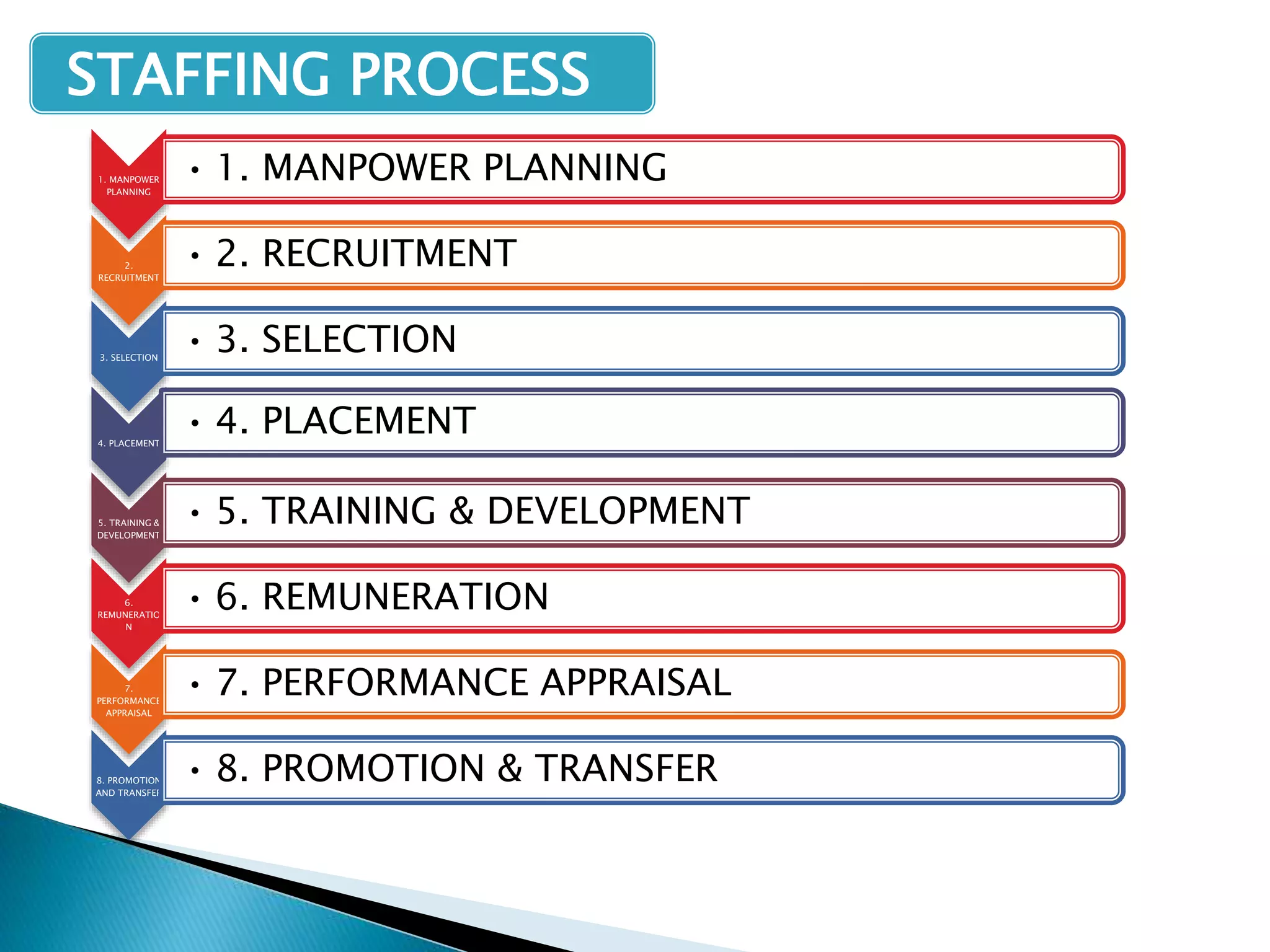
STAFFING PROCESS
1. MANPOWER
PLANNING
• 1. MANPOWER PLANNING
2.
RECRUITMENT
• 2. RECRUITMENT
3. SELECTION
• 3. SELECTION
4. PLACEMENT
• 4. PLACEMENT
5. TRAINING &
DEVELOPMENT
• 5. TRAINING & DEVELOPMENT
6.
REMUNERATIO
N
• 6. REMUNERATION
7.
PERFORMANCE
APPRAISAL
• 7. PERFORMANCE APPRAISAL
8. PROMOTION
AND TRANSFER
• 8. PROMOTION & TRANSFER
MANPOWER PLANNING
- First step in staffing
- Manpower planning which is also called as
human resource planning consists of putting right
number of people, right kind of people at the right place,
right time, doing the right things for which they are
suited for the achievement of goals of the organization.
STEPS IN MANPOWER PLANNING
1. Analyzing the current manpower inventory
A. Type Of Organization
B. Number Of Departments
C. Number And Quantity Of Such Departments
D. Employees In These Work Units
2. MAKING FUTURE MANPOWER
FORECASTS
A. Expert Forecasts
B. Trend Analysis
C. Work Loud Analysis
D. Work Force Analysis
E. Other Methods
STEPS IN MANPOWER PLANNING
3. DEVELOPING EMPLOYMENT PROGRAMS
4. DESIGN TRAINING PROGRAMS
IMPORTANCE OF MANPOWER PLANNING
1. Key To Managerial Function
2. Efficient Utilization
3. Motivation
4. Better Human Relations
5. Higher Productivity
NEEDS OF MANPOWER PLANNING:
ADVANTAGES:
1. Shortages & surpluses can be identified so
that speedy action can be taken wherever
required
2. All the recruitment & selection programs
are based on manpower planning
3. It also helps to reduce the labor cost as
excess staff can be identified & thereby
overstaffing can be avoided
NEEDS OF MANPOWER PLANNING:
ADVANTAGES:
4. It is also helps to identify the available
talents in a firm & accordingly training,
programs can be drawn out to develop those
talents
5. It facilitates in growth & diversification of
business. Through manpower planning,
human resources can be readily available &
they can be utilized in the best manner.
2. RECRUITMENT
- Is the process of attracting the
appropriate number of qualified individuals to
apply for vacant positions in an organization.
TYPES OF RECRUITMENTS
1. Internal recruitment
- Is a recruitment which takes place within
the concern or organization. Internal sources of
recruitment are readily available to an organization.
A. Transfers
B. Promotions
C. Re-employment Of Ex-employees
TYPES OF RECRUITMENTS
2. External recruitment
- External sources of recruitment have to be solicited
from outside the organization. But it involves lot of time
and money.
A. Employment At Factory Level
B. Advertisement
C. Employment Exchanges
D. Employment Agencies
E. Educational Institutions
F. Recommendations
G. Labor Contractors
SELECTION
- Refers to the process of choosing
from candidates those who will
become employees of the
organization.
SELECTION PROCESS
- Includes Activities Such As:
Development Of Selection Criteria
Advertising
Short- Listing
Application Forms Submission
Testing
Interviewing
Reference Check
Making The Final Selection Decision
Submission Of Medical Requirements
SELECTION PROCESS
DEVELOPING SELECTION CRITERIA
Republic of the Philippines
CIVIL SERVICE COMMISSION XII
Field Office for South Cotabato
Koronadal City
BULLETIN OF VACANT POSITIONS IN THE GOVERNMENT
Issue No. 003
Date: MAY 18, 2015
GOV'T ITEM PLACE OF
AGENCY SECTOR POSITION SG NUMBER ASSIGMENT EDUCATION EXPERIENCE TRAINING ELIGIBILITY
LGU-Tboli South
Cotabato
Local Gov't Unit
ENVIRONMENTAL
MANAGEMENT
SPECIALIST II
SG-15
OFFICE OF THE
MUNICIPAL
ENVIRONMENT AND
NATURAL
RESOURCES AND
NATURAL
RESOURCES
BACHELOR'S DEGREE
RELEVANT TO THE JOB
1-YEAR OF RELEVANT
EXPERIENCE
4 HOURS OF
RELEVANT
TRAINING
CAREER SERVICE PROFESSIONAL
OR SECOND LEVEL ELIGIBILITY
PREPARED BY: NOTED:
HRMO II Head of Agency
Municipal Mayor
CERTIFICATION
THIS IS TO CERTIFY THAT THIS POSTING OF VACANT POSITION IS POSTED IN THREE CONSPICUOS PLACES: NAMELY: MUNICIPAL HALL, PUBLIC PLAZA AND MARKET FROM MAY 18-JUNE 2, 2015.
HRMO II
SELECTION PROCESS
SHORT- LISTING
VITAL QUALIFICATIONS
ADVANTEGEOUS
QUALIFICATIONS
LOOK FOR
MORE
INFORMATION
BE RELIABLE ON
DOCUMENTS
DECISIONS MADE & THE
REASON FOR THEM
SELECTION PROCESS
APPLICATION FORMS
Language & experience is
significant
Do not include any invasive
or immaterial questions
Guarantee strict
confidentiality
SELECTION PROCESS
TESTING
Test match the essential
requirements of the job
Check the tests are up-to-
date
Check for any bias or
indirect discrimination
SELECTION PROCESS
INTERVIEWING
Permit applicants to display what they can offer to the
organization
Confirm if there is a need for any specific arrangements
Have questions prepared in advance
Ensure consistency & fairness in questioning
Focus on the real needs of the job
The selection committee is entitled to ask applicants whether
they can fulfill the requirements of the job
It is proper to ask people with disabilities whether they require
any adjustments to perform the job
Allow the interviewee time to make their point
Don’t make assumptions about a person’s ability
Do not ask invasive and irrelevant questions
SELECTION PROCESS
REFERENCE CHECKS
Help guarantee that suitable
candidate is hired
Clarify, verify and add data to what
has been learned in the interview
Never reveal information received
from the previous employer to the
candidate
Best source of information on any
candidate is the former employer
On- the- job performance is the
most useful predictor of future
success
SELECTION PROCESS
MAKING DECISIONS
Time to appraise all
information gathered
Grade applicants
Evaluate all information
Record decisions prepared
& reasons for them
If requested, offer
constructive comments to
unsuccessful applicants
SELECTION PROCESS
MEDICAL EXAMINATIONS
Have employees
medically examined
ORIENTATION & PLACEMENT
ORIENTATION
- PROCESS OF RECEIVING AND
WELCOMING AN EMPLOYEE WHEN HE
FIRST JOINS THE COMPANY
1. BRIEF HISTORY & OPERATIONS OF THE COMPANY
2. THE COMPANY’S ORGANIZATION STRUCTURE
3. POLICIES & PROCEDURES OF THE COMPANY
4. PRODUCTS & SERVICES OF THE COMPANY
5. LOCATION OF DEPARTMENT & EMPLOYEE FACILITIES
6. SAFETY MEASURES
7. GRIEVANCES PROCEDURES
8. BENEFITS & SERVICES OF EMPLOYEE
9. STANDING ORDERS & DISCIPLINARY PROCEDURES
10. OPPORTUNITIES FOR TRAINING, PROMOTIONS,
TRANSFERS, ETC.
11. SUGGESTION SCHEMES
12. RULES & REGULATIONS
INFORMATION GIVEN DURING AN ORIENTATION
SIGNIFICANCE OF PLACEMENT
1. IT ENHANCES EMPLOYEE MORALE
2. IT HELPS IN EMPLOYEE TURNOVER REDUCTION
3. IT AIDS IN LESSENING ABSENTEEISM
4. IT FACILITATES IN ACCIDENT RATES REDUCTION
5. IT AVOIDS MISFIT BETWEEN THE CANDIDATE AND
THE JOB
6. IT ASSISTS THE CANDIDATE TO WORK BASED ON
THE PRESET OBJECTIVES OF THE ORGANIZATION
TRAINING & DEVELOPMENT
THE PRINCIPAL OBJECTIVE:
Make sure the availability of a skilled and willing
workforce to an organization
4 Other Objectives
1. Individual Objectives
2. Organizational Objectives
3. Functional Objectives
4. Societal Objectives
THE NEED FOR TRAINING & DEVELOPMENT
 CHANGE
 DEVELOPMENT
DIFFERENT TYPES OF TRAINING & DEVELOPMENT
TECHNIQUES
1. ON- THE- JOB TRAINING AND
LECTURES
2. PROGRAMMED INSTRUCTION (PI)
3. COMPUTER- ASSITED INSTRUCTION
(CAD)
4. AUDIOVISUAL TECHNIQUES
5. SIMULATIONS
6. BUSINESS GAMES
REMUNERATION
REMUNERATION
- IS THE OVERALL COMPENSATION
THAT AN EMPLOYEE RECEIVES IN
EXCHANGE FOR THE SERVICES HE
PERFORMED FOR THE EMPLOYER.
TWO TYPES OF EMPLOYEE REMUNERATION
1. TIME RATE METHOD
2. PIECE RATE METHOD
REMUNERATION PACKAGES
 Employee benefits or fringe benefits
 Deferred payment (for example pension system)
 Relate to time (paid holidays, sick pay)
 Relate to payment in kind (subsidized meals or transport)
or items such as company cars which may be provided as a
reward and sign of status in the organizational hierarchy
rather than as tools for the performance of the job
PERFORMANCE APPRAISAL
- Is a review and discussion of an
employee’s performance of assigned
duties and responsibilities
WAYS IN PERFORMANCE APPRAISAL
 The supervisors measures the pay of employees
and compare it with targets and plans
 The supervisor analysis the factors behind work
performance of employees
 The employers are in position to guide the
employees for a better performance
OBJECTIVES OF PERFORMANCE APPRAISAL
 To keep records to decide on compensation
packages, wages structure, salaries raises, etc.
 To identify the strengths and weaknesses of
employees in order to place right men on right
job
 To assess the potentials present in a person for
further growth and development
OBJECTIVES OF PERFORMANCE APPRAISAL
 To offer a feedback to employees about their
performance and related status
 To serve as a basis for persuading working
habits of the employees.
 To appraise and preserve the promotional and
other training programs
ADVANTAGE OF PERFORMANCE APPRAISAL
 Promotion
 Compensation
 Employee Development
 Selection Validation
 Communication
 Motivation
PROMOTION & TRANSFER
Promotion
- Is the appointment of a member to another
position within the same department or
elsewhere in the organization, involving duties
and responsibilities of a more demanding and is
recognized by a higher pay grade and salary.
TRANSFER
- Is the appointment of a member to another
position within the same department or elsewhere
in the organization, involving duties and
responsibilities of a similar nature and having a
comparable pay grade and salary. In some
situations, the transfer may be at a lesser pay grade
or salary.LATERAL TRANSFER
- Is a move to a position with the same
or similar job title in the same pay grade
SENIORITY VS. MERIT PROMOTIONS
SENIORITY
Is an employee’s length of service in a
position, job grouping, or farm operation
MERIT
Refers to “worth” or “excellence”
1. Promotion By Seniority
2. Promotion By Merit
SENIORITY VS. MERIT IN LAYOFFS
LAYOFFS
- Are usually considered terminations
based on lack of work or capital, rather than
poor employee performance
- Are often temporary
PROMOTION FROM WITHIN OR OUTSIDE HIRE
Promotion from inside, supports employees
to look at the organization as one offering them
career growth
Promoting within may also mean missing the
privilege of filling positions with well- qualified
personnel
Staffing- Principles of Management

Staffing- Principles of Management

  • 2.
    • NATURE OFSTAFFING • STAFFING AS A MANAGEMENT FUNCTION • IMPORTANCE OF STAFFING DEFINITION OF STAFFING KINDS OF STAFFING STAFFING PROCESS
  • 4.
    - Is aprocess through which capable employees are recruited, selected, properly trained, effectively developed, rightfully rewarded and their joint efforts are harmoniously. - Is a managerial function that takes people with necessary skills into the organization and develops them into precious organizational resource. DEFINITION
  • 5.
    NATURE OF STAFFING 1.It is a significant function of management 2. It is an important part of management process 3. It is continuous activity function of management 4. It is concerned with human resources of an organization 5. It is separate from physical factors, because it is complicated and sensitive function 6. It deals with the maximum utilization of human resources like direction, coordination and control.
  • 6.
    STAFFING AS MANAGEMENTFUNCTION - Committed to acquiring, training, appraising, and compensating employees.
  • 7.
    1. All managersare human resource managers. 2. Employees are more important assets than buildings or equipment; good employees give a company the competitive edge. 3. Human resource management is a matching process therefore; it must match the needs of the organization with the needs of the employee. 3 PRINCIPLES TO BE UNDERSTOOD BY ALL MANAGERS
  • 8.
    IMPORTANCE OF STAFFING 1.Filling the organizational positions 2. Making possible discovery of able staff for challenges 3. Guaranteeing utmost productivity 4. Developing personnel for shouldering greater responsibilities
  • 9.
    5. Meeting upcomingrequirements of talented people 6. Satisfying job owing to correct placement 7. Utilizing of human resources most favorably 8. Supplying information concerning transfer, promotion, recruitment, death, demotions, ic. 9. Retaining professionalism among personnel
  • 10.
  • 11.
    1. SHORT- TERMSTAFFING 2. LONG- TERM STAFFING 3. SUCCESSION STAFFING 4. STRATEGIC STAFFING
  • 12.
    SHORT- TERM STAFFING -Centers on the urgent needs of the company LONG- TERM STAFFING - Engages taking a practical approach to company’s staffing needs - Covers at least one year
  • 13.
    SUCCESSION PLANNING - ALLOWSYOU TO COMPLETELY COMPREHEND THE DUTIES AND RESPONSIBILITIES OF YOUR MANAGEMENT STAFF SO YOU CAN TRAIN INSIDE CANDIDATE TO BE READY TO STEP INTO PROMOTION RIGHT AWAY SHOULD MANAGEMENT TURNOVER TAKES PLACE.STRATEGIC- STAFFING - INVOLVES A COMBINATION OF SHORT- TERM, LONG- TERM AND SUCCESSION PLANNING
  • 14.
    WHY IS STRATEGICSTAFFING PLANS ARE IMPORTANT? 1. Competitive Advantage 2. Executive Development 3. Legal Consideration 4. Cost Efficiency
  • 15.
    STAFFING PROCESS 1. MANPOWER PLANNING •1. MANPOWER PLANNING 2. RECRUITMENT • 2. RECRUITMENT 3. SELECTION • 3. SELECTION 4. PLACEMENT • 4. PLACEMENT 5. TRAINING & DEVELOPMENT • 5. TRAINING & DEVELOPMENT 6. REMUNERATIO N • 6. REMUNERATION 7. PERFORMANCE APPRAISAL • 7. PERFORMANCE APPRAISAL 8. PROMOTION AND TRANSFER • 8. PROMOTION & TRANSFER
  • 16.
    MANPOWER PLANNING - Firststep in staffing - Manpower planning which is also called as human resource planning consists of putting right number of people, right kind of people at the right place, right time, doing the right things for which they are suited for the achievement of goals of the organization.
  • 17.
    STEPS IN MANPOWERPLANNING 1. Analyzing the current manpower inventory A. Type Of Organization B. Number Of Departments C. Number And Quantity Of Such Departments D. Employees In These Work Units
  • 18.
    2. MAKING FUTUREMANPOWER FORECASTS A. Expert Forecasts B. Trend Analysis C. Work Loud Analysis D. Work Force Analysis E. Other Methods STEPS IN MANPOWER PLANNING
  • 19.
    STEPS IN MANPOWERPLANNING 3. DEVELOPING EMPLOYMENT PROGRAMS 4. DESIGN TRAINING PROGRAMS
  • 20.
    IMPORTANCE OF MANPOWERPLANNING 1. Key To Managerial Function 2. Efficient Utilization 3. Motivation 4. Better Human Relations 5. Higher Productivity
  • 21.
    NEEDS OF MANPOWERPLANNING: ADVANTAGES: 1. Shortages & surpluses can be identified so that speedy action can be taken wherever required 2. All the recruitment & selection programs are based on manpower planning 3. It also helps to reduce the labor cost as excess staff can be identified & thereby overstaffing can be avoided
  • 22.
    NEEDS OF MANPOWERPLANNING: ADVANTAGES: 4. It is also helps to identify the available talents in a firm & accordingly training, programs can be drawn out to develop those talents 5. It facilitates in growth & diversification of business. Through manpower planning, human resources can be readily available & they can be utilized in the best manner.
  • 24.
    2. RECRUITMENT - Isthe process of attracting the appropriate number of qualified individuals to apply for vacant positions in an organization.
  • 25.
    TYPES OF RECRUITMENTS 1.Internal recruitment - Is a recruitment which takes place within the concern or organization. Internal sources of recruitment are readily available to an organization. A. Transfers B. Promotions C. Re-employment Of Ex-employees
  • 26.
    TYPES OF RECRUITMENTS 2.External recruitment - External sources of recruitment have to be solicited from outside the organization. But it involves lot of time and money. A. Employment At Factory Level B. Advertisement C. Employment Exchanges D. Employment Agencies E. Educational Institutions F. Recommendations G. Labor Contractors
  • 27.
    SELECTION - Refers tothe process of choosing from candidates those who will become employees of the organization.
  • 28.
    SELECTION PROCESS - IncludesActivities Such As: Development Of Selection Criteria Advertising Short- Listing Application Forms Submission Testing Interviewing Reference Check Making The Final Selection Decision Submission Of Medical Requirements
  • 29.
    SELECTION PROCESS DEVELOPING SELECTIONCRITERIA Republic of the Philippines CIVIL SERVICE COMMISSION XII Field Office for South Cotabato Koronadal City BULLETIN OF VACANT POSITIONS IN THE GOVERNMENT Issue No. 003 Date: MAY 18, 2015 GOV'T ITEM PLACE OF AGENCY SECTOR POSITION SG NUMBER ASSIGMENT EDUCATION EXPERIENCE TRAINING ELIGIBILITY LGU-Tboli South Cotabato Local Gov't Unit ENVIRONMENTAL MANAGEMENT SPECIALIST II SG-15 OFFICE OF THE MUNICIPAL ENVIRONMENT AND NATURAL RESOURCES AND NATURAL RESOURCES BACHELOR'S DEGREE RELEVANT TO THE JOB 1-YEAR OF RELEVANT EXPERIENCE 4 HOURS OF RELEVANT TRAINING CAREER SERVICE PROFESSIONAL OR SECOND LEVEL ELIGIBILITY PREPARED BY: NOTED: HRMO II Head of Agency Municipal Mayor CERTIFICATION THIS IS TO CERTIFY THAT THIS POSTING OF VACANT POSITION IS POSTED IN THREE CONSPICUOS PLACES: NAMELY: MUNICIPAL HALL, PUBLIC PLAZA AND MARKET FROM MAY 18-JUNE 2, 2015. HRMO II
  • 31.
    SELECTION PROCESS SHORT- LISTING VITALQUALIFICATIONS ADVANTEGEOUS QUALIFICATIONS LOOK FOR MORE INFORMATION BE RELIABLE ON DOCUMENTS DECISIONS MADE & THE REASON FOR THEM
  • 32.
    SELECTION PROCESS APPLICATION FORMS Language& experience is significant Do not include any invasive or immaterial questions Guarantee strict confidentiality
  • 33.
    SELECTION PROCESS TESTING Test matchthe essential requirements of the job Check the tests are up-to- date Check for any bias or indirect discrimination
  • 34.
    SELECTION PROCESS INTERVIEWING Permit applicantsto display what they can offer to the organization Confirm if there is a need for any specific arrangements Have questions prepared in advance Ensure consistency & fairness in questioning Focus on the real needs of the job The selection committee is entitled to ask applicants whether they can fulfill the requirements of the job It is proper to ask people with disabilities whether they require any adjustments to perform the job Allow the interviewee time to make their point Don’t make assumptions about a person’s ability Do not ask invasive and irrelevant questions
  • 35.
    SELECTION PROCESS REFERENCE CHECKS Helpguarantee that suitable candidate is hired Clarify, verify and add data to what has been learned in the interview Never reveal information received from the previous employer to the candidate Best source of information on any candidate is the former employer On- the- job performance is the most useful predictor of future success
  • 36.
    SELECTION PROCESS MAKING DECISIONS Timeto appraise all information gathered Grade applicants Evaluate all information Record decisions prepared & reasons for them If requested, offer constructive comments to unsuccessful applicants
  • 37.
  • 38.
  • 39.
    ORIENTATION & PLACEMENT ORIENTATION -PROCESS OF RECEIVING AND WELCOMING AN EMPLOYEE WHEN HE FIRST JOINS THE COMPANY
  • 40.
    1. BRIEF HISTORY& OPERATIONS OF THE COMPANY 2. THE COMPANY’S ORGANIZATION STRUCTURE 3. POLICIES & PROCEDURES OF THE COMPANY 4. PRODUCTS & SERVICES OF THE COMPANY 5. LOCATION OF DEPARTMENT & EMPLOYEE FACILITIES 6. SAFETY MEASURES 7. GRIEVANCES PROCEDURES 8. BENEFITS & SERVICES OF EMPLOYEE 9. STANDING ORDERS & DISCIPLINARY PROCEDURES 10. OPPORTUNITIES FOR TRAINING, PROMOTIONS, TRANSFERS, ETC. 11. SUGGESTION SCHEMES 12. RULES & REGULATIONS INFORMATION GIVEN DURING AN ORIENTATION
  • 41.
    SIGNIFICANCE OF PLACEMENT 1.IT ENHANCES EMPLOYEE MORALE 2. IT HELPS IN EMPLOYEE TURNOVER REDUCTION 3. IT AIDS IN LESSENING ABSENTEEISM 4. IT FACILITATES IN ACCIDENT RATES REDUCTION 5. IT AVOIDS MISFIT BETWEEN THE CANDIDATE AND THE JOB 6. IT ASSISTS THE CANDIDATE TO WORK BASED ON THE PRESET OBJECTIVES OF THE ORGANIZATION
  • 42.
  • 43.
    TRAINING & DEVELOPMENT THEPRINCIPAL OBJECTIVE: Make sure the availability of a skilled and willing workforce to an organization 4 Other Objectives 1. Individual Objectives 2. Organizational Objectives 3. Functional Objectives 4. Societal Objectives
  • 44.
    THE NEED FORTRAINING & DEVELOPMENT  CHANGE  DEVELOPMENT
  • 45.
    DIFFERENT TYPES OFTRAINING & DEVELOPMENT TECHNIQUES 1. ON- THE- JOB TRAINING AND LECTURES 2. PROGRAMMED INSTRUCTION (PI) 3. COMPUTER- ASSITED INSTRUCTION (CAD) 4. AUDIOVISUAL TECHNIQUES 5. SIMULATIONS 6. BUSINESS GAMES
  • 46.
  • 47.
    REMUNERATION - IS THEOVERALL COMPENSATION THAT AN EMPLOYEE RECEIVES IN EXCHANGE FOR THE SERVICES HE PERFORMED FOR THE EMPLOYER.
  • 48.
    TWO TYPES OFEMPLOYEE REMUNERATION 1. TIME RATE METHOD 2. PIECE RATE METHOD
  • 49.
    REMUNERATION PACKAGES  Employeebenefits or fringe benefits  Deferred payment (for example pension system)  Relate to time (paid holidays, sick pay)  Relate to payment in kind (subsidized meals or transport) or items such as company cars which may be provided as a reward and sign of status in the organizational hierarchy rather than as tools for the performance of the job
  • 50.
    PERFORMANCE APPRAISAL - Isa review and discussion of an employee’s performance of assigned duties and responsibilities
  • 51.
    WAYS IN PERFORMANCEAPPRAISAL  The supervisors measures the pay of employees and compare it with targets and plans  The supervisor analysis the factors behind work performance of employees  The employers are in position to guide the employees for a better performance
  • 52.
    OBJECTIVES OF PERFORMANCEAPPRAISAL  To keep records to decide on compensation packages, wages structure, salaries raises, etc.  To identify the strengths and weaknesses of employees in order to place right men on right job  To assess the potentials present in a person for further growth and development
  • 53.
    OBJECTIVES OF PERFORMANCEAPPRAISAL  To offer a feedback to employees about their performance and related status  To serve as a basis for persuading working habits of the employees.  To appraise and preserve the promotional and other training programs
  • 54.
    ADVANTAGE OF PERFORMANCEAPPRAISAL  Promotion  Compensation  Employee Development  Selection Validation  Communication  Motivation
  • 55.
    PROMOTION & TRANSFER Promotion -Is the appointment of a member to another position within the same department or elsewhere in the organization, involving duties and responsibilities of a more demanding and is recognized by a higher pay grade and salary.
  • 56.
    TRANSFER - Is theappointment of a member to another position within the same department or elsewhere in the organization, involving duties and responsibilities of a similar nature and having a comparable pay grade and salary. In some situations, the transfer may be at a lesser pay grade or salary.LATERAL TRANSFER - Is a move to a position with the same or similar job title in the same pay grade
  • 57.
    SENIORITY VS. MERITPROMOTIONS SENIORITY Is an employee’s length of service in a position, job grouping, or farm operation MERIT Refers to “worth” or “excellence” 1. Promotion By Seniority 2. Promotion By Merit
  • 58.
    SENIORITY VS. MERITIN LAYOFFS LAYOFFS - Are usually considered terminations based on lack of work or capital, rather than poor employee performance - Are often temporary
  • 59.
    PROMOTION FROM WITHINOR OUTSIDE HIRE Promotion from inside, supports employees to look at the organization as one offering them career growth Promoting within may also mean missing the privilege of filling positions with well- qualified personnel