TRAINING AND
DEVELOPMENT, CAREER
MANAGEMENT
M-3
DR. JERRY JOHN
KCM
Training
&
Development
• Training & Development is a continuous
process in an organization to achieve its
organizational goals by improving the
skills and knowledge of the employees.
• The training and development function
in an organization has gained a lot of
importance due to advancement in
technology and changes in market force.
Training
• Training is basically a systematic
procedure for transferring technical
know-how to the employees to increase
their knowledge and skills for doing
jobs.
• Training usually involves teaching
operational or technical employees how
to do their jobs more effectively and/or
efficiently.
• Training is a process of teaching a new
employees the basic skills to perform
their jobs - Garry Dessler
Development
Dr.Jerry@KCM
Efforts made to improve employee’s ability to handle a variety of assignment.
Development is a process of preparing employees for future position and
improve their personal skills to handle the critical situations in an organization.
Development is generally aimed at helping managers better understand and
solve problems, make decisions, and capitalize on opportunities.
Development is often considered a HR function.
Training an Overview
• Training if effectively managed achieves aims and objectives of an
organization.
• Training is always job orientated for the development of the general
culture of the company.
• Training is a process to improve aptitude skills and abilities of the
employees to perform specific jobs.
• Due to rapid growth in technology fields there is a great need for
training for updating skills of employees.
• To respond effectively to competition from rival business
organization in house training is given to keep abreast with latest
development in their field.
Dr.Jerry@KCM
Present day
role of
training.
Dr.Jerry@KCM
At macro level it serves as an important agency to
contribute to the economic and social progress of the
country thus creating a need for large scale organized efforts
to develop technical and enterprising skills in youth to make
them productive units of society.
Now a days training is a crucial element , a sound basis for
modern day management at the micro level. It has an
extensive role in –
enhancing productivity.
improving organizational
functions.
What is the
need for
Training of
Personnel?
• Continuous management training is required to
build up a strong effective , motivated and dedicated
managerial cadre.
• In PEs training must shape the managers to
understand the requirement of the employers in
terms of organization and personal growth.
• It is essential for gaining competitive edge.
• For imparting diverse skills and performance
management abilities to managers for effectiveness
of business activities.
• For enhancement of emotional and intelligent
quotient in managers.
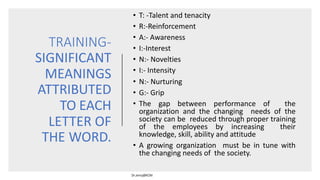
TRAINING-
SIGNIFICANT
MEANINGS
ATTRIBUTED
TO EACH
LETTER OF
THE WORD.
• T: -Talent and tenacity
• R:-Reinforcement
• A:- Awareness
• I:-Interest
• N:- Novelties
• I:- Intensity
• N:- Nurturing
• G:- Grip
• The gap between performance of the
organization and the changing needs of the
society can be reduced through proper training
of the employees by increasing their
knowledge, skill, ability and attitude
• A growing organization must be in tune with
the changing needs of the society.
Definitions of
Training
• Training is defined to be a organized activity
involving systematic procedures for transferring
technical know how to the employees for
increasing the knowledge and skills of the
people for a definite purpose.
• Definition by Edwin B Flippo. The purpose of
training is to achieve a change in the behavior
of those trained to enable them to do their jobs
better. It is equally necessary for the new as
well as the old employees. Training is a
continuous process to bring a positive change
in
• Knowledge
• Skills
• Attitude Of the workers
The Nature
of Training
Dr.Jerry@KCM
Training usually
involves teaching
operational or
technical employees
how to do their jobs
more effectively
and/or efficiently.
Responsibilities for
training are generally
assigned to the HR
function.
In general, training is
intended to help the
organization function
more effectively.
Managers must be
sure that productivity
can be increased
through training and
that productivity
gains are possible with
existing resources.
The Importance of Training
• Trained workers can work more efficiently.
• There will be fewer accidents. As training improves the knowledge of
employees regarding the use of machines and equipment.
• Wastage is eliminated to a large extent as they use tools, machines in a proper way.
• Training helps an employee to move from one organization to another easily. He can
be more mobile and pursue career goals easily.
• Training makes employees more loyal to an organization.
• They will be less inclined to leave the unit where there are growth
opportunities.
• Training enables employees to secure promotions easily.
• They can realize their career goals comfortably.
• Economical supervision-as there is less requirement for supervision for trained
employees.
Dr.Jerry@KCM
Types of
Training
Dr.Jerry@KCM
• To put the new recruits at ease and to make him
introduced with key personnel and informed about
company policies, procedures and benefits.
Orientation Training or Induction Training
• Includes four steps:
• Orient trainees to job situation by providing them
with an overview of the job
• Demonstrate the entire job
• Ask trainees to do the job
• Evaluate employee performance periodically and
offer supplementary training if necessary
Job-instruction Training
Types of
Training
Dr.Jerry@KCM
• Commonly found in industries such as
carpentry and plumbing, apprentices are
trainees here who spend a prescribed
period working with an experienced,
master worker.
Apprenticeship Training
• Company with various mandated legal
requirements (e.g., occupational safety,
EEO) and serves as training for all
employees (new employee orientation)
Required and regular training
Training Process
Dr.Jerry@KCM
Training
Needs
Analysis
Develop
Training
Objectives
Design
and Select
Training
Methods
Implement
Training
Evaluate
Training
Measure
Training
Results
1. Training
Needs Analysis
Dr.Jerry@KCM
The first step in training is to determine what
training is required, thus assessing the
training needs of the new employees is
important.
This is the diagnostic phase of setting
training objectives.
The manager must
carefully assess the
company’s:
Strategy
Resources available for
training
General philosophy
regarding training and
development
Techniques for
Identifying
Needs
Dr.Jerry@KCM
• TASK ANALYSIS
• PERFORMANCE ANALYSIS
There are two types of techniques to identify
NEEDS:
• An analysis of the job’s requirements to determine the training
required.
• It is done by TASK ANALYSIS RECORD FORM (tabular structure)
this consolidates information regarding the job’s required tasks
and skills which are helpful in determining training
requirements.
Task Analysis
Techniques for
Identifying
Needs
• Performance Analysis
• Verifies performance deficiency and
determine whether that deficiency should
be rectified through training or some other
means.
• The first step is to appraise employees’
performance, since to improve it, first
determine person’s current performance
compared to what it should be.
• To distinguish between can’t do and won’t
do problems, their specific causes and
solutions.
2. Developing Training Objectives
• After analyzing training needs, concrete
measurable training objectives should be set.
• Training objective is defined as “A description of
performance you want learners to be able to
exhibit before you consider them competent”.
• Objectives specify what the trainee should be
able to accomplish after training.
• Goals should be objective, verifiable, and
specific.
Dr.Jerry@KCM
3. Design and
Select Training
Methods
• Work-based Programs
• Tie the training and development activities directly to the
performance of the task.
1. On the Job Training
• Having employees learn their job while they are
performing it
2. Apprenticeship
• A combination of on-the-job and classroom instruction
3. Vestibule Training
• A work-simulation situation in which the job is performed
under a condition that closely simulates the real work
environment
4. Systematic Job Rotation and Transfer
• Systematically rotating or transferring the employee from
one job to another Approach training and development
from a teaching and learning perspective
5. Lecture or discussion approach
• A trainer presents the material to those attending the
program in a descriptive fashion
Different
Methods of
Training
• TRAINING TECHNOLOGY
• Computer-assisted Instruction
• Video Tele- conferencing
• Interactive Videos
• Team-building and group-based
methods
4. Implement
Training
Dr.Jerry@KCM
• Put the learner at ease - relieve the tension. Explain why
he/she is being taught.
• Create interest, encourage questions, find out about the
knowledge of the learner.
• Explain the why of the job, relate it to some job the worker
already knows.
• Place the learner as close to normal working position as
possible.
• Familiarize the worker with equipment, materials, tools,
trade terms
Preparation of the Learner
• Explain quantity and quality requirements. Go through the
job at the normal work pace.
• Explain each step between operations, difficult parts or
those in which errors are likely to be made.
• Explain the key points several times. Make the learner
explain the steps.
Presentation of the Operation
5. Evaluate
Training
• The penultimate stage in the training
strategy is the evaluation and monitoring of
training. It is the most important and
often the most neglected or least
adequately carried out part of the training
process.
• It is both Simplistic and Complicated.
• Simplistic because monitoring is a process
whereby information is gleaned from
trainee and then the course and the
program are amended in the light of these
comments.
• Complicated because there are other
‘stakeholders’ in the process besides the
trainees, i.e. designers of the courses, the
trainers and the sponsors.
Methods of Evaluation
• Questionnaires (Feedback forms) or ‘happiness sheets’ are common
way of eliciting trainee response programs.
• Tests or examinations are common on formal courses which provide a
certificate, e.g. diploma in word processing skills although end-of-
course tests can be provided after short courses to check the progress
of trainees.
• Projects initially seen as learning methods, but they can also be provide
valuable information to instructors.
• Structured exercises and case studies are opportunities to apply
learned skills and techniques under the observation of tutors and
evaluators.
Dr.Jerry@KCM
Methods of Evaluation
• Tutor reports. It is important to have the opinions of those who deliver
the training. This gives a valuable assessment from a different
perspective.
• Interviews of trainees post course or instruction period. These can be
informal or formal, individual or group or by telephone.
• Observation of courses and training by those devising training
strategies in the training department is very useful and information
from these observations can be compared with trainee responses.
• Participation and Discussion during training needs people who are
adept at intercepting responses as this can be highly subjective.
Dr.Jerry@KCM
Performance Measurement
• There are three basic categories of performance information and its
measurement:
• Trait-based assessment systems assesses or identifies the abilities or
a subjective character trait of employee such as-attitude, initiative or
creativity.
• Behavior-based systems measures the extent to which an employee
engages in specific, relatively well defined behaviors while at the job,
which leads to success.
• Results-based systems measures the bottom line associated with an
employees work and his/her accomplishments.
Dr.Jerry@KCM
Benefits of Training
• Training offers innumerable benefits both to employees and
• employers.
• Tips for Trainees on how to benefit from business seminars.
• Plan your schedule ahead of time
• Make sure what your company would like you to learn from
• the seminar.
• Learn about the proper attire for the seminar
• Network at the seminar. Bring business cards
• Meet people before each session and break the ice by making useful
conversation. Introduce yourself to the presenter.
• Bring back information to the company by either making a oral
Dr.Jerry@KCM
Benefits of
training to a
company
• The major benefits are:
• Increased productivity
• Improved morale
• Reduced supervision
• Reduced accidents
• Increase organizational stability
Benefits of Training to the employee
• Training makes employee more useful hence he will find employment more
easily.
• Training makes employee s more efficient and effective.
• Training helps them to secure promotions easily and realize their career
goals.
• Training helps an employee to move from one company to the other
• easily. He can be more mobile and pursue career goals easily.
• Employees can avoid mistakes, accidents on the job thus handle job with
more confidence, be more satisfied and would have high morale.
• It helps employees to cope with organizational , social and technological
change. It is an invaluable investment in human resource of an organization.
Dr.Jerry@KCM
Benefits of
Training to the
Business
Wastage is eliminated to a large extent
as workers work more effectively.
There are fewer accidents. As trained
workers have improved knowledge of
use and handling of machines.
Workers turn out better quality goods
Training makes workers more loyal to
the organization as they will have more
growth opportunities.
Training design models
• Designers of learning programs
should first explore existing models
before starting to design.
• Below are two training models that
training managers use while
designing training programs
– Instruction system development
model
– Transitional model
Dr.Jerry@KCM
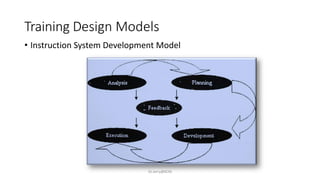
Training Design Models
• Instruction System Development Model
Dr.Jerry@KCM
Instruction System Development Model
• The Instructional System Development model comprises of five stages:
• Analysis
• This phase consist of training need assessment, job analysis, and target audience analysis.
• Planning
• This phase consist of setting goal of the learning outcome, instructional objectives that measures
behavior of a participant after the training, types of training material, media selection, methods of
evaluating the trainee, trainer and the training program, strategies to impart knowledge i.e. selection
of content, sequencing of content, etc.
• Development
• This phase translates design decisions into training material. It consists of developing course material
for the trainer including handouts, workbooks, visual aids, demonstration props, etc. course material
for the trainee including handouts of summary.
• Execution
• This phase focuses on logistical arrangements, such as arranging speakers, equipment benches,
podium, food facilities, cooling, lighting, parking, and other training accessories.
• Evaluation
• The purpose of this phase is to make sure that the training program has achieved its aim in terms of
subsequent work performance.
• This phase consists of identifying strengths and weaknesses and, making necessary amendments to
any of the previous stage in order to remedy or improve failure practices.
Dr.Jerry@KCM
Transitional Model
Dr.Jerry@KCM
Transitional
Model
• Transitional model focuses on the
organization as a whole.
• The outer loop describes the vision,
mission and values of the organization
on the basis of which training model i.e.
inner loop is executed.
• The mission, vision, and values precede
the objective in the inner loop.
• The objective is formulated keeping
these three things in mind and then the
training model is further implemented.
Transitional Model
• Vision
• Focuses on the milestones that the
organization would like to achieve after the
defined point of time
• Mission
• Explain the reason of organizational existence.
• Values
• Is the translation of vision and mission into
communicable ideals.
Dr.Jerry@KCM
Process of Training Design
Dr.Jerry@KCM
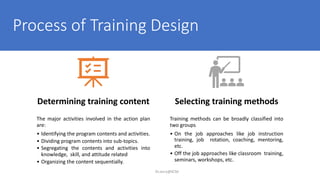
Determining training content
The major activities involved in the action plan
are:
• Identifying the program contents and activities.
• Dividing program contents into sub-topics.
• Segregating the contents and activities into
knowledge, skill, and attitude related
• Organizing the content sequentially.
Selecting training methods
Training methods can be broadly classified into
two groups
• On the job approaches like job instruction
training, job rotation, coaching, mentoring,
etc.
• Off the job approaches like classroom training,
seminars, workshops, etc.
Process of Training Design
Dr.Jerry@KCM
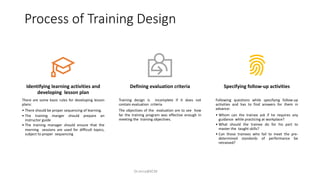
Identifying learning activities and
developing lesson plan
There are some basic rules for developing lesson
plans:
• There should be proper sequencing of learning.
• The training manger should prepare an
instructor guide
• The training manager should ensure that the
morning sessions are used for difficult topics,
subject to proper sequencing
Defining evaluation criteria
Training design is incomplete if it does not
contain evaluation criteria
The objectives of the evaluation are to see how
far the training program was effective enough in
meeting the training objectives.
Specifying follow-up activities
Following questions while specifying follow-up
activities and has to find answers for them in
advance:
• Whom can the trainee ask if he requires any
guidance while practicing at workplace?
• What should the trainee do for his part to
master the taught skills?
• Can those trainees who fail to meet the pre-
determined standards of performance be
retrained?
Process of
training design
• Designing a training program involves a series
of steps from identifying the learning
objectives, determining the training content,
deciding the methodologies, selecting the
learning activities, defining evaluation criteria
and to specifying follow-up activities.
• Even though it is the standard sequence of
activities, training managers may have some
variations depending upon the situations.
• Identifying the training objective
• Training objectives are of great significance
from a number of stakeholder perspectives:
Learning Theories
• Jean Piaget's theory of cognitive development.
• Children move through four different stages of mental development. His theory focuses
not only on understanding how children acquire knowledge, but also on understanding
the nature of intelligence.
• Sensorimotor stage: birth to 2 years
• Preoperational stage: ages 2 to 7
• Concrete operational stage: ages 7 to 11
• Formal operational stage: ages 12 and up
• Piaget believed that all children try to strike a balance between assimilation and
accommodation, which is achieved through a mechanism Piaget called equilibration.
• As children progress through the stages of cognitive development, it is important to
maintain a balance between applying previous knowledge (assimilation) and changing
behavior to account for new knowledge (accommodation).
• Equilibration helps explain how children can move from one stage of thought to the next
Dr.Jerry@KCM
Jean Piaget's theory of Cognitive Development.
Dr.Jerry@KCM
Social
Learning
Theory, Albert
Bandura
Dr.Jerry@KCM
Social learning theory is the view that people learn by
observing others.
• For example, a teenager might learn slang by observing peers.
• Social learning requires attention to the person(s) observed,
remembering the observed behavior, the ability to replicate the behavior,
and a motivation to act the same way.
The main idea of social learning is that we do what we
see.
Basically, behavior is learned from our environment
through observation.
From his research Bandura formulated four principles of
social learning.
• Attention. We cannot learn if we are not focused on the task. ...
• Retention. We learn by internalizing information in our memories. ...
• Reproduction. We reproduce previously learned information (behavior,
skills, knowledge) when required.
• Motivation
Kolb's model of learning style of Individual
• Learning Styles.
• Kolb's learning theory (1974) sets out four distinct learning styles, which are based
on a four-stage learning cycle
• Kolb explains that different people naturally prefer a certain single different learning
style.
• Our learning style is a product of these two choice decisions.
• Concrete Experience - a new experience or situation is encountered, or a
reinterpretation of existing experience.
• Reflective Observation of the New Experience - of importance are any
inconsistencies between experience and understanding.
• Abstract Conceptualization reflection gives rise to a new idea, or a modification
of an existing abstract concept (the person has learned from their experience).
• Active Experimentation - the learner applies their idea(s) to the world around
them to see what happens.
Dr.Jerry@KCM
Educational Implications of Kolb’s Model
• Both Kolb's (1984) learning stages and cycle could be used by teachers
to critically evaluate the learning provision typically available to
students, and to develop more appropriate learning opportunities.
• Educators should ensure that activities are designed and carried out in
ways that offer each learner the chance to engage in the manner that
suits them best.
• Also, individuals can be helped to learn more effectively by the
identification of their lesser preferred learning styles and the
strengthening of these through the application of the experiential
learning cycle.
• Ideally, activities and material should be developed in ways that draw on
abilities from each stage of the experiential learning cycle and take the
students through the whole process in sequence.
Dr.Jerry@KCM
Career Management
• Career management is conscious planning of one’s activities and engagements in the
jobs one undertakes during his life for better fulfilment, growth and financial
stability.
• It is a sequential process that starts from an understanding of oneself and
encompasses occupational awareness.
• An individual’s career is the sole source of one’s natural expression of self.
• One school of thought describes work as the purpose of life and the source of one’s
expression and the purpose of being or existence.
• Career management is more or less like the organizational management; after all an
organisation is nothing but an assortment of individuals.
• The process of career management begins with the formulation of goals and
objectives those that are short term or meant to be achieved in the short run.
Dr.Jerry@KCM
What Is Career Management?
• Career management is the process through which
employees:
• Become aware of their own interests, values, strengths,
and weaknesses
• Obtain information about job opportunities within the
company
• Identify career goals
• Establish action plans to achieve career goals
Dr.Jerry@KCM
Why Is Career
Management
Important?
• From the company’s perspective, the failure to
motivate employees to plan their careers can
result in:
• a shortage of employees to fill open
positions lower employee commitment
• inappropriate use of monies allocated for
training and development programs
• From the employees’ perspective, lack of career
management can result in:
• frustration
• feelings of not being valued by the company
• being unable to find suitable employment
should a job change be necessary due to
mergers, acquisitions, restructuring, or
downsizing
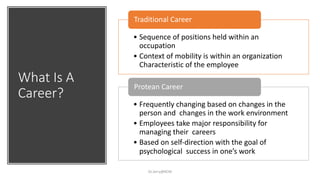
What Is A
Career?
Dr.Jerry@KCM
• Sequence of positions held within an
occupation
• Context of mobility is within an organization
Characteristic of the employee
Traditional Career
• Frequently changing based on changes in the
person and changes in the work environment
• Employees take major responsibility for
managing their careers
• Based on self-direction with the goal of
psychological success in one’s work
Protean Career
Components
of the Career
Management
Process:
Dr.Jerry@KCM
• Use of information by employees to determine their career
interests, values, aptitudes, and behavioral tendencies
• Often involves psychological tests
Self-Assessment
• Information employees receive about how the company
evaluates their skills and knowledge and where they fit into
company plans
Reality Check
• The process of employees developing short- and long- term
career objectives
• Usually discussed with the manager and written into a
development plan
Goal Setting
• Employees determining how they will achieve their short- and
long-term career goals
Action Planning
Evaluating Career Management Systems
• Career management systems need to be evaluated to ensure
that they are meeting the needs of employees and the
business
• Two types of outcomes can be used to evaluate:
Reactions of the customers (employees and managers)
who use the career management system
• Results of the career management system
• Evaluation of a career management system should be based
on its objectives
Dr.Jerry@KCM
Competency
Mapping
• Competency mapping involves the process by
which we determine:
• The nature and scope of a specific job role, the
skills required, the level of knowledge required,
and the behavioral capacities required to apply
those skills and knowledge in that role.
• Competency Mapping plays a vital role in selecting,
recruiting and retaining the right people.
• When the competency required for a particular
position is mapped, an accurate job profile is
created.
• Competency can be defined as the process of
identifying key attributes and skills for each position
and process within the company.
Broad
Categories In
Competency
Dr.Jerry@KCM
• Competencies which are considered essential for all
employees regardless of their function or level. For
example - Communication, initiative, listening skills
etc.
Generic
• Competencies which are considered essential for
managerial or supervisory responsibility
Managerial Competencies
• Specific competencies which are considered essential
to perform a specific role in the organisation within a
defined technical or functional area of work.
Technical / Functional

Training and Development, Career Management

  • 1.
  • 2.
    Training & Development • Training &Development is a continuous process in an organization to achieve its organizational goals by improving the skills and knowledge of the employees. • The training and development function in an organization has gained a lot of importance due to advancement in technology and changes in market force.
  • 3.
    Training • Training isbasically a systematic procedure for transferring technical know-how to the employees to increase their knowledge and skills for doing jobs. • Training usually involves teaching operational or technical employees how to do their jobs more effectively and/or efficiently. • Training is a process of teaching a new employees the basic skills to perform their jobs - Garry Dessler
  • 4.
    Development Dr.Jerry@KCM Efforts made toimprove employee’s ability to handle a variety of assignment. Development is a process of preparing employees for future position and improve their personal skills to handle the critical situations in an organization. Development is generally aimed at helping managers better understand and solve problems, make decisions, and capitalize on opportunities. Development is often considered a HR function.
  • 5.
    Training an Overview •Training if effectively managed achieves aims and objectives of an organization. • Training is always job orientated for the development of the general culture of the company. • Training is a process to improve aptitude skills and abilities of the employees to perform specific jobs. • Due to rapid growth in technology fields there is a great need for training for updating skills of employees. • To respond effectively to competition from rival business organization in house training is given to keep abreast with latest development in their field. Dr.Jerry@KCM
  • 6.
    Present day role of training. Dr.Jerry@KCM Atmacro level it serves as an important agency to contribute to the economic and social progress of the country thus creating a need for large scale organized efforts to develop technical and enterprising skills in youth to make them productive units of society. Now a days training is a crucial element , a sound basis for modern day management at the micro level. It has an extensive role in – enhancing productivity. improving organizational functions.
  • 7.
    What is the needfor Training of Personnel? • Continuous management training is required to build up a strong effective , motivated and dedicated managerial cadre. • In PEs training must shape the managers to understand the requirement of the employers in terms of organization and personal growth. • It is essential for gaining competitive edge. • For imparting diverse skills and performance management abilities to managers for effectiveness of business activities. • For enhancement of emotional and intelligent quotient in managers.
  • 8.
    TRAINING- SIGNIFICANT MEANINGS ATTRIBUTED TO EACH LETTER OF THEWORD. • T: -Talent and tenacity • R:-Reinforcement • A:- Awareness • I:-Interest • N:- Novelties • I:- Intensity • N:- Nurturing • G:- Grip • The gap between performance of the organization and the changing needs of the society can be reduced through proper training of the employees by increasing their knowledge, skill, ability and attitude • A growing organization must be in tune with the changing needs of the society.
  • 9.
    Definitions of Training • Trainingis defined to be a organized activity involving systematic procedures for transferring technical know how to the employees for increasing the knowledge and skills of the people for a definite purpose. • Definition by Edwin B Flippo. The purpose of training is to achieve a change in the behavior of those trained to enable them to do their jobs better. It is equally necessary for the new as well as the old employees. Training is a continuous process to bring a positive change in • Knowledge • Skills • Attitude Of the workers
  • 10.
    The Nature of Training Dr.Jerry@KCM Trainingusually involves teaching operational or technical employees how to do their jobs more effectively and/or efficiently. Responsibilities for training are generally assigned to the HR function. In general, training is intended to help the organization function more effectively. Managers must be sure that productivity can be increased through training and that productivity gains are possible with existing resources.
  • 11.
    The Importance ofTraining • Trained workers can work more efficiently. • There will be fewer accidents. As training improves the knowledge of employees regarding the use of machines and equipment. • Wastage is eliminated to a large extent as they use tools, machines in a proper way. • Training helps an employee to move from one organization to another easily. He can be more mobile and pursue career goals easily. • Training makes employees more loyal to an organization. • They will be less inclined to leave the unit where there are growth opportunities. • Training enables employees to secure promotions easily. • They can realize their career goals comfortably. • Economical supervision-as there is less requirement for supervision for trained employees. Dr.Jerry@KCM
  • 12.
    Types of Training Dr.Jerry@KCM • Toput the new recruits at ease and to make him introduced with key personnel and informed about company policies, procedures and benefits. Orientation Training or Induction Training • Includes four steps: • Orient trainees to job situation by providing them with an overview of the job • Demonstrate the entire job • Ask trainees to do the job • Evaluate employee performance periodically and offer supplementary training if necessary Job-instruction Training
  • 13.
    Types of Training Dr.Jerry@KCM • Commonlyfound in industries such as carpentry and plumbing, apprentices are trainees here who spend a prescribed period working with an experienced, master worker. Apprenticeship Training • Company with various mandated legal requirements (e.g., occupational safety, EEO) and serves as training for all employees (new employee orientation) Required and regular training
  • 14.
  • 15.
    1. Training Needs Analysis Dr.Jerry@KCM Thefirst step in training is to determine what training is required, thus assessing the training needs of the new employees is important. This is the diagnostic phase of setting training objectives. The manager must carefully assess the company’s: Strategy Resources available for training General philosophy regarding training and development
  • 16.
    Techniques for Identifying Needs Dr.Jerry@KCM • TASKANALYSIS • PERFORMANCE ANALYSIS There are two types of techniques to identify NEEDS: • An analysis of the job’s requirements to determine the training required. • It is done by TASK ANALYSIS RECORD FORM (tabular structure) this consolidates information regarding the job’s required tasks and skills which are helpful in determining training requirements. Task Analysis
  • 17.
    Techniques for Identifying Needs • PerformanceAnalysis • Verifies performance deficiency and determine whether that deficiency should be rectified through training or some other means. • The first step is to appraise employees’ performance, since to improve it, first determine person’s current performance compared to what it should be. • To distinguish between can’t do and won’t do problems, their specific causes and solutions.
  • 18.
    2. Developing TrainingObjectives • After analyzing training needs, concrete measurable training objectives should be set. • Training objective is defined as “A description of performance you want learners to be able to exhibit before you consider them competent”. • Objectives specify what the trainee should be able to accomplish after training. • Goals should be objective, verifiable, and specific. Dr.Jerry@KCM
  • 19.
    3. Design and SelectTraining Methods • Work-based Programs • Tie the training and development activities directly to the performance of the task. 1. On the Job Training • Having employees learn their job while they are performing it 2. Apprenticeship • A combination of on-the-job and classroom instruction 3. Vestibule Training • A work-simulation situation in which the job is performed under a condition that closely simulates the real work environment 4. Systematic Job Rotation and Transfer • Systematically rotating or transferring the employee from one job to another Approach training and development from a teaching and learning perspective 5. Lecture or discussion approach • A trainer presents the material to those attending the program in a descriptive fashion
  • 20.
    Different Methods of Training • TRAININGTECHNOLOGY • Computer-assisted Instruction • Video Tele- conferencing • Interactive Videos • Team-building and group-based methods
  • 21.
    4. Implement Training Dr.Jerry@KCM • Putthe learner at ease - relieve the tension. Explain why he/she is being taught. • Create interest, encourage questions, find out about the knowledge of the learner. • Explain the why of the job, relate it to some job the worker already knows. • Place the learner as close to normal working position as possible. • Familiarize the worker with equipment, materials, tools, trade terms Preparation of the Learner • Explain quantity and quality requirements. Go through the job at the normal work pace. • Explain each step between operations, difficult parts or those in which errors are likely to be made. • Explain the key points several times. Make the learner explain the steps. Presentation of the Operation
  • 22.
    5. Evaluate Training • Thepenultimate stage in the training strategy is the evaluation and monitoring of training. It is the most important and often the most neglected or least adequately carried out part of the training process. • It is both Simplistic and Complicated. • Simplistic because monitoring is a process whereby information is gleaned from trainee and then the course and the program are amended in the light of these comments. • Complicated because there are other ‘stakeholders’ in the process besides the trainees, i.e. designers of the courses, the trainers and the sponsors.
  • 23.
    Methods of Evaluation •Questionnaires (Feedback forms) or ‘happiness sheets’ are common way of eliciting trainee response programs. • Tests or examinations are common on formal courses which provide a certificate, e.g. diploma in word processing skills although end-of- course tests can be provided after short courses to check the progress of trainees. • Projects initially seen as learning methods, but they can also be provide valuable information to instructors. • Structured exercises and case studies are opportunities to apply learned skills and techniques under the observation of tutors and evaluators. Dr.Jerry@KCM
  • 24.
    Methods of Evaluation •Tutor reports. It is important to have the opinions of those who deliver the training. This gives a valuable assessment from a different perspective. • Interviews of trainees post course or instruction period. These can be informal or formal, individual or group or by telephone. • Observation of courses and training by those devising training strategies in the training department is very useful and information from these observations can be compared with trainee responses. • Participation and Discussion during training needs people who are adept at intercepting responses as this can be highly subjective. Dr.Jerry@KCM
  • 25.
    Performance Measurement • Thereare three basic categories of performance information and its measurement: • Trait-based assessment systems assesses or identifies the abilities or a subjective character trait of employee such as-attitude, initiative or creativity. • Behavior-based systems measures the extent to which an employee engages in specific, relatively well defined behaviors while at the job, which leads to success. • Results-based systems measures the bottom line associated with an employees work and his/her accomplishments. Dr.Jerry@KCM
  • 26.
    Benefits of Training •Training offers innumerable benefits both to employees and • employers. • Tips for Trainees on how to benefit from business seminars. • Plan your schedule ahead of time • Make sure what your company would like you to learn from • the seminar. • Learn about the proper attire for the seminar • Network at the seminar. Bring business cards • Meet people before each session and break the ice by making useful conversation. Introduce yourself to the presenter. • Bring back information to the company by either making a oral Dr.Jerry@KCM
  • 27.
    Benefits of training toa company • The major benefits are: • Increased productivity • Improved morale • Reduced supervision • Reduced accidents • Increase organizational stability
  • 28.
    Benefits of Trainingto the employee • Training makes employee more useful hence he will find employment more easily. • Training makes employee s more efficient and effective. • Training helps them to secure promotions easily and realize their career goals. • Training helps an employee to move from one company to the other • easily. He can be more mobile and pursue career goals easily. • Employees can avoid mistakes, accidents on the job thus handle job with more confidence, be more satisfied and would have high morale. • It helps employees to cope with organizational , social and technological change. It is an invaluable investment in human resource of an organization. Dr.Jerry@KCM
  • 29.
    Benefits of Training tothe Business Wastage is eliminated to a large extent as workers work more effectively. There are fewer accidents. As trained workers have improved knowledge of use and handling of machines. Workers turn out better quality goods Training makes workers more loyal to the organization as they will have more growth opportunities.
  • 30.
    Training design models •Designers of learning programs should first explore existing models before starting to design. • Below are two training models that training managers use while designing training programs – Instruction system development model – Transitional model Dr.Jerry@KCM
  • 31.
    Training Design Models •Instruction System Development Model Dr.Jerry@KCM
  • 32.
    Instruction System DevelopmentModel • The Instructional System Development model comprises of five stages: • Analysis • This phase consist of training need assessment, job analysis, and target audience analysis. • Planning • This phase consist of setting goal of the learning outcome, instructional objectives that measures behavior of a participant after the training, types of training material, media selection, methods of evaluating the trainee, trainer and the training program, strategies to impart knowledge i.e. selection of content, sequencing of content, etc. • Development • This phase translates design decisions into training material. It consists of developing course material for the trainer including handouts, workbooks, visual aids, demonstration props, etc. course material for the trainee including handouts of summary. • Execution • This phase focuses on logistical arrangements, such as arranging speakers, equipment benches, podium, food facilities, cooling, lighting, parking, and other training accessories. • Evaluation • The purpose of this phase is to make sure that the training program has achieved its aim in terms of subsequent work performance. • This phase consists of identifying strengths and weaknesses and, making necessary amendments to any of the previous stage in order to remedy or improve failure practices. Dr.Jerry@KCM
  • 33.
  • 34.
    Transitional Model • Transitional modelfocuses on the organization as a whole. • The outer loop describes the vision, mission and values of the organization on the basis of which training model i.e. inner loop is executed. • The mission, vision, and values precede the objective in the inner loop. • The objective is formulated keeping these three things in mind and then the training model is further implemented.
  • 35.
    Transitional Model • Vision •Focuses on the milestones that the organization would like to achieve after the defined point of time • Mission • Explain the reason of organizational existence. • Values • Is the translation of vision and mission into communicable ideals. Dr.Jerry@KCM
  • 36.
    Process of TrainingDesign Dr.Jerry@KCM Determining training content The major activities involved in the action plan are: • Identifying the program contents and activities. • Dividing program contents into sub-topics. • Segregating the contents and activities into knowledge, skill, and attitude related • Organizing the content sequentially. Selecting training methods Training methods can be broadly classified into two groups • On the job approaches like job instruction training, job rotation, coaching, mentoring, etc. • Off the job approaches like classroom training, seminars, workshops, etc.
  • 37.
    Process of TrainingDesign Dr.Jerry@KCM Identifying learning activities and developing lesson plan There are some basic rules for developing lesson plans: • There should be proper sequencing of learning. • The training manger should prepare an instructor guide • The training manager should ensure that the morning sessions are used for difficult topics, subject to proper sequencing Defining evaluation criteria Training design is incomplete if it does not contain evaluation criteria The objectives of the evaluation are to see how far the training program was effective enough in meeting the training objectives. Specifying follow-up activities Following questions while specifying follow-up activities and has to find answers for them in advance: • Whom can the trainee ask if he requires any guidance while practicing at workplace? • What should the trainee do for his part to master the taught skills? • Can those trainees who fail to meet the pre- determined standards of performance be retrained?
  • 38.
    Process of training design •Designing a training program involves a series of steps from identifying the learning objectives, determining the training content, deciding the methodologies, selecting the learning activities, defining evaluation criteria and to specifying follow-up activities. • Even though it is the standard sequence of activities, training managers may have some variations depending upon the situations. • Identifying the training objective • Training objectives are of great significance from a number of stakeholder perspectives:
  • 39.
    Learning Theories • JeanPiaget's theory of cognitive development. • Children move through four different stages of mental development. His theory focuses not only on understanding how children acquire knowledge, but also on understanding the nature of intelligence. • Sensorimotor stage: birth to 2 years • Preoperational stage: ages 2 to 7 • Concrete operational stage: ages 7 to 11 • Formal operational stage: ages 12 and up • Piaget believed that all children try to strike a balance between assimilation and accommodation, which is achieved through a mechanism Piaget called equilibration. • As children progress through the stages of cognitive development, it is important to maintain a balance between applying previous knowledge (assimilation) and changing behavior to account for new knowledge (accommodation). • Equilibration helps explain how children can move from one stage of thought to the next Dr.Jerry@KCM
  • 40.
    Jean Piaget's theoryof Cognitive Development. Dr.Jerry@KCM
  • 41.
    Social Learning Theory, Albert Bandura Dr.Jerry@KCM Social learningtheory is the view that people learn by observing others. • For example, a teenager might learn slang by observing peers. • Social learning requires attention to the person(s) observed, remembering the observed behavior, the ability to replicate the behavior, and a motivation to act the same way. The main idea of social learning is that we do what we see. Basically, behavior is learned from our environment through observation. From his research Bandura formulated four principles of social learning. • Attention. We cannot learn if we are not focused on the task. ... • Retention. We learn by internalizing information in our memories. ... • Reproduction. We reproduce previously learned information (behavior, skills, knowledge) when required. • Motivation
  • 42.
    Kolb's model oflearning style of Individual • Learning Styles. • Kolb's learning theory (1974) sets out four distinct learning styles, which are based on a four-stage learning cycle • Kolb explains that different people naturally prefer a certain single different learning style. • Our learning style is a product of these two choice decisions. • Concrete Experience - a new experience or situation is encountered, or a reinterpretation of existing experience. • Reflective Observation of the New Experience - of importance are any inconsistencies between experience and understanding. • Abstract Conceptualization reflection gives rise to a new idea, or a modification of an existing abstract concept (the person has learned from their experience). • Active Experimentation - the learner applies their idea(s) to the world around them to see what happens. Dr.Jerry@KCM
  • 43.
    Educational Implications ofKolb’s Model • Both Kolb's (1984) learning stages and cycle could be used by teachers to critically evaluate the learning provision typically available to students, and to develop more appropriate learning opportunities. • Educators should ensure that activities are designed and carried out in ways that offer each learner the chance to engage in the manner that suits them best. • Also, individuals can be helped to learn more effectively by the identification of their lesser preferred learning styles and the strengthening of these through the application of the experiential learning cycle. • Ideally, activities and material should be developed in ways that draw on abilities from each stage of the experiential learning cycle and take the students through the whole process in sequence. Dr.Jerry@KCM
  • 44.
    Career Management • Careermanagement is conscious planning of one’s activities and engagements in the jobs one undertakes during his life for better fulfilment, growth and financial stability. • It is a sequential process that starts from an understanding of oneself and encompasses occupational awareness. • An individual’s career is the sole source of one’s natural expression of self. • One school of thought describes work as the purpose of life and the source of one’s expression and the purpose of being or existence. • Career management is more or less like the organizational management; after all an organisation is nothing but an assortment of individuals. • The process of career management begins with the formulation of goals and objectives those that are short term or meant to be achieved in the short run. Dr.Jerry@KCM
  • 45.
    What Is CareerManagement? • Career management is the process through which employees: • Become aware of their own interests, values, strengths, and weaknesses • Obtain information about job opportunities within the company • Identify career goals • Establish action plans to achieve career goals Dr.Jerry@KCM
  • 46.
    Why Is Career Management Important? •From the company’s perspective, the failure to motivate employees to plan their careers can result in: • a shortage of employees to fill open positions lower employee commitment • inappropriate use of monies allocated for training and development programs • From the employees’ perspective, lack of career management can result in: • frustration • feelings of not being valued by the company • being unable to find suitable employment should a job change be necessary due to mergers, acquisitions, restructuring, or downsizing
  • 47.
    What Is A Career? Dr.Jerry@KCM •Sequence of positions held within an occupation • Context of mobility is within an organization Characteristic of the employee Traditional Career • Frequently changing based on changes in the person and changes in the work environment • Employees take major responsibility for managing their careers • Based on self-direction with the goal of psychological success in one’s work Protean Career
  • 48.
    Components of the Career Management Process: Dr.Jerry@KCM •Use of information by employees to determine their career interests, values, aptitudes, and behavioral tendencies • Often involves psychological tests Self-Assessment • Information employees receive about how the company evaluates their skills and knowledge and where they fit into company plans Reality Check • The process of employees developing short- and long- term career objectives • Usually discussed with the manager and written into a development plan Goal Setting • Employees determining how they will achieve their short- and long-term career goals Action Planning
  • 49.
    Evaluating Career ManagementSystems • Career management systems need to be evaluated to ensure that they are meeting the needs of employees and the business • Two types of outcomes can be used to evaluate: Reactions of the customers (employees and managers) who use the career management system • Results of the career management system • Evaluation of a career management system should be based on its objectives Dr.Jerry@KCM
  • 50.
    Competency Mapping • Competency mappinginvolves the process by which we determine: • The nature and scope of a specific job role, the skills required, the level of knowledge required, and the behavioral capacities required to apply those skills and knowledge in that role. • Competency Mapping plays a vital role in selecting, recruiting and retaining the right people. • When the competency required for a particular position is mapped, an accurate job profile is created. • Competency can be defined as the process of identifying key attributes and skills for each position and process within the company.
  • 51.
    Broad Categories In Competency Dr.Jerry@KCM • Competencieswhich are considered essential for all employees regardless of their function or level. For example - Communication, initiative, listening skills etc. Generic • Competencies which are considered essential for managerial or supervisory responsibility Managerial Competencies • Specific competencies which are considered essential to perform a specific role in the organisation within a defined technical or functional area of work. Technical / Functional