The document discusses staff scheduling problems and solutions. It describes different types of staff scheduling problems including shift scheduling, days-on scheduling, and tour scheduling. It also discusses modeling approaches, constraints, objectives, and solution techniques for staff scheduling problems including integer linear programming and heuristics. Finally, it provides an example of a staff scheduling problem at the USPS and its formulation in Lingo.
Overview What isStaff Scheduling? Types of Staff Scheduling Problems Application Areas Solution T echniques Modeling Approach A Real Time Problem in USPS Expression in Lingo Discussion of Solution
3.
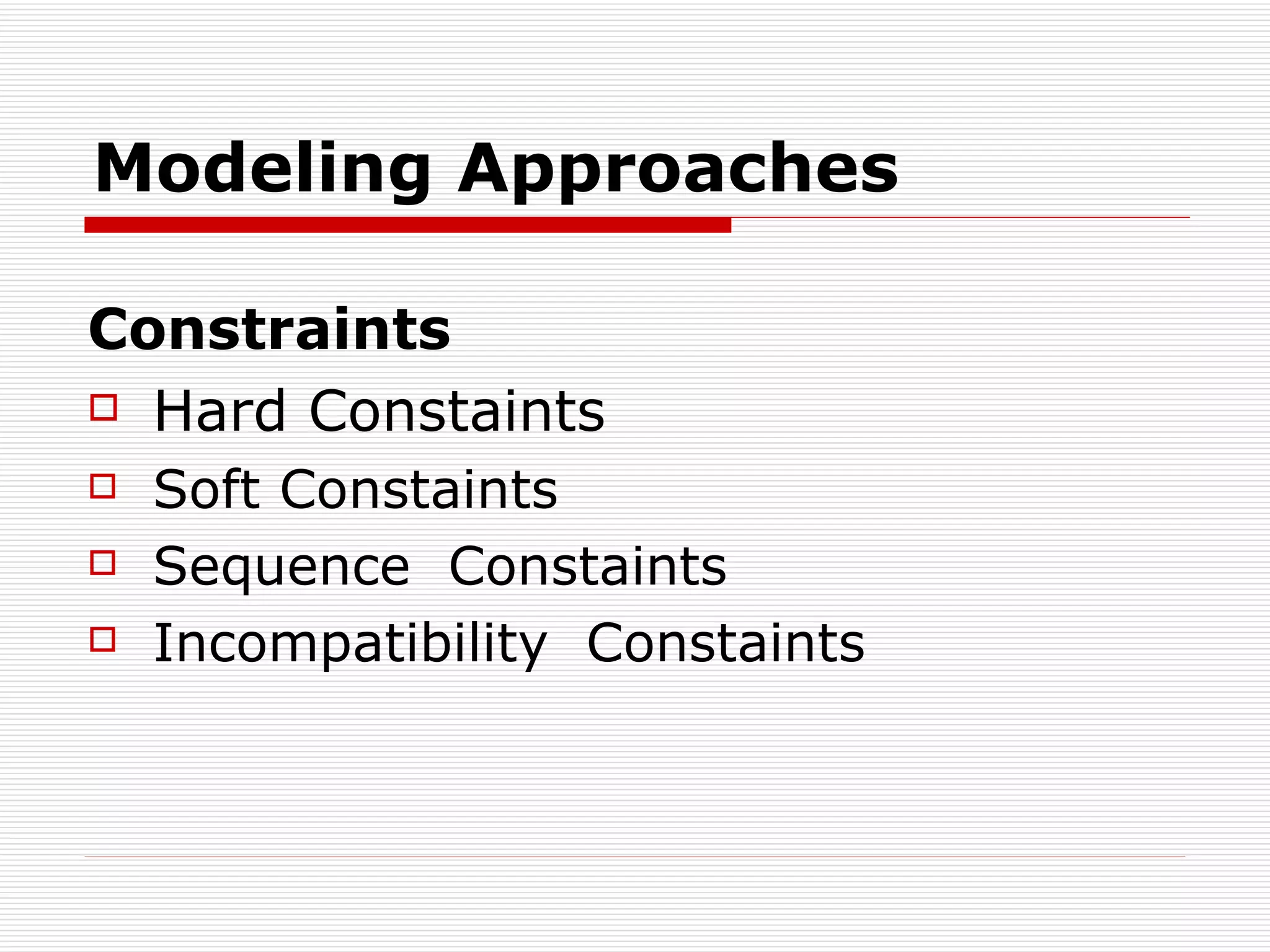
What is StaffScheduling? Staff scheduling problems are concerned with scheduling a workforce so as to meet demand which varies with the time of day and with the day of week . The major challenge is providing a reasonable labor cost and customer satisfaction while meeting this varying demand .
4.
Types of StaffScheduling Problems There are three kinds of staffing problems S hift scheduling D ays-on scheduling problem Tour scheduling problem
5.
S hift S cheduling It includes finding the optimal crew size and assigning each member of the crew to various shifts during the day .
6.
D ays-on scheduling This kind of scheduling requires to define the working days and not working days of employees in their work schedules in order to satisfy their days-off requirement.
7.
T our scheduling It contains both shift scheduling and days-on scheduling and it provides to plan working days of each employee in a planned period which is covered by the schedule. The objective of the tour scheduling problem is to find the least costly way to staff the system at the targeted levels by determining the ideal number of employees to be assigned to each feasible work schedule.
8.
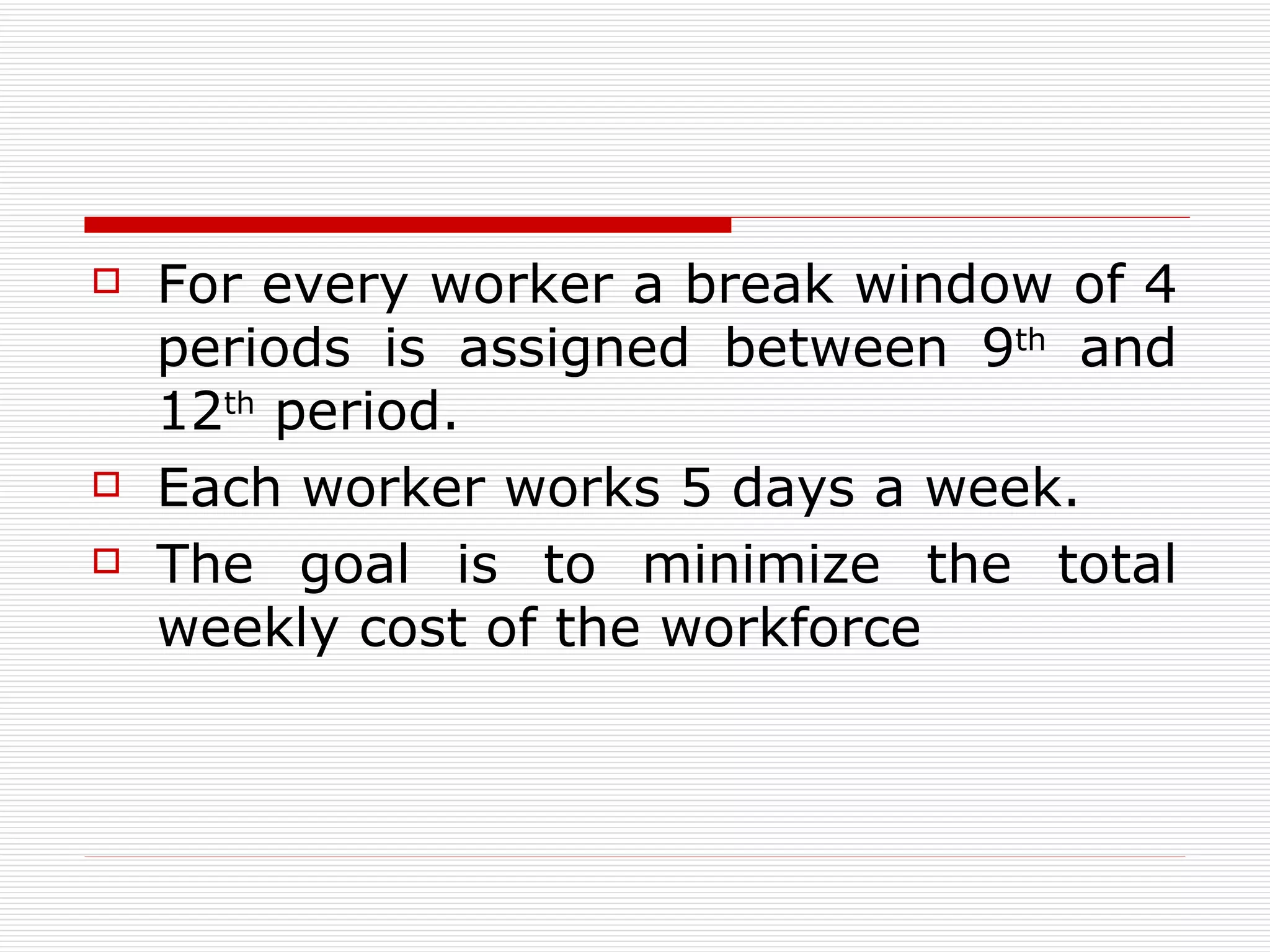
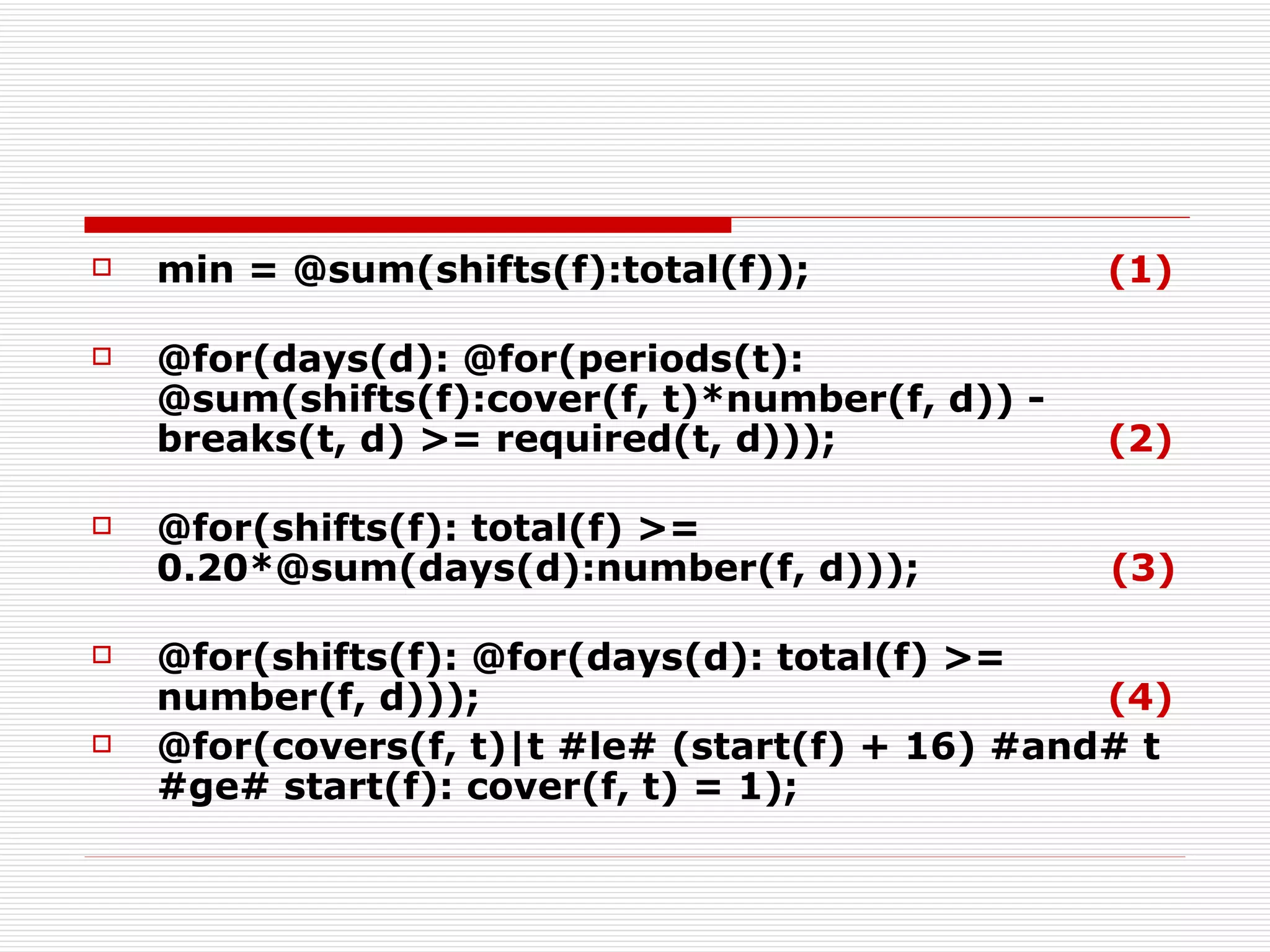
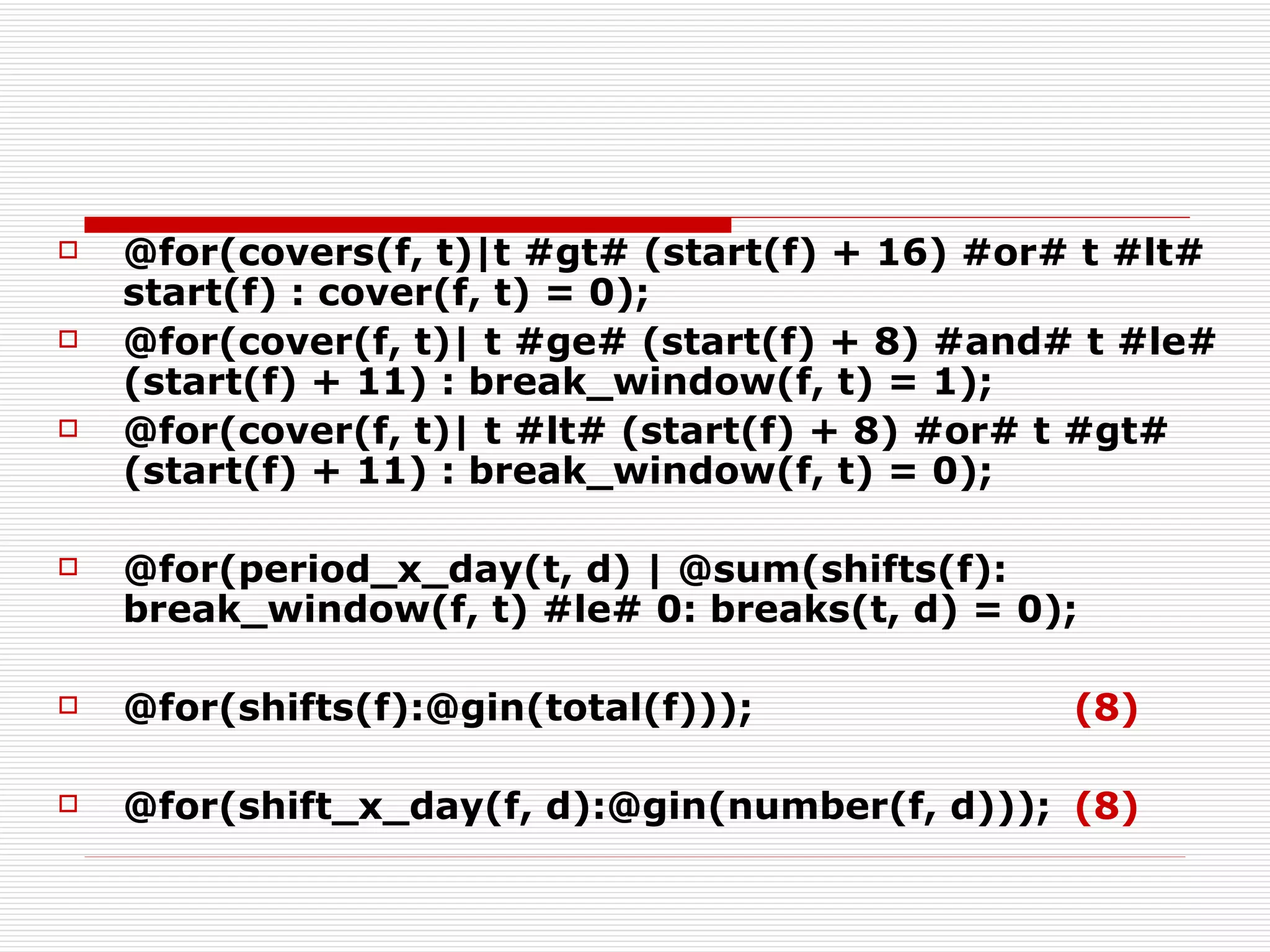
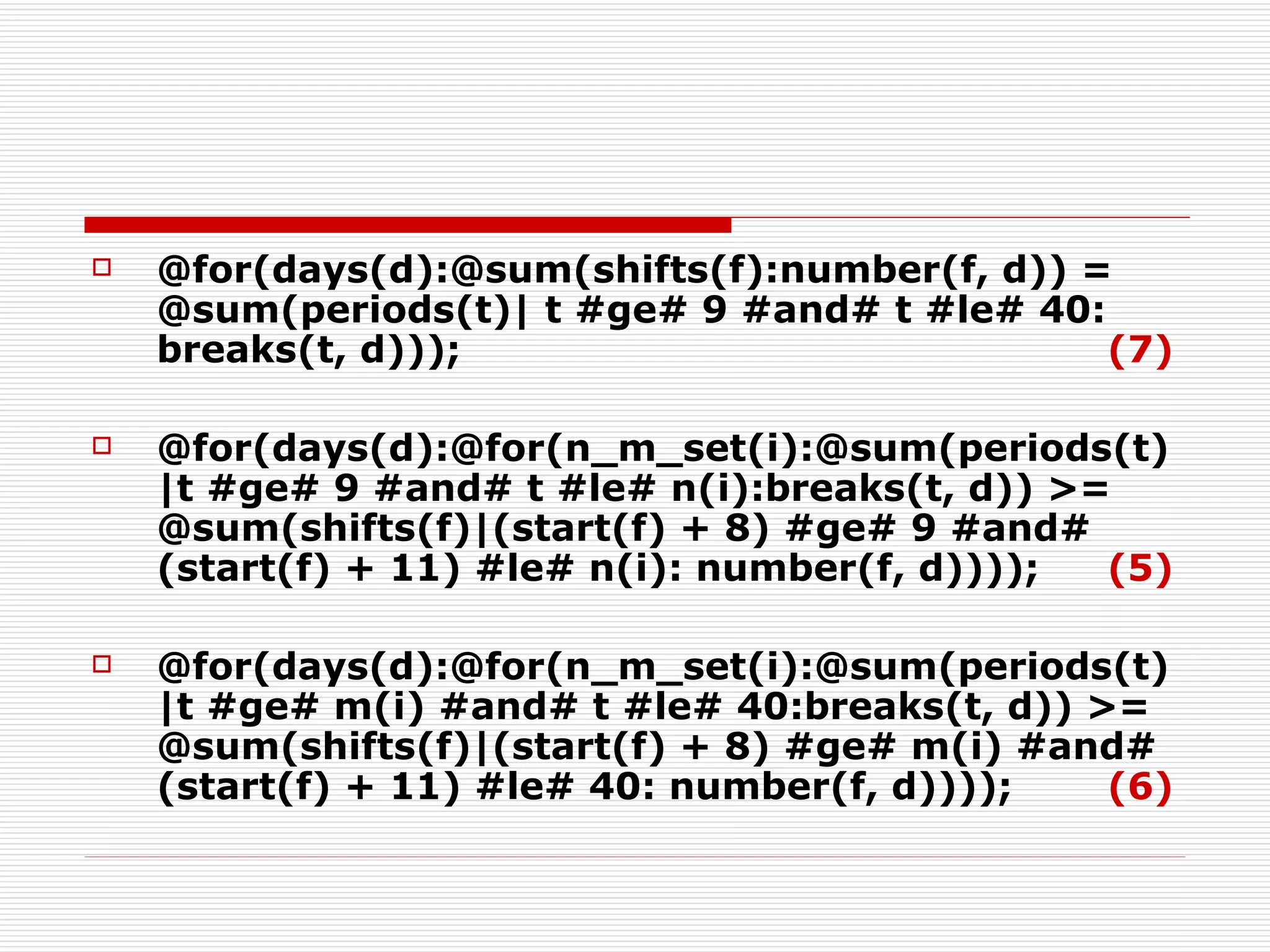
B reak window A break must be given in all shifts which are longer than a specific number of periods. These breaks generally can start after a specific time and must finish before another specific time; in literature this interval is called as break window.
9.
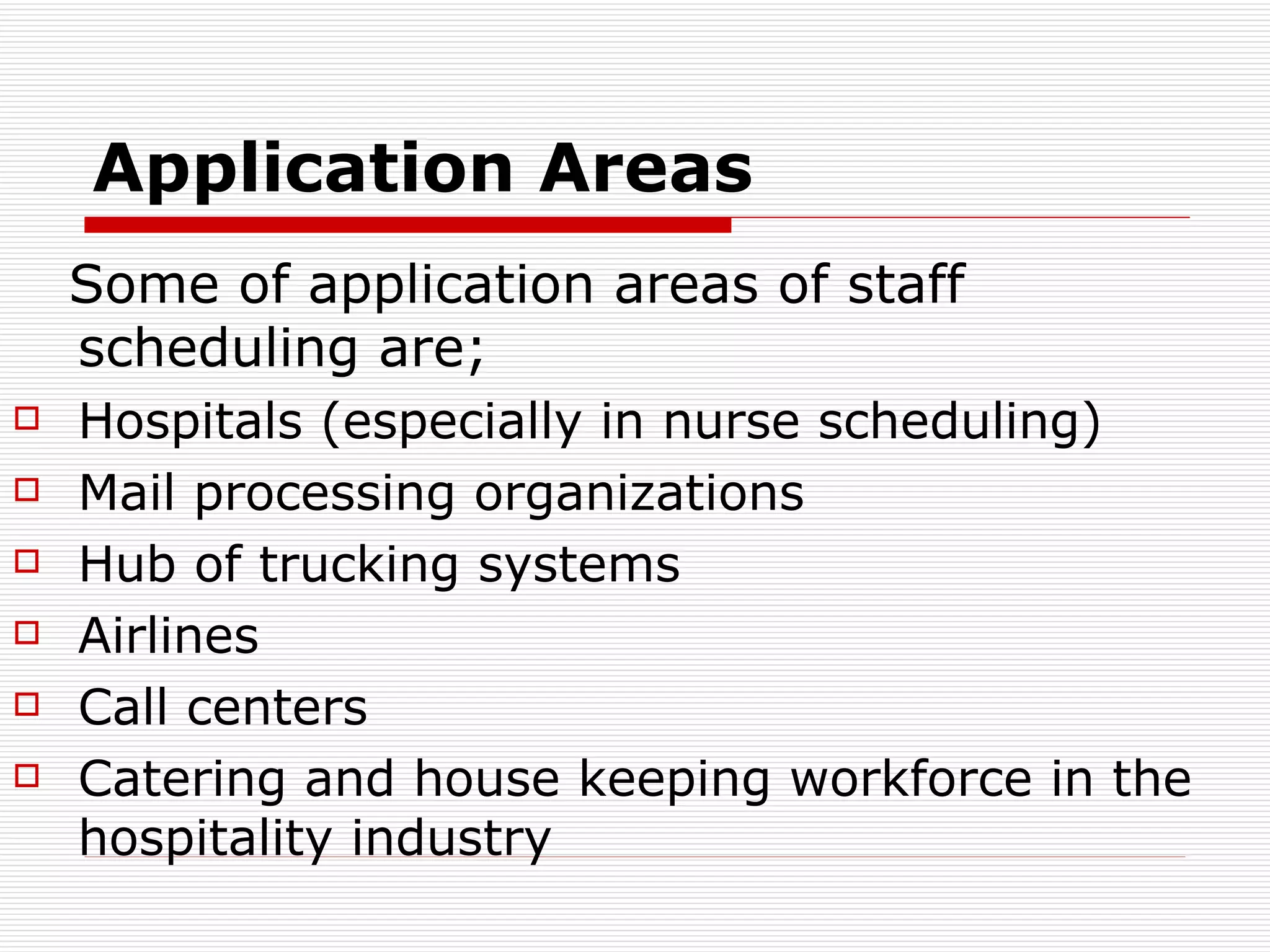
Application Areas Someof application areas of staff scheduling are; Hospitals (especially in nurse scheduling) Mail processing organizations Hub of trucking systems Airlines Call centers C atering and house keeping workforce in the hospitality industry
10.
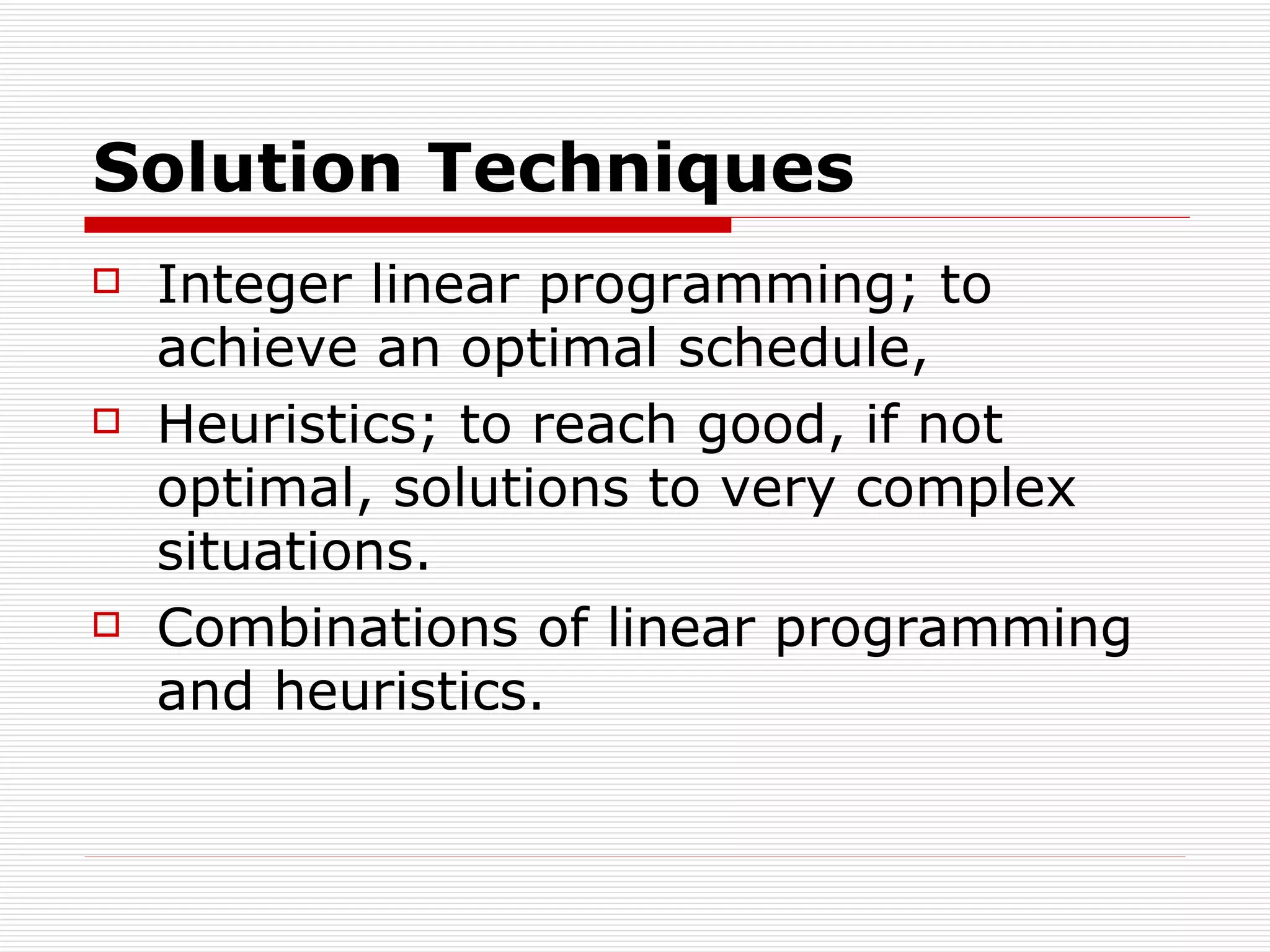
Solution Techniques Integer linear programming ; to achieve an optimal schedule, H euristics ; to reach good, if not optimal, solutions to very complex situations . C ombinations of linear programming and heuristics.
O bjectives Cost, F airness, S oft constraint violations
13.
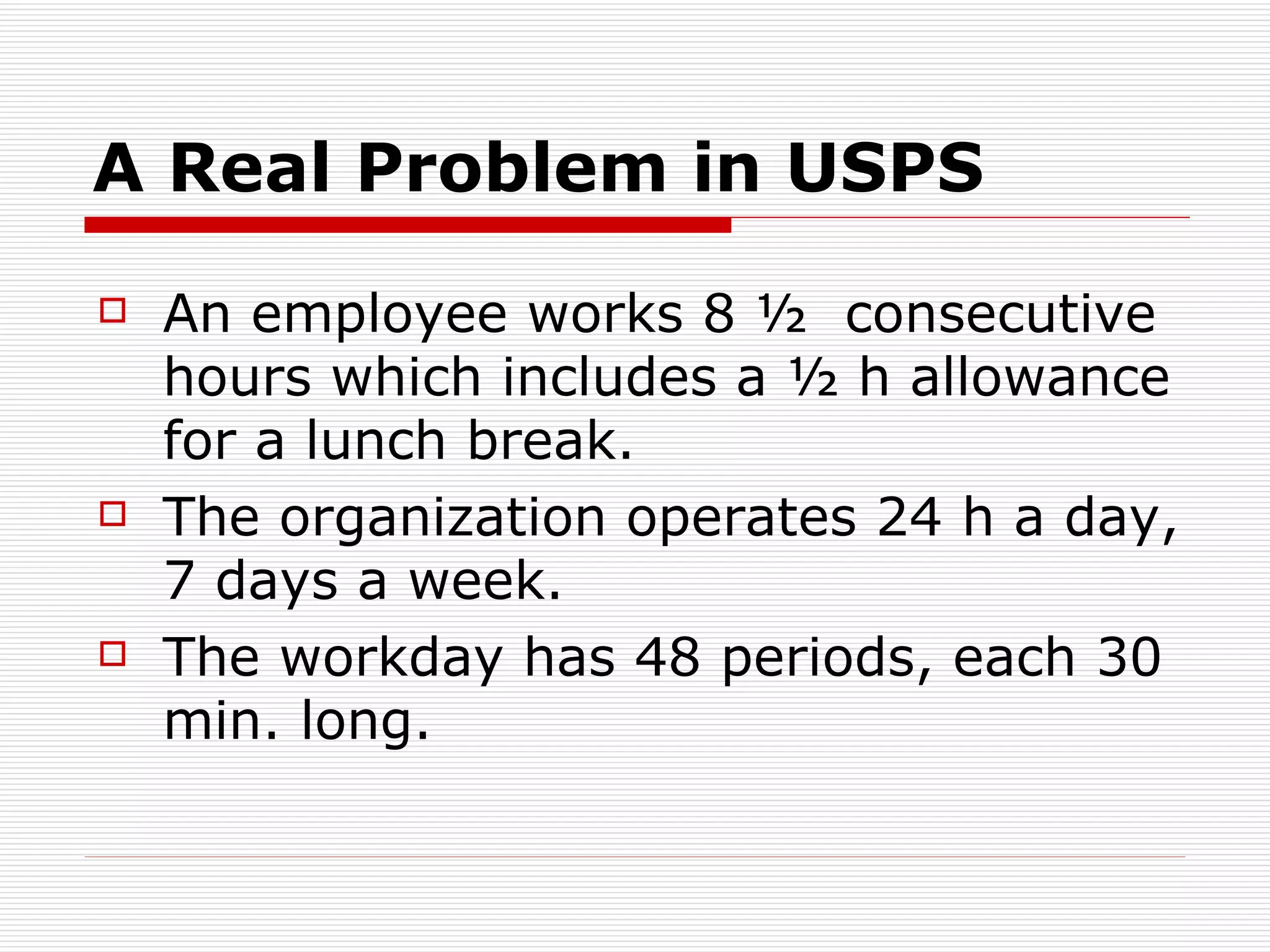
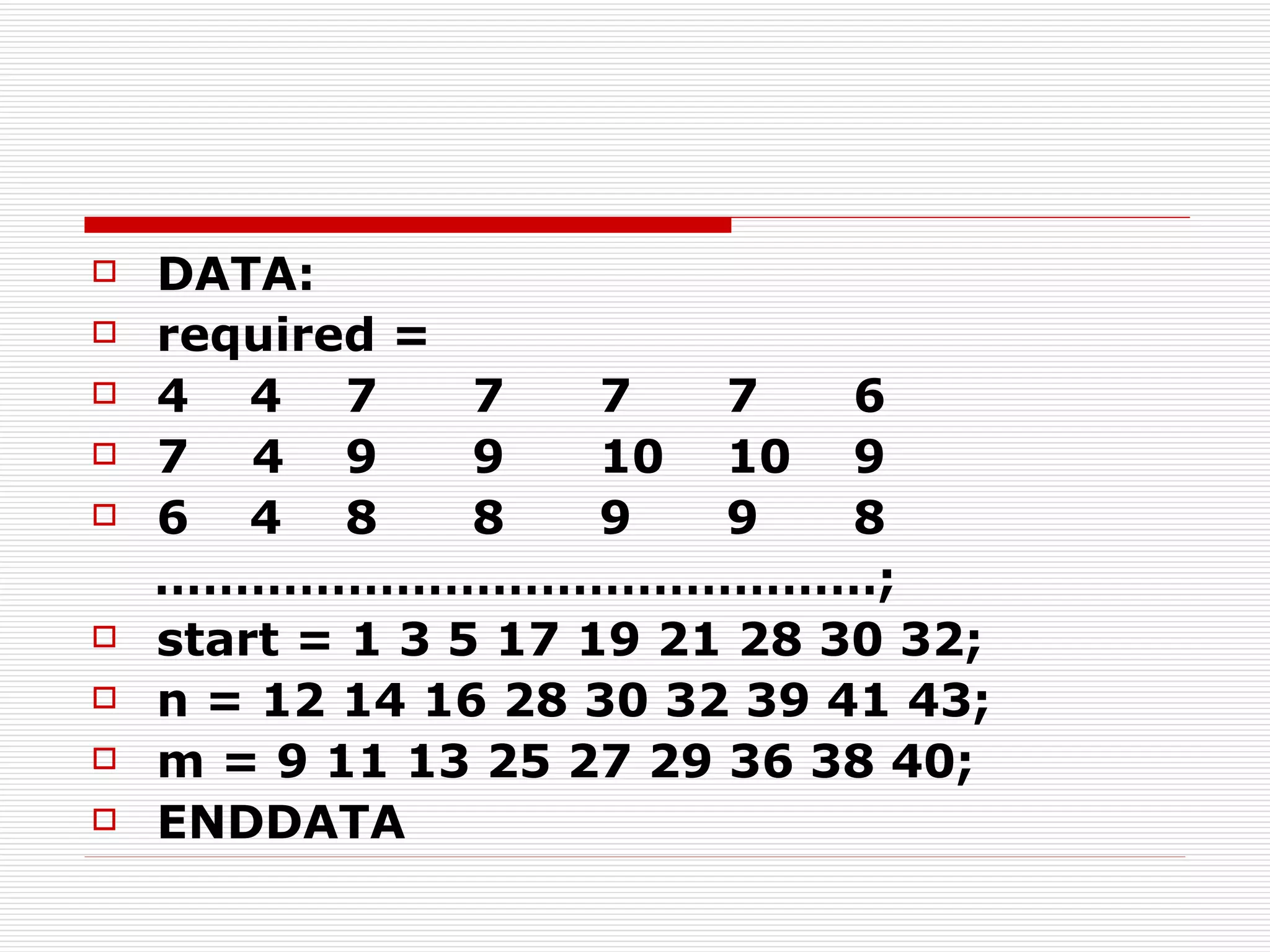
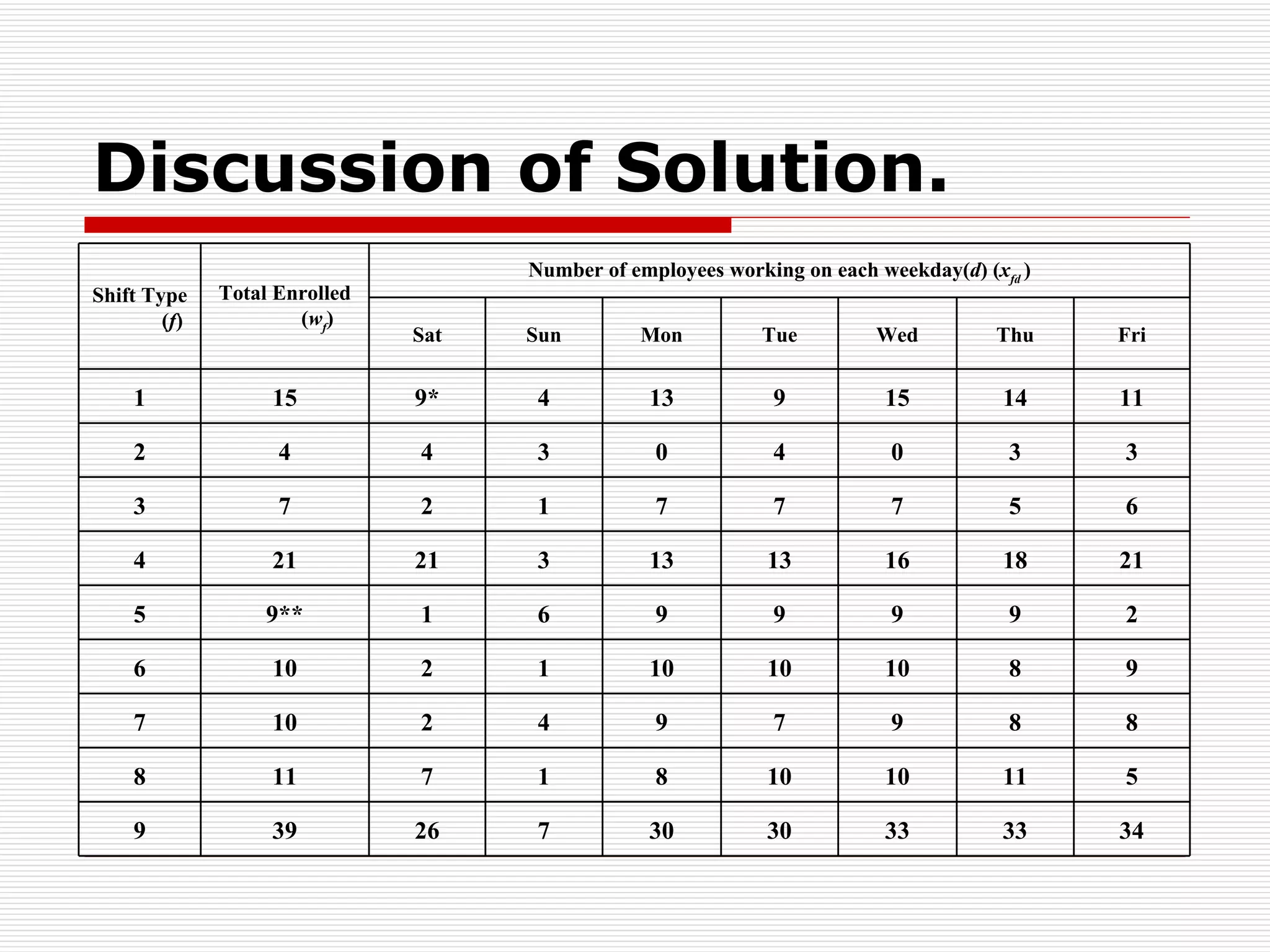
A Real Problemin USPS An employee works 8 ½ consecutive hours which includes a ½ h allowance for a lunch break. The organization operates 24 h a day, 7 days a week. The workday has 48 periods, each 30 min. long.
14.
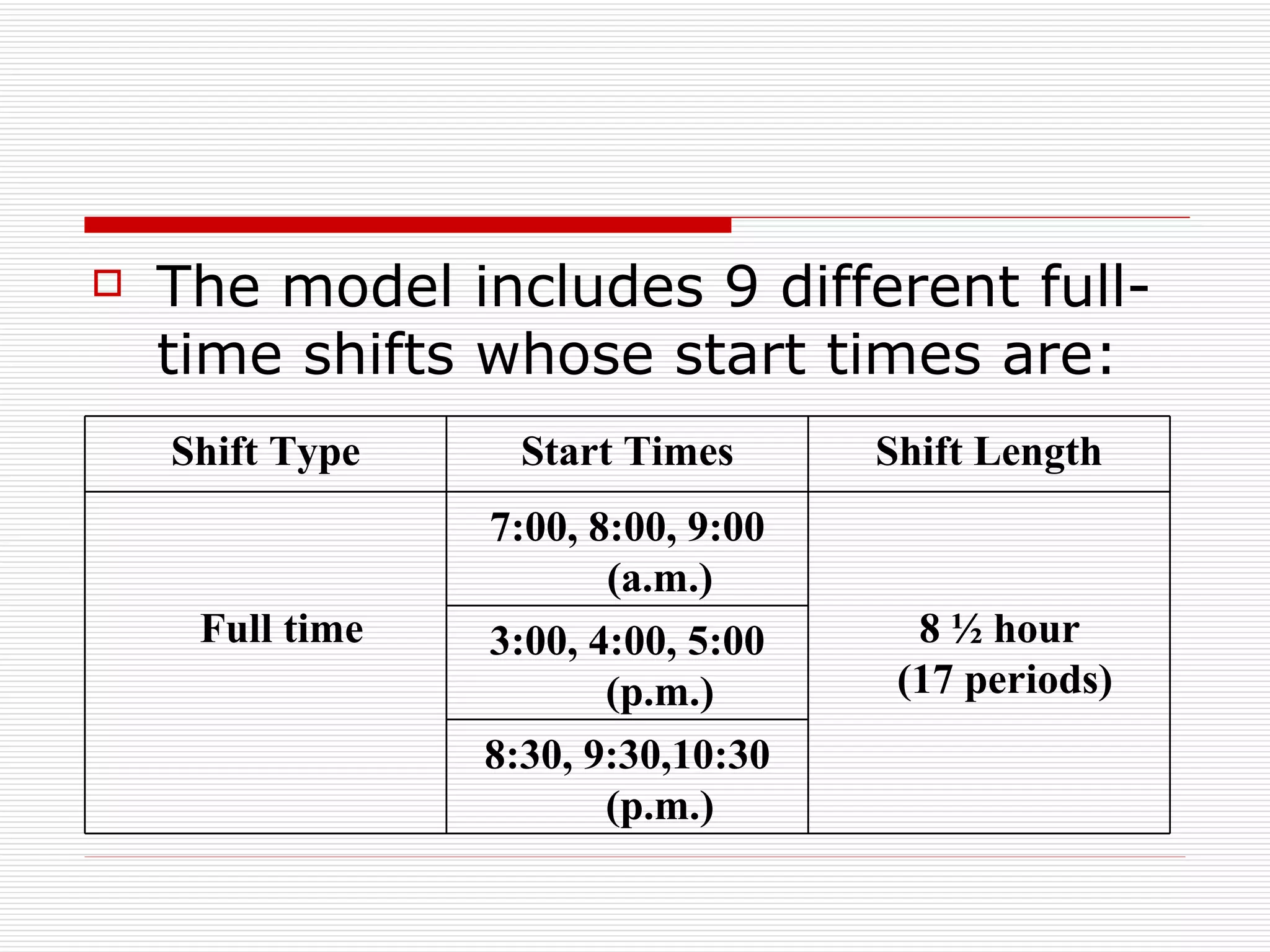
The model includes9 different full-time shifts whose start times are: 8:30, 9:30,10:30 (p.m.) 3:00, 4:00, 5:00 (p.m.) 8 ½ hour (17 periods) 7:00, 8:00, 9:00 (a.m.) Full time Shift Length Start Times Shift Type
15.
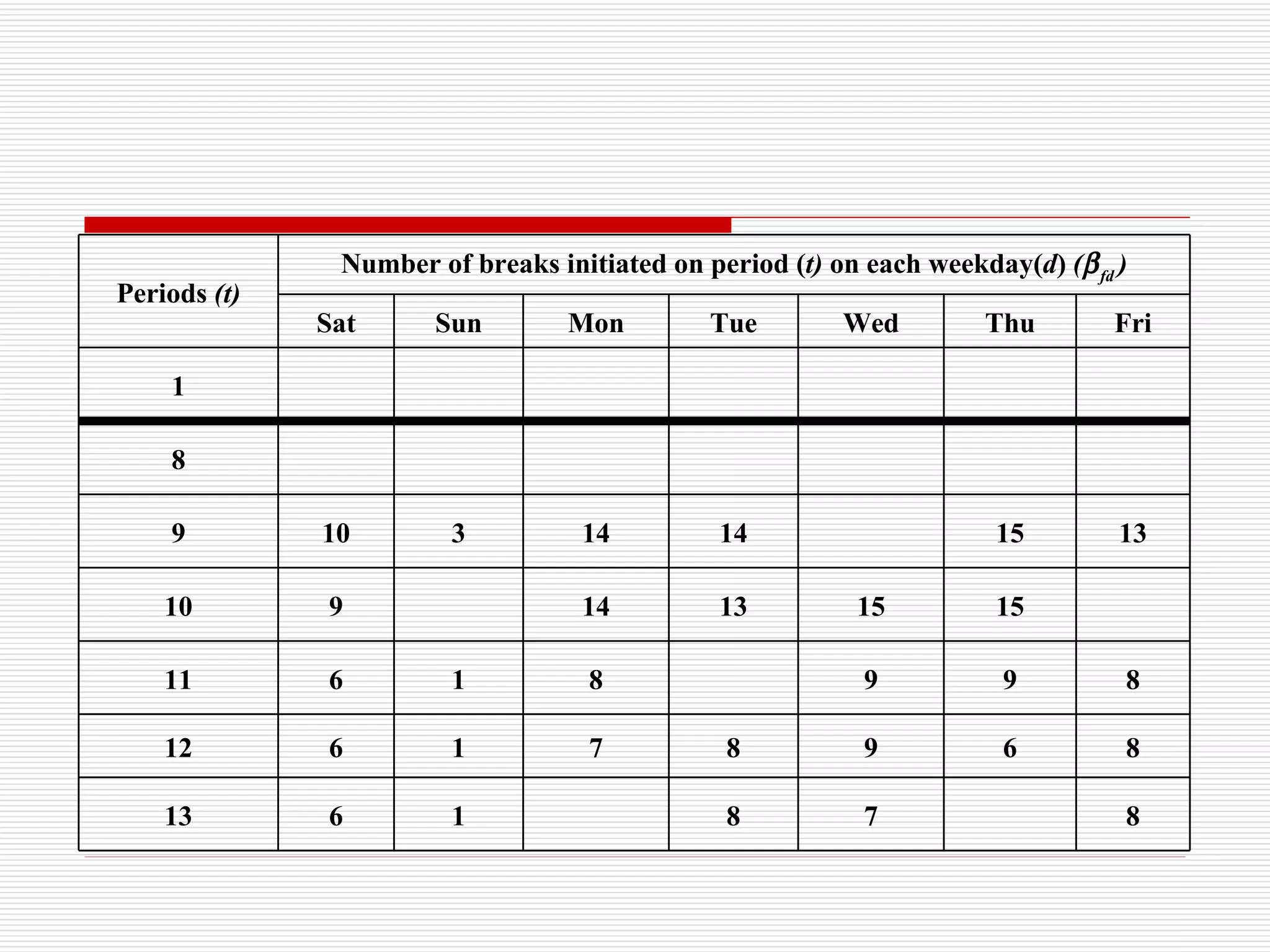
For e veryworker a break window of 4 periods is assigned between 9 th and 12 th period. E ach worker works 5 days a week. The goal is to minimize the total weekly cost of the workforce


![Vibe Coding vs. Spec-Driven Development [Free Meetup]](https://cdn.slidesharecdn.com/ss_thumbnails/vibecodingvsspecdrivendevelopment-251209105622-43f455e7-thumbnail.jpg?width=640&height=640&fit=bounds)


