Shift Scheduling with the Goal Programming
Method:
A Case Study in the Glass Industry
INTRODUCTION
In this presentation, we will explore
optimizing shift scheduling in the glass
industry using goal programming. We will
discuss the challenges faced and the potential
solutions to improve scheduling efficiency and
productivity.
.
• Scheduling based on personnel management has become important in today’s
world because resource utilization is important for business as they can make
profit by providing high level of efficiency
• Human resource has different demands & expectations than other resources,
therefore increasing level of interest in their field.
.
• Shift scheduling(sub problem of personnel management) is most frequent studied problem from past to
present.
• It is identified as a critical issue with personnel management. Efficient scheduling not only impacts
employee satisfaction but also affects operational cost like wages, overtime, etc
• It becomes difficult to solve shift scheduling problems manually as both parties want to provide for each
other .
• Therefore Goal Programming method is used.
.
• Goal programming allows consideration of multiple objective
simultaneously, which is critical in balancing the needs of both
organisation & employees.
• It involves mathematical model that aims to minimize deviations from
specified goals, providing closest desirable outcome.
.
• The further discussed case study is about a glass industry in Ankara, which
has 7 departments & 80 personnel.
• The objective or aim of it being- Which personnel should be assigned to
which shift for which department
Overview of Shift Scheduling Optimization
Shift scheduling is a complex task that integrates various operational requirements and human
factors to ensure efficient business operations while adhering to legal standards and maintaining
workforce satisfaction. The challenge lies in optimally assigning shifts, balancing workload,
ensuring compliance with working hours regulations, and meeting individual preferences and
qualifications.
Key Components of Shift Scheduling
1. Activities and Requirements: Shift schedules must account for various activities including work,
breaks (like tea and lunch breaks), rest periods, weekly holidays, and annual leaves.
2. Rules and Regulations: Scheduling must comply with labor laws, such as maximum working
hours, minimum rest periods, and overtime regulations.
3. Skill Matching: Employees should ideally be scheduled in departments or roles where they have
the most expertise, enhancing efficiency and job satisfaction.
4. Fairness and Equity: The distribution of shifts should be fair, avoiding overburdening some
employees while under-utilizing others.
Overview of Shift Scheduling Optimization
Mathematical Modeling in Shift Scheduling
Mathematical models for shift scheduling, like those pioneered by George Dantzig and
Elbridge Keith, provide frameworks that help automate and optimize the scheduling process.
These models typically involve:
• Integer Programming: This involves defining decision variables, constraints, and an
objective function. Decision variables could represent whether an employee is assigned a
specific shift. Constraints enforce labor laws and organizational policies. The objective
function could aim to maximize overall productivity or employee satisfaction.
• Constraint Programming: This approach focuses on satisfying a series of constraints. It's
particularly useful in scheduling where multiple, often conflicting requirements must be
met.
• Heuristic and Metaheuristic Methods: Techniques like genetic algorithms, simulated
annealing, or tabu search can be applied when traditional optimization methods become
computationally infeasible due to the complexity of real-world scheduling
Goal Programming
Introduction
Goal programming is a branch of multi-objective optimization, which itself is part of operations research.
This technique allows decision-makers to solve problems with multiple, often competing goals, by treating
them as a series of constraints and minimizing the deviations from these desired goals. It is particularly
useful in situations like shift scheduling where different objectives—such as minimizing labor costs,
maximizing employee satisfaction, and adhering to legal requirements—must be balanced.
Key Elements of Goal Programming
Goal programming models are structured around achieving set targets while minimizing the
underachievement or overachievement (deviations) relative to these targets. The key elements involved in
setting up a goal programming model include:
1. Decision Variables (Xj): These are the primary variables that influence outcomes in the model. In shift
scheduling, decision variables could represent the number of shifts assigned to each employee.
2. Coefficients (aij): These define the influence of each decision variable on each goal.
3. Goal Values (bi): These are the target values for each goal that the model aims to achieve.
4. Deviation Variables (d+i, d-i): These variables measure the degree to which the actual values deviate
from the target values. d+i measures the amount by which the actual value exceeds the target, while d-i
measures any shortfall
Goal Programming
Mathematical Representation
Application
In the context of shift scheduling, goal programming can be applied to balance various objectives, such as:
• Minimizing Total Overtime: Setting a goal for the maximum allowable overtime and minimizing deviations from
this goal.
• Maximizing Employee Satisfaction: Assigning shifts based on employee preferences and minimizing deviations
from these preferences.
• Ensuring Fairness: Equitably distributing undesirable shifts among all employees and minimizing deviations from
this fairness goal.
CASE STUDY:
A Glass Factory in Ankara Province
The case study involves a glass factory in Ankara Province that produces glass products
for the façade sector. The factory aims to optimize the scheduling and allocation of its
80 personnel across two shifts: a day shift from 08:00 to 18:00 and a night shift from
22:00 to 08:00. The shifts change on a weekly basis, and the factory remains closed on
Sundays.
The factory comprises seven sections—cutting, sanding, grinding, tempering,
laminating, double glazing, and shipment—where production operates continuously.
Orders from customers are classified based on the type of product and the final
process performed before shipment.
In evaluating the existing system, it was assumed that both departments and staff are
working at full capacity. The product range includes flat glass, colored glass, and solar
glass, indicating a focus on diverse and potentially specialized glass products.
Product Type
1.Flat Glass: Flat glass has high light transmittance due to its transparency.
2.Colored Glass: Colored glass is obtained by adding colorants to the glass paste; available in green, smoked, bronze and blue.
3.Solar and Heat Controlled Glass: This is a type of glass with different aesthetics and designs that can save energy.
4.Tempered Glass: A type of glass whose durability and resistance to thermal stresses are 5 times higher than those of flat
glass. Areas of application are generally glass railings and doors, walk-in showers, intermediate compartments, glass furniture,
refrigerator and oven windows, and side and rear windows of automobiles
5.Bullet Proof Glass: Bulletproof glass is aimed at preventing crime and facilitating the capture of the criminal after the action.
Areas of use are banks, police stations, museums, military buildings and other official organizations, psychiatric wards,
jewelers and so on. This category comprises polyvinyl butyral (PVB) or polycarbonate interlayer laminated glass.
6.Laminated Glass: Two or more glass plates are produced by combining special binder polyvinyl butyral (PVB) layers under
heat and pressure. This process minimizes the risk of glass breakage by keeping the pieces in place in such an event. It
contributes to sound insulation
Production Rotation
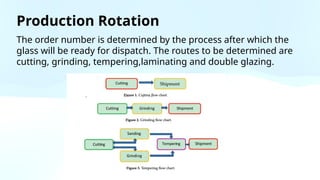
The order number is determined by the process after which the
glass will be ready for dispatch. The routes to be determined are
cutting, grinding, tempering,laminating and double glazing.
List of Personnel
The glass factory employs a total of 80 personnel. Each employee is evaluated and
assigned points for each department they work in based on expert opinions.
The scoring system ranges from 1 to 3 points, with 1 point indicating high competence in
a section and 3 points suggesting a lack of competence in that section.
The model focuses on minimizing the objective function and aims to limit the system to a
maximum of 5 points within each section.
This approach is used to assess and allocate personnel to various departments
effectively.
PARAMETERS OF THE MATHEMATICAL MODEL:-
n: number of personnel working in the factory, n = 80
m: number of days, m = 30
s: Number of sections in the factory, s = 7
t: Number of shifts, t = 2
i: Personnel index, i = 1,2, . . . ,n
j: Day index, j = 1,2, . . . ,m
k: Section index, k = 1,2, . . . ,s
l: Shift index, l = 1,2, . . . ,t
MATHEMATICAL MODEL
Xijkl =( 1, if shift, chapter and day is chosen for personnel
0, otherwise , i = 1, 2, . . . , n, j = 1, 2, . . . , m, k = 1, 2, . . . ,s, l = 1, 2, . . . , t
hij= ( 1, if vacation for personnel
0, otherwise , i = 1, 2, . . . , n, j = 1, 2, . . . , m
Decision Variables:-
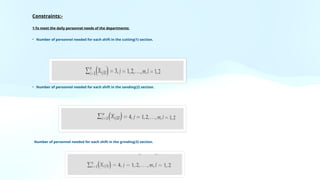
Constraints:-
1-To meet the daily personnel needs of the departments:
• Number of personnel needed for each shift in the cutting(1) section.
• Number of personnel needed for each shift in the sanding(2) section.
Number of personnel needed for each shift in the grinding(3) section.
• Number of personnel needed for each shift in the tempering (4) section
• Number of personnel needed for each shift in the laminating (5) section
• Number of personnel needed for each shift in the double glazing (6) section
• Number of personnel needed for each shift in the shipment (7)
section
2- Only one shift per personnel per day:
3.Personnel not working on the day of leave:
4- Each personnel member has a minimum of 1 and a maximum of 2 days a week.:
5-Upper limit for each personnel to work on 1 and 2 shifts:
6- Lower limit restrictions for each personnel on 1 and 2 shifts:
7- If an employee were assigned to the night shift on a given day, the next day’s shift in the
morning shift would be limited:
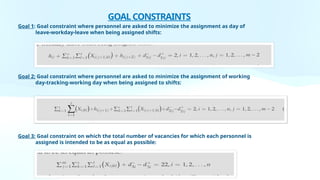
GOALCONSTRAINTS
Goal 1: Goal constraint where personnel are asked to minimize the assignment as day of
leave-workday-leave when being assigned shifts:
Goal 2: Goal constraint where personnel are asked to minimize the assignment of working
day-tracking-working day when being assigned to shifts:
Goal 3: Goal constraint on which the total number of vacancies for which each personnel is
assigned is intended to be as equal as possible:
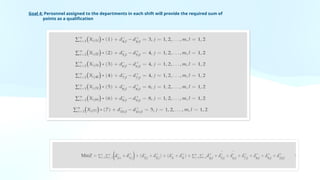
Goal 4: Personnel assigned to the departments in each shift will provide the required sum of
points as a qualification
• OBJECTIVE FUNCTION
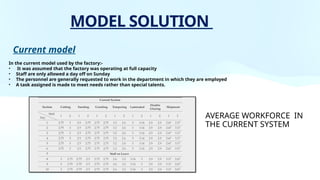
In the current model used by the factory:-
• It was assumed that the factory was operating at full capacity
• Staff are only allowed a day off on Sunday
• The personnel are generally requested to work in the department in which they are employed
• A task assigned is made to meet needs rather than special talents.
MODEL SOLUTION
Current model
AVERAGE WORKFORCE IN
THE CURRENT SYSTEM
For a sample average workforce calculation from the table, the 8th
day shift of the
sanding section
will be considered; on that day, 2, 18, 34, 75 staff members were assigned. The total
score of the assigned
personnel for the sanding section was 2 + 2 + 3 + 3 = 10. The score obtained was
divided by the number of staff required by the department, and the average
workforce was found. This is equal to 10/4 = 2.5.
This is why the average labour force is constant for each department ,each week, and
for every shift.
Average work force/ Shift labour force = Total competence
score
Total no. of personnel
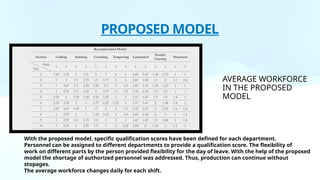
PROPOSED MODEL
With the proposed model, specific qualification scores have been defined for each department.
Personnel can be assigned to different departments to provide a qualification score. The flexibility of
work on different parts by the person provided flexibility for the day of leave. With the help of the proposed
model the shortage of authorized personnel was addressed. Thus, production can continue without
stopages.
The average workforce changes daily for each shift.
AVERAGE WORKFORCE
IN THE PROPOSED
MODEL
1.Improved Departmental Allocation:
Reduction in personnel requirements per department:
1.Cutting, sanding, grinding: From 4 to 3
2.Tempering: From 5 to 4
3.Laminating: From 7 to 6
4.Heaters: From 10 to 8
5.Shipments: From 6 to 5
Increased efficiency in departmental tasks due to better alignment of personnel skills and competencies.
CONCLUSION
2. Enhanced Shift Planning:
420 shifts scheduled monthly.
Only 5 shifts (1.2%) didn't meet desired outcomes, indicating high success rate.
Balanced distribution of morning and evening shifts to ensure fair workload and prevent fatigue.
Compliance with labor regulations by ensuring personnel don't work consecutive shifts without rest.
3. Effective Personnel Utilization:
Improved task completion rates due to better allocation of skilled personnel.
Enhanced productivity and efficiency in completing tasks.
Increased job satisfaction among employees resulting from more appropriate task assignments.
4. Goal Programming Method:
• Utilized goal programming to optimize multiple objectives simultaneously.
• Achieved minimal deviations from target values, ensuring successful goal achievement.
• Tailored shift and department assignments to personnel talents for optimized outcomes.
5. Improved Efficiency and Satisfaction:
• Overall improvement observed over the existing system.
• Increased departmental competence and task efficiency.
• Higher employee satisfaction attributed to improved skill utilization and fairer scheduling.
Presented by group 3:
Ansh Bhatia
Chetna Singh
Kanak Yadav
Kashish Wadhwani
Tanisha Bhadula

goal and integer programming for quantitative techniques

  • 1.
    Shift Scheduling withthe Goal Programming Method: A Case Study in the Glass Industry
  • 2.
    INTRODUCTION In this presentation,we will explore optimizing shift scheduling in the glass industry using goal programming. We will discuss the challenges faced and the potential solutions to improve scheduling efficiency and productivity.
  • 3.
    . • Scheduling basedon personnel management has become important in today’s world because resource utilization is important for business as they can make profit by providing high level of efficiency • Human resource has different demands & expectations than other resources, therefore increasing level of interest in their field.
  • 4.
    . • Shift scheduling(subproblem of personnel management) is most frequent studied problem from past to present. • It is identified as a critical issue with personnel management. Efficient scheduling not only impacts employee satisfaction but also affects operational cost like wages, overtime, etc • It becomes difficult to solve shift scheduling problems manually as both parties want to provide for each other . • Therefore Goal Programming method is used.
  • 5.
    . • Goal programmingallows consideration of multiple objective simultaneously, which is critical in balancing the needs of both organisation & employees. • It involves mathematical model that aims to minimize deviations from specified goals, providing closest desirable outcome.
  • 6.
    . • The furtherdiscussed case study is about a glass industry in Ankara, which has 7 departments & 80 personnel. • The objective or aim of it being- Which personnel should be assigned to which shift for which department
  • 7.
    Overview of ShiftScheduling Optimization Shift scheduling is a complex task that integrates various operational requirements and human factors to ensure efficient business operations while adhering to legal standards and maintaining workforce satisfaction. The challenge lies in optimally assigning shifts, balancing workload, ensuring compliance with working hours regulations, and meeting individual preferences and qualifications. Key Components of Shift Scheduling 1. Activities and Requirements: Shift schedules must account for various activities including work, breaks (like tea and lunch breaks), rest periods, weekly holidays, and annual leaves. 2. Rules and Regulations: Scheduling must comply with labor laws, such as maximum working hours, minimum rest periods, and overtime regulations. 3. Skill Matching: Employees should ideally be scheduled in departments or roles where they have the most expertise, enhancing efficiency and job satisfaction. 4. Fairness and Equity: The distribution of shifts should be fair, avoiding overburdening some employees while under-utilizing others.
  • 8.
    Overview of ShiftScheduling Optimization Mathematical Modeling in Shift Scheduling Mathematical models for shift scheduling, like those pioneered by George Dantzig and Elbridge Keith, provide frameworks that help automate and optimize the scheduling process. These models typically involve: • Integer Programming: This involves defining decision variables, constraints, and an objective function. Decision variables could represent whether an employee is assigned a specific shift. Constraints enforce labor laws and organizational policies. The objective function could aim to maximize overall productivity or employee satisfaction. • Constraint Programming: This approach focuses on satisfying a series of constraints. It's particularly useful in scheduling where multiple, often conflicting requirements must be met. • Heuristic and Metaheuristic Methods: Techniques like genetic algorithms, simulated annealing, or tabu search can be applied when traditional optimization methods become computationally infeasible due to the complexity of real-world scheduling
  • 9.
    Goal Programming Introduction Goal programmingis a branch of multi-objective optimization, which itself is part of operations research. This technique allows decision-makers to solve problems with multiple, often competing goals, by treating them as a series of constraints and minimizing the deviations from these desired goals. It is particularly useful in situations like shift scheduling where different objectives—such as minimizing labor costs, maximizing employee satisfaction, and adhering to legal requirements—must be balanced. Key Elements of Goal Programming Goal programming models are structured around achieving set targets while minimizing the underachievement or overachievement (deviations) relative to these targets. The key elements involved in setting up a goal programming model include: 1. Decision Variables (Xj): These are the primary variables that influence outcomes in the model. In shift scheduling, decision variables could represent the number of shifts assigned to each employee. 2. Coefficients (aij): These define the influence of each decision variable on each goal. 3. Goal Values (bi): These are the target values for each goal that the model aims to achieve. 4. Deviation Variables (d+i, d-i): These variables measure the degree to which the actual values deviate from the target values. d+i measures the amount by which the actual value exceeds the target, while d-i measures any shortfall

  • 10.
  • 11.
    Application In the contextof shift scheduling, goal programming can be applied to balance various objectives, such as: • Minimizing Total Overtime: Setting a goal for the maximum allowable overtime and minimizing deviations from this goal. • Maximizing Employee Satisfaction: Assigning shifts based on employee preferences and minimizing deviations from these preferences. • Ensuring Fairness: Equitably distributing undesirable shifts among all employees and minimizing deviations from this fairness goal.
  • 12.
    CASE STUDY: A GlassFactory in Ankara Province
  • 13.
    The case studyinvolves a glass factory in Ankara Province that produces glass products for the façade sector. The factory aims to optimize the scheduling and allocation of its 80 personnel across two shifts: a day shift from 08:00 to 18:00 and a night shift from 22:00 to 08:00. The shifts change on a weekly basis, and the factory remains closed on Sundays. The factory comprises seven sections—cutting, sanding, grinding, tempering, laminating, double glazing, and shipment—where production operates continuously. Orders from customers are classified based on the type of product and the final process performed before shipment. In evaluating the existing system, it was assumed that both departments and staff are working at full capacity. The product range includes flat glass, colored glass, and solar glass, indicating a focus on diverse and potentially specialized glass products.
  • 14.
    Product Type 1.Flat Glass:Flat glass has high light transmittance due to its transparency. 2.Colored Glass: Colored glass is obtained by adding colorants to the glass paste; available in green, smoked, bronze and blue. 3.Solar and Heat Controlled Glass: This is a type of glass with different aesthetics and designs that can save energy. 4.Tempered Glass: A type of glass whose durability and resistance to thermal stresses are 5 times higher than those of flat glass. Areas of application are generally glass railings and doors, walk-in showers, intermediate compartments, glass furniture, refrigerator and oven windows, and side and rear windows of automobiles 5.Bullet Proof Glass: Bulletproof glass is aimed at preventing crime and facilitating the capture of the criminal after the action. Areas of use are banks, police stations, museums, military buildings and other official organizations, psychiatric wards, jewelers and so on. This category comprises polyvinyl butyral (PVB) or polycarbonate interlayer laminated glass. 6.Laminated Glass: Two or more glass plates are produced by combining special binder polyvinyl butyral (PVB) layers under heat and pressure. This process minimizes the risk of glass breakage by keeping the pieces in place in such an event. It contributes to sound insulation
  • 15.
    Production Rotation The ordernumber is determined by the process after which the glass will be ready for dispatch. The routes to be determined are cutting, grinding, tempering,laminating and double glazing.
  • 17.
    List of Personnel Theglass factory employs a total of 80 personnel. Each employee is evaluated and assigned points for each department they work in based on expert opinions. The scoring system ranges from 1 to 3 points, with 1 point indicating high competence in a section and 3 points suggesting a lack of competence in that section. The model focuses on minimizing the objective function and aims to limit the system to a maximum of 5 points within each section. This approach is used to assess and allocate personnel to various departments effectively.
  • 18.
    PARAMETERS OF THEMATHEMATICAL MODEL:- n: number of personnel working in the factory, n = 80 m: number of days, m = 30 s: Number of sections in the factory, s = 7 t: Number of shifts, t = 2 i: Personnel index, i = 1,2, . . . ,n j: Day index, j = 1,2, . . . ,m k: Section index, k = 1,2, . . . ,s l: Shift index, l = 1,2, . . . ,t MATHEMATICAL MODEL
  • 19.
    Xijkl =( 1,if shift, chapter and day is chosen for personnel 0, otherwise , i = 1, 2, . . . , n, j = 1, 2, . . . , m, k = 1, 2, . . . ,s, l = 1, 2, . . . , t hij= ( 1, if vacation for personnel 0, otherwise , i = 1, 2, . . . , n, j = 1, 2, . . . , m Decision Variables:-
  • 20.
    Constraints:- 1-To meet thedaily personnel needs of the departments: • Number of personnel needed for each shift in the cutting(1) section. • Number of personnel needed for each shift in the sanding(2) section. Number of personnel needed for each shift in the grinding(3) section.
  • 21.
    • Number ofpersonnel needed for each shift in the tempering (4) section • Number of personnel needed for each shift in the laminating (5) section • Number of personnel needed for each shift in the double glazing (6) section
  • 22.
    • Number ofpersonnel needed for each shift in the shipment (7) section 2- Only one shift per personnel per day: 3.Personnel not working on the day of leave:
  • 23.
    4- Each personnelmember has a minimum of 1 and a maximum of 2 days a week.: 5-Upper limit for each personnel to work on 1 and 2 shifts: 6- Lower limit restrictions for each personnel on 1 and 2 shifts:
  • 24.
    7- If anemployee were assigned to the night shift on a given day, the next day’s shift in the morning shift would be limited:
  • 25.
    GOALCONSTRAINTS Goal 1: Goalconstraint where personnel are asked to minimize the assignment as day of leave-workday-leave when being assigned shifts: Goal 2: Goal constraint where personnel are asked to minimize the assignment of working day-tracking-working day when being assigned to shifts: Goal 3: Goal constraint on which the total number of vacancies for which each personnel is assigned is intended to be as equal as possible:
  • 26.
    Goal 4: Personnelassigned to the departments in each shift will provide the required sum of points as a qualification • OBJECTIVE FUNCTION
  • 27.
    In the currentmodel used by the factory:- • It was assumed that the factory was operating at full capacity • Staff are only allowed a day off on Sunday • The personnel are generally requested to work in the department in which they are employed • A task assigned is made to meet needs rather than special talents. MODEL SOLUTION Current model AVERAGE WORKFORCE IN THE CURRENT SYSTEM
  • 28.
    For a sampleaverage workforce calculation from the table, the 8th day shift of the sanding section will be considered; on that day, 2, 18, 34, 75 staff members were assigned. The total score of the assigned personnel for the sanding section was 2 + 2 + 3 + 3 = 10. The score obtained was divided by the number of staff required by the department, and the average workforce was found. This is equal to 10/4 = 2.5. This is why the average labour force is constant for each department ,each week, and for every shift. Average work force/ Shift labour force = Total competence score Total no. of personnel
  • 29.
    PROPOSED MODEL With theproposed model, specific qualification scores have been defined for each department. Personnel can be assigned to different departments to provide a qualification score. The flexibility of work on different parts by the person provided flexibility for the day of leave. With the help of the proposed model the shortage of authorized personnel was addressed. Thus, production can continue without stopages. The average workforce changes daily for each shift. AVERAGE WORKFORCE IN THE PROPOSED MODEL
  • 30.
    1.Improved Departmental Allocation: Reductionin personnel requirements per department: 1.Cutting, sanding, grinding: From 4 to 3 2.Tempering: From 5 to 4 3.Laminating: From 7 to 6 4.Heaters: From 10 to 8 5.Shipments: From 6 to 5 Increased efficiency in departmental tasks due to better alignment of personnel skills and competencies. CONCLUSION
  • 31.
    2. Enhanced ShiftPlanning: 420 shifts scheduled monthly. Only 5 shifts (1.2%) didn't meet desired outcomes, indicating high success rate. Balanced distribution of morning and evening shifts to ensure fair workload and prevent fatigue. Compliance with labor regulations by ensuring personnel don't work consecutive shifts without rest. 3. Effective Personnel Utilization: Improved task completion rates due to better allocation of skilled personnel. Enhanced productivity and efficiency in completing tasks. Increased job satisfaction among employees resulting from more appropriate task assignments.
  • 32.
    4. Goal ProgrammingMethod: • Utilized goal programming to optimize multiple objectives simultaneously. • Achieved minimal deviations from target values, ensuring successful goal achievement. • Tailored shift and department assignments to personnel talents for optimized outcomes. 5. Improved Efficiency and Satisfaction: • Overall improvement observed over the existing system. • Increased departmental competence and task efficiency. • Higher employee satisfaction attributed to improved skill utilization and fairer scheduling.
  • 33.
    Presented by group3: Ansh Bhatia Chetna Singh Kanak Yadav Kashish Wadhwani Tanisha Bhadula