Assignment  Problems Hazırlayanlar:  Ali Evren Erdin Arzu Çalık  Hilal Demirhan
INDEX Introduction Description Of The Assignment Problems Uses of The Assignment Problems Simple Examples The Article Explanation of the Article The Solution of the Problem in Lingo
Description of the Assignment Problems The problems that their  goal is to find an optimal assignment of agents to tasks without assigning an agent more than once and ensuring that all tasks are completed
What can be the objectives? M inimize the total time to complet e  set  of  tasks M aximize skill ratings M inimize the cost of the   assignments Or Etc.
What are the Applications of Assignment Problems? A ssigning  e mployees to tasks   Assigning  machines to production jobs   A ssign fleets of aircrafts   to particular  t rips   A ssigning school buses to routes   N etworking computers
A Simple Example...  An  assignment problem  seeks to minimize the total cost assignment of  m  workers to  m  jobs, given that the cost of worker  i  performing job  j  is  c ij .  It assumes all workers are assigned and each job is performed.
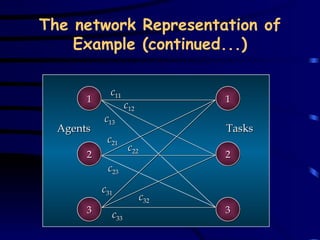
The network Representation of Example (continued...) 2 3 1 2 3 1 c 11 c 12 c 13 c 21 c 22 c 23 c 31 c 32 c 33 Agents Tasks
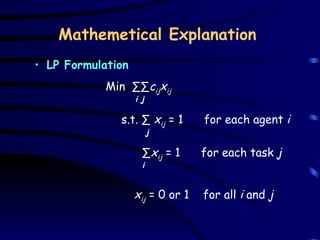
Mathemetical Explanation LP Formulation     Min  ∑∑ c ij x ij i   j s.t. ∑  x ij  = 1  for each agent  i j   ∑ x ij  = 1  for each task  j i   x ij  = 0 or 1  for all  i  and  j
 “ An Application of Genetic Algorithm Methods for Teacher Assignment Problems” The ARTICLE
What is the Problem?? “   What are the  most suitable teacher and course assignments ?” Which teacher?  Which Course?
What is Genetic Algorithm? The Genetic Algorithm is optimization procedure based on the natural law of evolution! The Key Idea of Genetic Algorithm is Survival of the Fittest! It is an Heuristic Approach based on Darwin’s Theory of Evolution
Teacher Assignment Problem include multiple constraints Teachers willingness need to be considered, There should be a fair distribution of over time Teacher satisfaction has to be maximized
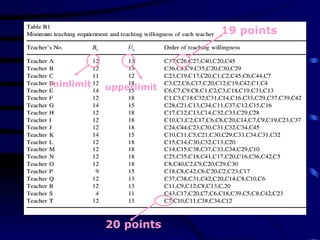
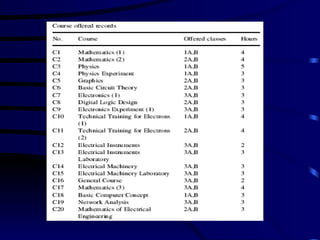
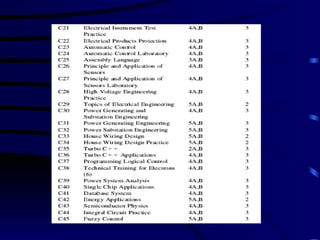
One course should not be appointed to different teachers. There are 20 teachers. There are 45 courses. Each course has two classes: A and B. Each teacher have an upper and minimum workhour limits Each Teacher rank the courses that they want to teach The Datas for the Problem
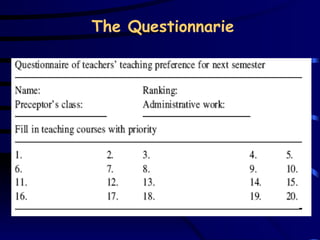
The Questionnarie
20 points 19 points minlimit upperlimit
 
 
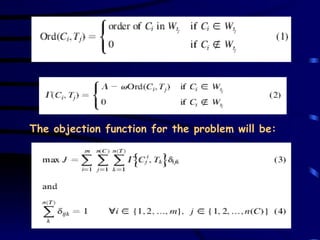
The objection function for  the  problem will be :
Upper And Lower Limits for teacher work Hours
The Lingo Formulation
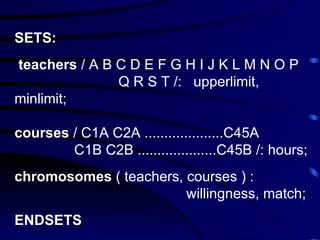
SETS : teachers  / A B C D E F G H I J K L M N O P    Q R S T /:   upperlimit, minlimit; c ourses   / C1A C2A  .................... C45A    C1B C2B  .................... C45B /:   hours; chromosomes  ( teachers, courses ) :     willingness, match; ENDSETS
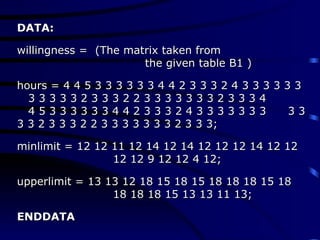
DATA: willingness =  (The matrix taken from  the   given table B1 ) hours = 4 4 5 3 3 3 3 3 3 4 4 2 3 3 3 2 4 3 3 3 3 3 3    3 3 3 3 3 2 3 3 3 2 2 3 3 3 3 3 3 3 2 3 3 3 4    4 5 3 3 3 3 3 3 4 4 2 3 3 3 2 4 3 3 3 3 3 3 3    3 3 3 3 2 3 3 3 2 2 3 3 3 3 3 3 3 2 3 3 3; minlimit = 12 12 11 12 14 12 14 12 12 12 14 12 12    12 12 9 12 12 4 12; upperlimit = 13 13 12 18 15 18 15 18 18 18 15 18  18 18 18 15 13 13 11 13; ENDDATA
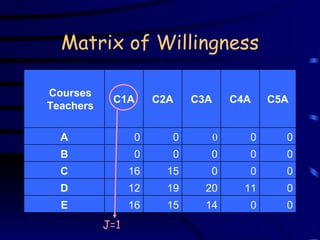
Matrix of Willingness J=1 0 0 14 15 16 E 0 11 20 19 12 D 0 0 0 15 16 C 0 0 0 0 0 B 0 0 0 0 0 A C5A C4A C3A C2A C1A Courses Teachers
OBJECTIVE FUNCTION MAX=   @SUM(chromozomes(i,j):   w illingness(i,j) *m atch(i,j));
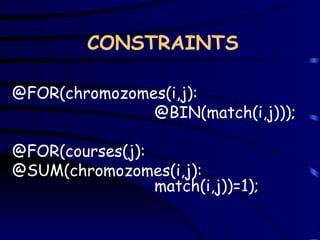
CONSTRAINTS @FOR(chromozomes(i,j):   @BIN(match(i,j)));  @FOR(courses(j): @SUM(chromozomes(i,j):   match(i,j))=1);
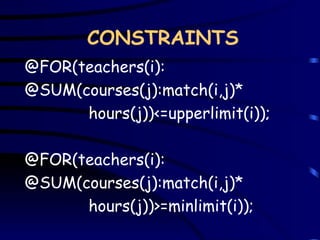
@FOR(teachers(i): @SUM(courses(j):match(i,j)* hours(j))<=upperlimit(i)); @FOR(teachers(i): @SUM(courses(j):match(i,j)* hours(j))>=minlimit(i)); CONSTRAINTS
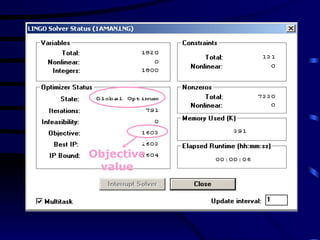
Objective value
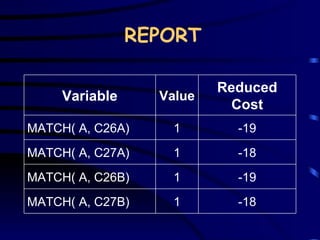
REPORT -18 1 MATCH( A, C27B) -19 1 MATCH( A, C26B) -18 1 MATCH( A, C27A) -19 1 MATCH( A, C26A) Reduced Cost Value Variable
The teacher  A is going to teach  : C 26 A ,  B C 2 7 A, B   courses.
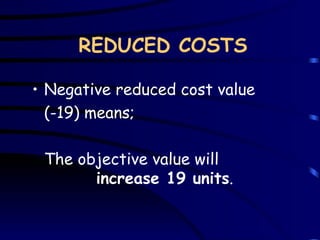
REDUCED COSTS Negative reduced cost value (-19) means; T he objective value will  increase  19  unit s .
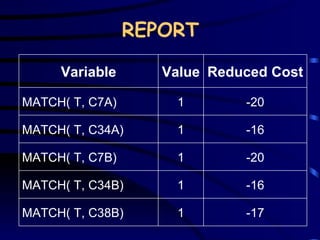
REPORT -17 1 MATCH( T, C38B) -16 1 MATCH( T, C34B) -20 1 MATCH( T, C7B) -16 1 MATCH( T, C34A) -20 1 MATCH( T, C7A) Reduced Cost Value Variable
THANKS!

Assingment Problem3

  • 1.
    Assignment ProblemsHazırlayanlar: Ali Evren Erdin Arzu Çalık Hilal Demirhan
  • 2.
    INDEX Introduction DescriptionOf The Assignment Problems Uses of The Assignment Problems Simple Examples The Article Explanation of the Article The Solution of the Problem in Lingo
  • 3.
    Description of theAssignment Problems The problems that their goal is to find an optimal assignment of agents to tasks without assigning an agent more than once and ensuring that all tasks are completed
  • 4.
    What can bethe objectives? M inimize the total time to complet e set of tasks M aximize skill ratings M inimize the cost of the assignments Or Etc.
  • 5.
    What are theApplications of Assignment Problems? A ssigning e mployees to tasks Assigning machines to production jobs A ssign fleets of aircrafts to particular t rips A ssigning school buses to routes N etworking computers
  • 6.
    A Simple Example... An assignment problem seeks to minimize the total cost assignment of m workers to m jobs, given that the cost of worker i performing job j is c ij . It assumes all workers are assigned and each job is performed.
  • 7.
    The network Representationof Example (continued...) 2 3 1 2 3 1 c 11 c 12 c 13 c 21 c 22 c 23 c 31 c 32 c 33 Agents Tasks
  • 8.
    Mathemetical Explanation LPFormulation Min ∑∑ c ij x ij i j s.t. ∑ x ij = 1 for each agent i j ∑ x ij = 1 for each task j i x ij = 0 or 1 for all i and j
  • 9.
    “ AnApplication of Genetic Algorithm Methods for Teacher Assignment Problems” The ARTICLE
  • 10.
    What is theProblem?? “ What are the most suitable teacher and course assignments ?” Which teacher? Which Course?
  • 11.
    What is GeneticAlgorithm? The Genetic Algorithm is optimization procedure based on the natural law of evolution! The Key Idea of Genetic Algorithm is Survival of the Fittest! It is an Heuristic Approach based on Darwin’s Theory of Evolution
  • 12.
    Teacher Assignment Probleminclude multiple constraints Teachers willingness need to be considered, There should be a fair distribution of over time Teacher satisfaction has to be maximized
  • 13.
    One course shouldnot be appointed to different teachers. There are 20 teachers. There are 45 courses. Each course has two classes: A and B. Each teacher have an upper and minimum workhour limits Each Teacher rank the courses that they want to teach The Datas for the Problem
  • 14.
  • 15.
    20 points 19points minlimit upperlimit
  • 16.
  • 17.
  • 18.
    The objection functionfor the problem will be :
  • 19.
    Upper And LowerLimits for teacher work Hours
  • 20.
  • 21.
    SETS : teachers / A B C D E F G H I J K L M N O P Q R S T /: upperlimit, minlimit; c ourses / C1A C2A .................... C45A C1B C2B .................... C45B /: hours; chromosomes ( teachers, courses ) : willingness, match; ENDSETS
  • 22.
    DATA: willingness = (The matrix taken from the given table B1 ) hours = 4 4 5 3 3 3 3 3 3 4 4 2 3 3 3 2 4 3 3 3 3 3 3 3 3 3 3 3 2 3 3 3 2 2 3 3 3 3 3 3 3 2 3 3 3 4 4 5 3 3 3 3 3 3 4 4 2 3 3 3 2 4 3 3 3 3 3 3 3 3 3 3 3 2 3 3 3 2 2 3 3 3 3 3 3 3 2 3 3 3; minlimit = 12 12 11 12 14 12 14 12 12 12 14 12 12 12 12 9 12 12 4 12; upperlimit = 13 13 12 18 15 18 15 18 18 18 15 18 18 18 18 15 13 13 11 13; ENDDATA
  • 23.
    Matrix of WillingnessJ=1 0 0 14 15 16 E 0 11 20 19 12 D 0 0 0 15 16 C 0 0 0 0 0 B 0 0 0 0 0 A C5A C4A C3A C2A C1A Courses Teachers
  • 24.
    OBJECTIVE FUNCTION MAX= @SUM(chromozomes(i,j): w illingness(i,j) *m atch(i,j));
  • 25.
    CONSTRAINTS @FOR(chromozomes(i,j): @BIN(match(i,j))); @FOR(courses(j): @SUM(chromozomes(i,j): match(i,j))=1);
  • 26.
    @FOR(teachers(i): @SUM(courses(j):match(i,j)* hours(j))<=upperlimit(i));@FOR(teachers(i): @SUM(courses(j):match(i,j)* hours(j))>=minlimit(i)); CONSTRAINTS
  • 27.
  • 28.
    REPORT -18 1MATCH( A, C27B) -19 1 MATCH( A, C26B) -18 1 MATCH( A, C27A) -19 1 MATCH( A, C26A) Reduced Cost Value Variable
  • 29.
    The teacher A is going to teach : C 26 A , B C 2 7 A, B courses.
  • 30.
    REDUCED COSTS Negativereduced cost value (-19) means; T he objective value will increase 19 unit s .
  • 31.
    REPORT -17 1MATCH( T, C38B) -16 1 MATCH( T, C34B) -20 1 MATCH( T, C7B) -16 1 MATCH( T, C34A) -20 1 MATCH( T, C7A) Reduced Cost Value Variable
  • 32.