CREW SCHEDULING İ.HAKAN KARAÇİZMELİ
GENERAL VIEW CREW SCHEDULING TYPES FLEXIBLE MANAGEMENT STRATEGIES DESCRIPTION OF PROBLEM FORMULATION OF PROBLEM MODEL IN LINGO SOLUTION & ANALYSIS
CREW SCHEDULING Airline Crew Scheduling 1. The most appropriate pairings. 2.Equal workloads. 3.Minimum crew COSTS. Mass Transit Crew Scheduling 1. Railway track maintenance problems. 2.Mathematical program.  3.Tabu search.
Generic Crew Scheduling 1. Manpower scheduling problems. 2.Mixed integer program. 3.Mimimum manpower. 4.Package programs(CPLEX..).
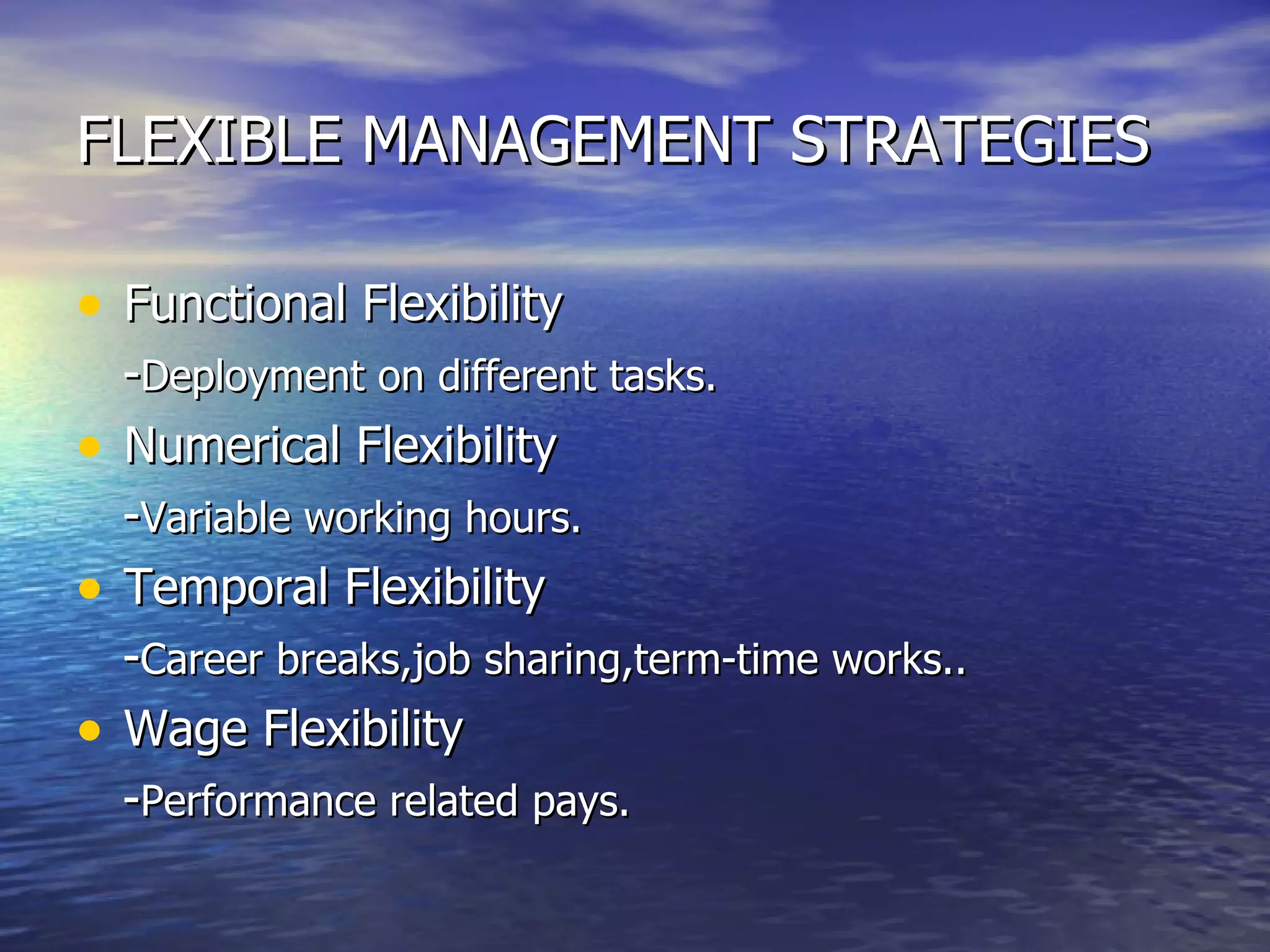
FLEXIBLE MANAGEMENT STRATEGIES Functional Flexibility - Deployment on different tasks. Numerical Flexibility - Variable working hours. Temporal Flexibility - Career breaks,job sharing,term-time works.. Wage Flexibility - Performance related pays.
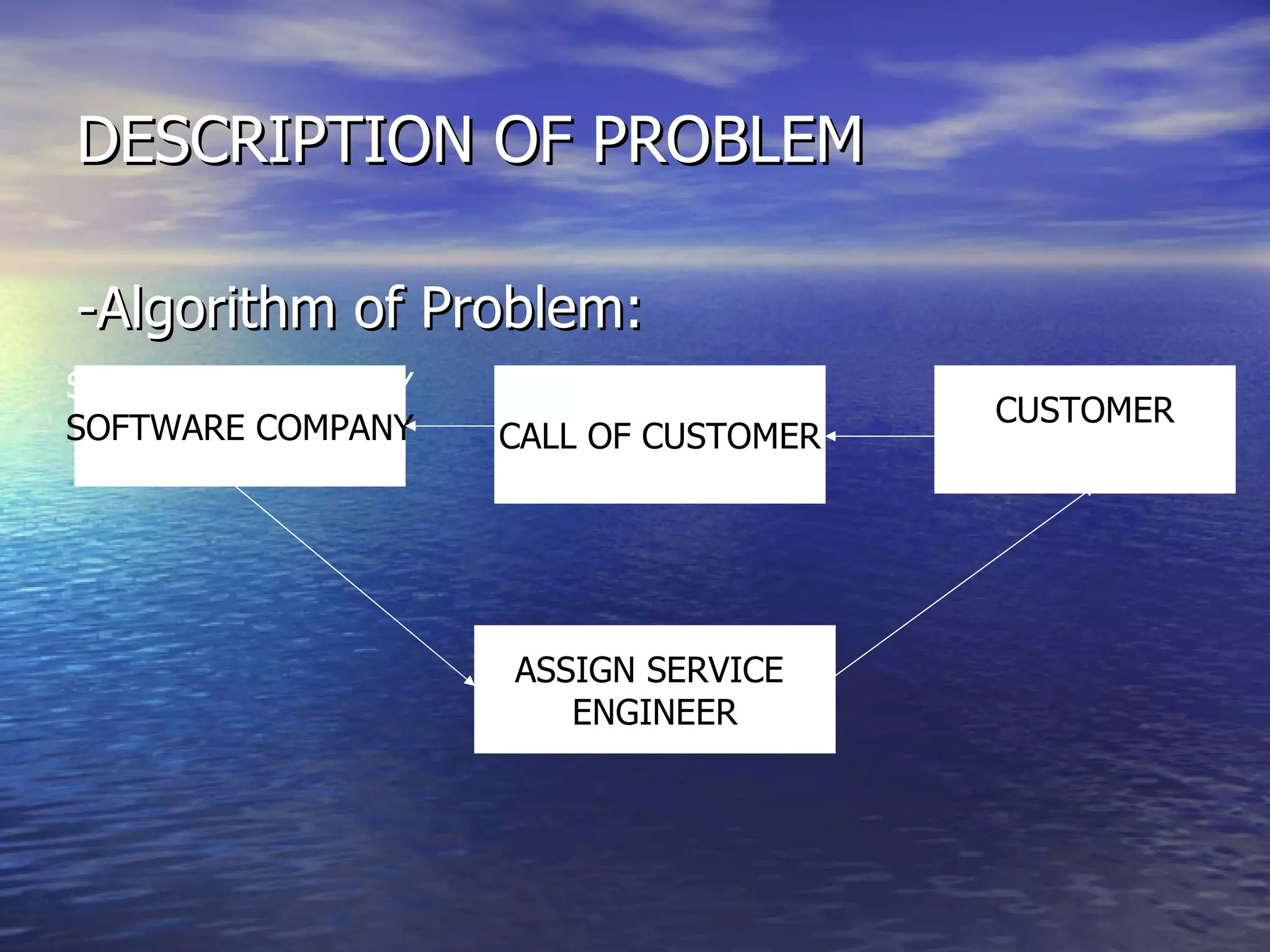
DESCRIPTION OF PROBLEM -Algorithm of Problem: SOFTWARE COMPANY SOFTWARE COMPANY CUSTOMER CALL OF CUSTOMER CALL OF CUSTOMER ASSIGN SERVICE  ENGINEER
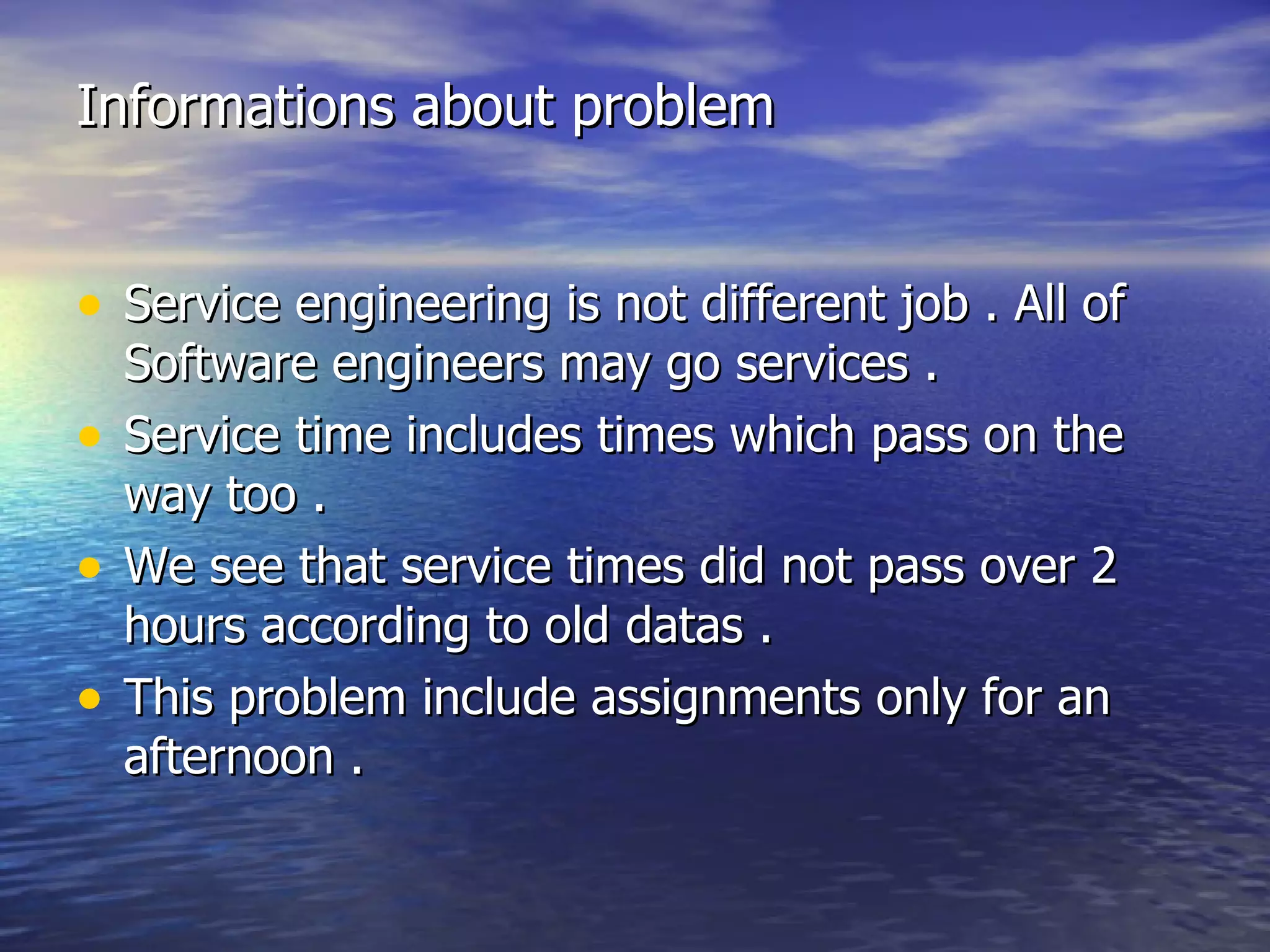
Informations about problem Service engineering is not different job . All of Software engineers may go services . Service time includes times which pass on the way too . We see that service times did not pass over 2 hours according to old datas . This problem include assignments only for an afternoon .
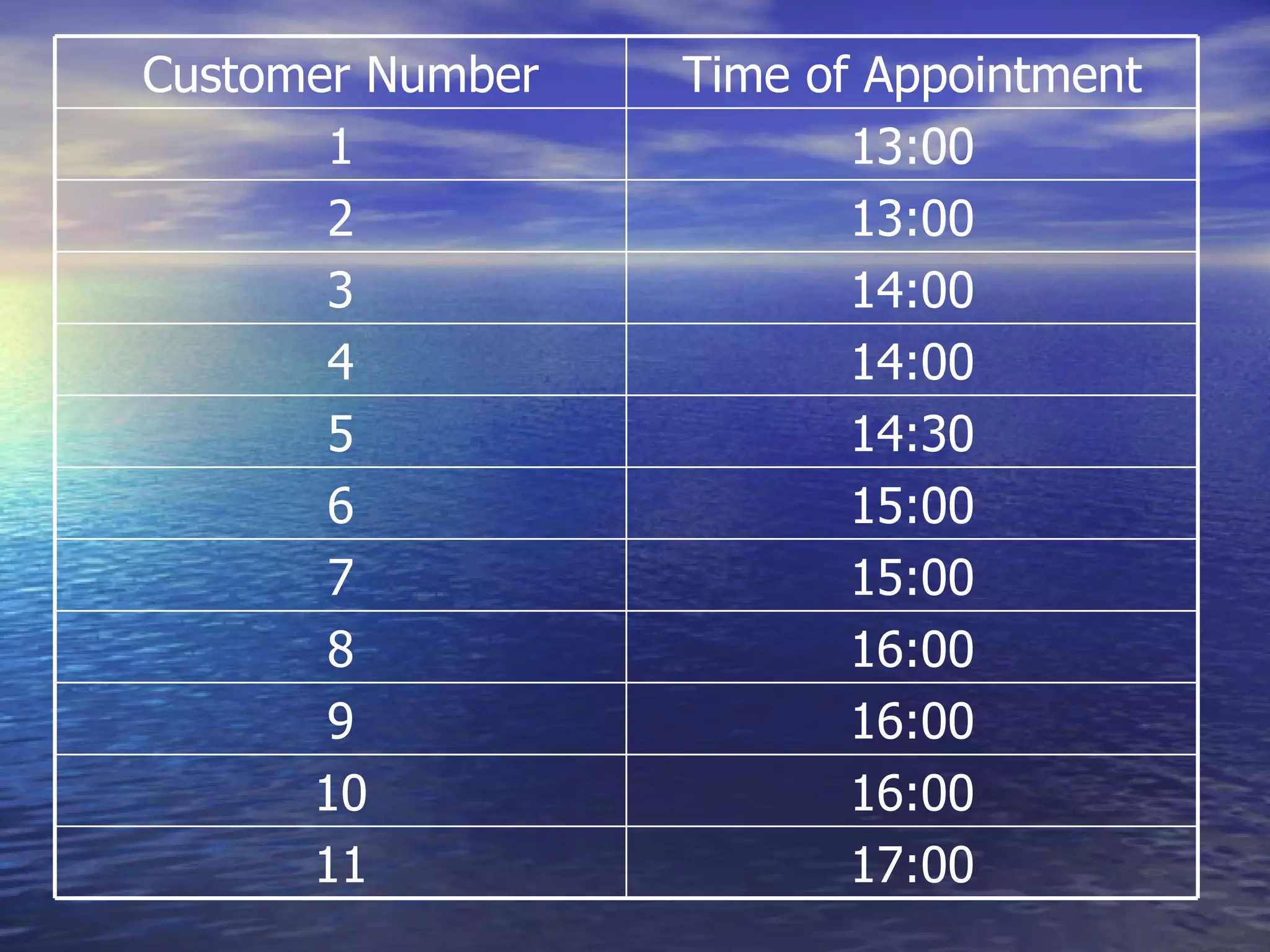
17:00 11 16:00 10 16:00 9 16:00 8 15:00 7 15:00 6 14:30 5 14:00 4 14:00 3 13:00 2 13:00 1 Time of Appointment Customer Number
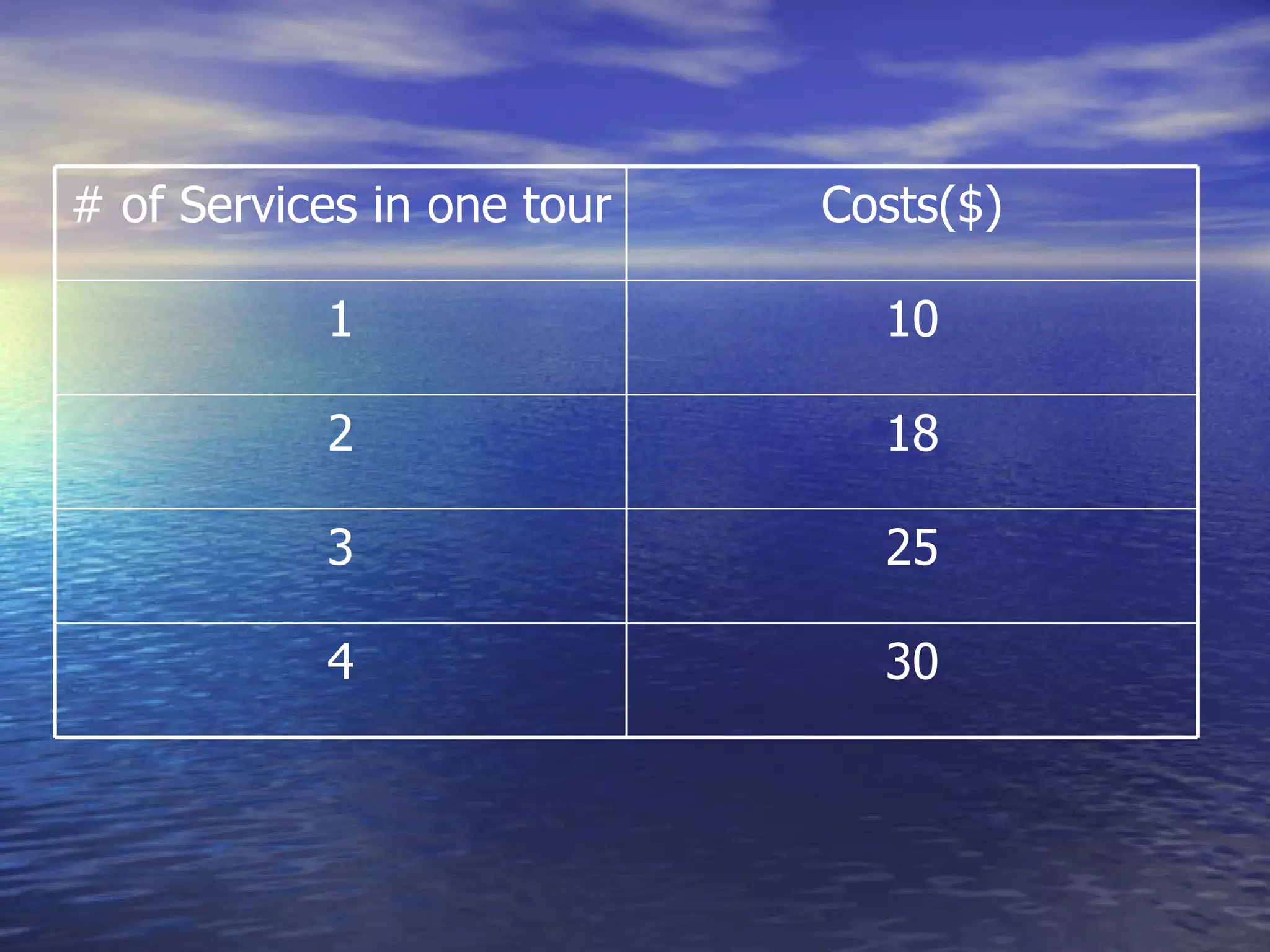
30 4 25 3 18 2 10 1 Costs($) # of Services in one tour
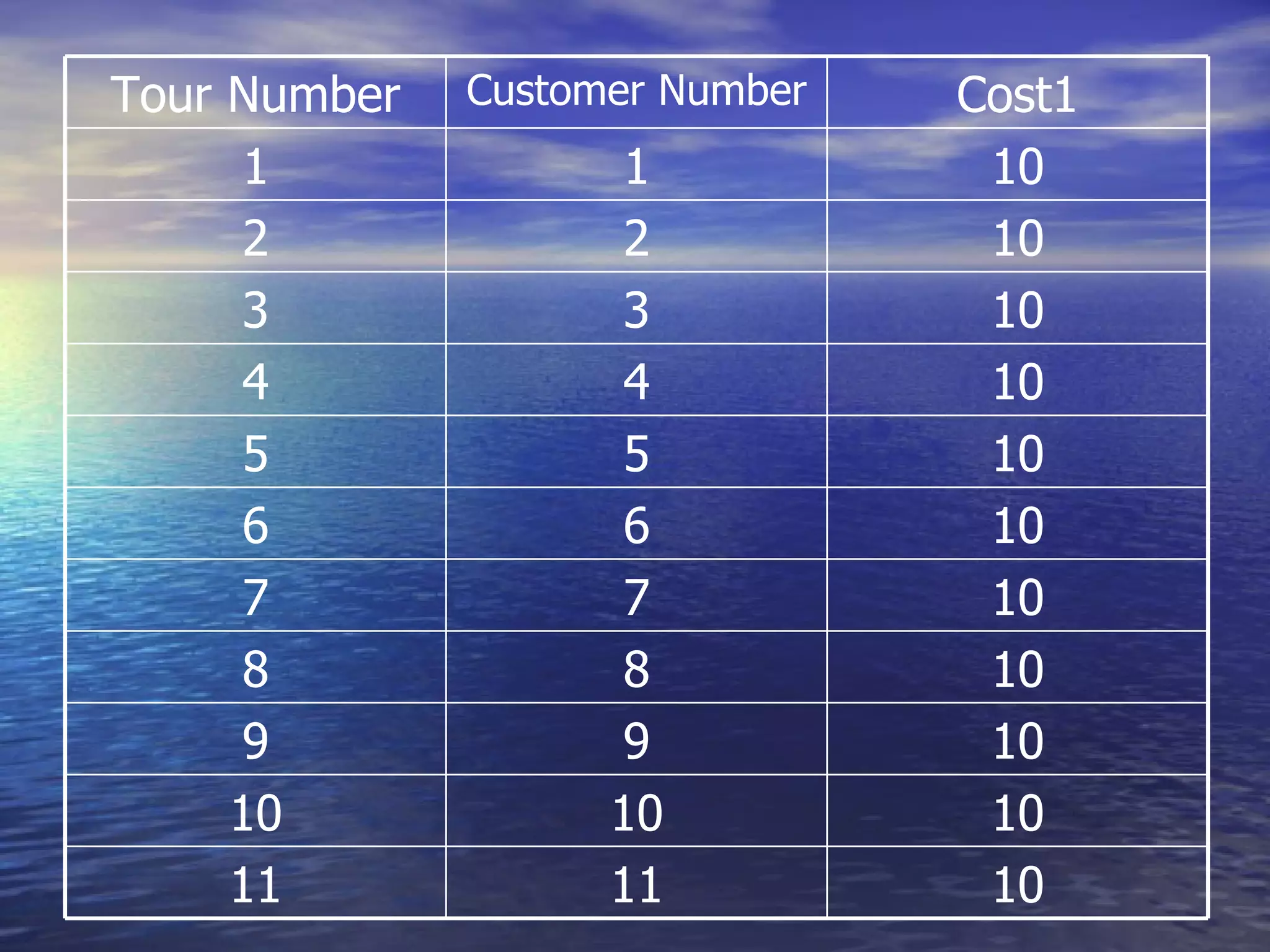
10 11 11 10 10 10 10 9 9 10 8 8 10 7 7 10 6 6 10 5 5 10 4 4 10 3 3 10 2 2 10 1 1 Cost1 Customer Number Tour Number
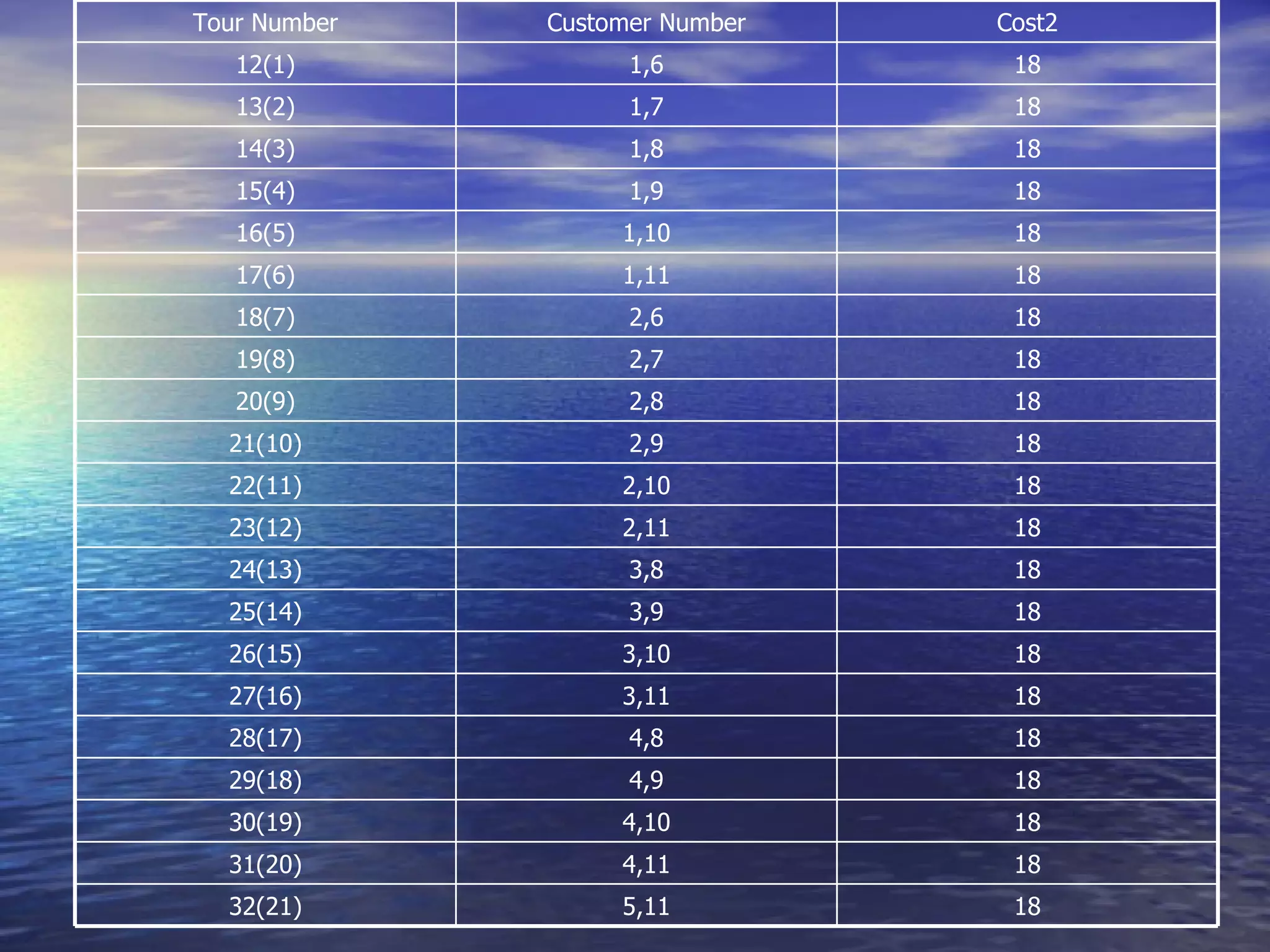
18 5,11 32(21) 18 4,11 31(20) 18 4,10 30(19) 18 4,9 29(18) 18 4,8 28(17) 18 3,11 27(16) 18 3,10 26(15) 18 3,9 25(14) 18 3,8 24(13) 18 2,11 23(12) 18 2,10 22(11) 18 2,9 21(10) 18 2,8 20(9) 18 2,7 19(8) 18 2,6 18(7) 18 1,11 17(6) 18 1,10 16(5) 18 1,9 15(4) 18 1,8 14(3) 18 1,7 13(2) 18 1,6 12(1) Cost2 Customer Number Tour Number
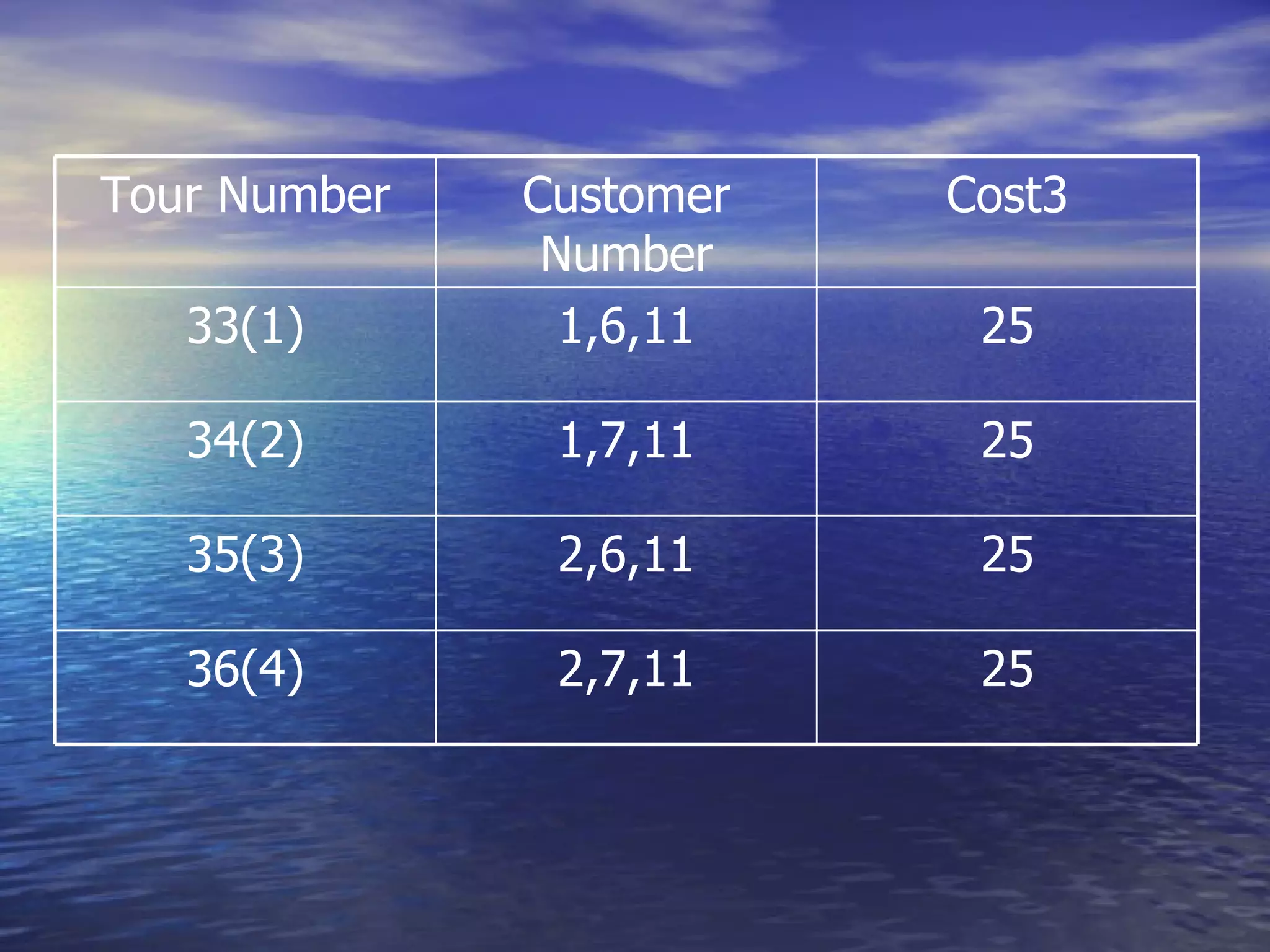
25 2,7,11 36(4) 25 2,6,11 35(3) 25 1,7,11 34(2) 25 1,6,11 33(1) Cost3 Customer Number Tour Number
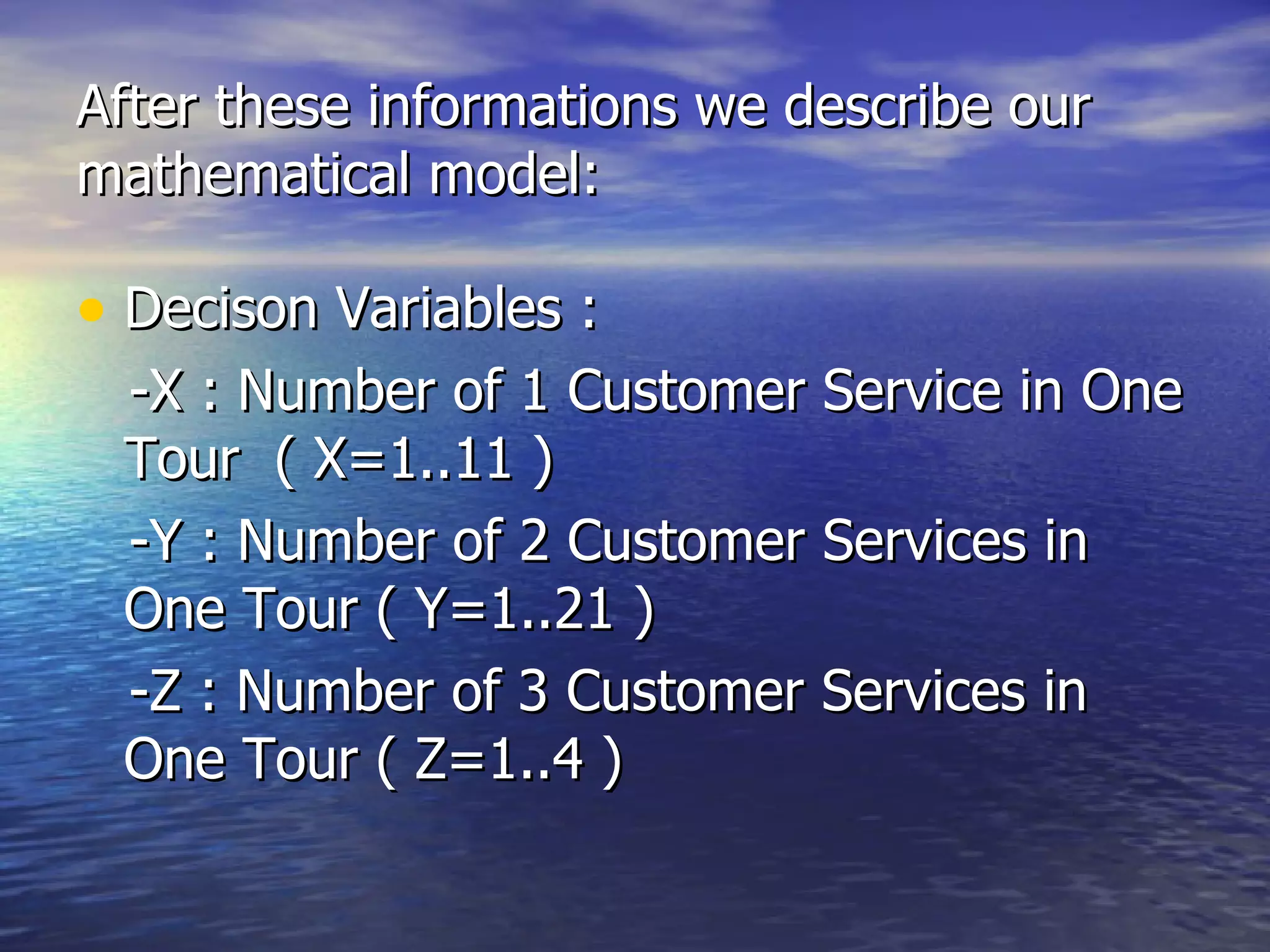
After these informations we describe our mathematical model: Decison Variables : -X : Number of 1 Customer Service in One Tour  ( X=1..11 ) -Y : Number of 2 Customer Services in One Tour ( Y=1..21 ) -Z : Number of 3 Customer Services in One Tour ( Z=1..4 )
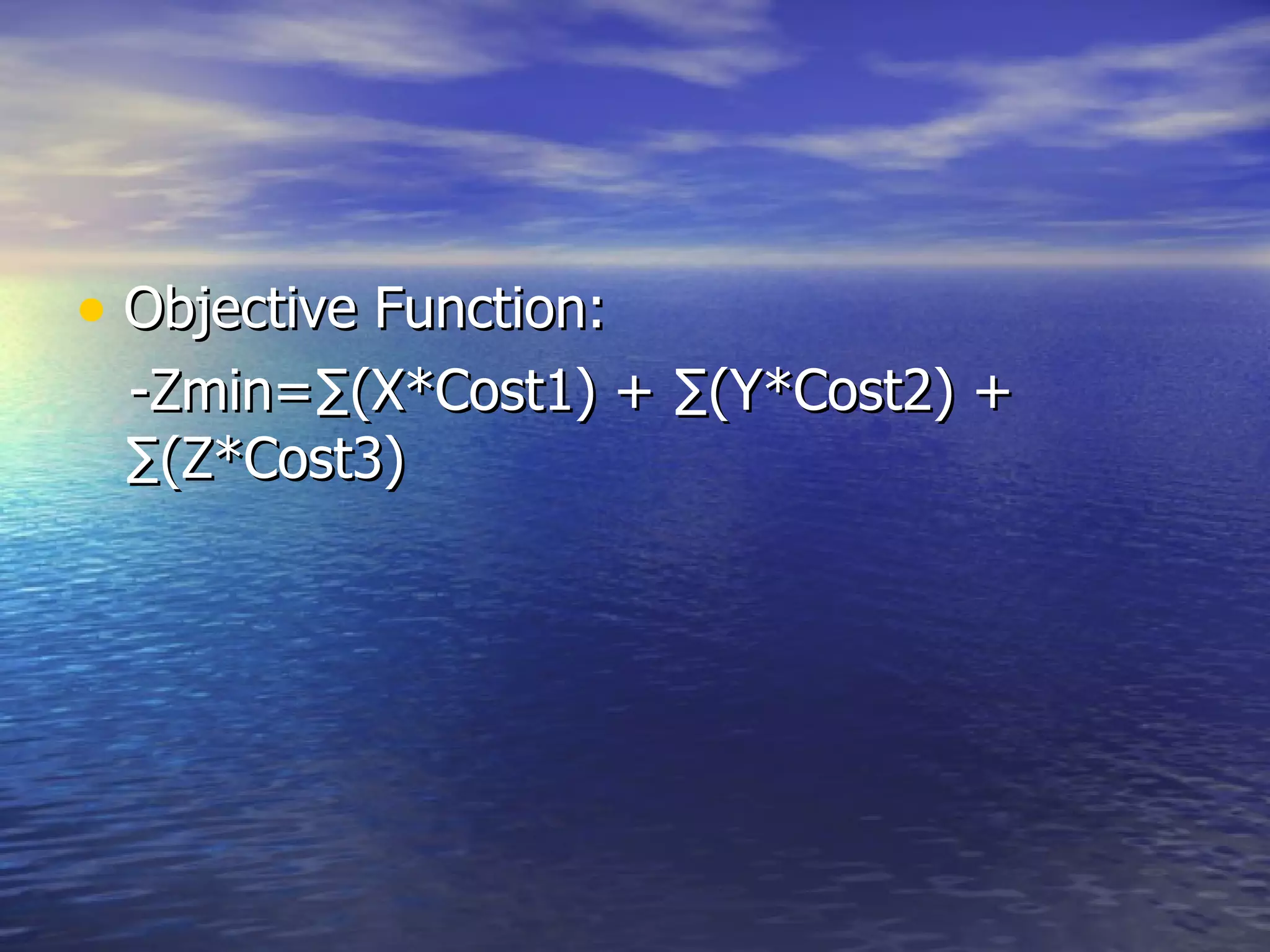
Objective Function: -Zmin=∑(X*Cost1) + ∑(Y*Cost2) + ∑(Z*Cost3)
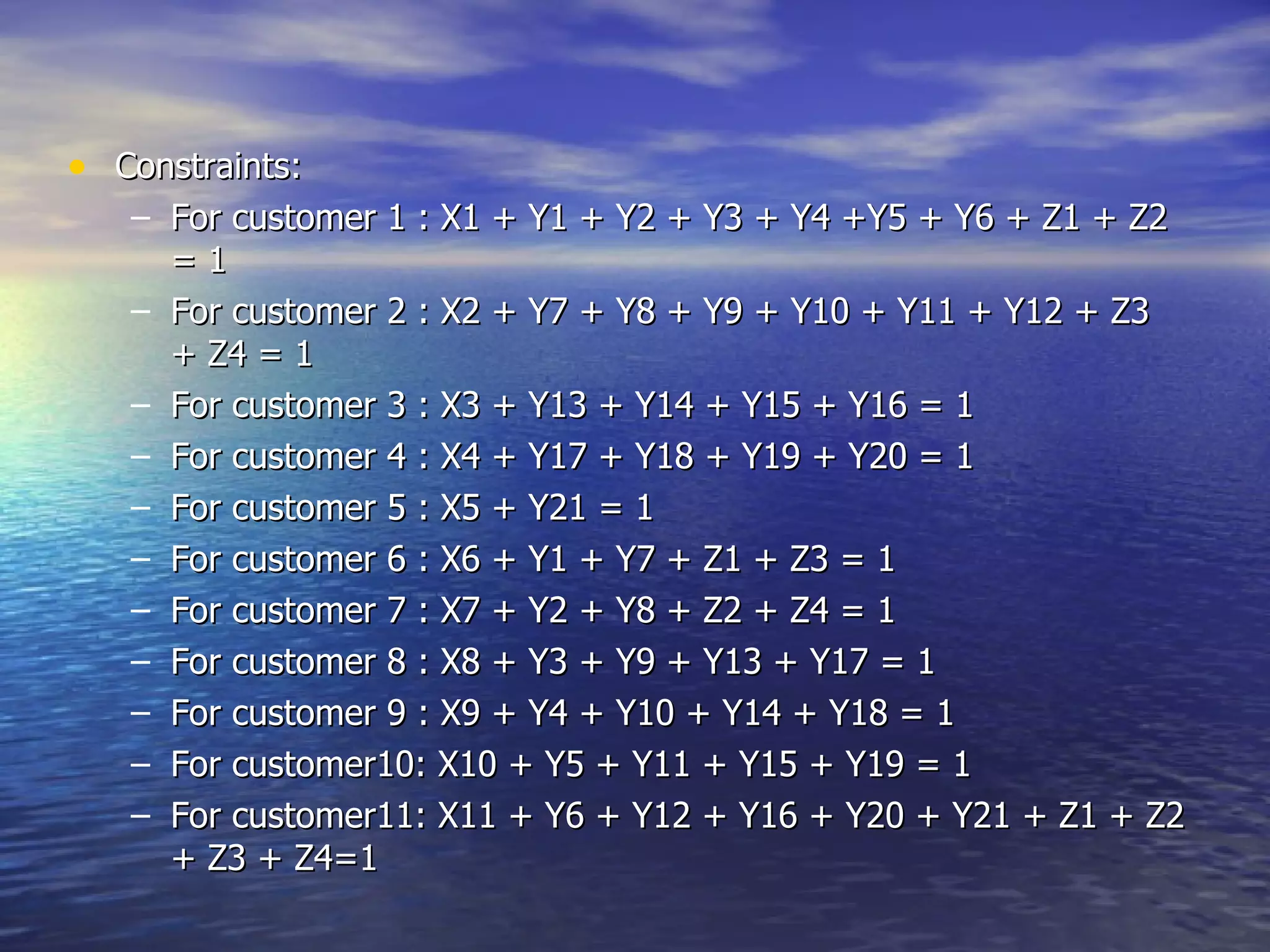
Constraints: For customer 1 : X1 + Y1 + Y2 + Y3 + Y4 +Y5 + Y6 + Z1 + Z2 = 1  For customer 2 : X2 + Y7 + Y8 + Y9 + Y10 + Y11 + Y12 + Z3 + Z4 = 1  For customer 3 : X3 + Y13 + Y14 + Y15 + Y16 = 1  For customer 4 : X4 + Y17 + Y18 + Y19 + Y20 = 1  For customer 5 : X5 + Y21 = 1  For customer 6 : X6 + Y1 + Y7 + Z1 + Z3 = 1  For customer 7 : X7 + Y2 + Y8 + Z2 + Z4 = 1  For customer 8 : X8 + Y3 + Y9 + Y13 + Y17 = 1  For customer 9 : X9 + Y4 + Y10 + Y14 + Y18 = 1  For customer10: X10 + Y5 + Y11 + Y15 + Y19 = 1  For customer11: X11 + Y6 + Y12 + Y16 + Y20 + Y21 + Z1 + Z2 + Z3 + Z4=1
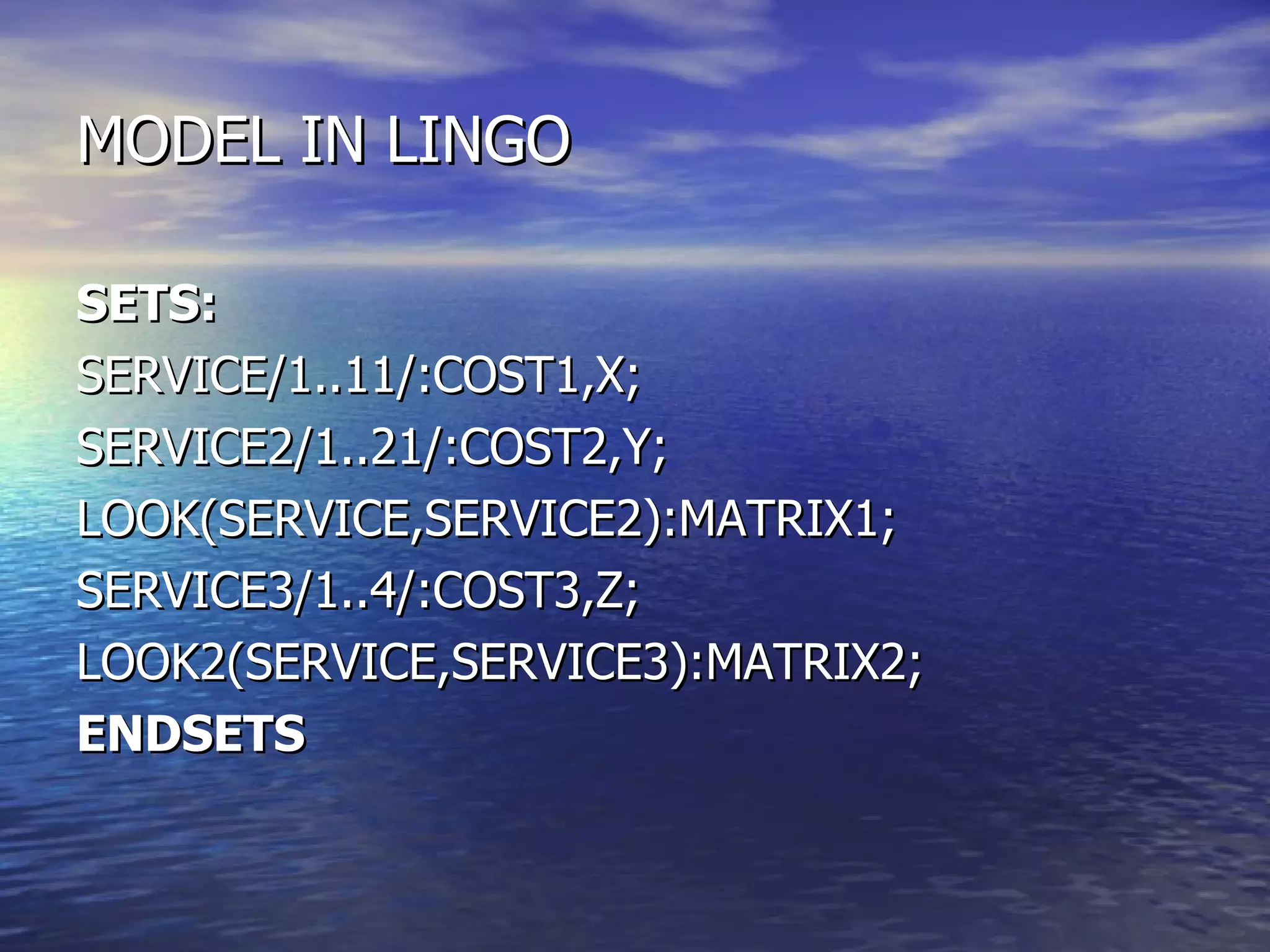
MODEL IN LINGO SETS: SERVICE/1..11/:COST1,X; SERVICE2/1..21/:COST2,Y; LOOK(SERVICE,SERVICE2):MATRIX1; SERVICE3/1..4/:COST3,Z; LOOK2(SERVICE,SERVICE3):MATRIX2; ENDSETS
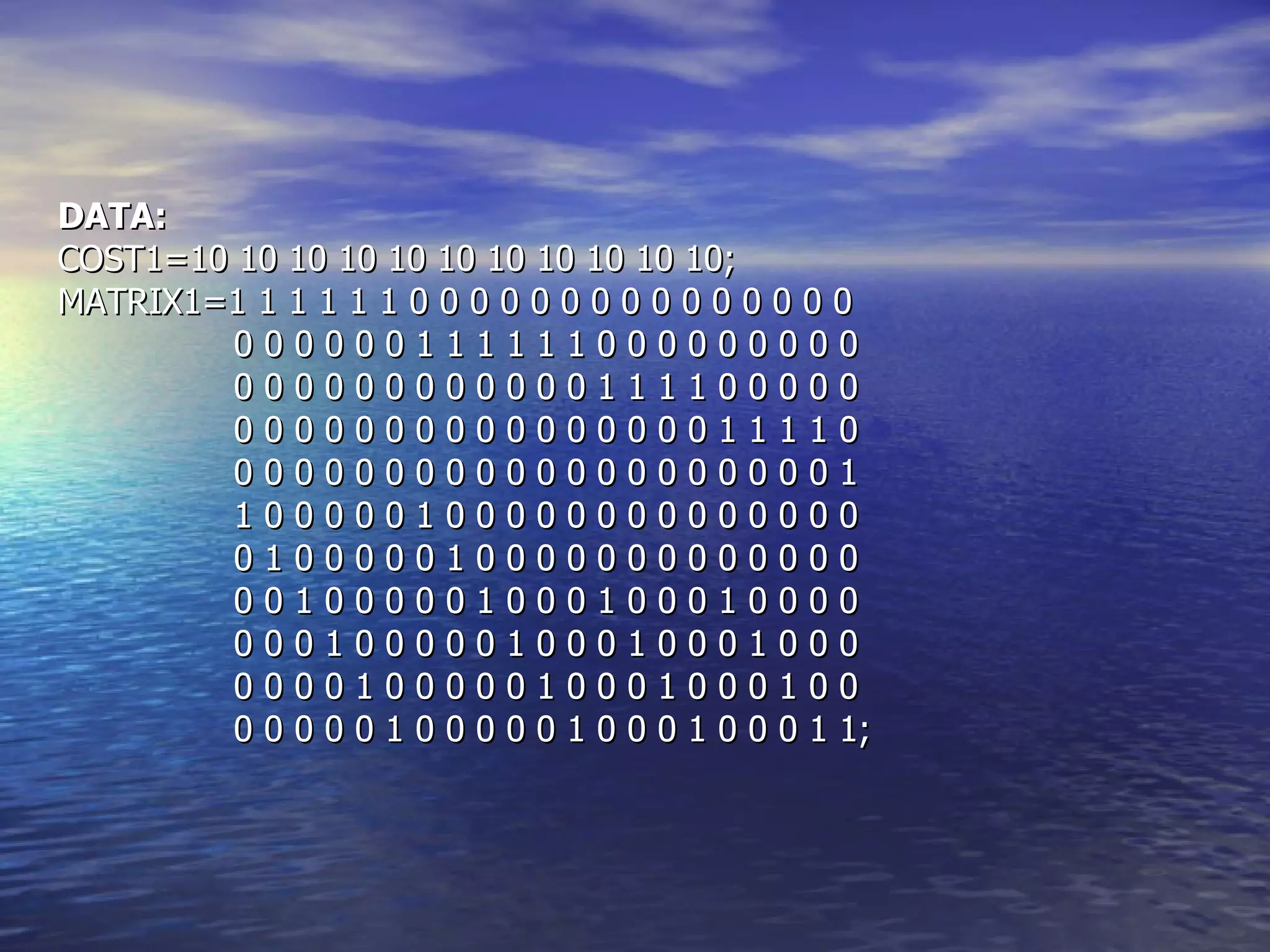
DATA: COST1=10 10 10 10 10 10 10 10 10 10 10; MATRIX1=1 1 1 1 1 1 0 0 0 0 0 0 0 0 0 0 0 0 0 0 0 0 0 0 0 0 0 1 1 1 1 1 1 0 0 0 0 0 0 0 0 0  0 0 0 0 0 0 0 0 0 0 0 0 1 1 1 1 0 0 0 0 0 0 0 0 0 0 0 0 0 0 0 0 0 0 0 0 0 1 1 1 1 0 0 0 0 0 0 0 0 0 0 0 0 0 0 0 0 0 0 0 0 0 1 1 0 0 0 0 0 1 0 0 0 0 0 0 0 0 0 0 0 0 0 0  0 1 0 0 0 0 0 1 0 0 0 0 0 0 0 0 0 0 0 0 0  0 0 1 0 0 0 0 0 1 0 0 0 1 0 0 0 1 0 0 0 0  0 0 0 1 0 0 0 0 0 1 0 0 0 1 0 0 0 1 0 0 0  0 0 0 0 1 0 0 0 0 0 1 0 0 0 1 0 0 0 1 0 0  0 0 0 0 0 1 0 0 0 0 0 1 0 0 0 1 0 0 0 1 1;
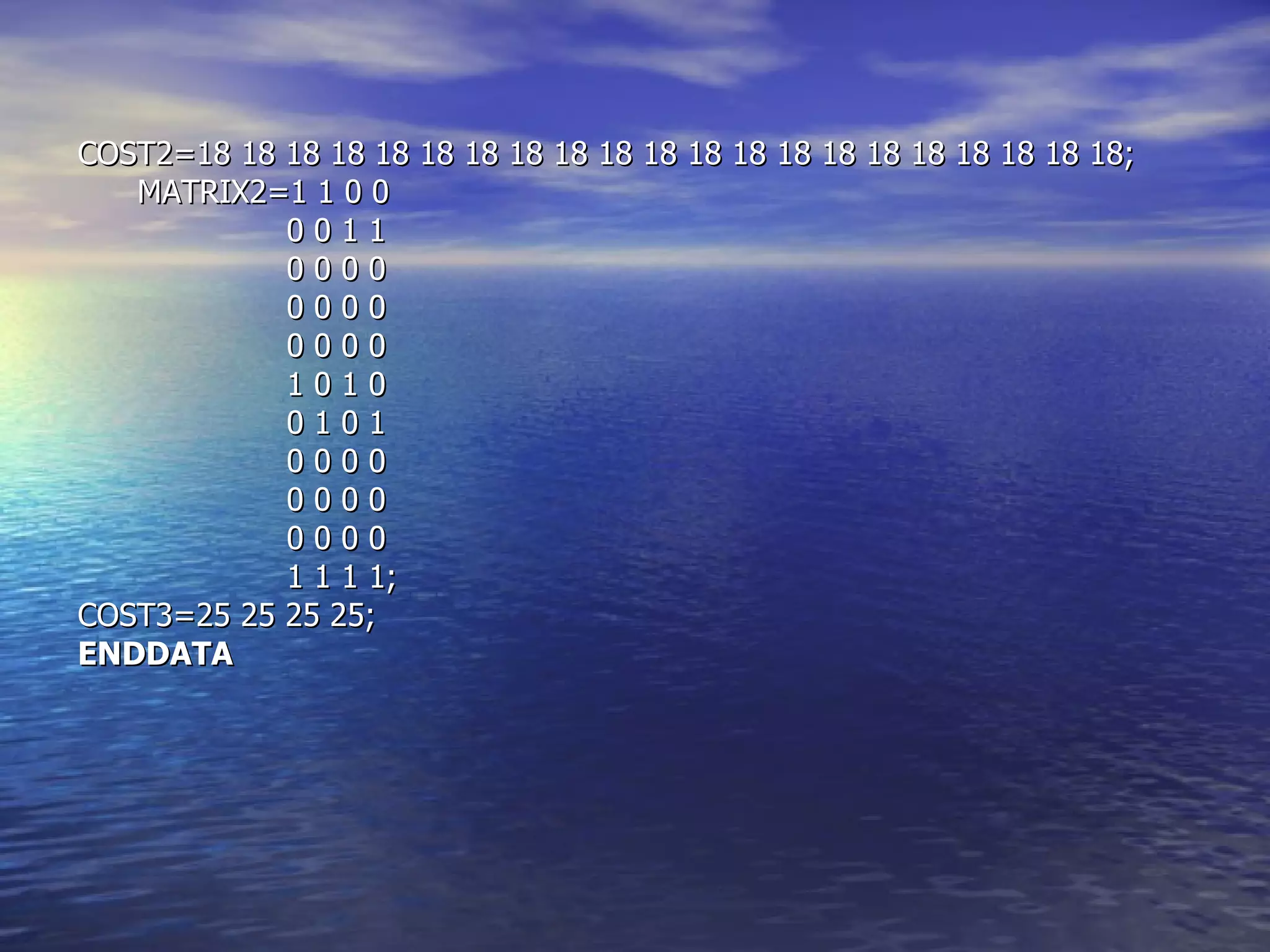
COST2=18 18 18 18 18 18 18 18 18 18 18 18 18 18 18 18 18 18 18 18 18; MATRIX2=1 1 0 0 0 0 1 1 0 0 0 0 0 0 0 0 0 0 0 0 1 0 1 0 0 1 0 1 0 0 0 0 0 0 0 0 0 0 0 0 1 1 1 1; COST3=25 25 25 25; ENDDATA
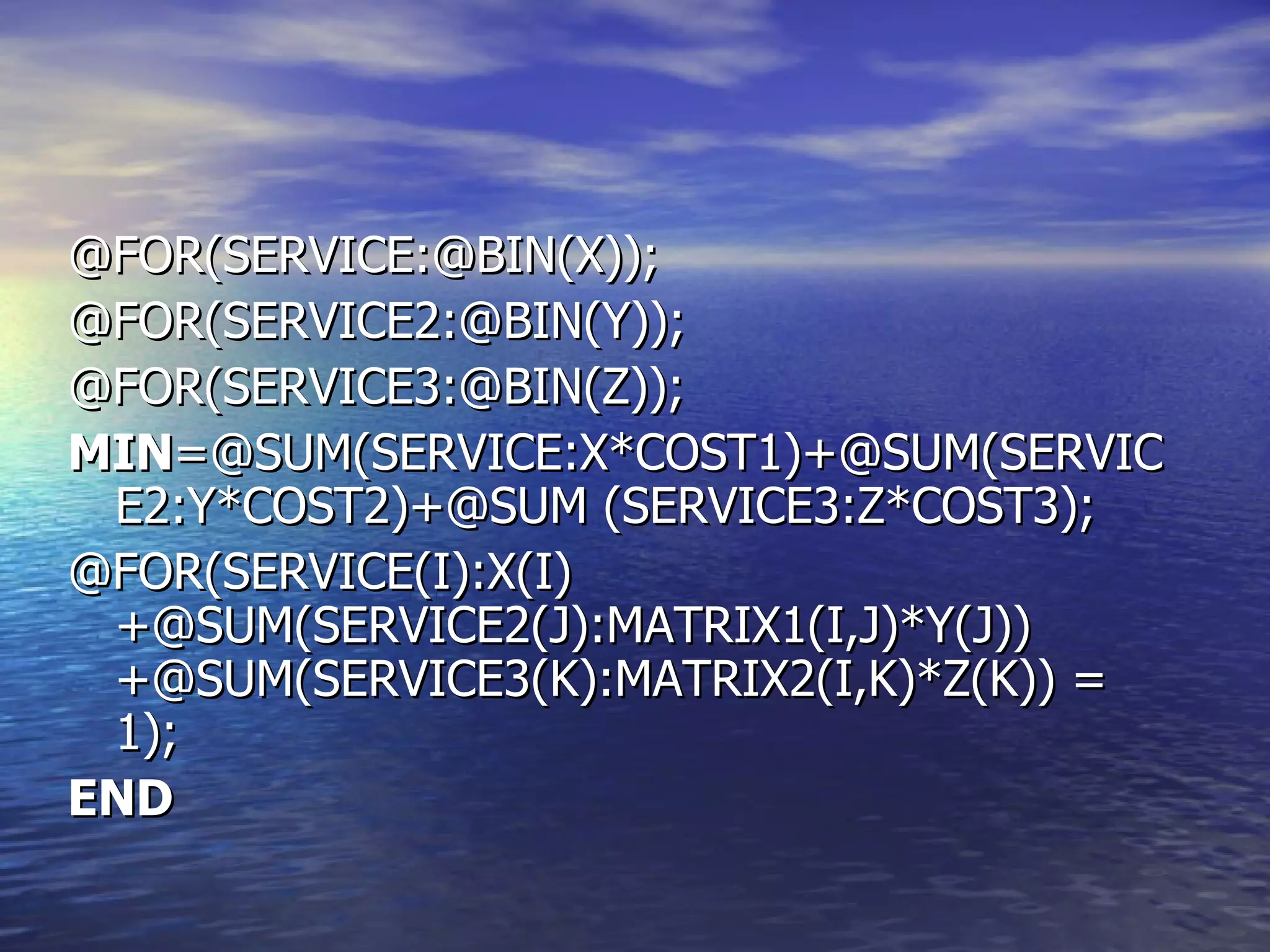
@FOR(SERVICE:@BIN(X)); @FOR(SERVICE2:@BIN(Y)); @FOR(SERVICE3:@BIN(Z)); MIN =@SUM(SERVICE:X*COST1)+@SUM(SERVICE2:Y*COST2)+@SUM (SERVICE3:Z*COST3); @FOR(SERVICE(I):X(I)+@SUM(SERVICE2(J):MATRIX1(I,J)*Y(J))+@SUM(SERVICE3(K):MATRIX2(I,K)*Z(K)) = 1); END
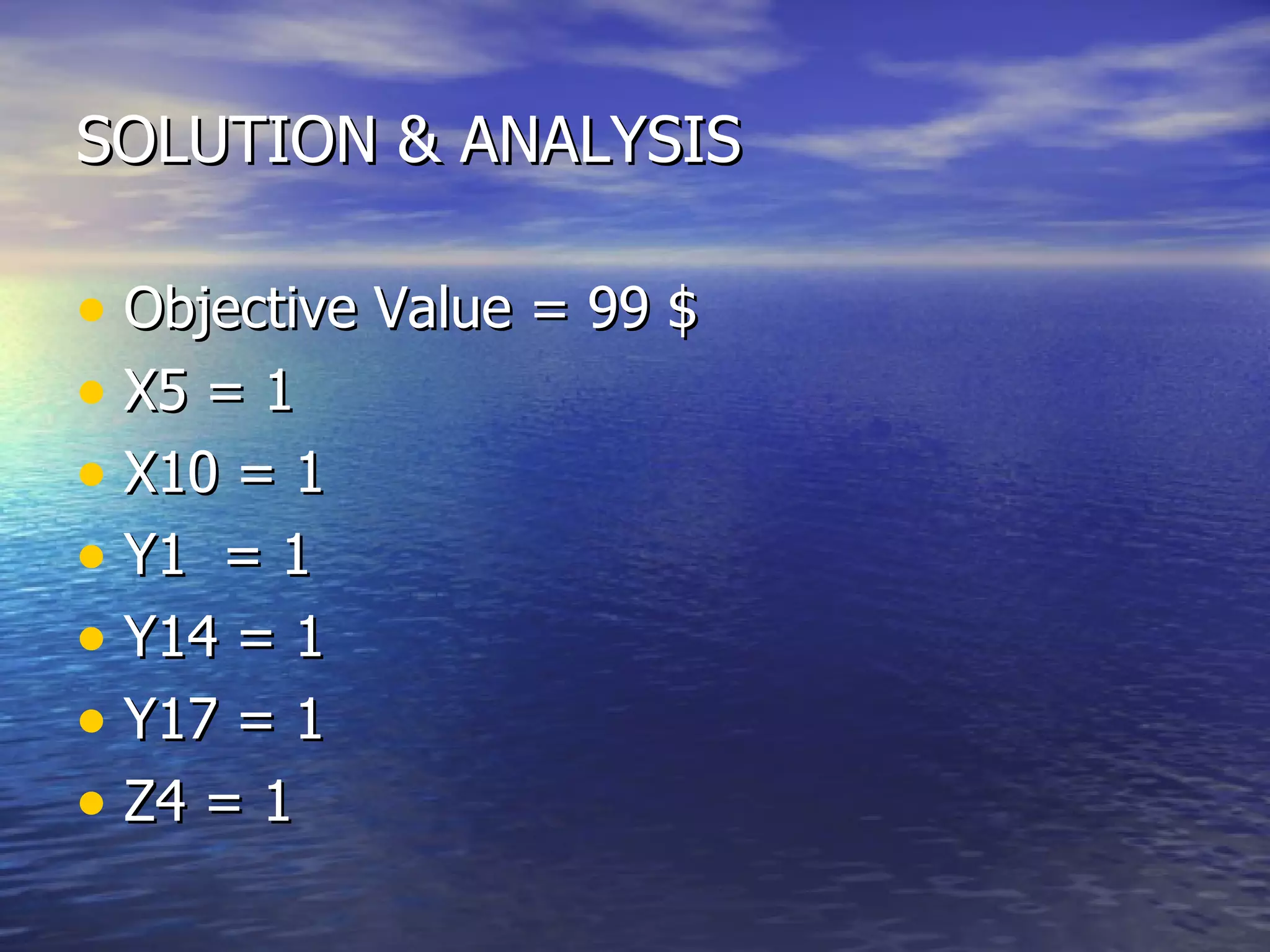
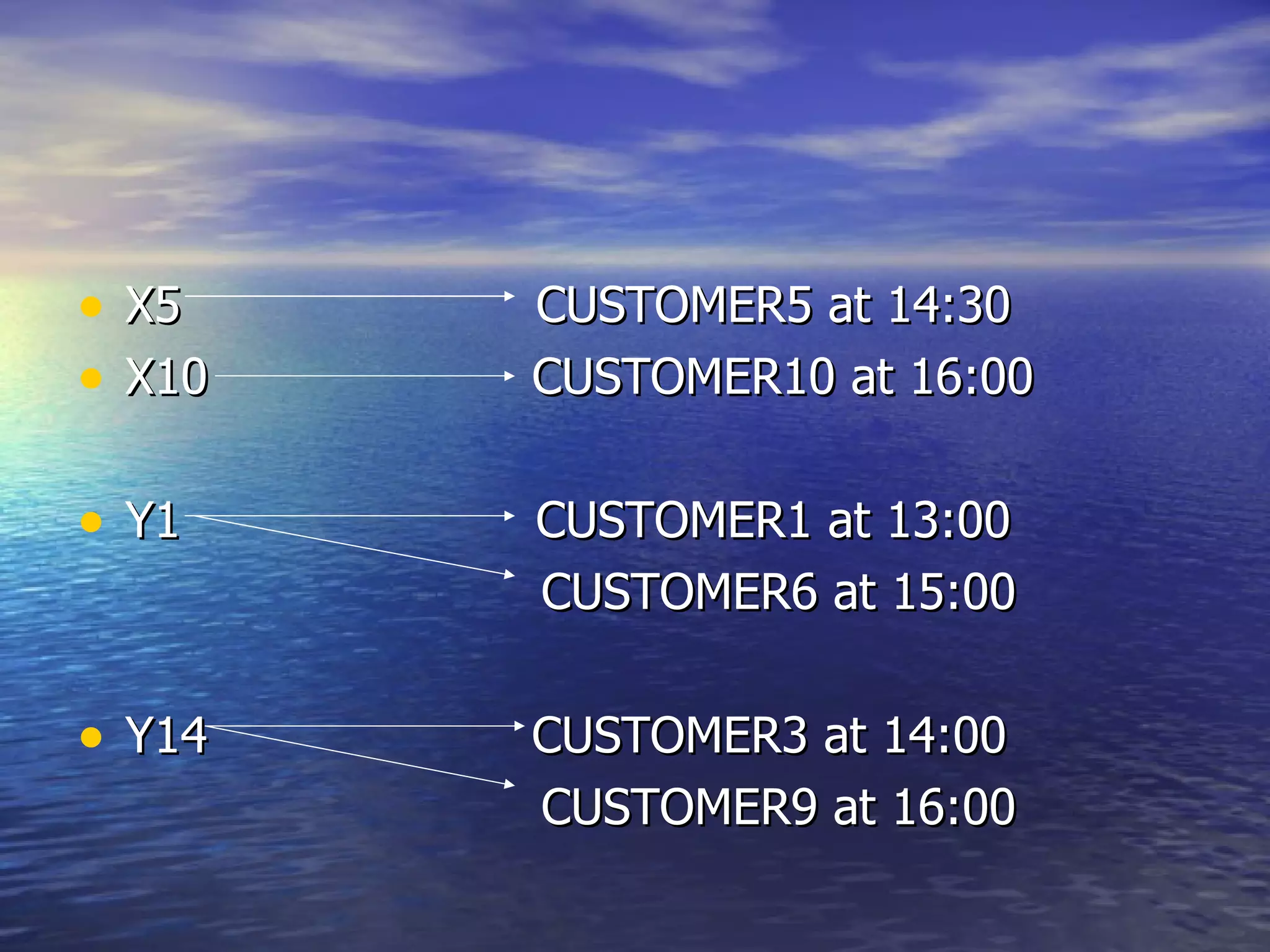
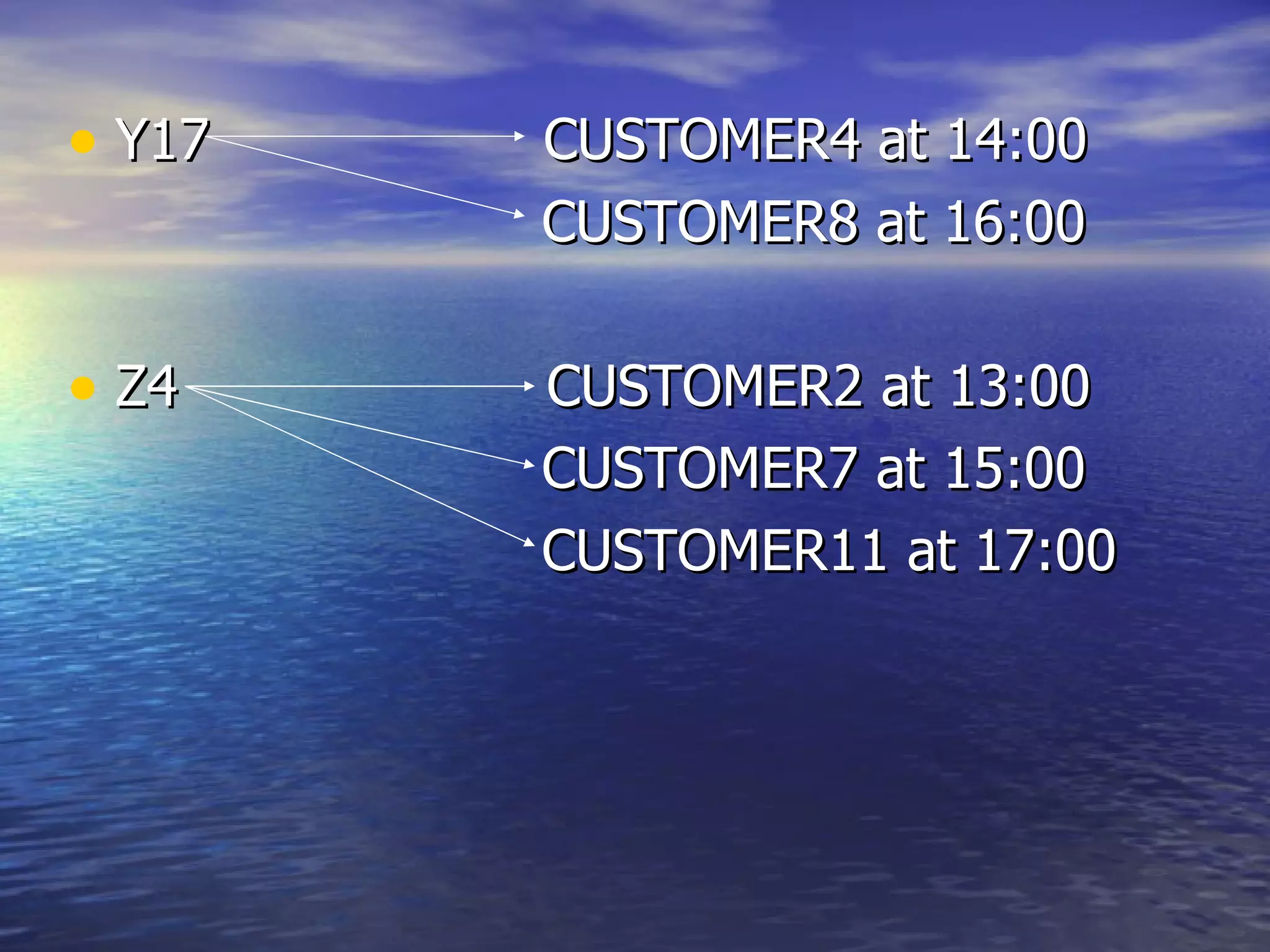
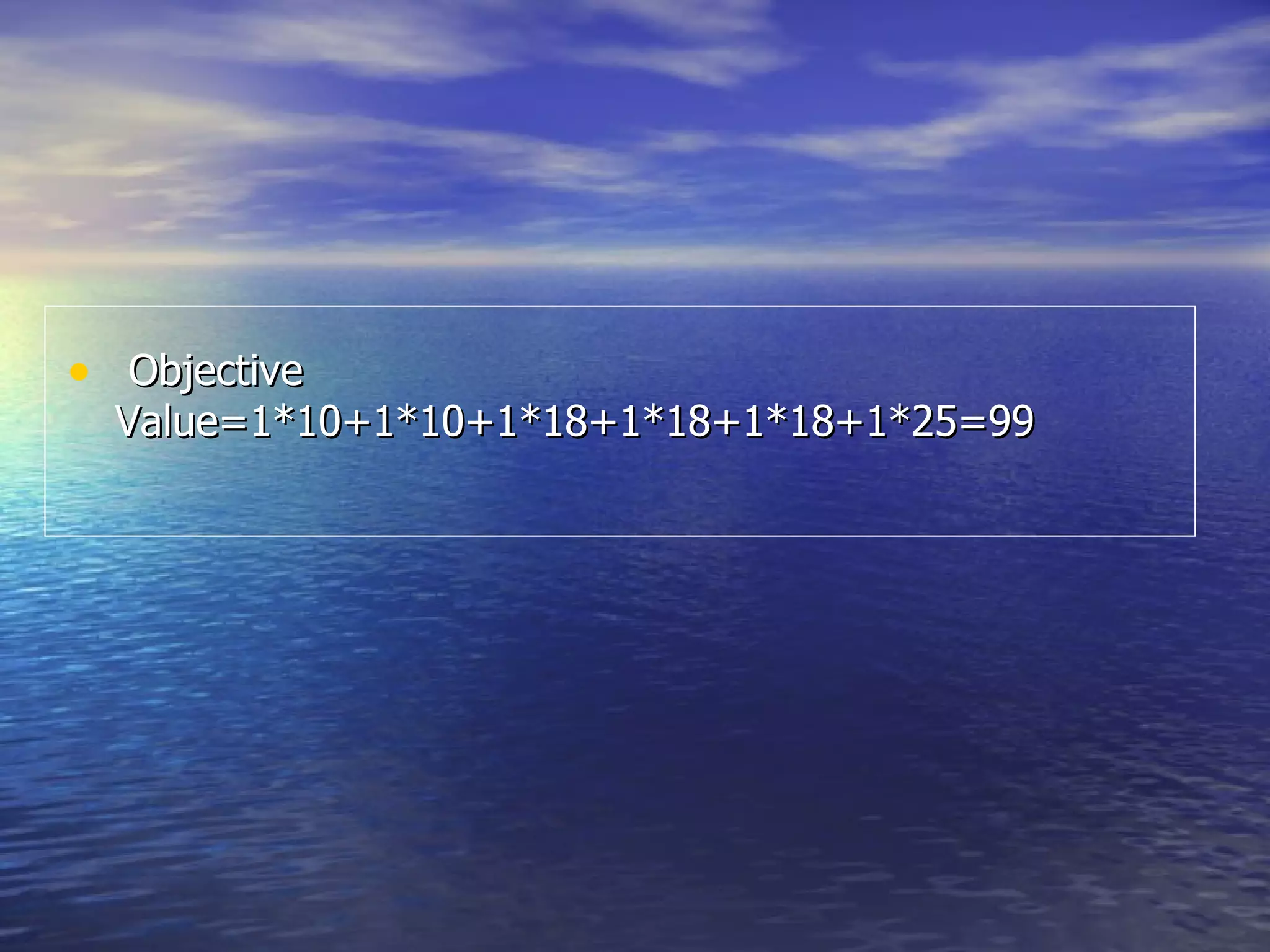
SOLUTION & ANALYSIS Objective Value = 99 $  X5 = 1 X10 = 1 Y1  = 1 Y14 = 1 Y17 = 1 Z4 = 1
X5  CUSTOMER5 at 14:30 X10  CUSTOMER10 at 16:00 Y1  CUSTOMER1 at 13:00 CUSTOMER6 at 15:00 Y14  CUSTOMER3 at 14:00 CUSTOMER9 at 16:00
Y17  CUSTOMER4 at 14:00 CUSTOMER8 at 16:00 Z4  CUSTOMER2 at 13:00 CUSTOMER7 at 15:00 CUSTOMER11 at 17:00
Objective  Value=1*10+1*10+1*18+1*18+1*18+1*25=99
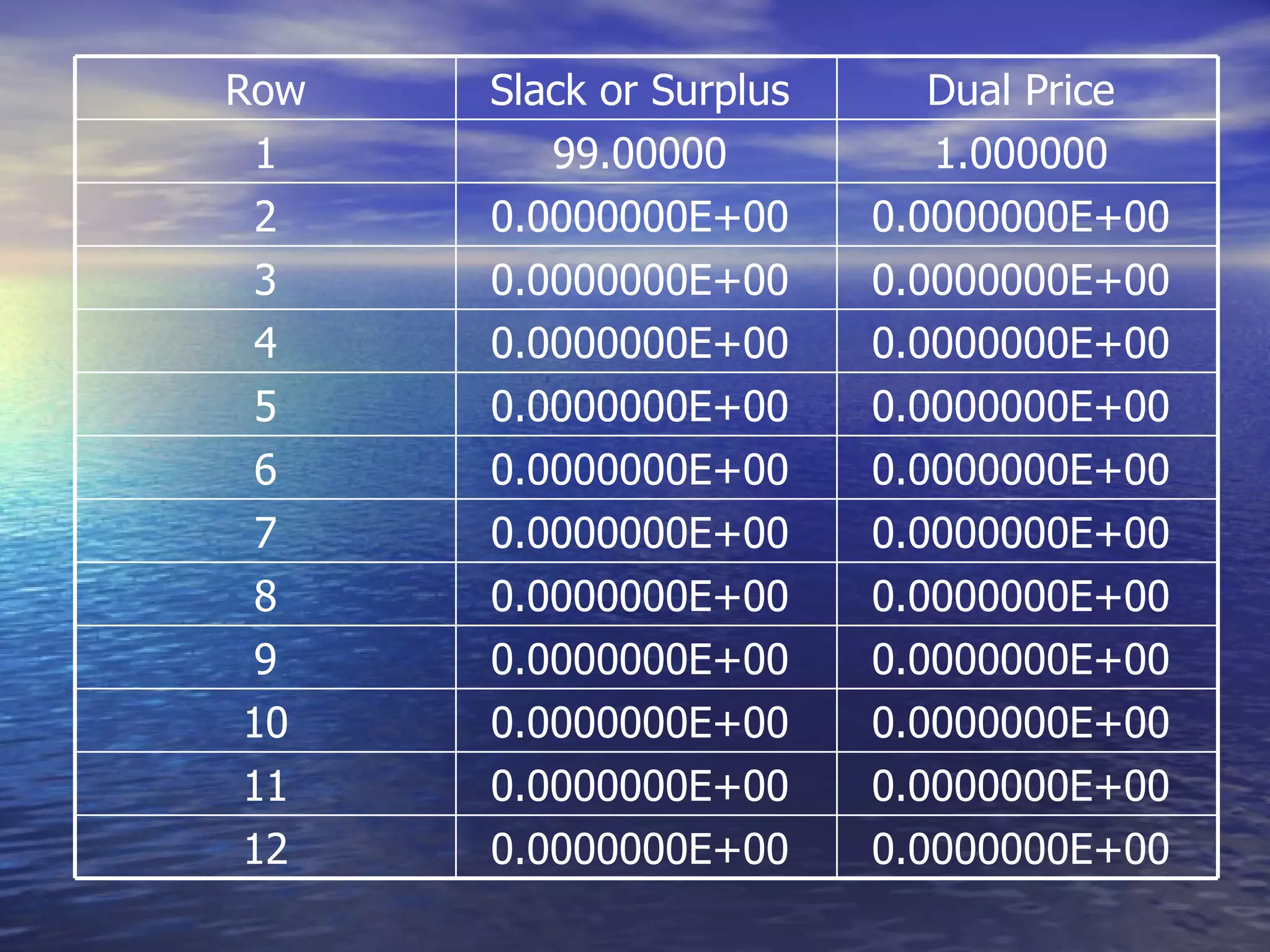
0.0000000E+00  0.0000000E+00  12 0.0000000E+00  0.0000000E+00  11 0.0000000E+00  0.0000000E+00  10 0.0000000E+00  0.0000000E+00  9 0.0000000E+00  0.0000000E+00  8 0.0000000E+00  0.0000000E+00  7 0.0000000E+00  0.0000000E+00  6 0.0000000E+00  0.0000000E+00  5 0.0000000E+00  0.0000000E+00  4 0.0000000E+00  0.0000000E+00  3 0.0000000E+00  0.0000000E+00  2 1.000000  99.00000  1 Dual Price  Slack or Surplus  Row
THANK YOU

CREW SCHEDULING

  • 1.
  • 2.
    GENERAL VIEW CREWSCHEDULING TYPES FLEXIBLE MANAGEMENT STRATEGIES DESCRIPTION OF PROBLEM FORMULATION OF PROBLEM MODEL IN LINGO SOLUTION & ANALYSIS
  • 3.
    CREW SCHEDULING AirlineCrew Scheduling 1. The most appropriate pairings. 2.Equal workloads. 3.Minimum crew COSTS. Mass Transit Crew Scheduling 1. Railway track maintenance problems. 2.Mathematical program. 3.Tabu search.
  • 4.
    Generic Crew Scheduling1. Manpower scheduling problems. 2.Mixed integer program. 3.Mimimum manpower. 4.Package programs(CPLEX..).
  • 5.
    FLEXIBLE MANAGEMENT STRATEGIESFunctional Flexibility - Deployment on different tasks. Numerical Flexibility - Variable working hours. Temporal Flexibility - Career breaks,job sharing,term-time works.. Wage Flexibility - Performance related pays.
  • 6.
    DESCRIPTION OF PROBLEM-Algorithm of Problem: SOFTWARE COMPANY SOFTWARE COMPANY CUSTOMER CALL OF CUSTOMER CALL OF CUSTOMER ASSIGN SERVICE ENGINEER
  • 7.
    Informations about problemService engineering is not different job . All of Software engineers may go services . Service time includes times which pass on the way too . We see that service times did not pass over 2 hours according to old datas . This problem include assignments only for an afternoon .
  • 8.
    17:00 11 16:0010 16:00 9 16:00 8 15:00 7 15:00 6 14:30 5 14:00 4 14:00 3 13:00 2 13:00 1 Time of Appointment Customer Number
  • 9.
    30 4 253 18 2 10 1 Costs($) # of Services in one tour
  • 10.
    10 11 1110 10 10 10 9 9 10 8 8 10 7 7 10 6 6 10 5 5 10 4 4 10 3 3 10 2 2 10 1 1 Cost1 Customer Number Tour Number
  • 11.
    18 5,11 32(21)18 4,11 31(20) 18 4,10 30(19) 18 4,9 29(18) 18 4,8 28(17) 18 3,11 27(16) 18 3,10 26(15) 18 3,9 25(14) 18 3,8 24(13) 18 2,11 23(12) 18 2,10 22(11) 18 2,9 21(10) 18 2,8 20(9) 18 2,7 19(8) 18 2,6 18(7) 18 1,11 17(6) 18 1,10 16(5) 18 1,9 15(4) 18 1,8 14(3) 18 1,7 13(2) 18 1,6 12(1) Cost2 Customer Number Tour Number
  • 12.
    25 2,7,11 36(4)25 2,6,11 35(3) 25 1,7,11 34(2) 25 1,6,11 33(1) Cost3 Customer Number Tour Number
  • 13.
    After these informationswe describe our mathematical model: Decison Variables : -X : Number of 1 Customer Service in One Tour ( X=1..11 ) -Y : Number of 2 Customer Services in One Tour ( Y=1..21 ) -Z : Number of 3 Customer Services in One Tour ( Z=1..4 )
  • 14.
    Objective Function: -Zmin=∑(X*Cost1)+ ∑(Y*Cost2) + ∑(Z*Cost3)
  • 15.
    Constraints: For customer1 : X1 + Y1 + Y2 + Y3 + Y4 +Y5 + Y6 + Z1 + Z2 = 1 For customer 2 : X2 + Y7 + Y8 + Y9 + Y10 + Y11 + Y12 + Z3 + Z4 = 1 For customer 3 : X3 + Y13 + Y14 + Y15 + Y16 = 1 For customer 4 : X4 + Y17 + Y18 + Y19 + Y20 = 1 For customer 5 : X5 + Y21 = 1 For customer 6 : X6 + Y1 + Y7 + Z1 + Z3 = 1 For customer 7 : X7 + Y2 + Y8 + Z2 + Z4 = 1 For customer 8 : X8 + Y3 + Y9 + Y13 + Y17 = 1 For customer 9 : X9 + Y4 + Y10 + Y14 + Y18 = 1 For customer10: X10 + Y5 + Y11 + Y15 + Y19 = 1 For customer11: X11 + Y6 + Y12 + Y16 + Y20 + Y21 + Z1 + Z2 + Z3 + Z4=1
  • 16.
    MODEL IN LINGOSETS: SERVICE/1..11/:COST1,X; SERVICE2/1..21/:COST2,Y; LOOK(SERVICE,SERVICE2):MATRIX1; SERVICE3/1..4/:COST3,Z; LOOK2(SERVICE,SERVICE3):MATRIX2; ENDSETS
  • 17.
    DATA: COST1=10 1010 10 10 10 10 10 10 10 10; MATRIX1=1 1 1 1 1 1 0 0 0 0 0 0 0 0 0 0 0 0 0 0 0 0 0 0 0 0 0 1 1 1 1 1 1 0 0 0 0 0 0 0 0 0 0 0 0 0 0 0 0 0 0 0 0 0 1 1 1 1 0 0 0 0 0 0 0 0 0 0 0 0 0 0 0 0 0 0 0 0 0 1 1 1 1 0 0 0 0 0 0 0 0 0 0 0 0 0 0 0 0 0 0 0 0 0 1 1 0 0 0 0 0 1 0 0 0 0 0 0 0 0 0 0 0 0 0 0 0 1 0 0 0 0 0 1 0 0 0 0 0 0 0 0 0 0 0 0 0 0 0 1 0 0 0 0 0 1 0 0 0 1 0 0 0 1 0 0 0 0 0 0 0 1 0 0 0 0 0 1 0 0 0 1 0 0 0 1 0 0 0 0 0 0 0 1 0 0 0 0 0 1 0 0 0 1 0 0 0 1 0 0 0 0 0 0 0 1 0 0 0 0 0 1 0 0 0 1 0 0 0 1 1;
  • 18.
    COST2=18 18 1818 18 18 18 18 18 18 18 18 18 18 18 18 18 18 18 18 18; MATRIX2=1 1 0 0 0 0 1 1 0 0 0 0 0 0 0 0 0 0 0 0 1 0 1 0 0 1 0 1 0 0 0 0 0 0 0 0 0 0 0 0 1 1 1 1; COST3=25 25 25 25; ENDDATA
  • 19.
    @FOR(SERVICE:@BIN(X)); @FOR(SERVICE2:@BIN(Y)); @FOR(SERVICE3:@BIN(Z));MIN =@SUM(SERVICE:X*COST1)+@SUM(SERVICE2:Y*COST2)+@SUM (SERVICE3:Z*COST3); @FOR(SERVICE(I):X(I)+@SUM(SERVICE2(J):MATRIX1(I,J)*Y(J))+@SUM(SERVICE3(K):MATRIX2(I,K)*Z(K)) = 1); END
  • 20.
    SOLUTION & ANALYSISObjective Value = 99 $ X5 = 1 X10 = 1 Y1 = 1 Y14 = 1 Y17 = 1 Z4 = 1
  • 21.
    X5 CUSTOMER5at 14:30 X10 CUSTOMER10 at 16:00 Y1 CUSTOMER1 at 13:00 CUSTOMER6 at 15:00 Y14 CUSTOMER3 at 14:00 CUSTOMER9 at 16:00
  • 22.
    Y17 CUSTOMER4at 14:00 CUSTOMER8 at 16:00 Z4 CUSTOMER2 at 13:00 CUSTOMER7 at 15:00 CUSTOMER11 at 17:00
  • 23.
  • 24.
    0.0000000E+00 0.0000000E+00 12 0.0000000E+00 0.0000000E+00 11 0.0000000E+00 0.0000000E+00 10 0.0000000E+00 0.0000000E+00 9 0.0000000E+00 0.0000000E+00 8 0.0000000E+00 0.0000000E+00 7 0.0000000E+00 0.0000000E+00 6 0.0000000E+00 0.0000000E+00 5 0.0000000E+00 0.0000000E+00 4 0.0000000E+00 0.0000000E+00 3 0.0000000E+00 0.0000000E+00 2 1.000000 99.00000 1 Dual Price Slack or Surplus Row
  • 25.