Staffing
Prof.Theresa L. Mendonca
Meaning
Staffing means number and composition of
personnel assigned to work on a unit at a
given time
Definition
According to Koontz ,O’donnell and
weihrich staffing involves manning the
organisational structure through proper and
effective selection ,appraisal estimate and
development of personnel to fill the roles
designed in to the structure
staffing
Definition –staffing is the systematic
approach to the problem of selecting
training , motivating ,and retaining
professional and non professional personal
in any organisation.
It involves manpower planning to have the
right person in the right placeand avoid
square peg in round hole.
Reasons increased the significance of
staffing
Advancement of technology
Increased size of the organisation
Long range need for manpower-future
labour turn over
High wage bill ---if right type of person is
not appointed then management has to
spend on wages and procedure ,even though
poor work out put
Recognition of human relations –financial
and nonfinancial incentives
Factors influencing staffing pattern
Pattern of delivery services
Standard of nursing care
Different type of activties performed
Size and type of unit
Philosophy
Nursing administrators believe that
It is possible to match employees
knowledge and skill to patient care needs in
a manner that optimises job satisfaction and
care quality.
The technical and humanistic care needs of
critically ill patients are so complex that all
aspects of that care should be provided by
professional nurse
The health teaching and rehabilitation needs of
chronically ill patients are so complex that
direct care for chronically ill patients should be
provided by professional and technical nurses.
That patient assignment , work quantification
and job analysis should be used to determine
the number of personal in each category to be
assigned to care for patients of each type
That a master staffing plan and policies to
implement the plan in all units should be
developed centrally by nursing heads and
staff of the hospital
Staffing plan should be administered at the
unit level by the head nurse so that selected
plan details such as shift start time, number
of staff assigned on holidays
objectives
Provide a professional staff nurse in critical
care unit operating room and emergency
unit
Provide sufficient staff to permit a 1:1 nurse
patient ratio for each shift in critical care
unit
Staff the general medical surgical paediatric
maternity and psychiatric units to achieve
2:1 ratio
Provide sufficient in general medical
surgical units to permit 1:5 nurse patient
ratio on a day and afternoon shift and 1:10
on night shift
Involve the head nurse and all nursing
person designing the departments staffing
programmes
design a staffing plan that specifies number
of personal in each classification assigned
to each ward in each shift
Head nurse is responsible for translating
master plan to weekly schedule
Empower head nurse to adjust extra
personal
Reward employee for long time services
Principles for staffing nurses
 A] patient care unit related
 Appropriate staffing levls reflects analisis of
individual patient and agrigate patient needs
 There is a clinical need to either retire or soriously
question the usefulness of the concept of nursing
hours per patient per day
 Unit functions necessary to support delivery of
quality patient care must also be considered in
determining the staffing levels
Staff related
The specific needs of various patient
populations should determine the appropriate
clinical competencies required of the nurse
practicing in that area
Staffing process
Recruitment
Selection
Training
Development
Appraisal
Remuneration of personnel
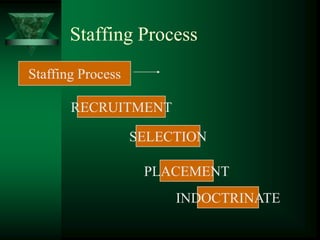
Staffing Process
Staffing Process
RECRUITMENT
SELECTION
PLACEMENT
INDOCTRINATE
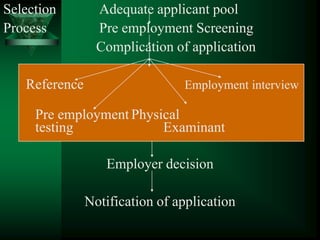
Selection Adequate applicant pool
Process Pre employment Screening
Complication of application
Reference Employment interview
Pre employment Physical
testing Examinant
Employer decision
Notification of application
Recruitment
Process of attracting the potential
employees to the organisation

Sources of recruitment
Internal sources
External sources
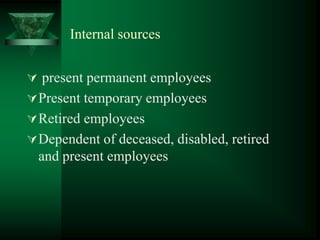
Internal sources
 present permanent employees
Present temporary employees
Retired employees
Dependent of deceased, disabled, retired
and present employees
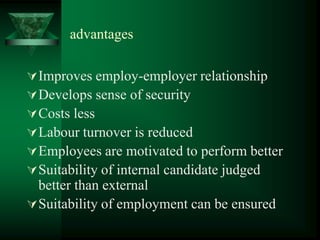
advantages
Improves employ-employer relationship
Develops sense of security
Costs less
Labour turnover is reduced
Employees are motivated to perform better
Suitability of internal candidate judged
better than external
Suitability of employment can be ensured
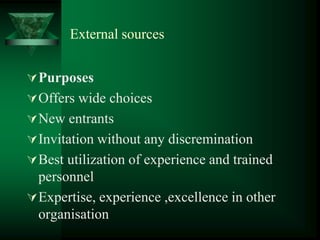
External sources
Purposes
Offers wide choices
New entrants
Invitation without any discremination
Best utilization of experience and trained
personnel
Expertise, experience ,excellence in other
organisation
sources
Campus recruitment
Own data bank
Advertisements
Third party method-employment exchange
Present employer
Deputation
Word of mouth—present employees
Trade union
Casual applicant
Educational institutions—placement cell
Recruitment process
Identifying the need to recruit
Identifying the job requirements
Deciding the sources of potential recruits
Deciding the selectionmethod
Short listing the candidates
Selection of the succesful candidates
Notifying the candidates of outcome
Appointing the succesful candidate
Selection
Selection is the process of choosing the
right candidate from the pool of applicants
Steps of selection
Screening and receiving the application
Conducting preliminary screening interview
Psychological tests
Background investigation
Indepth Interview
Physical examination/medical examination
Final selection
placement
Training and development
Is the process of developing
knowledge,skills and behaviour in people
that enable them to better perform their
current and future jobs
Training techniques
On the job
Off the job
On the job training
Coaching
Job rotation
Planned work activities
Off the job
Class room lecture
Case studies
Roleplaying
Programmed learning
Performance appraisal
Evaluating a workers performance and his
potential for development
Done through--- ranking method
 ratingscale
Peer review
Anecdotal record
checklist
Recruitment and selection of students
1. Admission policies—policies based on
kind of programme .
Carefully formulated and made known to
the person concerned with selection,
recruitment
Policies in relation to academic
qualification
What will be the educational requirement
for admission be the minimum required by
the statutory bodies
Are any specific subjects required, like
science, english
May any of the requirements be relaxed
under special circumstances ? If so what are
these?
Relation to personal and social
fitness
Will there be maximum age limit?if so
under what circumstances may it be
relaxed?
Will married students be eligible for
admission ?
Will male candidates be admitted?
Do the philosophy of the school requiees
the candidate to have any personal
qualification ?
Is admission subject to satisfactory medical
others
Will student be admittted from other school
or college
Ploicie regarding repeatedly failure of the
students in the final exam and not eligible.
Will they go home and come for exam or
will they be permitted tocontinue with the
junior students
2. Recruitment of the student
Notification in the local/national dailies or
other media
Students with good aptitude ,interest can
apply
Talks on t. v. through feature film on
nursing ,publishing article in the journals,
Individual college can do this by various
ways
Conducting function in which selected
members of the public participate
Broad casting such function in the radio, T.
V. news paper, journals etc.
Arranging talk by the nursing college in the
community organisation ,local school and
colleges
Arranging or celebrating important events
Publishing articles reports and pictures of
the activites in the local press.
Publication of the college brochure
Selection of students
1.Selection policies
How much and what information required
Whethe medical certificate be produced by
the student
Who all will be the members of the
selection committee
Will there be any interview
Will there be any aptitude test
2. application form
It is the administrative responsibility,
handled by the clerical staff under the
direction of administrative head
Analyze the entrance test,
Assessing the academic achievement
Information in the application form
3. selection committee
Representatives of the college
Head of the college
Nursing professors
Representative of the local controlling
authority
Educational psychologist
4. procedure
personal interview
Interview with the parents
Written test
Medical report
After the selection
Orientation programme
Staff recruitment and selection
Recruitment procedure
Selection procedure
Staffing pattern as per INC
After the selection
Orientation
Placement
Job description
Staff welfare programme
Inservice education

Staffing

  • 1.
  • 2.
    Meaning Staffing means numberand composition of personnel assigned to work on a unit at a given time
  • 3.
    Definition According to Koontz,O’donnell and weihrich staffing involves manning the organisational structure through proper and effective selection ,appraisal estimate and development of personnel to fill the roles designed in to the structure
  • 5.
    staffing Definition –staffing isthe systematic approach to the problem of selecting training , motivating ,and retaining professional and non professional personal in any organisation. It involves manpower planning to have the right person in the right placeand avoid square peg in round hole.
  • 6.
    Reasons increased thesignificance of staffing Advancement of technology Increased size of the organisation Long range need for manpower-future labour turn over
  • 7.
    High wage bill---if right type of person is not appointed then management has to spend on wages and procedure ,even though poor work out put Recognition of human relations –financial and nonfinancial incentives
  • 8.
    Factors influencing staffingpattern Pattern of delivery services Standard of nursing care Different type of activties performed Size and type of unit
  • 9.
    Philosophy Nursing administrators believethat It is possible to match employees knowledge and skill to patient care needs in a manner that optimises job satisfaction and care quality. The technical and humanistic care needs of critically ill patients are so complex that all aspects of that care should be provided by professional nurse
  • 10.
    The health teachingand rehabilitation needs of chronically ill patients are so complex that direct care for chronically ill patients should be provided by professional and technical nurses. That patient assignment , work quantification and job analysis should be used to determine the number of personal in each category to be assigned to care for patients of each type
  • 11.
    That a masterstaffing plan and policies to implement the plan in all units should be developed centrally by nursing heads and staff of the hospital Staffing plan should be administered at the unit level by the head nurse so that selected plan details such as shift start time, number of staff assigned on holidays
  • 12.
    objectives Provide a professionalstaff nurse in critical care unit operating room and emergency unit Provide sufficient staff to permit a 1:1 nurse patient ratio for each shift in critical care unit Staff the general medical surgical paediatric maternity and psychiatric units to achieve 2:1 ratio
  • 13.
    Provide sufficient ingeneral medical surgical units to permit 1:5 nurse patient ratio on a day and afternoon shift and 1:10 on night shift Involve the head nurse and all nursing person designing the departments staffing programmes design a staffing plan that specifies number of personal in each classification assigned to each ward in each shift
  • 14.
    Head nurse isresponsible for translating master plan to weekly schedule Empower head nurse to adjust extra personal Reward employee for long time services
  • 15.
    Principles for staffingnurses  A] patient care unit related  Appropriate staffing levls reflects analisis of individual patient and agrigate patient needs  There is a clinical need to either retire or soriously question the usefulness of the concept of nursing hours per patient per day  Unit functions necessary to support delivery of quality patient care must also be considered in determining the staffing levels
  • 16.
    Staff related The specificneeds of various patient populations should determine the appropriate clinical competencies required of the nurse practicing in that area
  • 17.
  • 18.
  • 19.
    Selection Adequate applicantpool Process Pre employment Screening Complication of application Reference Employment interview Pre employment Physical testing Examinant Employer decision Notification of application
  • 20.
    Recruitment Process of attractingthe potential employees to the organisation 
  • 21.
    Sources of recruitment Internalsources External sources
  • 22.
    Internal sources  presentpermanent employees Present temporary employees Retired employees Dependent of deceased, disabled, retired and present employees
  • 23.
    advantages Improves employ-employer relationship Developssense of security Costs less Labour turnover is reduced Employees are motivated to perform better Suitability of internal candidate judged better than external Suitability of employment can be ensured
  • 24.
    External sources Purposes Offers widechoices New entrants Invitation without any discremination Best utilization of experience and trained personnel Expertise, experience ,excellence in other organisation
  • 25.
    sources Campus recruitment Own databank Advertisements Third party method-employment exchange Present employer Deputation Word of mouth—present employees Trade union Casual applicant Educational institutions—placement cell
  • 26.
    Recruitment process Identifying theneed to recruit Identifying the job requirements Deciding the sources of potential recruits Deciding the selectionmethod Short listing the candidates Selection of the succesful candidates Notifying the candidates of outcome Appointing the succesful candidate
  • 27.
    Selection Selection is theprocess of choosing the right candidate from the pool of applicants
  • 28.
    Steps of selection Screeningand receiving the application Conducting preliminary screening interview Psychological tests Background investigation Indepth Interview Physical examination/medical examination Final selection placement
  • 29.
    Training and development Isthe process of developing knowledge,skills and behaviour in people that enable them to better perform their current and future jobs
  • 30.
  • 31.
    On the jobtraining Coaching Job rotation Planned work activities
  • 32.
    Off the job Classroom lecture Case studies Roleplaying Programmed learning
  • 33.
    Performance appraisal Evaluating aworkers performance and his potential for development Done through--- ranking method  ratingscale Peer review Anecdotal record checklist
  • 34.
    Recruitment and selectionof students 1. Admission policies—policies based on kind of programme . Carefully formulated and made known to the person concerned with selection, recruitment
  • 35.
    Policies in relationto academic qualification What will be the educational requirement for admission be the minimum required by the statutory bodies Are any specific subjects required, like science, english May any of the requirements be relaxed under special circumstances ? If so what are these?
  • 36.
    Relation to personaland social fitness Will there be maximum age limit?if so under what circumstances may it be relaxed? Will married students be eligible for admission ? Will male candidates be admitted? Do the philosophy of the school requiees the candidate to have any personal qualification ? Is admission subject to satisfactory medical
  • 37.
    others Will student beadmittted from other school or college Ploicie regarding repeatedly failure of the students in the final exam and not eligible. Will they go home and come for exam or will they be permitted tocontinue with the junior students
  • 38.
    2. Recruitment ofthe student Notification in the local/national dailies or other media Students with good aptitude ,interest can apply Talks on t. v. through feature film on nursing ,publishing article in the journals,
  • 39.
    Individual college cando this by various ways Conducting function in which selected members of the public participate Broad casting such function in the radio, T. V. news paper, journals etc. Arranging talk by the nursing college in the community organisation ,local school and colleges Arranging or celebrating important events
  • 40.
    Publishing articles reportsand pictures of the activites in the local press. Publication of the college brochure
  • 41.
    Selection of students 1.Selectionpolicies How much and what information required Whethe medical certificate be produced by the student Who all will be the members of the selection committee Will there be any interview Will there be any aptitude test
  • 42.
    2. application form Itis the administrative responsibility, handled by the clerical staff under the direction of administrative head Analyze the entrance test, Assessing the academic achievement
  • 43.
    Information in theapplication form 3. selection committee Representatives of the college Head of the college Nursing professors Representative of the local controlling authority Educational psychologist
  • 44.
    4. procedure personal interview Interviewwith the parents Written test Medical report
  • 45.
  • 46.
    Staff recruitment andselection Recruitment procedure Selection procedure Staffing pattern as per INC After the selection Orientation Placement Job description Staff welfare programme Inservice education