Scheduling/Rostering Staffing Guide
Performance Standards Standards required-levels of performance that establish the  quality  of the work that must be done. Performance standards state not only  what  must be done; they also describe in detail  how  the job must be done.  The key to consistency are the performance standards which are developed, communicated and managed.
Productivity Standards Productivity standards determine the acceptable “ quantity ” of work to be done by department employees. How long should it take for a department employee to perform an assigned task according to the department’s performance standard? Productivity standards must be determined in order to properly staff the department within the  limitations established by the hotel’s operating budget plan .
Performance & Productivity Standards The challenge is to  effectively balance  performance and productivity standards. Quality and quantity need not be a double edge sword; instead, each can serve to check and balance the other.  A concern for productivity may not necessarily lower performance standards-it can  sharpen  and  refine  current work methods and procedures.
Scheduling Labour is the greatest single accommodation expense. Overstaffing results in excessive labour costs that decrease hotel profits. Understaffing decreases labour costs-it may also decrease hotel profits-performance standards will not be met-dissatisfied guests and lost business.
Effective Scheduling Determine which positions within accommodation are fixed and which are variable in relation to occupancy levels within the hotel. Fixed Staff Positions : Generally managerial and administrative in nature-usually a 40 hour week. Variable Staff Positions :
Effective Scheduling Variable Staff Positions include : Floor Supervisors Room Attendants (day and afternoon shifts) HousePersons (day and afternoon shifts) Lobby Attendants
Staffing Guide Refer to Handout
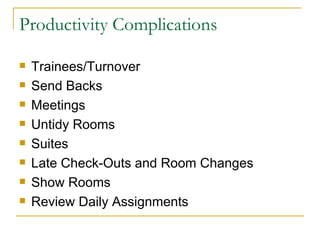
Productivity Complications Trainees/Turnover Send Backs Meetings Untidy Rooms Suites Late Check-Outs and Room Changes Show Rooms Review Daily Assignments
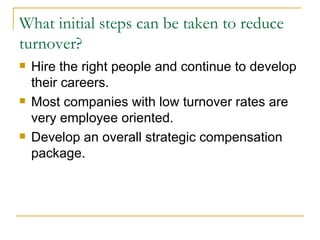
What initial steps can be taken to reduce turnover? Hire the right people and continue to develop their careers. Most companies with low turnover rates are very employee oriented. Develop an overall strategic compensation package.
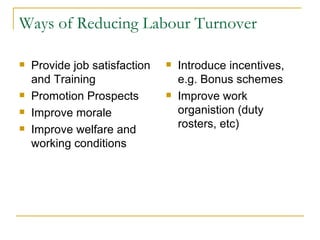
Ways of Reducing Labour Turnover Provide job satisfaction and Training Promotion Prospects Improve morale Improve welfare and working conditions Introduce incentives, e.g. Bonus schemes Improve work organistion (duty rosters, etc)
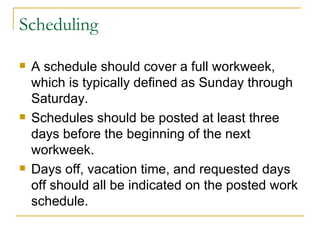
Scheduling  A schedule should cover a full workweek, which is typically defined as Sunday through Saturday. Schedules should be posted at least three days before the beginning of the next workweek. Days off, vacation time, and requested days off should all be indicated on the posted work schedule.
Downtime The length of time that a position is vacant until a new employee who can fully perform the job fills it.  Once an employee resigns, depending on your employer’s procedure, you may fill out an employment requisition form. A requisition is something like a purchase order that must be signed by an appropriate person.
To Reduce Downtime Forecast your personnel needs periodically. A Staffing Guide Form can be used every two months to help determine when to hire new employees so that downtime is minimised Staffing guides are based on the budget and expected volume of business.
Before Planning the Duty Roster.. Consider the amount of cover required. Consider the types of shifts. Make sure that all duties are covered. Sufficient cover of all grades of staff-each shift. Fair allocation of weekend work. Take into account break periods.
Different Types of Shift Straight shift Staff work a specified number of hours continuously Split shift Staff normally work a specified number of hours-then have a few hours off duty and return to work Rotating shift Three shifts of 8 hours rotate-6-2,2-10,10-6 Alternating Shift Staff work either a specified number of early and late shifts each week or one week early and one week late.
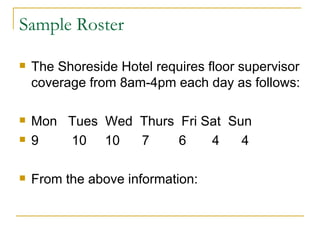
Sample Roster The Shoreside Hotel requires floor supervisor coverage from 8am-4pm each day as follows: Mon  Tues  Wed  Thurs  Fri Sat  Sun 9  10  10  7  6  4  4 From the above information:
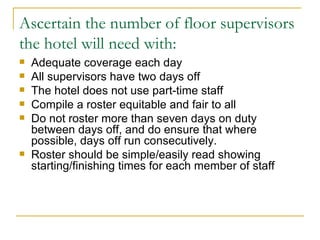
Ascertain the number of floor supervisors the hotel will need with: Adequate coverage each day All supervisors have two days off The hotel does not use part-time staff Compile a roster equitable and fair to all Do not roster more than seven days on duty between days off, and do ensure that where possible, days off run consecutively. Roster should be simple/easily read showing starting/finishing times for each member of staff

Duty rosters lec.2

  • 1.
  • 2.
    Performance Standards Standardsrequired-levels of performance that establish the quality of the work that must be done. Performance standards state not only what must be done; they also describe in detail how the job must be done. The key to consistency are the performance standards which are developed, communicated and managed.
  • 3.
    Productivity Standards Productivitystandards determine the acceptable “ quantity ” of work to be done by department employees. How long should it take for a department employee to perform an assigned task according to the department’s performance standard? Productivity standards must be determined in order to properly staff the department within the limitations established by the hotel’s operating budget plan .
  • 4.
    Performance & ProductivityStandards The challenge is to effectively balance performance and productivity standards. Quality and quantity need not be a double edge sword; instead, each can serve to check and balance the other. A concern for productivity may not necessarily lower performance standards-it can sharpen and refine current work methods and procedures.
  • 5.
    Scheduling Labour isthe greatest single accommodation expense. Overstaffing results in excessive labour costs that decrease hotel profits. Understaffing decreases labour costs-it may also decrease hotel profits-performance standards will not be met-dissatisfied guests and lost business.
  • 6.
    Effective Scheduling Determinewhich positions within accommodation are fixed and which are variable in relation to occupancy levels within the hotel. Fixed Staff Positions : Generally managerial and administrative in nature-usually a 40 hour week. Variable Staff Positions :
  • 7.
    Effective Scheduling VariableStaff Positions include : Floor Supervisors Room Attendants (day and afternoon shifts) HousePersons (day and afternoon shifts) Lobby Attendants
  • 8.
  • 9.
    Productivity Complications Trainees/TurnoverSend Backs Meetings Untidy Rooms Suites Late Check-Outs and Room Changes Show Rooms Review Daily Assignments
  • 10.
    What initial stepscan be taken to reduce turnover? Hire the right people and continue to develop their careers. Most companies with low turnover rates are very employee oriented. Develop an overall strategic compensation package.
  • 11.
    Ways of ReducingLabour Turnover Provide job satisfaction and Training Promotion Prospects Improve morale Improve welfare and working conditions Introduce incentives, e.g. Bonus schemes Improve work organistion (duty rosters, etc)
  • 12.
    Scheduling Aschedule should cover a full workweek, which is typically defined as Sunday through Saturday. Schedules should be posted at least three days before the beginning of the next workweek. Days off, vacation time, and requested days off should all be indicated on the posted work schedule.
  • 13.
    Downtime The lengthof time that a position is vacant until a new employee who can fully perform the job fills it. Once an employee resigns, depending on your employer’s procedure, you may fill out an employment requisition form. A requisition is something like a purchase order that must be signed by an appropriate person.
  • 14.
    To Reduce DowntimeForecast your personnel needs periodically. A Staffing Guide Form can be used every two months to help determine when to hire new employees so that downtime is minimised Staffing guides are based on the budget and expected volume of business.
  • 15.
    Before Planning theDuty Roster.. Consider the amount of cover required. Consider the types of shifts. Make sure that all duties are covered. Sufficient cover of all grades of staff-each shift. Fair allocation of weekend work. Take into account break periods.
  • 16.
    Different Types ofShift Straight shift Staff work a specified number of hours continuously Split shift Staff normally work a specified number of hours-then have a few hours off duty and return to work Rotating shift Three shifts of 8 hours rotate-6-2,2-10,10-6 Alternating Shift Staff work either a specified number of early and late shifts each week or one week early and one week late.
  • 17.
    Sample Roster TheShoreside Hotel requires floor supervisor coverage from 8am-4pm each day as follows: Mon Tues Wed Thurs Fri Sat Sun 9 10 10 7 6 4 4 From the above information:
  • 18.
    Ascertain the numberof floor supervisors the hotel will need with: Adequate coverage each day All supervisors have two days off The hotel does not use part-time staff Compile a roster equitable and fair to all Do not roster more than seven days on duty between days off, and do ensure that where possible, days off run consecutively. Roster should be simple/easily read showing starting/finishing times for each member of staff