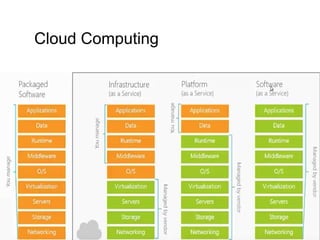
Cloud Computing
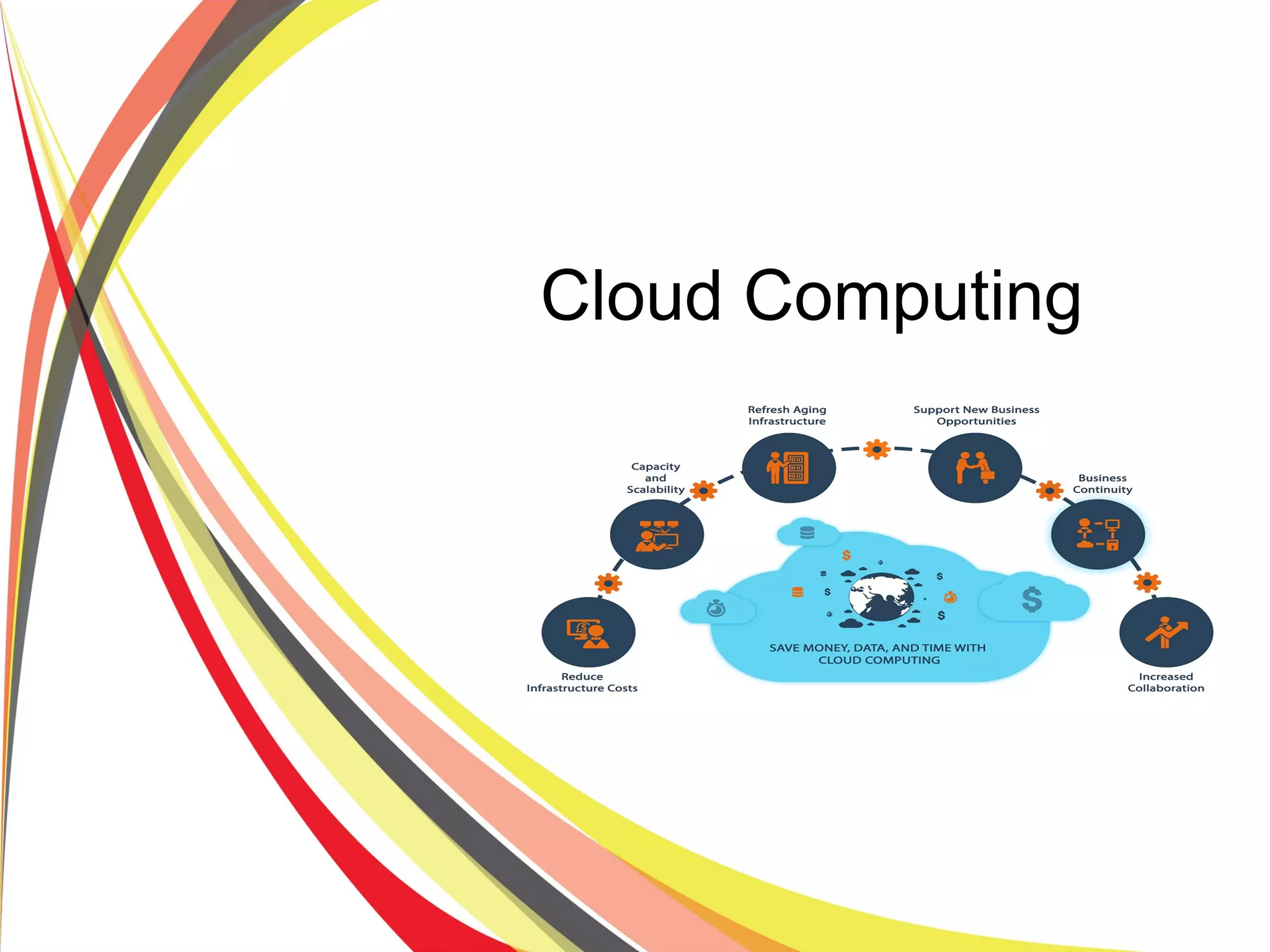
Cloud Computing
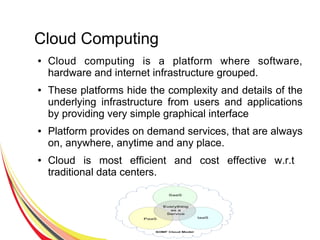
● Cloud computing is a platform where software,
hardware and internet infrastructure grouped.
● These platforms hide the complexity and details of the
underlying infrastructure from users and applications
by providing very simple graphical interface
● Platform provides on demand services, that are always
on, anywhere, anytime and any place.
● Cloud is most efficient and cost effective w.r.t
traditional data centers.
Cloud Characteristics
● On demand self-service
● Broad network access
● Resource pooling (Storage, processing, memory etc.)
● Rapid elasticity
● Measured services
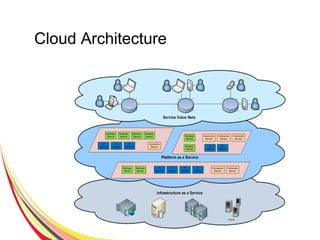
Cloud Architecture
Service Models
● Software as a Service (SaaS)
– Allows users to run existing online application.
– From end user’s point of view applications are
located in the cloud and software delivered through
the Internet.
● Advantages:
– Free or paid applications via subscription over the
internet.
– Accessible application from any where any time
through internet.
– Facilitate collaborative working.
● Disadvantage: Generic applications not always
suitable for business use.
Service Models ...
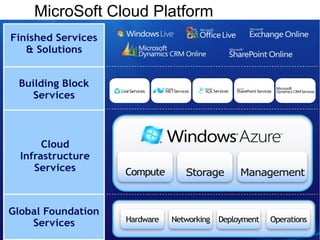
● Platform as a Service (PaaS)
– Allows users to create their own tools for creating
new online applications (Google App Engine,
Windows Azure Platform etc.)
● Advantages:
– Rapid development at low cost.
– Private or public deployment.
● Disadvantage:
– Limit developers to provide languages and tools.
Service Models ...
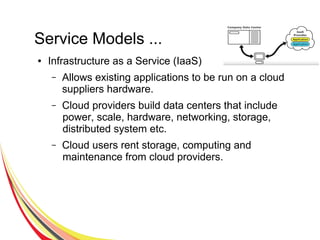
● Infrastructure as a Service (IaaS)
– Allows existing applications to be run on a cloud
suppliers hardware.
– Cloud providers build data centers that include
power, scale, hardware, networking, storage,
distributed system etc.
– Cloud users rent storage, computing and
maintenance from cloud providers.ho want to create
services but don't want to build their own cloud
Cloud Computing
MicroSoft Cloud Platform
Cloud Deployment Models
● Private Cloud:
– The cloud infrastructure is dedicated for single
organization.
– Cloud may be owned, managed, and operated by
the organization, a third party, or some combination
of them.
– It may exist on or off premises.
– Can be a single or multi site deployment.
●
Private Cloud Advantages:
– Fewer security concerns as existing data center
security stays in place.
– IT organization retains control over data center.
Cloud Deployment Models ...
●
Private Cloud Risks:
– High investment hurdle in private cloud
implementation, along with purchases of new
hardware and software.
– Require greater skill-set to manage the private cloud.
Cloud Deployment Models ...
● Public Cloud:
– The cloud infrastructure is provisioned for open use
by the general public.
– It may be owned, managed, and operated by a
business, academic, or government organization, or
some combination of them.
– It exists on the premises of the cloud provider.
– Normally includes pay-as-you-go pricing.
● Public Cloud Advantages:
– Low investment hurdle: pay for what you use.
– Good for test/development environment for applications
that scale to many servers.
Cloud Deployment Models ...
● Public Cloud Risks:
– Security concerns: multi-tenancy and transfers over the
Internet.
– IT organization may react negatively to loss of control
over data center function.
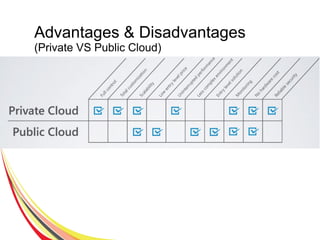
Advantages & Disadvantages
(Private VS Public Cloud)
Cloud Deployment Models ...
● Hybrid Cloud:
– The cloud infrastructure is a composition of two or
more distinct cloud infrastructures (private, public).
– Its deployed on multiple sites.
● Hybrid Cloud Advantages:
– Operational flexibility: run mission critical on private
cloud, dev/test on public cloud.
– Scalability: run peak and bursty workloads on the
public cloud.
● Hybrid Cloud Risks:
– Still under study and not in real use.
– Same security concerns as in public cloud.
Cloud Deployment Models ...
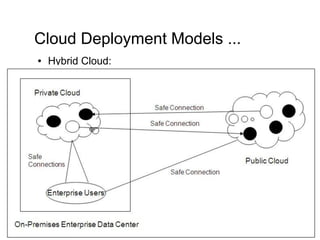
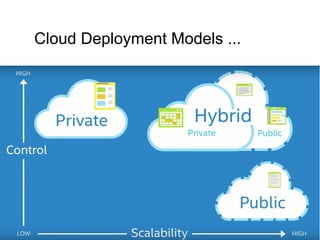
● Hybrid Cloud:
Cloud Deployment Models ...
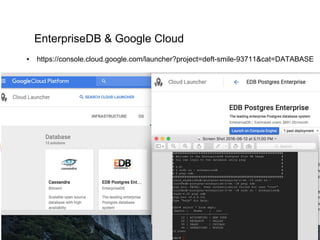
EnterpriseDB & Google Cloud
● https://console.cloud.google.com/launcher?project=deft-smile-93711&cat=DATABASE
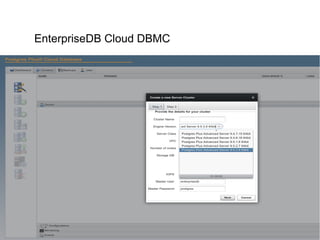
EnterpriseDB Cloud DBMC

Cloud computing & dbms

  • 1.
  • 2.
    Cloud Computing ● Cloudcomputing is a platform where software, hardware and internet infrastructure grouped. ● These platforms hide the complexity and details of the underlying infrastructure from users and applications by providing very simple graphical interface ● Platform provides on demand services, that are always on, anywhere, anytime and any place. ● Cloud is most efficient and cost effective w.r.t traditional data centers.
  • 3.
    Cloud Characteristics ● Ondemand self-service ● Broad network access ● Resource pooling (Storage, processing, memory etc.) ● Rapid elasticity ● Measured services
  • 4.
  • 5.
    Service Models ● Softwareas a Service (SaaS) – Allows users to run existing online application. – From end user’s point of view applications are located in the cloud and software delivered through the Internet. ● Advantages: – Free or paid applications via subscription over the internet. – Accessible application from any where any time through internet. – Facilitate collaborative working. ● Disadvantage: Generic applications not always suitable for business use.
  • 6.
    Service Models ... ●Platform as a Service (PaaS) – Allows users to create their own tools for creating new online applications (Google App Engine, Windows Azure Platform etc.) ● Advantages: – Rapid development at low cost. – Private or public deployment. ● Disadvantage: – Limit developers to provide languages and tools.
  • 7.
    Service Models ... ●Infrastructure as a Service (IaaS) – Allows existing applications to be run on a cloud suppliers hardware. – Cloud providers build data centers that include power, scale, hardware, networking, storage, distributed system etc. – Cloud users rent storage, computing and maintenance from cloud providers.ho want to create services but don't want to build their own cloud
  • 8.
  • 9.
  • 10.
    Cloud Deployment Models ●Private Cloud: – The cloud infrastructure is dedicated for single organization. – Cloud may be owned, managed, and operated by the organization, a third party, or some combination of them. – It may exist on or off premises. – Can be a single or multi site deployment. ● Private Cloud Advantages: – Fewer security concerns as existing data center security stays in place. – IT organization retains control over data center.
  • 11.
    Cloud Deployment Models... ● Private Cloud Risks: – High investment hurdle in private cloud implementation, along with purchases of new hardware and software. – Require greater skill-set to manage the private cloud.
  • 12.
    Cloud Deployment Models... ● Public Cloud: – The cloud infrastructure is provisioned for open use by the general public. – It may be owned, managed, and operated by a business, academic, or government organization, or some combination of them. – It exists on the premises of the cloud provider. – Normally includes pay-as-you-go pricing. ● Public Cloud Advantages: – Low investment hurdle: pay for what you use. – Good for test/development environment for applications that scale to many servers.
  • 13.
    Cloud Deployment Models... ● Public Cloud Risks: – Security concerns: multi-tenancy and transfers over the Internet. – IT organization may react negatively to loss of control over data center function.
  • 14.
  • 15.
    Cloud Deployment Models... ● Hybrid Cloud: – The cloud infrastructure is a composition of two or more distinct cloud infrastructures (private, public). – Its deployed on multiple sites. ● Hybrid Cloud Advantages: – Operational flexibility: run mission critical on private cloud, dev/test on public cloud. – Scalability: run peak and bursty workloads on the public cloud. ● Hybrid Cloud Risks: – Still under study and not in real use. – Same security concerns as in public cloud.
  • 16.
    Cloud Deployment Models... ● Hybrid Cloud:
  • 17.
  • 18.
    EnterpriseDB & GoogleCloud ● https://console.cloud.google.com/launcher?project=deft-smile-93711&cat=DATABASE
  • 19.