
Certified Scrum Master
(A Practical Guide)
By: Zaid Shabbir

zaidshabbir@gmail.com
Contents
• Bird Eye View
• Scrum Workflow
• Scrum Team
• Scrum Events
• Scrum Artifacts
• Other Concepts
• Self Assessment
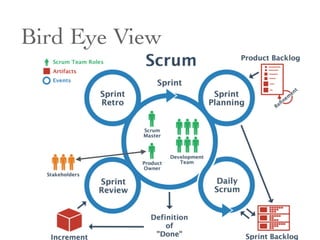
Bird Eye View
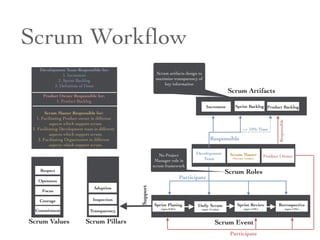
Scrum Values
Commitment
Courage
Focus
Openness
Respect
Scrum Pillars
Transparency
Inspection
Adoption
Scrum Event
Scrum Artifacts
Scrum Roles
Product BacklogSprint BacklogIncrement
Development
Team

Responsible
Scrum Master

(Servant Leader)
Product Owner
Sprint Planing

(upto 8 Hr)
Daily Scrum

(upto 15 min)
Sprint Review

(upto 4 Hr)
Retrospective

(upto 3 Hr)
<= 10% Time
Responsible
Development Team Responsible for:

1. Increment

2. Sprint Backlog

3. Definition of Done

Product Owner Responsible for:

1. Product Backlog


Scrum Master Responsible for:

1. Facilitating Product owner in different 

aspects which support scrum.

2. Facilitating Development team in different 

aspects which support scrum.

3. Facilitating Organization in different
aspects which support scrum.
 Support
Participate
Participate
Scrum artifacts design to
maximize transparency of
key information
No Project
Manager role in
scrum framework
Scrum Workflow
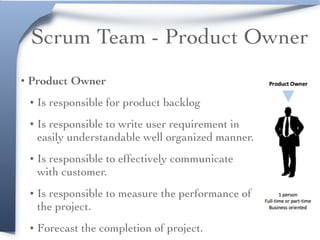
Scrum Team - Product Owner
• Product Owner
• Is responsible for product backlog
• Is responsible to write user requirement in
easily understandable well organized manner.
• Is responsible to effectively communicate
with customer.
• Is responsible to measure the performance of
the project.
• Forecast the completion of project.
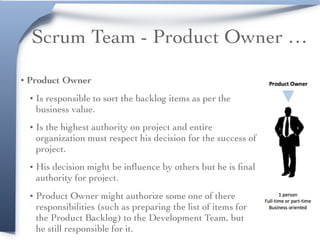
Scrum Team - Product Owner …
• Product Owner
• Is responsible to sort the backlog items as per the
business value.
• Is the highest authority on project and entire
organization must respect his decision for the success of
project.
• His decision might be influence by others but he is final
authority for project.
• Product Owner might authorize some one of there
responsibilities (such as preparing the list of items for
the Product Backlog) to the Development Team, but
he still responsible for it.
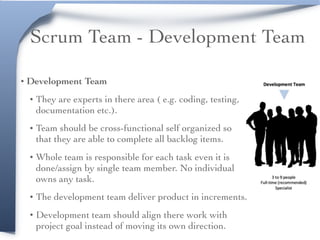
Scrum Team - Development Team
• Development Team
• They are experts in there area ( e.g. coding, testing,
documentation etc.).
• Team should be cross-functional self organized so
that they are able to complete all backlog items.
• Whole team is responsible for each task even it is
done/assign by single team member. No individual
owns any task.
• The development team deliver product in increments.
• Development team should align there work with
project goal instead of moving its own direction.
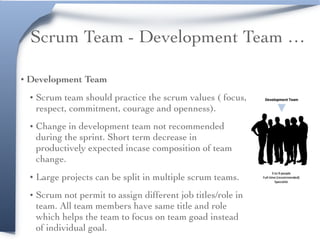
Scrum Team - Development Team …
• Development Team
• Scrum team should practice the scrum values ( focus,
respect, commitment, courage and openness).
• Change in development team not recommended
during the sprint. Short term decrease in
productively expected incase composition of team
change.
• Large projects can be split in multiple scrum teams.
• Scrum not permit to assign different job titles/role in
team. All team members have same title and role
which helps the team to focus on team goad instead
of individual goal.
Scrum Team - Scrum Master
• Scrum Master
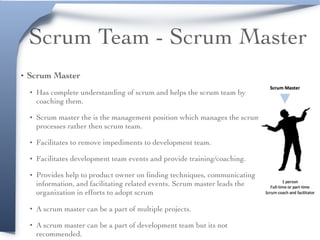
• Has complete understanding of scrum and helps the scrum team by
coaching them.
• Scrum master the is the management position which manages the scrum
processes rather then scrum team.
• Facilitates to remove impediments to development team.
• Facilitates development team events and provide training/coaching.
• Provides help to product owner on finding techniques, communicating
information, and facilitating related events. Scrum master leads the
organization in efforts to adopt scrum
• A scrum master can be a part of multiple projects.
• A scrum master can be a part of development team but its not
recommended.
Scrum Team - Scrum Master …
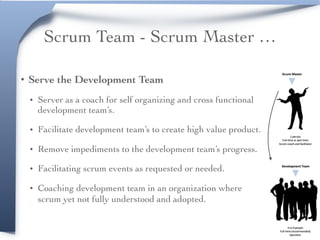
• Serve the Development Team
• Server as a coach for self organizing and cross functional
development team’s.
• Facilitate development team’s to create high value product.
• Remove impediments to the development team’s progress.
• Facilitating scrum events as requested or needed.
• Coaching development team in an organization where
scrum yet not fully understood and adopted. 

Scrum Team - Scrum Master …
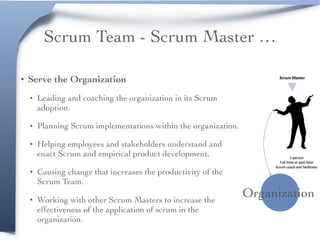
• Serve the Organization
• Leading and coaching the organization in its Scrum
adoption.
• Planning Scrum implementations within the organization.
• Helping employees and stakeholders understand and
enact Scrum and empirical product development.
• Causing change that increases the productivity of the
Scrum Team.
• Working with other Scrum Masters to increase the
effectiveness of the application of scrum in the
organization.
Organization
Scrum Events
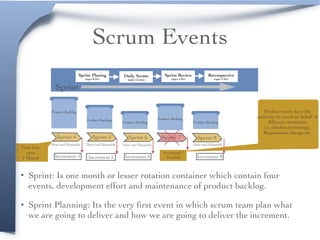
• Sprint: Is one month or lesser rotation container which contain four
events, development effort and maintenance of product backlog.
• Sprint Planning: Its the very first event in which scrum team plan what
we are going to deliver and how we are going to deliver the increment.
Sprint Planing

(upto 8 Hr)
Daily Scrum

(upto 15 min)
Sprint Review

(upto 4 Hr)
Retrospective

(upto 3 Hr)
Sprint
Sprint 4 Sprint 5 Sprint 6 Sprint 7 Sprint 8
Increment 4 Increment 5 Increment 6
Increment 7

Possible Increment 8
Product owner have the 

authority to cancel on behalf of
different constraints 

i.e. obsolete technology, 

Requirement change etc.
Time box,
upto 

1 Month
Done and Shippable Done and Shippable Done and Shippable
Product Backlog
Done and Shippable
Product Backlog
Product Backlog
Product Backlog
Product Backlog
Scrum Events …
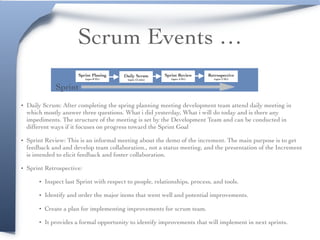
• Daily Scrum: After completing the spring planning meeting development team attend daily meeting in
which mostly answer three questions. What i did yesterday, What i will do today and is there any
impediments. The structure of the meeting is set by the Development Team and can be conducted in
different ways if it focuses on progress toward the Sprint Goal
• Sprint Review: This is an informal meeting about the demo of the increment. The main purpose is to get
feedback and and develop team collaboration., not a status meeting, and the presentation of the Increment
is intended to elicit feedback and foster collaboration.
• Sprint Retrospective:
• Inspect last Sprint with respect to people, relationships, process, and tools.
• Identify and order the major items that went well and potential improvements.
• Create a plan for implementing improvements for scrum team.
• It provides a formal opportunity to identify improvements that will implement in next sprints.
Sprint Planing

(upto 8 Hr)
Daily Scrum

(upto 15 min)
Sprint Review

(upto 4 Hr)
Retrospective

(upto 3 Hr)
Sprint
Scrum Artifacts …
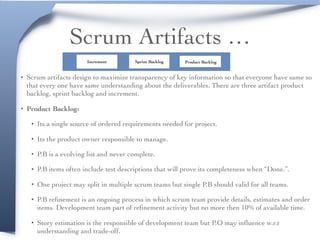
• Scrum artifacts design to maximize transparency of key information so that everyone have same so
that every one have same understanding about the deliverables. There are three artifact product
backlog, sprint backlog and increment.
• Product Backlog:
• Its a single source of ordered requirements needed for project.
• Its the product owner responsible to manage.
• P.B is a evolving list and never complete.
• P.B items often include test descriptions that will prove its completeness when “Done.”.
• One project may split in multiple scrum teams but single P.B should valid for all teams.
• P.B refinement is an ongoing process in which scrum team provide details, estimates and order
items. Development team part of refinement activity but no more then 10% of available time.
• Story estimation is the responsible of development team but P.O may influence w.r.t
understanding and trade-off.
Product BacklogSprint BacklogIncrement
Scrum Artifacts …
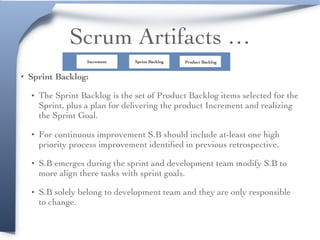
• Sprint Backlog:
• The Sprint Backlog is the set of Product Backlog items selected for the
Sprint, plus a plan for delivering the product Increment and realizing
the Sprint Goal.
• For continuous improvement S.B should include at-least one high
priority process improvement identified in previous retrospective.
• S.B emerges during the sprint and development team modify S.B to
more align there tasks with sprint goals.
• S.B solely belong to development team and they are only responsible
to change.
Product BacklogSprint BacklogIncrement
Scrum Artifacts …
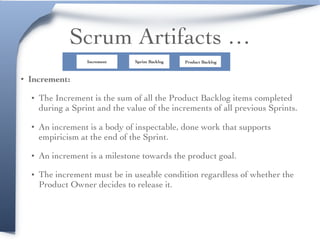
• Increment:
• The Increment is the sum of all the Product Backlog items completed
during a Sprint and the value of the increments of all previous Sprints.
• An increment is a body of inspectable, done work that supports
empiricism at the end of the Sprint.
• An increment is a milestone towards the product goal.
• The increment must be in useable condition regardless of whether the
Product Owner decides to release it.
Product BacklogSprint BacklogIncrement
Other Concepts
• Definition of Done: A shared understanding of expectations that
software must live up to in order to be releasable into production.
Managed by the Development Team.
• Monitoring Progress towards a Project Goal: Is the responsible of
product owner to monitor the progress towards the project goal.
• Monitoring Sprint Progress: Development team is responsible to
monitor the sprint progress towards the achievement of sprint goal.
• Velocity: An optional, but often used, indication of the average amount
of Product Backlog turned into an Increment of product during a Sprint
by a Scrum Team, tracked by the Development Team for use within the
Scrum Team.
Other Concepts …
• Increment: A piece of working software that adds to previously created
Increments, where the sum of all Increments -as a whole - form a product.
• Burn-Down Chart: A chart showing the evolution of remaining effort
against time. Burn-down charts are an optional implementation within
Scrum to make progress transparent.
• Main Qualities of Scrum Team Model:
• Flexibility
• Creativity
• Productivity
Self Assessment
• You can asses your scrum knowledge through free
assessment links.
• Assessment 1
• Assessment 2
• You can download official scrum guide from link.
• Scrum Guide
Get Certified Scrum Master
• Now after passing assessment 1 & 2 exams you will
be able to pass PSM -I & II examination. In case of
any query feel free to contact me on
zaidshabbir@gmail.com
• Examination Link

Software Development Guide To Accelerate Performance

  • 1.
    Certified Scrum Master (APractical Guide) By: Zaid Shabbir
 zaidshabbir@gmail.com
  • 2.
    Contents • Bird EyeView • Scrum Workflow • Scrum Team • Scrum Events • Scrum Artifacts • Other Concepts • Self Assessment
  • 3.
  • 4.
    Scrum Values Commitment Courage Focus Openness Respect Scrum Pillars Transparency Inspection Adoption ScrumEvent Scrum Artifacts Scrum Roles Product BacklogSprint BacklogIncrement Development Team
 Responsible Scrum Master
 (Servant Leader) Product Owner Sprint Planing
 (upto 8 Hr) Daily Scrum
 (upto 15 min) Sprint Review
 (upto 4 Hr) Retrospective
 (upto 3 Hr) <= 10% Time Responsible Development Team Responsible for:
 1. Increment
 2. Sprint Backlog
 3. Definition of Done
 Product Owner Responsible for:
 1. Product Backlog

 
 Scrum Master Responsible for:
 1. Facilitating Product owner in different 
 aspects which support scrum.
 2. Facilitating Development team in different 
 aspects which support scrum.
 3. Facilitating Organization in different aspects which support scrum.
 Support Participate Participate Scrum artifacts design to maximize transparency of key information No Project Manager role in scrum framework Scrum Workflow
  • 5.
    Scrum Team -Product Owner • Product Owner • Is responsible for product backlog • Is responsible to write user requirement in easily understandable well organized manner. • Is responsible to effectively communicate with customer. • Is responsible to measure the performance of the project. • Forecast the completion of project.
  • 6.
    Scrum Team -Product Owner … • Product Owner • Is responsible to sort the backlog items as per the business value. • Is the highest authority on project and entire organization must respect his decision for the success of project. • His decision might be influence by others but he is final authority for project. • Product Owner might authorize some one of there responsibilities (such as preparing the list of items for the Product Backlog) to the Development Team, but he still responsible for it.
  • 7.
    Scrum Team -Development Team • Development Team • They are experts in there area ( e.g. coding, testing, documentation etc.). • Team should be cross-functional self organized so that they are able to complete all backlog items. • Whole team is responsible for each task even it is done/assign by single team member. No individual owns any task. • The development team deliver product in increments. • Development team should align there work with project goal instead of moving its own direction.
  • 8.
    Scrum Team -Development Team … • Development Team • Scrum team should practice the scrum values ( focus, respect, commitment, courage and openness). • Change in development team not recommended during the sprint. Short term decrease in productively expected incase composition of team change. • Large projects can be split in multiple scrum teams. • Scrum not permit to assign different job titles/role in team. All team members have same title and role which helps the team to focus on team goad instead of individual goal.
  • 9.
    Scrum Team -Scrum Master • Scrum Master • Has complete understanding of scrum and helps the scrum team by coaching them. • Scrum master the is the management position which manages the scrum processes rather then scrum team. • Facilitates to remove impediments to development team. • Facilitates development team events and provide training/coaching. • Provides help to product owner on finding techniques, communicating information, and facilitating related events. Scrum master leads the organization in efforts to adopt scrum • A scrum master can be a part of multiple projects. • A scrum master can be a part of development team but its not recommended.
  • 10.
    Scrum Team -Scrum Master … • Serve the Development Team • Server as a coach for self organizing and cross functional development team’s. • Facilitate development team’s to create high value product. • Remove impediments to the development team’s progress. • Facilitating scrum events as requested or needed. • Coaching development team in an organization where scrum yet not fully understood and adopted. 

  • 11.
    Scrum Team -Scrum Master … • Serve the Organization • Leading and coaching the organization in its Scrum adoption. • Planning Scrum implementations within the organization. • Helping employees and stakeholders understand and enact Scrum and empirical product development. • Causing change that increases the productivity of the Scrum Team. • Working with other Scrum Masters to increase the effectiveness of the application of scrum in the organization. Organization
  • 12.
    Scrum Events • Sprint:Is one month or lesser rotation container which contain four events, development effort and maintenance of product backlog. • Sprint Planning: Its the very first event in which scrum team plan what we are going to deliver and how we are going to deliver the increment. Sprint Planing
 (upto 8 Hr) Daily Scrum
 (upto 15 min) Sprint Review
 (upto 4 Hr) Retrospective
 (upto 3 Hr) Sprint Sprint 4 Sprint 5 Sprint 6 Sprint 7 Sprint 8 Increment 4 Increment 5 Increment 6 Increment 7
 Possible Increment 8 Product owner have the 
 authority to cancel on behalf of different constraints 
 i.e. obsolete technology, 
 Requirement change etc. Time box, upto 
 1 Month Done and Shippable Done and Shippable Done and Shippable Product Backlog Done and Shippable Product Backlog Product Backlog Product Backlog Product Backlog
  • 13.
    Scrum Events … •Daily Scrum: After completing the spring planning meeting development team attend daily meeting in which mostly answer three questions. What i did yesterday, What i will do today and is there any impediments. The structure of the meeting is set by the Development Team and can be conducted in different ways if it focuses on progress toward the Sprint Goal • Sprint Review: This is an informal meeting about the demo of the increment. The main purpose is to get feedback and and develop team collaboration., not a status meeting, and the presentation of the Increment is intended to elicit feedback and foster collaboration. • Sprint Retrospective: • Inspect last Sprint with respect to people, relationships, process, and tools. • Identify and order the major items that went well and potential improvements. • Create a plan for implementing improvements for scrum team. • It provides a formal opportunity to identify improvements that will implement in next sprints. Sprint Planing
 (upto 8 Hr) Daily Scrum
 (upto 15 min) Sprint Review
 (upto 4 Hr) Retrospective
 (upto 3 Hr) Sprint
  • 14.
    Scrum Artifacts … •Scrum artifacts design to maximize transparency of key information so that everyone have same so that every one have same understanding about the deliverables. There are three artifact product backlog, sprint backlog and increment. • Product Backlog: • Its a single source of ordered requirements needed for project. • Its the product owner responsible to manage. • P.B is a evolving list and never complete. • P.B items often include test descriptions that will prove its completeness when “Done.”. • One project may split in multiple scrum teams but single P.B should valid for all teams. • P.B refinement is an ongoing process in which scrum team provide details, estimates and order items. Development team part of refinement activity but no more then 10% of available time. • Story estimation is the responsible of development team but P.O may influence w.r.t understanding and trade-off. Product BacklogSprint BacklogIncrement
  • 15.
    Scrum Artifacts … •Sprint Backlog: • The Sprint Backlog is the set of Product Backlog items selected for the Sprint, plus a plan for delivering the product Increment and realizing the Sprint Goal. • For continuous improvement S.B should include at-least one high priority process improvement identified in previous retrospective. • S.B emerges during the sprint and development team modify S.B to more align there tasks with sprint goals. • S.B solely belong to development team and they are only responsible to change. Product BacklogSprint BacklogIncrement
  • 16.
    Scrum Artifacts … •Increment: • The Increment is the sum of all the Product Backlog items completed during a Sprint and the value of the increments of all previous Sprints. • An increment is a body of inspectable, done work that supports empiricism at the end of the Sprint. • An increment is a milestone towards the product goal. • The increment must be in useable condition regardless of whether the Product Owner decides to release it. Product BacklogSprint BacklogIncrement
  • 17.
    Other Concepts • Definitionof Done: A shared understanding of expectations that software must live up to in order to be releasable into production. Managed by the Development Team. • Monitoring Progress towards a Project Goal: Is the responsible of product owner to monitor the progress towards the project goal. • Monitoring Sprint Progress: Development team is responsible to monitor the sprint progress towards the achievement of sprint goal. • Velocity: An optional, but often used, indication of the average amount of Product Backlog turned into an Increment of product during a Sprint by a Scrum Team, tracked by the Development Team for use within the Scrum Team.
  • 18.
    Other Concepts … •Increment: A piece of working software that adds to previously created Increments, where the sum of all Increments -as a whole - form a product. • Burn-Down Chart: A chart showing the evolution of remaining effort against time. Burn-down charts are an optional implementation within Scrum to make progress transparent. • Main Qualities of Scrum Team Model: • Flexibility • Creativity • Productivity
  • 19.
    Self Assessment • Youcan asses your scrum knowledge through free assessment links. • Assessment 1 • Assessment 2 • You can download official scrum guide from link. • Scrum Guide
  • 20.
    Get Certified ScrumMaster • Now after passing assessment 1 & 2 exams you will be able to pass PSM -I & II examination. In case of any query feel free to contact me on zaidshabbir@gmail.com • Examination Link