B.E. CIVIL ENGINEERING.
3rdYEAR
5th SEMESTER
HIGHWAY ENGINEERING(2150601)
SHAIKH MOHD.AMIR N. 150860106062
PRAJAPATI RIYA P. 150860106054
BHANDARI NEENAD H. 150860106006
RATHOD NEHA M. 150860106055
1. Definition
2. Factors affecting stopping sight distance
3. Analysis of stopping sight distance
4. PIEV theory
5. Braking distance
6. Formulas for stopping sight distance
7. Examples
 The minimum sight distance available on a
highway to stop a vehicle at design speed,
safely without any collision with any other
obstruction is called stopping sight distance.
 For the purpose of measuring stopping sight
distance, IRC has suggested the height of eye
level of driver as 1.2 m and the height of the
object as 0.15m above the road surface.
 Factors affecting SSD are:-
1. Speed of vehicles
2. Efficiency of brakes
3. Total reaction time of drivers
4. Frictional resistance between the road and
the tyres
5. Gradient of the road
 The stopping sight distance of the vehicle is the
sum of :
1. Lag distance: The distance travelled by the
vehicle during the total reaction time is known
as lag distance.
lag distance = speed of the vehicle (m/sec)
* total reaction time (secs)
2. Reaction time:The time taken from the instant
the object is visible to the driver to the instant
the brakes are efficiently applied.
 According to PIEV theory the total
reaction of the driver is divided into
four parts:
1. Perception time:The time required
to transmits the sensations
received by the eyes and ears to
the brain with help of nervous
system.
2. Intellection time:The time
required for understanding the
situation
3. Emotion time:The time elapsed
during emotional sensations and
disturbance such as fear, anger,
etc. with reference to the situation.
4. Volition time:The time taken for
the final action.
 Braking distance = v2 / 2gf
where,
v = speed of the vehicle in m/sec
g = acceleration due to gravity = 9.8 m/ sec2
f = coefficient of friction (0.4 to 0.35)
1. When road is without gradient
SSD = v * t + v2 / 2gf
2. When road is with ascending gradient
SSD = v * t + v2 / 2g(f+(n/100))
3.When road is with descending gradient
SSD = v * t + v2 / 2g(f-(n/100))
In case of single lane road with two way traffic,
the value of SSD is doubled.
Q: Calculate the safe SSD for design speed of 50kmph.
a.Two way traffic on a two lane road
b.Two way traffic on a single lane road
Ans: (a)Two way traffic on a two lane road:
v= 50kmph = 50/3.6 = 13.9 m/ sec2
t = 2.5 secs
f = 0.37
g = 9.8 m/ sec
:- SSD = v * t + v2 / 2gf
= 13.9 * 2.5 + 13.92 / 2*9.8*0.37
= 61.39 m
(b) Two way traffic on a single lane road:
:- SSD = 2* 61.39
= 122.78 m
Q: Two cars are approaching from the opposite directions at 90 & 60 kmph. Calculate the
minimum sight distance required to avoid head on collision.
Assume a reaction time of 2.5 secs, coefficient of friction of 0.7 and brake efficiency of
50%.
Ans: SSD = v * t + v2 / 2gf
v1 = 90 kmph = 90/3.6 = 25 m/sec
v2 = 60 kmph = 60/3.6 = 16.67 m/sec
Brake efficiency is 50%, therefore, f = 0.5 *0.7 = 0.35
:- for first car
SSD1 = v * t + v2 / 2gf
= 25 * 2.5 + 252 / 2 * 9.8 * 0.35
= 153.6 m
:- for second car
SSD2 = v * t + v2 / 2gf
= 16.67 * 2.5 + 16.672 / 2 * 9.8 * 0.35
= 82.20 m
SSD = SSD1 + SSD2
= 153.6 + 82.2
= 235.8 m
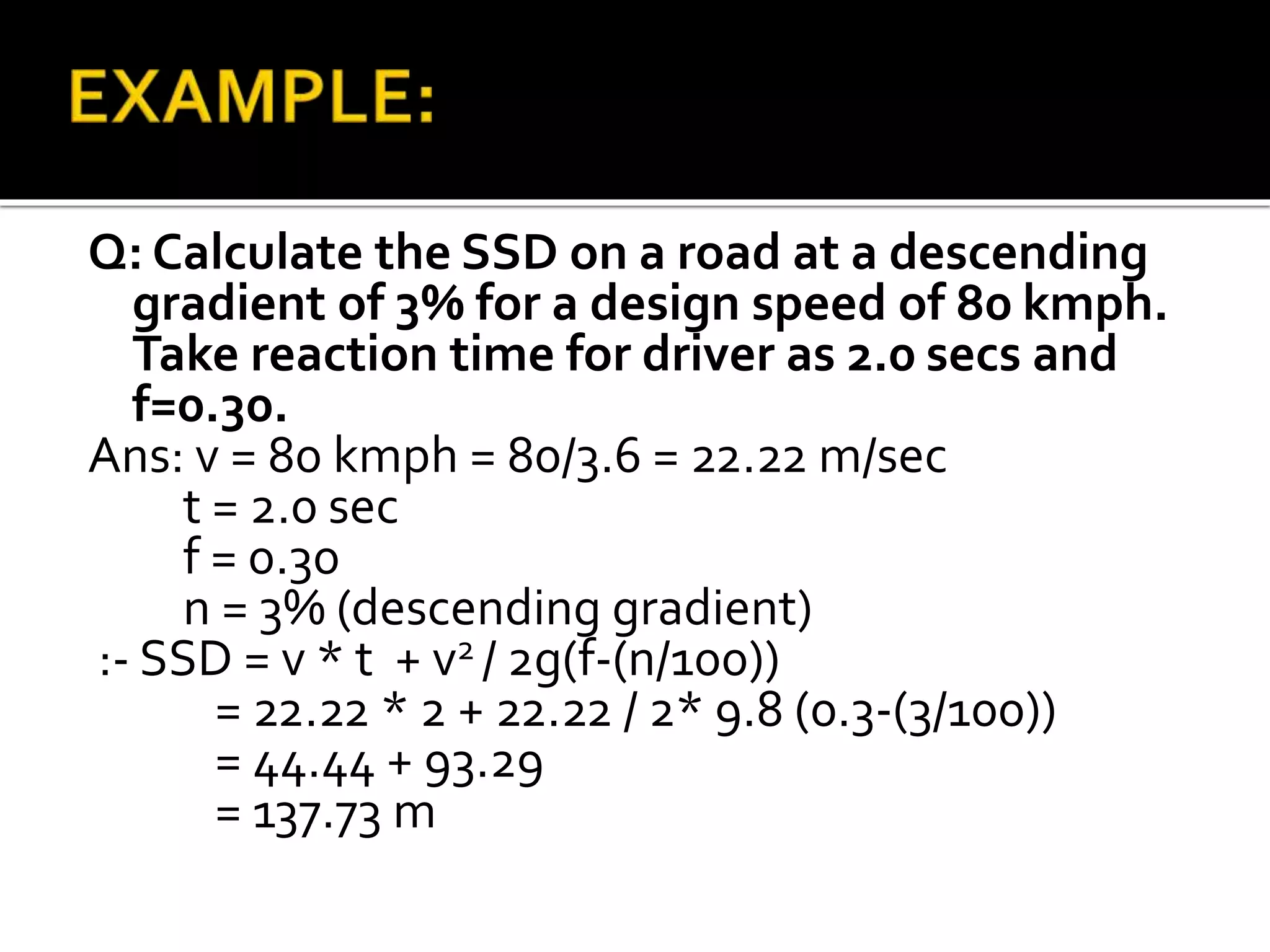
Q: Calculate the SSD on a road at a descending
gradient of 3% for a design speed of 80 kmph.
Take reaction time for driver as 2.0 secs and
f=0.30.
Ans: v = 80 kmph = 80/3.6 = 22.22 m/sec
t = 2.0 sec
f = 0.30
n = 3% (descending gradient)
:- SSD = v * t + v2 / 2g(f-(n/100))
= 22.22 * 2 + 22.22 / 2* 9.8 (0.3-(3/100))
= 44.44 + 93.29
= 137.73 m
THANKYOU…

Ssd

  • 1.
    B.E. CIVIL ENGINEERING. 3rdYEAR 5thSEMESTER HIGHWAY ENGINEERING(2150601) SHAIKH MOHD.AMIR N. 150860106062 PRAJAPATI RIYA P. 150860106054 BHANDARI NEENAD H. 150860106006 RATHOD NEHA M. 150860106055
  • 2.
    1. Definition 2. Factorsaffecting stopping sight distance 3. Analysis of stopping sight distance 4. PIEV theory 5. Braking distance 6. Formulas for stopping sight distance 7. Examples
  • 3.
     The minimumsight distance available on a highway to stop a vehicle at design speed, safely without any collision with any other obstruction is called stopping sight distance.  For the purpose of measuring stopping sight distance, IRC has suggested the height of eye level of driver as 1.2 m and the height of the object as 0.15m above the road surface.
  • 4.
     Factors affectingSSD are:- 1. Speed of vehicles 2. Efficiency of brakes 3. Total reaction time of drivers 4. Frictional resistance between the road and the tyres 5. Gradient of the road
  • 5.
     The stoppingsight distance of the vehicle is the sum of : 1. Lag distance: The distance travelled by the vehicle during the total reaction time is known as lag distance. lag distance = speed of the vehicle (m/sec) * total reaction time (secs) 2. Reaction time:The time taken from the instant the object is visible to the driver to the instant the brakes are efficiently applied.
  • 6.
     According toPIEV theory the total reaction of the driver is divided into four parts: 1. Perception time:The time required to transmits the sensations received by the eyes and ears to the brain with help of nervous system. 2. Intellection time:The time required for understanding the situation 3. Emotion time:The time elapsed during emotional sensations and disturbance such as fear, anger, etc. with reference to the situation. 4. Volition time:The time taken for the final action.
  • 7.
     Braking distance= v2 / 2gf where, v = speed of the vehicle in m/sec g = acceleration due to gravity = 9.8 m/ sec2 f = coefficient of friction (0.4 to 0.35)
  • 8.
    1. When roadis without gradient SSD = v * t + v2 / 2gf 2. When road is with ascending gradient SSD = v * t + v2 / 2g(f+(n/100)) 3.When road is with descending gradient SSD = v * t + v2 / 2g(f-(n/100)) In case of single lane road with two way traffic, the value of SSD is doubled.
  • 9.
    Q: Calculate thesafe SSD for design speed of 50kmph. a.Two way traffic on a two lane road b.Two way traffic on a single lane road Ans: (a)Two way traffic on a two lane road: v= 50kmph = 50/3.6 = 13.9 m/ sec2 t = 2.5 secs f = 0.37 g = 9.8 m/ sec :- SSD = v * t + v2 / 2gf = 13.9 * 2.5 + 13.92 / 2*9.8*0.37 = 61.39 m (b) Two way traffic on a single lane road: :- SSD = 2* 61.39 = 122.78 m
  • 10.
    Q: Two carsare approaching from the opposite directions at 90 & 60 kmph. Calculate the minimum sight distance required to avoid head on collision. Assume a reaction time of 2.5 secs, coefficient of friction of 0.7 and brake efficiency of 50%. Ans: SSD = v * t + v2 / 2gf v1 = 90 kmph = 90/3.6 = 25 m/sec v2 = 60 kmph = 60/3.6 = 16.67 m/sec Brake efficiency is 50%, therefore, f = 0.5 *0.7 = 0.35 :- for first car SSD1 = v * t + v2 / 2gf = 25 * 2.5 + 252 / 2 * 9.8 * 0.35 = 153.6 m :- for second car SSD2 = v * t + v2 / 2gf = 16.67 * 2.5 + 16.672 / 2 * 9.8 * 0.35 = 82.20 m SSD = SSD1 + SSD2 = 153.6 + 82.2 = 235.8 m
  • 11.
    Q: Calculate theSSD on a road at a descending gradient of 3% for a design speed of 80 kmph. Take reaction time for driver as 2.0 secs and f=0.30. Ans: v = 80 kmph = 80/3.6 = 22.22 m/sec t = 2.0 sec f = 0.30 n = 3% (descending gradient) :- SSD = v * t + v2 / 2g(f-(n/100)) = 22.22 * 2 + 22.22 / 2* 9.8 (0.3-(3/100)) = 44.44 + 93.29 = 137.73 m
  • 12.