LAXMI INSTITUTE OF
TECHNOLOGY,SARIGAM.
PRESENTATION ON:
ARCHES.
PRESENTED BY:
NAME:
BHANDARI NEENAD
PRAJAPATI RIYA P.
RATHOD NEHA M.
SHAIKH MOHD.AMIR N.
GUIDED BY:
ANKUR SHAH,
(HOD,CIVILDEPARTMENT,LIT)
ENROLLMENT NO.:
150860106006
150860106054
150860106055
150860106062
TOPICS:
 ARCHES
 LINEAR ARCH(THEORETICAL ARCH)
 TYPES OF ARCHES
 EDDY’S THEOREM
 THREE HINGED ARCH
 THREE HINGED PARABOLLIC ARCH
 THREE HINGED CIRCULAR (SEGMENTAL) ARCH
ARCHES:
 An arch looks like curved girder , either a solid rib
or braced supported at its ends and carrying
transverse loads which are frequently vertical .
 The early Indian railway and highways bridges also
use masonry arches. Arches are also used in
buildings to carry loads over doorways, windows
etc., as well as to add an aesthetic touch to
building.
LINEAR(THEORETICAL) ARCHES:
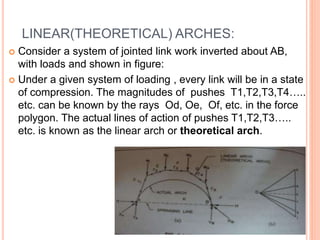
 Consider a system of jointed link work inverted about AB,
with loads and shown in figure:
 Under a given system of loading , every link will be in a state
of compression. The magnitudes of pushes T1,T2,T3,T4…..
etc. can be known by the rays Od, Oe, Of, etc. in the force
polygon. The actual lines of action of pushes T1,T2,T3…..
etc. is known as the linear arch or theoretical arch.
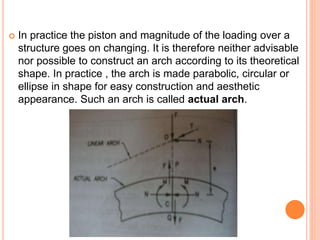
 In practice the piston and magnitude of the loading over a
structure goes on changing. It is therefore neither advisable
nor possible to construct an arch according to its theoretical
shape. In practice , the arch is made parabolic, circular or
ellipse in shape for easy construction and aesthetic
appearance. Such an arch is called actual arch.
 Consider a cross-section PQ of the arches as shown in fig.
 Let T is neither normal to the cross-section nor does it act
through centre C of the cross-section.
 The resultant thrust can be tangential to the section PQ.
 Let N is be the normal component and F be the tangential
component F will cause shear force at the section PQ. The
normal component N acts eccentrically, the eccentricity e
being equal to CD. Thus the action of N acting at D is
twofold (i) a normal thrust N at C and
(ii) a bending moment , M = N.e at C.
 At any cross-section of arch is thus subjected to three
stating actions:
1. Shear force / radial shear (F)
2. Bending moment (M)
3. Normal thrust (N)
TYPES OF ARCHES:
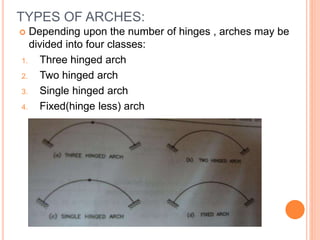
 Depending upon the number of hinges , arches may be
divided into four classes:
1. Three hinged arch
2. Two hinged arch
3. Single hinged arch
4. Fixed(hinge less) arch
EDDY’S THEOREM:
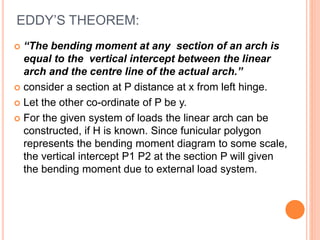
 “The bending moment at any section of an arch is
equal to the vertical intercept between the linear
arch and the centre line of the actual arch.”
 consider a section at P distance at x from left hinge.
 Let the other co-ordinate of P be y.
 For the given system of loads the linear arch can be
constructed, if H is known. Since funicular polygon
represents the bending moment diagram to some scale,
the vertical intercept P1 P2 at the section P will given
the bending moment due to external load system.
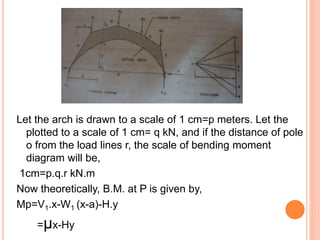
Let the arch is drawn to a scale of 1 cm=p meters. Let the
plotted to a scale of 1 cm= q kN, and if the distance of pole
o from the load lines r, the scale of bending moment
diagram will be,
1cm=p.q.r kN.m
Now theoretically, B.M. at P is given by,
Mp=V1.x-W1 (x-a)-H.y
=µx-Hy
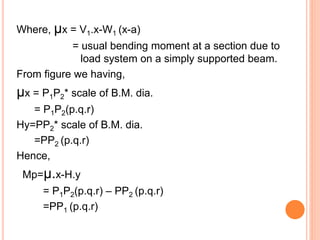
Where, µx = V1.x-W1 (x-a)
= usual bending moment at a section due to
load system on a simply supported beam.
From figure we having,
µx = P1P2* scale of B.M. dia.
= P1P2(p.q.r)
Hy=PP2* scale of B.M. dia.
=PP2 (p.q.r)
Hence,
Mp=µ.x-H.y
= P1P2(p.q.r) – PP2 (p.q.r)
=PP1 (p.q.r)
THREE HINGED ARCH:
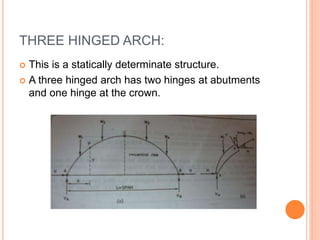
 This is a statically determinate structure.
 A three hinged arch has two hinges at abutments
and one hinge at the crown.
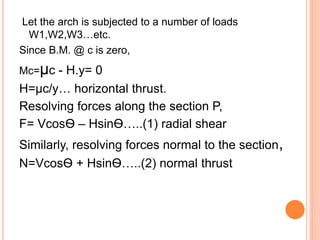
Let the arch is subjected to a number of loads
W1,W2,W3…etc.
Since B.M. @ c is zero,
Mc=µc - H.y= 0
H=µc/y… horizontal thrust.
Resolving forces along the section P,
F= VcosѲ – HsinѲ…..(1) radial shear
Similarly, resolving forces normal to the section,
N=VcosѲ + HsinѲ…..(2) normal thrust
THREE HINGED PARABOLIC ARCH:
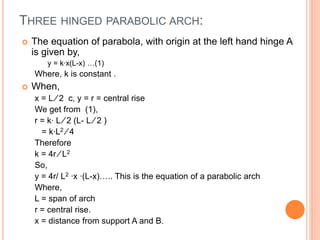
 The equation of parabola, with origin at the left hand hinge A
is given by,
y = k∙x(L-x) …(1)
Where, k is constant .
 When,
x = L ∕ 2 c, y = r = central rise
We get from (1),
r = k∙ L ∕ 2 (L- L ∕ 2 )
= k∙L2 ∕ 4
Therefore
k = 4r ∕ L2
So,
y = 4r/ L2 ∙x ∙(L-x)….. This is the equation of a parabolic arch
Where,
L = span of arch
r = central rise.
x = distance from support A and B.
THREE HINGED CIRCULAR ARCH:
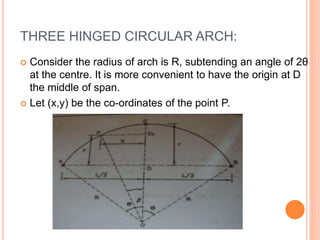
 Consider the radius of arch is R, subtending an angle of 2θ
at the centre. It is more convenient to have the origin at D
the middle of span.
 Let (x,y) be the co-ordinates of the point P.
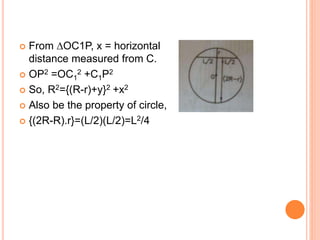
 From ∆OC1P, x = horizontal
distance measured from C.
 OP2 =OC1
2 +C1P2
 So, R2={(R-r)+y}2 +x2
 Also be the property of circle,
 {(2R-R).r}=(L/2)(L/2)=L2/4
THANK YOU…

150860106006 54 55_62_arches

  • 1.
  • 2.
    PRESENTED BY: NAME: BHANDARI NEENAD PRAJAPATIRIYA P. RATHOD NEHA M. SHAIKH MOHD.AMIR N. GUIDED BY: ANKUR SHAH, (HOD,CIVILDEPARTMENT,LIT) ENROLLMENT NO.: 150860106006 150860106054 150860106055 150860106062
  • 3.
    TOPICS:  ARCHES  LINEARARCH(THEORETICAL ARCH)  TYPES OF ARCHES  EDDY’S THEOREM  THREE HINGED ARCH  THREE HINGED PARABOLLIC ARCH  THREE HINGED CIRCULAR (SEGMENTAL) ARCH
  • 4.
    ARCHES:  An archlooks like curved girder , either a solid rib or braced supported at its ends and carrying transverse loads which are frequently vertical .  The early Indian railway and highways bridges also use masonry arches. Arches are also used in buildings to carry loads over doorways, windows etc., as well as to add an aesthetic touch to building.
  • 5.
    LINEAR(THEORETICAL) ARCHES:  Considera system of jointed link work inverted about AB, with loads and shown in figure:  Under a given system of loading , every link will be in a state of compression. The magnitudes of pushes T1,T2,T3,T4….. etc. can be known by the rays Od, Oe, Of, etc. in the force polygon. The actual lines of action of pushes T1,T2,T3….. etc. is known as the linear arch or theoretical arch.
  • 6.
     In practicethe piston and magnitude of the loading over a structure goes on changing. It is therefore neither advisable nor possible to construct an arch according to its theoretical shape. In practice , the arch is made parabolic, circular or ellipse in shape for easy construction and aesthetic appearance. Such an arch is called actual arch.
  • 7.
     Consider across-section PQ of the arches as shown in fig.  Let T is neither normal to the cross-section nor does it act through centre C of the cross-section.  The resultant thrust can be tangential to the section PQ.  Let N is be the normal component and F be the tangential component F will cause shear force at the section PQ. The normal component N acts eccentrically, the eccentricity e being equal to CD. Thus the action of N acting at D is twofold (i) a normal thrust N at C and (ii) a bending moment , M = N.e at C.  At any cross-section of arch is thus subjected to three stating actions: 1. Shear force / radial shear (F) 2. Bending moment (M) 3. Normal thrust (N)
  • 8.
    TYPES OF ARCHES: Depending upon the number of hinges , arches may be divided into four classes: 1. Three hinged arch 2. Two hinged arch 3. Single hinged arch 4. Fixed(hinge less) arch
  • 9.
    EDDY’S THEOREM:  “Thebending moment at any section of an arch is equal to the vertical intercept between the linear arch and the centre line of the actual arch.”  consider a section at P distance at x from left hinge.  Let the other co-ordinate of P be y.  For the given system of loads the linear arch can be constructed, if H is known. Since funicular polygon represents the bending moment diagram to some scale, the vertical intercept P1 P2 at the section P will given the bending moment due to external load system.
  • 10.
    Let the archis drawn to a scale of 1 cm=p meters. Let the plotted to a scale of 1 cm= q kN, and if the distance of pole o from the load lines r, the scale of bending moment diagram will be, 1cm=p.q.r kN.m Now theoretically, B.M. at P is given by, Mp=V1.x-W1 (x-a)-H.y =µx-Hy
  • 11.
    Where, µx =V1.x-W1 (x-a) = usual bending moment at a section due to load system on a simply supported beam. From figure we having, µx = P1P2* scale of B.M. dia. = P1P2(p.q.r) Hy=PP2* scale of B.M. dia. =PP2 (p.q.r) Hence, Mp=µ.x-H.y = P1P2(p.q.r) – PP2 (p.q.r) =PP1 (p.q.r)
  • 12.
    THREE HINGED ARCH: This is a statically determinate structure.  A three hinged arch has two hinges at abutments and one hinge at the crown.
  • 13.
    Let the archis subjected to a number of loads W1,W2,W3…etc. Since B.M. @ c is zero, Mc=µc - H.y= 0 H=µc/y… horizontal thrust. Resolving forces along the section P, F= VcosѲ – HsinѲ…..(1) radial shear Similarly, resolving forces normal to the section, N=VcosѲ + HsinѲ…..(2) normal thrust
  • 14.
    THREE HINGED PARABOLICARCH:  The equation of parabola, with origin at the left hand hinge A is given by, y = k∙x(L-x) …(1) Where, k is constant .  When, x = L ∕ 2 c, y = r = central rise We get from (1), r = k∙ L ∕ 2 (L- L ∕ 2 ) = k∙L2 ∕ 4 Therefore k = 4r ∕ L2 So, y = 4r/ L2 ∙x ∙(L-x)….. This is the equation of a parabolic arch Where, L = span of arch r = central rise. x = distance from support A and B.
  • 15.
    THREE HINGED CIRCULARARCH:  Consider the radius of arch is R, subtending an angle of 2θ at the centre. It is more convenient to have the origin at D the middle of span.  Let (x,y) be the co-ordinates of the point P.
  • 16.
     From ∆OC1P,x = horizontal distance measured from C.  OP2 =OC1 2 +C1P2  So, R2={(R-r)+y}2 +x2  Also be the property of circle,  {(2R-R).r}=(L/2)(L/2)=L2/4
  • 17.