PRESENTATION ON:
DETERMINATION OF COEFFICIENT OF
CONSOLIDATION BY SQAURE ROOT OF TIME
FITTING METHOD.
PRESENTED BY:
RIYA PRAJAPATI(150860106054).
LAXMI INSTITUTE OF
TECHNOLOGY, SARIGAM.
THE SQUARE ROOT OF TIME FITING METHOD.
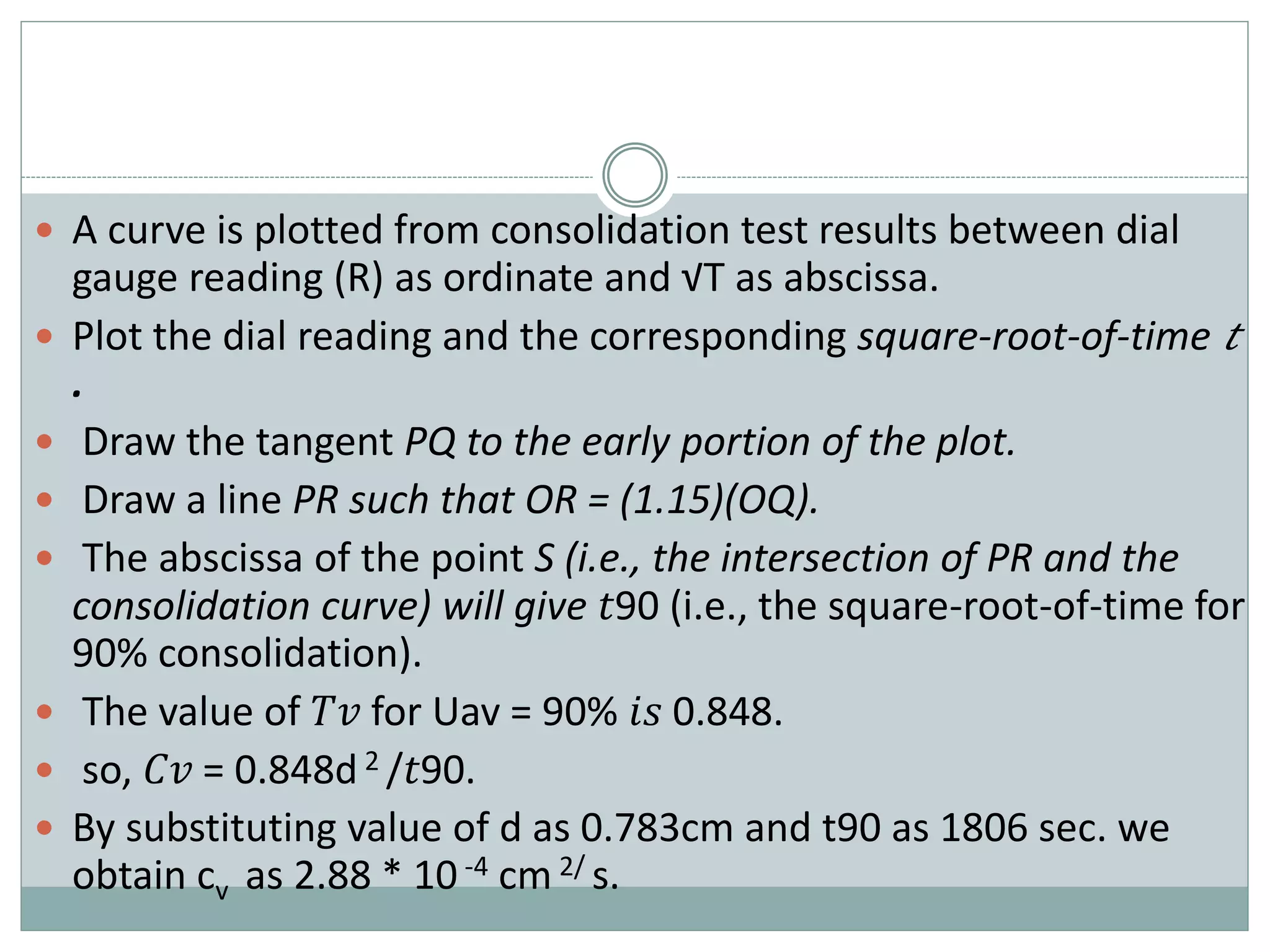
 This method, developed by Taylor, utilizes theoretical
relationship between U and √Tv.
 The relationship is linear up to value of u equal to about
60%.
 It was observed that at U=90%, value of √Tv is 1.15 times
value obtained by extension of the initial straight line
portion.
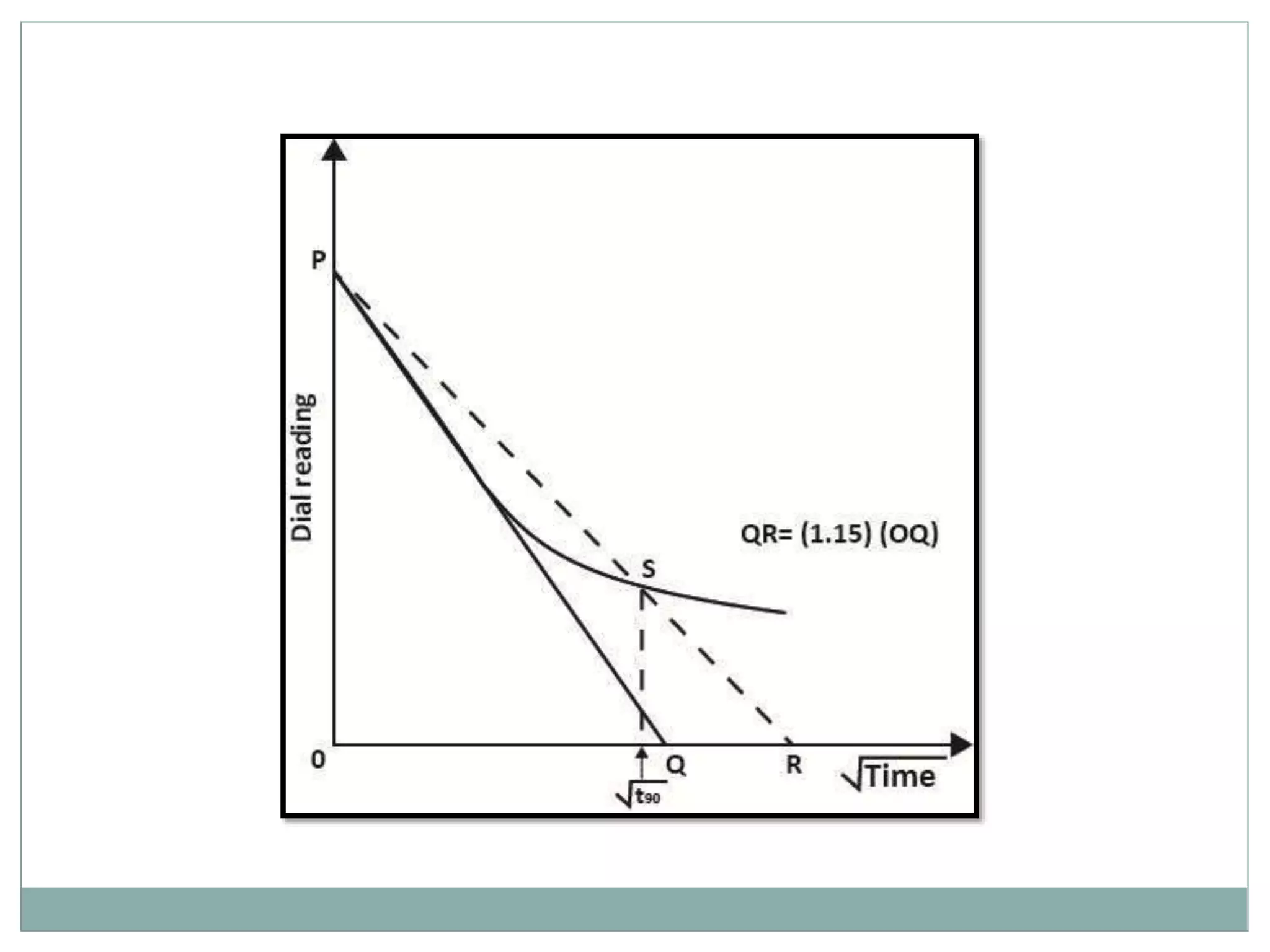
 A curve is plotted from consolidation test results between dial
gauge reading (R) as ordinate and √T as abscissa.
 Plot the dial reading and the corresponding square-root-of-time 𝑡
.
 Draw the tangent PQ to the early portion of the plot.
 Draw a line PR such that OR = (1.15)(OQ).
 The abscissa of the point S (i.e., the intersection of PR and the
consolidation curve) will give 𝑡90 (i.e., the square-root-of-time for
90% consolidation).
 The value of 𝑇𝑣 for Uav = 90% 𝑖𝑠 0.848.
 so, 𝐶𝑣 = 0.848d 2 /𝑡90.
 By substituting value of d as 0.783cm and t90 as 1806 sec. we
obtain cv as 2.88 * 10 -4 cm 2/ s.
DRAWBACKS:
 One of the major throwback of this theory is that
both Poisson's ratio and the elastic modulus of the
soil remain constant whereas in reality they both
vary as consolidation proceeds.
 Owing to this continuous variation there is a
continuous change in the stress distribution within
the soil which in turn causes a continuous change in
the values of pore water pressures.
THANK YOU…

Timefitting curve

  • 1.
    PRESENTATION ON: DETERMINATION OFCOEFFICIENT OF CONSOLIDATION BY SQAURE ROOT OF TIME FITTING METHOD. PRESENTED BY: RIYA PRAJAPATI(150860106054). LAXMI INSTITUTE OF TECHNOLOGY, SARIGAM.
  • 2.
    THE SQUARE ROOTOF TIME FITING METHOD.  This method, developed by Taylor, utilizes theoretical relationship between U and √Tv.  The relationship is linear up to value of u equal to about 60%.  It was observed that at U=90%, value of √Tv is 1.15 times value obtained by extension of the initial straight line portion.
  • 4.
     A curveis plotted from consolidation test results between dial gauge reading (R) as ordinate and √T as abscissa.  Plot the dial reading and the corresponding square-root-of-time 𝑡 .  Draw the tangent PQ to the early portion of the plot.  Draw a line PR such that OR = (1.15)(OQ).  The abscissa of the point S (i.e., the intersection of PR and the consolidation curve) will give 𝑡90 (i.e., the square-root-of-time for 90% consolidation).  The value of 𝑇𝑣 for Uav = 90% 𝑖𝑠 0.848.  so, 𝐶𝑣 = 0.848d 2 /𝑡90.  By substituting value of d as 0.783cm and t90 as 1806 sec. we obtain cv as 2.88 * 10 -4 cm 2/ s.
  • 6.
    DRAWBACKS:  One ofthe major throwback of this theory is that both Poisson's ratio and the elastic modulus of the soil remain constant whereas in reality they both vary as consolidation proceeds.  Owing to this continuous variation there is a continuous change in the stress distribution within the soil which in turn causes a continuous change in the values of pore water pressures.
  • 7.