INTRODUCTION
TO
GREEN BUILDING
&
FLY-ASH BRICK.
GUIDED BY:
PARESH MISTRY.
SHAIKH MOHD. AMIR N.
PRAJAPATI RIYA P.
BHANDARI NEENAD H
RATHOD NEHA M.
PRESENTED BY:
CONTENT:
 Introduction
 Benefits
 Features
 Green Building materials
 Fly ash brick constituents
 Grades of fly ash
 Comparison
 Why to choose fly ash brick???
 Conclusion
WHAT IS GREEN BUILDING???
 Green building is a type of building which is eco-friendly as well as
sustainable.
 It is same as normal building instead of using energy from non-
renewable sources it uses energy from natural and renewable sources.
 Green building is a type of building which is good to the environment
in addition to bring resource efficiency throughout their life cycle.
 Green building uses natural resources for energy generation and other
works and reduce the harmful effect caused due to the use of artificial
materials.
 The buildings have greater life time with same initial cost as that of
traditional building.
 Using renewable energy resources and also use of eco-friendly
material for construction so it has minimum effect on environment.
BENEFITS OF GREEN BUILDING:
 The most important benefit is in reduction of operating energy and
water costs right from day one during the entire life cycle of the
building.
 Buildings consume at least 40-50% less energy and 20-30% less water
compare to conventional buildings.
 Green buildings are always fresh and healthy.
 Working in environment with access to daylight and views provides
connection to the exterior environment.
 30-40% reduction in operating cost.
 Health and safety of building components.
 Improve productivity of the occupants.
 Incorporate latest techniques and technologies.
GREEN BUILDING FEATURES:
 Energy efficient equipment for air conditioning and lighting systems
and use of onsite renewable energy.
 Use of non-toxic and recycled/recyclable materials.
 Use of recycled and environmental friendly buiding materials.
 Efficient use of water recycling.
 Indoor air quality improvement for human safety and comfort.
 Use of building materials having a high recycled content.
 Use of rapidly renewable materials.
 Providing day lights and views for the occupied areas.
 Recycling of construction debris to other sites.
GREEN BUILDING MATERIALS:
 BAMBOO
 WOOD
 RECYCLED PLASTIC
 ASHCRETE
 FLY-ASH BRICKS
 GRASSCRETE
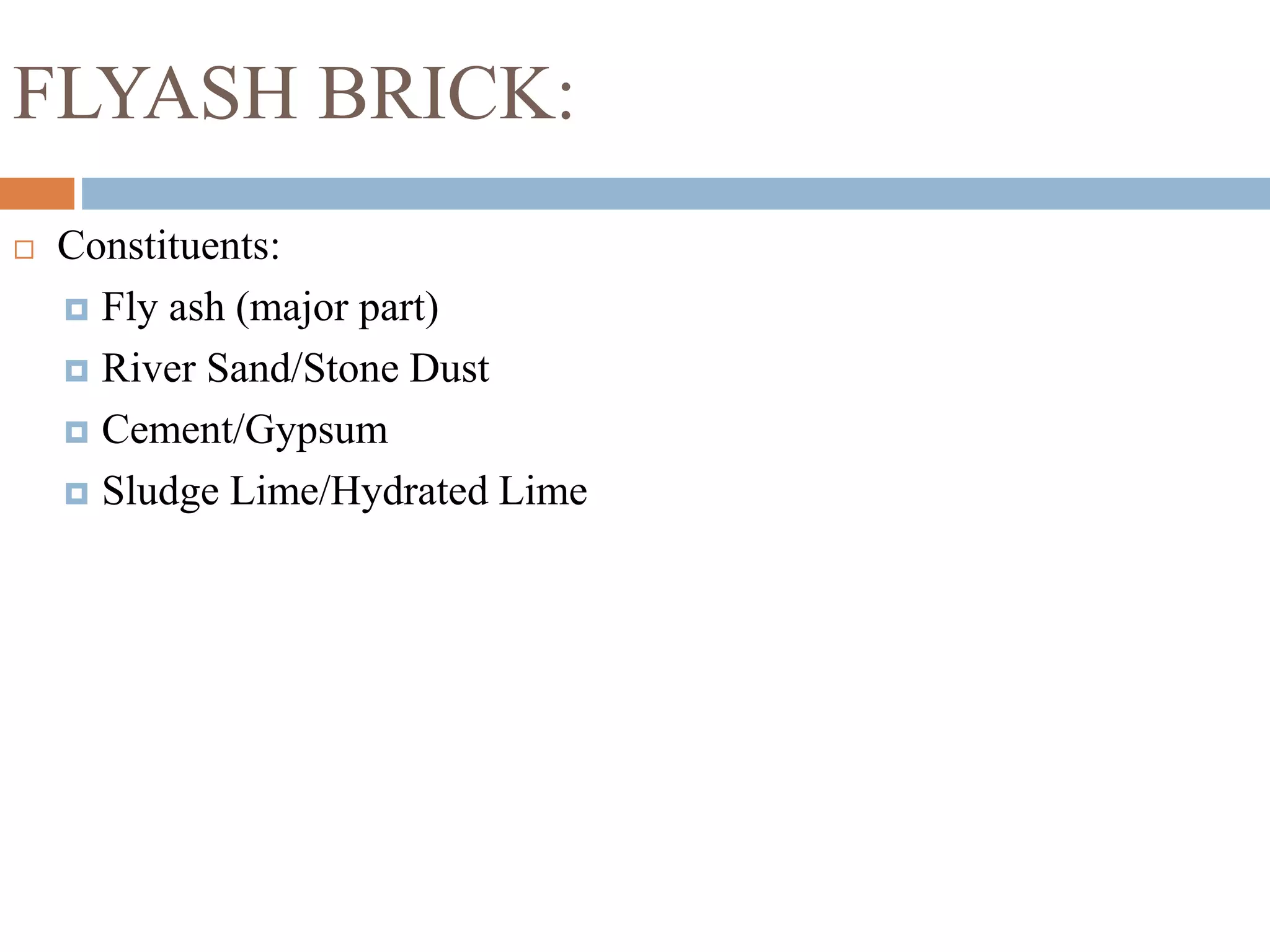
FLYASH BRICK:
 Constituents:
 Fly ash (major part)
 River Sand/Stone Dust
 Cement/Gypsum
 Sludge Lime/Hydrated Lime
PROPORTIONS:
 Method-1
 Fly Ash(Class-F) – 55 to 60%
 River Sand or Stone dust – 20 to 25%
 Sludge Lime –15 to 22%
 Gypsum – 5%
 Method-2
 Fly ash(Class-F) – 57 to 65%
 River Sand or Stone dust – 18 to 27%
 Hydrated Lime – 9 to 12 %
 Gypsum – 5%
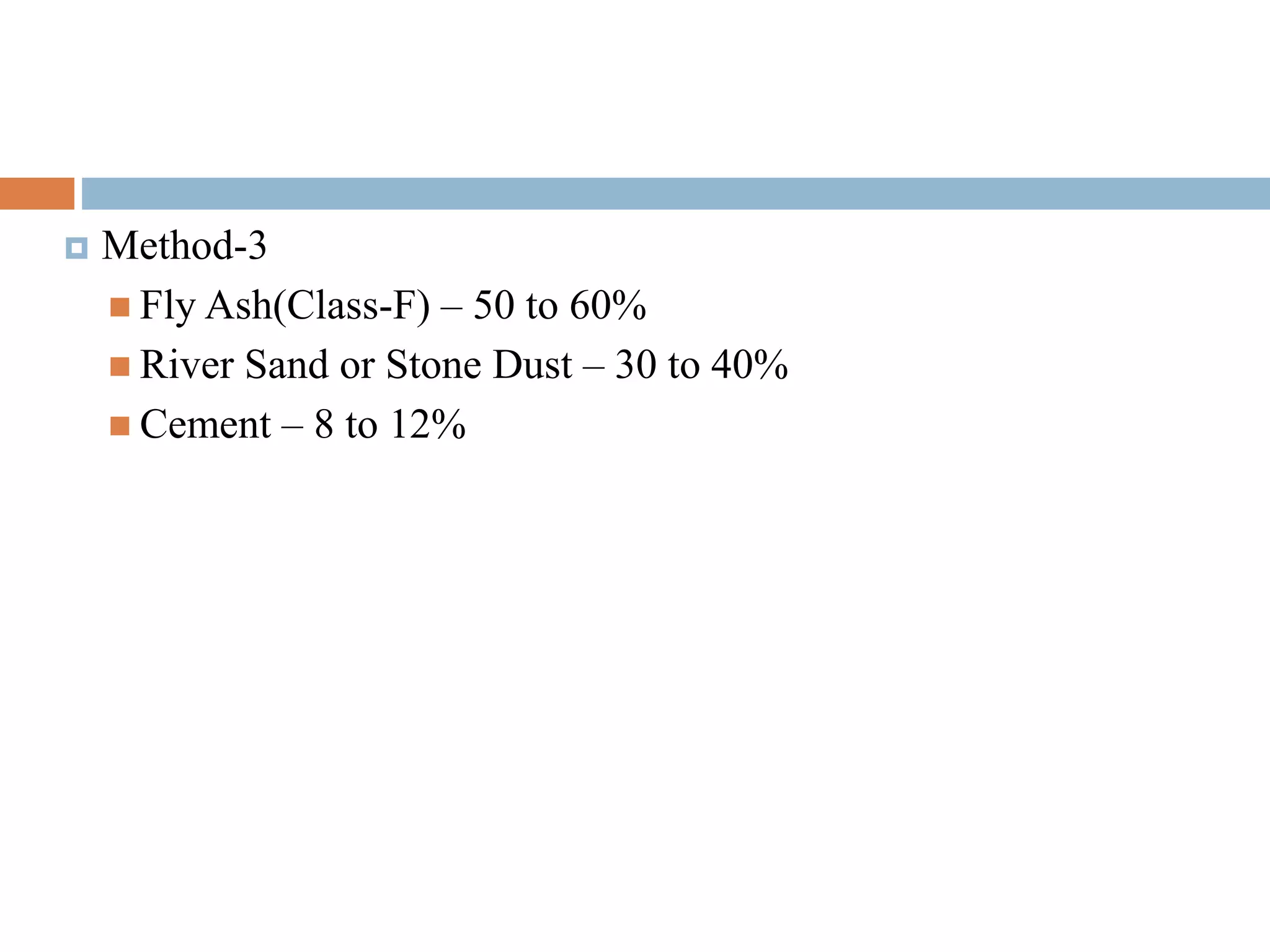
 Method-3
 Fly Ash(Class-F) – 50 to 60%
 River Sand or Stone Dust – 30 to 40%
 Cement – 8 to 12%
GRADES OF FLY ASH :
 Class F fly ash:
 The burning of harder, older anthracite and bituminous coal
typically produces Class F fly ash.
 This fly ash is pozzolanic in nature, and contains less than 7% lime
(CaO).
 Possessing pozzolanic properties, the glassy silica and alumina of
Class F fly ash requires a cementing agent, such as Portland
cement, quicklime, or hydrated lime—mixed with water to react
and produce cementitious compounds.
 Alternatively, adding a chemical activator such as sodium silicate
(water glass) to a Class F ash can form a geopolymer.
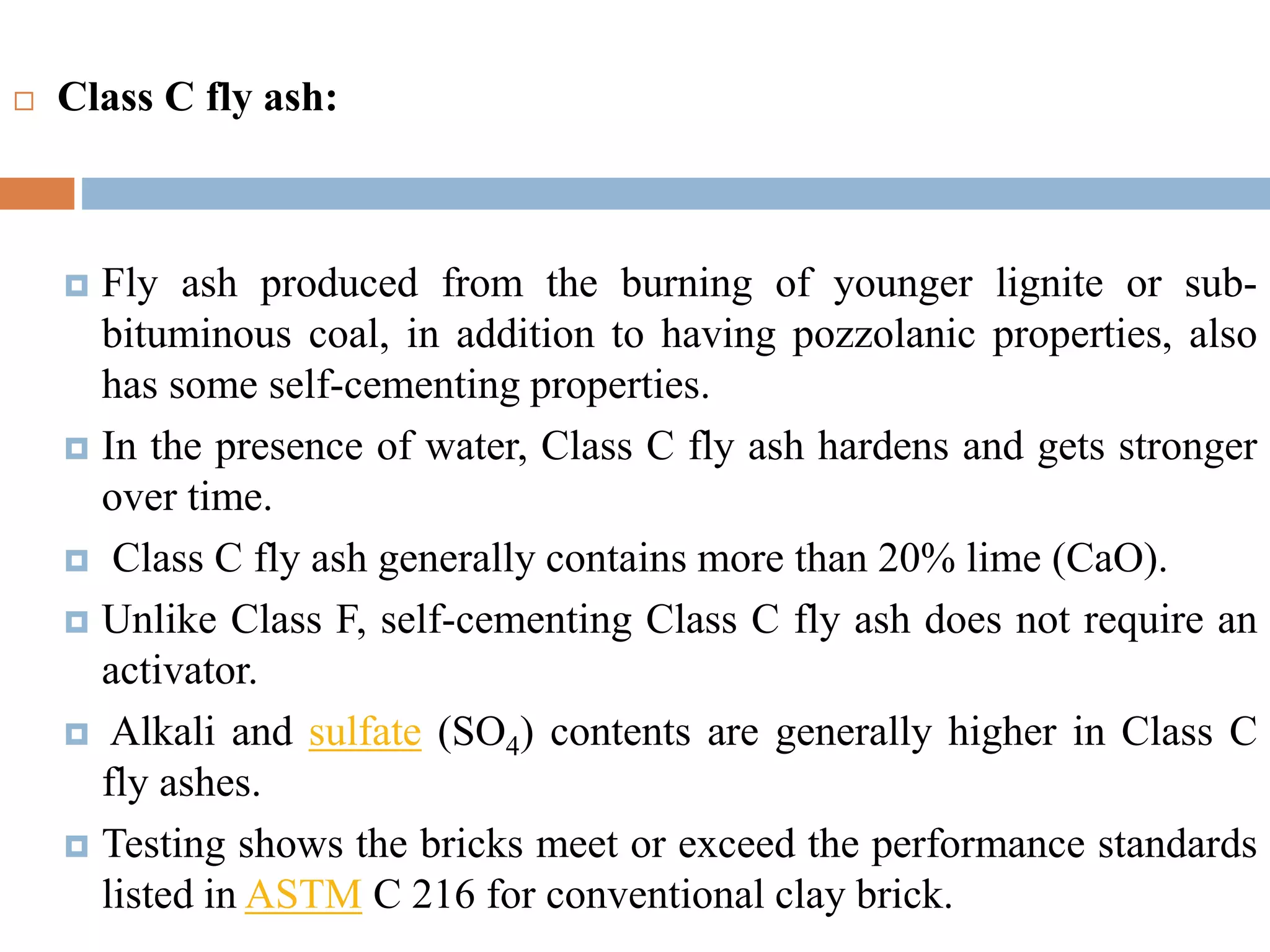
 Class C fly ash:
 Fly ash produced from the burning of younger lignite or sub-
bituminous coal, in addition to having pozzolanic properties, also
has some self-cementing properties.
 In the presence of water, Class C fly ash hardens and gets stronger
over time.
 Class C fly ash generally contains more than 20% lime (CaO).
 Unlike Class F, self-cementing Class C fly ash does not require an
activator.
 Alkali and sulfate (SO4) contents are generally higher in Class C
fly ashes.
 Testing shows the bricks meet or exceed the performance standards
listed in ASTM C 216 for conventional clay brick.
TEST ON FLY ASH BRICKS:
 Compressive strength test
 Water Absorption test
 Efflorescence test
 Hardness test
 Size, Shape and Color test
 Soundness test
 Structure test
TEST METHOD:
1. Compressive strength test
This test is done to know the compressive strength of brick. It is also
called crushing strength of brick. Generally 5 specimens of bricks are
taken to laboratory for testing and tested one by one. In this test a
brick specimen is put on crushing machine and applied pressure till it
breaks. The ultimate pressure at which brick is crushed is taken into
account. All five brick specimens are tested one by one and average
result is taken as brick’s compressive/crushing strength.
2. Hardness test
In this test a scratch is made on brick surface with a hard thing. If that
doesn’t left any impression on brick then that is good quality brick.
3.Water Absorption test
this test bricks are weighed in dry condition and let them immersed in
fresh water for 24 hours. After 24 hours of immersion those are taken
out from water and wipe out with cloth. Then brick is weighed in wet
condition. The difference between weights is the water absorbed by
brick. The percentage of water absorption is then calculated.
The less water absorbed by brick the greater its quality. Good quality
brick doesn’t absorb more than 20% water of its own weight.
4. Structure test
In this test a brick is broken or a broken brick is collected and closely
observed. If there are any flows, cracks or holes present on that broken
face then that isn’t good quality brick.
5. Efflorescense test
The presence of alkalies in bricks is harmful and they form a gray or
white layer on brick surface by absorbing moisture. To find out the
presence of alkalis in bricks this test is performed. In this test a brick
is immersed in fresh water for 24 hours and then it’s taken out from
water and allowed to dry in shade.
If the whitish layer is not visible on surface it proofs that absence of
alkalis in brick. If the whitish layer visible about 10% of brick surface
then the presence of alkalis is in acceptable range. If that is about 50%
of surface then it is moderate. If the alkalis’s presence is over 50%
then the brick is severely affected by alkalies
6. Size, shape and color test
In this test randomly collected 20 bricks are staked along lengthwise,
widthwise and heightwise and then those are measured to know the
variation of sizes as per standard. Bricks are closely viewed to check if
its edges are sharp and straight and uniform in shape. A good quality
brick should have bright and uniform color throughout.
7. Soundness test
In this test two bricks are held by both hands and struck with one
another. If the bricks give clear metallic ringing sound and don’t break
then those are good quality bricks.
COMPARISONS:
CHARACTERISTICS FLYASH BRICK TRADITIONAL BRICK
COLOR
Uniform pleasing color like
cement
Varying color as per soil
SHAPE AND SIZE
Uniform in shape and smooth in
finish
Uneven shape as hand made
COMPOSITION Dense composition Lightly bonded
PLASTERING No plastering required plastering required
WEIGTH Lighter in weight Heavier in weight
COMPRESSIVE STRENGTH
Compressive strength is around
100 Kg/ Cm2
Compressive strength is around 35
Kg/Cm2
POROSITY Less porous More porous
THERMAL CONDUCTIVITY
Thermal conductivity 0.90-1.05
W/m2 ºC
Thermal conductivity 1.25 – 1.35
W/m2 ºC
WATER ABSORPTION Water absorption 6-12% Water absorption 20-25%
WHY TO CHOOSE FLY ASH
BRICK???
 Fly ash brick consists of fly ash which is a residue (left over material)
from the thermal power station as its main component.
 The disposal of fly ash was the main issue before it was used as main
component of bricks.
 The strength obtained from this brick is also far way better than the
normal bricks.
 Its cost is also low as the residue is used.
 Thus it is both economical as well as eco-friendly.
 Also the normal bricks uses clay digged out from the earth which
creates open spaces and hollowness in the earth.
 Thus it also serves as the alternative of it.
 Also the normal bricks uses clay digged out from the earth which
creates open spaces and hollowness in the earth.
 Thus it also serves as the alternative of it.
 Now a days world is developing at a very fast rate so to cope with the
increasing needs of brick we were to find an alternative for clay bricks
and we got the fly ash bricks.
 It has better properties from every point of view compared to the clay
bricks.
 Also the construction of fly ash brick is easier than the clay brick.
 This brick needs less or no firing.
 In fact in today's fats growing world where people needs better and
sustainable products fly ash brick has more use and its construction is
increasing day-by-day.
CONCLUSIONS:
 We found that by using fly ash brick we can reduce the pollution.
 It is more convenient to use fly ash brick than to use traditionl bricks.
 Fly ash bricks are more economical compared to traditional bricks.
 Manufacturing is also easy compare to normal bricks.
THANK YOU…

Green building

  • 1.
    INTRODUCTION TO GREEN BUILDING & FLY-ASH BRICK. GUIDEDBY: PARESH MISTRY. SHAIKH MOHD. AMIR N. PRAJAPATI RIYA P. BHANDARI NEENAD H RATHOD NEHA M. PRESENTED BY:
  • 2.
    CONTENT:  Introduction  Benefits Features  Green Building materials  Fly ash brick constituents  Grades of fly ash  Comparison  Why to choose fly ash brick???  Conclusion
  • 3.
    WHAT IS GREENBUILDING???  Green building is a type of building which is eco-friendly as well as sustainable.  It is same as normal building instead of using energy from non- renewable sources it uses energy from natural and renewable sources.  Green building is a type of building which is good to the environment in addition to bring resource efficiency throughout their life cycle.  Green building uses natural resources for energy generation and other works and reduce the harmful effect caused due to the use of artificial materials.  The buildings have greater life time with same initial cost as that of traditional building.  Using renewable energy resources and also use of eco-friendly material for construction so it has minimum effect on environment.
  • 4.
    BENEFITS OF GREENBUILDING:  The most important benefit is in reduction of operating energy and water costs right from day one during the entire life cycle of the building.  Buildings consume at least 40-50% less energy and 20-30% less water compare to conventional buildings.  Green buildings are always fresh and healthy.  Working in environment with access to daylight and views provides connection to the exterior environment.  30-40% reduction in operating cost.  Health and safety of building components.  Improve productivity of the occupants.  Incorporate latest techniques and technologies.
  • 5.
    GREEN BUILDING FEATURES: Energy efficient equipment for air conditioning and lighting systems and use of onsite renewable energy.  Use of non-toxic and recycled/recyclable materials.  Use of recycled and environmental friendly buiding materials.  Efficient use of water recycling.  Indoor air quality improvement for human safety and comfort.  Use of building materials having a high recycled content.  Use of rapidly renewable materials.  Providing day lights and views for the occupied areas.  Recycling of construction debris to other sites.
  • 6.
    GREEN BUILDING MATERIALS: BAMBOO  WOOD  RECYCLED PLASTIC  ASHCRETE  FLY-ASH BRICKS  GRASSCRETE
  • 7.
    FLYASH BRICK:  Constituents: Fly ash (major part)  River Sand/Stone Dust  Cement/Gypsum  Sludge Lime/Hydrated Lime
  • 8.
    PROPORTIONS:  Method-1  FlyAsh(Class-F) – 55 to 60%  River Sand or Stone dust – 20 to 25%  Sludge Lime –15 to 22%  Gypsum – 5%  Method-2  Fly ash(Class-F) – 57 to 65%  River Sand or Stone dust – 18 to 27%  Hydrated Lime – 9 to 12 %  Gypsum – 5%
  • 9.
     Method-3  FlyAsh(Class-F) – 50 to 60%  River Sand or Stone Dust – 30 to 40%  Cement – 8 to 12%
  • 10.
    GRADES OF FLYASH :  Class F fly ash:  The burning of harder, older anthracite and bituminous coal typically produces Class F fly ash.  This fly ash is pozzolanic in nature, and contains less than 7% lime (CaO).  Possessing pozzolanic properties, the glassy silica and alumina of Class F fly ash requires a cementing agent, such as Portland cement, quicklime, or hydrated lime—mixed with water to react and produce cementitious compounds.  Alternatively, adding a chemical activator such as sodium silicate (water glass) to a Class F ash can form a geopolymer.
  • 11.
     Class Cfly ash:  Fly ash produced from the burning of younger lignite or sub- bituminous coal, in addition to having pozzolanic properties, also has some self-cementing properties.  In the presence of water, Class C fly ash hardens and gets stronger over time.  Class C fly ash generally contains more than 20% lime (CaO).  Unlike Class F, self-cementing Class C fly ash does not require an activator.  Alkali and sulfate (SO4) contents are generally higher in Class C fly ashes.  Testing shows the bricks meet or exceed the performance standards listed in ASTM C 216 for conventional clay brick.
  • 12.
    TEST ON FLYASH BRICKS:  Compressive strength test  Water Absorption test  Efflorescence test  Hardness test  Size, Shape and Color test  Soundness test  Structure test
  • 13.
    TEST METHOD: 1. Compressivestrength test This test is done to know the compressive strength of brick. It is also called crushing strength of brick. Generally 5 specimens of bricks are taken to laboratory for testing and tested one by one. In this test a brick specimen is put on crushing machine and applied pressure till it breaks. The ultimate pressure at which brick is crushed is taken into account. All five brick specimens are tested one by one and average result is taken as brick’s compressive/crushing strength. 2. Hardness test In this test a scratch is made on brick surface with a hard thing. If that doesn’t left any impression on brick then that is good quality brick.
  • 14.
    3.Water Absorption test thistest bricks are weighed in dry condition and let them immersed in fresh water for 24 hours. After 24 hours of immersion those are taken out from water and wipe out with cloth. Then brick is weighed in wet condition. The difference between weights is the water absorbed by brick. The percentage of water absorption is then calculated. The less water absorbed by brick the greater its quality. Good quality brick doesn’t absorb more than 20% water of its own weight. 4. Structure test In this test a brick is broken or a broken brick is collected and closely observed. If there are any flows, cracks or holes present on that broken face then that isn’t good quality brick.
  • 15.
    5. Efflorescense test Thepresence of alkalies in bricks is harmful and they form a gray or white layer on brick surface by absorbing moisture. To find out the presence of alkalis in bricks this test is performed. In this test a brick is immersed in fresh water for 24 hours and then it’s taken out from water and allowed to dry in shade. If the whitish layer is not visible on surface it proofs that absence of alkalis in brick. If the whitish layer visible about 10% of brick surface then the presence of alkalis is in acceptable range. If that is about 50% of surface then it is moderate. If the alkalis’s presence is over 50% then the brick is severely affected by alkalies
  • 16.
    6. Size, shapeand color test In this test randomly collected 20 bricks are staked along lengthwise, widthwise and heightwise and then those are measured to know the variation of sizes as per standard. Bricks are closely viewed to check if its edges are sharp and straight and uniform in shape. A good quality brick should have bright and uniform color throughout. 7. Soundness test In this test two bricks are held by both hands and struck with one another. If the bricks give clear metallic ringing sound and don’t break then those are good quality bricks.
  • 17.
    COMPARISONS: CHARACTERISTICS FLYASH BRICKTRADITIONAL BRICK COLOR Uniform pleasing color like cement Varying color as per soil SHAPE AND SIZE Uniform in shape and smooth in finish Uneven shape as hand made COMPOSITION Dense composition Lightly bonded PLASTERING No plastering required plastering required WEIGTH Lighter in weight Heavier in weight COMPRESSIVE STRENGTH Compressive strength is around 100 Kg/ Cm2 Compressive strength is around 35 Kg/Cm2 POROSITY Less porous More porous THERMAL CONDUCTIVITY Thermal conductivity 0.90-1.05 W/m2 ºC Thermal conductivity 1.25 – 1.35 W/m2 ºC WATER ABSORPTION Water absorption 6-12% Water absorption 20-25%
  • 18.
    WHY TO CHOOSEFLY ASH BRICK???  Fly ash brick consists of fly ash which is a residue (left over material) from the thermal power station as its main component.  The disposal of fly ash was the main issue before it was used as main component of bricks.  The strength obtained from this brick is also far way better than the normal bricks.  Its cost is also low as the residue is used.  Thus it is both economical as well as eco-friendly.  Also the normal bricks uses clay digged out from the earth which creates open spaces and hollowness in the earth.  Thus it also serves as the alternative of it.
  • 19.
     Also thenormal bricks uses clay digged out from the earth which creates open spaces and hollowness in the earth.  Thus it also serves as the alternative of it.  Now a days world is developing at a very fast rate so to cope with the increasing needs of brick we were to find an alternative for clay bricks and we got the fly ash bricks.  It has better properties from every point of view compared to the clay bricks.  Also the construction of fly ash brick is easier than the clay brick.  This brick needs less or no firing.  In fact in today's fats growing world where people needs better and sustainable products fly ash brick has more use and its construction is increasing day-by-day.
  • 20.
    CONCLUSIONS:  We foundthat by using fly ash brick we can reduce the pollution.  It is more convenient to use fly ash brick than to use traditionl bricks.  Fly ash bricks are more economical compared to traditional bricks.  Manufacturing is also easy compare to normal bricks.
  • 21.