


復健與安寧緩和照護
Palliative	
 Care	
 
曹昭懿
Goals
•  To	
  cure	
  some-mes	
  
•  To	
  relieve	
  o0en	
  
•  To	
  comfort	
  always	
  
Pallia-ve	
  Care
•  Goal:	
  achievement	
  of	
  the	
  best	
  quality	
  of	
  life	
  
for	
  pa-ents	
  and	
  their	
  families	
  	
  
•  Focus	
  on	
  func-onal	
  consequence	
  of	
  the	
  
disease	
  and	
  its	
  treatment,	
  including	
  
physical	
  and	
  psychological	
  aspects	
  
•  Func-onal	
  reserve	
  and	
  maximize	
  func-on	
  
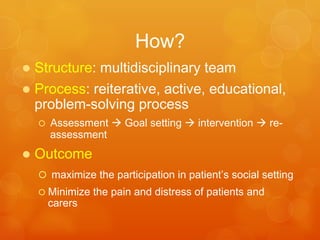
How?
•  Structure:	
  mul-disciplinary	
  team	
  
•  Process:	
  reitera-ve,	
  ac-ve,	
  educa-onal,	
  
problem-­‐solving	
  process	
  
–  Assessment	
  à	
  Goal	
  seHng	
  à	
  interven-on	
  à	
  re-­‐
assessment	
  
•  Outcome	
  
–  	
  maximize	
  the	
  par-cipa-on	
  in	
  pa-ent’s	
  social	
  seHng	
  
–  Minimize	
  the	
  pain	
  and	
  distress	
  of	
  pa-ents	
  and	
  carers	
  
Where?
•  Hospital	
  
•  Hospice/specialist	
  pallia-ve	
  seHng	
  
•  Day	
  care	
  center	
  
•  Community	
  
What?
•  Disease	
  related:	
  brain	
  tumor…	
  
•  Treatment	
  related:	
  chemotherapy	
  
induced,	
  radiotherapy	
  induced…	
  
•  Symptoms,	
  e-ology	
  of	
  the	
  symptoms	
  	
  
Symptoms	
  
•  Func-onal	
  limita-on	
  
•  Pain	
  
•  Breathless/Dyspnea	
  	
  
•  Cancer	
  related	
  fa-gue	
  (CRF)	
  
•  Mental	
  Health:	
  communica-on	
  
Assessment
Pa-ent	
  	
  Family	
  Centered
•  Pa-ent	
  	
  family’s	
  expecta-on	
  
–  Expected	
  ac-vity	
  
–  Physical	
  ability	
  
–  Environmental	
  	
  
Ques-ons
•  Pa-ent	
  
–  What	
  are	
  the	
  most	
  important	
  things	
  prevented?	
  
–  What	
  brings	
  you	
  the	
  most	
  pleasure?	
  
–  What	
  do	
  you	
  most	
  like	
  to	
  do	
  tomorrow	
  if	
  you	
  can?	
  
•  Caregiver	
  
–  What’s	
  the	
  most	
  concerned	
  in	
  caring	
  for	
  the	
  
physical	
  needs	
  of	
  the	
  pa-ent?	
  
–  What	
  are	
  you	
  allowing	
  the	
  pa-ent	
  to	
  do	
  
independently?	
  
RED	
  FLAGS	
  OR	
  YELLOW	
  FLAGS	
  
l Complete blood count
l  Anemia
l  Neutropenic
l  Thrombocytopenic
l Neural impairments
l Skeletal impairments
l Cardiovascular or pulmonary system
	
  
PHYSICAL	
  FUNCTIONING
l  Strength, ROM, muscular and cardiopulmonary
endurance, pain
l  Eastern Cooperative Oncology Group (ECOG) scale
l  Karnofsky Performance Status scale (KPS scale)
ECOG	
  performance	
  status	
  
Grade ECOG
0 Fully active, able to carry on all pre-disease performance
without restriction
1
Restricted in physically strenuous activity but ambulatory and
able to carry out work of a light or sedentary nature, e.g., light
house work, office work
2 Ambulatory and capable of all selfcare but unable to carry out
any work activities. Up and about more than 50% of waking
hours
3 Capable of only limited self care, confined to bed or chair more
than 50% of waking hours
4 Completely disabled. Cannot carry on any selfcare. Totally
confined to bed or chair
5 Dead
Oken, et al. Am J Clin Oncol 1982;5:649-655
KPS scale
Able to carry on normal
activity and to work; no
special care needed.
100 Normal no complaints; no evidence of disease.
90 Able to carry on normal activity; minor signs or symptoms
of disease.
80 Normal activity with effort; some signs or symptoms of
disease.
Unable to work; able to
live at home and care for
most personal needs;
varying amount of
assistance needed.
70 Cares for self; unable to carry on normal activity or to do
active work.
60 Requires occasional assistance, but is able to care for most
of his personal needs.
50 Requires considerable assistance and frequent medical
care.
Unable to care for self;
requires equivalent of
institutional or hospital
care; disease may be
progressing rapidly.
40 Disabled; requires special care and assistance.
30 Severely disabled; hospital admission is indicated although
death not imminent.
20 Very sick; hospital admission necessary; active supportive
treatment necessary.
10 Moribund; fatal processes progressing rapidly.
0 Dead
GOAL	
  SETTING
l  Patient and family need
l  Achievable within one week
l  Compensatory approach is concerned
確認現有的資源及優勢-1	
 
病患本身及家屬	
 
1.  是否認清疾病進展對功能的影響?	
 
2.  期望,是否好高騖遠?	
 
3.  達成病患的目標需要花多少時間或介入的
次數?	
 
4.  病患的家庭支持系統好嗎?家屬願意配合
嗎?照顧者是固定的嗎?
確認現有的資源及優勢-2	
 
病患本身及家屬(續):	
 
5.  病患現有的身體功能,有哪些可以安全的
參與於活動當中?	
 
6.  病患現有的輔具有哪些?合適嗎?可以維
修或修改嗎?有輔具資源可運用嗎?	
 
7.  病患使否有身障手冊?可爭取到哪些社會
福利資源?	
 
8.  後續的安置問題	
 
尊重病人自主權
確認現有的資源及優勢-3	
 
照顧團隊的考量:	
 
1.  對於病患的期望或需要,緩和病房團隊成
員覺得可行嗎?	
 
2.  可以給予怎樣的配合及幫助?(護理師、社
工、志工、宗教師)	
 
3.  如何以最有效率、節省人力、物力成本的
方式提供服務呢?
確認現有的資源及優勢-4	
 
•  和病患、家屬及團隊共同擬訂計畫後一起
解決問題。	
 
★	
 病患的參與可以減少其對疾病的絕望	
 
★	
 增進和病患、家屬和醫療者間的關係	
 
★	
 提升病患的生活品質和減輕照顧者的負擔
PALLIATION
l Managing symptoms
l Improving mobility
l Slowing functional decline
l Maintaining QOL
l 6-week structured PA: significant decrease in
fatigue  increase in physical performance 
emotional functioning (Oldervoll et al, 2005, 2006 )
l 50 patients, home-based PA, walking
(Lowe, et al. Support Care Cancer 2010;18:1469-75)
INTERVENTION—FUNCTION
l  Strength training, ROM exercise, muscular and
cardiopulmonary endurance training, pain
management
l  Activity modification
l  Assistive devices
l  Environmental adaptation
CASE	
  1
l  BC, bone meta with spine compression fracture
l  Sit, dinner with family
l  Pain, weakness, contracture of knee, poor
endurance
INTERVENTION—PAIN
l Somatic pain
l Neuropathic pain
l Visceral pain
l Total suffering
INTERVENTION—PAIN	
  (I)
l Medication: mouth, clock, the ladder
INTERVENTION—PAIN	
  (2)
l PT measures
l  Exercise and movement
l  Graded and purposeful activity
l  Postural re-education
l  Massage
l  Manual techniques
l  Pain control modalities: TENS, heat  cold
PAIN	
  AND	
  FUNCTION
(Rehabilita-on	
  in	
  cancer	
  care,	
  2008)
(Rehabilita-on	
  in	
  cancer	
  
care,	
  2008)
Interven-on—dyspnea
•  Medical	
  interven-on	
  
•  Alter	
  the	
  physiological	
  mechanisms	
  
•  Alter	
  the	
  central	
  percep-on	
  of	
  dyspnea	
  
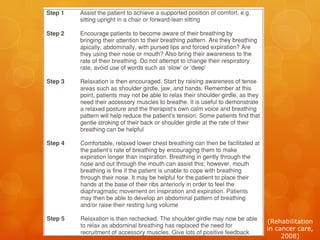
(Rehabilita-on	
  in	
  
cancer	
  care,	
  
2008)
Helpful	
  Posi-ons
•  High	
  side	
  lying	
  
•  SiHng	
  upright	
  in	
  a	
  chair	
  with	
  feet,	
  back	
  
and	
  arms	
  supported	
  
•  Forward	
  lean	
  siHng	
  with	
  arms	
  res-ng	
  on	
  
pillows	
  on	
  a	
  table	
  
•  Standing	
  relaxed,	
  leaning	
  forward	
  with	
  
arms	
  res-ng	
  on	
  	
  a	
  support	
  such	
  as	
  a	
  
windowsill	
  
•  Standing	
  relaxed,	
  leaning	
  backwards	
  
against	
  a	
  wall	
  with	
  the	
  legs	
  slightly	
  apart,	
  
chest	
  forward	
  and	
  relaxed,	
  arms	
  hanging	
  
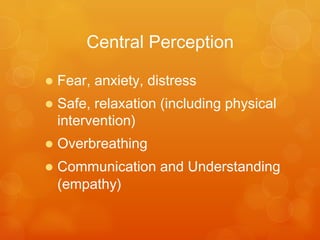
Central	
  Percep-on
•  Fear,	
  anxiety,	
  distress	
  
•  Safe,	
  relaxa-on	
  (including	
  physical	
  
interven-on)	
  
•  Overbreathing	
  	
  
•  Communica-on	
  and	
  Understanding	
  
(empathy)	
  
Fa-gue:	
  Screening	
  	
  Assessment
•  Age	
  5-­‐6	
  y/o:	
  not	
  -red,	
  -red	
  
•  Age	
  7-­‐12	
  y/o:	
  1-­‐5	
  scale	
  
– 1-­‐2:	
  mild	
  
– 3:	
  moderate	
  
– 4-­‐5:	
  severe	
  
•  Age	
  12	
  y/o:	
  0-­‐10	
  scale	
  
– 0-­‐3:	
  none	
  to	
  mild	
  
– 4-­‐6:	
  moderate	
  
– 7-­‐10:	
  severe	
  
Non	
  to	
  Mild
•  Not	
  -red	
  in	
  age	
  5-­‐6,	
  scores	
  1-­‐2	
  in	
  age	
  
7-­‐12,	
  or	
  scores	
  0-­‐3	
  in	
  age12	
  
•  Educa-on	
  
– Ac-ve	
  treatment	
  
– Post	
  treatment	
  
– End	
  of	
  life	
  
•  General	
  strategies	
  to	
  manage	
  fa-gue	
  
– Ac-ve	
  treatment	
  
– Post	
  treatment	
  
– End	
  of	
  life
Non	
  to	
  Mild:	
  	
  Ac-ve	
  Treatment
Non	
  to	
  Mild:	
  	
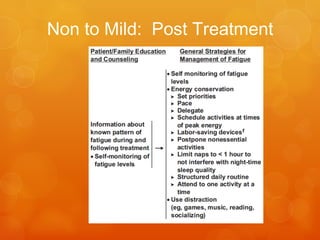
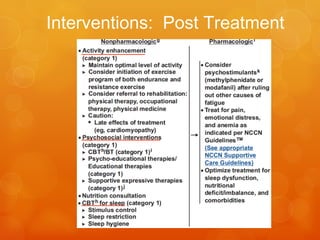
  Post	
  Treatment
Non	
  to	
  Mild:	
  	
  End	
  of	
  Life
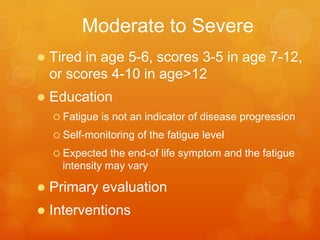
Moderate	
  to	
  Severe
•  Tired	
  in	
  age	
  5-­‐6,	
  scores	
  3-­‐5	
  in	
  age	
  7-­‐12,	
  or	
  
scores	
  4-­‐10	
  in	
  age12	
  
•  Educa-on	
  
– Fa-gue	
  is	
  not	
  an	
  indicator	
  of	
  disease	
  
progression	
  
– Self-­‐monitoring	
  of	
  the	
  fa-gue	
  level	
  
– Expected	
  the	
  end-­‐of	
  life	
  symptom	
  and	
  the	
  
fa-gue	
  intensity	
  may	
  vary	
  
•  Primary	
  evalua-on	
  
•  Interven-ons	
  
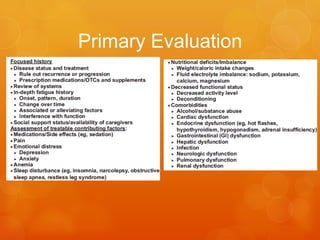
Primary	
  Evalua-on
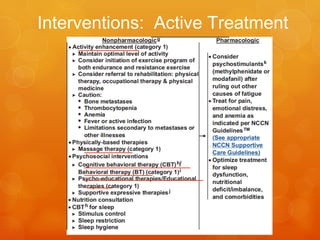
Interven-ons:	
  	
  Ac-ve	
  Treatment
Interven-ons:	
  	
  Post	
  Treatment
Interven-ons:	
  	
  End	
  of	
  Life
Ac-vity	
  Enhancement	
  (I)
•  Fa-gue:	
  **	
  
–  during	
  cancer	
  treatment	
  
–  following	
  cancer	
  treatment	
  
•  Aerobic	
  capacity:	
  
–  11/22:	
  significant	
  difference	
  between	
  
interven-on	
  and	
  control	
  group	
  
–  3/22:	
  significant	
  pre-­‐post	
  difference	
  
–  8/22:	
  	
  non	
  significant	
  difference	
  
•  Quality	
  of	
  life:	
  	
  -­‐-­‐	
  
•  Anxiety:	
  	
  -­‐-­‐	
  
•  Depression:	
  	
  -­‐-­‐
Cramp	
  et	
  al,	
  2008
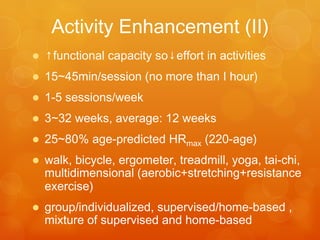
Ac-vity	
  Enhancement	
  (II)
•  ↑func-onal	
  capacity	
  so↓effort	
  in	
  ac-vi-es	
  
•  15~45min/session	
  (no	
  more	
  than	
  I	
  hour)	
  
•  1-­‐5	
  sessions/week	
  
•  3~32	
  weeks,	
  average:	
  12	
  weeks	
  
•  25~80%	
  age-­‐predicted	
  HRmax	
  (220-­‐age)	
  
•  walk,	
  bicycle,	
  ergometer,	
  treadmill,	
  yoga,	
  tai-­‐chi,	
  
mul-dimensional	
  (aerobic+stretching+resistance	
  
exercise)	
  	
  
•  group/individualized,	
  supervised/home-­‐based	
  ,	
  
mixture	
  of	
  supervised	
  and	
  home-­‐based
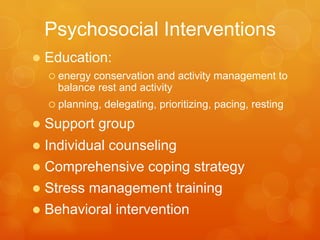
Psychosocial	
  Interven-ons
•  Educa-on:	
  	
  
– energy	
  conserva-on	
  and	
  ac-vity	
  
management	
  to	
  balance	
  rest	
  and	
  ac-vity	
  
– planning,	
  delega-ng,	
  priori-zing,	
  pacing,	
  
res-ng	
  
•  Support	
  group	
  
•  Individual	
  counseling	
  
•  Comprehensive	
  coping	
  strategy	
  
•  Stress	
  management	
  training	
  
•  Behavioral	
  interven-on
Sleep	
  Therapy
•  S-mulus	
  control	
  
–  go	
  to	
  bed	
  when	
  sleepy,	
  get	
  out	
  of	
  bed	
  a0er	
  20	
  
min	
  of	
  wakefulness	
  
–  Have	
  a	
  rou-ne	
  bed-me	
  and	
  rising	
  -me	
  
•  Sleep	
  restric-on	
  
–  avoidance	
  of	
  long	
  or	
  late	
  day	
  naps	
  
–  Limi-ng	
  total	
  -me	
  in	
  bed	
  
•  Sleep	
  hygiene	
  
–  caffeine	
  and	
  exercise	
  avoidance	
  near	
  bed-me	
  
–  comfortable	
  sleep	
  surroundings	
  (dark,	
  
relaxing…)	
  
–  soothing	
  ac-vi-es	
  at	
  bed-me	
  (music,	
  …)	
  
癌末頻死症狀	
 
•  進行性惡化徵候	
 
– 肌力下降、體重下降、神智混亂昏睡、時空感
消失、注意力越來越差、皮膚顏色變化(濕冷、
斑駁)、四肢發冷末端發紺、脈搏減弱、血壓逐
漸降低。	
 
•  臨終脫水	
 
– 不再進食及喝水。是一預備死亡的自然過程,
大部分患者不會感到不適。	
 
•  死亡咯咯聲(death	
 rattle)	
 
– 喉頭及支氣管內分泌物無法排出,隨呼氣及吐
氣上下移動發出聲音。
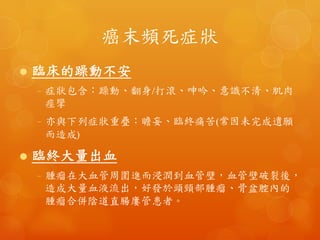
癌末頻死症狀	
 
•  臨床的躁動不安	
 
– 症狀包含:躁動、翻身/打滾、呻吟、意識不清、
肌肉痙攣	
 
– 亦與下列症狀重疊:瞻妄、臨終痛苦(常因未完
成遺願而造成)	
 
•  臨終大量出血	
 
– 腫瘤在大血管周圍進而浸潤到血管壁,血管壁
破裂後,造成大量血液流出,好發於頭頸部腫
瘤、骨盆腔內的腫瘤合併陰道直腸廔管患者。
Thank	
  you	
  for	
  your	
  anen-on!	
  
Any	
  Sharing?
考題
•  病人的疼痛應先試物理治療,一個月沒效
再開始用強效止痛劑 (X)	
  
•  病人無法經由訓練提升功能時,則應停止
物理治療 (X)	
  
•  病人可以選擇不接受治療 (O)

曹昭懿物理治療師-復健與安寧緩和照護20130922

  • 1.
  • 2.
    Goals •  To  cure  some-mes   •  To  relieve  o0en   •  To  comfort  always  
  • 3.
    Pallia-ve  Care •  Goal:  achievement  of  the  best  quality  of  life   for  pa-ents  and  their  families     •  Focus  on  func-onal  consequence  of  the   disease  and  its  treatment,  including   physical  and  psychological  aspects   •  Func-onal  reserve  and  maximize  func-on  
  • 4.
    How? •  Structure:  mul-disciplinary  team   •  Process:  reitera-ve,  ac-ve,  educa-onal,   problem-­‐solving  process   –  Assessment  à  Goal  seHng  à  interven-on  à  re-­‐ assessment   •  Outcome   –   maximize  the  par-cipa-on  in  pa-ent’s  social  seHng   –  Minimize  the  pain  and  distress  of  pa-ents  and  carers  
  • 5.
    Where? •  Hospital   • Hospice/specialist  pallia-ve  seHng   •  Day  care  center   •  Community  
  • 6.
    What? •  Disease  related:  brain  tumor…   •  Treatment  related:  chemotherapy   induced,  radiotherapy  induced…   •  Symptoms,  e-ology  of  the  symptoms    
  • 7.
    Symptoms   •  Func-onal  limita-on   •  Pain   •  Breathless/Dyspnea     •  Cancer  related  fa-gue  (CRF)   •  Mental  Health:  communica-on  
  • 9.
  • 10.
    Pa-ent    Family  Centered •  Pa-ent    family’s  expecta-on   –  Expected  ac-vity   –  Physical  ability   –  Environmental    
  • 11.
    Ques-ons •  Pa-ent   – What  are  the  most  important  things  prevented?   –  What  brings  you  the  most  pleasure?   –  What  do  you  most  like  to  do  tomorrow  if  you  can?   •  Caregiver   –  What’s  the  most  concerned  in  caring  for  the   physical  needs  of  the  pa-ent?   –  What  are  you  allowing  the  pa-ent  to  do   independently?  
  • 12.
    RED  FLAGS  OR  YELLOW  FLAGS   l Complete blood count l  Anemia l  Neutropenic l  Thrombocytopenic l Neural impairments l Skeletal impairments l Cardiovascular or pulmonary system  
  • 13.
    PHYSICAL  FUNCTIONING l  Strength,ROM, muscular and cardiopulmonary endurance, pain l  Eastern Cooperative Oncology Group (ECOG) scale l  Karnofsky Performance Status scale (KPS scale)
  • 14.
    ECOG  performance  status   Grade ECOG 0 Fully active, able to carry on all pre-disease performance without restriction 1 Restricted in physically strenuous activity but ambulatory and able to carry out work of a light or sedentary nature, e.g., light house work, office work 2 Ambulatory and capable of all selfcare but unable to carry out any work activities. Up and about more than 50% of waking hours 3 Capable of only limited self care, confined to bed or chair more than 50% of waking hours 4 Completely disabled. Cannot carry on any selfcare. Totally confined to bed or chair 5 Dead Oken, et al. Am J Clin Oncol 1982;5:649-655
  • 15.
    KPS scale Able tocarry on normal activity and to work; no special care needed. 100 Normal no complaints; no evidence of disease. 90 Able to carry on normal activity; minor signs or symptoms of disease. 80 Normal activity with effort; some signs or symptoms of disease. Unable to work; able to live at home and care for most personal needs; varying amount of assistance needed. 70 Cares for self; unable to carry on normal activity or to do active work. 60 Requires occasional assistance, but is able to care for most of his personal needs. 50 Requires considerable assistance and frequent medical care. Unable to care for self; requires equivalent of institutional or hospital care; disease may be progressing rapidly. 40 Disabled; requires special care and assistance. 30 Severely disabled; hospital admission is indicated although death not imminent. 20 Very sick; hospital admission necessary; active supportive treatment necessary. 10 Moribund; fatal processes progressing rapidly. 0 Dead
  • 16.
    GOAL  SETTING l  Patientand family need l  Achievable within one week l  Compensatory approach is concerned
  • 17.
    確認現有的資源及優勢-1 病患本身及家屬 1. 是否認清疾病進展對功能的影響? 2.  期望,是否好高騖遠? 3.  達成病患的目標需要花多少時間或介入的 次數? 4.  病患的家庭支持系統好嗎?家屬願意配合 嗎?照顧者是固定的嗎?
  • 18.
    確認現有的資源及優勢-2 病患本身及家屬(續): 5. 病患現有的身體功能,有哪些可以安全的 參與於活動當中? 6.  病患現有的輔具有哪些?合適嗎?可以維 修或修改嗎?有輔具資源可運用嗎? 7.  病患使否有身障手冊?可爭取到哪些社會 福利資源? 8.  後續的安置問題 尊重病人自主權
  • 19.
    確認現有的資源及優勢-3 照顧團隊的考量: 1. 對於病患的期望或需要,緩和病房團隊成 員覺得可行嗎? 2.  可以給予怎樣的配合及幫助?(護理師、社 工、志工、宗教師) 3.  如何以最有效率、節省人力、物力成本的 方式提供服務呢?
  • 20.
    確認現有的資源及優勢-4 •  和病患、家屬及團隊共同擬訂計畫後一起 解決問題。 ★ 病患的參與可以減少其對疾病的絕望 ★ 增進和病患、家屬和醫療者間的關係 ★ 提升病患的生活品質和減輕照顧者的負擔
  • 21.
    PALLIATION l Managing symptoms l Improving mobility l Slowingfunctional decline l Maintaining QOL l 6-week structured PA: significant decrease in fatigue increase in physical performance emotional functioning (Oldervoll et al, 2005, 2006 ) l 50 patients, home-based PA, walking (Lowe, et al. Support Care Cancer 2010;18:1469-75)
  • 22.
    INTERVENTION—FUNCTION l  Strength training,ROM exercise, muscular and cardiopulmonary endurance training, pain management l  Activity modification l  Assistive devices l  Environmental adaptation
  • 23.
    CASE  1 l  BC,bone meta with spine compression fracture l  Sit, dinner with family l  Pain, weakness, contracture of knee, poor endurance
  • 24.
  • 25.
  • 26.
    INTERVENTION—PAIN  (2) l PT measures l Exercise and movement l  Graded and purposeful activity l  Postural re-education l  Massage l  Manual techniques l  Pain control modalities: TENS, heat cold
  • 27.
    PAIN  AND  FUNCTION (Rehabilita-on  in  cancer  care,  2008)
  • 28.
  • 29.
    Interven-on—dyspnea •  Medical  interven-on   •  Alter  the  physiological  mechanisms   •  Alter  the  central  percep-on  of  dyspnea  
  • 30.
  • 31.
    Helpful  Posi-ons •  High  side  lying   •  SiHng  upright  in  a  chair  with  feet,  back   and  arms  supported   •  Forward  lean  siHng  with  arms  res-ng  on   pillows  on  a  table   •  Standing  relaxed,  leaning  forward  with   arms  res-ng  on    a  support  such  as  a   windowsill   •  Standing  relaxed,  leaning  backwards   against  a  wall  with  the  legs  slightly  apart,   chest  forward  and  relaxed,  arms  hanging  
  • 32.
    Central  Percep-on •  Fear,  anxiety,  distress   •  Safe,  relaxa-on  (including  physical   interven-on)   •  Overbreathing     •  Communica-on  and  Understanding   (empathy)  
  • 33.
    Fa-gue:  Screening    Assessment •  Age  5-­‐6  y/o:  not  -red,  -red   •  Age  7-­‐12  y/o:  1-­‐5  scale   – 1-­‐2:  mild   – 3:  moderate   – 4-­‐5:  severe   •  Age  12  y/o:  0-­‐10  scale   – 0-­‐3:  none  to  mild   – 4-­‐6:  moderate   – 7-­‐10:  severe  
  • 34.
    Non  to  Mild • Not  -red  in  age  5-­‐6,  scores  1-­‐2  in  age   7-­‐12,  or  scores  0-­‐3  in  age12   •  Educa-on   – Ac-ve  treatment   – Post  treatment   – End  of  life   •  General  strategies  to  manage  fa-gue   – Ac-ve  treatment   – Post  treatment   – End  of  life
  • 35.
    Non  to  Mild:    Ac-ve  Treatment
  • 36.
    Non  to  Mild:    Post  Treatment
  • 37.
    Non  to  Mild:    End  of  Life
  • 38.
    Moderate  to  Severe • Tired  in  age  5-­‐6,  scores  3-­‐5  in  age  7-­‐12,  or   scores  4-­‐10  in  age12   •  Educa-on   – Fa-gue  is  not  an  indicator  of  disease   progression   – Self-­‐monitoring  of  the  fa-gue  level   – Expected  the  end-­‐of  life  symptom  and  the   fa-gue  intensity  may  vary   •  Primary  evalua-on   •  Interven-ons  
  • 39.
  • 40.
  • 41.
  • 42.
  • 43.
    Ac-vity  Enhancement  (I) • Fa-gue:  **   –  during  cancer  treatment   –  following  cancer  treatment   •  Aerobic  capacity:   –  11/22:  significant  difference  between   interven-on  and  control  group   –  3/22:  significant  pre-­‐post  difference   –  8/22:    non  significant  difference   •  Quality  of  life:    -­‐-­‐   •  Anxiety:    -­‐-­‐   •  Depression:    -­‐-­‐ Cramp  et  al,  2008
  • 44.
    Ac-vity  Enhancement  (II) • ↑func-onal  capacity  so↓effort  in  ac-vi-es   •  15~45min/session  (no  more  than  I  hour)   •  1-­‐5  sessions/week   •  3~32  weeks,  average:  12  weeks   •  25~80%  age-­‐predicted  HRmax  (220-­‐age)   •  walk,  bicycle,  ergometer,  treadmill,  yoga,  tai-­‐chi,   mul-dimensional  (aerobic+stretching+resistance   exercise)     •  group/individualized,  supervised/home-­‐based  ,   mixture  of  supervised  and  home-­‐based
  • 45.
    Psychosocial  Interven-ons •  Educa-on:     – energy  conserva-on  and  ac-vity   management  to  balance  rest  and  ac-vity   – planning,  delega-ng,  priori-zing,  pacing,   res-ng   •  Support  group   •  Individual  counseling   •  Comprehensive  coping  strategy   •  Stress  management  training   •  Behavioral  interven-on
  • 46.
    Sleep  Therapy •  S-mulus  control   –  go  to  bed  when  sleepy,  get  out  of  bed  a0er  20   min  of  wakefulness   –  Have  a  rou-ne  bed-me  and  rising  -me   •  Sleep  restric-on   –  avoidance  of  long  or  late  day  naps   –  Limi-ng  total  -me  in  bed   •  Sleep  hygiene   –  caffeine  and  exercise  avoidance  near  bed-me   –  comfortable  sleep  surroundings  (dark,   relaxing…)   –  soothing  ac-vi-es  at  bed-me  (music,  …)  
  • 47.
    癌末頻死症狀 •  進行性惡化徵候 – 肌力下降、體重下降、神智混亂昏睡、時空感 消失、注意力越來越差、皮膚顏色變化(濕冷、 斑駁)、四肢發冷末端發紺、脈搏減弱、血壓逐 漸降低。 •  臨終脫水 – 不再進食及喝水。是一預備死亡的自然過程, 大部分患者不會感到不適。 •  死亡咯咯聲(death rattle) – 喉頭及支氣管內分泌物無法排出,隨呼氣及吐 氣上下移動發出聲音。
  • 48.
    癌末頻死症狀 •  臨床的躁動不安 – 症狀包含:躁動、翻身/打滾、呻吟、意識不清、 肌肉痙攣 – 亦與下列症狀重疊:瞻妄、臨終痛苦(常因未完 成遺願而造成) •  臨終大量出血 – 腫瘤在大血管周圍進而浸潤到血管壁,血管壁 破裂後,造成大量血液流出,好發於頭頸部腫 瘤、骨盆腔內的腫瘤合併陰道直腸廔管患者。
  • 49.
    Thank  you  for  your  anen-on!   Any  Sharing?
  • 50.
    考題 •  病人的疼痛應先試物理治療,一個月沒效 再開始用強效止痛劑 (X)   •  病人無法經由訓練提升功能時,則應停止 物理治療 (X)   •  病人可以選擇不接受治療 (O)