Cancer Pain Management
Brief Guidelines
Prof. Shad Salim Akhtar
MBBS, MD, MRCP(UK), FRCP(Edin), FACP(USA)
Consultant Medical Oncologist & Medical Director
Prince Faisal Oncology Center, KFSH
Professor of Clinical Medicine
Qassim Medical University
Buraidah, Al-Qassim
IARC Globocan 2002, Figures based on 1998-2002 prevalence
Burden
of
Cancer
Magnitude of the Problem-
Future looks GRIM
New cases in 2020
Cancer Pain
30-50% of cancer pts are on active therapy
5 million or more cancer patients are
suffering from pain
 With or without adequate therapy
57% patients perceive cancer death painful
69% consider committing suicide due to pain
Cancer Related Pain
At diagnosis 25%
Advanced disease 75%
During therapy 30%
Goudas LC et al: Cancer Invest 2005;23:519
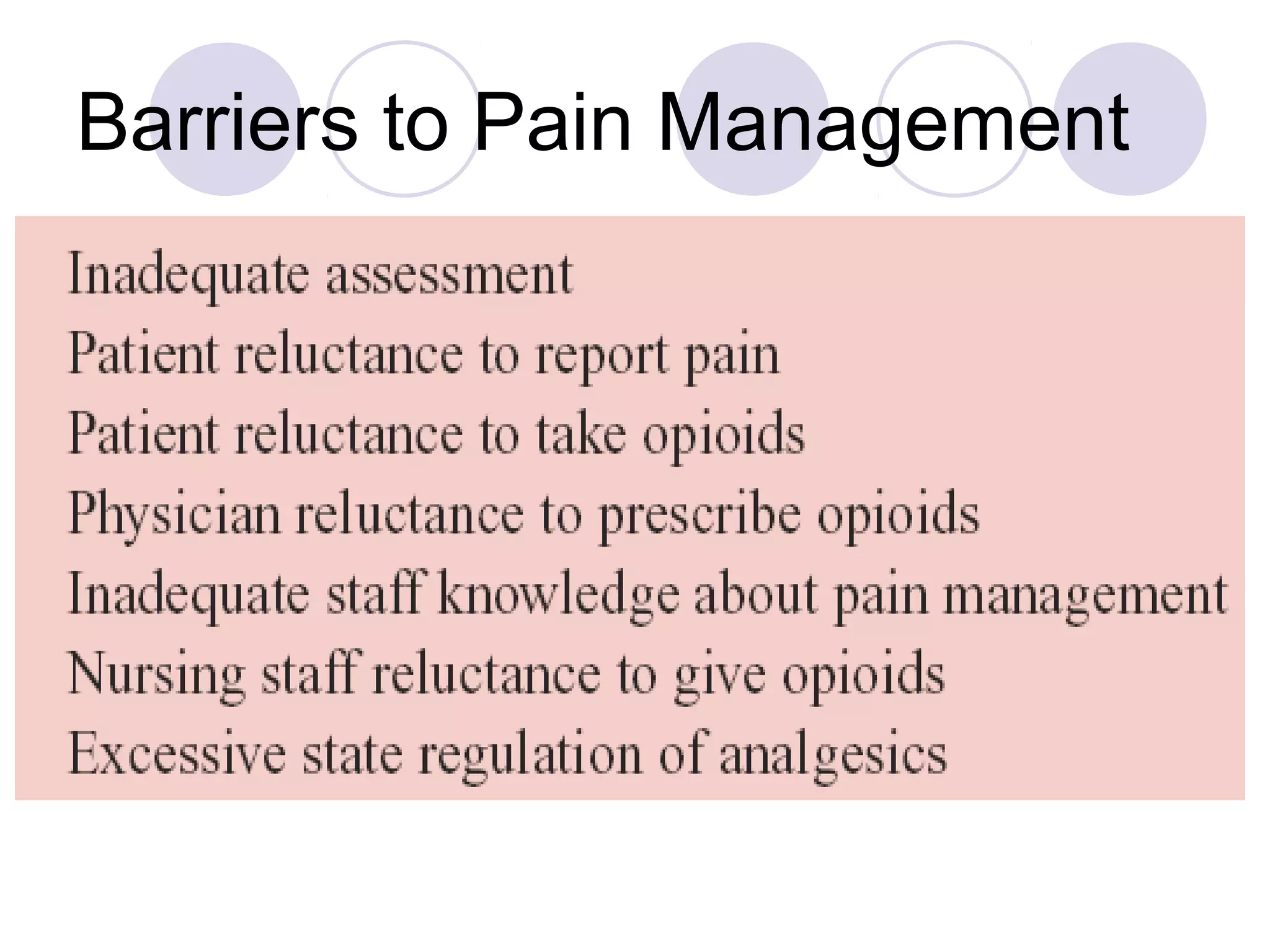
Barriers to Pain Management
Neurophysiology
Nociceptive receptors
 Myelinated fibres
 Noxious mechanical stimuli
 Rapid conduction
 A delta fibres- sharp stinging pain
 Unmyelinated fibres
 Chemical stimuli
 Mechanical stimuli
 Thermal stimuli
 C fibres- dull burning aching pain
Cancer Pain Classification
Nociceptive (skin, viscera, muscles,
connective tissue)
 Somatic pain
 Most common type
 Bone metastasis most common cause
 Visceral pain
 Commonly refd to cutaneous sites
Neuropathic pain
 Injury to peripheral or CNS
Caraceni A et al: Oncology 2001;15:1627
WHO Three - Step Approach
New Concepts of Management
Assessment of pain
Individualization of therapeutic approach
Continual reassessment
Simplest approach
Continuing communication
Define goals
Assurance of availability of expertise
Universal Screening
Screen for pain
Quantify pain
Pain >0 comprehensive pain
assessment
 Pain=0 repeat screening at each subsequent
visit
Clinical Assessment of Pain
Believe the patients complaint
Careful history
Characteristics of each pain
List and prioritize each pain complaint
Evaluate response to previous therapy
Psychological state evaluation
Alcohol or drug dependence
Comprehensive Pain
Assessment
Intensity
At rest
With movement
Interference with activities
Pain Intensity Numerical Scale
Verbal: “How much pain are you having?”
from 0 (no pain) to 10 (worst imaginable
pain)
Written: “Circle the number that describes
how much pain you are having.”
0 1 2 3 4 5 6 7 8 9 10
No pain Worst imaginable pain
Wong DL et al:2001; Mosby Inc Ess Ped Nurs
Pain Intensity Wong-Baker
Faces
Wong DL et al:2001; Mosby Inc Ess Ped Nurs
Pain Intensity Categorical
Scale
None (0)
Mild (1–3)
Moderate (4–6)
Severe (7–10)
Wong DL et al:2001; Mosby Inc Ess Ped Nurs
Comprehensive Pain
Assessment
Location
Pathophysiology (Character)
Somatic: pain in skin, muscle, bone described
as aching, stabbing, throbbing, pressure
Visceral: pain in organs or viscera described
as gnawing, cramping, aching, sharp
Neuropathic: pain caused by nerve damage
described as sharp, tingling, burning, shooting
History of Pain Other Points
Onset
Duration
Course
Referred pain, radiation
Aggravating & alleviating factors
Associated symptoms
Response to current and prior treatment
including reasons for discontinuing
Etiology (Pain syndromes)
 Associated with tumour infiltration
 Associated with cancer therapy
 Unrelated to cancer therapy
Medical history
 Current medications including prescribed,
over the counter
 Complimentary and alternative therapies
 Oncologic
 Other significant medical illnesses
Comprehensive Pain
Assessment
Psychosocial Aspects of Pain
Patient distress
Family and other available support
Psychiatric history including current or prior
history of substance abuse
Special issues relating to pain
 Meaning of pain for patient/family
 Patient/family knowledge and beliefs surrounding
pain
 Cultural beliefs toward pain
 Spiritual or religious considerations
Clinical examination
Appropriate diagnostic procedures
Treat pain as necessary for work up
Individualize diagnostic and therapeutic
approach
Continuity of care
Reassess patient for response
Discuss advance directive with the pt &
family
Clinical Assessment of Pain
Pain not related
to an Oncologic
emergency
Patient not
taking opioids
Patient taking
opioids
Opioid Naive Patient Severity 7-10
Rapidly titrate short-acting opioid
 Begin bowel regimen
Recognize and treat side effects
Co-analgesics as indicated
Provide psychosocial support
Begin educational activities
Repeat comprehensive assessment in 24 hrs
Titrate short-acting opioid
 Begin bowel regimen
Recognize and treat side effects
Co analgesics as indicated
Provide psychosocial support
Begin educational activities
Repeat assessment in 24-48 hrs
Opioid Naive Patient Severity 4-6
Consider NSAID or acetaminophen without
opioid if patient is not on analgesics or
Consider titrating short-acting opioid
 Begin bowel regimen
Recognize and treat side effects
Co analgesics as indicated
Provide psychosocial support
Begin educational activities
Repeat assessment in 72 hrs
Opioid Naive Patient Severity 1-3
Approximate Opioid Doses
The appropriate dose is the dose that relieves the patient’s pain
throughout its dosing interval without causing unmanageable
side effects.
Pain 7-10 Consider increasing dose by 50%-100%
Pain 4-6 Consider increasing dose by 25%-50%
Pain 1-3 Consider increasing dose by 25%
Pain with Oncological Emergency
 Bone fracture or impending fracture of weight
bearing bone
 Brain metastases
 Epidural metastases
 Leptomeningeal metastases
 Pain related to infection
 Perforated viscous
 (acute abdomen)
 Analgesics as specified by pathway
 Specific treatment for oncological emergency as clinically
indicated
 (eg, surgery, steroids, RT, antibiotics)
Consider conversion to SR when 24 hr
opioid requirement is stable
Extended-release morphine sulfate tablets
every 8-24 h depending on brand.
Capsules every 8-24 h
Extended-release oxycodone hydrochloride
tablets every 8-12 h
Transdermal fentanyl delivery system every
48-72 h
Provide rescue short acting opioids
Maintenance Therapy
Interventional Strategy
Pain likely to be relieved with nerve block
 Pancreas/upper abdomen
 Celiac plexus block,
 Lower abdomen
 superior hypogastric plexus block,
 Intercostal nerve block
 Peripheral nerve block
Interventional Strategy
Failure of response without side effects
 Intraspinal agents
 Blocks
 Spinal cord stimulation
 Destructive neurosurgical procedures
 Neurolysis
 Thoracic splanchnicectomy
 Midline myelotomy
 Cordotomy
Surgical Procedures for Pain Control
Specific Pain Problems
Inflammation
 NSAIDS
 Corticoides
Bone pain
 Bisphosphonates
Neuropathic pain
 Tricyclic
 Anticonvulsants
 Topical agents
Cancer chemotherapy/radiotherapy
Additional therapeutic modalities
Physiotherapy
Hypnosis
Acupuncture
Alternative therapies
Cancer pain management

Cancer pain management

  • 1.
    Cancer Pain Management BriefGuidelines Prof. Shad Salim Akhtar MBBS, MD, MRCP(UK), FRCP(Edin), FACP(USA) Consultant Medical Oncologist & Medical Director Prince Faisal Oncology Center, KFSH Professor of Clinical Medicine Qassim Medical University Buraidah, Al-Qassim
  • 2.
    IARC Globocan 2002,Figures based on 1998-2002 prevalence Burden of Cancer
  • 3.
    Magnitude of theProblem- Future looks GRIM New cases in 2020
  • 5.
    Cancer Pain 30-50% ofcancer pts are on active therapy 5 million or more cancer patients are suffering from pain  With or without adequate therapy 57% patients perceive cancer death painful 69% consider committing suicide due to pain
  • 6.
    Cancer Related Pain Atdiagnosis 25% Advanced disease 75% During therapy 30% Goudas LC et al: Cancer Invest 2005;23:519
  • 7.
    Barriers to PainManagement
  • 8.
    Neurophysiology Nociceptive receptors  Myelinatedfibres  Noxious mechanical stimuli  Rapid conduction  A delta fibres- sharp stinging pain  Unmyelinated fibres  Chemical stimuli  Mechanical stimuli  Thermal stimuli  C fibres- dull burning aching pain
  • 9.
    Cancer Pain Classification Nociceptive(skin, viscera, muscles, connective tissue)  Somatic pain  Most common type  Bone metastasis most common cause  Visceral pain  Commonly refd to cutaneous sites Neuropathic pain  Injury to peripheral or CNS Caraceni A et al: Oncology 2001;15:1627
  • 10.
    WHO Three -Step Approach
  • 11.
    New Concepts ofManagement Assessment of pain Individualization of therapeutic approach Continual reassessment Simplest approach Continuing communication Define goals Assurance of availability of expertise
  • 12.
    Universal Screening Screen forpain Quantify pain Pain >0 comprehensive pain assessment  Pain=0 repeat screening at each subsequent visit
  • 13.
    Clinical Assessment ofPain Believe the patients complaint Careful history Characteristics of each pain List and prioritize each pain complaint Evaluate response to previous therapy Psychological state evaluation Alcohol or drug dependence
  • 14.
    Comprehensive Pain Assessment Intensity At rest Withmovement Interference with activities
  • 15.
    Pain Intensity NumericalScale Verbal: “How much pain are you having?” from 0 (no pain) to 10 (worst imaginable pain) Written: “Circle the number that describes how much pain you are having.” 0 1 2 3 4 5 6 7 8 9 10 No pain Worst imaginable pain Wong DL et al:2001; Mosby Inc Ess Ped Nurs
  • 16.
    Pain Intensity Wong-Baker Faces WongDL et al:2001; Mosby Inc Ess Ped Nurs
  • 17.
    Pain Intensity Categorical Scale None(0) Mild (1–3) Moderate (4–6) Severe (7–10) Wong DL et al:2001; Mosby Inc Ess Ped Nurs
  • 18.
    Comprehensive Pain Assessment Location Pathophysiology (Character) Somatic:pain in skin, muscle, bone described as aching, stabbing, throbbing, pressure Visceral: pain in organs or viscera described as gnawing, cramping, aching, sharp Neuropathic: pain caused by nerve damage described as sharp, tingling, burning, shooting
  • 19.
    History of PainOther Points Onset Duration Course Referred pain, radiation Aggravating & alleviating factors Associated symptoms Response to current and prior treatment including reasons for discontinuing
  • 20.
    Etiology (Pain syndromes) Associated with tumour infiltration  Associated with cancer therapy  Unrelated to cancer therapy Medical history  Current medications including prescribed, over the counter  Complimentary and alternative therapies  Oncologic  Other significant medical illnesses Comprehensive Pain Assessment
  • 21.
    Psychosocial Aspects ofPain Patient distress Family and other available support Psychiatric history including current or prior history of substance abuse Special issues relating to pain  Meaning of pain for patient/family  Patient/family knowledge and beliefs surrounding pain  Cultural beliefs toward pain  Spiritual or religious considerations
  • 22.
    Clinical examination Appropriate diagnosticprocedures Treat pain as necessary for work up Individualize diagnostic and therapeutic approach Continuity of care Reassess patient for response Discuss advance directive with the pt & family Clinical Assessment of Pain
  • 24.
    Pain not related toan Oncologic emergency Patient not taking opioids Patient taking opioids
  • 25.
    Opioid Naive PatientSeverity 7-10 Rapidly titrate short-acting opioid  Begin bowel regimen Recognize and treat side effects Co-analgesics as indicated Provide psychosocial support Begin educational activities Repeat comprehensive assessment in 24 hrs
  • 26.
    Titrate short-acting opioid Begin bowel regimen Recognize and treat side effects Co analgesics as indicated Provide psychosocial support Begin educational activities Repeat assessment in 24-48 hrs Opioid Naive Patient Severity 4-6
  • 27.
    Consider NSAID oracetaminophen without opioid if patient is not on analgesics or Consider titrating short-acting opioid  Begin bowel regimen Recognize and treat side effects Co analgesics as indicated Provide psychosocial support Begin educational activities Repeat assessment in 72 hrs Opioid Naive Patient Severity 1-3
  • 28.
    Approximate Opioid Doses Theappropriate dose is the dose that relieves the patient’s pain throughout its dosing interval without causing unmanageable side effects. Pain 7-10 Consider increasing dose by 50%-100% Pain 4-6 Consider increasing dose by 25%-50% Pain 1-3 Consider increasing dose by 25%
  • 32.
    Pain with OncologicalEmergency  Bone fracture or impending fracture of weight bearing bone  Brain metastases  Epidural metastases  Leptomeningeal metastases  Pain related to infection  Perforated viscous  (acute abdomen)  Analgesics as specified by pathway  Specific treatment for oncological emergency as clinically indicated  (eg, surgery, steroids, RT, antibiotics)
  • 33.
    Consider conversion toSR when 24 hr opioid requirement is stable Extended-release morphine sulfate tablets every 8-24 h depending on brand. Capsules every 8-24 h Extended-release oxycodone hydrochloride tablets every 8-12 h Transdermal fentanyl delivery system every 48-72 h Provide rescue short acting opioids Maintenance Therapy
  • 34.
    Interventional Strategy Pain likelyto be relieved with nerve block  Pancreas/upper abdomen  Celiac plexus block,  Lower abdomen  superior hypogastric plexus block,  Intercostal nerve block  Peripheral nerve block
  • 35.
    Interventional Strategy Failure ofresponse without side effects  Intraspinal agents  Blocks  Spinal cord stimulation  Destructive neurosurgical procedures  Neurolysis  Thoracic splanchnicectomy  Midline myelotomy  Cordotomy
  • 36.
  • 37.
    Specific Pain Problems Inflammation NSAIDS  Corticoides Bone pain  Bisphosphonates Neuropathic pain  Tricyclic  Anticonvulsants  Topical agents Cancer chemotherapy/radiotherapy
  • 38.

Editor's Notes

  • #29 Doses above 1.5 mg/kg are not recommended due to increased adverse effects. Equivalency ratios comparing morphine (and other opioids) to methadone are dose-dependent. This ratio may range from 1:1 at low doses of oral morphine to as high as 20:1 for patients receiving oral morphine in excess of 300 mg per day. Because of its long half-life, high potency, and interindividual variations in pharmacokinetics, methadone should be started at lower doses and titrated upwards carefully with provisioin of adequate breakthrough pain medications during the titration period. Dosing range: fentanyl, 50 mcg/hour q72 h » 90-268 mg oral morphine q 24 h, or q72 h dose of transdermal fentanyl » x mg/day dose of oral morphine. Dose equivalency is approximately of morphine. Recommended dose frequency for immediate release opioids.