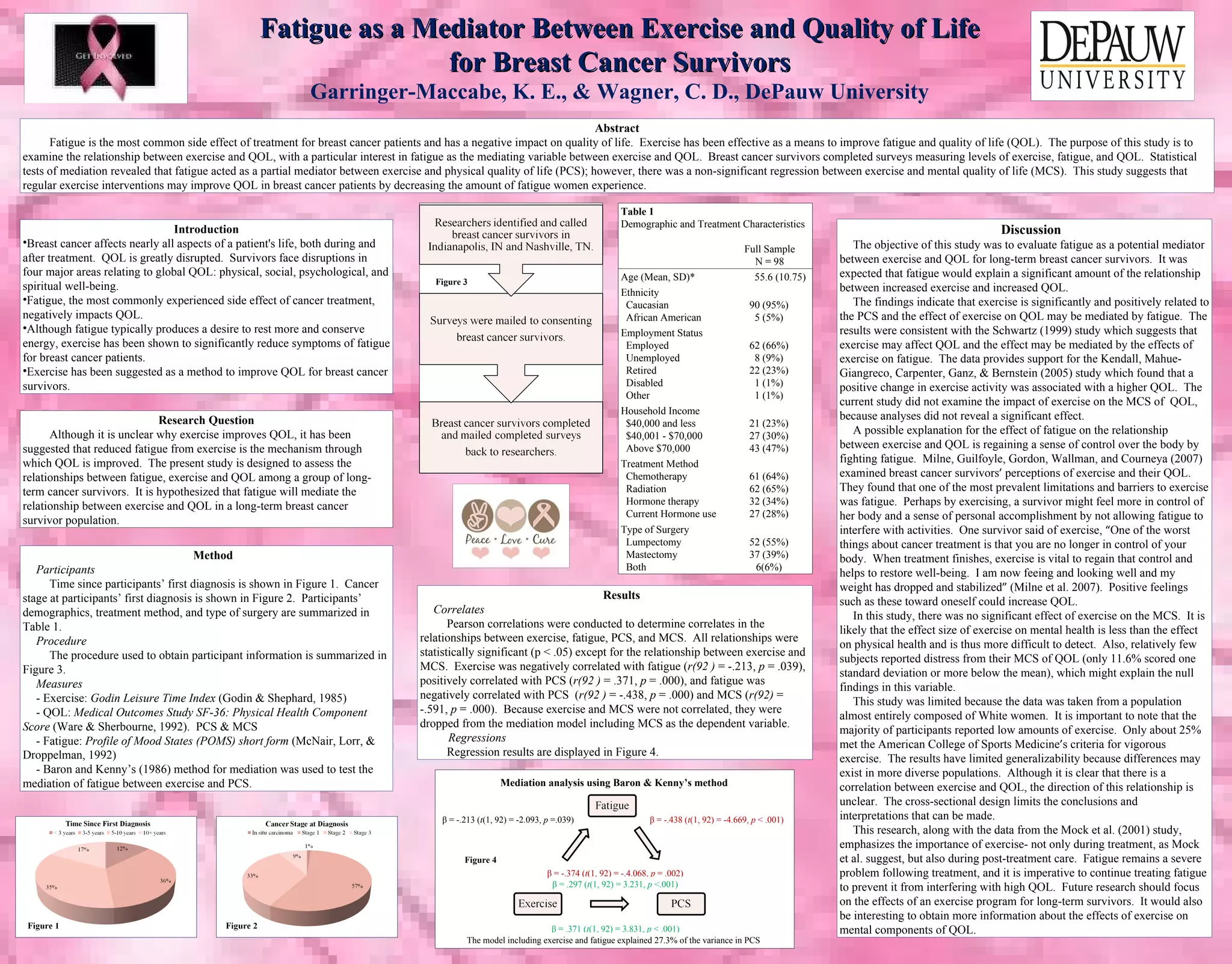
Fatigue as a Mediator Between Exercise and Quality of Life for Breast Cancer Survivors Garringer-Maccabe, K. E., & Wagner, C. D., DePauw University Abstract Fatigue is the most common side effect of treatment for breast cancer patients and has a negative impact on quality of life.  Exercise has been effective as a means to improve fatigue and quality of life (QOL).  The purpose of this study is to examine the relationship between exercise and QOL, with a particular interest in fatigue as the mediating variable between exercise and QOL.  Breast cancer survivors completed surveys measuring levels of exercise, fatigue, and QOL.  Statistical tests of mediation revealed that fatigue acted as a partial mediator between exercise and physical quality of life (PCS); however, there was a non-significant regression between exercise and mental quality of life (MCS).  This study suggests that regular exercise interventions may improve QOL in breast cancer patients by decreasing the amount of fatigue women experience.  Introduction Breast cancer affects nearly all aspects of a patient's life, both during and after treatment.  QOL is greatly disrupted.  Survivors face disruptions in four major areas relating to global QOL: physical, social, psychological, and spiritual well-being.  Fatigue, the most commonly experienced side effect of cancer treatment, negatively impacts QOL. Although fatigue typically produces a desire to rest more and conserve energy, exercise has been shown to significantly reduce symptoms of fatigue for breast cancer patients.  Exercise has been suggested as a method to improve QOL for breast cancer survivors. Results Correlates Pearson correlations were conducted to determine correlates in the relationships between exercise, fatigue, PCS, and MCS.  All relationships were statistically significant (p < .05) except for the relationship between exercise and MCS.  Exercise was negatively correlated with fatigue ( r(92 )  = -.213,  p  = .039), positively correlated with PCS ( r(92 )  = .371,  p  = .000), and fatigue was negatively correlated with PCS  ( r(92 )  = -.438,  p  = .000) and MCS ( r(92)  = -.591,  p  = .000).  Because exercise and MCS were not correlated, they were dropped from the mediation model including MCS as the dependent variable.  Regressions Regression results are displayed in Figure 4. Discussion The objective of this study was to evaluate fatigue as a potential mediator between exercise and QOL for long-term breast cancer survivors.  It was expected that fatigue would explain a significant amount of the relationship between increased exercise and increased QOL.  The findings indicate that exercise is significantly and positively related to the PCS and the effect of exercise on QOL may be mediated by fatigue.  The results were consistent with the Schwartz (1999) study which suggests that exercise may affect QOL and the effect may be mediated by the effects of exercise on fatigue.  The data provides support for the Kendall, Mahue-Giangreco, Carpenter, Ganz, & Bernstein (2005) study which found that a positive change in exercise activity was associated with a higher QOL.  The current study did not examine the impact of exercise on the MCS of  QOL, because analyses did not reveal a significant effect.  A possible explanation for the effect of fatigue on the relationship between exercise and QOL is regaining a sense of control over the body by fighting fatigue.  Milne, Guilfoyle, Gordon, Wallman, and Courneya (2007) examined breast cancer survivors ’  perceptions of exercise and their QOL.  They found that one of the most prevalent limitations and barriers to exercise was fatigue.  Perhaps by exercising, a survivor might feel more in control of her body and a sense of personal accomplishment by not allowing fatigue to interfere with activities.  One survivor said of exercise,  “ One of the worst things about cancer treatment is that you are no longer in control of your body.  When treatment finishes, exercise is vital to regain that control and helps to restore well-being.  I am now feeing and looking well and my weight has dropped and stabilized ”  (Milne et al. 2007).  Positive feelings such as these toward oneself could increase QOL. In this study, there was no significant effect of exercise on the MCS.  It is likely that the effect size of exercise on mental health is less than the effect on physical health and is thus more difficult to detect.  Also, relatively few subjects reported distress from their MCS of QOL (only 11.6% scored one standard deviation or more below the mean), which might explain the null findings in this variable.  This study was limited because the data was taken from a population almost entirely composed of White women.  It is important to note that the majority of participants reported low amounts of exercise.  Only about 25% met the American College of Sports Medicine ’ s criteria for vigorous exercise.  The results have limited generalizability because differences may exist in more diverse populations.  Although it is clear that there is a correlation between exercise and QOL, the direction of this relationship is unclear.  The cross-sectional design limits the conclusions and interpretations that can be made.  This research, along with the data from the Mock et al. (2001) study, emphasizes the importance of exercise- not only during treatment, as Mock et al. suggest, but also during post-treatment care.  Fatigue remains a severe problem following treatment, and it is imperative to continue treating fatigue to prevent it from interfering with high QOL.  Future research should focus on the effects of an exercise program for long-term survivors.  It would also be interesting to obtain more information about the effects of exercise on mental components of QOL. Method Participants Time since participants’ first diagnosis is shown in Figure 1.  Cancer stage at participants’ first diagnosis is shown in Figure 2.  Participants’ demographics, treatment method, and type of surgery are summarized in Table 1.  Procedure The procedure used to obtain participant information is summarized in Figure 3.  Measures - Exercise:  Godin Leisure Time Index  (Godin & Shephard, 1985)  - QOL:  Medical Outcomes Study SF-36: Physical Health Component Score  (Ware & Sherbourne, 1992).  PCS & MCS - Fatigue:  Profile of Mood States (POMS) short form  (McNair, Lorr, & Droppelman, 1992) - Baron and Kenny’s (1986) method for mediation was used to test the mediation of fatigue between exercise and PCS. Figure 3 β = .371 ( t (1, 92) = 3.831,  p  < .001) β = -.438 ( t (1, 92) = -4.669,  p  < .001) β = -.213 ( t (1, 92) = -2.093,  p  =.039) β = -.374 ( t (1, 92) = -.4.068,  p  = .002) Mediation analysis using Baron & Kenny’s method The model including exercise and fatigue explained 27.3% of the variance in PCS Figure 4 β = .297 ( t (1, 92) = 3.231,  p  <.001) Research Question Although it is unclear why exercise improves QOL, it has been suggested that reduced fatigue from exercise is the mechanism through which QOL is improved.  The present study is designed to assess the relationships between fatigue, exercise and QOL among a group of long-term cancer survivors.  It is hypothesized that fatigue will mediate the relationship between exercise and QOL in a long-term breast cancer survivor population. Table 1  Demographic and Treatment Characteristics  Full Sample N = 98 Age (Mean, SD)*  55.6 (10.75) Ethnicity Caucasian African American 90 (95%) 5 (5%) Employment Status Employed Unemployed Retired Disabled Other 62 (66%) 8 (9%) 22 (23%) 1 (1%) 1 (1%) Household Income $40,000 and less $40,001 - $70,000 Above $70,000  21 (23%) 27 (30%) 43 (47%) Treatment Method Chemotherapy Radiation Hormone therapy Current Hormone use 61 (64%) 62 (65%) 32 (34%) 27 (28%) Type of Surgery Lumpectomy   Mastectomy Both 52 (55%) 37 (39%) 6(6%)

Concise Fatigueposter

  • 1.
    Fatigue as aMediator Between Exercise and Quality of Life for Breast Cancer Survivors Garringer-Maccabe, K. E., & Wagner, C. D., DePauw University Abstract Fatigue is the most common side effect of treatment for breast cancer patients and has a negative impact on quality of life. Exercise has been effective as a means to improve fatigue and quality of life (QOL). The purpose of this study is to examine the relationship between exercise and QOL, with a particular interest in fatigue as the mediating variable between exercise and QOL. Breast cancer survivors completed surveys measuring levels of exercise, fatigue, and QOL. Statistical tests of mediation revealed that fatigue acted as a partial mediator between exercise and physical quality of life (PCS); however, there was a non-significant regression between exercise and mental quality of life (MCS). This study suggests that regular exercise interventions may improve QOL in breast cancer patients by decreasing the amount of fatigue women experience. Introduction Breast cancer affects nearly all aspects of a patient's life, both during and after treatment. QOL is greatly disrupted. Survivors face disruptions in four major areas relating to global QOL: physical, social, psychological, and spiritual well-being. Fatigue, the most commonly experienced side effect of cancer treatment, negatively impacts QOL. Although fatigue typically produces a desire to rest more and conserve energy, exercise has been shown to significantly reduce symptoms of fatigue for breast cancer patients. Exercise has been suggested as a method to improve QOL for breast cancer survivors. Results Correlates Pearson correlations were conducted to determine correlates in the relationships between exercise, fatigue, PCS, and MCS. All relationships were statistically significant (p < .05) except for the relationship between exercise and MCS. Exercise was negatively correlated with fatigue ( r(92 ) = -.213, p = .039), positively correlated with PCS ( r(92 ) = .371, p = .000), and fatigue was negatively correlated with PCS ( r(92 ) = -.438, p = .000) and MCS ( r(92) = -.591, p = .000). Because exercise and MCS were not correlated, they were dropped from the mediation model including MCS as the dependent variable. Regressions Regression results are displayed in Figure 4. Discussion The objective of this study was to evaluate fatigue as a potential mediator between exercise and QOL for long-term breast cancer survivors. It was expected that fatigue would explain a significant amount of the relationship between increased exercise and increased QOL. The findings indicate that exercise is significantly and positively related to the PCS and the effect of exercise on QOL may be mediated by fatigue. The results were consistent with the Schwartz (1999) study which suggests that exercise may affect QOL and the effect may be mediated by the effects of exercise on fatigue. The data provides support for the Kendall, Mahue-Giangreco, Carpenter, Ganz, & Bernstein (2005) study which found that a positive change in exercise activity was associated with a higher QOL. The current study did not examine the impact of exercise on the MCS of QOL, because analyses did not reveal a significant effect. A possible explanation for the effect of fatigue on the relationship between exercise and QOL is regaining a sense of control over the body by fighting fatigue. Milne, Guilfoyle, Gordon, Wallman, and Courneya (2007) examined breast cancer survivors ’ perceptions of exercise and their QOL. They found that one of the most prevalent limitations and barriers to exercise was fatigue. Perhaps by exercising, a survivor might feel more in control of her body and a sense of personal accomplishment by not allowing fatigue to interfere with activities. One survivor said of exercise, “ One of the worst things about cancer treatment is that you are no longer in control of your body. When treatment finishes, exercise is vital to regain that control and helps to restore well-being. I am now feeing and looking well and my weight has dropped and stabilized ” (Milne et al. 2007). Positive feelings such as these toward oneself could increase QOL. In this study, there was no significant effect of exercise on the MCS. It is likely that the effect size of exercise on mental health is less than the effect on physical health and is thus more difficult to detect. Also, relatively few subjects reported distress from their MCS of QOL (only 11.6% scored one standard deviation or more below the mean), which might explain the null findings in this variable. This study was limited because the data was taken from a population almost entirely composed of White women. It is important to note that the majority of participants reported low amounts of exercise. Only about 25% met the American College of Sports Medicine ’ s criteria for vigorous exercise. The results have limited generalizability because differences may exist in more diverse populations. Although it is clear that there is a correlation between exercise and QOL, the direction of this relationship is unclear. The cross-sectional design limits the conclusions and interpretations that can be made. This research, along with the data from the Mock et al. (2001) study, emphasizes the importance of exercise- not only during treatment, as Mock et al. suggest, but also during post-treatment care. Fatigue remains a severe problem following treatment, and it is imperative to continue treating fatigue to prevent it from interfering with high QOL. Future research should focus on the effects of an exercise program for long-term survivors. It would also be interesting to obtain more information about the effects of exercise on mental components of QOL. Method Participants Time since participants’ first diagnosis is shown in Figure 1. Cancer stage at participants’ first diagnosis is shown in Figure 2. Participants’ demographics, treatment method, and type of surgery are summarized in Table 1. Procedure The procedure used to obtain participant information is summarized in Figure 3. Measures - Exercise: Godin Leisure Time Index (Godin & Shephard, 1985) - QOL: Medical Outcomes Study SF-36: Physical Health Component Score (Ware & Sherbourne, 1992). PCS & MCS - Fatigue: Profile of Mood States (POMS) short form (McNair, Lorr, & Droppelman, 1992) - Baron and Kenny’s (1986) method for mediation was used to test the mediation of fatigue between exercise and PCS. Figure 3 β = .371 ( t (1, 92) = 3.831, p < .001) β = -.438 ( t (1, 92) = -4.669, p < .001) β = -.213 ( t (1, 92) = -2.093, p =.039) β = -.374 ( t (1, 92) = -.4.068, p = .002) Mediation analysis using Baron & Kenny’s method The model including exercise and fatigue explained 27.3% of the variance in PCS Figure 4 β = .297 ( t (1, 92) = 3.231, p <.001) Research Question Although it is unclear why exercise improves QOL, it has been suggested that reduced fatigue from exercise is the mechanism through which QOL is improved. The present study is designed to assess the relationships between fatigue, exercise and QOL among a group of long-term cancer survivors. It is hypothesized that fatigue will mediate the relationship between exercise and QOL in a long-term breast cancer survivor population. Table 1 Demographic and Treatment Characteristics Full Sample N = 98 Age (Mean, SD)* 55.6 (10.75) Ethnicity Caucasian African American 90 (95%) 5 (5%) Employment Status Employed Unemployed Retired Disabled Other 62 (66%) 8 (9%) 22 (23%) 1 (1%) 1 (1%) Household Income $40,000 and less $40,001 - $70,000 Above $70,000 21 (23%) 27 (30%) 43 (47%) Treatment Method Chemotherapy Radiation Hormone therapy Current Hormone use 61 (64%) 62 (65%) 32 (34%) 27 (28%) Type of Surgery Lumpectomy Mastectomy Both 52 (55%) 37 (39%) 6(6%)