STRABISMUS
Presenter- Dr. Kriti Chandra
 Horizontal rectus muscle plication
 Surgeries for strabismus in high myopia
 Graded rectus muscle tenotomy + Slanted
recessions of horizontal rectus muscles
 Vertical rectus transposition to correct abduction
deficiency in esotropic Duane’s syndrome(similar
to what is performed for complete LR palsy)
 Lateral rectus split with medial transposition in III
nerve palsy
 Minimally invasive strabismus surgery (MISS) –
MISS recession/ plication
Plication /tuck /imbrication is a method to shorten the
rectus EOM thus strengthening it
Chaudhuri Z, Demer J. Surgical Outcomes Following Rectus Muscle Plication. JAMA
Ophthalmol. 2014;132(5):579.
Chaudhuri Z, Demer J. Surgical Outcomes Following Rectus Muscle Plication. JAMA
Ophthalmol. 2014;132(5):579.
1. Advantage of retaining an undisturbed or less disturbed
anterior ciliary circulation compared to the resection
2. Produces almost nil postoperative tissue reaction
3. No unsightly lump .
4. According to dose response curve by Park’s nomogram,
a plication is as effective as a similar sized resection.
Chaudhuri Z, Demer J. Surgical Outcomes Following Rectus Muscle Plication. JAMA
Ophthalmol. 2014;132(5):579.
 Can be readily performed under topical
anesthesia as it does not entail relatively
painful crushing of EOMs as in resection.
 In situation where increased post-operative
inflammation is expected, e.g. thyroid
ophthalmopathy or in children, where
resection has conventionally been avoided for
fear of exacerbating inflammation, plication
can be substituted
Chaudhuri & Demer: Horizontal Rectus Muscle Plication in Children: An
Effective Vessel Sparing Alternative to Resection AIOS/WSPOS.2014
 Less destructive, simpler procedure, time saving.
 Less trauma, less inflammation as minimized muscle
handling, maybe better in thyroid ophthalmopathy and
children
 A plicated muscle can never be lost.
 Anterior segment ischemia risk minimized vessels are
preserved
 Plication can also be done as adjustable surgery
Velez FG, Demer JL, Pihlblad MS, et al J AAPOS October 2013;17:480-483
 May be performed through a small conjunctival incision
with functionally and cosmetically satisfactory results
(MISS Plication)
Mojon D. Minimally invasive strabismus surgery for horizontal rectus muscle
reoperations. British Journal of Ophthalmology. 2008;92(12):1648-1652.
DS Mojon. Minimally Invasive Strabismus Surgery.
European Ophthalmic Review, 2011;5(1):27-32
A subhuman primate model of ASI was developed in order to study
a novel muscle tuck procedure designed to preserve anterior ciliary
artery circulation.
Park C, Min B, Wright K. Effect of a modified rectus tuck on anterior ciliary artery perfusion.
Korean Journal of Ophthalmology. 1991;5(1):15.
 Iris fluorescein angiograms were obtained before and after surgery to determine
the effect of the muscle surgery on iris circulation.
 Postoperative angiograms documented preservation of perfusion in the
distribution of the tucked muscle .
In a recent study conducted on humans, it was found on iris fluorescein
angiograms that rectus muscle plication spares the ciliary vessels and may
be considered a safer alternative to resection for patients at risk for anterior
segment ischaemia, especially when surgery involves a vertical rectus
muscle.
Oltra E, Pineles S, Demer J, Quan A, Velez F. The effect of rectus muscle recession, resection and plication
on anterior segment circulation in humans. British Journal of Ophthalmology. 2014;99(4):556-560
 How does it affect surgical outcomes?
 Surgery for concomitant deviations may require
higher dosing
 Conventional dosing + addition for the elongated globe
 Special situations: Myopic strabismus fixus / heavy
eye syndrome
 Myopia with exotropia
 Myopic strabismus fixus
 Alternative terms:
 Acquired progressive esotropia associated with severe
myopia (APEASM), or
 Heavy eye syndrome.
 Adult onset esotropia associated with high
axial myopia.
 Typically described as progressive esotropia
and hypotropia associated with restricted
elevation and abduction of variable degree and
severity.
 The disease may progress over years from a small
degree of esotropia with free ocular movements to the
end stage of large angle fixed esotropia.
Axial elongation of eyeball causes superotemporal
eyeball prolapse from the muscle cone, as described by
Krzizok and Yoshiko et al.
Krzizok TH, Kaufmann H, Traupe H. Elucidation of restrictive motility in high
myopia by magnetic resonance imaging. Arch Ophthalmol.1997;115:1019-27
The displacement of the superior rectus muscle nasally
causes a mechanical adduction, with limitation of abduction
and the displacement of the lateral rectus muscle inferiorly
causes a mechanical depression, with limitation of elevation
Kang Yeun Pak, Jae Ho Jung, Hee Young Choi
Korean Ophthalmol Soc. 2013 Mar;54(3):534-539.
(Korean)
 Yokoyama et. al. performed loop myopexy of the LR
and SR muscles to treat patients who had progressive
esotropia with high myopia.
A retroequatorial approach was performed by a bridge
suture of the intact belly of the LR muscle and SR
muscle—or their superior and temporal portions,
respectively—obtained with an incision.
Yokoyama T, Ataka S, Tabuchi H, Shiraki K, Miki T. Treatment ofprogressive esotropia caused by high
myopia—a new surgical procedure based on its pathogenesis. In: de Faber J-T, editor. Transactions:27th
Meeting, European Strabismological Association, Florence, Italy, 2001. Lisse (Netherlands): Swets and
Zeitlinger; 2002:145-8.
 Yamada et. al. performed hemi transposition of the LR
and SR combined with a large recession of the MR
muscle.
Yamada M, Taniguchi S, Muroi T, Satofuka S, Nishina S. Rectus eye muscle paths after surgical
correction of convergent strabismus fixus. Am J Ophthalmol 2002;134:630-2.
Later, Larsen treated patients with highly myopic acquired
esotropia using hemi-Jensen procedure of the SR and LR muscles
without MR muscle recession.
Larsen PC, Gole GA. Partial Jensen’s procedure for the treatment of myopic strabismus fixus. J
AAPOS 2004;8:393-5.
 The procedure proposed by Yamaguchi et al. unites the LR and
SR muscle with nonabsorbable suture 15 mm behind the limbus.
Yamaguchi, T. Yokoyama, and K. Shiraki, “Surgical procedure for correcting globe dislocation
in highly myopic strabismus,” The American Journal of Ophthalmology, vol. 149, no. 2, pp.
341–346, 2010.M
• A modification of loop myopexy was proposed by Kekunnaya
using a 240 silicone band that is passed through a scleral tunnel
and a sleeve to unite the muscles with using anchoring sutures
on the sclera .
Shenoy BH, Sachdeva V, Kekunnaya R. Silicone band loop myopexy in the treatment of
myopic strabismus fixus: Surgical outcome of a novel modification. Br J Ophthalmol
2015;99:36-40.
• Wong et al. reported a similar procedure where only silicone
band loop myopexy without sclera anchorage was performed
with good outcomes.
Wong, S.-W. Leo, and B.-K. Khoo, “Loop myopexy for treatment of myopic strabismus fixus,”
Journal of AAPOS, vol. 9, no. 6, pp. 589–591, 2005.
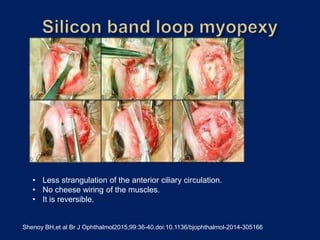
Shenoy BH,et al Br J Ophthalmol2015;99:36-40.doi:10.1136/bjophthalmol-2014-305166
• Less strangulation of the anterior ciliary circulation.
• No cheese wiring of the muscles.
• It is reversible.
Exotropia associated with hypotropia in high myopia is a
rare entity,initially described on orbital imaging by
Krzizok and Schroeder.
In their series, they reported 2 cases with exotropia-
hypotropia with a caudal dislocation of MR muscles.
Krzizok TH, Schroeder BU. Measurement of recti eye muscle paths by magnetic resonance imaging
in highly myopic and normal subjects. Invest Ophthalmol Vis Sci. 1999;40:2554–60
In contrast to esotropia-hypotropia complex, a single
specific procedure is not described for this condition.
Kekunnaya R, Chandrasekharan A, Sachdeva V. Management of strabismus in
myopes. Middle East African Journal of Ophthalmology. 2015;22(3):298.
 It is a CCDD(congenital cranial disinnervation
disorder)
Characterized by
 Limitation of abduction/or adduction.
 With narrowing of palpebral aperture.
 Retraction of globe and variable upshoots and downshoot of globe on
attempted adduction.
HUBER’S CLASSIFICATION
 Duane Type 1 consists of limited or absent abduction with relatively normal
adduction
 Duane type II consists of limited or absent adduction with relatively normal
abduction
 Duane type III is characterized by both limited abduction and adduction.
 DRS results from failure of normal development of the pontine
abducens nucleus or nerve resulting in failure of the normal
innervation of the lateral rectus muscle on the affected side.
 Posteriorly or multiply inserted medial rectus muscle and/or
fibrotic, inelastic lateral rectus muscle have been widely described.
It was believed that the cause of abduction deficiency was the
fibrosis of the lateral rectus muscle and that limitation of adduction
was due to the abnormal posterior insertion of the medial rectus
muscle or to adhesions between the medial rectus muscle and the
orbital wall
 At the same time, an aberrant branch of the oculomotor nerve
innervates the lateral rectus muscle.
Thus, globe retraction results from co-contraction of the medial
and lateral rectus muscles on attempted adduction.
Duane, Thomas D. Clinical Ophthalmology. Pediatric Ophthalmic Surgery. Vol. 6.
Philadelphia, PA: Lippincott Williams & Wilkins; 1994.
 Indications for surgical correction
1. Abnormal head position (AHP) of greater than 15°
2. A significant deviation in primary position
3. Marked upshoot or downshoot on adduction
4. Marked retraction of the globe on adduction
 Classical management of Duane’s Syndrome does
not provide abduction improvement as an option
 Classical hypothesis does not recommend LR
resection, as co-innervation would increase the signs
of Duane’s syndrome
 Surgeries aimed at improving abduction.
1. Molarte and Rosenbaum recommended vertical rectus
muscle transposition for the treatment of Duane’s Type I
patients with severe abduction deficiency.
Molarte AB, Rosenbaum AL. Vertical rectus muscle transposition surgery
forDuane’s syndrome.J Pediatr Ophthalmol Strabismus1990;27:171–7
2. Foster proposed vertical muscle transposition augmented
with lateral posterior fixation sutures to enhance the tonic
abducting force without compromising adduction.
Foster RS. Vertical muscle transposition augmented with lateral fixation.J AAPOS 1997;1:20–30
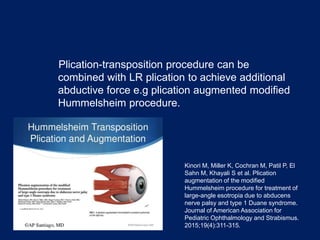
Plication-transposition procedure can be
combined with LR plication to achieve additional
abductive force e.g plication augmented modified
Hummelsheim procedure.
Kinori M, Miller K, Cochran M, Patil P, El
Sahn M, Khayali S et al. Plication
augmentation of the modified
Hummelsheim procedure for treatment of
large-angle esotropia due to abducens
nerve palsy and type 1 Duane syndrome.
Journal of American Association for
Pediatric Ophthalmology and Strabismus.
2015;19(4):311-315.
Based on same principles used
to treat LR palsy
Vertical RT (Hummelsheim procedure )
( O’Connor’s procedure)
(Jenson’s procedure)
 Johnston et al introduced a modification of the VRT in
which only the superior rectus muscle is transposed.
Abduction limitation will develop tightness or contracture
of the medial rectus muscle over time. This condition
can limit the effectiveness of a transposition procedure,
MR recession can be performed to reduce abduction
limitation.
Combining SRT and MR recession improve esotropia,
head position, abduction limitation, and stereopsis
without inducing torsional diplopia.
Mehendale R. Superior Rectus Transposition and Medial Rectus Recession for Duane
Syndrome and Sixth Nerve Palsy. Archives of Ophthalmology. 2012;130(2):195.
 In 2000, Alan B. Scott, described a rectus muscle weakening
procedure called “graded rectus muscle tenotomy,” to treat small
degrees of vertical strabismus (< 10 PD).
Scott AB. Graded rectus muscle tenotomy for small deviations. In: Proceedings of the
Jampolsky Festschrift. San Francisco: The Smith-Kettlewell Eye Research Institute; 2000:215–
216.
 The procedure consists of making successive small cuts in the
tendon of a rectus muscle at the insertion until the desired effect is
achieved.
 Graded vertical rectus tenotomy can effectively reduce small
degrees of hypertropia and associated diplopia, improve binocular
function, and reduce or eliminate the need for prism correction
(90% cut can correct upto 8-10 PD deviation).
 Sagging eye syndrome (SES) is a recently recognised orbital connective tissue
degeneration leading to degeneration of the lateral rectus superior rectus(LR-SR)
band ligament, inferior sag of the LR pulley and limited supraduction.
 SES is a major cause of small-angle hypertropia in the elderly.
Chaudhuri Z, Demer JL. Sagging eye syndrome: connective tissue involution as a cause of horizontal
and vertical strabismus in older patients. JAMA Ophthalmol 2013;131:619–25.
 The diagnosis of SES is supported by clinical findings of adnexal
laxity, blepharoptosis, limited supraduction and greater
excycloposition in the hypotropic than hypertropic eye.
 SES is confirmed by MRI for demonstration of characteristic greater
inferior displacement of the LR muscle in the hypotropic than
hypertropic orbit.
 Graded vertical rectus tenotomy (GVRT) may be elected for patients
with hypertropia due to SES.
Chaudhuri Z, Demer JL. Br J Ophthalmol
2015;0:1–4. doi:10.1136/bjophthalmol
-2015-306783
The inferior rectus (IR) is chosen for GVRT when hypertropia is vertically
concomitant or greatest in infraversion.
The SR is chosen when hypertropia is greatest in supraversion or absent
in infraversion.
Temporal GVRT is chosen for the IR and nasal GVRT for the SR.
Can be performed under topical anaesthesia.
Vessel sparing is often possible.
Adjustments are made to the degree of correction intraoperatively,
presumably giving a greater chance for success with the first operation.
Wright described central partial tenotomy, advantages of which
includes intact tendon poles, maintaining normal wide rectus insertions.
However, unlike GVRT from the poles, the torsional component is not
corrected.
Wright KW. Mini-tenotomy procedure to correct diplopia associated with small-angle strabismus.
Trans Am Ophthalmol Soc 2009;107:97–102.
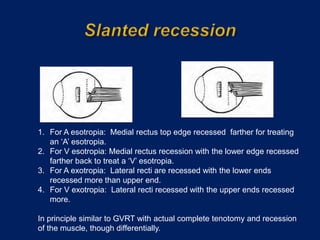
1. For A esotropia: Medial rectus top edge recessed farther for treating
an ‘A’ esotropia.
2. For V esotropia: Medial rectus recession with the lower edge recessed
farther back to treat a ‘V’ esotropia.
3. For A exotropia: Lateral recti are recessed with the lower ends
recessed more than upper end.
4. For V exotropia: Lateral recti recessed with the upper ends recessed
more.
In principle similar to GVRT with actual complete tenotomy and recession
of the muscle, though differentially.
 Insertion slanting recessions have been
reported to be useful for treating-:
 A- and V-pattern strabismus.
 Convergence insufficiency.
 Convergence excess esotropia.
Insertion Slanting Strabismus Surgical Procedures. JAMA .2011; 129
(12):1620-1625. .
This follows the principle of selective weakening by moving the
entire muscle in the direction that is intend to weaken the muscle.
Effectivity of both GVRT and slanted recessions can be postulated to
be due to the recently proven compartment hypothesis of rectus
extra-ocular muscles
 Adjacent but arbitrarily selected portions of EOMs and their
tendons have a substantial degree of mechanical
independence during longitudinal loading.
 Longitudinal tension in any one compartment is transmitted
to the complimentary compartment, whether during
extension or relative compression.
Intramuscular motor nerve arborizations in the horizontal rectus EOMs
do not cross transverse compartmental boundaries anywhere along the
lengths of these EOMs, so the groups of EOM fibers separately
innervated by the superior and inferior motor nerve trunks can constitute
functionally independent superior and inferior muscle actuators whose
tensions are delivered to separate insertions on the ocular sclera.
Shin A, Yoo L, Chaudhuri Z, Demer J. Independent Passive Mechanical Behavior of Bovine
Extraocular Muscle Compartments. Investigative Opthalmology & Visual Science.
2012;53(13):8414.
 The biomechanical findings permit the inference that surgical
division from the scleral insertion of a portion of the fibers of a
rectus tendon would release the tension in those fibers, while
maintaining nearly unchanged the tension in the fibers that remain
attached to the sclera.
 This interpretation is consistent with the finding of a predictable
relationship between the percentage of vertical rectus tenotomy
and the degree of correction of vertical strabismus in humans. 1
 Existence of partial rectus muscle palsy as in the recently
postulated partial superior compartment LR palsy can be treated
differentially by horizontal muscle GVRT / slanted EOM surgery. 2
1. Chaudhuri Z, Hendler K, Demer JL. Graded rectus tenotomy in small angle hypertropia due to sagging eye
syndrome. Absrt Ann Mtg of Am Assoc Ped Ophthalmol Strabismus 2013; Boston, MA
2. Clark RA, Demer JL. Lateral Rectus superior compartment palsy. Am J Ophthalmol 2014; 157(2):479-87
 Complete 3rd nerve palsy presents with complete ptosis,
with the eye positioned downward and outward and
unable to adduct, infraduct, or supraduct, and dilated
pupil with sluggish reaction.
 Partial 3rd nerve palsy are more common, and presents
with a variable duction limitation of the affected
extraocular muscles and with variable degree of ptosis
and/or pupil dysfunction.
Surgical management is tailored towards providing
binocularity in primary and down gaze.
 SURGICAL TREATMENT
 Transposition of SO muscles anterior and medial to SR (Scott’s
procedure),
 large LR recessions
 Occasionally recession-resection / plication of horizontal recti
muscles (if the medial rectus is mildly to moderately paretic)
 Fixation of the globe to the periosteum of the medial orbital wall or
medial canthal ligament
 Medial transposition of the lateral rectus (LR) muscle.
 Complete LR
 Split LR
 In 1991 Kauffmann introduced lateral rectus muscle splitting with
medial transposition for complete oculomotor palsy.
H. Kaufmann“Lateralis splitting” in total oculomotor paralysis with trochlear nerve paralysis
Fortschr Ophthalmol, 88 (1991), pp. 314–316 [in German]
 He split the lateral rectus muscle and transposed its upper and
lower halves to the retroequatorial point, 20 mm from the limbus,
near the nasal superior and inferior vortex veins.
 During the transposition procedure, he passed the upper half of
the lateral rectus muscle under the superior rectus muscle and
the lower half of the lateral rectus muscle under the inferior
rectus muscles.
Subsequently,Gokyigit et al presented a modification of this
technique by transposing the superior and inferior halves of the split
LR muscle anterior to the vortex vein and 2mm posterior to the
superior and inferior borders of the MR muscle.
Gokyigit B,Akar S,Satna B,Demirok A,Yilmaz OF.Medial transposition of a split lateral rectus
muscle for complete oculomotor nerve palsy.J AAPOS.2013;17(4):402-410
Adjustable nasal transposition of the split LR muscle can also
achieve excellent oculomotor alignment in cases of third nerve
palsy. The adjustable modification allows optimization of horizontal
and vertical alignment. It can be combined with MR recession.
Imaging confirms that the split LR muscle anchor the globe,
rotating it toward primary position.
Shah A, Prabhu S, Sadiq M, Mantagos I, Hunter D, Dagi L. Adjustable Nasal
Transposition of Split Lateral Rectus Muscle for Third Nerve Palsy. JAMA Ophthalmol.
2014;132(8):963.
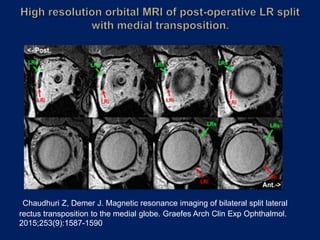
The LR pulley does not change position even after split LR
transposition to the MR insertion, confirming the profound
constraint of the connective tissue pulley system on the LR path.
Chaudhuri Z, Demer J. Magnetic resonance imaging of bilateral split lateral rectus transposition
to the medial globe. Graefes Arch Clin Exp Ophthalmol. 2015;253(9):1587-1590.
Chaudhuri Z, Demer J. Magnetic resonance imaging of bilateral split lateral
rectus transposition to the medial globe. Graefes Arch Clin Exp Ophthalmol.
2015;253(9):1587-1590
 Different conjunctival approches-:
1. Limbal incision of von Noorden.
2. Over the muscle incision of swan
3. Paralimbal incision of Prem prakash.
4. Fornix incision of Parks
5. Minimal incision strabismus surgery.
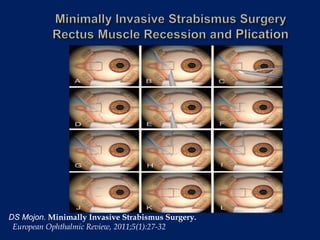
 The concept of minimally invasive strabismus surgery
(MISS) consists of the following principles:
 • placement of all conjunctival cuts as far away from the
limbus as possible.
 • avoidance of conjunctival opening where not necessary to
perform the surgical steps.
 • reduction of total conjunctival opening size by using
several keyhole openings instead of one large access.
 • placement of keyhole cuts in a way to permit joining them if
increased visibility is needed.
DS Mojon. Minimally Invasive Strabismus Surgery.
European Ophthalmic Review, 2011;5(1):27-32
 The relative disadvantages is that the MISS
technique-:
 Provides more limited exposure which may be difficult
when performing larger recessions and plications
(without extending the incision) and
 Probably has a steep learning curve (does not remain
a limitation after adequate practice).
THANK YOU

Strabismus

  • 1.
  • 2.
     Horizontal rectusmuscle plication  Surgeries for strabismus in high myopia  Graded rectus muscle tenotomy + Slanted recessions of horizontal rectus muscles  Vertical rectus transposition to correct abduction deficiency in esotropic Duane’s syndrome(similar to what is performed for complete LR palsy)  Lateral rectus split with medial transposition in III nerve palsy  Minimally invasive strabismus surgery (MISS) – MISS recession/ plication
  • 3.
    Plication /tuck /imbricationis a method to shorten the rectus EOM thus strengthening it Chaudhuri Z, Demer J. Surgical Outcomes Following Rectus Muscle Plication. JAMA Ophthalmol. 2014;132(5):579.
  • 4.
    Chaudhuri Z, DemerJ. Surgical Outcomes Following Rectus Muscle Plication. JAMA Ophthalmol. 2014;132(5):579.
  • 5.
    1. Advantage ofretaining an undisturbed or less disturbed anterior ciliary circulation compared to the resection 2. Produces almost nil postoperative tissue reaction 3. No unsightly lump . 4. According to dose response curve by Park’s nomogram, a plication is as effective as a similar sized resection. Chaudhuri Z, Demer J. Surgical Outcomes Following Rectus Muscle Plication. JAMA Ophthalmol. 2014;132(5):579.
  • 6.
     Can bereadily performed under topical anesthesia as it does not entail relatively painful crushing of EOMs as in resection.  In situation where increased post-operative inflammation is expected, e.g. thyroid ophthalmopathy or in children, where resection has conventionally been avoided for fear of exacerbating inflammation, plication can be substituted Chaudhuri & Demer: Horizontal Rectus Muscle Plication in Children: An Effective Vessel Sparing Alternative to Resection AIOS/WSPOS.2014
  • 7.
     Less destructive,simpler procedure, time saving.  Less trauma, less inflammation as minimized muscle handling, maybe better in thyroid ophthalmopathy and children  A plicated muscle can never be lost.  Anterior segment ischemia risk minimized vessels are preserved  Plication can also be done as adjustable surgery Velez FG, Demer JL, Pihlblad MS, et al J AAPOS October 2013;17:480-483  May be performed through a small conjunctival incision with functionally and cosmetically satisfactory results (MISS Plication) Mojon D. Minimally invasive strabismus surgery for horizontal rectus muscle reoperations. British Journal of Ophthalmology. 2008;92(12):1648-1652.
  • 8.
    DS Mojon. MinimallyInvasive Strabismus Surgery. European Ophthalmic Review, 2011;5(1):27-32
  • 9.
    A subhuman primatemodel of ASI was developed in order to study a novel muscle tuck procedure designed to preserve anterior ciliary artery circulation. Park C, Min B, Wright K. Effect of a modified rectus tuck on anterior ciliary artery perfusion. Korean Journal of Ophthalmology. 1991;5(1):15.  Iris fluorescein angiograms were obtained before and after surgery to determine the effect of the muscle surgery on iris circulation.  Postoperative angiograms documented preservation of perfusion in the distribution of the tucked muscle . In a recent study conducted on humans, it was found on iris fluorescein angiograms that rectus muscle plication spares the ciliary vessels and may be considered a safer alternative to resection for patients at risk for anterior segment ischaemia, especially when surgery involves a vertical rectus muscle. Oltra E, Pineles S, Demer J, Quan A, Velez F. The effect of rectus muscle recession, resection and plication on anterior segment circulation in humans. British Journal of Ophthalmology. 2014;99(4):556-560
  • 10.
     How doesit affect surgical outcomes?  Surgery for concomitant deviations may require higher dosing  Conventional dosing + addition for the elongated globe  Special situations: Myopic strabismus fixus / heavy eye syndrome  Myopia with exotropia
  • 11.
     Myopic strabismusfixus  Alternative terms:  Acquired progressive esotropia associated with severe myopia (APEASM), or  Heavy eye syndrome.  Adult onset esotropia associated with high axial myopia.  Typically described as progressive esotropia and hypotropia associated with restricted elevation and abduction of variable degree and severity.
  • 12.
     The diseasemay progress over years from a small degree of esotropia with free ocular movements to the end stage of large angle fixed esotropia. Axial elongation of eyeball causes superotemporal eyeball prolapse from the muscle cone, as described by Krzizok and Yoshiko et al. Krzizok TH, Kaufmann H, Traupe H. Elucidation of restrictive motility in high myopia by magnetic resonance imaging. Arch Ophthalmol.1997;115:1019-27
  • 13.
    The displacement ofthe superior rectus muscle nasally causes a mechanical adduction, with limitation of abduction and the displacement of the lateral rectus muscle inferiorly causes a mechanical depression, with limitation of elevation Kang Yeun Pak, Jae Ho Jung, Hee Young Choi Korean Ophthalmol Soc. 2013 Mar;54(3):534-539. (Korean)
  • 14.
     Yokoyama et.al. performed loop myopexy of the LR and SR muscles to treat patients who had progressive esotropia with high myopia. A retroequatorial approach was performed by a bridge suture of the intact belly of the LR muscle and SR muscle—or their superior and temporal portions, respectively—obtained with an incision. Yokoyama T, Ataka S, Tabuchi H, Shiraki K, Miki T. Treatment ofprogressive esotropia caused by high myopia—a new surgical procedure based on its pathogenesis. In: de Faber J-T, editor. Transactions:27th Meeting, European Strabismological Association, Florence, Italy, 2001. Lisse (Netherlands): Swets and Zeitlinger; 2002:145-8.
  • 16.
     Yamada et.al. performed hemi transposition of the LR and SR combined with a large recession of the MR muscle. Yamada M, Taniguchi S, Muroi T, Satofuka S, Nishina S. Rectus eye muscle paths after surgical correction of convergent strabismus fixus. Am J Ophthalmol 2002;134:630-2. Later, Larsen treated patients with highly myopic acquired esotropia using hemi-Jensen procedure of the SR and LR muscles without MR muscle recession. Larsen PC, Gole GA. Partial Jensen’s procedure for the treatment of myopic strabismus fixus. J AAPOS 2004;8:393-5.
  • 17.
     The procedureproposed by Yamaguchi et al. unites the LR and SR muscle with nonabsorbable suture 15 mm behind the limbus. Yamaguchi, T. Yokoyama, and K. Shiraki, “Surgical procedure for correcting globe dislocation in highly myopic strabismus,” The American Journal of Ophthalmology, vol. 149, no. 2, pp. 341–346, 2010.M • A modification of loop myopexy was proposed by Kekunnaya using a 240 silicone band that is passed through a scleral tunnel and a sleeve to unite the muscles with using anchoring sutures on the sclera . Shenoy BH, Sachdeva V, Kekunnaya R. Silicone band loop myopexy in the treatment of myopic strabismus fixus: Surgical outcome of a novel modification. Br J Ophthalmol 2015;99:36-40. • Wong et al. reported a similar procedure where only silicone band loop myopexy without sclera anchorage was performed with good outcomes. Wong, S.-W. Leo, and B.-K. Khoo, “Loop myopexy for treatment of myopic strabismus fixus,” Journal of AAPOS, vol. 9, no. 6, pp. 589–591, 2005.
  • 18.
    Shenoy BH,et alBr J Ophthalmol2015;99:36-40.doi:10.1136/bjophthalmol-2014-305166 • Less strangulation of the anterior ciliary circulation. • No cheese wiring of the muscles. • It is reversible.
  • 19.
    Exotropia associated withhypotropia in high myopia is a rare entity,initially described on orbital imaging by Krzizok and Schroeder. In their series, they reported 2 cases with exotropia- hypotropia with a caudal dislocation of MR muscles. Krzizok TH, Schroeder BU. Measurement of recti eye muscle paths by magnetic resonance imaging in highly myopic and normal subjects. Invest Ophthalmol Vis Sci. 1999;40:2554–60 In contrast to esotropia-hypotropia complex, a single specific procedure is not described for this condition. Kekunnaya R, Chandrasekharan A, Sachdeva V. Management of strabismus in myopes. Middle East African Journal of Ophthalmology. 2015;22(3):298.
  • 20.
     It isa CCDD(congenital cranial disinnervation disorder) Characterized by  Limitation of abduction/or adduction.  With narrowing of palpebral aperture.  Retraction of globe and variable upshoots and downshoot of globe on attempted adduction. HUBER’S CLASSIFICATION  Duane Type 1 consists of limited or absent abduction with relatively normal adduction  Duane type II consists of limited or absent adduction with relatively normal abduction  Duane type III is characterized by both limited abduction and adduction.
  • 21.
     DRS resultsfrom failure of normal development of the pontine abducens nucleus or nerve resulting in failure of the normal innervation of the lateral rectus muscle on the affected side.  Posteriorly or multiply inserted medial rectus muscle and/or fibrotic, inelastic lateral rectus muscle have been widely described. It was believed that the cause of abduction deficiency was the fibrosis of the lateral rectus muscle and that limitation of adduction was due to the abnormal posterior insertion of the medial rectus muscle or to adhesions between the medial rectus muscle and the orbital wall  At the same time, an aberrant branch of the oculomotor nerve innervates the lateral rectus muscle. Thus, globe retraction results from co-contraction of the medial and lateral rectus muscles on attempted adduction.
  • 22.
    Duane, Thomas D.Clinical Ophthalmology. Pediatric Ophthalmic Surgery. Vol. 6. Philadelphia, PA: Lippincott Williams &amp; Wilkins; 1994.
  • 23.
     Indications forsurgical correction 1. Abnormal head position (AHP) of greater than 15° 2. A significant deviation in primary position 3. Marked upshoot or downshoot on adduction 4. Marked retraction of the globe on adduction  Classical management of Duane’s Syndrome does not provide abduction improvement as an option  Classical hypothesis does not recommend LR resection, as co-innervation would increase the signs of Duane’s syndrome
  • 24.
     Surgeries aimedat improving abduction. 1. Molarte and Rosenbaum recommended vertical rectus muscle transposition for the treatment of Duane’s Type I patients with severe abduction deficiency. Molarte AB, Rosenbaum AL. Vertical rectus muscle transposition surgery forDuane’s syndrome.J Pediatr Ophthalmol Strabismus1990;27:171–7 2. Foster proposed vertical muscle transposition augmented with lateral posterior fixation sutures to enhance the tonic abducting force without compromising adduction. Foster RS. Vertical muscle transposition augmented with lateral fixation.J AAPOS 1997;1:20–30
  • 25.
    Plication-transposition procedure canbe combined with LR plication to achieve additional abductive force e.g plication augmented modified Hummelsheim procedure. Kinori M, Miller K, Cochran M, Patil P, El Sahn M, Khayali S et al. Plication augmentation of the modified Hummelsheim procedure for treatment of large-angle esotropia due to abducens nerve palsy and type 1 Duane syndrome. Journal of American Association for Pediatric Ophthalmology and Strabismus. 2015;19(4):311-315.
  • 26.
    Based on sameprinciples used to treat LR palsy Vertical RT (Hummelsheim procedure ) ( O’Connor’s procedure) (Jenson’s procedure)
  • 28.
     Johnston etal introduced a modification of the VRT in which only the superior rectus muscle is transposed. Abduction limitation will develop tightness or contracture of the medial rectus muscle over time. This condition can limit the effectiveness of a transposition procedure, MR recession can be performed to reduce abduction limitation. Combining SRT and MR recession improve esotropia, head position, abduction limitation, and stereopsis without inducing torsional diplopia. Mehendale R. Superior Rectus Transposition and Medial Rectus Recession for Duane Syndrome and Sixth Nerve Palsy. Archives of Ophthalmology. 2012;130(2):195.
  • 29.
     In 2000,Alan B. Scott, described a rectus muscle weakening procedure called “graded rectus muscle tenotomy,” to treat small degrees of vertical strabismus (< 10 PD). Scott AB. Graded rectus muscle tenotomy for small deviations. In: Proceedings of the Jampolsky Festschrift. San Francisco: The Smith-Kettlewell Eye Research Institute; 2000:215– 216.  The procedure consists of making successive small cuts in the tendon of a rectus muscle at the insertion until the desired effect is achieved.  Graded vertical rectus tenotomy can effectively reduce small degrees of hypertropia and associated diplopia, improve binocular function, and reduce or eliminate the need for prism correction (90% cut can correct upto 8-10 PD deviation).
  • 30.
     Sagging eyesyndrome (SES) is a recently recognised orbital connective tissue degeneration leading to degeneration of the lateral rectus superior rectus(LR-SR) band ligament, inferior sag of the LR pulley and limited supraduction.  SES is a major cause of small-angle hypertropia in the elderly. Chaudhuri Z, Demer JL. Sagging eye syndrome: connective tissue involution as a cause of horizontal and vertical strabismus in older patients. JAMA Ophthalmol 2013;131:619–25.
  • 31.
     The diagnosisof SES is supported by clinical findings of adnexal laxity, blepharoptosis, limited supraduction and greater excycloposition in the hypotropic than hypertropic eye.  SES is confirmed by MRI for demonstration of characteristic greater inferior displacement of the LR muscle in the hypotropic than hypertropic orbit.  Graded vertical rectus tenotomy (GVRT) may be elected for patients with hypertropia due to SES. Chaudhuri Z, Demer JL. Br J Ophthalmol 2015;0:1–4. doi:10.1136/bjophthalmol -2015-306783
  • 32.
    The inferior rectus(IR) is chosen for GVRT when hypertropia is vertically concomitant or greatest in infraversion. The SR is chosen when hypertropia is greatest in supraversion or absent in infraversion. Temporal GVRT is chosen for the IR and nasal GVRT for the SR. Can be performed under topical anaesthesia. Vessel sparing is often possible. Adjustments are made to the degree of correction intraoperatively, presumably giving a greater chance for success with the first operation. Wright described central partial tenotomy, advantages of which includes intact tendon poles, maintaining normal wide rectus insertions. However, unlike GVRT from the poles, the torsional component is not corrected. Wright KW. Mini-tenotomy procedure to correct diplopia associated with small-angle strabismus. Trans Am Ophthalmol Soc 2009;107:97–102.
  • 33.
    1. For Aesotropia: Medial rectus top edge recessed farther for treating an ‘A’ esotropia. 2. For V esotropia: Medial rectus recession with the lower edge recessed farther back to treat a ‘V’ esotropia. 3. For A exotropia: Lateral recti are recessed with the lower ends recessed more than upper end. 4. For V exotropia: Lateral recti recessed with the upper ends recessed more. In principle similar to GVRT with actual complete tenotomy and recession of the muscle, though differentially.
  • 34.
     Insertion slantingrecessions have been reported to be useful for treating-:  A- and V-pattern strabismus.  Convergence insufficiency.  Convergence excess esotropia. Insertion Slanting Strabismus Surgical Procedures. JAMA .2011; 129 (12):1620-1625. . This follows the principle of selective weakening by moving the entire muscle in the direction that is intend to weaken the muscle. Effectivity of both GVRT and slanted recessions can be postulated to be due to the recently proven compartment hypothesis of rectus extra-ocular muscles
  • 35.
     Adjacent butarbitrarily selected portions of EOMs and their tendons have a substantial degree of mechanical independence during longitudinal loading.  Longitudinal tension in any one compartment is transmitted to the complimentary compartment, whether during extension or relative compression. Intramuscular motor nerve arborizations in the horizontal rectus EOMs do not cross transverse compartmental boundaries anywhere along the lengths of these EOMs, so the groups of EOM fibers separately innervated by the superior and inferior motor nerve trunks can constitute functionally independent superior and inferior muscle actuators whose tensions are delivered to separate insertions on the ocular sclera. Shin A, Yoo L, Chaudhuri Z, Demer J. Independent Passive Mechanical Behavior of Bovine Extraocular Muscle Compartments. Investigative Opthalmology & Visual Science. 2012;53(13):8414.
  • 36.
     The biomechanicalfindings permit the inference that surgical division from the scleral insertion of a portion of the fibers of a rectus tendon would release the tension in those fibers, while maintaining nearly unchanged the tension in the fibers that remain attached to the sclera.  This interpretation is consistent with the finding of a predictable relationship between the percentage of vertical rectus tenotomy and the degree of correction of vertical strabismus in humans. 1  Existence of partial rectus muscle palsy as in the recently postulated partial superior compartment LR palsy can be treated differentially by horizontal muscle GVRT / slanted EOM surgery. 2 1. Chaudhuri Z, Hendler K, Demer JL. Graded rectus tenotomy in small angle hypertropia due to sagging eye syndrome. Absrt Ann Mtg of Am Assoc Ped Ophthalmol Strabismus 2013; Boston, MA 2. Clark RA, Demer JL. Lateral Rectus superior compartment palsy. Am J Ophthalmol 2014; 157(2):479-87
  • 37.
     Complete 3rdnerve palsy presents with complete ptosis, with the eye positioned downward and outward and unable to adduct, infraduct, or supraduct, and dilated pupil with sluggish reaction.  Partial 3rd nerve palsy are more common, and presents with a variable duction limitation of the affected extraocular muscles and with variable degree of ptosis and/or pupil dysfunction. Surgical management is tailored towards providing binocularity in primary and down gaze.
  • 38.
     SURGICAL TREATMENT Transposition of SO muscles anterior and medial to SR (Scott’s procedure),  large LR recessions  Occasionally recession-resection / plication of horizontal recti muscles (if the medial rectus is mildly to moderately paretic)  Fixation of the globe to the periosteum of the medial orbital wall or medial canthal ligament  Medial transposition of the lateral rectus (LR) muscle.  Complete LR  Split LR
  • 39.
     In 1991Kauffmann introduced lateral rectus muscle splitting with medial transposition for complete oculomotor palsy. H. Kaufmann“Lateralis splitting” in total oculomotor paralysis with trochlear nerve paralysis Fortschr Ophthalmol, 88 (1991), pp. 314–316 [in German]  He split the lateral rectus muscle and transposed its upper and lower halves to the retroequatorial point, 20 mm from the limbus, near the nasal superior and inferior vortex veins.  During the transposition procedure, he passed the upper half of the lateral rectus muscle under the superior rectus muscle and the lower half of the lateral rectus muscle under the inferior rectus muscles. Subsequently,Gokyigit et al presented a modification of this technique by transposing the superior and inferior halves of the split LR muscle anterior to the vortex vein and 2mm posterior to the superior and inferior borders of the MR muscle. Gokyigit B,Akar S,Satna B,Demirok A,Yilmaz OF.Medial transposition of a split lateral rectus muscle for complete oculomotor nerve palsy.J AAPOS.2013;17(4):402-410
  • 41.
    Adjustable nasal transpositionof the split LR muscle can also achieve excellent oculomotor alignment in cases of third nerve palsy. The adjustable modification allows optimization of horizontal and vertical alignment. It can be combined with MR recession. Imaging confirms that the split LR muscle anchor the globe, rotating it toward primary position. Shah A, Prabhu S, Sadiq M, Mantagos I, Hunter D, Dagi L. Adjustable Nasal Transposition of Split Lateral Rectus Muscle for Third Nerve Palsy. JAMA Ophthalmol. 2014;132(8):963. The LR pulley does not change position even after split LR transposition to the MR insertion, confirming the profound constraint of the connective tissue pulley system on the LR path. Chaudhuri Z, Demer J. Magnetic resonance imaging of bilateral split lateral rectus transposition to the medial globe. Graefes Arch Clin Exp Ophthalmol. 2015;253(9):1587-1590.
  • 42.
    Chaudhuri Z, DemerJ. Magnetic resonance imaging of bilateral split lateral rectus transposition to the medial globe. Graefes Arch Clin Exp Ophthalmol. 2015;253(9):1587-1590
  • 43.
     Different conjunctivalapproches-: 1. Limbal incision of von Noorden. 2. Over the muscle incision of swan 3. Paralimbal incision of Prem prakash. 4. Fornix incision of Parks 5. Minimal incision strabismus surgery.
  • 45.
     The conceptof minimally invasive strabismus surgery (MISS) consists of the following principles:  • placement of all conjunctival cuts as far away from the limbus as possible.  • avoidance of conjunctival opening where not necessary to perform the surgical steps.  • reduction of total conjunctival opening size by using several keyhole openings instead of one large access.  • placement of keyhole cuts in a way to permit joining them if increased visibility is needed.
  • 46.
    DS Mojon. MinimallyInvasive Strabismus Surgery. European Ophthalmic Review, 2011;5(1):27-32
  • 47.
     The relativedisadvantages is that the MISS technique-:  Provides more limited exposure which may be difficult when performing larger recessions and plications (without extending the incision) and  Probably has a steep learning curve (does not remain a limitation after adequate practice).
  • 48.

Editor's Notes

  • #10 muscle . The modified tuck procedure thus appears to preserve anterior ciliary artery blood flow, and may be useful as a muscle strengthening procedure in patients predisposed to developing ASI.
  • #15  Therefore, the intervention allows to bring the elongated myopic bulb back to its original position inside the muscular cone