New technique for squint surgery :
(myectomy technique)
Short running head: squint surgery technique.
Said Jamal Eddin MD.SYRIA .Diaa Menem FRCS Libya
giasuddinahmadMS, DO,Bangladesh.. Rukban al saadi CES
KSA.Abdulkader Jamal eddin Medical Student.
NO FUNDS
Address for correspondence reprints:-
Name: SAID JAMAL EDDIN..BAISH G Hospital--JAZAN-KSA
Telephone: 00966505846293-00966558867848
Email: dr.jamal19.gmail.com
Conflicts of interest: No
Abstract;
Objective:
To explain a new surgical technique in squint surgery and to discuss and compare with old
Conventional ones
Background:
There is a taboo in all kinds of medicine which we did not discuss such as: squint surgical rules
and guidelines, Terms of ocular movements: -Antogisnt –Agonist –Yoke Muscle –Synergist,
Laws of ocular mobility: [Sherrington Law: reciprocal innervations] [Herring Law: equal
innervations] .A taboo such as conventional squint surgery and motility of the eye which we are
following many years. In my study and based on my observation and my experience I have
developed a new outstanding technique for squint surgery only depend on myectomy without
any suture with very good results. The classical surgical squint techniques mostly depend on
changing the mechanical action of the muscle. By resections or recessions .and those rules
explain the movement of the eye. I think the Eye is not a machine (turn to left and turn to right)...
There is also a compass like center in the eye ball or ocular muscles itself has control center like
pacemaker of the heart or there have been neurogenic control (supranuclear) of ocular muscles1
.
We don’t have any idea about these?!Or there may be another rule which need to discuss more.
1 Step by step squint surgery, Prasad Walimbe, first edition 2011
Material and methods
I have operated about 74 primary squint patients (XT-ET and some secondary cases – re
operated). And the observations of their results after using this New technique for one year , two
years By photo and vedio.
Results:
We found that when we do a myectomy especially to the medial rectus or lateral rectus and
leaves it as it is There is no need to reinsert the muscle because the muscle will adjust and
reinsert by itself as the eye motility require.
Conclusion:
This new technique is a new revolution in our ophthalmic field because it is simpler, easier to do,
require less time (15 min), no need to suturing, small incision, under local anesthesia, no side-
effects with more efficient results.
Cosmetic improvement is round (85 -95) %. And the binocular vision is improved in young
children about 45%.
All the patients showed well improvement, no permanent double vision and no allergy to the
suture.
Introduction:
conventional Strabismus surgeries is based on performing certain actions on the ocular muscle
based either by weakening or strengthening and sometimes repositioning the extraocular
muscles, which are located on the surface of the eye. The eye muscle surgery main purpose is to
restore the alignment of the straight eye. And its performed to align both eyes in the same
direction and move together as a team; to improve appearance; and to promote the development
of binocular vision in a young child. To achieve binocular vision, the eyes must align so that the
location of the image on the retina of one eye corresponds to the location of the image on the
retina of the other eye. There is two methods to change extraocular muscles. Traditionally , the surgical
intervention can be used to weakening , strengthening or repositioning an extraocular muscle. The
surgeon first makes an incision in the conjunctiva (the clear membrane covering the sclera), then puts a
suture into the muscle to hold it in place, and loosens the muscle from the eyeball with a surgical hook.
During a resection, the muscle is detached from the sclera, a piece of muscle is removed so that the
muscle is now shorter, and the muscle is reattached to the same place. This strengthens the muscle. In a
recession, the muscle is made weaker by repositioning it. More than one extraocular eye muscle might be
operated on at the same time. The strabismus (muscle eye surgery) is performed on the eye while
it’s in its normal place and usually takes an hour and a half. At no time during the operation is
the eye removed from the socket. The surgeon calculate where to reattach the muscles based on
eye measurements taken before surgery and its hardly be seeing without a magnification, Like
and other surgery, there are risks involved but the Eye muscle surgery is relatively safe, complication can
varies from a cut in the muscle which cannot be retrieved. Or some other serious reactions, including
those caused by anesthetics, can result in vision loss in the affected eye. Occasionally, retinal or nerve
damage occurs. Permanent double vision is also a risk of eye muscle surgery. The success rate of this
surgery changes from one person to another and depends on each person's particular condition. Some
other rare complication may be allergy to the sutures, bleeding, and change in pupil size. But the main
risk of this surgery is the failure to achieve a satisfactory alignment of the eyes. It can be and under
correction or an overcorrection, or the eyes turning the other way after the operation. Surgeon’s goal to
reach a perfect alignment, but this is not always possible. If the alignment is still unsatisfactory at the final
postoperative visit, then a second operation may be necessary and off course infections can occur but it’s
rare, and can be treated with antibiotics, Scarring can always be seen due to the incision which is made
through the conjunctiva and muscle either by using a microscope or by close examination
Discussion:
It started when I noticed that the adjustable suture is not necessary to the recession of the ocular
Muscle. Because I realized that the ocular motility is good in the direction of the operated muscle
in the next day and step by step this realization gave me the idea to invent this technique which is
based on doing myectomy to the muscles that needs recession. This happened to all of the
extraocular muscles. especially to the lateral and medial rectus muscles.
I found also some rules which I depended on it :
First evaluate the eye motility under local anesthesia and balance the case after every step during
surgery to decide what to do next, Second do Myectomoy either on insertion or 1 mm from it or
2 mm from it either for one or both eyes depending on the squint degree (small, medium or big),
Third more dissection for high squint degree, Forth put tractional suture if there is still no
alignment .
I lost too many cases documented in my clinic in SYRIA five years before 2010. And I have
Now only 74 cases documented.. 40 cases in Libya and 34 case in Saudi Arabia at Baish
General. Hospital JAZAN in the last six month.
Most of those 74 cases had been made under. L.A (lidocain2%) drops and inject around muscles:
Unless the patient is under 10 Years old I did light GA: and I made CT before and after. For
some cases to see what happened to the muscles.
9 cases of esotropia less than 20 degree Refraction between (+0.5 - +3) both medial
Rectus myectomy. 100% improvement.
11 cases of esotropia 35 degree. Refraction (Plano - +1) OU medial rectus myectomy one
Mm from insertion. With 95% improvement.
10 cases of esotropia 45 degree .refraction (+1 - + 2) OU medial rectus myectomoy 2mm from
Insertion with 90% improvement.
15 cases of exotropia 50degree .refraction (-1 - -4) OU lateral rectus myectomoy 2 mm from
insertion with 90% improvement.
5 cases residual paralysis of the 6th
nerve (60degree -). Refraction (-1 _ -4) amblyopia.OU
Lateral rectus myectomoy 2 mm from insertion with traction suture medially for one week 85%
improvement
4 cases of partial paralysis 55 degrees. Of the VI nerve palsy. OU medial rectus myectomoy
2 mm from the insertion for the muscle which is more paralyzed and the other one 1 mm .with
90% improvement
6 cases residual right exotropia 50 degrees refraction (-2) with amblyopia OU medial rectus
myectomy 2 mm from the insertion for one muscle with 85% improvement.
4 cases of consecutive exotropia with anisometropia secondary to previous surgeries 55 degrees
.greater to the left eye .refraction between ( -9 OS _OD -2) OU lateral rectus myectomy 2 mm
from the insertion with 95% improvement .
5 cases of cross esotropia refraction between (+12 _+20) OU medial rectus myectomy 2mm from
the insertion with tractional suture .80% improvement.
3 case of strabismus fixus 60 degrees no abduction for the OS, abduction of OD to the midline,
OU medial rectus myectomy with 2mm from the insertion. with100 % improve
2 case of inferior oblique over action. In the left eye .myectomy 2.5 mm with 100 %
improvement
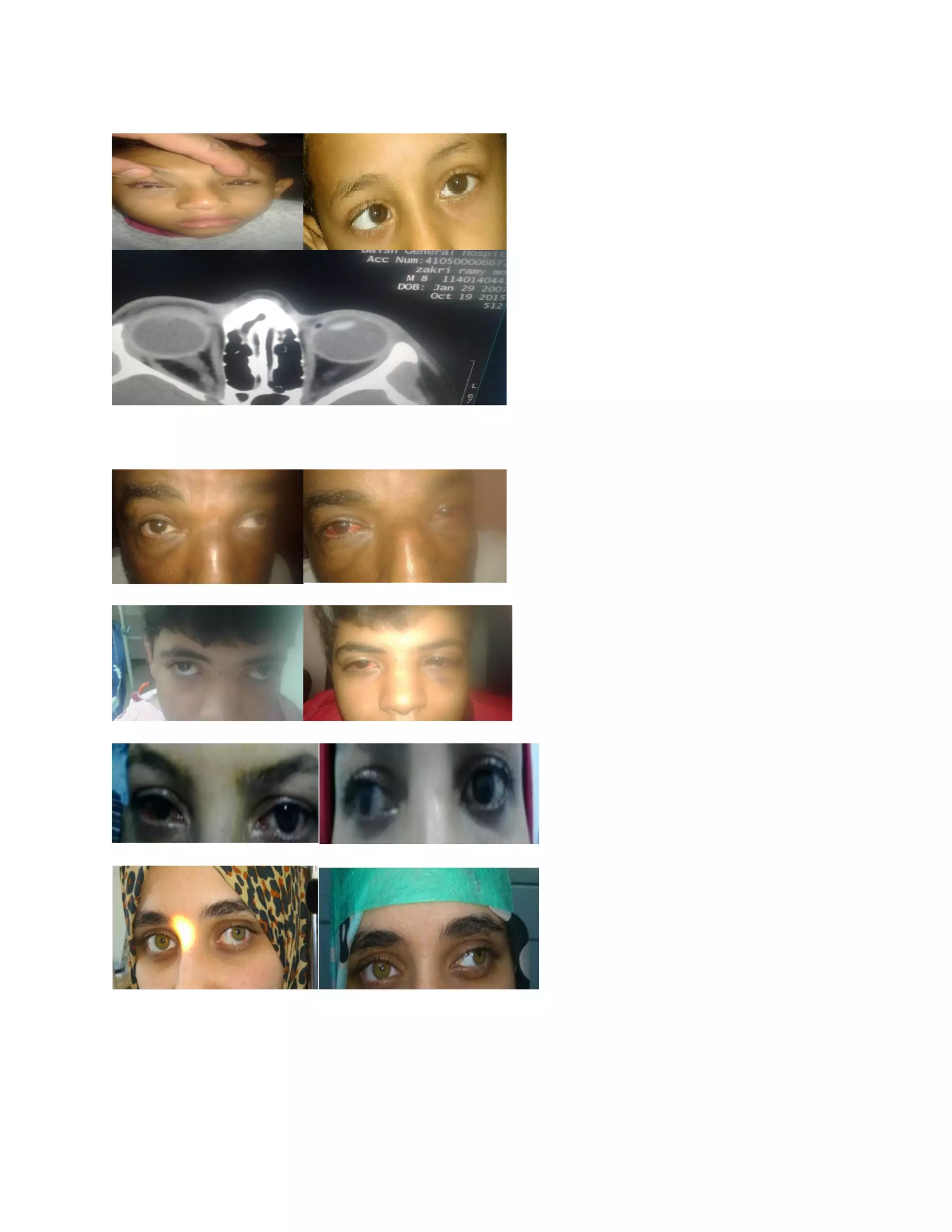
CT Found that ocular muscles after operation will very soon insert to the sclera in new place and
adjust by itself.
before and after :
Resources
Books
1. Step by step squint surgery, Prasad Walimbe, first edition 2011
2.Calhoun jh, nelson RD, atlas of pediatric ophthalmic surgery Philadelphia, PA: WB Saunders:
1987
3.Birch EE, stager DR Sr. long-term motor and sensory outcomes after early surgery for infantile
esotropia. J AAPOS 2006; 10(5):409-413
4.Nelson lb. olbitsky SE. Harley’s pediatric ophthalmology. 6th
end Philadelphia, PA: Lippincott
Williams & Wilkins: 0214.
5.Wrotham E V.Greenwald MJ. Expanded bimpcilar peripheral visual fields following. Surgery
for esotropia, J pediatr Opthalmol Strabismus. 1989; 26(3):109-112
6.Rogers GL. Chazzan s fellows r, tsou BH. Strabismus surgery and its effect upon infant
development in congenital esotropia, ophthalmology. 1982;89(5):479-483
7.Nelson BA, Gunton KB, Lasker JN, Nelson LB. Drohan LA, The psychosocial aspect of
strabismus in teenagers and adults and the impact of surgical correction. J AAPOS
2008;12(1):72.76.e1.
8.Parks MM. Atlas of Strabismus Surgery Philadelphia , PA: Harper and Row ; 1983.
9. Dyer, J. A., and D. A. Lee. Atlas of Extraocular Muscle Surgery. Westport, CT: Praeger
Publishers, 1984.
10. Good, William V., and Craig S. Hoyt. Strabismus Management. Boston: Butterworth-
Hienemann, 1996.
Periodicals
Bosman, J., M. P. ten Tusscher, I. de Jong, J. S. Vles, and H. Kingma. "The Influence of Eye
Muscle Surgery on Shape and Relative Orientation of Displacement Planes: Indirect Evidence
for Neural Control of 3D Eye Movements." Strabismus 10 (September 2002): 199–209.
Mayr, H. "Virtual Eye Muscle Surgery Based upon Biomechanical Models." Studies in Health
and Technology Information 81 (2001): 305–311.
Murray, T. "Eye Muscle Surgery." Current Opinion in Ophthalmology 11 (October 2000): 336–
341.
Rubsam, B., W. D. Schafer, B. Schulte, and N. Roewer. "Preliminary Report: Analgesia with
Remifentanil for Complicated Eye Muscle Surgery." Strabismus 8 (December 2000): 287–289.
Watts, J. C. "Total Intravenous Anesthesia Without Muscle Relaxant for Eye Surgery in a Patient
with Kugelberg-Welander Syndrome." Anesthesia 58 (January 2003): 96.
organizations
American Academy of Ophthalmology. 655 Beach Street, P.O. Box 7424, San Francisco, CA
94120-7424. http://www.eyenet.org .
American Academy of Pediatric Ophthalmology and Strabismus (AAPOS). http://med-
aapos.bu.edu .
other
Kolinsky, Scott E., and Leonard B. Nelson. Strabismus Web
Book. http://www.members.aol.com/scottolitsky/webbook.htm

Abstract of strabismus surgery

  • 1.
    New technique forsquint surgery : (myectomy technique) Short running head: squint surgery technique.
  • 2.
    Said Jamal EddinMD.SYRIA .Diaa Menem FRCS Libya giasuddinahmadMS, DO,Bangladesh.. Rukban al saadi CES KSA.Abdulkader Jamal eddin Medical Student. NO FUNDS Address for correspondence reprints:- Name: SAID JAMAL EDDIN..BAISH G Hospital--JAZAN-KSA Telephone: 00966505846293-00966558867848 Email: dr.jamal19.gmail.com Conflicts of interest: No Abstract; Objective: To explain a new surgical technique in squint surgery and to discuss and compare with old Conventional ones Background: There is a taboo in all kinds of medicine which we did not discuss such as: squint surgical rules and guidelines, Terms of ocular movements: -Antogisnt –Agonist –Yoke Muscle –Synergist, Laws of ocular mobility: [Sherrington Law: reciprocal innervations] [Herring Law: equal innervations] .A taboo such as conventional squint surgery and motility of the eye which we are following many years. In my study and based on my observation and my experience I have developed a new outstanding technique for squint surgery only depend on myectomy without any suture with very good results. The classical surgical squint techniques mostly depend on changing the mechanical action of the muscle. By resections or recessions .and those rules explain the movement of the eye. I think the Eye is not a machine (turn to left and turn to right)... There is also a compass like center in the eye ball or ocular muscles itself has control center like pacemaker of the heart or there have been neurogenic control (supranuclear) of ocular muscles1 . We don’t have any idea about these?!Or there may be another rule which need to discuss more. 1 Step by step squint surgery, Prasad Walimbe, first edition 2011
  • 3.
    Material and methods Ihave operated about 74 primary squint patients (XT-ET and some secondary cases – re operated). And the observations of their results after using this New technique for one year , two years By photo and vedio. Results: We found that when we do a myectomy especially to the medial rectus or lateral rectus and leaves it as it is There is no need to reinsert the muscle because the muscle will adjust and reinsert by itself as the eye motility require. Conclusion: This new technique is a new revolution in our ophthalmic field because it is simpler, easier to do, require less time (15 min), no need to suturing, small incision, under local anesthesia, no side- effects with more efficient results. Cosmetic improvement is round (85 -95) %. And the binocular vision is improved in young children about 45%. All the patients showed well improvement, no permanent double vision and no allergy to the suture. Introduction: conventional Strabismus surgeries is based on performing certain actions on the ocular muscle based either by weakening or strengthening and sometimes repositioning the extraocular muscles, which are located on the surface of the eye. The eye muscle surgery main purpose is to restore the alignment of the straight eye. And its performed to align both eyes in the same direction and move together as a team; to improve appearance; and to promote the development of binocular vision in a young child. To achieve binocular vision, the eyes must align so that the location of the image on the retina of one eye corresponds to the location of the image on the retina of the other eye. There is two methods to change extraocular muscles. Traditionally , the surgical intervention can be used to weakening , strengthening or repositioning an extraocular muscle. The surgeon first makes an incision in the conjunctiva (the clear membrane covering the sclera), then puts a suture into the muscle to hold it in place, and loosens the muscle from the eyeball with a surgical hook. During a resection, the muscle is detached from the sclera, a piece of muscle is removed so that the muscle is now shorter, and the muscle is reattached to the same place. This strengthens the muscle. In a recession, the muscle is made weaker by repositioning it. More than one extraocular eye muscle might be operated on at the same time. The strabismus (muscle eye surgery) is performed on the eye while it’s in its normal place and usually takes an hour and a half. At no time during the operation is the eye removed from the socket. The surgeon calculate where to reattach the muscles based on eye measurements taken before surgery and its hardly be seeing without a magnification, Like and other surgery, there are risks involved but the Eye muscle surgery is relatively safe, complication can varies from a cut in the muscle which cannot be retrieved. Or some other serious reactions, including those caused by anesthetics, can result in vision loss in the affected eye. Occasionally, retinal or nerve
  • 4.
    damage occurs. Permanentdouble vision is also a risk of eye muscle surgery. The success rate of this surgery changes from one person to another and depends on each person's particular condition. Some other rare complication may be allergy to the sutures, bleeding, and change in pupil size. But the main risk of this surgery is the failure to achieve a satisfactory alignment of the eyes. It can be and under correction or an overcorrection, or the eyes turning the other way after the operation. Surgeon’s goal to reach a perfect alignment, but this is not always possible. If the alignment is still unsatisfactory at the final postoperative visit, then a second operation may be necessary and off course infections can occur but it’s rare, and can be treated with antibiotics, Scarring can always be seen due to the incision which is made through the conjunctiva and muscle either by using a microscope or by close examination Discussion: It started when I noticed that the adjustable suture is not necessary to the recession of the ocular Muscle. Because I realized that the ocular motility is good in the direction of the operated muscle in the next day and step by step this realization gave me the idea to invent this technique which is based on doing myectomy to the muscles that needs recession. This happened to all of the extraocular muscles. especially to the lateral and medial rectus muscles. I found also some rules which I depended on it : First evaluate the eye motility under local anesthesia and balance the case after every step during surgery to decide what to do next, Second do Myectomoy either on insertion or 1 mm from it or 2 mm from it either for one or both eyes depending on the squint degree (small, medium or big), Third more dissection for high squint degree, Forth put tractional suture if there is still no alignment . I lost too many cases documented in my clinic in SYRIA five years before 2010. And I have Now only 74 cases documented.. 40 cases in Libya and 34 case in Saudi Arabia at Baish General. Hospital JAZAN in the last six month. Most of those 74 cases had been made under. L.A (lidocain2%) drops and inject around muscles: Unless the patient is under 10 Years old I did light GA: and I made CT before and after. For some cases to see what happened to the muscles. 9 cases of esotropia less than 20 degree Refraction between (+0.5 - +3) both medial Rectus myectomy. 100% improvement. 11 cases of esotropia 35 degree. Refraction (Plano - +1) OU medial rectus myectomy one Mm from insertion. With 95% improvement. 10 cases of esotropia 45 degree .refraction (+1 - + 2) OU medial rectus myectomoy 2mm from Insertion with 90% improvement. 15 cases of exotropia 50degree .refraction (-1 - -4) OU lateral rectus myectomoy 2 mm from insertion with 90% improvement. 5 cases residual paralysis of the 6th nerve (60degree -). Refraction (-1 _ -4) amblyopia.OU
  • 5.
    Lateral rectus myectomoy2 mm from insertion with traction suture medially for one week 85% improvement 4 cases of partial paralysis 55 degrees. Of the VI nerve palsy. OU medial rectus myectomoy 2 mm from the insertion for the muscle which is more paralyzed and the other one 1 mm .with 90% improvement 6 cases residual right exotropia 50 degrees refraction (-2) with amblyopia OU medial rectus myectomy 2 mm from the insertion for one muscle with 85% improvement. 4 cases of consecutive exotropia with anisometropia secondary to previous surgeries 55 degrees .greater to the left eye .refraction between ( -9 OS _OD -2) OU lateral rectus myectomy 2 mm from the insertion with 95% improvement . 5 cases of cross esotropia refraction between (+12 _+20) OU medial rectus myectomy 2mm from the insertion with tractional suture .80% improvement. 3 case of strabismus fixus 60 degrees no abduction for the OS, abduction of OD to the midline, OU medial rectus myectomy with 2mm from the insertion. with100 % improve 2 case of inferior oblique over action. In the left eye .myectomy 2.5 mm with 100 % improvement CT Found that ocular muscles after operation will very soon insert to the sclera in new place and adjust by itself. before and after :
  • 7.
    Resources Books 1. Step bystep squint surgery, Prasad Walimbe, first edition 2011 2.Calhoun jh, nelson RD, atlas of pediatric ophthalmic surgery Philadelphia, PA: WB Saunders: 1987 3.Birch EE, stager DR Sr. long-term motor and sensory outcomes after early surgery for infantile esotropia. J AAPOS 2006; 10(5):409-413 4.Nelson lb. olbitsky SE. Harley’s pediatric ophthalmology. 6th end Philadelphia, PA: Lippincott Williams & Wilkins: 0214. 5.Wrotham E V.Greenwald MJ. Expanded bimpcilar peripheral visual fields following. Surgery for esotropia, J pediatr Opthalmol Strabismus. 1989; 26(3):109-112 6.Rogers GL. Chazzan s fellows r, tsou BH. Strabismus surgery and its effect upon infant development in congenital esotropia, ophthalmology. 1982;89(5):479-483 7.Nelson BA, Gunton KB, Lasker JN, Nelson LB. Drohan LA, The psychosocial aspect of strabismus in teenagers and adults and the impact of surgical correction. J AAPOS 2008;12(1):72.76.e1. 8.Parks MM. Atlas of Strabismus Surgery Philadelphia , PA: Harper and Row ; 1983. 9. Dyer, J. A., and D. A. Lee. Atlas of Extraocular Muscle Surgery. Westport, CT: Praeger Publishers, 1984. 10. Good, William V., and Craig S. Hoyt. Strabismus Management. Boston: Butterworth- Hienemann, 1996.
  • 8.
    Periodicals Bosman, J., M.P. ten Tusscher, I. de Jong, J. S. Vles, and H. Kingma. "The Influence of Eye Muscle Surgery on Shape and Relative Orientation of Displacement Planes: Indirect Evidence for Neural Control of 3D Eye Movements." Strabismus 10 (September 2002): 199–209. Mayr, H. "Virtual Eye Muscle Surgery Based upon Biomechanical Models." Studies in Health and Technology Information 81 (2001): 305–311. Murray, T. "Eye Muscle Surgery." Current Opinion in Ophthalmology 11 (October 2000): 336– 341. Rubsam, B., W. D. Schafer, B. Schulte, and N. Roewer. "Preliminary Report: Analgesia with Remifentanil for Complicated Eye Muscle Surgery." Strabismus 8 (December 2000): 287–289. Watts, J. C. "Total Intravenous Anesthesia Without Muscle Relaxant for Eye Surgery in a Patient with Kugelberg-Welander Syndrome." Anesthesia 58 (January 2003): 96. organizations American Academy of Ophthalmology. 655 Beach Street, P.O. Box 7424, San Francisco, CA 94120-7424. http://www.eyenet.org . American Academy of Pediatric Ophthalmology and Strabismus (AAPOS). http://med- aapos.bu.edu . other Kolinsky, Scott E., and Leonard B. Nelson. Strabismus Web Book. http://www.members.aol.com/scottolitsky/webbook.htm