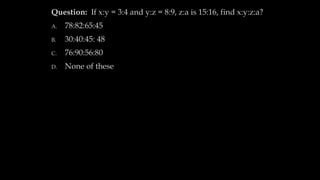
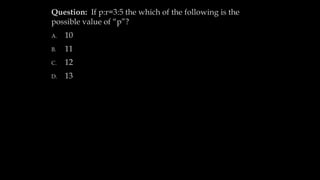
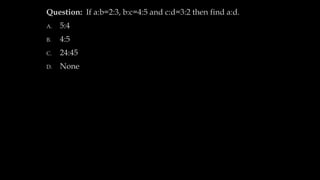
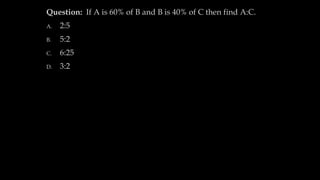
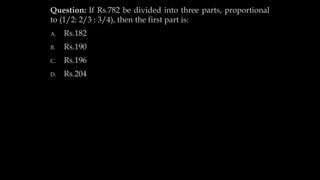
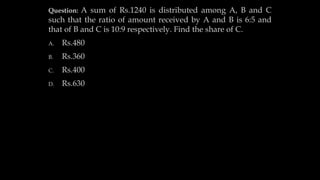
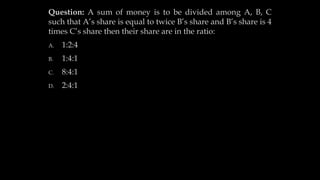
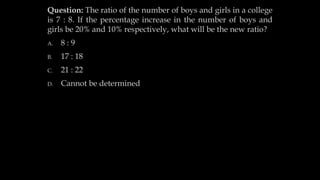
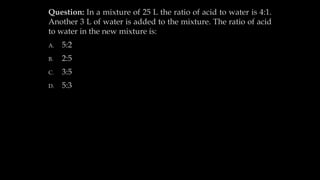
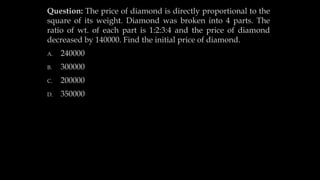
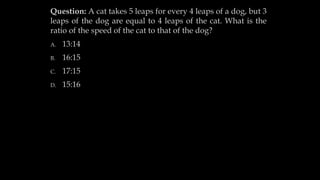
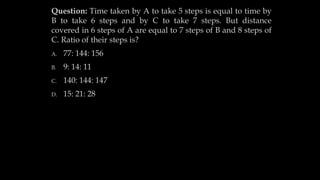
VEDIC MATHS
MULTIPLICATION OF NUMBERS
WITH 11
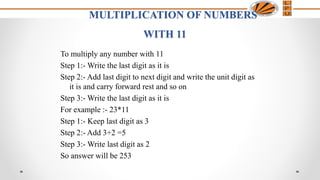
To multiply any number with 11
Step 1:- Write the last digit as it is
Step 2:- Add last digit to next digit and write the unit digit as
it is and carry forward rest and so on
Step 3:- Write the last digit as it is
For example :- 23*11
Step 1:- Keep last digit as 3
Step 2:- Add 3+2 =5
Step 3:- Write last digit as 2
So answer will be 253
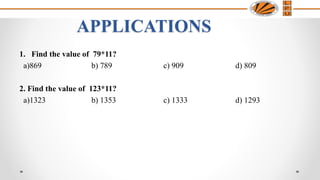
APPLICATIONS
1. Find the value of 79*11?
a)869 b) 789 c) 909 d) 809
2. Find the value of 123*11?
a)1323 b) 1353 c) 1333 d) 1293
MULTIPLICATION OF NUMBERS
WITH 9, 99 & 999…
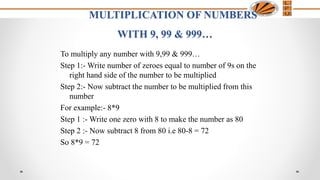
To multiply any number with 9,99 & 999…
Step 1:- Write number of zeroes equal to number of 9s on the
right hand side of the number to be multiplied
Step 2:- Now subtract the number to be multiplied from this
number
For example:- 8*9
Step 1 :- Write one zero with 8 to make the number as 80
Step 2 :- Now subtract 8 from 80 i.e 80-8 = 72
So 8*9 = 72
APPLICATIONS
1. Find the value of 257*9
a)2353 b) 2303 c) 2313 d) 2363
2. Find the value of 58*99
a)5632 b) 6182 c) 6822 d) 5742
APPLICATIONS
3. Find the value of 436*99
a)39452 b) 43164 c) 44724 d) 42492
4. Find the value of 689*999
a)687431 b) 688411 c) 688311 d) 688321
MULTIPLICATION OF TWO DIGIT
NUMBERS USING CRISS CROSS
METHOD
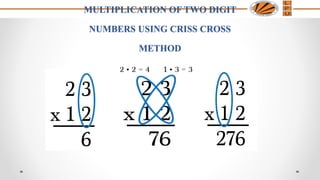
Step 1:- First of all multiply the last digits and keep the
unit digit only and carry forward rest
Step 2:- Now cross multiply the digits and again keep the
unit digit only
Step 3:- Now again multiply the last digits.
It is shown on the next slide with an example
MULTIPLICATION OF TWO DIGIT
NUMBERS USING CRISS CROSS
METHOD
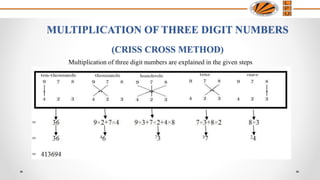
MULTIPLICATION OF THREE DIGIT NUMBERS
(CRISS CROSS METHOD)
Multiplication of three digit numbers are explained in the given steps
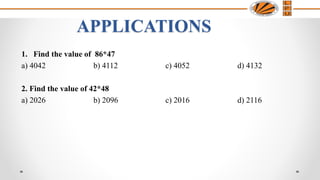
APPLICATIONS
1. Find the value of 86*47
a) 4042 b) 4112 c) 4052 d) 4132
2. Find the value of 42*48
a) 2026 b) 2096 c) 2016 d) 2116
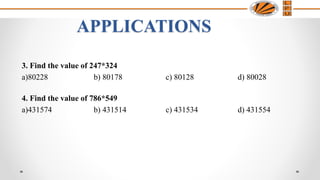
APPLICATIONS
3. Find the value of 247*324
a)80228 b) 80178 c) 80128 d) 80028
4. Find the value of 786*549
a)431574 b) 431514 c) 431534 d) 431554
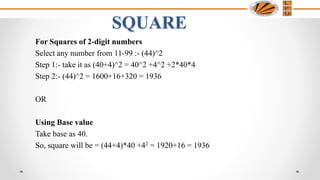
SQUARE
For Squares of 2-digit numbers
Select any number from 11-99 :- (44)^2
Step 1:- take it as (40+4)^2 = 40^2 +4^2 +2*40*4
Step 2:- (44)^2 = 1600+16+320 = 1936
OR
Using Base value
Take base as 40.
So, square will be = (44+4)*40 +42 = 1920+16 = 1936
SQUARE
For Squares of three digit numbers
Select any number from 100-999 :- (588)^2
Step 1:- Take the difference of this number and the nearest number ending with zero. Lets take
that number be 600, so difference will be 600-588 = 12
Step 2:- Take square of this difference and that will be 12^2 = 144
Step 3:- Now first add and then subtract the difference from step 1. i.e. 600 and 576
Step 4:- multiply 600 and 576 and then add 144(from step 2) in the result, so it will become
(588)^2 = 576*600 + 144 = 345600+144 = 345744
OR
Using base value
As 588=600-12, so take the base value as 600.
So, square of the number will be= (588-12)*600 +122 = 345600+144 = 345744
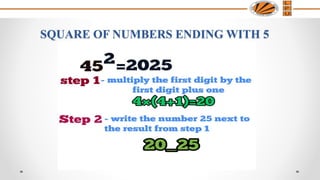
SQUARE OF NUMBERS ENDING WITH 5
1. Find the square of 46?
a) 2116 b) 2378 c) 2216 d) 2316
2. Find the square of 396?
a) 156216 b) 156816 c) 152664 d) 161664
3. Find the square of 112?
a) 11544 b) 12544 c) 11344 d) 12444
APPLICATIONS
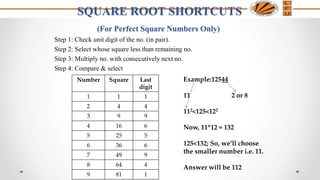
SQUARE ROOT SHORTCUTS
(For Perfect Square Numbers Only)
Step 1: Check unit digit of the no. (in pair).
Step 2: Select whose square less than remaining no.
Step 3: Multiply no. with consecutively next no.
Step 4: Compare & select
Number Square Last
digit
1 1 1
2 4 4
3 9 9
4 16 6
5 25 5
6 36 6
7 49 9
8 64 4
9 81 1
Example:12544
11 2 or 8
112<125<122
Now, 11*12 = 132
125<132; So, we’ll choose
the smaller number i.e. 11.
Answer will be 112
APPLICATIONS
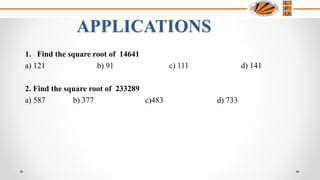
1. Find the square root of 14641
a) 121 b) 91 c) 111 d) 141
2. Find the square root of 233289
a) 587 b) 377 c)483 d) 733
18
Number Systems
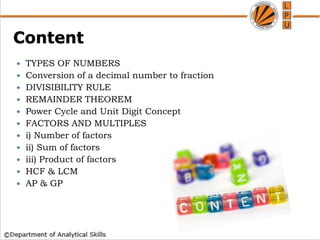
Content
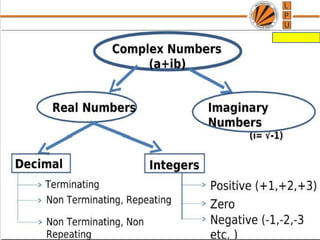
 TYPES OF NUMBERS
 Conversion of a decimal number to fraction
 DIVISIBILITY RULE
 REMAINDER THEOREM
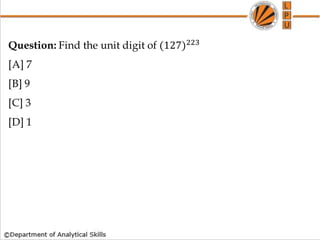
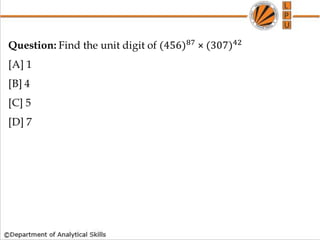
 Power Cycle and Unit Digit Concept
 FACTORS AND MULTIPLES
 i) Number of factors
 ii) Sum of factors
 iii) Product of factors
 HCF & LCM
 AP & GP
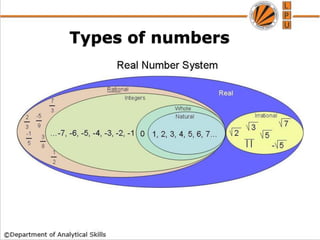
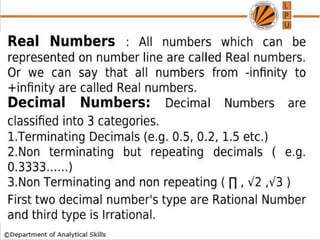
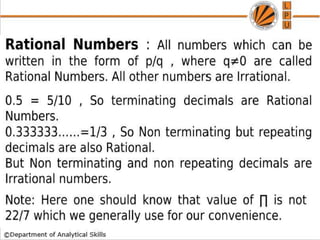
Types of numbers
How to find whether a no is Prime or not
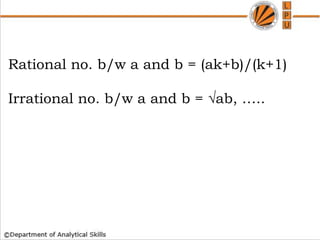
Rational no. b/w a and b = (ak+b)/(k+1)
Irrational no. b/w a and b = √ab, …..
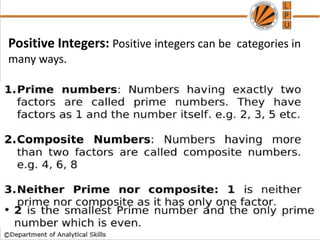
Positive Integers: Positive integers can be categories in
many ways.
How to find whether a no is Prime or not
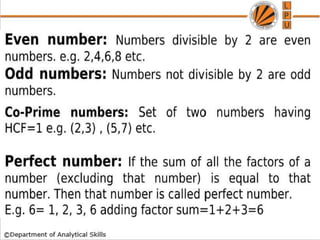
Important rules related to Even and Odd
numbers:
odd ± odd = even;
even ± even = even;
even ± odd = odd
odd × odd = odd;
even × even = even;
even × odd = even.
odd(any number) = odd
even(any number) = even
How to find if a number is prime or not?
N is a prime number if it is not divisible by numbers lesser
than √N.
Example: 191 is a prime number since it is not divisible by 2, 3,
5, 7, 11 and 13 [numbers less than √191 (≈14)].
Note: Prime numbers will always be in the form (6k±1) where k=
1, 2, 3....
But not all (6k±1) will be a prime number.
prime numbers
(6k±1)
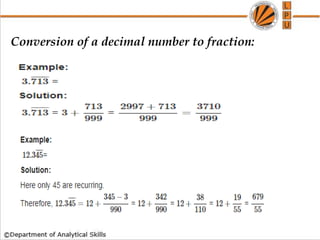
Conversion of a decimal number to fraction:
Q. Find the rational form of the recurring rational
0.2333333333
[A] 11/99
[B] 1/3
[C] 7/30
[D] 13/30
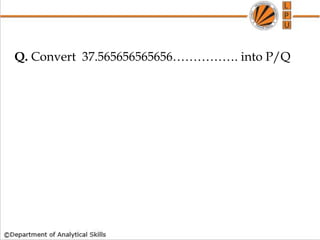
Q. Convert 37.565656565656……………. into P/Q
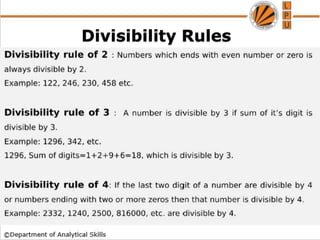
Divisibility Rules
How to find whether a no is Prime or not
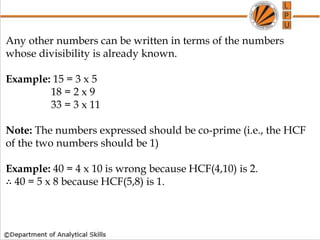
Any other numbers can be written in terms of the numbers
whose divisibility is already known.
Example: 15 = 3 x 5
18 = 2 x 9
33 = 3 x 11
Note: The numbers expressed should be co-prime (i.e., the HCF
of the two numbers should be 1)
Example: 40 = 4 x 10 is wrong because HCF(4,10) is 2.
∴ 40 = 5 x 8 because HCF(5,8) is 1.
Question: If number 1792N is divisible by 2. How many values
N can take?
[A] 4
[B] 5
[C] 3
[D] 6
Question: What should come in place of K if 563K5 is divisible
by 9?
[A] 7
[B] 8
[C] 9
[D] 2
Question: For what values of P number 345472P34 is exactly
divisible by 9.
[A] 3
[B] 4
[C] 6
[D] 7
Question: For what values of N number 9724N is exactly
divisible by 6.
[A] 2 & 8
[B] 4 & 6
[C] 2 & 6
[D] 6 & 8
Question: For what values of N number 857N32 is exactly
divisible by 11.
[A] 1
[B] 0
[C] 3
[D] 4
Question: What should come in place x if 4857x is divisible by
88?
[A] 6
[B] 8
[C] 2
[D] 4
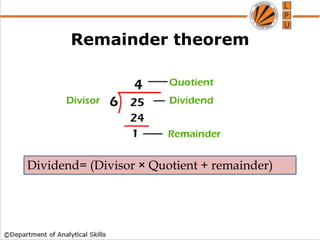
Remainder theorem
Dividend= (Divisor × Quotient + remainder)
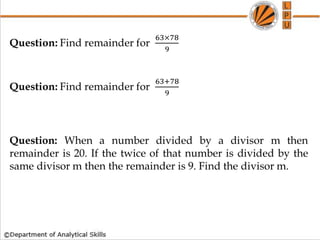
Question: In a division process divisor is 5 times of quotient
and remainder is 3 times of quotient. If remainder is 15. Find
dividend.
[A] 140
[B] 150
[C] 170
[D] 190
Question: When a number is divided by 102 leaves remainder
87. If the same no. is divided by 17. Find remainder.
[A] 1
[B] 5
[C] 7
[D] 2
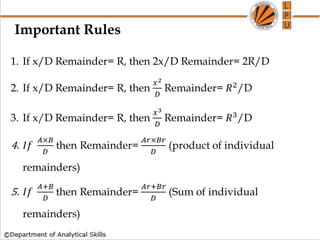
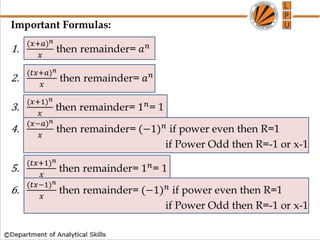
Important Rules
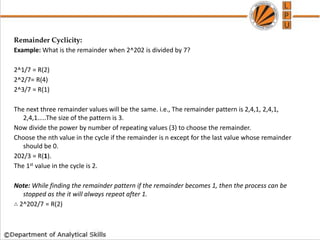
Remainder Cyclicity:
Example: What is the remainder when 2^202 is divided by 7?
2^1/7 = R(2)
2^2/7= R(4)
2^3/7 = R(1)
The next three remainder values will be the same. i.e., The remainder pattern is 2,4,1, 2,4,1,
2,4,1.....The size of the pattern is 3.
Now divide the power by number of repeating values (3) to choose the remainder.
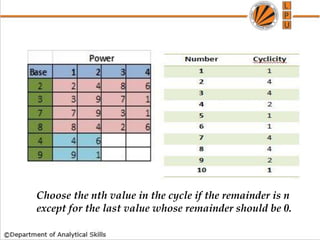
Choose the nth value in the cycle if the remainder is n except for the last value whose remainder
should be 0.
202/3 = R(1).
The 1st value in the cycle is 2.
Note: While finding the remainder pattern if the remainder becomes 1, then the process can be
stopped as the it will always repeat after 1.
∴ 2^202/7 = R(2)
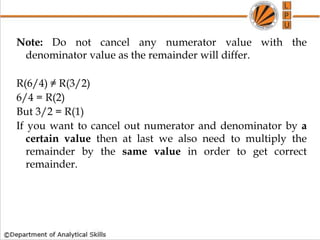
Note: Do not cancel any numerator value with the
denominator value as the remainder will differ.
R(6/4) ≠ R(3/2)
6/4 = R(2)
But 3/2 = R(1)
If you want to cancel out numerator and denominator by a
certain value then at last we also need to multiply the
remainder by the same value in order to get correct
remainder.
Q) What is the remainder when 3^7 is divided by 8?
[A] 3
[B] 4
[C] 5
[D] 7
Q) Remainder when 17^23 is divided by 16?
[A] 1
[B] 2
[C] 3
[D] 4
Q) Remainder when 35^113 is divided by 9?
[A] 1
[B] 8
[C] 3
[D] 4
Q) Remainder when 2^33 is divided by 9?
[A] 1
[B] 4
[C] 8
[D] 5
Q) Remainder when 2^99 is divided by 10?
[A] 1
[B] 4
[C] 2
[D] 8
Q) Remainder when 5^500 is divided by 500?
[A] 125
[B] 1
[C] 5
[D] 250
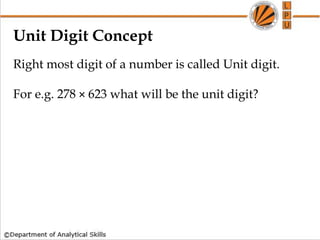
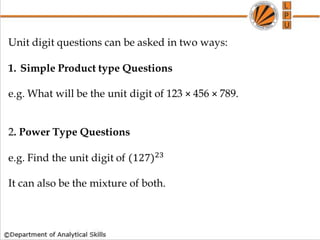
Unit Digit Concept
Right most digit of a number is called Unit digit.
For e.g. 278 × 623 what will be the unit digit?
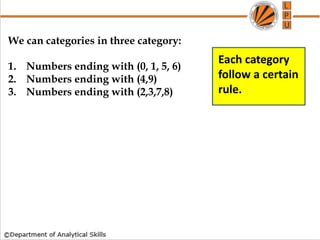
We can categories in three category:
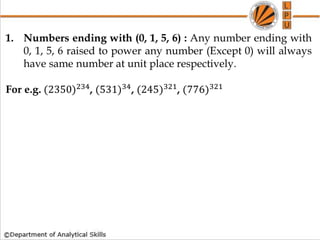
1. Numbers ending with (0, 1, 5, 6)
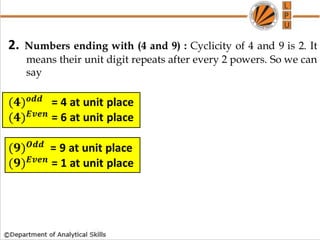
2. Numbers ending with (4,9)
3. Numbers ending with (2,3,7,8)
Each category
follow a certain
rule.
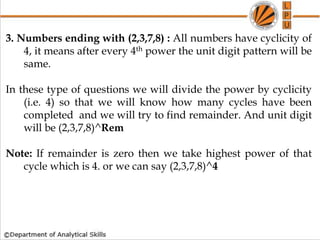
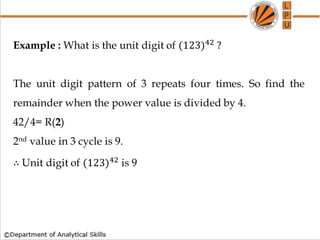
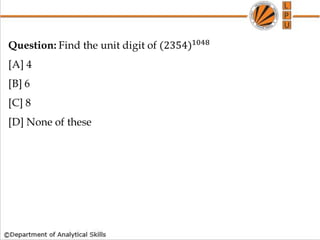
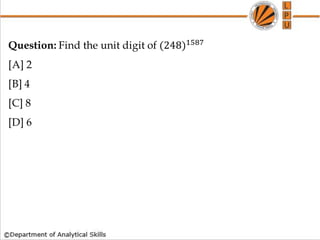
3. Numbers ending with (2,3,7,8) : All numbers have cyclicity of
4, it means after every 4th power the unit digit pattern will be
same.
In these type of questions we will divide the power by cyclicity
(i.e. 4) so that we will know how many cycles have been
completed and we will try to find remainder. And unit digit
will be (2,3,7,8)^Rem
Note: If remainder is zero then we take highest power of that
cycle which is 4. or we can say (2,3,7,8)^4
Choose the nth value in the cycle if the remainder is n
except for the last value whose remainder should be 0.
How to find whether a no is Prime or not
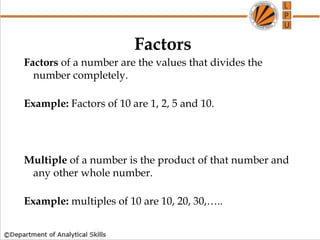
Factors
Factors of a number are the values that divides the
number completely.
Example: Factors of 10 are 1, 2, 5 and 10.
Multiple of a number is the product of that number and
any other whole number.
Example: multiples of 10 are 10, 20, 30,…..
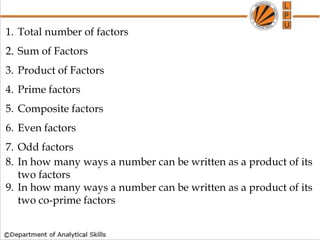
1. Total number of factors
2. Sum of Factors
3. Product of Factors
4. Prime factors
5. Composite factors
6. Even factors
7. Odd factors
8. In how many ways a number can be written as a product of its
two factors
9. In how many ways a number can be written as a product of its
two co-prime factors
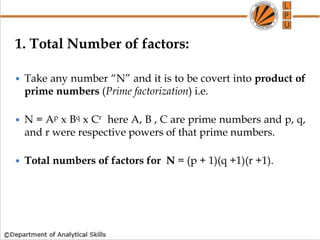
1. Total Number of factors:
 Take any number “N” and it is to be covert into product of
prime numbers (Prime factorization) i.e.
 N = Ap x Bq x Cr here A, B , C are prime numbers and p, q,
and r were respective powers of that prime numbers.
 Total numbers of factors for N = (p + 1)(q +1)(r +1).
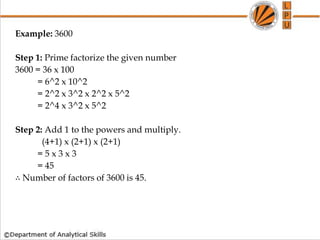
Example: 3600
Step 1: Prime factorize the given number
3600 = 36 x 100
= 6^2 x 10^2
= 2^2 x 3^2 x 2^2 x 5^2
= 2^4 x 3^2 x 5^2
Step 2: Add 1 to the powers and multiply.
(4+1) x (2+1) x (2+1)
= 5 x 3 x 3
= 45
∴ Number of factors of 3600 is 45.
Question: Find the total number of factors of 330.
[A] 2
[B] 8
[C] 16
[D] 32
Question: Find the total number of factors of 1560.
[A] 6
[B] 16
[C] 12
[D] 32
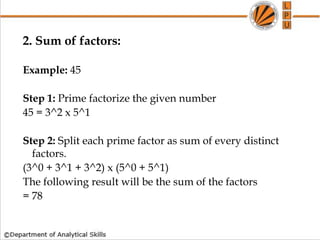
2. Sum of factors:
Example: 45
Step 1: Prime factorize the given number
45 = 3^2 x 5^1
Step 2: Split each prime factor as sum of every distinct
factors.
(3^0 + 3^1 + 3^2) x (5^0 + 5^1)
The following result will be the sum of the factors
= 78
Question: Find the sum of factors of 24.
[A] 60
[B] 46
[C] 56
[D] 59
Question: Find the sum of factors of 98.
[A] 161
[B] 171
[C] 160
[D] None
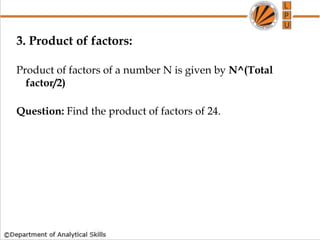
3. Product of factors:
Product of factors of a number N is given by N^(Total
factor/2)
Question: Find the product of factors of 24.
4. Prime factors:
Number of Prime factors used in prime factorization are
prime factors.
5. Composite Factors:
(Total factors – Prime factors)-1
Question: Find the number of prime factors of 300.
[A] 2
[B] 3
[C] 4
[D] 5
Question: Find the number of composite factors of 42.
[A] 1
[B] 4
[C] 5
[D] 3
Even and Odd factors: We can find any one of two values
and other we can find from subtracting from the total
number of factors.
6. Odd factors: To find odd factors we will not consider
power of 2 as it is a even Prime number.
Note: Do not consider even prime factor
7. Even factors: We can also find even factor directly. After
prime factorization we will increase all power by 1 except
power of 2. It will remain constant.
Odd Factors:
Example: 4500
4500 = 45 x 100 = 9 x 5 x 10 x 10 = 3 x 3 x 5 x 5 x 2 x 5 x 2
4500 = 22 x 32 x 53 Here consider A = 2 , B = 3 , C = 5 , p= 2 , q =
2 and r = 3
Here identifying that odd number are 3 and 5
Numbers of odd factors of number 4500 = (q + 1 ) (r + 1) = 3 x
4 = 12
Note: Do not consider even prime factor
Question: How many factors of 340 are even.
[A] 12
[B] 16
[C] 8
[D] 6
Question: How many factors of 408 are even.
[A] 12
[B] 16
[C] 8
[D] 10
8. In how many ways a number can be written as a product
of its two factors:
It is given by (Total Factors/2)
Note: If the total number of factors are odd then Product of
two number= (total factors+1)/2
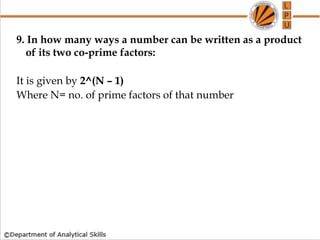
9. In how many ways a number can be written as a product
of its two co-prime factors:
It is given by 2^(N – 1)
Where N= no. of prime factors of that number
Question: In How many ways 320 can be written as a product
of its two co-prime factors .
[A] 2
[B] 6
[C] 1
[D] 5
Question: In How many ways 12 can be written as a product
of its two co-prime factors .
[A] 2
[B] 6
[C] 8
[D] 6
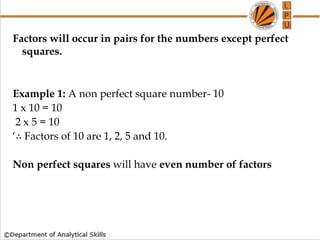
Factors will occur in pairs for the numbers except perfect
squares.
Example 1: A non perfect square number- 10
1 x 10 = 10
2 x 5 = 10
‘∴ Factors of 10 are 1, 2, 5 and 10.
Non perfect squares will have even number of factors
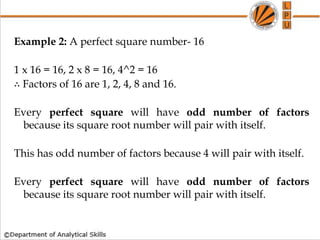
Example 2: A perfect square number- 16
1 x 16 = 16, 2 x 8 = 16, 4^2 = 16
∴ Factors of 16 are 1, 2, 4, 8 and 16.
Every perfect square will have odd number of factors
because its square root number will pair with itself.
This has odd number of factors because 4 will pair with itself.
Every perfect square will have odd number of factors
because its square root number will pair with itself.
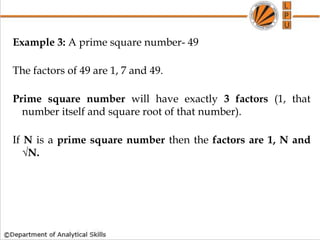
Example 3: A prime square number- 49
The factors of 49 are 1, 7 and 49.
Prime square number will have exactly 3 factors (1, that
number itself and square root of that number).
If N is a prime square number then the factors are 1, N and
√N.
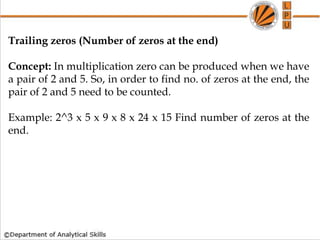
Trailing zeros (Number of zeros at the end)
Concept: In multiplication zero can be produced when we have
a pair of 2 and 5. So, in order to find no. of zeros at the end, the
pair of 2 and 5 need to be counted.
Example: 2^3 x 5 x 9 x 8 x 24 x 15 Find number of zeros at the
end.
How to find Trailing zeros in any n! :
Ex: Find number of zeros in 10!
Answer: 10! = 1x2x3x4x5x6x7x8x9x10
Note: For any factorial value number of 5s are always less than
number of 2s. So our concern will be to find number of 5.
For counting 5s in any n! value we divide n by powers of 5.
= [n/5] + [n/5^2] + [n/5^3] + [n/5^4]+…………
Question: Find number of trailing zeros in 100!
[A] 24
[B] 25
[C] 26
[D] 27
Question: Find number of trailing zeros in 154!
[A] 35
[B] 31
[C] 34
[D] 37
Question: Find number of trailing zeros in 56!
[A] 13
[B] 11
[C] 12
[D] 6
Question: Find number of trailing zero in 100!+200!
[A] 24
[B] 49
[C] 73
[D] None of these
Question: Find number of trailing zero in 100! X 200!
[A] 24
[B] 49
[C] 73
[D] None of these
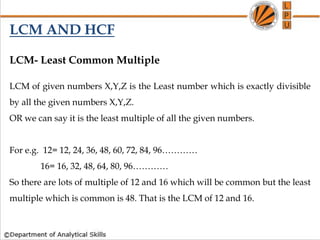
LCM- Least Common Multiple
LCM of given numbers X,Y,Z is the Least number which is exactly divisible
by all the given numbers X,Y,Z.
OR we can say it is the least multiple of all the given numbers.
For e.g. 12= 12, 24, 36, 48, 60, 72, 84, 96…………
16= 16, 32, 48, 64, 80, 96…………
So there are lots of multiple of 12 and 16 which will be common but the least
multiple which is common is 48. That is the LCM of 12 and 16.
LCM AND HCF
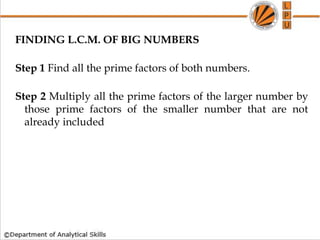
FINDING L.C.M. OF BIG NUMBERS
Step 1 Find all the prime factors of both numbers.
Step 2 Multiply all the prime factors of the larger number by
those prime factors of the smaller number that are not
already included
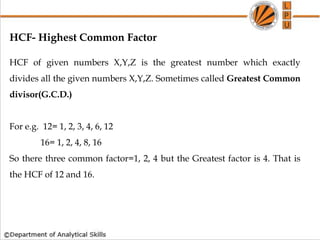
HCF- Highest Common Factor
HCF of given numbers X,Y,Z is the greatest number which exactly
divides all the given numbers X,Y,Z. Sometimes called Greatest Common
divisor(G.C.D.)
For e.g. 12= 1, 2, 3, 4, 6, 12
16= 1, 2, 4, 8, 16
So there three common factor=1, 2, 4 but the Greatest factor is 4. That is
the HCF of 12 and 16.
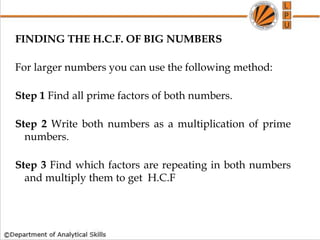
FINDING THE H.C.F. OF BIG NUMBERS
For larger numbers you can use the following method:
Step 1 Find all prime factors of both numbers.
Step 2 Write both numbers as a multiplication of prime
numbers.
Step 3 Find which factors are repeating in both numbers
and multiply them to get H.C.F
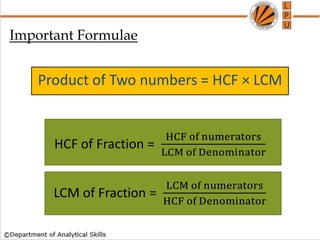
Product of Two numbers = HCF × LCM
Important Formulae
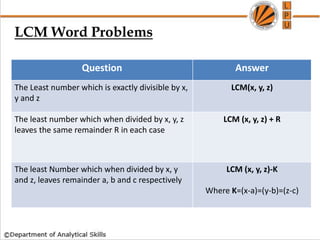
Question Answer
The Least number which is exactly divisible by x,
y and z
LCM(x, y, z)
The least number which when divided by x, y, z
leaves the same remainder R in each case
LCM (x, y, z) + R
The least Number which when divided by x, y
and z, leaves remainder a, b and c respectively
LCM (x, y, z)-K
Where K=(x-a)=(y-b)=(z-c)
LCM Word Problems
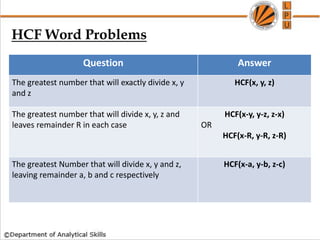
Question Answer
The greatest number that will exactly divide x, y
and z
HCF(x, y, z)
The greatest number that will divide x, y, z and
leaves remainder R in each case
HCF(x-y, y-z, z-x)
OR
HCF(x-R, y-R, z-R)
The greatest Number that will divide x, y and z,
leaving remainder a, b and c respectively
HCF(x-a, y-b, z-c)
HCF Word Problems
Q) Find the lowest common multiple of 24, 36 and 40.
[A] 120
[B] 240
[C] 360
[D] 480
Q) The least number which is exactly divisible by 8, 16, 40 and
80 is:
[A] 16
[B] 120
[C] 80
[D] None
Q) The greatest number that will exactly divide 36 and 84 is:
[A] 4
[B] 6
[C] 12
[D] 18
Q) The greatest possible length which can be used to measure
exactly the lengths 7 m, 3 m 85 cm, 12 m 95 cm is:
[A] 15
[B] 25
[C] 35
[D] 42
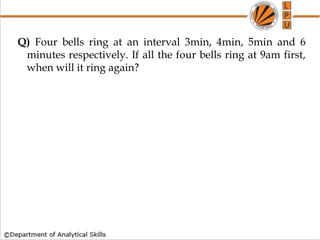
Q) Four bells ring at an interval 3min, 4min, 5min and 6
minutes respectively. If all the four bells ring at 9am first,
when will it ring again?
Q) The H.C.F. of two numbers is 11 and their L.C.M. is 7700.
If one of the numbers is 275, then the other is:
[A] 308
[B] 310
[C] 312
[D] None
Q) The H.C.F of 9/10, 12/25, 18/35, and 21/40 is?
[A] 3/1400
[B] 5/1400
[C] 7/1400
[D] None
Q) Which of the following fraction is the largest? 7/8, 13/16,
31/40, 63/80
[A] 7/8
[B] 13/16
[C] 31/40
[D] 63/80
Q) Three number are in the ratio of 3 : 4 : 5 and their L.C.M. is
2400. Their H.C.F. is:
[A] 40
[B] 80
[C] 120
[D] 200
Q) The ratio of two numbers is 3 : 4 and their H.C.F. is 4. Their
L.C.M. is:
[A] 12
[B] 16
[C] 24
[D] 48
Q) The least number, which when divided by 12, 15, 20 and 54
leaves in each case a remainder of 8 is:
[A] 504
[B] 536
[C] 544
[D] 548
Q) Find the smallest number, which when divided by 3, 4 and
5 leaves remainder 1, 2 and 3 respectively?
[A] 60
[B] 53
[C] 58
[D] None
Q) The greatest number which on dividing 1657 and 2037
leaves remainders 6 and 5 respectively, is:
[A] 123
[B] 127
[C] 235
[D] 305
Q) Find the greatest number that will divide 43, 91 and 183 so
as to leave the same remainder in each case.
[A] 4
[B] 7
[C] 9
[D] 13
Q) The product of two numbers is 4107. If the H.C.F. of these
numbers is 37, then the greater number is:
[A] 101
[B] 107
[C] 111
[D] 185
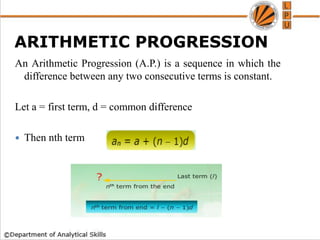
An Arithmetic Progression (A.P.) is a sequence in which the
difference between any two consecutive terms is constant.
Let a = first term, d = common difference
 Then nth term
ARITHMETIC PROGRESSION
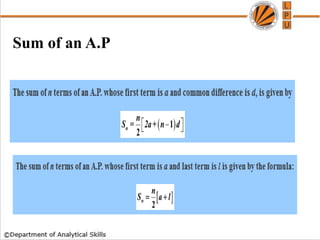
Sum of an A.P
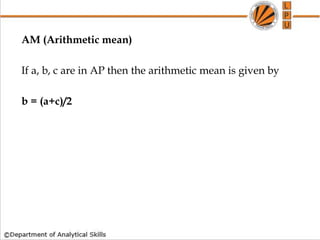
AM (Arithmetic mean)
If a, b, c are in AP then the arithmetic mean is given by
b = (a+c)/2
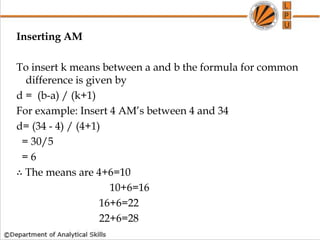
Inserting AM
To insert k means between a and b the formula for common
difference is given by
d = (b-a) / (k+1)
For example: Insert 4 AM’s between 4 and 34
d= (34 - 4) / (4+1)
= 30/5
= 6
∴ The means are 4+6=10
10+6=16
16+6=22
22+6=28
Question: 1,3,5, 7, …….. Which term of this AP is 55?
[A] 25th
[B] 26th
[C] 27th
[D] 28th
Question: Find the 15th term of the series 20,15,10,……..
[A] -45
[B] -50
[C] -55
[D] 0
Question: How many terms are there in the AP 20, 25, 30,
…….. 130?
[A] 21
[B] 22
[C] 23
[D] 24
Question: Find the sum of the series 5,8,11,…….. 221
[A] 8249
[B] 8239
[C] 7886
[D] 9000
Question: Find the sum of all 2-digit numbers, which are
exactly divisible by 9?
[A] 525
[B] 565
[C] 575
[D] 585
Question: Find the first term of an AP whose 8th and 12th
terms are 39 and 59 respectively?
[A] 3
[B] 4
[C] 5
[D] 6
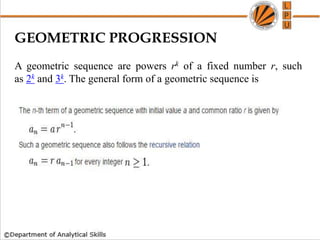
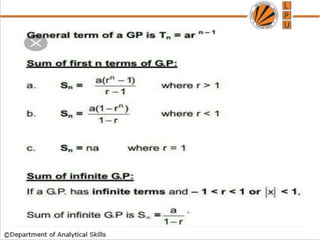
GEOMETRIC PROGRESSION
A geometric sequence are powers rk of a fixed number r, such
as 2k and 3k. The general form of a geometric sequence is
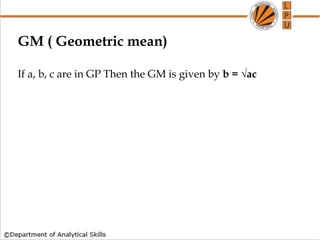
GM ( Geometric mean)
If a, b, c are in GP Then the GM is given by b = √ac
Inserting GM
To insert k means between a and b the formula for common
ratio is given by
r = (b/a)^(1/(k+1))
For example: Insert 4 GM’s between 2 and 486
r = (486/2)^(1/(4+1)) = (243)^(1/5) = 3
∴ the means are 2x3 = 6
6x3 = 18
18x3 = 54
54x3 = 162
Question: How many terms are there in the sequence
5, 20, 80, 320, …….. 20480?
[A] 5
[B] 6
[C] 7
[D] 8
Question: If the first and fifth term of a GP are 16 and 81
respectively then find the fourth term?
[A] 18
[B] 24
[C] 36
[D] 54
Question: Find the sum of the series 2, 4, 8, 16…. 256.
[A] 510
[B] 1020
[C] 520
[D] None
Next Class Averages
AVERAGE- TRICKS & TIPS
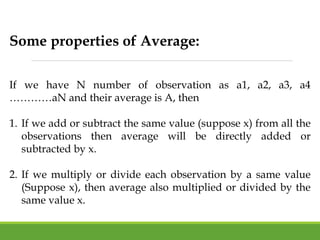
Some properties of Average:
If we have N number of observation as a1, a2, a3, a4
…………aN and their average is A, then
1. If we add or subtract the same value (suppose x) from all the
observations then average will be directly added or
subtracted by x.
2. If we multiply or divide each observation by a same value
(Suppose x), then average also multiplied or divided by the
same value x.
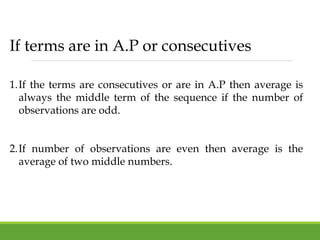
If terms are in A.P or consecutives
1.If the terms are consecutives or are in A.P then average is
always the middle term of the sequence if the number of
observations are odd.
2.If number of observations are even then average is the
average of two middle numbers.
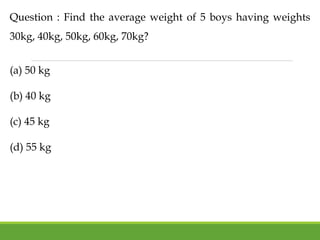
Question : Find the average weight of 5 boys having weights
30kg, 40kg, 50kg, 60kg, 70kg?
(a) 50 kg
(b) 40 kg
(c) 45 kg
(d) 55 kg
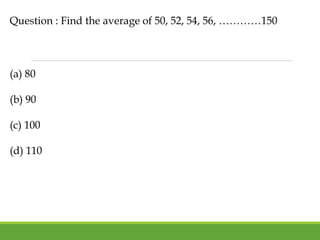
Question : Find the average of 50, 52, 54, 56, …………150
(a) 80
(b) 90
(c) 100
(d) 110
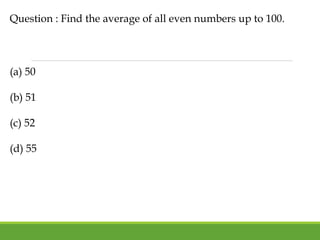
Question : Find the average of all even numbers up to 100.
(a) 50
(b) 51
(c) 52
(d) 55
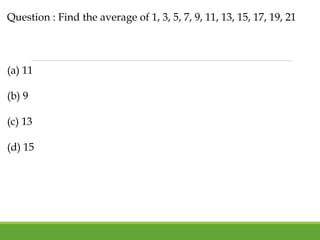
Question : Find the average of 1, 3, 5, 7, 9, 11, 13, 15, 17, 19, 21
(a) 11
(b) 9
(c) 13
(d) 15
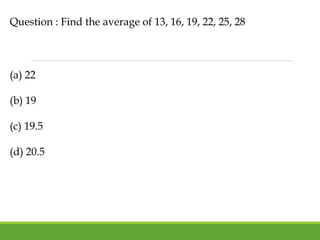
Question : Find the average of 13, 16, 19, 22, 25, 28
(a) 22
(b) 19
(c) 19.5
(d) 20.5
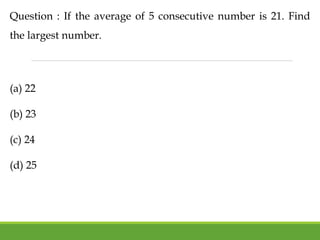
Question : If the average of 5 consecutive number is 21. Find
the largest number.
(a) 22
(b) 23
(c) 24
(d) 25
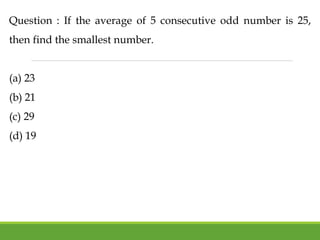
Question : If the average of 5 consecutive odd number is 25,
then find the smallest number.
(a) 23
(b) 21
(c) 29
(d) 19
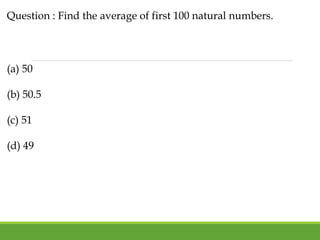
Question : Find the average of first 100 natural numbers.
(a) 50
(b) 50.5
(c) 51
(d) 49
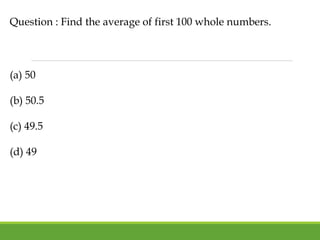
Question : Find the average of first 100 whole numbers.
(a) 50
(b) 50.5
(c) 49.5
(d) 49
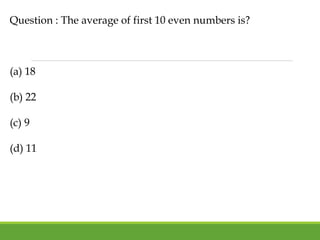
Question : The average of first 10 even numbers is?
(a) 18
(b) 22
(c) 9
(d) 11
Question : Find the average of first 17 multiples of 5?
(a) 50
(b) 85
(c) 45
(d) 60
COMBINED AVERAGE
Class A
0
Class B
100
What is the combined average?
50 marks??
NO
We cannot determine the average without knowing the number
of students in each class
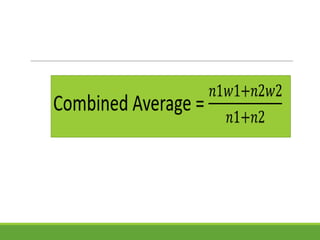
The combined average depends on the number of students and
the average in each class
Question : There are 36 students in a class A whose average
weight is 30kg and 24 students in class B whose average is
40kg. What will be the average if the classes are combined?
(a) 35
(b) 34
(c) 36
(d) 32
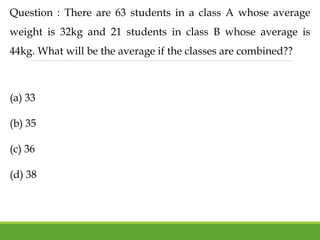
Question : There are 63 students in a class A whose average
weight is 32kg and 21 students in class B whose average is
44kg. What will be the average if the classes are combined??
(a) 33
(b) 35
(c) 36
(d) 38
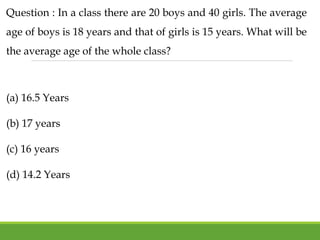
Question : In a class there are 20 boys and 40 girls. The average
age of boys is 18 years and that of girls is 15 years. What will be
the average age of the whole class?
(a) 16.5 Years
(b) 17 years
(c) 16 years
(d) 14.2 Years
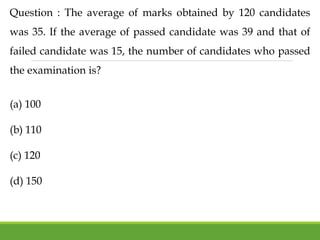
Question : The average of marks obtained by 120 candidates
was 35. If the average of passed candidate was 39 and that of
failed candidate was 15, the number of candidates who passed
the examination is?
(a) 100
(b) 110
(c) 120
(d) 150
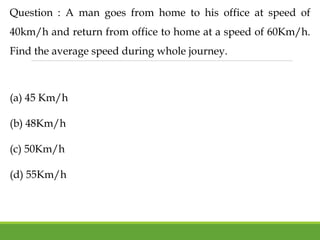
Question : A man goes from home to his office at speed of
40km/h and return from office to home at a speed of 60Km/h.
Find the average speed during whole journey.
(a) 45 Km/h
(b) 48Km/h
(c) 50Km/h
(d) 55Km/h
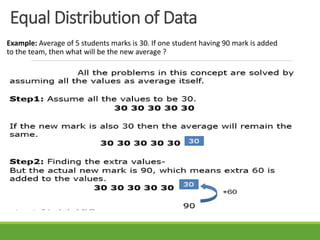
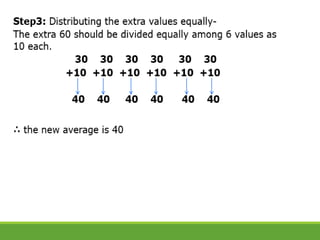
Equal Distribution of Data
Example: Average of 5 students marks is 30. If one student having 90 mark is added
to the team, then what will be the new average ?
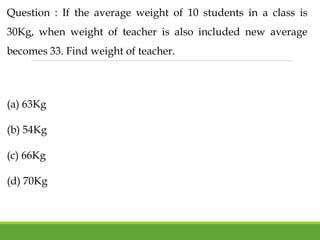
Question : If the average weight of 10 students in a class is
30Kg, when weight of teacher is also included new average
becomes 33. Find weight of teacher.
(a) 63Kg
(b) 54Kg
(c) 66Kg
(d) 70Kg
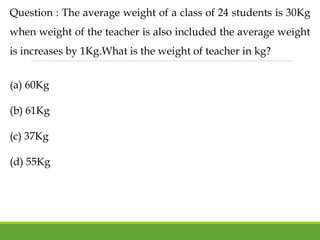
Question : The average weight of a class of 24 students is 30Kg
when weight of the teacher is also included the average weight
is increases by 1Kg.What is the weight of teacher in kg?
(a) 60Kg
(b) 61Kg
(c) 37Kg
(d) 55Kg
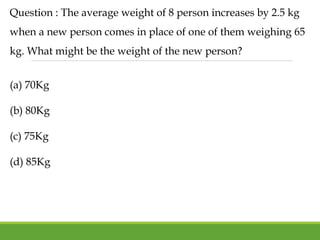
Question : The average weight of 8 person increases by 2.5 kg
when a new person comes in place of one of them weighing 65
kg. What might be the weight of the new person?
(a) 70Kg
(b) 80Kg
(c) 75Kg
(d) 85Kg
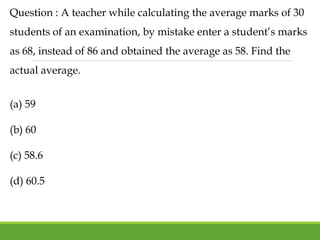
Question : A teacher while calculating the average marks of 30
students of an examination, by mistake enter a student’s marks
as 68, instead of 86 and obtained the average as 58. Find the
actual average.
(a) 59
(b) 60
(c) 58.6
(d) 60.5
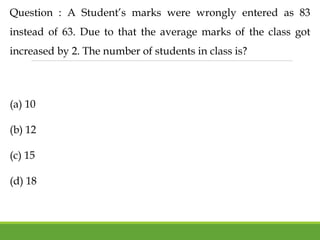
Question : A Student’s marks were wrongly entered as 83
instead of 63. Due to that the average marks of the class got
increased by 2. The number of students in class is?
(a) 10
(b) 12
(c) 15
(d) 18
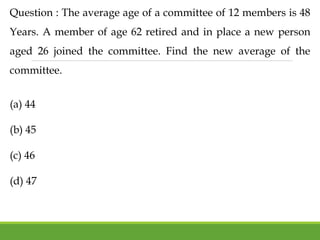
Question : The average age of a committee of 12 members is 48
Years. A member of age 62 retired and in place a new person
aged 26 joined the committee. Find the new average of the
committee.
(a) 44
(b) 45
(c) 46
(d) 47
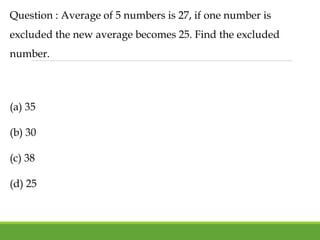
Question : Average of 5 numbers is 27, if one number is
excluded the new average becomes 25. Find the excluded
number.
(a) 35
(b) 30
(c) 38
(d) 25
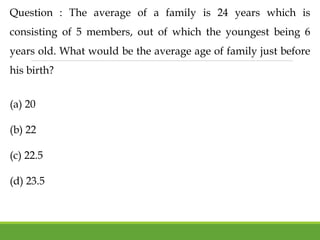
Question : The average of a family is 24 years which is
consisting of 5 members, out of which the youngest being 6
years old. What would be the average age of family just before
his birth?
(a) 20
(b) 22
(c) 22.5
(d) 23.5
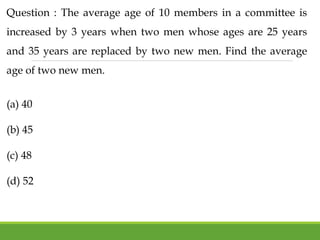
Question : The average age of 10 members in a committee is
increased by 3 years when two men whose ages are 25 years
and 35 years are replaced by two new men. Find the average
age of two new men.
(a) 40
(b) 45
(c) 48
(d) 52
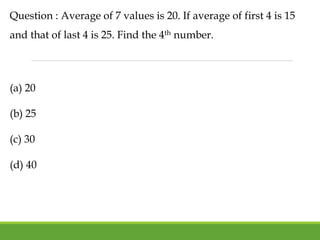
Question : Average of 7 values is 20. If average of first 4 is 15
and that of last 4 is 25. Find the 4th number.
(a) 20
(b) 25
(c) 30
(d) 40
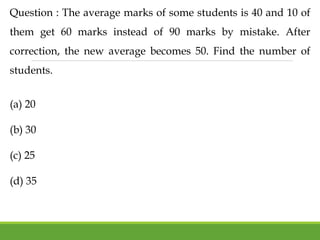
Question : The average marks of some students is 40 and 10 of
them get 60 marks instead of 90 marks by mistake. After
correction, the new average becomes 50. Find the number of
students.
(a) 20
(b) 30
(c) 25
(d) 35
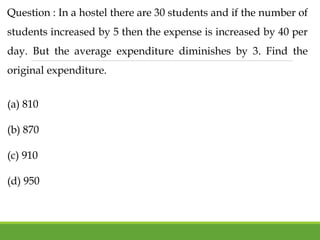
Question : In a hostel there are 30 students and if the number of
students increased by 5 then the expense is increased by 40 per
day. But the average expenditure diminishes by 3. Find the
original expenditure.
(a) 810
(b) 870
(c) 910
(d) 950
Question : A batsman has a certain average of runs for 16
innings, In the 17th inning, he makes a score of 85 runs there by
increasing the average by 3 What is the average of 17 innings?
(a) 38
(b) 37
(c) 36
(d) 34
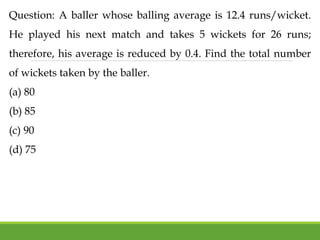
Question: A baller whose balling average is 12.4 runs/wicket.
He played his next match and takes 5 wickets for 26 runs;
therefore, his average is reduced by 0.4. Find the total number
of wickets taken by the baller.
(a) 80
(b) 85
(c) 90
(d) 75
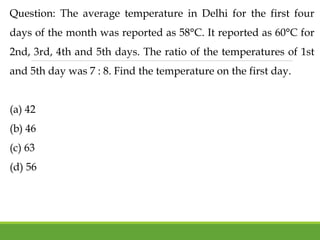
Question: The average temperature in Delhi for the first four
days of the month was reported as 58°C. It reported as 60°C for
2nd, 3rd, 4th and 5th days. The ratio of the temperatures of 1st
and 5th day was 7 : 8. Find the temperature on the first day.
(a) 42
(b) 46
(c) 63
(d) 56
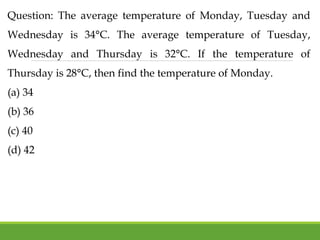
Question: The average temperature of Monday, Tuesday and
Wednesday is 34°C. The average temperature of Tuesday,
Wednesday and Thursday is 32°C. If the temperature of
Thursday is 28°C, then find the temperature of Monday.
(a) 34
(b) 36
(c) 40
(d) 42
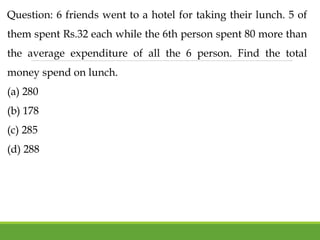
Question: 6 friends went to a hotel for taking their lunch. 5 of
them spent Rs.32 each while the 6th person spent 80 more than
the average expenditure of all the 6 person. Find the total
money spend on lunch.
(a) 280
(b) 178
(c) 285
(d) 288
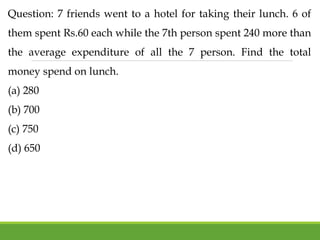
Question: 7 friends went to a hotel for taking their lunch. 6 of
them spent Rs.60 each while the 7th person spent 240 more than
the average expenditure of all the 7 person. Find the total
money spend on lunch.
(a) 280
(b) 700
(c) 750
(d) 650
Percentage
Concept to discuss
1. Conversion of percentage to fraction and vice versa
2. X % of Y = Y% of X
3. Percentage change
4. Percentage Increase and decrease concept
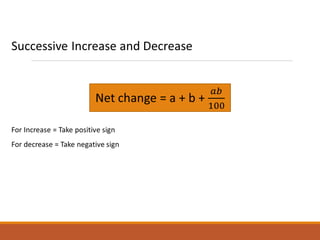
5. Successive increase and decrease
6. Consumption and Expenditure
7. Examination , election and population
Percentage: Per means divided and cent means 100.
To convert any value on the base of hundred.
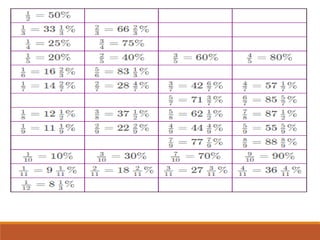
Conversion of percentage to fraction: To convert percentage to fraction,
divide that percent value by 100.
E.G. 50% = 50/100 = ½
25% = 25/100 = ¼
Conversion of fraction to percentage: To convert fraction to percentage
multiply the fraction by 100.
For e.g. 3/8 = (3/8)*100 = 37.5 %
Question : Find 55.55 % of 45.
Question : Find 45.45 % of 44
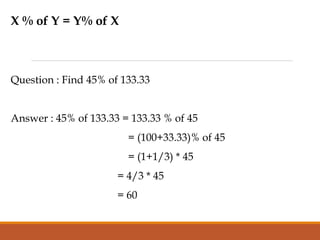
X % of Y = Y% of X
Question : Find 45% of 133.33
Answer : 45% of 133.33 = 133.33 % of 45
= (100+33.33)% of 45
= (1+1/3) * 45
= 4/3 * 45
= 60
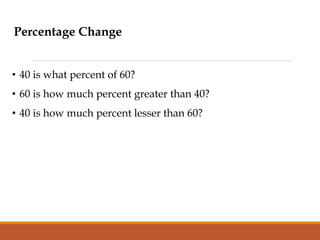
Percentage Change
• 40 is what percent of 60?
• 60 is how much percent greater than 40?
• 40 is how much percent lesser than 60?
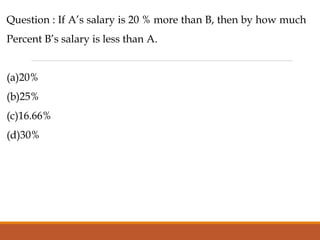
Question : If A’s salary is 20 % more than B, then by how much
Percent B’s salary is less than A.
(a)20%
(b)25%
(c)16.66%
(d)30%
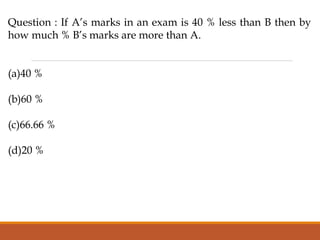
Question : If A’s marks in an exam is 40 % less than B then by
how much % B’s marks are more than A.
(a)40 %
(b)60 %
(c)66.66 %
(d)20 %
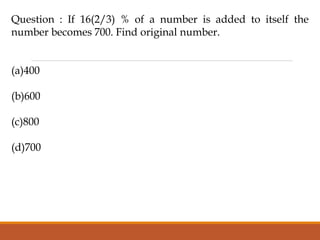
Question : If 16(2/3) % of a number is added to itself the
number becomes 700. Find original number.
(a)400
(b)600
(c)800
(d)700
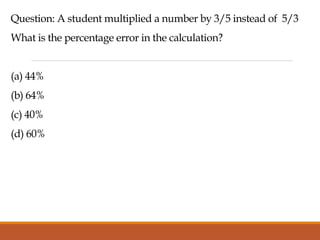
Question: A student multiplied a number by 3/5 instead of 5/3
What is the percentage error in the calculation?
(a) 44%
(b) 64%
(c) 40%
(d) 60%
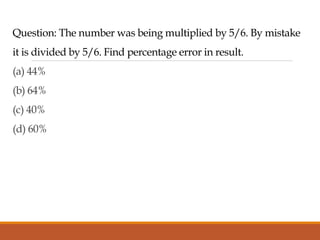
Question: The number was being multiplied by 5/6. By mistake
it is divided by 5/6. Find percentage error in result.
(a) 44%
(b) 64%
(c) 40%
(d) 60%
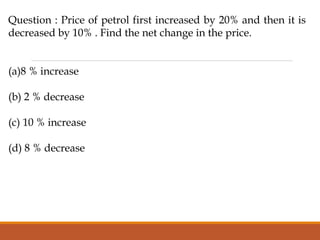
Question : Price of petrol first increased by 20% and then it is
decreased by 10% . Find the net change in the price.
(a)8 % increase
(b) 2 % decrease
(c) 10 % increase
(d) 8 % decrease
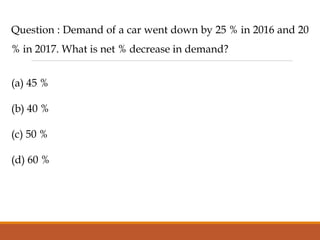
Question : Demand of a car went down by 25 % in 2016 and 20
% in 2017. What is net % decrease in demand?
(a) 45 %
(b) 40 %
(c) 50 %
(d) 60 %
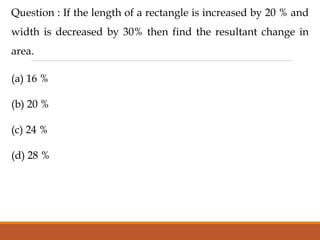
Question : If the length of a rectangle is increased by 20 % and
width is decreased by 30% then find the resultant change in
area.
(a) 16 %
(b) 20 %
(c) 24 %
(d) 28 %
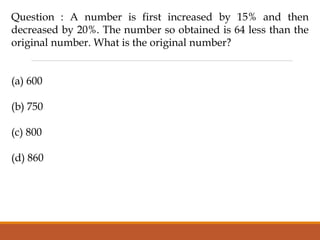
Question : A number is first increased by 15% and then
decreased by 20%. The number so obtained is 64 less than the
original number. What is the original number?
(a) 600
(b) 750
(c) 800
(d) 860
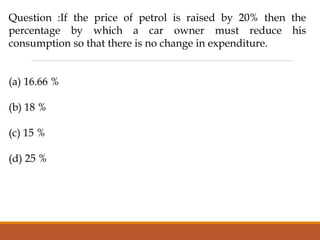
Question :If the price of petrol is raised by 20% then the
percentage by which a car owner must reduce his
consumption so that there is no change in expenditure.
(a) 16.66 %
(b) 18 %
(c) 15 %
(d) 25 %
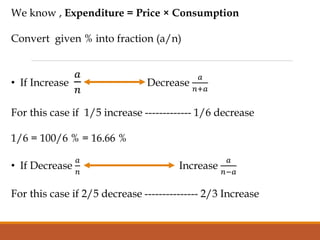
We know , Expenditure = Price × Consumption
Convert given % into fraction (a/n)
• If Increase
𝑎
𝑛
Decrease
𝑎
𝑛+𝑎
For this case if 1/5 increase ------------- 1/6 decrease
1/6 = 100/6 % = 16.66 %
• If Decrease
𝑎
𝑛
Increase
𝑎
𝑛−𝑎
For this case if 2/5 decrease --------------- 2/3 Increase
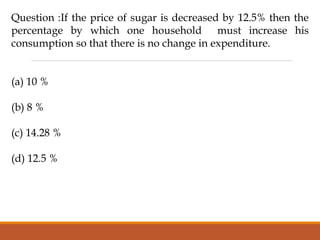
Question :If the price of sugar is decreased by 12.5% then the
percentage by which one household must increase his
consumption so that there is no change in expenditure.
(a) 10 %
(b) 8 %
(c) 14.28 %
(d) 12.5 %
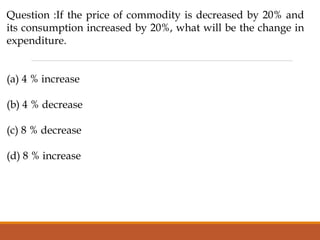
Question :If the price of commodity is decreased by 20% and
its consumption increased by 20%, what will be the change in
expenditure.
(a) 4 % increase
(b) 4 % decrease
(c) 8 % decrease
(d) 8 % increase
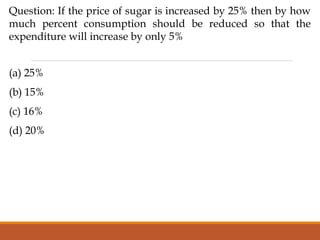
Question: If the price of sugar is increased by 25% then by how
much percent consumption should be reduced so that the
expenditure will increase by only 5%
(a) 25%
(b) 15%
(c) 16%
(d) 20%
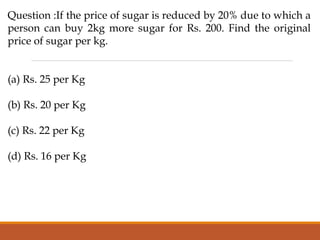
Question :If the price of sugar is reduced by 20% due to which a
person can buy 2kg more sugar for Rs. 200. Find the original
price of sugar per kg.
(a) Rs. 25 per Kg
(b) Rs. 20 per Kg
(c) Rs. 22 per Kg
(d) Rs. 16 per Kg
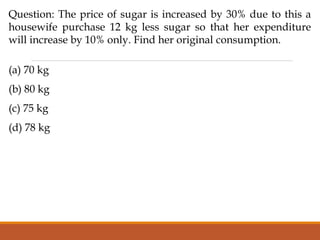
Question: The price of sugar is increased by 30% due to this a
housewife purchase 12 kg less sugar so that her expenditure
will increase by 10% only. Find her original consumption.
(a) 70 kg
(b) 80 kg
(c) 75 kg
(d) 78 kg
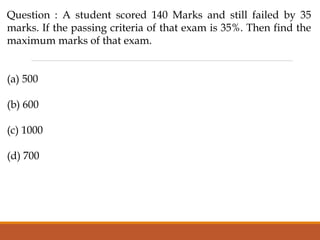
Question : A student scored 140 Marks and still failed by 35
marks. If the passing criteria of that exam is 35%. Then find the
maximum marks of that exam.
(a) 500
(b) 600
(c) 1000
(d) 700
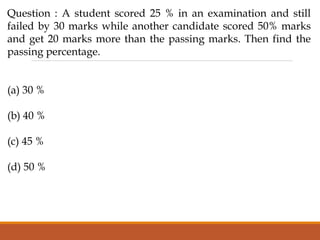
Question : A student scored 25 % in an examination and still
failed by 30 marks while another candidate scored 50% marks
and get 20 marks more than the passing marks. Then find the
passing percentage.
(a) 30 %
(b) 40 %
(c) 45 %
(d) 50 %
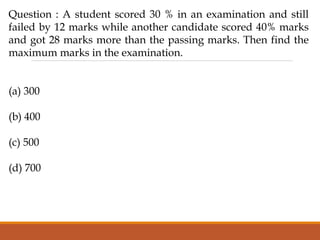
Question : A student scored 30 % in an examination and still
failed by 12 marks while another candidate scored 40% marks
and got 28 marks more than the passing marks. Then find the
maximum marks in the examination.
(a) 300
(b) 400
(c) 500
(d) 700
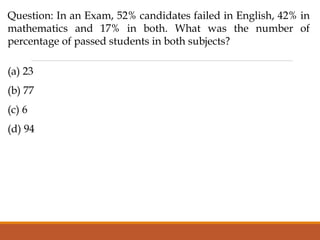
Question: In an Exam, 52% candidates failed in English, 42% in
mathematics and 17% in both. What was the number of
percentage of passed students in both subjects?
(a) 23
(b) 77
(c) 6
(d) 94
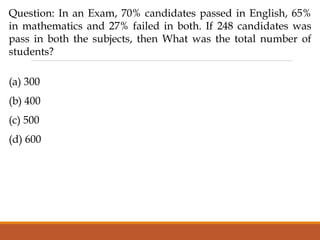
Question: In an Exam, 70% candidates passed in English, 65%
in mathematics and 27% failed in both. If 248 candidates was
pass in both the subjects, then What was the total number of
students?
(a) 300
(b) 400
(c) 500
(d) 600
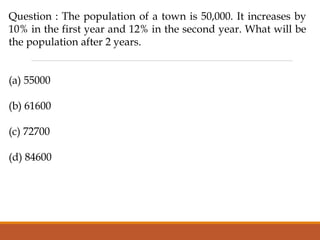
Question : The population of a town is 50,000. It increases by
10% in the first year and 12% in the second year. What will be
the population after 2 years.
(a) 55000
(b) 61600
(c) 72700
(d) 84600
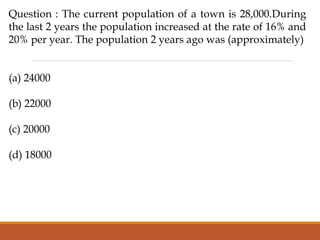
Question : The current population of a town is 28,000.During
the last 2 years the population increased at the rate of 16% and
20% per year. The population 2 years ago was (approximately)
(a) 24000
(b) 22000
(c) 20000
(d) 18000
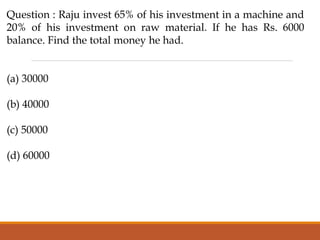
Question : Raju invest 65% of his investment in a machine and
20% of his investment on raw material. If he has Rs. 6000
balance. Find the total money he had.
(a) 30000
(b) 40000
(c) 50000
(d) 60000
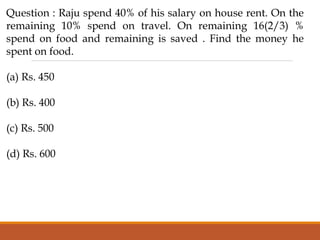
Question : Raju spend 40% of his salary on house rent. On the
remaining 10% spend on travel. On remaining 16(2/3) %
spend on food and remaining is saved . Find the money he
spent on food.
(a) Rs. 450
(b) Rs. 400
(c) Rs. 500
(d) Rs. 600
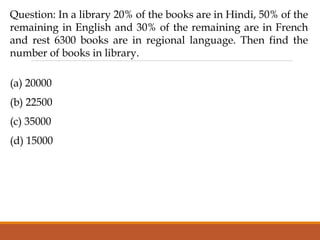
Question: In a library 20% of the books are in Hindi, 50% of the
remaining in English and 30% of the remaining are in French
and rest 6300 books are in regional language. Then find the
number of books in library.
(a) 20000
(b) 22500
(c) 35000
(d) 15000
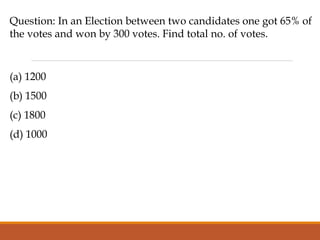
Question: In an Election between two candidates one got 65% of
the votes and won by 300 votes. Find total no. of votes.
(a) 1200
(b) 1500
(c) 1800
(d) 1000
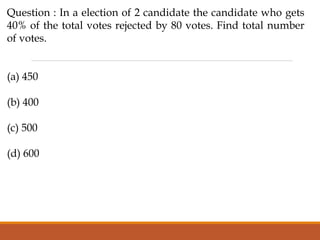
Question : In a election of 2 candidate the candidate who gets
40% of the total votes rejected by 80 votes. Find total number
of votes.
(a) 450
(b) 400
(c) 500
(d) 600
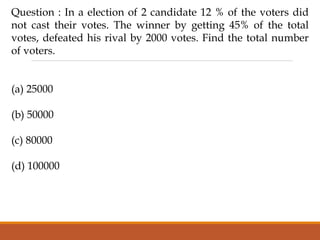
Question : In a election of 2 candidate 12 % of the voters did
not cast their votes. The winner by getting 45% of the total
votes, defeated his rival by 2000 votes. Find the total number
of voters.
(a) 25000
(b) 50000
(c) 80000
(d) 100000
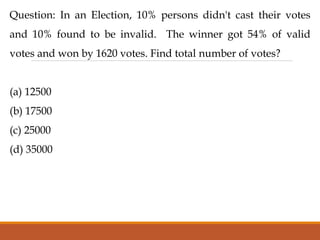
Question: In an Election, 10% persons didn't cast their votes
and 10% found to be invalid. The winner got 54% of valid
votes and won by 1620 votes. Find total number of votes?
(a) 12500
(b) 17500
(c) 25000
(d) 35000
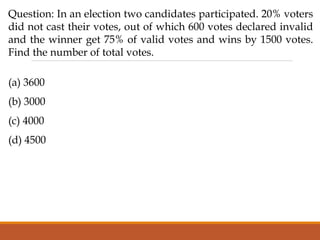
Question: In an election two candidates participated. 20% voters
did not cast their votes, out of which 600 votes declared invalid
and the winner get 75% of valid votes and wins by 1500 votes.
Find the number of total votes.
(a) 3600
(b) 3000
(c) 4000
(d) 4500
Profit and Loss
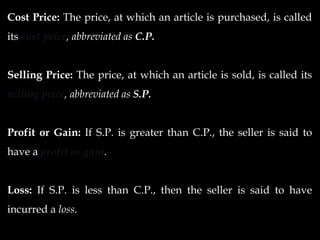
Cost Price: The price, at which an article is purchased, is called
its cost price, abbreviated as C.P.
Selling Price: The price, at which an article is sold, is called its
selling price, abbreviated as S.P.
Profit or Gain: If S.P. is greater than C.P., the seller is said to
have a profit or gain.
Loss: If S.P. is less than C.P., then the seller is said to have
incurred a loss.
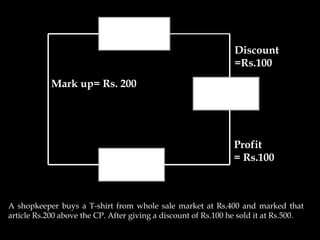
MP= Rs. 600
CP= Rs.400
SP= Rs.500
Mark up= Rs. 200
Discount
=Rs.100
Profit
= Rs.100
A shopkeeper buys a T-shirt from whole sale market at Rs.400 and marked that
article Rs.200 above the CP. After giving a discount of Rs.100 he sold it at Rs.500.
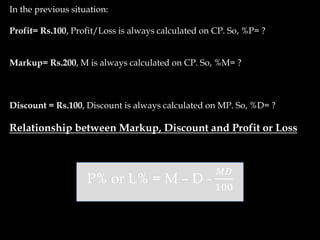
In the previous situation:
Profit= Rs.100, Profit/Loss is always calculated on CP. So, %P= ?
Markup= Rs.200, M is always calculated on CP. So, %M= ?
Discount = Rs.100, Discount is always calculated on MP. So, %D= ?
Relationship between Markup, Discount and Profit or Loss
P% or L% = M – D -
𝑀𝐷
100
Questions: A TV is purchased at Rs. 5000 and sold at Rs. 4000,
find the lost percent.
[A] 10%
[B] 20%
[C] 25%
[D] 28%
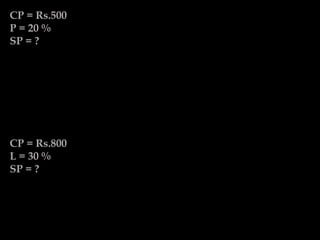
CP = Rs.500
P = 20 %
SP = ?
CP = Rs.800
L = 30 %
SP = ?
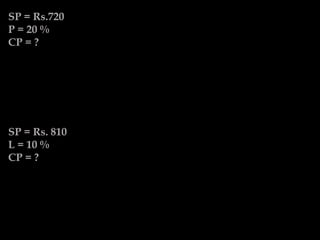
SP = Rs.720
P = 20 %
CP = ?
SP = Rs. 810
L = 10 %
CP = ?
Questions: When a plot is sold for Rs. 18,700, the owner loses
15%. At what price must that plot be sold in order to gain 15%?
[A] Rs.21000
[B] Rs.22500
[C] Rs.25300
[D] Rs.25800
Questions: Alfred buys an old scooter for Rs. 4700 and spends
Rs. 800 on its repairs. If he sells the scooter for Rs. 5800, his gain
percent is
[A] 6/19%
[B] 6/11%
[C] 60/11%
[D] 38/11%
Question: If CP of 25 articles is equal to SP of 20
articles. Find the profit or loss percent.
[A] 25% loss
[B] 25% profit
[C] 20 % profit
[D] 20 % loss
Question: If CP of 30 articles is equal to SP of 45
articles. Find the profit or loss percent.
[A] 33.33 % loss
[B] 33.33 profit
[C] 20 % loss
[D] 20 % profit
Question: By selling 12 articles a man earn a loss of
which is equal to selling price of 4 articles. Find his
loss percent.
[A] 20 %
[B] 25%
[C] 33.33%
[D] 16.66 %
Question: By selling 66m cloths a man earn a profit of
equal to selling price of 6m cloths. Find his profit
percent.
[A] 20 %
[B] 25 %
[C] 10%
[D] 33.33%
Question: By selling 40 articles a man earn a profit of
equal to cost price of 5 articles. Find his loss or profit
percent.
[A] 33.33 % profit
[B] 12.5 % loss
[C] 25 % loss
[D] 12.5 % profit
Question: A shopkeeper buy some number of article at the
rate of 11 articles for Rs.10 and sold all of them at the rate
of 10 articles for Rs.11. Find his profit or loss percent.
[A] 20 % profit
[B] 21% profit
[C] 25 % loss
[D] 21 % loss
Question: A shopkeeper buy some number of article at the
rate of 12 articles for Rs.15 and sold all of them at the rate
of 10 articles for Rs.14. Find his profit or loss percent.
[A] 20 % loss
[B] 33.33 % profit
[C] 12 % profit
[D] 12.5 % loss
Question: A Shopkeeper buy some lemons at rate of 2 for Rs.1.
Again he bought the some number of lemons at rate of 1 for
Rs.2. He mixed both the types and sold at 3 for Rs.3. find profit
/ loss %.
[A] 20 % loss
[B] 25 % loss
[C] 20 % profit
[D] 25 % profit
Question: A shopkeeper purchase some number of article
for Rs.8400. He sold 3/5th of them at 15 % profit each. At
what percent profit should he sell the remaining to gain
overall 20 % profit.
[A] 26%
[B] 27%
[C] 27.5%
[D] None
Question: A shopkeeper purchase some number of article
for Rs.5520. He sold 5/7th of them at 14 % profit each. At
what percent profit should he sell the remaining to gain
overall 18 % profit.
[A] 20%
[B] 25%
[C] 33.33%
[D] 28%
Question: A shopkeeper purchase some number of article
for Rs.4500. He sold 1/3rd of them at 10 % loss each. At
what percent profit should he sell the remaining to gain
overall 20 % profit.
[A] 30%
[B] 25%
[C] 35%
[D] None
Question: A shopkeeper professes to sell his goods at
its CP, But he uses 950 gm. In place of 1 kg. Find his
profit percent.
[A] 12.5 %
[B] 5%
[C] 5.26%
[D] 4%
Question: A shopkeeper professes to sell his goods at
its CP, But he uses 800 gm. In place of 1 kg. Find his
profit percent.
[A] 25%
[B] 20%
[C] 33.33%
[D] 40%
Question: A shopkeeper professes to sell his goods at
10% profit, But he uses 20% less weight. Find his total
profit percent.
[A] 37.5%
[B] 45%
[C] 25%
[D] 20%
Question: A shopkeeper professes to sell his goods at
44% loss, But he uses 30% less weight. Find his profit
or loss percent.
[A] 20% profit
[B] 25% profit
[C] 25% loss
[D] 20% loss
Question: A shopkeeper selling his goods at 7% loss.
Had he sold it for Rs.800 more then he would get 9%
profit. Find the CP of that article.
[A] 500
[B] 6000
[C] 5000
[D] 4500
Question: A shopkeeper selling his goods at 20% profit.
Had he purchase it 10% less and sold it for Rs.18 less then
he would get 30% profit. Find the initial CP of that article.
[A] 540
[B] 600
[C] 1200
[D] 720
Question: A shopkeeper selling his goods at 10% profit.
Had he purchase it 20% less and sold it for Rs.20 more
then he would get 40% profit. Find the initial SP of that
article.
[A] 1000
[B] 2000
[C] 1100
[D] 720
Question: A shopkeeper selling his goods at 30% profit.
Had he purchase it for Rs.2700 less and sold it for Rs.2700
less then he would get 10% more profit. Find the initial CP
of that article.
[A] 10000
[B] 10800
[C] 12500
[D] None
Question: A shopkeeper sold an article at 25% profit. If the
CP and SP are decreased by Rs.20 and Rs.40 respectively
then the profit percent would be decreased by 15 %. Find
CP of the articles.
[A] 120
[B] 200
[C] 180
[D] 240
Question: A man purchase some number of articles at
the rate of 11 articles for Rs.1. How many articles
should he sell for Rs.1 to gain 10% profit.
[A] 11
[B] 10
[C] 12
[D] 14
Question: A man purchase 25 articles for Rs.1. How
many articles should he sell for Rs.1 to gain 25%
profit.
[A] 21
[B] 28
[C] 20
[D] None
Question: By selling 32 articles for Rs.1 a man earn loss
of 40 %. How many articles should he sell for Rs.1 to
gain 20% profit.
[A] 16
[B] 17
[C] 18
[D] 19
Question: By selling 45 articles for Rs.40 a man earn
loss of 20 %. How many articles should he sell for
Rs.24 to gain 20% profit.
[A] 20
[B] 27
[C] 18
[D] None
Question: A shopkeeper purchase 2 articles for
Rs.9600. He sold the first article at 20% loss and
second article at 60% profit then he find that both the
articles being sold on the same price. Find the CP of
first article.
[A] 6400
[B] 3200
[C] 6000
[D] 5400
Question: A shopkeeper sells 2 articles. He sold the first
article at 15% loss and second article at 19% profit. During the
whole transaction he earn a loss of Rs90. Find the CP of second
article if the SP of both articles are same.
[A] 5000
[B] 4500
[C] 2000
[D] None
Question: A shopkeeper sells 3 articles. He sold the first article
at 20% profit, second article at 10% loss and third at 25% loss.
During the whole transaction he earn a loss of Rs60. Find the SP
of first article if the SP of all the articles are same.
[A] 216
[B] 180
[C] 240
[D] None
Problems on Discount:
Questions: A bag marked at Rs80 is sold for Rs68. The rate of
discount is:
[A] 20%
[B] 15%
[C] 17 (11/17)%
[D] 12%
Questions: An item was sold at a price after giving two
successive discount of 30% and 50 %. If the selling price of the
item was Rs 448, then what was the marked price of the item?
[A] 840
[B] 1280
[C] 1140
[D] none of these
Questions: If after giving a discount of 12%, a profit of 10% was
made on an article, then by what % was the price marked up?
[A] 20%
[B] 25%
[C] 32.5%
[D] 35%
Questions: The cost price of a table is Rs 330. It is sold for a
profit of Rs 30 after giving 10% discount find its marked price
[A] Rs.400
[B] Rs.380
[C] Rs.420
[D] None
Questions: A sold a table to B at a profit of 15%. Later on, B sold
it back to A at a profit of 20%, thereby gaining Rs. 69. How
much did A pay for the table originally?
[A] Rs.300
[B] Rs.320
[C] Rs.345
[D] Rs.350
Question: Buy 5 articles get 3 articles free. Find
discount percent.
[A] 33.33%
[B] 12.5%
[C] 37.5%
[D] 60%
Question: Buy 2 articles get 1 article free. Find
discount percent.
[A] 50%
[B] 33.33%
[C] 20%
[D] 25%
Question: A retailer purchase 70 pens at the mark price of
56 pens and sell them to a customer at their MP. Find the
profit percent of shopkeeper.
[A] 25%
[B] 20%
[C] 33.33%
[D] 16.66%
Question: A retailer purchase 40 pens at the mark
price of 36 pens and sell them at a discount of 1 %.
Find the profit percent of shopkeeper.
[A] 20%
[B] 15%
[C] 10%
[D] None
Question: By how much percent a shopkeeper should
mark his goods above its CP so that he will gain 10%
profit after giving 30% discount.
[A] 200/7%
[B] 400/7%
[C] 100%
[D] None
Question: By how much percent a shopkeeper should
mark his goods above its CP so that he will gain 10%
profit after giving 10% discount.
[A] 200/9 %
[B] 110/9 %
[C] 100/9 %
[D] None
Question: A shopkeeper gives 10% discount on an
article and earn 20% profit then find his profit percent
if he will give 20% discount on the same article.
[A] 16.66%
[B] 5.66%
[C] 6.66%
[D] None
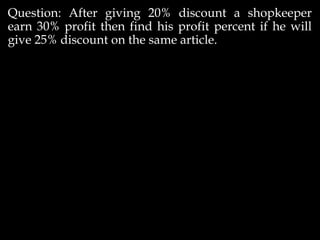
Question: After giving 20% discount a shopkeeper
earn 30% profit then find his profit percent if he will
give 25% discount on the same article.
Question: A shopkeeper give 1 article free of every
purchase of 15 article and also gives a discount of 4 % and
after all that his profit percent is 35%. Find CP:MP.
[A] 3:2
[B] 4:5
[C] 3:4
[D] 2:3
Question: A shopkeeper give 4 articles free of every
purchase of 12 articles and also gives a discount of 20 %
and after all that his profit percent is 20%. Find CP:MP.
[A] 1:2
[B] 2:1
[C] 5:7
[D] 3:2
Simple Interest
and Compound
Interest
Principal
The money borrowed or lent out for a certain period is called
the principal or the sum.
Interest
Extra money paid for using other's money is called interest.
Simple Interest
If the interest on a sum borrowed for certain period is reckoned
uniformly, then it is called simple interest.
If P= Rs.1000, R=10% p.a. T=3 years. Find Simple Interest for 3
years.
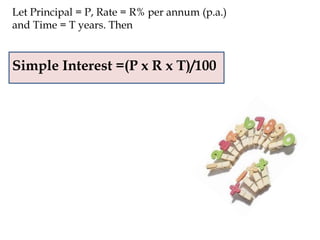
Let Principal = P, Rate = R% per annum (p.a.)
and Time = T years. Then
Simple Interest =(P x R x T)/100
Question: Reena took a loan of Rs. 1200 with simple interest for
as many years as the rate of interest. If she paid Rs. 432 as
interest at the end of the loan period, what was the rate of
interest?
[A] 3.6
[B] 6
[C] 18
[D] Can not be determined
Question: A man took loan from a bank at the rate of 12% p.a.
simple interest. After 3 years he had to pay Rs. 5400 interest
only for the period. The principal amount borrowed by him
was:
[A] Rs.2000
[B] Rs.10000
[C] Rs.15000
[D] Rs.20000
Question: How much time will it take for an amount of Rs. 450
to yield Rs. 81 as interest at 4.5% per annum of simple interest?
[A] 3.5 years
[B] 4 years
[C] 4.5 years
[D] 5 years
Question: The interest for the 3rd year on a certain sum at a
certain rate of simple interest is Rs.3000. find the sum of the
interests accrued on it in the 6th, 7th and 8th years.
[A] Rs.6000
[B] Rs.9000
[C] Rs.4500
[D] Rs.12000
Question: A sum was invest for 2 years. It will give Rs. 300
more, if invested at 3% higher rate. Find the sum.
[A] Rs.4000
[B] Rs.5000
[C] Rs.6000
[D] Rs.10000
Question: A sum amounts to Rs.1008 in 2 years and amounts to
Rs.1112 in 3 years at SI. Find the sum and rate of interest per
annum.
[A] Rs.800, 13% pa
[B] Rs.600, 12 % pa
[C] Rs.800, 12% pa
[D] Rs.600, 13% pa
Question: S.I. On Rs 400 for 5 years together with that on Rs.
600, for 4 year to Rs. 132. If the Rate is same in both the case.
Find rate % of interest?
[A] 2% pa
[B] 3% pa
[C] 5% pa
[D] 8% pa
Question: A shopkeeper borrow Rs. 20,000 from two money
lenders. For one loan, he paid 12% pa and for other 14% pa.
After one year he paid Rs. 2560 as total interest. How much did
he borrow each?
[A] Rs.8000, Rs.12000
[B] Rs.12000, Rs.8000
[C] Rs.6000, Rs.14000
[D] Rs.14000, Rs.6000
Question: Rs. 1500 is invested in two such parts that if one part
be invested at 6% and other at 5%, S.I= Rs. 85 for one year.
Then how much was invested at 5%?
[A] Rs.1000
[B] Rs.500
[C] Rs.600
[D] Rs.800
Question: Rs. 8400 is invested in two such parts that if one part
be invested at 8% and remaining at 𝟔 𝟑
𝟐
% pa, his total interest
after one and half year was Rs. 882. Then how much invested at
different rates?
[A] Rs.6300, Rs.2100
[B] Rs.6000, Rs.2400
[C] Rs.2400, Rs.6000
[D] Rs.2100, Rs.6300
Question: Rs. 950 is lend in two ways. The rate of S.I given on
one part is 6% and on other part is 4%. If the S.I of 5 years is Rs.
200 then how much is given on 6%?
[A] Rs.500
[B] Rs.400
[C] Rs.200
[D] Rs.100
Question: If a sum of money at simple interest doubles in 6
years, it will become 4 times in:
[A] 12 years
[B] 14 years
[C] 16 years
[D] 18 years
Question: If a sum of money at simple interest doubles in 8
years, it will become 4 times in:
[A] 16 years
[B] 24 years
[C] 64 years
[D] 32 years
Question: Find the present value (in Rs.) of Rs.3000 due after 5
years at 10% p.a. simple interest.
[A] Rs.1500
[B] Rs.1800
[C] Rs.2000
[D] Rs.2500
Compound interest
If P= Rs.1000, R=10% p.a. T=3 years. Find Compound Interest
for 3 years.
Compound Interest:
Compound interest is the interest earned not only on the original principal,
but also on all interests earned previously
Let Principal = P, Rate = R% per annum, Time = n years.
1. When interest is compounded Annually:
Amount= P(1+R/100)^n
2. When interest is compounded Half-yearly:
Amount=P[1+(R/2)/100]^2n
3. When interest is compounded Quarterly:
Amount=P[1+(R/4)/100]^4n
Question: Find the compound interest earned on Rs.20000 for 2
years at 10% p.a. the interest being compounded annually.
[A] Rs.2100
[B] Rs.4200
[C] Rs.6300
[D] Rs.5600
Question: Find the interest earned in the first year on Rs.400 at
20%p.a. compound interest, the interest being compounded
half yearly.
[A] Rs.42
[B] Rs.72
[C] Rs.84
[D] Rs.144
Question: Find CI. If P= Rs. 10000, r = 10 % p.a. and T= 1 year
and 73 days.
[A] Rs.2220
[B] Rs.3200
[C] Rs.2120
[D] Rs.1220
Question: Find CI. If P= Rs. 10000, r = 10 % p.a. and
T= 𝟐 𝟓
𝟑
year.
[A] Rs.2226
[B] Rs.826
[C] Rs.2628
[D] Rs.2826
Question: Find C.I. on Rs. 8000, 20% P.A. For 9 month
compounded quarterly.
[A] Rs.262
[B] Rs.1261
[C] Rs.9261
[D] Rs.831
Question: If Rs.2000 amounts to Rs.2880 in 2 years at
compound interest, what is the rate of interest per annum if the
interest is being compounded annually?
[A] 10%
[B] 20%
[C] 15%
[D] 25%
Question: What will be the difference between the S.I and C.I.
On Rs. 600 for one year at 10% P.A, if compounded half yearly.
[A] Rs.1.5
[B] Rs.15
[C] Rs.3.5
[D] Rs.35
Question: A sum of money lent at C.I. For two years at 20% pa
give Rs. 723 more if the interest was half year in place of
annually. The sum is.
[A] 30000
[B] 60000
[C] 40000
[D] 20000
Question: If the S.I of certain money for 3 years is Rs. 225 & C.I
on same money, same rate for 2 years is Rs. 153. then what was
the principal amount?
[A] Rs.875
[B] Rs.1875
[C] Rs.785
[D] Rs.1785
Question: If the difference between S.I and C.I at 4% P.A for 2
years is 20 Rs. What will be the value of principle amount?
[A] Rs.50000
[B] Rs.12000
[C] Rs.12500
[D] Rs.25000
Question: The difference between C.I and S.I at the some rate
for Rs. 5000 for 2 years is Rs. 72. what is the rate of interest per
annum?
[A] 6% pa
[B] 10% pa
[C] 12% pa
[D] 15% pa
Question: Divide Rs. 6100 between A & B, so that A’s share at
the end of 3 year = B’s share at end of 5 year. C.I. Rate =20% pa.
[A] 3600, 2500
[B] 2000, 4100
[C] 2500, 3600
[D] 4100, 2000
Question: A sum doubles in 8 years at compound interest. In
how many years will the sum become 4 times the original sum
if the interest is compounded annually?
[A] 16 years
[B] 24 years
[C] 64 years
[D] 32 years
Question: A sum of money under compound interest doubles
itself in 4 years. In how many years will it become 16 times
itself?
[A] 12 years
[B] 16 years
[C] 8 years
[D] None of these
Question: The difference between the compound interest and
simple interest on a certain sum at 12% per annum for 2 years is
Rs.126.72. Find the sum.
[A] Rs.8000
[B] Rs.8800
[C] Rs.10200
[D] Rs.12400
Unit-3 (PEA-305)
1. Alphabet Test
2. Series completion, Number and Alphabet series
3. Coding Decoding
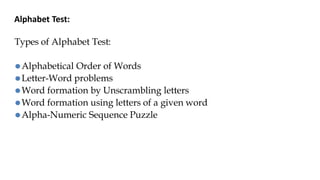
Alphabet Test:
Types of Alphabet Test:
⚫Alphabetical Order of Words
⚫Letter-Word problems
⚫Word formation by Unscrambling letters
⚫Word formation using letters of a given word
⚫Alpha-Numeric Sequence Puzzle
Question: Which of the following words will come second in the English dictionary?
[A] Magical
[B] Magnify
[C] Maternal
[D] Marshal
[E] Magnetic
Question: Which of the following words will come in the middle if all of them are arranged
alphabetically as in a dictionary?
[A] Apology
[B] Branch
[C] Antigen
[D] Antique
[E] Antipathy
Question: How many such pairs of letters are there in the word CORPORATE each of which has
as many letters in the same sequence between them in the word as in the English alphabet?
[A] 1
[B] 2
[C] 3
[D] More than 3
[E] None of the above
Question: If the letters in the word UNDERTAKING are rearranged in the alphabetical order,
which one will be in the middle in order after the rearrangement?
[A] G
[B] I
[C] K
[D] N
[E] T
Question: Which letter in the word CYBERNETICS occupies the same position as it does in the
English alphabet?
[A] C
[B] E
[C] S
[D] I
[E] Y
Question: If the last four letters of the word CONCENTRATION are written in reverse order
followed by next two in the reverse order and next three in the reverse order and then followed by
first four in the reverse order, counting from the left, which letter would be eighth in the new
arrangement?
[A] N
[B] T
[C] E
[D] R
Question: Select the combination of numbers so that the letters arranged accordingly in the form
of meaningful word.
T I R B H G
1 2 3 4 5 6
[A] 1, 3, 2, 4, 6, 5
[B] 3, 2, 6, 5, 3, 1
[C] 4, 3, 2, 6, 5, 1
[D] 4, 5, 2, 3, 6, 1
Question: Select the combination of numbers so that the letters arranged accordingly in the form
of meaningful word.
T L P N A E
1 2 3 4 5 6
[A] 3, 2, 5, 4, 1, 6
[B] 3, 2, 5, 4, 6, 1
[C] 4, 5, 3, 6, 2, 1
[D] 4, 6, 1, 3, 5, 2
Question: If the letters of the word ARTICULATES can be used as many times as one wants to
use, then which one of the following four words cannot be formed?
[A] COURTS
[B] LATER
[C] ELECTRIC
[D] ARTICLE
Question: Below are given four words in which some letters are missing. A group of three letters
completes these words meaningfully. Select these three letters from the alternatives given.
_ _ _ vent, _ _ _ nect, _ _ _ duct, _ _ _ dole
[A] Cor
[B] Coc
[C] Cov
[D] Con
Question: ₤= β F 2 * K S 7 5 # $P L V 8 @ M U E 6 ∞Q G © 9 3 & T Y ¥
How many such letters are there in the arrangement each of which is either immediately
preceded by a symbol or immediately followed by a number, but not both?
[A] 3
[B] 4
[C] 5
[D] 6
[E] None of these
Question: R E 5 D A P $ 3 T I Q 7 9 B # 2 K % U 1 M W 4 * J 8 N
Which of the following is exactly in the middle between 3 and 1 in the above arrangement?
[A] B
[B] K
[C] 9
[D] #
[E] None of these
Question: R E 5 D A P $ 3 T I Q 7 9 B # 2 K % U 1 M W 4 * J 8 N
How many such numbers are there in the above arrangement, each of which is immediately
preceded by a consonant and not immediately followed by a consonant?
[A] None
[B] 1
[C] 2
[D] 3
[E] None of these
Question: R E 5 D A P $ 3 T I Q 7 9 B # 2 K % U 1 M W 4 * J 8 N
Which of the following is seventh to the left of the sixteenth from the left in the above
arrangement?
[A] A
[B] U
[C] 4
[D] T
[E] None of these
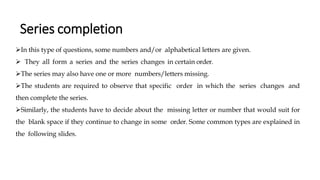
Series completion
➢In this type of questions, some numbers and/or alphabetical letters are given.
➢ They all form a series and the series changes in certain order.
➢The series may also have one or more numbers/letters missing.
➢The students are required to observe that specific order in which the series changes and
then complete the series.
➢Similarly, the students have to decide about the missing letter or number that would suit for
the blank space if they continue to change in some order. Some common types are explained in
the following slides.
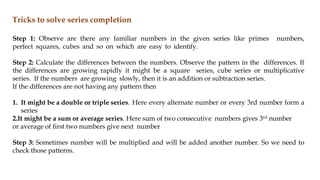
Tricks to solve series completion
Step 1: Observe are there any familiar numbers in the given series like primes numbers,
perfect squares, cubes and so on which are easy to identify.
Step 2: Calculate the differences between the numbers. Observe the pattern in the differences. If
the differences are growing rapidly it might be a square series, cube series or multiplicative
series. If the numbers are growing slowly, then it is an addition or subtraction series.
If the differences are not having any pattern then
1. It might be a double or triple series. Here every alternate number or every 3rd number form a
series
2.It might be a sum or average series. Here sum of two consecutive numbers gives 3rd number
or average of first two numbers give next number
Step 3: Sometimes number will be multiplied and will be added another number. So we need to
check those patterns.
Question: Find the next term in the series.
2, 3, 5, 7, 11, 13, ...........
[A] 15
[B] 17
[C] 19
[D] 21
Question: Find the next term in the series.
2, 5, 11, 17, 23, ...........41.
[A] 29
[B] 31
[C] 33
[D] 37
Question: Find the next term in the series.
2, 5, 8, 11, 14, 17,...........,23.
[A] 21
[B] 19
[C] 20
[D] 22
Question: Find the next term in the series.
45, 38, 31, 24, 17, ...........,3.
[A] 15
[B] 14
[C] 10
[D] 12
Question: Find the next term in the series.
2, 6, 18, 54, 162,.........,1458
[A] 486
[B] 810
[C] 648
[D] 480
Question: Find the next term in the series.
3, 12, 48, 192,............,3072.
[A] 384
[B] 576
[C] 768
[D] 960
Question: Find the next term in the series.
32, 48, 72, 108, .........., 243.
[A] 132
[B] 162
[C] 160
[D] 154
Question: Find the next term in the series.
0, 4, 16, 36, 64, ........ 144.
[A] 100
[B] 81
[C] 121
[D] 94
Question: Find the next term in the series.
0, 3, 8, 15, 24, 35, 48, ..........,
[A] 54
[B] 58
[C] 61
[D] 63
Question: Find the next term in the series.
2, 5, 10, 17, 26, 37, .........., 65.
[A] 54
[B] 50
[C] 58
[D] 61
Question: Find the next term in the series.
2, 6, 12, 20, ............, 42.
[A] 30
[B] 34
[C] 38
[D] 39
Question: Find the next term in the series.
1, 8, 27, 64, 125, 216, ......... .
[A] 343
[B] 512
[C] 729
[D] 325
Question: Find the missing term in the series :
3, 20, 63, 144, 275, ?
[A] 354
[B] 468
[C] 548
[D] 554
Question: Find the missing term in the series :
2, 5, 9, 19, 37, ?
[A] 73
[B] 75
[C] 76
[D] 78
Question: In following alphabet series , one term missing as shown by question mark . Choose
missing term from options.
Y, W, U, S, Q, ?, ?
[A] N, J
[B] M, L
[C] L, M
[D] O, M
Question: Find the missing term WFB, TGD, QHG, ?
[A] NIJ
[B] NIK
[C] OJK
[D] NLK
Question: Which term comes next in the sequence: AC, FH, KM, PR, ?
[A] UW
[B] VW
[C] UX
[D] TV
[E] None of these
Question: Find the next term in the alpha-numeric series:
Z1A, X2D, V6G, T21J, R88M, P445P, ?
[A] N2676S
[B] N2676T
[C] T2670N
[D] T2676N
Coding Decoding
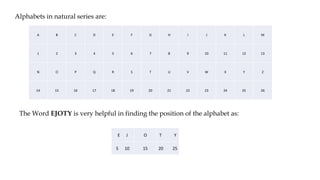
Alphabets in natural series are:
A B C D E F G H I J K L M
1 2 3 4 5 6 7 8 9 10 11 12 13
N O P Q R S T U V W X Y Z
14 15 16 17 18 19 20 21 22 23 24 25 26
The Word EJOTY is very helpful in finding the position of the alphabet as:
E J O T Y
5 10 15 20 25
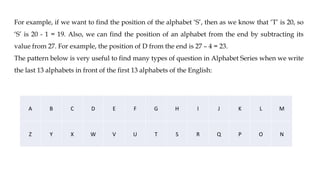
For example, if we want to find the position of the alphabet ‘S’, then as we know that ‘T’ is 20, so
‘S’ is 20 - 1 = 19. Also, we can find the position of an alphabet from the end by subtracting its
value from 27. For example, the position of D from the end is 27 – 4 = 23.
The pattern below is very useful to find many types of question in Alphabet Series when we write
the last 13 alphabets in front of the first 13 alphabets of the English:
A B C D E F G H I J K L M
Z Y X W V U T S R Q P O N
Letter Coding:
Question: If COURSE is coded as FRXUVH, how is RACE coded as?
[A] ABHF
[B] UDFH
[C] DUHF
[D] WQYF
Question: In a certain code, MONKEY is written as XDJMNL. How is TIGER written in that code?
[A] QDFHS
[B] FHSQD
[C] DQSFH
[D] STFDQ
Question: If BOMBAY is written as MYMYMY, how will TAMIL NADU be written in that
code?
[A] YMNYMNYMN
[B] ABHABHABH
[C] ABCDABCDA
[D] MNUMNUMNU
Question: In a certain code, TOGETHER is written as RQEGRJCT. In the same code, what will
PAROLE be written as?
[A] PQJGNC
[B] CNGJPQ
[C] NCPQJG
[D] NCJQPG
Question: If in a certain code, TWENTY is written as 863985 and ELEVEN is written as 323039,
how is TWELVE written in that code?
[A] 203863
[B] 368302
[C] 863203
[D] 320368
Number Coding:
Question: If ENGLAND is written as 1234526 and FRANCE is written as 785291, how is
GREECE coded?
[A] 117186
[B] 381191
[C] 131871
[D] 112235
Question: In a certain code, if LOGIC is coded as 1512201824, how is PEARL coded as?
[A] 112226915
[B] 113331596
[C] 112226710
[D] 113336734
Question: If APPLE is written as 24991320, how is LOVELY coded as?
[A] 13101310130
[B] 1310320130
[C] 13101350140
[D] 13101340120
Question: If Z = 52 and ACT = 48, then BAT will be equal to:
[A] 39
[B] 41
[C] 44
[D] 46
Question: If tee see pee means drink fruit juice,
see kee lee means juice is sweet,
lee ree mee means he is intelligent,
then which word means sweet?
[A] see
[B] pee
[C] kee
[D] tee
Mixed Coding:
Question: If in a certain code language,
‘col tip mot’ means ‘singing is appreciable‘,
‘mot baj min‘ means ‘dancing is good'
‘tip nop baj’ means ‘singing and dancing’.
Which of the following stands for ‘good' in that language?
[A] mot
[B] baj
[C] min
[D] nop
Question: If in a certain code language,
‘8 5 1’ means 'good sweet fruit‘,
‘7 8 3‘ means 'good red rose'
‘3 4 1’ means 'rose and fruit’.
Which of the following digits stands for 'sweet' in that language?
[A] 2
[B] 3
[C] 4
[D] 5
Question: If in a certain code language,
‘2 5 6’ means ‘you are good‘,
‘6 3 7‘ means ‘we are bad'
‘3 5 8’ means ‘good and bad’.
Which of the following digits stands for ‘and' in that language?
[A] 5
[B] 6
[C] 7
[D] 8
Question: If white is called blue, blue is called red, red is called yellow, yellow is called green, green is
called black, black is called violet and violet is called orange, what would be the color of human
blood?
[A] Blue
[B] Yellow
[C] Black
[D] Violet
Question: If the animals which can walk are called swimmers, animals who crawl are called flying,
those living in water are called snakes and those which fly in the sky are called hunters, then what
will a lizard be called ?
[A] Flying
[B] Swimmers
[C] Snakes
[D] Hunters
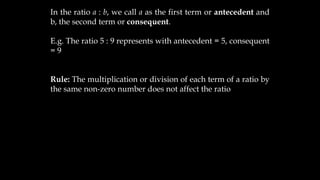
In the ratio a : b, we call a as the first term or antecedent and
b, the second term or consequent.
E.g. The ratio 5 : 9 represents with antecedent = 5, consequent
= 9
Rule: The multiplication or division of each term of a ratio by
the same non-zero number does not affect the ratio
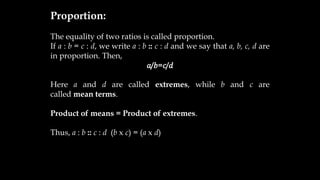
Proportion:
The equality of two ratios is called proportion.
If a : b = c : d, we write a : b :: c : d and we say that a, b, c, d are
in proportion. Then,
𝑎/𝑏=𝑐/𝑑
Here a and d are called extremes, while b and c are
called mean terms.
Product of means = Product of extremes.
Thus, a : b :: c : d (b x c) = (a x d)
Question: If 0.75 : x :: 5 : 8, then x is equal to:
[A] 1.12
[B] 1.2
[C] 1.25
[D] 1.30
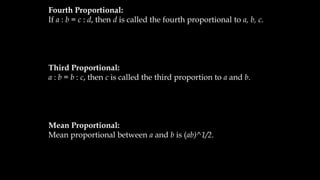
Fourth Proportional:
If a : b = c : d, then d is called the fourth proportional to a, b, c.
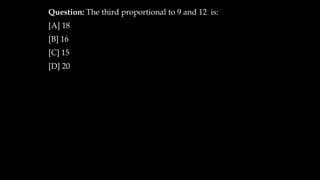
Third Proportional:
a : b = b : c, then c is called the third proportion to a and b.
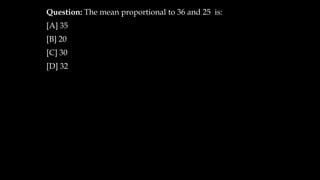
Mean Proportional:
Mean proportional between a and b is (ab)^1/2.
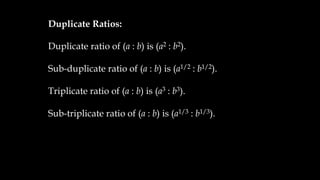
Duplicate Ratios:
Duplicate ratio of (a : b) is (a2 : b2).
Sub-duplicate ratio of (a : b) is (a1/2 : b1/2).
Triplicate ratio of (a : b) is (a3 : b3).
Sub-triplicate ratio of (a : b) is (a1/3 : b1/3).
Question: Find the duplicate ratio of 3:4?
[A] 3:4 [B] 4:3 [C] 9:16 [D] 27:64
Question: Find the sub-triplicate ratio of 64:125?
[A] 8:25 [B] 4:5 [C] 5:4 [D] 4:25
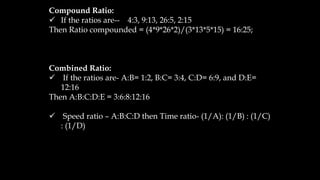
Compound Ratio:
✓ If the ratios are-- 4:3, 9:13, 26:5, 2:15
Then Ratio compounded = (4*9*26*2)/(3*13*5*15) = 16:25;
Combined Ratio:
✓ If the ratios are- A:B= 1:2, B:C= 3:4, C:D= 6:9, and D:E=
12:16
Then A:B:C:D:E = 3:6:8:12:16
✓ Speed ratio – A:B:C:D then Time ratio- (1/A): (1/B) : (1/C)
: (1/D)
Mixture and
Alligation
Mixture: Mixing of two or more than two
type of quantities gives us a mixture.
Example:
Quantities of these elements can be
expressed as percentage or ratio.(20% of
sugar in water)
Fraction ( A solution of sugar and water such
that sugar : water = 1:4)
Alligation : Alligation is a rule which is used to
solve the problems related to mixture and its
ingredient.
It is the rule that enables us to find the ratio in
which two or more ingredients at the given price
must be mixed to produce a mixture of desired
price.
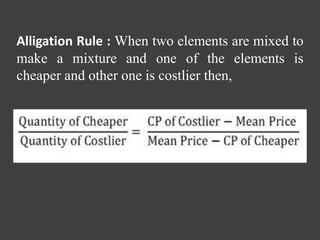
Alligation Rule : When two elements are mixed to
make a mixture and one of the elements is
cheaper and other one is costlier then,
Cost Price of
Cheaper
[ C ]
Cost Price of
Dearer
[ D ]
Cost Price of
Mixture
[ M ]
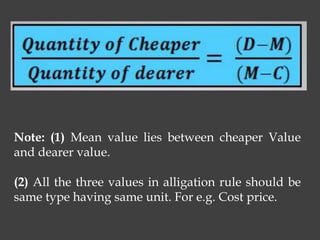
(D-M) (M-C)
Note: (1) Mean value lies between cheaper Value
and dearer value.
(2) All the three values in alligation rule should be
same type having same unit. For e.g. Cost price.
1. In what ratio must a grocer should mix two
varieties of pulses costing Rs.15 /Kg and
Rs.20/Kg respectively so as to get a mixture
worth Rs.16.50/Kg?
[A] 7 : 3
[B] 4 : 5
[C] 6 : 4
[D] None of the above
2. Find the ratio in which rice at Rs.7.20 a Kg be
mixed with rice at Rs. 5.70 a Kg to produce a
mixture worth Rs. 6.30 a Kg?
[A] 1 : 3
[B] 2 : 3
[C] 3 : 4
[D] 4 : 5
3. In what ratio must a grocer mix two varieties of
tea worth Rs. 60 a kg and Rs. 65 a kg so that by
selling the mixture at Rs. 68.20 a kg he may gain
10%?
[A] 3 : 2
[B] 3 : 5
[C] 3 : 6
[D] None of the above
4. How many kg of tea worth Rs. 25/kg must be
blended with 30 kg of tea worth Rs. 35/kg so
that by selling the blended variety at Rs. 33/kg
there should be a gain of 10%?
[A] 36 Kg
[B] 40 Kg
[C] 32 Kg
[D] None of the above
5. A dishonest milkman professes to sell his milk at
cost price but he mixes it with water and thereby
gains 25%. The percentage of water in the
mixture is:
[A] 20%
[B] 10 %
[C] 11 %
[D] None of the above
6. In what ratio must water be added to spirit to
gain 10% by selling it at the cost price?
[A] 1 : 11
[B] 1 : 5
[C] 1 : 10
[D] 1 : 9
7. Sea water contains 5% salt by weight. How many
kilograms of fresh water must be added to 40kg
of sea water for the salt content of the solution to
be 2%?
[A] 50
[B] 60
[C] 65
[D] 70
8. A mixture of 45 L of spirit and water contains
20% of water in it. How much water must be
added to it to make the water 25% in the new
mixture?
[A] 3 L
[B] 4 L
[C] 5 L
[D] 6 L
9. In a zoo, there are rabbits and pigeons. If head
are counted, there are 200 and legs are 580. How
many rabbits are there ?
[A] 110
[B] 90
[C] 80
[D] 120
10. A man has 90 pens. He sells some of these at
profit of 15 % and rest at 9% profit. On the whole
transaction he gets a profit of 11%.How many
pens did he sell at 9% profit.
[A] 60
[B] 50
[C] 40
[D] 70
11. A trader has 25 kg of rice. A part of which he
sold at 4% profit and rest at 9% profit. His
overall gain is 7%. What is the quantity he sold at
9% profit?
[A] 9 Kg
[B] 10 Kg
[C] 12 Kg
[D] 15 Kg
12. A man buys two cows for Rs. 1350 and sells one
for loss of 6% and the other for gain of 7.5% and
on the whole he neither gains nor loses. What
does each cow cost?
[A] Rs. 850, Rs.500
[B] Rs. 650, Rs. 700
[C] Rs. 750, Rs. 600
[D] Rs. 550, Rs. 800
13. There are 50 students in a class, Rs. 320 are
distributed among them so that each boy get 10
Rs. and each girl get 5 Rs. Find no. of girls.?
[A] 36
[B] 18
[C] 14
[D] 7
14. A merchant borrowed Rs.3500 from two money
lenders. For one loan he paid 14% p.a. and for
other 18% p.a. Total interest paid for one year
was Rs.525. How much did he borrow at 18%
p.a.
[A] Rs.875
[B] Rs.625
[C] Rs.750
[D] Rs.1000
15. A man travels 80 km in 7 hrs. Some part on foot
with 8kmph and rest on cycle with 16kmph. Find
the distance covered by cycle.
[A] 16 Km
[B] 32 Km
[C] 24 Km
[D] 48 Km
16. In what ratio must a person mix three kinds of
tea costing Rs.60/kg, Rs.75/kg and Rs.100 /kg
so that the resultant mixture when sold at
Rs.96/kg yields a profit of 20%?
[A] 1 : 2 : 4
[B] 3 : 7 : 6
[C] 1 : 4 : 2
[D] None of these
17. Find out the ratio of new mixture so that it will
cost Rs 1.40 per kg from the given three kinds of
rice costing Rs 1.20, Rs 1.45 and Rs 1.74.
[A] 39 : 20 : 20
[B] 30 : 20 : 30
[C] 30 : 29 : 29
[D] None of these
Mixture Questions
18. In 28L mixture of milk and water the ratio of
milk and water is 5:2. How much quantity of
water is to be added so that the milk and water
becomes 2:5
[A] 60 L
[B] 42 L
[C] 40 L
[D] 36 L
19. A mixture consist Milk and water in 5:1. On
adding 5 L water, the ratio becomes 5:2. Find
quantity of milk in original mixture.
[A] 5 L
[B] 10 L
[C] 15 L
[D] 25 L
20. Mixture consist Milk and water in 4:3. On
adding 2 L of water, ratio becomes 8:7. find total
quantity of final mixture.
[A] 15 L
[B] 30 L
[C] 45 L
[D] 60 L
21. Two bucket contains same amount of mixture of
Milk and water in 9:5 and 4:3 resp. If these
buckets are further mixed, find the ratio of milk
and water in final mixture.
[A] 11 : 17
[B] 17 : 11
[C] 9 : 8
[D] 8 : 9
22. Two bucket contains same amount of mixture of
Milk and water in 9:5 and 4:3 resp. If these
buckets are further mixed in 1:2, find the ratio of
milk and water in final mixture.
[A] 17 : 25
[B] 25 : 17
[C] 9 : 16
[D] 8 : 18
23. Three equal glasses are filled with mixture of
Milk and water in 3 : 1, 5 : 3 and 9 : 7 resp. If
these glasses are further mixed, find the ratio of
milk and water in final mixture.
[A] 11:17
[B] 17:11
[C] 31 : 17
[D] 17 : 31
24. Mixture consist 80% Acid and rest water. A part
of this mixture is replaced with same amount of
water and new ratio becomes 4:3. find part of
mixture which is replaced.
[A] 1/5
[B] 2/5
[C] 1/7
[D] 2/7
25. A tank is filled with mixture consist 3 part
water & 5 part alcohol. A part of this mixture is
drawn off and replaced with same amount of
water. New mixture contains half water and half
alcohol. find part of mixture which is replaced.
[A] 1/5
[B] 2/5
[C] 1/7
[D] 2/7
26. A bucket contains two liquids A and B in 5:3. If
16 L of mixture is drawn off and replaced with
same amount of liquid B, the ratio becomes 3:5.
How much Liter bucket holds?
[A] 40 L
[B] 24 L
[C] 26 L
[D] 80 L
27. Two vessels A and B contain M and W in 4:3
and 2:3 resp. In what ratio the liquids may be
mix to obtain a new mixture containing half milk
and half water ?
[A] 7 : 5
[B] 5 : 7
[C] 1 : 4
[D] 1 : 2
28. Two vessels A and B contain M and W in 8:5
and 5:2 resp. In what ratio the liquids may be
mix to obtain a new mixture containing
69and(3/13) % milk ?
[A] 2 : 7
[B] 7 : 2
[C] 5 : 6
[D] 6 : 5
Removal and Replacement
If a vessel contains “x” liters of liquid A and if “y”
liters be withdrawn and replaced by liquid B, then if
“y” liters of the mixture be withdrawn and replaced
by liquid B, and the operation is repeated ‘n’ times
in all, then :
F.C = I.C(1-y/x)n
FC= Final concentration
IC= Initial concentration
y = no. of liters replaced
x = Total concentration
n = total number of iterations
29. A container contains 40 L milk. 4 L was taken
out and replaced with water. This process is
repeated further 2 times. Now how much milk is
there in the mixture?
[A] 28 L
[B] 29.16 L
[C] 27.16 L
[D] 30 L
30. A vessel contains 125 liters of wine. 25 liters of
wine was taken out of the vessel and replaced by
water. Then, 25 liters of mixture was withdrawn
and again replaced by water. The operation was
repeated for third time. How much wine is now
left in the vessel?
[A] 49 L
[B] 64 L
[C] 72 L
[D] 56 L
31. 8 L was taken out from a cask full of wine and
replaced with water. This operation is performed
3 more times. The ratio of quantity of wine left in
the cask to that of water is 16:65. how much wine
did the cask hold initially?
[A] 12 L
[B] 18 L
[C] 24 L
[D] 30 L
32. A jar full of whisky contains 40% alcohol. A part
of this is replaced with another containing 19%
alcohol. Now there is 26% alcohol. Find the
quantity of whisky which is replaced.
[A] 1/2
[B] 1/3
[C] 1/5
[D] 2/3
Permutation
&
Combination
Fundamental Principal of counting
• Rule of product : If there are ‘m’ ways to do a process and there
are ‘n’ ways to do another, then total number of ways of doing
both process is given by ‘m x n’
• If there are 3 shirts and 2 pants then in how many
ways a person can dress up for a seminar?
P1
S1
P2
P1
S2
P2
P1
S3
P2
Directly, Total ways = 3 * 2 = 6 ways
• Rule of addition : If there are ‘m’ ways to do a
process and there are ‘n’ ways to do another and
we can not do both at the same time, then there
are ‘m + n’ ways to choose one of the actions.
• If there are 3 formal shoes and 2 casual shoes
then in how many ways we can choose a
footwear for a party.
F1, F2, F3, C1, C2
F1 or F2 or F3 or C1 or C2
Total ways = 3 + 2 = 5 ways
Question: Let us assume you have 3 shirts, 4
pants, 3 shoes and 2 sandals to wear. Find in
how many ways you can decide an outfit.
1. Shirt – Pants – Shoes
2. Shirt – Pants – Sandal
(3x4x3) + (3x4x2) = 60
Note : Multiplication ------- “ AND” (Stages)
Addition------------- “ OR” (Choice)
Difference between Permutation and
Combination
Permutation : Arrangement
: Order matters
Combination : Selection
: Order doesn’t matters
Question: If suppose we have 3 objects A, B, C then
find no. of ways in which any 2 items can be
selected.
Answer:
1. AB (BA)
2. BC (CB)
3. CA (AC)
Question: If suppose we have 3 objects A, B, C then
find no. of ways to arrange any 2 items.
Answer:
1. AB
2. BA
3. BC
4. CB
5. CA
6. AC
Practice Question
1. In how many ways can we select a team of 4
players out of 15 eligible players.
[A] 1365
[B] 1455
[C] 1295
[D] 1525
2. In a class there are 6 boys and 5 girls. In how
many ways can a group of 5 members to be formed
by selecting 3 boys and 2 girls.
[A] 350
[B] 300
[C] 250
[D] 200
3. In how many ways 3 VIPs can be seated in 3 seats
of first row of a function.
[A] 3
[B] 4
[C] 5
[D] 6
Note : Number of ways of arranging ‘n’
different items in a row = n !
In previous question,
3 x 2 x 1 = 3! = 6 ways
4. In how many ways 5 medals of different games
can be arranged in a shelf.
[A] 100
[B] 110
[C] 120
[D] 150
5. Suppose you have to choose a 3 letter password.
First letter is an alphabet, followed by a number and
last one is an special character. There are 5 special
character available. Find no. of ways to choose
password.
[A] 1050
[B] 1200
[C] 1300
[D] 1560
6. How many 2 digit numbers can be made from the
digits 1, 2, 3 and 4 without repetition?
[A] 24
[B] 18
[C] 12
[D] 6
Problems on Numbers
7. How many 4 digit numbers are possible with the
digits 1, 2, 3, 6, 7, 8 and 9 without repetition?
[A] 720
[B] 480
[C] 840
[D] 320
8. How many 4 digit numbers are possible with the
digits 1, 2, 3, 6, 7, 8 and 9 if repetition is allowed?
[A] 2401
[B] 820
[C] 343
[D] 729
9. How many 4 digit numbers can be made from the
digits 7, 8, 5, 0, and 4 without repetition?
[A] 70
[B] 96
[C] 84
[D] 48
10. How many 3 digit numbers greater than 400 can
be made with the digits 2, 3, 4, 0, 5, 6 (digits cannot
be repeated)?
[A] 119
[B] 59
[C] 120
[D] 60
11. How many 3 digit numbers between 200 and 700
can be made with the digits 1, 3, 4, 0, 5, 6 (digits
cannot be repeated) ?
[A] 80
[B] 120
[C] 60
[D] None of these
12. How many 3 digit number can be formed with
the digits 5, 6, 2, 3, 7 and 9 which are divisible by 5
and none of its digit is repeated?
[A] 12
[B] 16
[C] 20
[D] 100
13. How many 4 digit number can be formed with
the digits 0, 1, 2, 3, 4, 5, 6 which are divisible by 5
and none of its digit is repeated?
[A] 120
[B] 100
[C] 220
[D] 320
14. How many 4 digit odd number can be formed
with the digits 0, 1, 2, 3, 4, 5, 6 if none of its digit is
repeated?
[A] 120
[B] 100
[C] 220
[D] 300
15. How many 4 digit even number can be formed
with the digits 0, 1, 2, 3, 4, 5, 6 if none of its digit is
repeated?
[A] 120
[B] 420
[C] 220
[D] 200
16. Find the no of 3 digit numbers such that at least
one of the digit is 6 (with repetitions)?
[A] 252
[B] 345
[C] 648
[D] 560
17. In How many different ways the letters of the
word EQUATION can be arranged ?
[A] 7!
[B] 8!
[C] 9!
[D] 6!
Problems on Words:
18. In How many different ways the letters of the
word EQUATION can be arranged, if it starts with
letter Q ?
[A] 7!
[B] 8!
[C] 9!
[D] 6!
19. In How many different ways the letters of the
word EQUATION can be arranged, if it starts with
consonants?
[A] 7!
[B] 8!
[C] 2*7!
[D] 3*7!
20. In How many ways the word OPTICAL be
arranged such that all vowels are together?
[A] 720
[B] 820
[C] 2160
[D] 1000
21. In How many ways the word OPTICAL be
arranged such that all vowels are never together?
[A] 720
[B] 1000
[C] 2160
[D] 4320
22. In How many ways the word MANPOWER be
arranged such that all vowels are together?
[A] 3! 6!
[B] 2! 7!
[C] 3! 5!
[D] 4! 4!
23. In How many ways letters of word PRAISE be
arranged such that all consonants are together?
[A] 3! 4!
[B] 4! 4!
[C] 3! 5!
[D] 4! 5!
24. In How many ways letters of word PREVIOUS
be arranged such that all vowels always come
together?
[A] 1440
[B] 2880
[C] 4320
[D] 840
25. In how many ways can the letters of word
FLEECED be arranged?
[A] 410
[B] 880
[C] 840
[D] 1260
26. Find the total arrangement of the letters of the
word “MISSISSIPPI?
[A] 34650
[B] 32540
[C] 28450
[D] 24560
27. In how many different ways can the letter of the
word “ELEPHANT” be arranged so that E’s are
never together?
[A] 5040
[B] 15120
[C] 20160
[D] 35280
28. Find the total arrangement of the letters of the
word “INVISIBILITY” such that all ‘I’ always come
together.
[A] 8!
[B] 8!*5!
[C] 8!*5
[D] 7!*5!
29. In how many ways can the letters of the word
“MACHINE” be arranged so that the vowels may
occupy only odd positions?
[A] 4*7!
[B] 576
[C] 288
[D] 4 * 4!
30. Find the rank of the word “CHASM” if all the
words can be formed by permuting the letters of this
word without repetition are arranged in dictionary
order.
[A] 24
[B] 31
[C] 32
[D] 30
31. Find the rank of the word “JAIPUR” if all the
words can be formed by permuting the letters of this
word without repetition are arranged in dictionary
order.
[A] 241
[B] 122
[C] 123
[D] 242
31. Find the rank of the word “INDIA” if all the
words can be formed by permuting the letters of this
word without repetition are arranged in dictionary
order.
[A] 41
[B] 42
[C] 45
[D] 46
32. Find the rank of the word “GOOGLE” if all the
words can be formed by permuting the letters of this
word without repetition are arranged in dictionary
order.
[A] 78
[B] 84
[C] 85
[D] 88
33. In how many ways a group of 4 men and 3
women be made out of a total of 8 men and 5
women?
[A] 720
[B] 700
[C] 120
[D] 360
Problems on Combination (Group
Formation)
34. There are 8 men and 7 women. In how many
ways a group of 5 people can be made such that the
particular woman is always to be included?
[A] 860
[B] 1262
[C] 1001
[D] 1768
35. There are 4 men and 3 women. In how many
ways a group of three people can be formed such
that there is at least 1 women in the group.
[A] 40
[B] 20
[C] 34
[D] 31
36. In a group of 6 boys and 5 girls, 5 students have
to be selected. In how many ways it can be done so
that at least 2 boys are included.
[A] 124
[B] 526
[C] 154
[D] 431
37. A box contains ten balls out of which 3 are red
and rest blue. In how many ways can a random
sample of six balls be drawn so that at most 2 red
balls are included.
[A] 105
[B] 189
[C] 168
[D] 175
38. In a party there are 12 persons. How many
handshakes are possible if every person handshake
with every other person?
[A] 66
[B] 24
[C] 72
[D] 68
Circular arrangements
n distinct objects --------- Linear---------n!
n distinct objects---------- Circular----- (n-1)!
Note: In circle there is symmetry and hence there is
no starting and end point, so when we need to
arrange n distinct objects around a circle 1st object
will break the symmetry ( specify the position) and it
can be done in 1 way and rest (n-1) objects can be
arranged in (n-1)! Ways
Circular arrangement of n objects= 1 x (n-1)!= (n-1)!
If there is a difference between Clockwise and anti-
Clockwise arrangement , and if
1. We need to arrange r objects out of n objects
then = nPr/r
2. We need to arrange all n distinct objects =nPn/n
= n!/n = (n-1)!
If there is no difference between Clockwise and
anti-Clockwise arrangement ( like in case of
Garlands, Bead and Necklace etc.) , and if
1. We need to arrange r objects out of n objects
then = nPr/2r
2. We need to arrange all n distinct objects =
nPn/2n = n!/2n = (n-1)!/2
39. In how many ways 5 Americans and 5 Indians be
seated along a circular table, so that they occupy
alternative positions
[A] 5! 5!
[B] 6! 4!
[C] 4! 5!
[D] 4! 4!
40. A meeting of 20 delegates is to be held in a hotel.
In how many ways these delegates can be seated
around a circular table if 3 particular delegates
always seat together.
[A] 17! 3!
[B] 18! 3!
[C] 17! 4!
[D] None
41. How many triangles can be formed by joining the
vertices of hexagon?
[A] 20
[B] 12
[C] 24
[D] 10
42. How many diagonals can be formed by joining
the vertices of hexagon?
[A] 10
[B] 12
[C] 9
[D] 8
Probability
Probability
Probability is a measure of likelihood that an event will
occur.
Example: Tossing a coin: When a coin is tossed, there are
two possible outcomes : either heads (H) or tails (T). We say
that the probability of the coin landing H is ½. And the
probability of the coin landing T is ½
TERMINOLOGY
Random Experiment: Experiments whose outcomes are
unpredictable is known as Random Experiments. For
example: Tossing a coin
Sample Space(S): It is the collection of all possible
outcome of an experiment. Example: In tossing a coin
one time S={H,T}
Event: The outcome of an experiment is known as Event.
Mathematically we can say that event is a subset of sample
space.
Example: Getting a head while tossing a coin one time is an
event.
Types of Events:
For example If S={1,2,3,4,5,6} and E=[odd no.]={1,3,5}
Then E'=[Even number]={2,4,6}
2. Equally likely Events: If E and F are two events such that
P(E)= P(F) then these are called Equally Likely events. For e.g.
In Tossing a coin probability of coming up of head and tail is
Equal.
3. Mutually Exclusive Event: Two or more events are said to be
mutually exclusive if both cannot occur simultaneously in the
same experiment.
Example: In a throw of single coin, either head can come or tail
can come. There will be no common outcome in those events. It
means E∩F=Φ (null Set)
4. Collective Exhaustive Events: If E and F are two events and
both events gives complete sample space then these are called
Exhaustive events.
E U F = S
5. Independent Events: Two events are said to be independent
of each other when the happening of one event does not affect
the happening of other event and vice versa. Here sample
spaces are different for both cases.
When two events A and B are independent, the probability of
both occurring is:
P(A and B)= P(A). P(B)
Probability: The probability of an event is defined as the ratio
of no. of ways an event can happen to the no. of ways sample
space can happen.
Let S be the sample space and let E be the event.
PROBABILITY= n(E)/n(S)
6. Dependent Events: Two events are dependent if the
outcome or occurrence of the first affects the outcome or
occurrence of the second so that the probability is changed.
When two events, A and B, are dependent, the probability of
both occurring is:
P(A and B) = P(A) · P(B|A)
where P(B|A) is the conditional probability of an event B in
relationship to an event A is the Probability that event B occurs
given that event A has already occurred.
Example: The probability of choosing a jack on the second pick
given that a queen was chosen on the first pick (without
replacement) is called a conditional probability.
Rules of Probability
1. 0 <P (E) <1
2. P(S) = 1 (Definite event)
3. P(Φ) = 0 (Impossible event)
4. If A’ denotes (not-A), then P(A’) = 1 - P(A).
5. For any events A and B we have :
P(AUB) = P(A) + P(B) - P(A∩B)
But for mutually exclusive event P(A∩B)=0
For mutually exclusive events
P(AUB) = P(A) + P(B)
6. P(A∩B)= P(A). P(B/A) = P(B). P(A/B)
7. P(AUBUC)=P(A)+P(B)+P(C)-P(A∩B)-P(B∩C)
-P(C∩A)+P(A∩B∩C)
Coins
One coin {H,T}= 2
Two coins={HH,HT,TH,TT}= 4
Three Coin={HHH,TTT,HHT,TTH,HTH,THT,THH,HTT}= 8
Four Coins={HHHH, TTTT
HHHT, TTTH
HHTH, TTHT
HTHH, THTT
THHH, HTTT,
HHTT, HTTT,
HTTH, HTHT
TTHH, THTH} =16
Question 1: In a simultaneous toss of 2 coins find the
probability of 2 Tails?
[A] 1/2
[B] 1/4
[C] 2/3
[D] 3/4
Question 2: In a simultaneous toss of 2 coins find the
probability of Exactly 1 Tail?
[A] 1/3
[B] 2/3
[C] 3/4
[D] 1/2
Question 3: In a simultaneous toss of 2 coins find the
probability of No Tail?
[A] 1/3
[B] 1/4
[C] 1/2
[D] 2/3
Question 4: In a simultaneous toss of 2 coins find the
probability of No head?
[A] 1/2
[B] 1/4
[C] 1/3
[D] 2/3
Question 5: Three coins are tossed simultaneously. Find the
probability of all are heads.
[A] 1/4
[B] 1/8
[C] 2/3
[D] 5/8
Question 6: Three coins are tossed simultaneously. Find the
probability of exactly two heads.
[A] 1/4
[B] 1/8
[C] 3/8
[D] 5/8
Question 7: Three coins are tossed simultaneously. Find the
probability of at least two heads.
[A] 1/3
[B] 1/8
[C] 1/8
[D] 3/8
Question 8: Three coins are tossed simultaneously. Find the
probability of no heads.
[A] 1/8
[B] 1/4
[C] 1/2
[D] 5/8
Question 9: Three coins are tossed simultaneously. Find the
probability of at least 1 head and 1 tail.
[A] 1/8
[B] 1/4
[C] 3/4
[D] 5/8
Question 10: 4 coins are tossed simultaneously. Find the
probability exactly 3 tails
[A] 1/8
[B] 1/4
[C] 1/2
[D] 5/8
Question 11: 4 coins are tossed simultaneously. Find the
probability at least 1 tail.
[A] 1/16
[B] 1/4
[C] 1/2
[D] 15/16
DICE
When a dice is thrown= {1, 2 , 3, 4, 5, 6} =6
When two dice are thrown, S =
{(1,1),(1,2),(1,3),(1,4),(1,5),(1,6)
(2,1),(2,2),(2,3),(2,4),(2,5),(2,6)
(3,1),(3,2),(3,3),(3,4),(3,5),(3,6)
(4,1),(4,2),(4,3),(4,4),(4,5),(4,6)
(5,1),(5,2),(5,3),(5,4),(5,5),(5,6)
(6,1),(6,2),(6,3),(6,4),(6,5),(6,6)} = 36
Question 1: In a single throw of 2 Dice, What is the probability
of a doublet?
[A] 1/3
[B] 1/36
[C] 1/6
[D] 1/12
Question 2: In a single throw of 2 Dice, What is the probability
of getting sum equals to:
I. 5
II. Multiple of 5
III. 7
IV. Multiple of 3
V. Greater than 9
Short Cut For Two Dice
SUM 2 3 4 5 6 7 8 9 10 11 12
Fav. 1 2 3 4 5 6 5 4 3 2 1
Question 3: In a simultaneous throw of 3 Dice find the
probability of getting a total of 5.
[A] 1/6
[B] 1/36
[C] 1/216
[D] 5/216
Cards
1. There are four Suits in a deck of
Card viz. Spade, Diamond, Heart,
Club.
2. Red card=26 (13 Diamonds+ 13
Hearts)
3. 3. Black Card= 26 (13 Clubs+13
Spades)
4. Every suit contains 13 cards viz.
Ace, 2 to 10, Jack, Queen, King
Face cards and Honored Card
Note: When ace is included in Face cards the combination is
called Honored card.
Question 1: One card is drawn at random from the well shuffled
pack of 52 cards. What is the probability of picking a black card?
[A] 1/3
[B] 1/2
[C] 1/4
[D] 1/13
Question 2: One card is drawn at random from the well shuffled
pack of 52 cards. What is the probability of picking a Ace of
spades or the jack of diamonds?
[A] 1/52
[B] 1/26
[C] 1/13
[D] 1/4
Question 3: One card is drawn at random from the well shuffled
pack of 52 cards. What is the probability of picking an ace?
[A] 1/13
[B] 1/52
[C] 1/26
[D] 1/4
Question 4: One card is drawn at random from the well shuffled
pack of 52 cards. What is the probability that the card is either a
red card or a King?
[A] 5/13
[B] 7/13
[C] 9/13
[D] 1/52
Question 5: One card is drawn at random from the well
shuffled pack of 52 cards. What is the probability that it is
neither club nor queen?
[A] 4/13
[B] 5/13
[C] 7/13
[D] 9/13
Balls in a Bag OR marbles in a Bag
Questions 1: .A bag contains 5 red balls and 7 blue balls. Two
balls are drawn at random without replacement, and then find
the probability of that one is red and other is blue.
[A] 33/65
[B] 35/66
[C] 37/66
[D] 41/65
Questions 2: . A urn contains 4 red balls, 5 green balls and 6
white balls, if one ball is drawn at random, find the probability
that it is neither red nor white.
[A] 1/3
[B] 1/4
[C] 1/5
[D] 2/3
Questions 3: . A bag contains 6 red balls and 7 white balls.
Another bag contains 5 red balls and 3 white balls. One ball is
selected from each. Find the probability that one ball is red and
one is white?
[A] 53/104
[B] 47/104
[C] 63/104
[D] 51/104
Questions 4: In a bag there are 4 white, 4 red and 2 green balls.
Two balls are drawn at random. What is the probability that at
least one ball is of red color?
[A] 4/3
[B] 7/3
[C] 1/3
[D] 2/3
Questions 5: . A bag contains 2 red caps, 4 blue caps, 3 yellow
caps and 5 green caps. If three caps are picked at random, what
is the probability that none is green?
[A] 2/13
[B] 3/13
[C] 1/13
[D] 5/13
Questions 6: A bag contains 5 red and 7 white balls. Four balls
are drawn out one by one and not replaced. What is the
probability that they are alternatively of different colors?
[A] 7/99
[B] 11/99
[C] 14/99
[D] 19/99
Questions 7: A basket contains 5 red 4 blue 3 green marbles. If
three marbles picked up random, What is the probability that
either all are green or all are red?
[A] 1/20
[B] 7/20
[C] 3/20
[D] 9/20
Questions 8: A bag contains 3 red balls and 8 blacks ball and
another bag contains 5 red balls and 7 blacks balls, one ball is
drawn at random from either of the bag, find the probability
that the ball is red.
[A] 93/264
[B] 95/264
[C] 91/264
[D] 97/264
Questions 1: A fair dice is rolled twice. The probability that an
odd number will follow on even number is? GATE-2005
[A] 1/2
[B] 1/6
[C] 1/3
[D] 1/4
Miscellaneous Questions:
Questions 2: An examination consists of two papers, Paper1 and
2. The probability of failing in Paper1 is 0.3 and that in paper 2 is
0.2. Given that a student has failed in paper2, the probability of
failing in paper 1 is 0.6. the probability of failing in both the
papers is? GATE-2007
[A] 0.5
[B] 0.18
[C] 0.12
[D] 0.06
Bayes' Theorem:
Let S be the sample space and let E1,E2,E3,……En be n
mutually exclusive and exhaustive events associated with a
random experiment. If A is any event which occurs with E1 or
E2 or E3…or En. then,
Question : A card from a pack of 52 cards is lost. From the
remaining cards of the pack, two cards are drawn and are found
to be both hearts. Find the probability of the lost card being a
heart?
[A] 12/50
[B] 8/50
[C] 11/50
[D] 9/50
Binomial Distribution:
If p is the probability of success of any event and q is the
probability of failure of that event, then probability of event
success x times in n trials( i.e. x success and n-x failure) is
given by:
Where X= Random variable, x= no. of success in n trials
P= probability of success, q= 1-p= probability of failure
Question: Find the probability of getting sum 9 exactly two in
three times with a pair of dice.
Answer= 8/243
Unit-6
➢Direction Sense
➢Blood Relation
Direction Sense
• Direction sense is one of the prime topics in logical
reasoning.
• Questions from this topic generally involve an individual
travelling certain distances in certain directions.
• The best way to solve these problems is to represent the
traces of the path traversed by the person, as found in the
information provided by the question.
• There are four main directions –
North, South, East and West.
• There are four cardinal directions – North-East(N-E),
North-West(N-W), South-East
(S-E), South-West(S-W).
Things to be noted:
• At the time of sunrise if a man stands facing the east, his
shadow will be towards west.
• At the time of sunset the shadow of an object is always in
the east.
• If a man stands facing the North, at the time of sunrise his
shadow will be towards his left and at the time of sunset it
will be towards his right.
• At 12.00 noon, the rays of the sun are vertically downward
hence there will be no shadow.
• Always rainbow will occur opposite to the sun.
• Always shortest distance should be calculated.
Practice Questions
1. Santosh goes first 7 Km north then turns left and move 10
Km, again he turns left and moves 7 Km, how far is he from
the starting point?
[A] 7 Km
[B] 10 Km
[C] 17 Km
[D] 24 Km
2. Mohan travels 7 Km to north direction from where he is
standing and turns to his right. He then walks straight for
another 3 Km. Turning to his right he moves 7 Km. How
many Km away from starting point is he?
[A] 1
[B] 2
[C] 3
[D] 5
3. A man walks 5 Km towards south and then turns to the
right. After walking 3 Km he turns to the left and walks 5
Km. Now in which direction is he from the starting place?
[A] West
[B] South
[C] North east
[D] South west
4. Ranuka started walking from her house, she first walked
for 3 Km towards west, then she turned towards north
and moved 4 Km in that direction. How far is Ranuka
from her house?
[A] 3 Km South
[B] 3 Km South-East
[C] 5 Km West
[D] 5 Km North-West
6. A man walks northwards. After a while he turns to his
right and a little further to his left. Finally, after walking a
distance of 1km, he turns towards his left again. In which
direction is he moving now?
[A] South
[B] North
[C] West
[D] East
7. A man started walking positioning his back towards the
sun. After sometime, he turned left, then turned right and
then towards the left again. In which direction is he going
now?
[A] North or South
[B] East or West
[C] North or West
[D] South or West
8. A man went 10 Km towards south. Then turned East and covered 10
Km and turned to the right. Again after 10 Km he turned to the left
and covered 10kms to reach the destination. How far and in which
direction is he to his starting point?
[A] 20√2 km, South- East
[B] 20√2 km, North- East
[C] 20√2 m, South- East
[D] 20 km, South East
9. A man went 15 Km to the North. Then he turned West
and covered 10 Km. Then he turned south and covered 5
Km. Finally, turned to East, he covered 10 Km. In which
direction is he from his house?
[A] West
[B] East
[C] North
[D] South
10. If South-East becomes North, North-East becomes West and
so on. What will West become?
[A] North East
[B] North West
[C] South East
[D] South West
11. Rahul put his timepiece on the table in such a way that at 6
PM hour hand points to north. In which direction the
minute hand will point at 9:15 PM?
[A] South East
[B] South
[C] North
[D] West
12. K is 40m South-West of L. If M is 40m South-East of L, then
M is in which direction of K?
[A] East
[B] West
[C] North-East
[D] South
Shadow Type Questions:
• Shadow of any object is always opposite of SUN, if it is the
case of Morning then Shadow will fall in the WEST and if it
is the case of Evening then shadow will fall in the EAST.
➢ If a man stands facing North in the Morning his shadow
will be towards his left and if he is facing North in Evening
his shadow will be towards his Right.
➢If a man stands facing South in the Morning his shadow
will be towards his Right and if he is facing South in
Evening his Shadow will be towards his Left.
13. One evening before sunset Rekha and Hema were talking
to each other face to face. If Hema’s shadow was exactly to
the right of Hema, which direction was Rekha facing?
[A] North
[B] South
[C] East
[D] West
14. One morning Udai and Vishal were talking to each other
face to face at a crossing. If Vishal’s shadow was exactly to
the left of Udai, which direction was Udai facing?
[A] East
[B] West
[C] North
[D] South
15. Roshan walks 10 meters westwards, then turns left and
walks 10 meters. He then again turns left and walks 10
meters. He takes a 45 degree turn to his right and walks
straight. In which direction is he walking now?
[A] South-East
[B] South
[C] South West
[D] East
16. After his office hours in the evening, Gautam starts
walking facing the sun. First he turns to his right, then he
turns to his left and after walking for some meters to his
left, he turns to his right. In what direction is he moving
now?
[A] South
[B] North
[C] West
[D] East
17. Amit’s office is situated 5 kilometers North of Ben’s office.
Ben starts from his office and walks 2 kilometers towards
Amit’s office. He then turns right and walks 3 kilometers
and then turns left and walks 3 kilometers. To which
direction will he turn to reach Amit’s office?
[A] West
[B] North
[C] South
[D] East
18. A lady leaves her home and walks 30 meters in North-
West direction and then 30 meters in South-West. Next,
she walks 30 meters in South-East direction. Finally, she
turns towards her house. In which direction is she moving
now?
[A] North-East
[B] North-West
[C] South-East
[D] South-West
19. Deepak walks 8 kilometers East, turns South-West and
walks another 8 kilometers. He again takes a turn towards
North-West and walks another 8 kilometers. In which
direction from his starting point is he standing now?
[A] North-East
[B] South
[C] West
[D] East
20. The school is to the West of the hospital. The hospital is to
the South of the police post. The workshop is to the North
of the school. If the 4 places are equidistant from each
other, then to which direction of workshop is the police
post?
[A] East
[B] West
[C] North
[D] South
Directions for Q21 to Q25:
Joe walks 2 kilometers towards North and turns to his right
and walks 4 kilometers more. He then turns to his right and
walks 4 kilometers and turns again to his right and walks
another 4 kilometers. Here he meets Renu who is coming from
the opposite direction. They both stop there.
21. After taking the first turn, in which direction was Joe
going?
[A] South
[B] North
[C] West
[D] East
22. If the starting point is marked ‘A’ and finishing point is
marked ‘B’. What will be the distance between these
points?
[A] 10 Km
[B] 8 Km
[C] 6 Km
[D] 2 Km
23. From which direction was Renu coming?
[A] West
[B] North
[C] East
[D] South-East
24. After taking the second turn, in which direction was Joe
walking?
[A] South
[B] West
[C] North
[D] East
25. If Joe is to again reach the point from where he started, in
which direction will he have to go from where he’s
standing now?
[A] East
[B] North
[C] North-East
[D] South-East
26. A clock is so placed that at 12 noon its minute hand points
towards North-East. In which direction does its hour hand
point at 1.30 pm?
[A] North
[B] South
[C] East
[D] West
27. One evening before sunset, two friends Jane and Jackie
were talking facing each other. If Jackie's shadow was
exactly to his right side, which direction was Jane facing?
[A] North
[B] South
[C] East
[D] West
Blood
Relationship
Definition and Concept
➢Questions in Test of Reasoning on Family/Blood Relationship are
about the relationship of a particular person with another person
of the family, based on the chain of relationships between other
members of that family.
➢ Family/Blood Relation Tests are an exercise to test the student’s
ability to comprehend and come to the crux of an issue from
complex, lengthy and even confusing data.
Great-Uncle/Aunt: A brother/sister to any of one's grandparents.
In-laws
In-laws only apply to brother, sister, and parents.
e.g. There is no relationship between you and your spouses cousins.
My sister-in-law could be:
1. the sister of my spouse, or
2. the wife of my brother, or
3. the wife of my spouse's brother.
UNCLE: Uncle in American society this term can refer to a man in four
different relative positions: father's brother; mother's brother;
father's sister's husband; mother's sister's husband.
NEPHEW - NIECE: Nephew or Niece is one who is the child of a sibling
(or a half-sibling, or step-sibling, or a child of a spouse's sibling, or
your spouse's sibling. Since the term derives from the Latin term,
"Nepos" meaning grandson, it is possible an early colonial reference
may have this meaning.
Four thumb rule to solve Blood Relation Problems
1. Male is denoted by + sign and female by - sign in a family tree.
2. Father/mother and Son/daughter are joined by a vertical line
to show generation gap between them.
Father/mother
Son/Daughter
3. Siblings(Brother sister) are joined by a horizontal line because
there is no generation gap between them.
Brother Sister
Note: We never joined cousins by any line in a family tree as they are siblings from
different parents.
4. Married couples are always written adjacent to each other but
joined by a couple sign.
Husband Wife
➢Only use the details provided in the question to form the tree. DO
NOT assume values on your own-Unless specifically provided or
logically concluded.
➢Relations on the mother's side is called 'Maternal' while on
Father's side is called 'Paternal'.
In every competitive exam and placement exam, Blood relation can
be asked in the following three forms:
Type 1 : Indicating type or Deciphering jumbled up description
Type 2 : Relation puzzle ( A set of statements)
Type 3 : Coded blood relation ( In the form of Symbols)
Type 1: Indicating type Problems
1. Introducing Neeta, Anil(Male) said "She is the wife of my
mother's only son'". How is Neeta related to Anil?
A. Wife
B. Sister
C. Mother
D. Aunt
2. If Kamal says ," Ravi's mother is the only daughter of my
mother", how is Kamal related to Ravi ?
A. Grandfather
B. Father
C. Brother
D. None of these
3. Pointing towards photograph, Vipul said, "She is the daughter of
my grandfather's only son." How is Vipul related to the girl in
the photograph ?
A. Mother
B. Father
C. Brother
D. Grand Mother
4. Pointing towards a person in a photograph, Anjali said, "He is
the only son of the father of my sister's brother." How is that
person is related to Anjali ?
A. Father
B. Cousin
C. Brother
D. Maternal Uncle
5. Pointing out to a lady, Rajan said, “She is the daughter of the
woman who is the mother of the husband of my mother”. Who
is that lady to Rajan?
A. Aunt
B. Grand daughter
C. Daughter
D. Sister
6. If Neha says, "Amrita's father Raj is the only son of my father-
in-law Mahesh,” then how Bindu, who is the sister of Amrita
related to Mahesh?
A. Daughter
B. Wife
C. Niece
D. Grand daughter
7. The son of M is the father of N and grandfather of R. S is the
daughter of N and sister of B. How is M related to B?
A. Grand father
B. Grand mother
C. Grand father's father
D. Data inadequate
Type 2: Relation Puzzle
In these types of problems, relations will be given in the form of
puzzle i.e. a set of statements. We need to draw the family tree
according to given statements and answer the questions based on
those relations.
1. 'Ram' is the father of 'Kusha' but 'Kusha' is not his son. 'Mala' is
the daughter of 'Kusha'. 'Shalaka' is the spouse of 'Ram'. 'Gopal' is
the brother of 'Kusha'. 'Hari' is the son of 'Gopal'. 'Meena' is the
spouse of 'Gopal'. 'Ganpat' is the father of 'Meena'. Who is the
grand daughter of 'Ram'?
A. Mala
B. Meena
C. Hari
D. Shalaka
2. X is the husband of Y. W is the daughter of X. Z is the husband
of W. N is the daughter of Z. What is the relationship of N to Y.
A. Cousin
B. Niece
C. Daughter
D. Grand daughter
Directions (3-5):In a family there are eight members. A is mother of
B, who is brother of C. C and Q are siblings. Y is daughter of P. Z is
brother in law of B, who is son of D. A has only one son. There are
only two married couples in the family. P is married to B.
3. How is P related with Z?
A. Brother
B. Daughter
C. Nephew
D. None of these
4. How is C related with Y?
A. Aunt
B. Daughter in Law
C. Uncle
D. Grand father
5. How many male members are there in the family?
A. Four
B. Three
C. five
D. Two
Type 3: Coded Blood Relation
In these types of problems, relations will be given in the form of
codes and symbols. We need to draw the family tree according to
given symbols and answer the questions based on those relations.
1. ‘ P +Q’ means that P is the son of Q, ‘P-Q’ means that P is the
wife of Q, ‘P*Q’ means that P is the brother of Q, ‘P/Q’ means
that P is the mother of Q and ‘P=Q’ means that P is the sister of
Q. then, what does X+Y-Z mean?
A. Z is the father of X
B. Z is the son of X
C. Z is the uncle of X
D. Z is the brother of X
2. If ‘A × D’ mean ‘D is the sister of A’, ‘A + D’ means ‘D is the
daughter of A’ , ‘A ÷ D’ means ‘A is the wife of D’, and ‘A-D’ means
‘A is brother of D’ then which of the following expression shows
‘J is sister of K’ ?
A. J - K ÷ P + L
B. K + P + M × J
C. J – K ÷ L + P
D. K – J ÷ L + P
Direction for Q3 & Q4: Study the following information carefully to answer these
questions.
‘A$B’ means ‘A is mother of B’
‘A#B’ means ‘A is the father of B’
‘A@B’ means ‘A is the husband of B’
‘A%B’ means ‘A is daughter of B’
3. P@Q$M#T indicates what relationship of P with T?
A. Maternal Grandfather
B. Maternal Grandmother
C. Paternal Grandfather
D. None of the above
4. Which of the following expressions indicates ‘R is the sister
of H’?
a) R$D@F#H
b) H%D@F$R
c) R%D@F$H
d) H$D@F#R
Directions (5-6):
‘A × B’ means ‘A is mother of B’.
‘A – B’ means ‘A is brother of B’.
‘A + B’ means ‘A is sister of B’.
‘A ÷ B’ means ‘A is father of B’.
5. If the expression M × N + R ÷ T is true, then which of the following
is true?
A. M is father of R
B. N is aunt of T
C. M is grandfather of T
D. T is sister of N
6. Which of the following means ‘Q’ is brother of ‘T’?
A. Y ÷ Q – T + R
B. T ÷ Q – Y- R
C. T × M – R + Q
D. T + M ÷ Y + Q
PEA 305.pdf

PEA 305.pdf

  • 1.
  • 2.
    MULTIPLICATION OF NUMBERS WITH11 To multiply any number with 11 Step 1:- Write the last digit as it is Step 2:- Add last digit to next digit and write the unit digit as it is and carry forward rest and so on Step 3:- Write the last digit as it is For example :- 23*11 Step 1:- Keep last digit as 3 Step 2:- Add 3+2 =5 Step 3:- Write last digit as 2 So answer will be 253
  • 3.
    APPLICATIONS 1. Find thevalue of 79*11? a)869 b) 789 c) 909 d) 809 2. Find the value of 123*11? a)1323 b) 1353 c) 1333 d) 1293
  • 4.
    MULTIPLICATION OF NUMBERS WITH9, 99 & 999… To multiply any number with 9,99 & 999… Step 1:- Write number of zeroes equal to number of 9s on the right hand side of the number to be multiplied Step 2:- Now subtract the number to be multiplied from this number For example:- 8*9 Step 1 :- Write one zero with 8 to make the number as 80 Step 2 :- Now subtract 8 from 80 i.e 80-8 = 72 So 8*9 = 72
  • 5.
    APPLICATIONS 1. Find thevalue of 257*9 a)2353 b) 2303 c) 2313 d) 2363 2. Find the value of 58*99 a)5632 b) 6182 c) 6822 d) 5742
  • 6.
    APPLICATIONS 3. Find thevalue of 436*99 a)39452 b) 43164 c) 44724 d) 42492 4. Find the value of 689*999 a)687431 b) 688411 c) 688311 d) 688321
  • 7.
    MULTIPLICATION OF TWODIGIT NUMBERS USING CRISS CROSS METHOD Step 1:- First of all multiply the last digits and keep the unit digit only and carry forward rest Step 2:- Now cross multiply the digits and again keep the unit digit only Step 3:- Now again multiply the last digits. It is shown on the next slide with an example
  • 8.
    MULTIPLICATION OF TWODIGIT NUMBERS USING CRISS CROSS METHOD
  • 9.
    MULTIPLICATION OF THREEDIGIT NUMBERS (CRISS CROSS METHOD) Multiplication of three digit numbers are explained in the given steps
  • 10.
    APPLICATIONS 1. Find thevalue of 86*47 a) 4042 b) 4112 c) 4052 d) 4132 2. Find the value of 42*48 a) 2026 b) 2096 c) 2016 d) 2116
  • 11.
    APPLICATIONS 3. Find thevalue of 247*324 a)80228 b) 80178 c) 80128 d) 80028 4. Find the value of 786*549 a)431574 b) 431514 c) 431534 d) 431554
  • 12.
    SQUARE For Squares of2-digit numbers Select any number from 11-99 :- (44)^2 Step 1:- take it as (40+4)^2 = 40^2 +4^2 +2*40*4 Step 2:- (44)^2 = 1600+16+320 = 1936 OR Using Base value Take base as 40. So, square will be = (44+4)*40 +42 = 1920+16 = 1936
  • 13.
    SQUARE For Squares ofthree digit numbers Select any number from 100-999 :- (588)^2 Step 1:- Take the difference of this number and the nearest number ending with zero. Lets take that number be 600, so difference will be 600-588 = 12 Step 2:- Take square of this difference and that will be 12^2 = 144 Step 3:- Now first add and then subtract the difference from step 1. i.e. 600 and 576 Step 4:- multiply 600 and 576 and then add 144(from step 2) in the result, so it will become (588)^2 = 576*600 + 144 = 345600+144 = 345744 OR Using base value As 588=600-12, so take the base value as 600. So, square of the number will be= (588-12)*600 +122 = 345600+144 = 345744
  • 14.
    SQUARE OF NUMBERSENDING WITH 5
  • 15.
    1. Find thesquare of 46? a) 2116 b) 2378 c) 2216 d) 2316 2. Find the square of 396? a) 156216 b) 156816 c) 152664 d) 161664 3. Find the square of 112? a) 11544 b) 12544 c) 11344 d) 12444 APPLICATIONS
  • 16.
    SQUARE ROOT SHORTCUTS (ForPerfect Square Numbers Only) Step 1: Check unit digit of the no. (in pair). Step 2: Select whose square less than remaining no. Step 3: Multiply no. with consecutively next no. Step 4: Compare & select Number Square Last digit 1 1 1 2 4 4 3 9 9 4 16 6 5 25 5 6 36 6 7 49 9 8 64 4 9 81 1 Example:12544 11 2 or 8 112<125<122 Now, 11*12 = 132 125<132; So, we’ll choose the smaller number i.e. 11. Answer will be 112
  • 17.
    APPLICATIONS 1. Find thesquare root of 14641 a) 121 b) 91 c) 111 d) 141 2. Find the square root of 233289 a) 587 b) 377 c)483 d) 733
  • 18.
  • 19.
  • 20.
    Content  TYPES OFNUMBERS  Conversion of a decimal number to fraction  DIVISIBILITY RULE  REMAINDER THEOREM  Power Cycle and Unit Digit Concept  FACTORS AND MULTIPLES  i) Number of factors  ii) Sum of factors  iii) Product of factors  HCF & LCM  AP & GP
  • 21.
  • 25.
    How to findwhether a no is Prime or not Rational no. b/w a and b = (ak+b)/(k+1) Irrational no. b/w a and b = √ab, …..
  • 26.
    Positive Integers: Positiveintegers can be categories in many ways.
  • 28.
    How to findwhether a no is Prime or not Important rules related to Even and Odd numbers: odd ± odd = even; even ± even = even; even ± odd = odd odd × odd = odd; even × even = even; even × odd = even. odd(any number) = odd even(any number) = even
  • 29.
    How to findif a number is prime or not? N is a prime number if it is not divisible by numbers lesser than √N. Example: 191 is a prime number since it is not divisible by 2, 3, 5, 7, 11 and 13 [numbers less than √191 (≈14)]. Note: Prime numbers will always be in the form (6k±1) where k= 1, 2, 3.... But not all (6k±1) will be a prime number. prime numbers (6k±1)
  • 30.
    Conversion of adecimal number to fraction:
  • 31.
    Q. Find therational form of the recurring rational 0.2333333333 [A] 11/99 [B] 1/3 [C] 7/30 [D] 13/30
  • 32.
  • 33.
  • 36.
    How to findwhether a no is Prime or not Any other numbers can be written in terms of the numbers whose divisibility is already known. Example: 15 = 3 x 5 18 = 2 x 9 33 = 3 x 11 Note: The numbers expressed should be co-prime (i.e., the HCF of the two numbers should be 1) Example: 40 = 4 x 10 is wrong because HCF(4,10) is 2. ∴ 40 = 5 x 8 because HCF(5,8) is 1.
  • 37.
    Question: If number1792N is divisible by 2. How many values N can take? [A] 4 [B] 5 [C] 3 [D] 6
  • 38.
    Question: What shouldcome in place of K if 563K5 is divisible by 9? [A] 7 [B] 8 [C] 9 [D] 2
  • 39.
    Question: For whatvalues of P number 345472P34 is exactly divisible by 9. [A] 3 [B] 4 [C] 6 [D] 7
  • 40.
    Question: For whatvalues of N number 9724N is exactly divisible by 6. [A] 2 & 8 [B] 4 & 6 [C] 2 & 6 [D] 6 & 8
  • 42.
    Question: For whatvalues of N number 857N32 is exactly divisible by 11. [A] 1 [B] 0 [C] 3 [D] 4
  • 43.
    Question: What shouldcome in place x if 4857x is divisible by 88? [A] 6 [B] 8 [C] 2 [D] 4
  • 44.
    Remainder theorem Dividend= (Divisor× Quotient + remainder)
  • 45.
    Question: In adivision process divisor is 5 times of quotient and remainder is 3 times of quotient. If remainder is 15. Find dividend. [A] 140 [B] 150 [C] 170 [D] 190
  • 46.
    Question: When anumber is divided by 102 leaves remainder 87. If the same no. is divided by 17. Find remainder. [A] 1 [B] 5 [C] 7 [D] 2
  • 47.
  • 50.
    Remainder Cyclicity: Example: Whatis the remainder when 2^202 is divided by 7? 2^1/7 = R(2) 2^2/7= R(4) 2^3/7 = R(1) The next three remainder values will be the same. i.e., The remainder pattern is 2,4,1, 2,4,1, 2,4,1.....The size of the pattern is 3. Now divide the power by number of repeating values (3) to choose the remainder. Choose the nth value in the cycle if the remainder is n except for the last value whose remainder should be 0. 202/3 = R(1). The 1st value in the cycle is 2. Note: While finding the remainder pattern if the remainder becomes 1, then the process can be stopped as the it will always repeat after 1. ∴ 2^202/7 = R(2)
  • 51.
    Note: Do notcancel any numerator value with the denominator value as the remainder will differ. R(6/4) ≠ R(3/2) 6/4 = R(2) But 3/2 = R(1) If you want to cancel out numerator and denominator by a certain value then at last we also need to multiply the remainder by the same value in order to get correct remainder.
  • 52.
    Q) What isthe remainder when 3^7 is divided by 8? [A] 3 [B] 4 [C] 5 [D] 7
  • 53.
    Q) Remainder when17^23 is divided by 16? [A] 1 [B] 2 [C] 3 [D] 4
  • 54.
    Q) Remainder when35^113 is divided by 9? [A] 1 [B] 8 [C] 3 [D] 4
  • 55.
    Q) Remainder when2^33 is divided by 9? [A] 1 [B] 4 [C] 8 [D] 5
  • 56.
    Q) Remainder when2^99 is divided by 10? [A] 1 [B] 4 [C] 2 [D] 8
  • 57.
    Q) Remainder when5^500 is divided by 500? [A] 125 [B] 1 [C] 5 [D] 250
  • 58.
    Unit Digit Concept Rightmost digit of a number is called Unit digit. For e.g. 278 × 623 what will be the unit digit?
  • 60.
    We can categoriesin three category: 1. Numbers ending with (0, 1, 5, 6) 2. Numbers ending with (4,9) 3. Numbers ending with (2,3,7,8) Each category follow a certain rule.
  • 63.
    3. Numbers endingwith (2,3,7,8) : All numbers have cyclicity of 4, it means after every 4th power the unit digit pattern will be same. In these type of questions we will divide the power by cyclicity (i.e. 4) so that we will know how many cycles have been completed and we will try to find remainder. And unit digit will be (2,3,7,8)^Rem Note: If remainder is zero then we take highest power of that cycle which is 4. or we can say (2,3,7,8)^4
  • 64.
    Choose the nthvalue in the cycle if the remainder is n except for the last value whose remainder should be 0.
  • 65.
    How to findwhether a no is Prime or not
  • 70.
    Factors Factors of anumber are the values that divides the number completely. Example: Factors of 10 are 1, 2, 5 and 10. Multiple of a number is the product of that number and any other whole number. Example: multiples of 10 are 10, 20, 30,…..
  • 71.
    1. Total numberof factors 2. Sum of Factors 3. Product of Factors 4. Prime factors 5. Composite factors 6. Even factors 7. Odd factors 8. In how many ways a number can be written as a product of its two factors 9. In how many ways a number can be written as a product of its two co-prime factors
  • 72.
    1. Total Numberof factors:  Take any number “N” and it is to be covert into product of prime numbers (Prime factorization) i.e.  N = Ap x Bq x Cr here A, B , C are prime numbers and p, q, and r were respective powers of that prime numbers.  Total numbers of factors for N = (p + 1)(q +1)(r +1).
  • 73.
    Example: 3600 Step 1:Prime factorize the given number 3600 = 36 x 100 = 6^2 x 10^2 = 2^2 x 3^2 x 2^2 x 5^2 = 2^4 x 3^2 x 5^2 Step 2: Add 1 to the powers and multiply. (4+1) x (2+1) x (2+1) = 5 x 3 x 3 = 45 ∴ Number of factors of 3600 is 45.
  • 74.
    Question: Find thetotal number of factors of 330. [A] 2 [B] 8 [C] 16 [D] 32
  • 75.
    Question: Find thetotal number of factors of 1560. [A] 6 [B] 16 [C] 12 [D] 32
  • 76.
    2. Sum offactors: Example: 45 Step 1: Prime factorize the given number 45 = 3^2 x 5^1 Step 2: Split each prime factor as sum of every distinct factors. (3^0 + 3^1 + 3^2) x (5^0 + 5^1) The following result will be the sum of the factors = 78
  • 77.
    Question: Find thesum of factors of 24. [A] 60 [B] 46 [C] 56 [D] 59
  • 78.
    Question: Find thesum of factors of 98. [A] 161 [B] 171 [C] 160 [D] None
  • 79.
    3. Product offactors: Product of factors of a number N is given by N^(Total factor/2) Question: Find the product of factors of 24.
  • 80.
    4. Prime factors: Numberof Prime factors used in prime factorization are prime factors. 5. Composite Factors: (Total factors – Prime factors)-1
  • 81.
    Question: Find thenumber of prime factors of 300. [A] 2 [B] 3 [C] 4 [D] 5
  • 82.
    Question: Find thenumber of composite factors of 42. [A] 1 [B] 4 [C] 5 [D] 3
  • 83.
    Even and Oddfactors: We can find any one of two values and other we can find from subtracting from the total number of factors. 6. Odd factors: To find odd factors we will not consider power of 2 as it is a even Prime number. Note: Do not consider even prime factor 7. Even factors: We can also find even factor directly. After prime factorization we will increase all power by 1 except power of 2. It will remain constant.
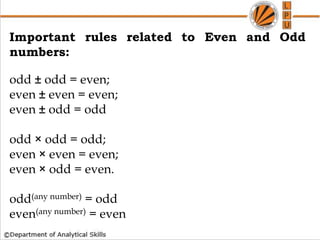
  • 84.
    Odd Factors: Example: 4500 4500= 45 x 100 = 9 x 5 x 10 x 10 = 3 x 3 x 5 x 5 x 2 x 5 x 2 4500 = 22 x 32 x 53 Here consider A = 2 , B = 3 , C = 5 , p= 2 , q = 2 and r = 3 Here identifying that odd number are 3 and 5 Numbers of odd factors of number 4500 = (q + 1 ) (r + 1) = 3 x 4 = 12 Note: Do not consider even prime factor
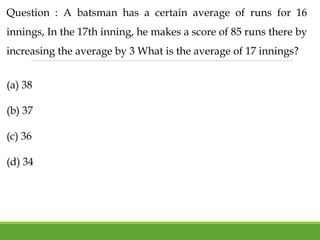
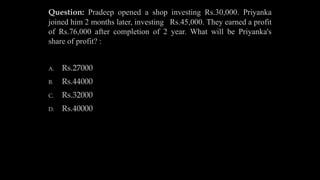
  • 85.
    Question: How manyfactors of 340 are even. [A] 12 [B] 16 [C] 8 [D] 6
  • 86.
    Question: How manyfactors of 408 are even. [A] 12 [B] 16 [C] 8 [D] 10
  • 87.
    8. In howmany ways a number can be written as a product of its two factors: It is given by (Total Factors/2) Note: If the total number of factors are odd then Product of two number= (total factors+1)/2
  • 88.
    9. In howmany ways a number can be written as a product of its two co-prime factors: It is given by 2^(N – 1) Where N= no. of prime factors of that number
  • 89.
    Question: In Howmany ways 320 can be written as a product of its two co-prime factors . [A] 2 [B] 6 [C] 1 [D] 5
  • 90.
    Question: In Howmany ways 12 can be written as a product of its two co-prime factors . [A] 2 [B] 6 [C] 8 [D] 6
  • 91.
    Factors will occurin pairs for the numbers except perfect squares. Example 1: A non perfect square number- 10 1 x 10 = 10 2 x 5 = 10 ‘∴ Factors of 10 are 1, 2, 5 and 10. Non perfect squares will have even number of factors
  • 92.
    Example 2: Aperfect square number- 16 1 x 16 = 16, 2 x 8 = 16, 4^2 = 16 ∴ Factors of 16 are 1, 2, 4, 8 and 16. Every perfect square will have odd number of factors because its square root number will pair with itself. This has odd number of factors because 4 will pair with itself. Every perfect square will have odd number of factors because its square root number will pair with itself.
  • 93.
    Example 3: Aprime square number- 49 The factors of 49 are 1, 7 and 49. Prime square number will have exactly 3 factors (1, that number itself and square root of that number). If N is a prime square number then the factors are 1, N and √N.
  • 94.
    Trailing zeros (Numberof zeros at the end) Concept: In multiplication zero can be produced when we have a pair of 2 and 5. So, in order to find no. of zeros at the end, the pair of 2 and 5 need to be counted. Example: 2^3 x 5 x 9 x 8 x 24 x 15 Find number of zeros at the end.
  • 95.
    How to findTrailing zeros in any n! : Ex: Find number of zeros in 10! Answer: 10! = 1x2x3x4x5x6x7x8x9x10 Note: For any factorial value number of 5s are always less than number of 2s. So our concern will be to find number of 5. For counting 5s in any n! value we divide n by powers of 5. = [n/5] + [n/5^2] + [n/5^3] + [n/5^4]+…………
  • 96.
    Question: Find numberof trailing zeros in 100! [A] 24 [B] 25 [C] 26 [D] 27
  • 97.
    Question: Find numberof trailing zeros in 154! [A] 35 [B] 31 [C] 34 [D] 37
  • 98.
    Question: Find numberof trailing zeros in 56! [A] 13 [B] 11 [C] 12 [D] 6
  • 99.
    Question: Find numberof trailing zero in 100!+200! [A] 24 [B] 49 [C] 73 [D] None of these
  • 100.
    Question: Find numberof trailing zero in 100! X 200! [A] 24 [B] 49 [C] 73 [D] None of these
  • 101.
    LCM- Least CommonMultiple LCM of given numbers X,Y,Z is the Least number which is exactly divisible by all the given numbers X,Y,Z. OR we can say it is the least multiple of all the given numbers. For e.g. 12= 12, 24, 36, 48, 60, 72, 84, 96………… 16= 16, 32, 48, 64, 80, 96………… So there are lots of multiple of 12 and 16 which will be common but the least multiple which is common is 48. That is the LCM of 12 and 16. LCM AND HCF
  • 102.
    FINDING L.C.M. OFBIG NUMBERS Step 1 Find all the prime factors of both numbers. Step 2 Multiply all the prime factors of the larger number by those prime factors of the smaller number that are not already included
  • 103.
    HCF- Highest CommonFactor HCF of given numbers X,Y,Z is the greatest number which exactly divides all the given numbers X,Y,Z. Sometimes called Greatest Common divisor(G.C.D.) For e.g. 12= 1, 2, 3, 4, 6, 12 16= 1, 2, 4, 8, 16 So there three common factor=1, 2, 4 but the Greatest factor is 4. That is the HCF of 12 and 16.
  • 104.
    FINDING THE H.C.F.OF BIG NUMBERS For larger numbers you can use the following method: Step 1 Find all prime factors of both numbers. Step 2 Write both numbers as a multiplication of prime numbers. Step 3 Find which factors are repeating in both numbers and multiply them to get H.C.F
  • 105.
    Product of Twonumbers = HCF × LCM Important Formulae
  • 106.
    Question Answer The Leastnumber which is exactly divisible by x, y and z LCM(x, y, z) The least number which when divided by x, y, z leaves the same remainder R in each case LCM (x, y, z) + R The least Number which when divided by x, y and z, leaves remainder a, b and c respectively LCM (x, y, z)-K Where K=(x-a)=(y-b)=(z-c) LCM Word Problems
  • 107.
    Question Answer The greatestnumber that will exactly divide x, y and z HCF(x, y, z) The greatest number that will divide x, y, z and leaves remainder R in each case HCF(x-y, y-z, z-x) OR HCF(x-R, y-R, z-R) The greatest Number that will divide x, y and z, leaving remainder a, b and c respectively HCF(x-a, y-b, z-c) HCF Word Problems
  • 108.
    Q) Find thelowest common multiple of 24, 36 and 40. [A] 120 [B] 240 [C] 360 [D] 480
  • 109.
    Q) The leastnumber which is exactly divisible by 8, 16, 40 and 80 is: [A] 16 [B] 120 [C] 80 [D] None
  • 110.
    Q) The greatestnumber that will exactly divide 36 and 84 is: [A] 4 [B] 6 [C] 12 [D] 18
  • 111.
    Q) The greatestpossible length which can be used to measure exactly the lengths 7 m, 3 m 85 cm, 12 m 95 cm is: [A] 15 [B] 25 [C] 35 [D] 42
  • 112.
    Q) Four bellsring at an interval 3min, 4min, 5min and 6 minutes respectively. If all the four bells ring at 9am first, when will it ring again?
  • 113.
    Q) The H.C.F.of two numbers is 11 and their L.C.M. is 7700. If one of the numbers is 275, then the other is: [A] 308 [B] 310 [C] 312 [D] None
  • 114.
    Q) The H.C.Fof 9/10, 12/25, 18/35, and 21/40 is? [A] 3/1400 [B] 5/1400 [C] 7/1400 [D] None
  • 115.
    Q) Which ofthe following fraction is the largest? 7/8, 13/16, 31/40, 63/80 [A] 7/8 [B] 13/16 [C] 31/40 [D] 63/80
  • 116.
    Q) Three numberare in the ratio of 3 : 4 : 5 and their L.C.M. is 2400. Their H.C.F. is: [A] 40 [B] 80 [C] 120 [D] 200
  • 117.
    Q) The ratioof two numbers is 3 : 4 and their H.C.F. is 4. Their L.C.M. is: [A] 12 [B] 16 [C] 24 [D] 48
  • 118.
    Q) The leastnumber, which when divided by 12, 15, 20 and 54 leaves in each case a remainder of 8 is: [A] 504 [B] 536 [C] 544 [D] 548
  • 119.
    Q) Find thesmallest number, which when divided by 3, 4 and 5 leaves remainder 1, 2 and 3 respectively? [A] 60 [B] 53 [C] 58 [D] None
  • 120.
    Q) The greatestnumber which on dividing 1657 and 2037 leaves remainders 6 and 5 respectively, is: [A] 123 [B] 127 [C] 235 [D] 305
  • 121.
    Q) Find thegreatest number that will divide 43, 91 and 183 so as to leave the same remainder in each case. [A] 4 [B] 7 [C] 9 [D] 13
  • 122.
    Q) The productof two numbers is 4107. If the H.C.F. of these numbers is 37, then the greater number is: [A] 101 [B] 107 [C] 111 [D] 185
  • 123.
    An Arithmetic Progression(A.P.) is a sequence in which the difference between any two consecutive terms is constant. Let a = first term, d = common difference  Then nth term ARITHMETIC PROGRESSION
  • 124.
  • 125.
    AM (Arithmetic mean) Ifa, b, c are in AP then the arithmetic mean is given by b = (a+c)/2
  • 126.
    Inserting AM To insertk means between a and b the formula for common difference is given by d = (b-a) / (k+1) For example: Insert 4 AM’s between 4 and 34 d= (34 - 4) / (4+1) = 30/5 = 6 ∴ The means are 4+6=10 10+6=16 16+6=22 22+6=28
  • 127.
    Question: 1,3,5, 7,…….. Which term of this AP is 55? [A] 25th [B] 26th [C] 27th [D] 28th
  • 128.
    Question: Find the15th term of the series 20,15,10,…….. [A] -45 [B] -50 [C] -55 [D] 0
  • 129.
    Question: How manyterms are there in the AP 20, 25, 30, …….. 130? [A] 21 [B] 22 [C] 23 [D] 24
  • 130.
    Question: Find thesum of the series 5,8,11,…….. 221 [A] 8249 [B] 8239 [C] 7886 [D] 9000
  • 131.
    Question: Find thesum of all 2-digit numbers, which are exactly divisible by 9? [A] 525 [B] 565 [C] 575 [D] 585
  • 132.
    Question: Find thefirst term of an AP whose 8th and 12th terms are 39 and 59 respectively? [A] 3 [B] 4 [C] 5 [D] 6
  • 133.
    GEOMETRIC PROGRESSION A geometricsequence are powers rk of a fixed number r, such as 2k and 3k. The general form of a geometric sequence is
  • 135.
    GM ( Geometricmean) If a, b, c are in GP Then the GM is given by b = √ac
  • 136.
    Inserting GM To insertk means between a and b the formula for common ratio is given by r = (b/a)^(1/(k+1)) For example: Insert 4 GM’s between 2 and 486 r = (486/2)^(1/(4+1)) = (243)^(1/5) = 3 ∴ the means are 2x3 = 6 6x3 = 18 18x3 = 54 54x3 = 162
  • 137.
    Question: How manyterms are there in the sequence 5, 20, 80, 320, …….. 20480? [A] 5 [B] 6 [C] 7 [D] 8
  • 138.
    Question: If thefirst and fifth term of a GP are 16 and 81 respectively then find the fourth term? [A] 18 [B] 24 [C] 36 [D] 54
  • 139.
    Question: Find thesum of the series 2, 4, 8, 16…. 256. [A] 510 [B] 1020 [C] 520 [D] None
  • 140.
  • 141.
  • 144.
    Some properties ofAverage: If we have N number of observation as a1, a2, a3, a4 …………aN and their average is A, then 1. If we add or subtract the same value (suppose x) from all the observations then average will be directly added or subtracted by x. 2. If we multiply or divide each observation by a same value (Suppose x), then average also multiplied or divided by the same value x.
  • 145.
    If terms arein A.P or consecutives 1.If the terms are consecutives or are in A.P then average is always the middle term of the sequence if the number of observations are odd. 2.If number of observations are even then average is the average of two middle numbers.
  • 146.
    Question : Findthe average weight of 5 boys having weights 30kg, 40kg, 50kg, 60kg, 70kg? (a) 50 kg (b) 40 kg (c) 45 kg (d) 55 kg
  • 147.
    Question : Findthe average of 50, 52, 54, 56, …………150 (a) 80 (b) 90 (c) 100 (d) 110
  • 148.
    Question : Findthe average of all even numbers up to 100. (a) 50 (b) 51 (c) 52 (d) 55
  • 149.
    Question : Findthe average of 1, 3, 5, 7, 9, 11, 13, 15, 17, 19, 21 (a) 11 (b) 9 (c) 13 (d) 15
  • 150.
    Question : Findthe average of 13, 16, 19, 22, 25, 28 (a) 22 (b) 19 (c) 19.5 (d) 20.5
  • 151.
    Question : Ifthe average of 5 consecutive number is 21. Find the largest number. (a) 22 (b) 23 (c) 24 (d) 25
  • 152.
    Question : Ifthe average of 5 consecutive odd number is 25, then find the smallest number. (a) 23 (b) 21 (c) 29 (d) 19
  • 153.
    Question : Findthe average of first 100 natural numbers. (a) 50 (b) 50.5 (c) 51 (d) 49
  • 154.
    Question : Findthe average of first 100 whole numbers. (a) 50 (b) 50.5 (c) 49.5 (d) 49
  • 155.
    Question : Theaverage of first 10 even numbers is? (a) 18 (b) 22 (c) 9 (d) 11
  • 156.
    Question : Findthe average of first 17 multiples of 5? (a) 50 (b) 85 (c) 45 (d) 60
  • 157.
    COMBINED AVERAGE Class A 0 ClassB 100 What is the combined average? 50 marks?? NO We cannot determine the average without knowing the number of students in each class The combined average depends on the number of students and the average in each class
  • 159.
    Question : Thereare 36 students in a class A whose average weight is 30kg and 24 students in class B whose average is 40kg. What will be the average if the classes are combined? (a) 35 (b) 34 (c) 36 (d) 32
  • 160.
    Question : Thereare 63 students in a class A whose average weight is 32kg and 21 students in class B whose average is 44kg. What will be the average if the classes are combined?? (a) 33 (b) 35 (c) 36 (d) 38
  • 161.
    Question : Ina class there are 20 boys and 40 girls. The average age of boys is 18 years and that of girls is 15 years. What will be the average age of the whole class? (a) 16.5 Years (b) 17 years (c) 16 years (d) 14.2 Years
  • 162.
    Question : Theaverage of marks obtained by 120 candidates was 35. If the average of passed candidate was 39 and that of failed candidate was 15, the number of candidates who passed the examination is? (a) 100 (b) 110 (c) 120 (d) 150
  • 163.
    Question : Aman goes from home to his office at speed of 40km/h and return from office to home at a speed of 60Km/h. Find the average speed during whole journey. (a) 45 Km/h (b) 48Km/h (c) 50Km/h (d) 55Km/h
  • 164.
    Equal Distribution ofData Example: Average of 5 students marks is 30. If one student having 90 mark is added to the team, then what will be the new average ?
  • 166.
    Question : Ifthe average weight of 10 students in a class is 30Kg, when weight of teacher is also included new average becomes 33. Find weight of teacher. (a) 63Kg (b) 54Kg (c) 66Kg (d) 70Kg
  • 167.
    Question : Theaverage weight of a class of 24 students is 30Kg when weight of the teacher is also included the average weight is increases by 1Kg.What is the weight of teacher in kg? (a) 60Kg (b) 61Kg (c) 37Kg (d) 55Kg
  • 168.
    Question : Theaverage weight of 8 person increases by 2.5 kg when a new person comes in place of one of them weighing 65 kg. What might be the weight of the new person? (a) 70Kg (b) 80Kg (c) 75Kg (d) 85Kg
  • 169.
    Question : Ateacher while calculating the average marks of 30 students of an examination, by mistake enter a student’s marks as 68, instead of 86 and obtained the average as 58. Find the actual average. (a) 59 (b) 60 (c) 58.6 (d) 60.5
  • 170.
    Question : AStudent’s marks were wrongly entered as 83 instead of 63. Due to that the average marks of the class got increased by 2. The number of students in class is? (a) 10 (b) 12 (c) 15 (d) 18
  • 171.
    Question : Theaverage age of a committee of 12 members is 48 Years. A member of age 62 retired and in place a new person aged 26 joined the committee. Find the new average of the committee. (a) 44 (b) 45 (c) 46 (d) 47
  • 172.
    Question : Averageof 5 numbers is 27, if one number is excluded the new average becomes 25. Find the excluded number. (a) 35 (b) 30 (c) 38 (d) 25
  • 173.
    Question : Theaverage of a family is 24 years which is consisting of 5 members, out of which the youngest being 6 years old. What would be the average age of family just before his birth? (a) 20 (b) 22 (c) 22.5 (d) 23.5
  • 174.
    Question : Theaverage age of 10 members in a committee is increased by 3 years when two men whose ages are 25 years and 35 years are replaced by two new men. Find the average age of two new men. (a) 40 (b) 45 (c) 48 (d) 52
  • 175.
    Question : Averageof 7 values is 20. If average of first 4 is 15 and that of last 4 is 25. Find the 4th number. (a) 20 (b) 25 (c) 30 (d) 40
  • 176.
    Question : Theaverage marks of some students is 40 and 10 of them get 60 marks instead of 90 marks by mistake. After correction, the new average becomes 50. Find the number of students. (a) 20 (b) 30 (c) 25 (d) 35
  • 177.
    Question : Ina hostel there are 30 students and if the number of students increased by 5 then the expense is increased by 40 per day. But the average expenditure diminishes by 3. Find the original expenditure. (a) 810 (b) 870 (c) 910 (d) 950
  • 178.
    Question : Abatsman has a certain average of runs for 16 innings, In the 17th inning, he makes a score of 85 runs there by increasing the average by 3 What is the average of 17 innings? (a) 38 (b) 37 (c) 36 (d) 34
  • 179.
    Question: A ballerwhose balling average is 12.4 runs/wicket. He played his next match and takes 5 wickets for 26 runs; therefore, his average is reduced by 0.4. Find the total number of wickets taken by the baller. (a) 80 (b) 85 (c) 90 (d) 75
  • 180.
    Question: The averagetemperature in Delhi for the first four days of the month was reported as 58°C. It reported as 60°C for 2nd, 3rd, 4th and 5th days. The ratio of the temperatures of 1st and 5th day was 7 : 8. Find the temperature on the first day. (a) 42 (b) 46 (c) 63 (d) 56
  • 181.
    Question: The averagetemperature of Monday, Tuesday and Wednesday is 34°C. The average temperature of Tuesday, Wednesday and Thursday is 32°C. If the temperature of Thursday is 28°C, then find the temperature of Monday. (a) 34 (b) 36 (c) 40 (d) 42
  • 182.
    Question: 6 friendswent to a hotel for taking their lunch. 5 of them spent Rs.32 each while the 6th person spent 80 more than the average expenditure of all the 6 person. Find the total money spend on lunch. (a) 280 (b) 178 (c) 285 (d) 288
  • 183.
    Question: 7 friendswent to a hotel for taking their lunch. 6 of them spent Rs.60 each while the 7th person spent 240 more than the average expenditure of all the 7 person. Find the total money spend on lunch. (a) 280 (b) 700 (c) 750 (d) 650
  • 185.
  • 186.
    Concept to discuss 1.Conversion of percentage to fraction and vice versa 2. X % of Y = Y% of X 3. Percentage change 4. Percentage Increase and decrease concept 5. Successive increase and decrease 6. Consumption and Expenditure 7. Examination , election and population
  • 187.
    Percentage: Per meansdivided and cent means 100. To convert any value on the base of hundred. Conversion of percentage to fraction: To convert percentage to fraction, divide that percent value by 100. E.G. 50% = 50/100 = ½ 25% = 25/100 = ¼ Conversion of fraction to percentage: To convert fraction to percentage multiply the fraction by 100. For e.g. 3/8 = (3/8)*100 = 37.5 %
  • 189.
    Question : Find55.55 % of 45. Question : Find 45.45 % of 44
  • 190.
    X % ofY = Y% of X Question : Find 45% of 133.33 Answer : 45% of 133.33 = 133.33 % of 45 = (100+33.33)% of 45 = (1+1/3) * 45 = 4/3 * 45 = 60
  • 191.
    Percentage Change • 40is what percent of 60? • 60 is how much percent greater than 40? • 40 is how much percent lesser than 60?
  • 192.
    Question : IfA’s salary is 20 % more than B, then by how much Percent B’s salary is less than A. (a)20% (b)25% (c)16.66% (d)30%
  • 193.
    Question : IfA’s marks in an exam is 40 % less than B then by how much % B’s marks are more than A. (a)40 % (b)60 % (c)66.66 % (d)20 %
  • 194.
    Question : If16(2/3) % of a number is added to itself the number becomes 700. Find original number. (a)400 (b)600 (c)800 (d)700
  • 195.
    Question: A studentmultiplied a number by 3/5 instead of 5/3 What is the percentage error in the calculation? (a) 44% (b) 64% (c) 40% (d) 60%
  • 196.
    Question: The numberwas being multiplied by 5/6. By mistake it is divided by 5/6. Find percentage error in result. (a) 44% (b) 64% (c) 40% (d) 60%
  • 198.
    Question : Priceof petrol first increased by 20% and then it is decreased by 10% . Find the net change in the price. (a)8 % increase (b) 2 % decrease (c) 10 % increase (d) 8 % decrease
  • 199.
    Question : Demandof a car went down by 25 % in 2016 and 20 % in 2017. What is net % decrease in demand? (a) 45 % (b) 40 % (c) 50 % (d) 60 %
  • 200.
    Question : Ifthe length of a rectangle is increased by 20 % and width is decreased by 30% then find the resultant change in area. (a) 16 % (b) 20 % (c) 24 % (d) 28 %
  • 201.
    Question : Anumber is first increased by 15% and then decreased by 20%. The number so obtained is 64 less than the original number. What is the original number? (a) 600 (b) 750 (c) 800 (d) 860
  • 202.
    Question :If theprice of petrol is raised by 20% then the percentage by which a car owner must reduce his consumption so that there is no change in expenditure. (a) 16.66 % (b) 18 % (c) 15 % (d) 25 %
  • 203.
    We know ,Expenditure = Price × Consumption Convert given % into fraction (a/n) • If Increase 𝑎 𝑛 Decrease 𝑎 𝑛+𝑎 For this case if 1/5 increase ------------- 1/6 decrease 1/6 = 100/6 % = 16.66 % • If Decrease 𝑎 𝑛 Increase 𝑎 𝑛−𝑎 For this case if 2/5 decrease --------------- 2/3 Increase
  • 204.
    Question :If theprice of sugar is decreased by 12.5% then the percentage by which one household must increase his consumption so that there is no change in expenditure. (a) 10 % (b) 8 % (c) 14.28 % (d) 12.5 %
  • 205.
    Question :If theprice of commodity is decreased by 20% and its consumption increased by 20%, what will be the change in expenditure. (a) 4 % increase (b) 4 % decrease (c) 8 % decrease (d) 8 % increase
  • 206.
    Question: If theprice of sugar is increased by 25% then by how much percent consumption should be reduced so that the expenditure will increase by only 5% (a) 25% (b) 15% (c) 16% (d) 20%
  • 207.
    Question :If theprice of sugar is reduced by 20% due to which a person can buy 2kg more sugar for Rs. 200. Find the original price of sugar per kg. (a) Rs. 25 per Kg (b) Rs. 20 per Kg (c) Rs. 22 per Kg (d) Rs. 16 per Kg
  • 208.
    Question: The priceof sugar is increased by 30% due to this a housewife purchase 12 kg less sugar so that her expenditure will increase by 10% only. Find her original consumption. (a) 70 kg (b) 80 kg (c) 75 kg (d) 78 kg
  • 209.
    Question : Astudent scored 140 Marks and still failed by 35 marks. If the passing criteria of that exam is 35%. Then find the maximum marks of that exam. (a) 500 (b) 600 (c) 1000 (d) 700
  • 210.
    Question : Astudent scored 25 % in an examination and still failed by 30 marks while another candidate scored 50% marks and get 20 marks more than the passing marks. Then find the passing percentage. (a) 30 % (b) 40 % (c) 45 % (d) 50 %
  • 211.
    Question : Astudent scored 30 % in an examination and still failed by 12 marks while another candidate scored 40% marks and got 28 marks more than the passing marks. Then find the maximum marks in the examination. (a) 300 (b) 400 (c) 500 (d) 700
  • 212.
    Question: In anExam, 52% candidates failed in English, 42% in mathematics and 17% in both. What was the number of percentage of passed students in both subjects? (a) 23 (b) 77 (c) 6 (d) 94
  • 213.
    Question: In anExam, 70% candidates passed in English, 65% in mathematics and 27% failed in both. If 248 candidates was pass in both the subjects, then What was the total number of students? (a) 300 (b) 400 (c) 500 (d) 600
  • 214.
    Question : Thepopulation of a town is 50,000. It increases by 10% in the first year and 12% in the second year. What will be the population after 2 years. (a) 55000 (b) 61600 (c) 72700 (d) 84600
  • 215.
    Question : Thecurrent population of a town is 28,000.During the last 2 years the population increased at the rate of 16% and 20% per year. The population 2 years ago was (approximately) (a) 24000 (b) 22000 (c) 20000 (d) 18000
  • 216.
    Question : Rajuinvest 65% of his investment in a machine and 20% of his investment on raw material. If he has Rs. 6000 balance. Find the total money he had. (a) 30000 (b) 40000 (c) 50000 (d) 60000
  • 217.
    Question : Rajuspend 40% of his salary on house rent. On the remaining 10% spend on travel. On remaining 16(2/3) % spend on food and remaining is saved . Find the money he spent on food. (a) Rs. 450 (b) Rs. 400 (c) Rs. 500 (d) Rs. 600
  • 218.
    Question: In alibrary 20% of the books are in Hindi, 50% of the remaining in English and 30% of the remaining are in French and rest 6300 books are in regional language. Then find the number of books in library. (a) 20000 (b) 22500 (c) 35000 (d) 15000
  • 219.
    Question: In anElection between two candidates one got 65% of the votes and won by 300 votes. Find total no. of votes. (a) 1200 (b) 1500 (c) 1800 (d) 1000
  • 220.
    Question : Ina election of 2 candidate the candidate who gets 40% of the total votes rejected by 80 votes. Find total number of votes. (a) 450 (b) 400 (c) 500 (d) 600
  • 221.
    Question : Ina election of 2 candidate 12 % of the voters did not cast their votes. The winner by getting 45% of the total votes, defeated his rival by 2000 votes. Find the total number of voters. (a) 25000 (b) 50000 (c) 80000 (d) 100000
  • 222.
    Question: In anElection, 10% persons didn't cast their votes and 10% found to be invalid. The winner got 54% of valid votes and won by 1620 votes. Find total number of votes? (a) 12500 (b) 17500 (c) 25000 (d) 35000
  • 223.
    Question: In anelection two candidates participated. 20% voters did not cast their votes, out of which 600 votes declared invalid and the winner get 75% of valid votes and wins by 1500 votes. Find the number of total votes. (a) 3600 (b) 3000 (c) 4000 (d) 4500
  • 225.
  • 226.
    Cost Price: Theprice, at which an article is purchased, is called its cost price, abbreviated as C.P. Selling Price: The price, at which an article is sold, is called its selling price, abbreviated as S.P. Profit or Gain: If S.P. is greater than C.P., the seller is said to have a profit or gain. Loss: If S.P. is less than C.P., then the seller is said to have incurred a loss.
  • 228.
    MP= Rs. 600 CP=Rs.400 SP= Rs.500 Mark up= Rs. 200 Discount =Rs.100 Profit = Rs.100 A shopkeeper buys a T-shirt from whole sale market at Rs.400 and marked that article Rs.200 above the CP. After giving a discount of Rs.100 he sold it at Rs.500.
  • 229.
    In the previoussituation: Profit= Rs.100, Profit/Loss is always calculated on CP. So, %P= ? Markup= Rs.200, M is always calculated on CP. So, %M= ? Discount = Rs.100, Discount is always calculated on MP. So, %D= ? Relationship between Markup, Discount and Profit or Loss P% or L% = M – D - 𝑀𝐷 100
  • 232.
    Questions: A TVis purchased at Rs. 5000 and sold at Rs. 4000, find the lost percent. [A] 10% [B] 20% [C] 25% [D] 28%
  • 233.
    CP = Rs.500 P= 20 % SP = ? CP = Rs.800 L = 30 % SP = ?
  • 234.
    SP = Rs.720 P= 20 % CP = ? SP = Rs. 810 L = 10 % CP = ?
  • 235.
    Questions: When aplot is sold for Rs. 18,700, the owner loses 15%. At what price must that plot be sold in order to gain 15%? [A] Rs.21000 [B] Rs.22500 [C] Rs.25300 [D] Rs.25800
  • 236.
    Questions: Alfred buysan old scooter for Rs. 4700 and spends Rs. 800 on its repairs. If he sells the scooter for Rs. 5800, his gain percent is [A] 6/19% [B] 6/11% [C] 60/11% [D] 38/11%
  • 237.
    Question: If CPof 25 articles is equal to SP of 20 articles. Find the profit or loss percent. [A] 25% loss [B] 25% profit [C] 20 % profit [D] 20 % loss
  • 238.
    Question: If CPof 30 articles is equal to SP of 45 articles. Find the profit or loss percent. [A] 33.33 % loss [B] 33.33 profit [C] 20 % loss [D] 20 % profit
  • 239.
    Question: By selling12 articles a man earn a loss of which is equal to selling price of 4 articles. Find his loss percent. [A] 20 % [B] 25% [C] 33.33% [D] 16.66 %
  • 240.
    Question: By selling66m cloths a man earn a profit of equal to selling price of 6m cloths. Find his profit percent. [A] 20 % [B] 25 % [C] 10% [D] 33.33%
  • 241.
    Question: By selling40 articles a man earn a profit of equal to cost price of 5 articles. Find his loss or profit percent. [A] 33.33 % profit [B] 12.5 % loss [C] 25 % loss [D] 12.5 % profit
  • 242.
    Question: A shopkeeperbuy some number of article at the rate of 11 articles for Rs.10 and sold all of them at the rate of 10 articles for Rs.11. Find his profit or loss percent. [A] 20 % profit [B] 21% profit [C] 25 % loss [D] 21 % loss
  • 243.
    Question: A shopkeeperbuy some number of article at the rate of 12 articles for Rs.15 and sold all of them at the rate of 10 articles for Rs.14. Find his profit or loss percent. [A] 20 % loss [B] 33.33 % profit [C] 12 % profit [D] 12.5 % loss
  • 244.
    Question: A Shopkeeperbuy some lemons at rate of 2 for Rs.1. Again he bought the some number of lemons at rate of 1 for Rs.2. He mixed both the types and sold at 3 for Rs.3. find profit / loss %. [A] 20 % loss [B] 25 % loss [C] 20 % profit [D] 25 % profit
  • 245.
    Question: A shopkeeperpurchase some number of article for Rs.8400. He sold 3/5th of them at 15 % profit each. At what percent profit should he sell the remaining to gain overall 20 % profit. [A] 26% [B] 27% [C] 27.5% [D] None
  • 246.
    Question: A shopkeeperpurchase some number of article for Rs.5520. He sold 5/7th of them at 14 % profit each. At what percent profit should he sell the remaining to gain overall 18 % profit. [A] 20% [B] 25% [C] 33.33% [D] 28%
  • 247.
    Question: A shopkeeperpurchase some number of article for Rs.4500. He sold 1/3rd of them at 10 % loss each. At what percent profit should he sell the remaining to gain overall 20 % profit. [A] 30% [B] 25% [C] 35% [D] None
  • 248.
    Question: A shopkeeperprofesses to sell his goods at its CP, But he uses 950 gm. In place of 1 kg. Find his profit percent. [A] 12.5 % [B] 5% [C] 5.26% [D] 4%
  • 249.
    Question: A shopkeeperprofesses to sell his goods at its CP, But he uses 800 gm. In place of 1 kg. Find his profit percent. [A] 25% [B] 20% [C] 33.33% [D] 40%
  • 250.
    Question: A shopkeeperprofesses to sell his goods at 10% profit, But he uses 20% less weight. Find his total profit percent. [A] 37.5% [B] 45% [C] 25% [D] 20%
  • 251.
    Question: A shopkeeperprofesses to sell his goods at 44% loss, But he uses 30% less weight. Find his profit or loss percent. [A] 20% profit [B] 25% profit [C] 25% loss [D] 20% loss
  • 252.
    Question: A shopkeeperselling his goods at 7% loss. Had he sold it for Rs.800 more then he would get 9% profit. Find the CP of that article. [A] 500 [B] 6000 [C] 5000 [D] 4500
  • 253.
    Question: A shopkeeperselling his goods at 20% profit. Had he purchase it 10% less and sold it for Rs.18 less then he would get 30% profit. Find the initial CP of that article. [A] 540 [B] 600 [C] 1200 [D] 720
  • 254.
    Question: A shopkeeperselling his goods at 10% profit. Had he purchase it 20% less and sold it for Rs.20 more then he would get 40% profit. Find the initial SP of that article. [A] 1000 [B] 2000 [C] 1100 [D] 720
  • 255.
    Question: A shopkeeperselling his goods at 30% profit. Had he purchase it for Rs.2700 less and sold it for Rs.2700 less then he would get 10% more profit. Find the initial CP of that article. [A] 10000 [B] 10800 [C] 12500 [D] None
  • 256.
    Question: A shopkeepersold an article at 25% profit. If the CP and SP are decreased by Rs.20 and Rs.40 respectively then the profit percent would be decreased by 15 %. Find CP of the articles. [A] 120 [B] 200 [C] 180 [D] 240
  • 257.
    Question: A manpurchase some number of articles at the rate of 11 articles for Rs.1. How many articles should he sell for Rs.1 to gain 10% profit. [A] 11 [B] 10 [C] 12 [D] 14
  • 258.
    Question: A manpurchase 25 articles for Rs.1. How many articles should he sell for Rs.1 to gain 25% profit. [A] 21 [B] 28 [C] 20 [D] None
  • 259.
    Question: By selling32 articles for Rs.1 a man earn loss of 40 %. How many articles should he sell for Rs.1 to gain 20% profit. [A] 16 [B] 17 [C] 18 [D] 19
  • 260.
    Question: By selling45 articles for Rs.40 a man earn loss of 20 %. How many articles should he sell for Rs.24 to gain 20% profit. [A] 20 [B] 27 [C] 18 [D] None
  • 261.
    Question: A shopkeeperpurchase 2 articles for Rs.9600. He sold the first article at 20% loss and second article at 60% profit then he find that both the articles being sold on the same price. Find the CP of first article. [A] 6400 [B] 3200 [C] 6000 [D] 5400
  • 262.
    Question: A shopkeepersells 2 articles. He sold the first article at 15% loss and second article at 19% profit. During the whole transaction he earn a loss of Rs90. Find the CP of second article if the SP of both articles are same. [A] 5000 [B] 4500 [C] 2000 [D] None
  • 263.
    Question: A shopkeepersells 3 articles. He sold the first article at 20% profit, second article at 10% loss and third at 25% loss. During the whole transaction he earn a loss of Rs60. Find the SP of first article if the SP of all the articles are same. [A] 216 [B] 180 [C] 240 [D] None
  • 264.
    Problems on Discount: Questions:A bag marked at Rs80 is sold for Rs68. The rate of discount is: [A] 20% [B] 15% [C] 17 (11/17)% [D] 12%
  • 265.
    Questions: An itemwas sold at a price after giving two successive discount of 30% and 50 %. If the selling price of the item was Rs 448, then what was the marked price of the item? [A] 840 [B] 1280 [C] 1140 [D] none of these
  • 266.
    Questions: If aftergiving a discount of 12%, a profit of 10% was made on an article, then by what % was the price marked up? [A] 20% [B] 25% [C] 32.5% [D] 35%
  • 267.
    Questions: The costprice of a table is Rs 330. It is sold for a profit of Rs 30 after giving 10% discount find its marked price [A] Rs.400 [B] Rs.380 [C] Rs.420 [D] None
  • 268.
    Questions: A solda table to B at a profit of 15%. Later on, B sold it back to A at a profit of 20%, thereby gaining Rs. 69. How much did A pay for the table originally? [A] Rs.300 [B] Rs.320 [C] Rs.345 [D] Rs.350
  • 269.
    Question: Buy 5articles get 3 articles free. Find discount percent. [A] 33.33% [B] 12.5% [C] 37.5% [D] 60%
  • 270.
    Question: Buy 2articles get 1 article free. Find discount percent. [A] 50% [B] 33.33% [C] 20% [D] 25%
  • 271.
    Question: A retailerpurchase 70 pens at the mark price of 56 pens and sell them to a customer at their MP. Find the profit percent of shopkeeper. [A] 25% [B] 20% [C] 33.33% [D] 16.66%
  • 272.
    Question: A retailerpurchase 40 pens at the mark price of 36 pens and sell them at a discount of 1 %. Find the profit percent of shopkeeper. [A] 20% [B] 15% [C] 10% [D] None
  • 273.
    Question: By howmuch percent a shopkeeper should mark his goods above its CP so that he will gain 10% profit after giving 30% discount. [A] 200/7% [B] 400/7% [C] 100% [D] None
  • 274.
    Question: By howmuch percent a shopkeeper should mark his goods above its CP so that he will gain 10% profit after giving 10% discount. [A] 200/9 % [B] 110/9 % [C] 100/9 % [D] None
  • 275.
    Question: A shopkeepergives 10% discount on an article and earn 20% profit then find his profit percent if he will give 20% discount on the same article. [A] 16.66% [B] 5.66% [C] 6.66% [D] None
  • 276.
    Question: After giving20% discount a shopkeeper earn 30% profit then find his profit percent if he will give 25% discount on the same article.
  • 277.
    Question: A shopkeepergive 1 article free of every purchase of 15 article and also gives a discount of 4 % and after all that his profit percent is 35%. Find CP:MP. [A] 3:2 [B] 4:5 [C] 3:4 [D] 2:3
  • 278.
    Question: A shopkeepergive 4 articles free of every purchase of 12 articles and also gives a discount of 20 % and after all that his profit percent is 20%. Find CP:MP. [A] 1:2 [B] 2:1 [C] 5:7 [D] 3:2
  • 280.
  • 281.
    Principal The money borrowedor lent out for a certain period is called the principal or the sum. Interest Extra money paid for using other's money is called interest. Simple Interest If the interest on a sum borrowed for certain period is reckoned uniformly, then it is called simple interest.
  • 282.
    If P= Rs.1000,R=10% p.a. T=3 years. Find Simple Interest for 3 years.
  • 283.
    Let Principal =P, Rate = R% per annum (p.a.) and Time = T years. Then Simple Interest =(P x R x T)/100
  • 284.
    Question: Reena tooka loan of Rs. 1200 with simple interest for as many years as the rate of interest. If she paid Rs. 432 as interest at the end of the loan period, what was the rate of interest? [A] 3.6 [B] 6 [C] 18 [D] Can not be determined
  • 285.
    Question: A mantook loan from a bank at the rate of 12% p.a. simple interest. After 3 years he had to pay Rs. 5400 interest only for the period. The principal amount borrowed by him was: [A] Rs.2000 [B] Rs.10000 [C] Rs.15000 [D] Rs.20000
  • 286.
    Question: How muchtime will it take for an amount of Rs. 450 to yield Rs. 81 as interest at 4.5% per annum of simple interest? [A] 3.5 years [B] 4 years [C] 4.5 years [D] 5 years
  • 287.
    Question: The interestfor the 3rd year on a certain sum at a certain rate of simple interest is Rs.3000. find the sum of the interests accrued on it in the 6th, 7th and 8th years. [A] Rs.6000 [B] Rs.9000 [C] Rs.4500 [D] Rs.12000
  • 288.
    Question: A sumwas invest for 2 years. It will give Rs. 300 more, if invested at 3% higher rate. Find the sum. [A] Rs.4000 [B] Rs.5000 [C] Rs.6000 [D] Rs.10000
  • 289.
    Question: A sumamounts to Rs.1008 in 2 years and amounts to Rs.1112 in 3 years at SI. Find the sum and rate of interest per annum. [A] Rs.800, 13% pa [B] Rs.600, 12 % pa [C] Rs.800, 12% pa [D] Rs.600, 13% pa
  • 290.
    Question: S.I. OnRs 400 for 5 years together with that on Rs. 600, for 4 year to Rs. 132. If the Rate is same in both the case. Find rate % of interest? [A] 2% pa [B] 3% pa [C] 5% pa [D] 8% pa
  • 291.
    Question: A shopkeeperborrow Rs. 20,000 from two money lenders. For one loan, he paid 12% pa and for other 14% pa. After one year he paid Rs. 2560 as total interest. How much did he borrow each? [A] Rs.8000, Rs.12000 [B] Rs.12000, Rs.8000 [C] Rs.6000, Rs.14000 [D] Rs.14000, Rs.6000
  • 292.
    Question: Rs. 1500is invested in two such parts that if one part be invested at 6% and other at 5%, S.I= Rs. 85 for one year. Then how much was invested at 5%? [A] Rs.1000 [B] Rs.500 [C] Rs.600 [D] Rs.800
  • 293.
    Question: Rs. 8400is invested in two such parts that if one part be invested at 8% and remaining at 𝟔 𝟑 𝟐 % pa, his total interest after one and half year was Rs. 882. Then how much invested at different rates? [A] Rs.6300, Rs.2100 [B] Rs.6000, Rs.2400 [C] Rs.2400, Rs.6000 [D] Rs.2100, Rs.6300
  • 294.
    Question: Rs. 950is lend in two ways. The rate of S.I given on one part is 6% and on other part is 4%. If the S.I of 5 years is Rs. 200 then how much is given on 6%? [A] Rs.500 [B] Rs.400 [C] Rs.200 [D] Rs.100
  • 295.
    Question: If asum of money at simple interest doubles in 6 years, it will become 4 times in: [A] 12 years [B] 14 years [C] 16 years [D] 18 years
  • 296.
    Question: If asum of money at simple interest doubles in 8 years, it will become 4 times in: [A] 16 years [B] 24 years [C] 64 years [D] 32 years
  • 297.
    Question: Find thepresent value (in Rs.) of Rs.3000 due after 5 years at 10% p.a. simple interest. [A] Rs.1500 [B] Rs.1800 [C] Rs.2000 [D] Rs.2500
  • 298.
    Compound interest If P=Rs.1000, R=10% p.a. T=3 years. Find Compound Interest for 3 years.
  • 299.
    Compound Interest: Compound interestis the interest earned not only on the original principal, but also on all interests earned previously Let Principal = P, Rate = R% per annum, Time = n years. 1. When interest is compounded Annually: Amount= P(1+R/100)^n 2. When interest is compounded Half-yearly: Amount=P[1+(R/2)/100]^2n 3. When interest is compounded Quarterly: Amount=P[1+(R/4)/100]^4n
  • 301.
    Question: Find thecompound interest earned on Rs.20000 for 2 years at 10% p.a. the interest being compounded annually. [A] Rs.2100 [B] Rs.4200 [C] Rs.6300 [D] Rs.5600
  • 302.
    Question: Find theinterest earned in the first year on Rs.400 at 20%p.a. compound interest, the interest being compounded half yearly. [A] Rs.42 [B] Rs.72 [C] Rs.84 [D] Rs.144
  • 303.
    Question: Find CI.If P= Rs. 10000, r = 10 % p.a. and T= 1 year and 73 days. [A] Rs.2220 [B] Rs.3200 [C] Rs.2120 [D] Rs.1220
  • 304.
    Question: Find CI.If P= Rs. 10000, r = 10 % p.a. and T= 𝟐 𝟓 𝟑 year. [A] Rs.2226 [B] Rs.826 [C] Rs.2628 [D] Rs.2826
  • 305.
    Question: Find C.I.on Rs. 8000, 20% P.A. For 9 month compounded quarterly. [A] Rs.262 [B] Rs.1261 [C] Rs.9261 [D] Rs.831
  • 306.
    Question: If Rs.2000amounts to Rs.2880 in 2 years at compound interest, what is the rate of interest per annum if the interest is being compounded annually? [A] 10% [B] 20% [C] 15% [D] 25%
  • 307.
    Question: What willbe the difference between the S.I and C.I. On Rs. 600 for one year at 10% P.A, if compounded half yearly. [A] Rs.1.5 [B] Rs.15 [C] Rs.3.5 [D] Rs.35
  • 308.
    Question: A sumof money lent at C.I. For two years at 20% pa give Rs. 723 more if the interest was half year in place of annually. The sum is. [A] 30000 [B] 60000 [C] 40000 [D] 20000
  • 309.
    Question: If theS.I of certain money for 3 years is Rs. 225 & C.I on same money, same rate for 2 years is Rs. 153. then what was the principal amount? [A] Rs.875 [B] Rs.1875 [C] Rs.785 [D] Rs.1785
  • 310.
    Question: If thedifference between S.I and C.I at 4% P.A for 2 years is 20 Rs. What will be the value of principle amount? [A] Rs.50000 [B] Rs.12000 [C] Rs.12500 [D] Rs.25000
  • 311.
    Question: The differencebetween C.I and S.I at the some rate for Rs. 5000 for 2 years is Rs. 72. what is the rate of interest per annum? [A] 6% pa [B] 10% pa [C] 12% pa [D] 15% pa
  • 312.
    Question: Divide Rs.6100 between A & B, so that A’s share at the end of 3 year = B’s share at end of 5 year. C.I. Rate =20% pa. [A] 3600, 2500 [B] 2000, 4100 [C] 2500, 3600 [D] 4100, 2000
  • 313.
    Question: A sumdoubles in 8 years at compound interest. In how many years will the sum become 4 times the original sum if the interest is compounded annually? [A] 16 years [B] 24 years [C] 64 years [D] 32 years
  • 314.
    Question: A sumof money under compound interest doubles itself in 4 years. In how many years will it become 16 times itself? [A] 12 years [B] 16 years [C] 8 years [D] None of these
  • 315.
    Question: The differencebetween the compound interest and simple interest on a certain sum at 12% per annum for 2 years is Rs.126.72. Find the sum. [A] Rs.8000 [B] Rs.8800 [C] Rs.10200 [D] Rs.12400
  • 317.
    Unit-3 (PEA-305) 1. AlphabetTest 2. Series completion, Number and Alphabet series 3. Coding Decoding
  • 318.
    Alphabet Test: Types ofAlphabet Test: ⚫Alphabetical Order of Words ⚫Letter-Word problems ⚫Word formation by Unscrambling letters ⚫Word formation using letters of a given word ⚫Alpha-Numeric Sequence Puzzle
  • 319.
    Question: Which ofthe following words will come second in the English dictionary? [A] Magical [B] Magnify [C] Maternal [D] Marshal [E] Magnetic
  • 320.
    Question: Which ofthe following words will come in the middle if all of them are arranged alphabetically as in a dictionary? [A] Apology [B] Branch [C] Antigen [D] Antique [E] Antipathy
  • 321.
    Question: How manysuch pairs of letters are there in the word CORPORATE each of which has as many letters in the same sequence between them in the word as in the English alphabet? [A] 1 [B] 2 [C] 3 [D] More than 3 [E] None of the above
  • 322.
    Question: If theletters in the word UNDERTAKING are rearranged in the alphabetical order, which one will be in the middle in order after the rearrangement? [A] G [B] I [C] K [D] N [E] T
  • 323.
    Question: Which letterin the word CYBERNETICS occupies the same position as it does in the English alphabet? [A] C [B] E [C] S [D] I [E] Y
  • 324.
    Question: If thelast four letters of the word CONCENTRATION are written in reverse order followed by next two in the reverse order and next three in the reverse order and then followed by first four in the reverse order, counting from the left, which letter would be eighth in the new arrangement? [A] N [B] T [C] E [D] R
  • 325.
    Question: Select thecombination of numbers so that the letters arranged accordingly in the form of meaningful word. T I R B H G 1 2 3 4 5 6 [A] 1, 3, 2, 4, 6, 5 [B] 3, 2, 6, 5, 3, 1 [C] 4, 3, 2, 6, 5, 1 [D] 4, 5, 2, 3, 6, 1
  • 326.
    Question: Select thecombination of numbers so that the letters arranged accordingly in the form of meaningful word. T L P N A E 1 2 3 4 5 6 [A] 3, 2, 5, 4, 1, 6 [B] 3, 2, 5, 4, 6, 1 [C] 4, 5, 3, 6, 2, 1 [D] 4, 6, 1, 3, 5, 2
  • 327.
    Question: If theletters of the word ARTICULATES can be used as many times as one wants to use, then which one of the following four words cannot be formed? [A] COURTS [B] LATER [C] ELECTRIC [D] ARTICLE
  • 328.
    Question: Below aregiven four words in which some letters are missing. A group of three letters completes these words meaningfully. Select these three letters from the alternatives given. _ _ _ vent, _ _ _ nect, _ _ _ duct, _ _ _ dole [A] Cor [B] Coc [C] Cov [D] Con
  • 329.
    Question: ₤= βF 2 * K S 7 5 # $P L V 8 @ M U E 6 ∞Q G © 9 3 & T Y ¥ How many such letters are there in the arrangement each of which is either immediately preceded by a symbol or immediately followed by a number, but not both? [A] 3 [B] 4 [C] 5 [D] 6 [E] None of these
  • 330.
    Question: R E5 D A P $ 3 T I Q 7 9 B # 2 K % U 1 M W 4 * J 8 N Which of the following is exactly in the middle between 3 and 1 in the above arrangement? [A] B [B] K [C] 9 [D] # [E] None of these
  • 331.
    Question: R E5 D A P $ 3 T I Q 7 9 B # 2 K % U 1 M W 4 * J 8 N How many such numbers are there in the above arrangement, each of which is immediately preceded by a consonant and not immediately followed by a consonant? [A] None [B] 1 [C] 2 [D] 3 [E] None of these
  • 332.
    Question: R E5 D A P $ 3 T I Q 7 9 B # 2 K % U 1 M W 4 * J 8 N Which of the following is seventh to the left of the sixteenth from the left in the above arrangement? [A] A [B] U [C] 4 [D] T [E] None of these
  • 333.
    Series completion ➢In thistype of questions, some numbers and/or alphabetical letters are given. ➢ They all form a series and the series changes in certain order. ➢The series may also have one or more numbers/letters missing. ➢The students are required to observe that specific order in which the series changes and then complete the series. ➢Similarly, the students have to decide about the missing letter or number that would suit for the blank space if they continue to change in some order. Some common types are explained in the following slides.
  • 334.
    Tricks to solveseries completion Step 1: Observe are there any familiar numbers in the given series like primes numbers, perfect squares, cubes and so on which are easy to identify. Step 2: Calculate the differences between the numbers. Observe the pattern in the differences. If the differences are growing rapidly it might be a square series, cube series or multiplicative series. If the numbers are growing slowly, then it is an addition or subtraction series. If the differences are not having any pattern then 1. It might be a double or triple series. Here every alternate number or every 3rd number form a series 2.It might be a sum or average series. Here sum of two consecutive numbers gives 3rd number or average of first two numbers give next number Step 3: Sometimes number will be multiplied and will be added another number. So we need to check those patterns.
  • 335.
    Question: Find thenext term in the series. 2, 3, 5, 7, 11, 13, ........... [A] 15 [B] 17 [C] 19 [D] 21
  • 336.
    Question: Find thenext term in the series. 2, 5, 11, 17, 23, ...........41. [A] 29 [B] 31 [C] 33 [D] 37
  • 337.
    Question: Find thenext term in the series. 2, 5, 8, 11, 14, 17,...........,23. [A] 21 [B] 19 [C] 20 [D] 22
  • 338.
    Question: Find thenext term in the series. 45, 38, 31, 24, 17, ...........,3. [A] 15 [B] 14 [C] 10 [D] 12
  • 339.
    Question: Find thenext term in the series. 2, 6, 18, 54, 162,.........,1458 [A] 486 [B] 810 [C] 648 [D] 480
  • 340.
    Question: Find thenext term in the series. 3, 12, 48, 192,............,3072. [A] 384 [B] 576 [C] 768 [D] 960
  • 341.
    Question: Find thenext term in the series. 32, 48, 72, 108, .........., 243. [A] 132 [B] 162 [C] 160 [D] 154
  • 342.
    Question: Find thenext term in the series. 0, 4, 16, 36, 64, ........ 144. [A] 100 [B] 81 [C] 121 [D] 94
  • 343.
    Question: Find thenext term in the series. 0, 3, 8, 15, 24, 35, 48, .........., [A] 54 [B] 58 [C] 61 [D] 63
  • 344.
    Question: Find thenext term in the series. 2, 5, 10, 17, 26, 37, .........., 65. [A] 54 [B] 50 [C] 58 [D] 61
  • 345.
    Question: Find thenext term in the series. 2, 6, 12, 20, ............, 42. [A] 30 [B] 34 [C] 38 [D] 39
  • 346.
    Question: Find thenext term in the series. 1, 8, 27, 64, 125, 216, ......... . [A] 343 [B] 512 [C] 729 [D] 325
  • 347.
    Question: Find themissing term in the series : 3, 20, 63, 144, 275, ? [A] 354 [B] 468 [C] 548 [D] 554
  • 348.
    Question: Find themissing term in the series : 2, 5, 9, 19, 37, ? [A] 73 [B] 75 [C] 76 [D] 78
  • 349.
    Question: In followingalphabet series , one term missing as shown by question mark . Choose missing term from options. Y, W, U, S, Q, ?, ? [A] N, J [B] M, L [C] L, M [D] O, M
  • 350.
    Question: Find themissing term WFB, TGD, QHG, ? [A] NIJ [B] NIK [C] OJK [D] NLK
  • 351.
    Question: Which termcomes next in the sequence: AC, FH, KM, PR, ? [A] UW [B] VW [C] UX [D] TV [E] None of these
  • 352.
    Question: Find thenext term in the alpha-numeric series: Z1A, X2D, V6G, T21J, R88M, P445P, ? [A] N2676S [B] N2676T [C] T2670N [D] T2676N
  • 353.
  • 354.
    Alphabets in naturalseries are: A B C D E F G H I J K L M 1 2 3 4 5 6 7 8 9 10 11 12 13 N O P Q R S T U V W X Y Z 14 15 16 17 18 19 20 21 22 23 24 25 26 The Word EJOTY is very helpful in finding the position of the alphabet as: E J O T Y 5 10 15 20 25
  • 355.
    For example, ifwe want to find the position of the alphabet ‘S’, then as we know that ‘T’ is 20, so ‘S’ is 20 - 1 = 19. Also, we can find the position of an alphabet from the end by subtracting its value from 27. For example, the position of D from the end is 27 – 4 = 23. The pattern below is very useful to find many types of question in Alphabet Series when we write the last 13 alphabets in front of the first 13 alphabets of the English: A B C D E F G H I J K L M Z Y X W V U T S R Q P O N
  • 356.
    Letter Coding: Question: IfCOURSE is coded as FRXUVH, how is RACE coded as? [A] ABHF [B] UDFH [C] DUHF [D] WQYF
  • 357.
    Question: In acertain code, MONKEY is written as XDJMNL. How is TIGER written in that code? [A] QDFHS [B] FHSQD [C] DQSFH [D] STFDQ
  • 358.
    Question: If BOMBAYis written as MYMYMY, how will TAMIL NADU be written in that code? [A] YMNYMNYMN [B] ABHABHABH [C] ABCDABCDA [D] MNUMNUMNU
  • 359.
    Question: In acertain code, TOGETHER is written as RQEGRJCT. In the same code, what will PAROLE be written as? [A] PQJGNC [B] CNGJPQ [C] NCPQJG [D] NCJQPG
  • 360.
    Question: If ina certain code, TWENTY is written as 863985 and ELEVEN is written as 323039, how is TWELVE written in that code? [A] 203863 [B] 368302 [C] 863203 [D] 320368 Number Coding:
  • 361.
    Question: If ENGLANDis written as 1234526 and FRANCE is written as 785291, how is GREECE coded? [A] 117186 [B] 381191 [C] 131871 [D] 112235
  • 362.
    Question: In acertain code, if LOGIC is coded as 1512201824, how is PEARL coded as? [A] 112226915 [B] 113331596 [C] 112226710 [D] 113336734
  • 363.
    Question: If APPLEis written as 24991320, how is LOVELY coded as? [A] 13101310130 [B] 1310320130 [C] 13101350140 [D] 13101340120
  • 364.
    Question: If Z= 52 and ACT = 48, then BAT will be equal to: [A] 39 [B] 41 [C] 44 [D] 46
  • 365.
    Question: If teesee pee means drink fruit juice, see kee lee means juice is sweet, lee ree mee means he is intelligent, then which word means sweet? [A] see [B] pee [C] kee [D] tee Mixed Coding:
  • 366.
    Question: If ina certain code language, ‘col tip mot’ means ‘singing is appreciable‘, ‘mot baj min‘ means ‘dancing is good' ‘tip nop baj’ means ‘singing and dancing’. Which of the following stands for ‘good' in that language? [A] mot [B] baj [C] min [D] nop
  • 367.
    Question: If ina certain code language, ‘8 5 1’ means 'good sweet fruit‘, ‘7 8 3‘ means 'good red rose' ‘3 4 1’ means 'rose and fruit’. Which of the following digits stands for 'sweet' in that language? [A] 2 [B] 3 [C] 4 [D] 5
  • 368.
    Question: If ina certain code language, ‘2 5 6’ means ‘you are good‘, ‘6 3 7‘ means ‘we are bad' ‘3 5 8’ means ‘good and bad’. Which of the following digits stands for ‘and' in that language? [A] 5 [B] 6 [C] 7 [D] 8
  • 369.
    Question: If whiteis called blue, blue is called red, red is called yellow, yellow is called green, green is called black, black is called violet and violet is called orange, what would be the color of human blood? [A] Blue [B] Yellow [C] Black [D] Violet
  • 370.
    Question: If theanimals which can walk are called swimmers, animals who crawl are called flying, those living in water are called snakes and those which fly in the sky are called hunters, then what will a lizard be called ? [A] Flying [B] Swimmers [C] Snakes [D] Hunters
  • 373.
    In the ratioa : b, we call a as the first term or antecedent and b, the second term or consequent. E.g. The ratio 5 : 9 represents with antecedent = 5, consequent = 9 Rule: The multiplication or division of each term of a ratio by the same non-zero number does not affect the ratio
  • 374.
    Proportion: The equality oftwo ratios is called proportion. If a : b = c : d, we write a : b :: c : d and we say that a, b, c, d are in proportion. Then, 𝑎/𝑏=𝑐/𝑑 Here a and d are called extremes, while b and c are called mean terms. Product of means = Product of extremes. Thus, a : b :: c : d (b x c) = (a x d)
  • 375.
    Question: If 0.75: x :: 5 : 8, then x is equal to: [A] 1.12 [B] 1.2 [C] 1.25 [D] 1.30
  • 376.
    Fourth Proportional: If a: b = c : d, then d is called the fourth proportional to a, b, c. Third Proportional: a : b = b : c, then c is called the third proportion to a and b. Mean Proportional: Mean proportional between a and b is (ab)^1/2.
  • 380.
    Duplicate Ratios: Duplicate ratioof (a : b) is (a2 : b2). Sub-duplicate ratio of (a : b) is (a1/2 : b1/2). Triplicate ratio of (a : b) is (a3 : b3). Sub-triplicate ratio of (a : b) is (a1/3 : b1/3).
  • 381.
    Question: Find theduplicate ratio of 3:4? [A] 3:4 [B] 4:3 [C] 9:16 [D] 27:64 Question: Find the sub-triplicate ratio of 64:125? [A] 8:25 [B] 4:5 [C] 5:4 [D] 4:25
  • 382.
    Compound Ratio: ✓ Ifthe ratios are-- 4:3, 9:13, 26:5, 2:15 Then Ratio compounded = (4*9*26*2)/(3*13*5*15) = 16:25; Combined Ratio: ✓ If the ratios are- A:B= 1:2, B:C= 3:4, C:D= 6:9, and D:E= 12:16 Then A:B:C:D:E = 3:6:8:12:16 ✓ Speed ratio – A:B:C:D then Time ratio- (1/A): (1/B) : (1/C) : (1/D)
  • 426.
  • 427.
    Mixture: Mixing oftwo or more than two type of quantities gives us a mixture. Example: Quantities of these elements can be expressed as percentage or ratio.(20% of sugar in water) Fraction ( A solution of sugar and water such that sugar : water = 1:4)
  • 428.
    Alligation : Alligationis a rule which is used to solve the problems related to mixture and its ingredient. It is the rule that enables us to find the ratio in which two or more ingredients at the given price must be mixed to produce a mixture of desired price.
  • 429.
    Alligation Rule :When two elements are mixed to make a mixture and one of the elements is cheaper and other one is costlier then,
  • 430.
    Cost Price of Cheaper [C ] Cost Price of Dearer [ D ] Cost Price of Mixture [ M ] (D-M) (M-C)
  • 431.
    Note: (1) Meanvalue lies between cheaper Value and dearer value. (2) All the three values in alligation rule should be same type having same unit. For e.g. Cost price.
  • 432.
    1. In whatratio must a grocer should mix two varieties of pulses costing Rs.15 /Kg and Rs.20/Kg respectively so as to get a mixture worth Rs.16.50/Kg? [A] 7 : 3 [B] 4 : 5 [C] 6 : 4 [D] None of the above
  • 433.
    2. Find theratio in which rice at Rs.7.20 a Kg be mixed with rice at Rs. 5.70 a Kg to produce a mixture worth Rs. 6.30 a Kg? [A] 1 : 3 [B] 2 : 3 [C] 3 : 4 [D] 4 : 5
  • 434.
    3. In whatratio must a grocer mix two varieties of tea worth Rs. 60 a kg and Rs. 65 a kg so that by selling the mixture at Rs. 68.20 a kg he may gain 10%? [A] 3 : 2 [B] 3 : 5 [C] 3 : 6 [D] None of the above
  • 435.
    4. How manykg of tea worth Rs. 25/kg must be blended with 30 kg of tea worth Rs. 35/kg so that by selling the blended variety at Rs. 33/kg there should be a gain of 10%? [A] 36 Kg [B] 40 Kg [C] 32 Kg [D] None of the above
  • 436.
    5. A dishonestmilkman professes to sell his milk at cost price but he mixes it with water and thereby gains 25%. The percentage of water in the mixture is: [A] 20% [B] 10 % [C] 11 % [D] None of the above
  • 437.
    6. In whatratio must water be added to spirit to gain 10% by selling it at the cost price? [A] 1 : 11 [B] 1 : 5 [C] 1 : 10 [D] 1 : 9
  • 438.
    7. Sea watercontains 5% salt by weight. How many kilograms of fresh water must be added to 40kg of sea water for the salt content of the solution to be 2%? [A] 50 [B] 60 [C] 65 [D] 70
  • 439.
    8. A mixtureof 45 L of spirit and water contains 20% of water in it. How much water must be added to it to make the water 25% in the new mixture? [A] 3 L [B] 4 L [C] 5 L [D] 6 L
  • 440.
    9. In azoo, there are rabbits and pigeons. If head are counted, there are 200 and legs are 580. How many rabbits are there ? [A] 110 [B] 90 [C] 80 [D] 120
  • 441.
    10. A manhas 90 pens. He sells some of these at profit of 15 % and rest at 9% profit. On the whole transaction he gets a profit of 11%.How many pens did he sell at 9% profit. [A] 60 [B] 50 [C] 40 [D] 70
  • 442.
    11. A traderhas 25 kg of rice. A part of which he sold at 4% profit and rest at 9% profit. His overall gain is 7%. What is the quantity he sold at 9% profit? [A] 9 Kg [B] 10 Kg [C] 12 Kg [D] 15 Kg
  • 443.
    12. A manbuys two cows for Rs. 1350 and sells one for loss of 6% and the other for gain of 7.5% and on the whole he neither gains nor loses. What does each cow cost? [A] Rs. 850, Rs.500 [B] Rs. 650, Rs. 700 [C] Rs. 750, Rs. 600 [D] Rs. 550, Rs. 800
  • 444.
    13. There are50 students in a class, Rs. 320 are distributed among them so that each boy get 10 Rs. and each girl get 5 Rs. Find no. of girls.? [A] 36 [B] 18 [C] 14 [D] 7
  • 445.
    14. A merchantborrowed Rs.3500 from two money lenders. For one loan he paid 14% p.a. and for other 18% p.a. Total interest paid for one year was Rs.525. How much did he borrow at 18% p.a. [A] Rs.875 [B] Rs.625 [C] Rs.750 [D] Rs.1000
  • 446.
    15. A mantravels 80 km in 7 hrs. Some part on foot with 8kmph and rest on cycle with 16kmph. Find the distance covered by cycle. [A] 16 Km [B] 32 Km [C] 24 Km [D] 48 Km
  • 447.
    16. In whatratio must a person mix three kinds of tea costing Rs.60/kg, Rs.75/kg and Rs.100 /kg so that the resultant mixture when sold at Rs.96/kg yields a profit of 20%? [A] 1 : 2 : 4 [B] 3 : 7 : 6 [C] 1 : 4 : 2 [D] None of these
  • 448.
    17. Find outthe ratio of new mixture so that it will cost Rs 1.40 per kg from the given three kinds of rice costing Rs 1.20, Rs 1.45 and Rs 1.74. [A] 39 : 20 : 20 [B] 30 : 20 : 30 [C] 30 : 29 : 29 [D] None of these
  • 449.
  • 450.
    18. In 28Lmixture of milk and water the ratio of milk and water is 5:2. How much quantity of water is to be added so that the milk and water becomes 2:5 [A] 60 L [B] 42 L [C] 40 L [D] 36 L
  • 451.
    19. A mixtureconsist Milk and water in 5:1. On adding 5 L water, the ratio becomes 5:2. Find quantity of milk in original mixture. [A] 5 L [B] 10 L [C] 15 L [D] 25 L
  • 452.
    20. Mixture consistMilk and water in 4:3. On adding 2 L of water, ratio becomes 8:7. find total quantity of final mixture. [A] 15 L [B] 30 L [C] 45 L [D] 60 L
  • 453.
    21. Two bucketcontains same amount of mixture of Milk and water in 9:5 and 4:3 resp. If these buckets are further mixed, find the ratio of milk and water in final mixture. [A] 11 : 17 [B] 17 : 11 [C] 9 : 8 [D] 8 : 9
  • 454.
    22. Two bucketcontains same amount of mixture of Milk and water in 9:5 and 4:3 resp. If these buckets are further mixed in 1:2, find the ratio of milk and water in final mixture. [A] 17 : 25 [B] 25 : 17 [C] 9 : 16 [D] 8 : 18
  • 455.
    23. Three equalglasses are filled with mixture of Milk and water in 3 : 1, 5 : 3 and 9 : 7 resp. If these glasses are further mixed, find the ratio of milk and water in final mixture. [A] 11:17 [B] 17:11 [C] 31 : 17 [D] 17 : 31
  • 456.
    24. Mixture consist80% Acid and rest water. A part of this mixture is replaced with same amount of water and new ratio becomes 4:3. find part of mixture which is replaced. [A] 1/5 [B] 2/5 [C] 1/7 [D] 2/7
  • 457.
    25. A tankis filled with mixture consist 3 part water & 5 part alcohol. A part of this mixture is drawn off and replaced with same amount of water. New mixture contains half water and half alcohol. find part of mixture which is replaced. [A] 1/5 [B] 2/5 [C] 1/7 [D] 2/7
  • 458.
    26. A bucketcontains two liquids A and B in 5:3. If 16 L of mixture is drawn off and replaced with same amount of liquid B, the ratio becomes 3:5. How much Liter bucket holds? [A] 40 L [B] 24 L [C] 26 L [D] 80 L
  • 459.
    27. Two vesselsA and B contain M and W in 4:3 and 2:3 resp. In what ratio the liquids may be mix to obtain a new mixture containing half milk and half water ? [A] 7 : 5 [B] 5 : 7 [C] 1 : 4 [D] 1 : 2
  • 460.
    28. Two vesselsA and B contain M and W in 8:5 and 5:2 resp. In what ratio the liquids may be mix to obtain a new mixture containing 69and(3/13) % milk ? [A] 2 : 7 [B] 7 : 2 [C] 5 : 6 [D] 6 : 5
  • 461.
    Removal and Replacement Ifa vessel contains “x” liters of liquid A and if “y” liters be withdrawn and replaced by liquid B, then if “y” liters of the mixture be withdrawn and replaced by liquid B, and the operation is repeated ‘n’ times in all, then : F.C = I.C(1-y/x)n FC= Final concentration IC= Initial concentration y = no. of liters replaced x = Total concentration n = total number of iterations
  • 462.
    29. A containercontains 40 L milk. 4 L was taken out and replaced with water. This process is repeated further 2 times. Now how much milk is there in the mixture? [A] 28 L [B] 29.16 L [C] 27.16 L [D] 30 L
  • 463.
    30. A vesselcontains 125 liters of wine. 25 liters of wine was taken out of the vessel and replaced by water. Then, 25 liters of mixture was withdrawn and again replaced by water. The operation was repeated for third time. How much wine is now left in the vessel? [A] 49 L [B] 64 L [C] 72 L [D] 56 L
  • 464.
    31. 8 Lwas taken out from a cask full of wine and replaced with water. This operation is performed 3 more times. The ratio of quantity of wine left in the cask to that of water is 16:65. how much wine did the cask hold initially? [A] 12 L [B] 18 L [C] 24 L [D] 30 L
  • 465.
    32. A jarfull of whisky contains 40% alcohol. A part of this is replaced with another containing 19% alcohol. Now there is 26% alcohol. Find the quantity of whisky which is replaced. [A] 1/2 [B] 1/3 [C] 1/5 [D] 2/3
  • 466.
  • 467.
    Fundamental Principal ofcounting • Rule of product : If there are ‘m’ ways to do a process and there are ‘n’ ways to do another, then total number of ways of doing both process is given by ‘m x n’
  • 468.
    • If thereare 3 shirts and 2 pants then in how many ways a person can dress up for a seminar? P1 S1 P2 P1 S2 P2 P1 S3 P2 Directly, Total ways = 3 * 2 = 6 ways
  • 469.
    • Rule ofaddition : If there are ‘m’ ways to do a process and there are ‘n’ ways to do another and we can not do both at the same time, then there are ‘m + n’ ways to choose one of the actions.
  • 470.
    • If thereare 3 formal shoes and 2 casual shoes then in how many ways we can choose a footwear for a party. F1, F2, F3, C1, C2 F1 or F2 or F3 or C1 or C2 Total ways = 3 + 2 = 5 ways
  • 471.
    Question: Let usassume you have 3 shirts, 4 pants, 3 shoes and 2 sandals to wear. Find in how many ways you can decide an outfit. 1. Shirt – Pants – Shoes 2. Shirt – Pants – Sandal (3x4x3) + (3x4x2) = 60
  • 472.
    Note : Multiplication------- “ AND” (Stages) Addition------------- “ OR” (Choice)
  • 473.
    Difference between Permutationand Combination Permutation : Arrangement : Order matters Combination : Selection : Order doesn’t matters
  • 475.
    Question: If supposewe have 3 objects A, B, C then find no. of ways in which any 2 items can be selected. Answer: 1. AB (BA) 2. BC (CB) 3. CA (AC)
  • 476.
    Question: If supposewe have 3 objects A, B, C then find no. of ways to arrange any 2 items. Answer: 1. AB 2. BA 3. BC 4. CB 5. CA 6. AC
  • 477.
    Practice Question 1. Inhow many ways can we select a team of 4 players out of 15 eligible players. [A] 1365 [B] 1455 [C] 1295 [D] 1525
  • 478.
    2. In aclass there are 6 boys and 5 girls. In how many ways can a group of 5 members to be formed by selecting 3 boys and 2 girls. [A] 350 [B] 300 [C] 250 [D] 200
  • 479.
    3. In howmany ways 3 VIPs can be seated in 3 seats of first row of a function. [A] 3 [B] 4 [C] 5 [D] 6
  • 480.
    Note : Numberof ways of arranging ‘n’ different items in a row = n ! In previous question, 3 x 2 x 1 = 3! = 6 ways
  • 481.
    4. In howmany ways 5 medals of different games can be arranged in a shelf. [A] 100 [B] 110 [C] 120 [D] 150
  • 482.
    5. Suppose youhave to choose a 3 letter password. First letter is an alphabet, followed by a number and last one is an special character. There are 5 special character available. Find no. of ways to choose password. [A] 1050 [B] 1200 [C] 1300 [D] 1560
  • 483.
    6. How many2 digit numbers can be made from the digits 1, 2, 3 and 4 without repetition? [A] 24 [B] 18 [C] 12 [D] 6 Problems on Numbers
  • 484.
    7. How many4 digit numbers are possible with the digits 1, 2, 3, 6, 7, 8 and 9 without repetition? [A] 720 [B] 480 [C] 840 [D] 320
  • 485.
    8. How many4 digit numbers are possible with the digits 1, 2, 3, 6, 7, 8 and 9 if repetition is allowed? [A] 2401 [B] 820 [C] 343 [D] 729
  • 486.
    9. How many4 digit numbers can be made from the digits 7, 8, 5, 0, and 4 without repetition? [A] 70 [B] 96 [C] 84 [D] 48
  • 487.
    10. How many3 digit numbers greater than 400 can be made with the digits 2, 3, 4, 0, 5, 6 (digits cannot be repeated)? [A] 119 [B] 59 [C] 120 [D] 60
  • 488.
    11. How many3 digit numbers between 200 and 700 can be made with the digits 1, 3, 4, 0, 5, 6 (digits cannot be repeated) ? [A] 80 [B] 120 [C] 60 [D] None of these
  • 489.
    12. How many3 digit number can be formed with the digits 5, 6, 2, 3, 7 and 9 which are divisible by 5 and none of its digit is repeated? [A] 12 [B] 16 [C] 20 [D] 100
  • 490.
    13. How many4 digit number can be formed with the digits 0, 1, 2, 3, 4, 5, 6 which are divisible by 5 and none of its digit is repeated? [A] 120 [B] 100 [C] 220 [D] 320
  • 491.
    14. How many4 digit odd number can be formed with the digits 0, 1, 2, 3, 4, 5, 6 if none of its digit is repeated? [A] 120 [B] 100 [C] 220 [D] 300
  • 492.
    15. How many4 digit even number can be formed with the digits 0, 1, 2, 3, 4, 5, 6 if none of its digit is repeated? [A] 120 [B] 420 [C] 220 [D] 200
  • 493.
    16. Find theno of 3 digit numbers such that at least one of the digit is 6 (with repetitions)? [A] 252 [B] 345 [C] 648 [D] 560
  • 494.
    17. In Howmany different ways the letters of the word EQUATION can be arranged ? [A] 7! [B] 8! [C] 9! [D] 6! Problems on Words:
  • 495.
    18. In Howmany different ways the letters of the word EQUATION can be arranged, if it starts with letter Q ? [A] 7! [B] 8! [C] 9! [D] 6!
  • 496.
    19. In Howmany different ways the letters of the word EQUATION can be arranged, if it starts with consonants? [A] 7! [B] 8! [C] 2*7! [D] 3*7!
  • 497.
    20. In Howmany ways the word OPTICAL be arranged such that all vowels are together? [A] 720 [B] 820 [C] 2160 [D] 1000
  • 498.
    21. In Howmany ways the word OPTICAL be arranged such that all vowels are never together? [A] 720 [B] 1000 [C] 2160 [D] 4320
  • 499.
    22. In Howmany ways the word MANPOWER be arranged such that all vowels are together? [A] 3! 6! [B] 2! 7! [C] 3! 5! [D] 4! 4!
  • 500.
    23. In Howmany ways letters of word PRAISE be arranged such that all consonants are together? [A] 3! 4! [B] 4! 4! [C] 3! 5! [D] 4! 5!
  • 501.
    24. In Howmany ways letters of word PREVIOUS be arranged such that all vowels always come together? [A] 1440 [B] 2880 [C] 4320 [D] 840
  • 502.
    25. In howmany ways can the letters of word FLEECED be arranged? [A] 410 [B] 880 [C] 840 [D] 1260
  • 503.
    26. Find thetotal arrangement of the letters of the word “MISSISSIPPI? [A] 34650 [B] 32540 [C] 28450 [D] 24560
  • 504.
    27. In howmany different ways can the letter of the word “ELEPHANT” be arranged so that E’s are never together? [A] 5040 [B] 15120 [C] 20160 [D] 35280
  • 505.
    28. Find thetotal arrangement of the letters of the word “INVISIBILITY” such that all ‘I’ always come together. [A] 8! [B] 8!*5! [C] 8!*5 [D] 7!*5!
  • 506.
    29. In howmany ways can the letters of the word “MACHINE” be arranged so that the vowels may occupy only odd positions? [A] 4*7! [B] 576 [C] 288 [D] 4 * 4!
  • 507.
    30. Find therank of the word “CHASM” if all the words can be formed by permuting the letters of this word without repetition are arranged in dictionary order. [A] 24 [B] 31 [C] 32 [D] 30
  • 508.
    31. Find therank of the word “JAIPUR” if all the words can be formed by permuting the letters of this word without repetition are arranged in dictionary order. [A] 241 [B] 122 [C] 123 [D] 242
  • 509.
    31. Find therank of the word “INDIA” if all the words can be formed by permuting the letters of this word without repetition are arranged in dictionary order. [A] 41 [B] 42 [C] 45 [D] 46
  • 510.
    32. Find therank of the word “GOOGLE” if all the words can be formed by permuting the letters of this word without repetition are arranged in dictionary order. [A] 78 [B] 84 [C] 85 [D] 88
  • 511.
    33. In howmany ways a group of 4 men and 3 women be made out of a total of 8 men and 5 women? [A] 720 [B] 700 [C] 120 [D] 360 Problems on Combination (Group Formation)
  • 512.
    34. There are8 men and 7 women. In how many ways a group of 5 people can be made such that the particular woman is always to be included? [A] 860 [B] 1262 [C] 1001 [D] 1768
  • 513.
    35. There are4 men and 3 women. In how many ways a group of three people can be formed such that there is at least 1 women in the group. [A] 40 [B] 20 [C] 34 [D] 31
  • 514.
    36. In agroup of 6 boys and 5 girls, 5 students have to be selected. In how many ways it can be done so that at least 2 boys are included. [A] 124 [B] 526 [C] 154 [D] 431
  • 515.
    37. A boxcontains ten balls out of which 3 are red and rest blue. In how many ways can a random sample of six balls be drawn so that at most 2 red balls are included. [A] 105 [B] 189 [C] 168 [D] 175
  • 516.
    38. In aparty there are 12 persons. How many handshakes are possible if every person handshake with every other person? [A] 66 [B] 24 [C] 72 [D] 68
  • 517.
    Circular arrangements n distinctobjects --------- Linear---------n! n distinct objects---------- Circular----- (n-1)! Note: In circle there is symmetry and hence there is no starting and end point, so when we need to arrange n distinct objects around a circle 1st object will break the symmetry ( specify the position) and it can be done in 1 way and rest (n-1) objects can be arranged in (n-1)! Ways Circular arrangement of n objects= 1 x (n-1)!= (n-1)!
  • 518.
    If there isa difference between Clockwise and anti- Clockwise arrangement , and if 1. We need to arrange r objects out of n objects then = nPr/r 2. We need to arrange all n distinct objects =nPn/n = n!/n = (n-1)!
  • 519.
    If there isno difference between Clockwise and anti-Clockwise arrangement ( like in case of Garlands, Bead and Necklace etc.) , and if 1. We need to arrange r objects out of n objects then = nPr/2r 2. We need to arrange all n distinct objects = nPn/2n = n!/2n = (n-1)!/2
  • 520.
    39. In howmany ways 5 Americans and 5 Indians be seated along a circular table, so that they occupy alternative positions [A] 5! 5! [B] 6! 4! [C] 4! 5! [D] 4! 4!
  • 521.
    40. A meetingof 20 delegates is to be held in a hotel. In how many ways these delegates can be seated around a circular table if 3 particular delegates always seat together. [A] 17! 3! [B] 18! 3! [C] 17! 4! [D] None
  • 522.
    41. How manytriangles can be formed by joining the vertices of hexagon? [A] 20 [B] 12 [C] 24 [D] 10
  • 523.
    42. How manydiagonals can be formed by joining the vertices of hexagon? [A] 10 [B] 12 [C] 9 [D] 8
  • 524.
  • 525.
    Probability Probability is ameasure of likelihood that an event will occur. Example: Tossing a coin: When a coin is tossed, there are two possible outcomes : either heads (H) or tails (T). We say that the probability of the coin landing H is ½. And the probability of the coin landing T is ½
  • 526.
    TERMINOLOGY Random Experiment: Experimentswhose outcomes are unpredictable is known as Random Experiments. For example: Tossing a coin Sample Space(S): It is the collection of all possible outcome of an experiment. Example: In tossing a coin one time S={H,T}
  • 527.
    Event: The outcomeof an experiment is known as Event. Mathematically we can say that event is a subset of sample space. Example: Getting a head while tossing a coin one time is an event. Types of Events: For example If S={1,2,3,4,5,6} and E=[odd no.]={1,3,5} Then E'=[Even number]={2,4,6}
  • 528.
    2. Equally likelyEvents: If E and F are two events such that P(E)= P(F) then these are called Equally Likely events. For e.g. In Tossing a coin probability of coming up of head and tail is Equal. 3. Mutually Exclusive Event: Two or more events are said to be mutually exclusive if both cannot occur simultaneously in the same experiment. Example: In a throw of single coin, either head can come or tail can come. There will be no common outcome in those events. It means E∩F=Φ (null Set)
  • 529.
    4. Collective ExhaustiveEvents: If E and F are two events and both events gives complete sample space then these are called Exhaustive events. E U F = S 5. Independent Events: Two events are said to be independent of each other when the happening of one event does not affect the happening of other event and vice versa. Here sample spaces are different for both cases. When two events A and B are independent, the probability of both occurring is: P(A and B)= P(A). P(B)
  • 530.
    Probability: The probabilityof an event is defined as the ratio of no. of ways an event can happen to the no. of ways sample space can happen. Let S be the sample space and let E be the event. PROBABILITY= n(E)/n(S) 6. Dependent Events: Two events are dependent if the outcome or occurrence of the first affects the outcome or occurrence of the second so that the probability is changed.
  • 531.
    When two events,A and B, are dependent, the probability of both occurring is: P(A and B) = P(A) · P(B|A) where P(B|A) is the conditional probability of an event B in relationship to an event A is the Probability that event B occurs given that event A has already occurred. Example: The probability of choosing a jack on the second pick given that a queen was chosen on the first pick (without replacement) is called a conditional probability.
  • 532.
    Rules of Probability 1.0 <P (E) <1 2. P(S) = 1 (Definite event) 3. P(Φ) = 0 (Impossible event) 4. If A’ denotes (not-A), then P(A’) = 1 - P(A). 5. For any events A and B we have : P(AUB) = P(A) + P(B) - P(A∩B) But for mutually exclusive event P(A∩B)=0 For mutually exclusive events P(AUB) = P(A) + P(B)
  • 533.
    6. P(A∩B)= P(A).P(B/A) = P(B). P(A/B) 7. P(AUBUC)=P(A)+P(B)+P(C)-P(A∩B)-P(B∩C) -P(C∩A)+P(A∩B∩C)
  • 534.
    Coins One coin {H,T}=2 Two coins={HH,HT,TH,TT}= 4 Three Coin={HHH,TTT,HHT,TTH,HTH,THT,THH,HTT}= 8 Four Coins={HHHH, TTTT HHHT, TTTH HHTH, TTHT HTHH, THTT THHH, HTTT, HHTT, HTTT, HTTH, HTHT TTHH, THTH} =16
  • 535.
    Question 1: Ina simultaneous toss of 2 coins find the probability of 2 Tails? [A] 1/2 [B] 1/4 [C] 2/3 [D] 3/4
  • 536.
    Question 2: Ina simultaneous toss of 2 coins find the probability of Exactly 1 Tail? [A] 1/3 [B] 2/3 [C] 3/4 [D] 1/2
  • 537.
    Question 3: Ina simultaneous toss of 2 coins find the probability of No Tail? [A] 1/3 [B] 1/4 [C] 1/2 [D] 2/3
  • 538.
    Question 4: Ina simultaneous toss of 2 coins find the probability of No head? [A] 1/2 [B] 1/4 [C] 1/3 [D] 2/3
  • 539.
    Question 5: Threecoins are tossed simultaneously. Find the probability of all are heads. [A] 1/4 [B] 1/8 [C] 2/3 [D] 5/8
  • 540.
    Question 6: Threecoins are tossed simultaneously. Find the probability of exactly two heads. [A] 1/4 [B] 1/8 [C] 3/8 [D] 5/8
  • 541.
    Question 7: Threecoins are tossed simultaneously. Find the probability of at least two heads. [A] 1/3 [B] 1/8 [C] 1/8 [D] 3/8
  • 542.
    Question 8: Threecoins are tossed simultaneously. Find the probability of no heads. [A] 1/8 [B] 1/4 [C] 1/2 [D] 5/8
  • 543.
    Question 9: Threecoins are tossed simultaneously. Find the probability of at least 1 head and 1 tail. [A] 1/8 [B] 1/4 [C] 3/4 [D] 5/8
  • 544.
    Question 10: 4coins are tossed simultaneously. Find the probability exactly 3 tails [A] 1/8 [B] 1/4 [C] 1/2 [D] 5/8
  • 545.
    Question 11: 4coins are tossed simultaneously. Find the probability at least 1 tail. [A] 1/16 [B] 1/4 [C] 1/2 [D] 15/16
  • 546.
    DICE When a diceis thrown= {1, 2 , 3, 4, 5, 6} =6 When two dice are thrown, S = {(1,1),(1,2),(1,3),(1,4),(1,5),(1,6) (2,1),(2,2),(2,3),(2,4),(2,5),(2,6) (3,1),(3,2),(3,3),(3,4),(3,5),(3,6) (4,1),(4,2),(4,3),(4,4),(4,5),(4,6) (5,1),(5,2),(5,3),(5,4),(5,5),(5,6) (6,1),(6,2),(6,3),(6,4),(6,5),(6,6)} = 36
  • 547.
    Question 1: Ina single throw of 2 Dice, What is the probability of a doublet? [A] 1/3 [B] 1/36 [C] 1/6 [D] 1/12
  • 548.
    Question 2: Ina single throw of 2 Dice, What is the probability of getting sum equals to: I. 5 II. Multiple of 5 III. 7 IV. Multiple of 3 V. Greater than 9
  • 549.
    Short Cut ForTwo Dice SUM 2 3 4 5 6 7 8 9 10 11 12 Fav. 1 2 3 4 5 6 5 4 3 2 1
  • 550.
    Question 3: Ina simultaneous throw of 3 Dice find the probability of getting a total of 5. [A] 1/6 [B] 1/36 [C] 1/216 [D] 5/216
  • 551.
    Cards 1. There arefour Suits in a deck of Card viz. Spade, Diamond, Heart, Club. 2. Red card=26 (13 Diamonds+ 13 Hearts) 3. 3. Black Card= 26 (13 Clubs+13 Spades) 4. Every suit contains 13 cards viz. Ace, 2 to 10, Jack, Queen, King
  • 552.
    Face cards andHonored Card Note: When ace is included in Face cards the combination is called Honored card.
  • 553.
    Question 1: Onecard is drawn at random from the well shuffled pack of 52 cards. What is the probability of picking a black card? [A] 1/3 [B] 1/2 [C] 1/4 [D] 1/13
  • 554.
    Question 2: Onecard is drawn at random from the well shuffled pack of 52 cards. What is the probability of picking a Ace of spades or the jack of diamonds? [A] 1/52 [B] 1/26 [C] 1/13 [D] 1/4
  • 555.
    Question 3: Onecard is drawn at random from the well shuffled pack of 52 cards. What is the probability of picking an ace? [A] 1/13 [B] 1/52 [C] 1/26 [D] 1/4
  • 556.
    Question 4: Onecard is drawn at random from the well shuffled pack of 52 cards. What is the probability that the card is either a red card or a King? [A] 5/13 [B] 7/13 [C] 9/13 [D] 1/52
  • 557.
    Question 5: Onecard is drawn at random from the well shuffled pack of 52 cards. What is the probability that it is neither club nor queen? [A] 4/13 [B] 5/13 [C] 7/13 [D] 9/13
  • 558.
    Balls in aBag OR marbles in a Bag Questions 1: .A bag contains 5 red balls and 7 blue balls. Two balls are drawn at random without replacement, and then find the probability of that one is red and other is blue. [A] 33/65 [B] 35/66 [C] 37/66 [D] 41/65
  • 559.
    Questions 2: .A urn contains 4 red balls, 5 green balls and 6 white balls, if one ball is drawn at random, find the probability that it is neither red nor white. [A] 1/3 [B] 1/4 [C] 1/5 [D] 2/3
  • 560.
    Questions 3: .A bag contains 6 red balls and 7 white balls. Another bag contains 5 red balls and 3 white balls. One ball is selected from each. Find the probability that one ball is red and one is white? [A] 53/104 [B] 47/104 [C] 63/104 [D] 51/104
  • 561.
    Questions 4: Ina bag there are 4 white, 4 red and 2 green balls. Two balls are drawn at random. What is the probability that at least one ball is of red color? [A] 4/3 [B] 7/3 [C] 1/3 [D] 2/3
  • 562.
    Questions 5: .A bag contains 2 red caps, 4 blue caps, 3 yellow caps and 5 green caps. If three caps are picked at random, what is the probability that none is green? [A] 2/13 [B] 3/13 [C] 1/13 [D] 5/13
  • 563.
    Questions 6: Abag contains 5 red and 7 white balls. Four balls are drawn out one by one and not replaced. What is the probability that they are alternatively of different colors? [A] 7/99 [B] 11/99 [C] 14/99 [D] 19/99
  • 564.
    Questions 7: Abasket contains 5 red 4 blue 3 green marbles. If three marbles picked up random, What is the probability that either all are green or all are red? [A] 1/20 [B] 7/20 [C] 3/20 [D] 9/20
  • 565.
    Questions 8: Abag contains 3 red balls and 8 blacks ball and another bag contains 5 red balls and 7 blacks balls, one ball is drawn at random from either of the bag, find the probability that the ball is red. [A] 93/264 [B] 95/264 [C] 91/264 [D] 97/264
  • 566.
    Questions 1: Afair dice is rolled twice. The probability that an odd number will follow on even number is? GATE-2005 [A] 1/2 [B] 1/6 [C] 1/3 [D] 1/4 Miscellaneous Questions:
  • 567.
    Questions 2: Anexamination consists of two papers, Paper1 and 2. The probability of failing in Paper1 is 0.3 and that in paper 2 is 0.2. Given that a student has failed in paper2, the probability of failing in paper 1 is 0.6. the probability of failing in both the papers is? GATE-2007 [A] 0.5 [B] 0.18 [C] 0.12 [D] 0.06
  • 568.
    Bayes' Theorem: Let Sbe the sample space and let E1,E2,E3,……En be n mutually exclusive and exhaustive events associated with a random experiment. If A is any event which occurs with E1 or E2 or E3…or En. then,
  • 569.
    Question : Acard from a pack of 52 cards is lost. From the remaining cards of the pack, two cards are drawn and are found to be both hearts. Find the probability of the lost card being a heart? [A] 12/50 [B] 8/50 [C] 11/50 [D] 9/50
  • 570.
    Binomial Distribution: If pis the probability of success of any event and q is the probability of failure of that event, then probability of event success x times in n trials( i.e. x success and n-x failure) is given by: Where X= Random variable, x= no. of success in n trials P= probability of success, q= 1-p= probability of failure
  • 571.
    Question: Find theprobability of getting sum 9 exactly two in three times with a pair of dice. Answer= 8/243
  • 573.
  • 574.
  • 575.
    • Direction senseis one of the prime topics in logical reasoning. • Questions from this topic generally involve an individual travelling certain distances in certain directions. • The best way to solve these problems is to represent the traces of the path traversed by the person, as found in the information provided by the question.
  • 576.
    • There arefour main directions – North, South, East and West. • There are four cardinal directions – North-East(N-E), North-West(N-W), South-East (S-E), South-West(S-W).
  • 577.
    Things to benoted: • At the time of sunrise if a man stands facing the east, his shadow will be towards west. • At the time of sunset the shadow of an object is always in the east. • If a man stands facing the North, at the time of sunrise his shadow will be towards his left and at the time of sunset it will be towards his right. • At 12.00 noon, the rays of the sun are vertically downward hence there will be no shadow. • Always rainbow will occur opposite to the sun. • Always shortest distance should be calculated.
  • 578.
    Practice Questions 1. Santoshgoes first 7 Km north then turns left and move 10 Km, again he turns left and moves 7 Km, how far is he from the starting point? [A] 7 Km [B] 10 Km [C] 17 Km [D] 24 Km
  • 579.
    2. Mohan travels7 Km to north direction from where he is standing and turns to his right. He then walks straight for another 3 Km. Turning to his right he moves 7 Km. How many Km away from starting point is he? [A] 1 [B] 2 [C] 3 [D] 5
  • 580.
    3. A manwalks 5 Km towards south and then turns to the right. After walking 3 Km he turns to the left and walks 5 Km. Now in which direction is he from the starting place? [A] West [B] South [C] North east [D] South west
  • 581.
    4. Ranuka startedwalking from her house, she first walked for 3 Km towards west, then she turned towards north and moved 4 Km in that direction. How far is Ranuka from her house? [A] 3 Km South [B] 3 Km South-East [C] 5 Km West [D] 5 Km North-West
  • 582.
    6. A manwalks northwards. After a while he turns to his right and a little further to his left. Finally, after walking a distance of 1km, he turns towards his left again. In which direction is he moving now? [A] South [B] North [C] West [D] East
  • 583.
    7. A manstarted walking positioning his back towards the sun. After sometime, he turned left, then turned right and then towards the left again. In which direction is he going now? [A] North or South [B] East or West [C] North or West [D] South or West
  • 584.
    8. A manwent 10 Km towards south. Then turned East and covered 10 Km and turned to the right. Again after 10 Km he turned to the left and covered 10kms to reach the destination. How far and in which direction is he to his starting point? [A] 20√2 km, South- East [B] 20√2 km, North- East [C] 20√2 m, South- East [D] 20 km, South East
  • 585.
    9. A manwent 15 Km to the North. Then he turned West and covered 10 Km. Then he turned south and covered 5 Km. Finally, turned to East, he covered 10 Km. In which direction is he from his house? [A] West [B] East [C] North [D] South
  • 586.
    10. If South-Eastbecomes North, North-East becomes West and so on. What will West become? [A] North East [B] North West [C] South East [D] South West
  • 587.
    11. Rahul puthis timepiece on the table in such a way that at 6 PM hour hand points to north. In which direction the minute hand will point at 9:15 PM? [A] South East [B] South [C] North [D] West
  • 588.
    12. K is40m South-West of L. If M is 40m South-East of L, then M is in which direction of K? [A] East [B] West [C] North-East [D] South
  • 589.
    Shadow Type Questions: •Shadow of any object is always opposite of SUN, if it is the case of Morning then Shadow will fall in the WEST and if it is the case of Evening then shadow will fall in the EAST.
  • 591.
    ➢ If aman stands facing North in the Morning his shadow will be towards his left and if he is facing North in Evening his shadow will be towards his Right. ➢If a man stands facing South in the Morning his shadow will be towards his Right and if he is facing South in Evening his Shadow will be towards his Left.
  • 592.
    13. One eveningbefore sunset Rekha and Hema were talking to each other face to face. If Hema’s shadow was exactly to the right of Hema, which direction was Rekha facing? [A] North [B] South [C] East [D] West
  • 593.
    14. One morningUdai and Vishal were talking to each other face to face at a crossing. If Vishal’s shadow was exactly to the left of Udai, which direction was Udai facing? [A] East [B] West [C] North [D] South
  • 594.
    15. Roshan walks10 meters westwards, then turns left and walks 10 meters. He then again turns left and walks 10 meters. He takes a 45 degree turn to his right and walks straight. In which direction is he walking now? [A] South-East [B] South [C] South West [D] East
  • 595.
    16. After hisoffice hours in the evening, Gautam starts walking facing the sun. First he turns to his right, then he turns to his left and after walking for some meters to his left, he turns to his right. In what direction is he moving now? [A] South [B] North [C] West [D] East
  • 596.
    17. Amit’s officeis situated 5 kilometers North of Ben’s office. Ben starts from his office and walks 2 kilometers towards Amit’s office. He then turns right and walks 3 kilometers and then turns left and walks 3 kilometers. To which direction will he turn to reach Amit’s office? [A] West [B] North [C] South [D] East
  • 597.
    18. A ladyleaves her home and walks 30 meters in North- West direction and then 30 meters in South-West. Next, she walks 30 meters in South-East direction. Finally, she turns towards her house. In which direction is she moving now? [A] North-East [B] North-West [C] South-East [D] South-West
  • 598.
    19. Deepak walks8 kilometers East, turns South-West and walks another 8 kilometers. He again takes a turn towards North-West and walks another 8 kilometers. In which direction from his starting point is he standing now? [A] North-East [B] South [C] West [D] East
  • 599.
    20. The schoolis to the West of the hospital. The hospital is to the South of the police post. The workshop is to the North of the school. If the 4 places are equidistant from each other, then to which direction of workshop is the police post? [A] East [B] West [C] North [D] South
  • 600.
    Directions for Q21to Q25: Joe walks 2 kilometers towards North and turns to his right and walks 4 kilometers more. He then turns to his right and walks 4 kilometers and turns again to his right and walks another 4 kilometers. Here he meets Renu who is coming from the opposite direction. They both stop there. 21. After taking the first turn, in which direction was Joe going? [A] South [B] North [C] West [D] East
  • 601.
    22. If thestarting point is marked ‘A’ and finishing point is marked ‘B’. What will be the distance between these points? [A] 10 Km [B] 8 Km [C] 6 Km [D] 2 Km 23. From which direction was Renu coming? [A] West [B] North [C] East [D] South-East
  • 602.
    24. After takingthe second turn, in which direction was Joe walking? [A] South [B] West [C] North [D] East 25. If Joe is to again reach the point from where he started, in which direction will he have to go from where he’s standing now? [A] East [B] North [C] North-East [D] South-East
  • 603.
    26. A clockis so placed that at 12 noon its minute hand points towards North-East. In which direction does its hour hand point at 1.30 pm? [A] North [B] South [C] East [D] West 27. One evening before sunset, two friends Jane and Jackie were talking facing each other. If Jackie's shadow was exactly to his right side, which direction was Jane facing? [A] North [B] South [C] East [D] West
  • 605.
  • 606.
    Definition and Concept ➢Questionsin Test of Reasoning on Family/Blood Relationship are about the relationship of a particular person with another person of the family, based on the chain of relationships between other members of that family. ➢ Family/Blood Relation Tests are an exercise to test the student’s ability to comprehend and come to the crux of an issue from complex, lengthy and even confusing data.
  • 608.
    Great-Uncle/Aunt: A brother/sisterto any of one's grandparents. In-laws In-laws only apply to brother, sister, and parents. e.g. There is no relationship between you and your spouses cousins. My sister-in-law could be: 1. the sister of my spouse, or 2. the wife of my brother, or 3. the wife of my spouse's brother.
  • 609.
    UNCLE: Uncle inAmerican society this term can refer to a man in four different relative positions: father's brother; mother's brother; father's sister's husband; mother's sister's husband. NEPHEW - NIECE: Nephew or Niece is one who is the child of a sibling (or a half-sibling, or step-sibling, or a child of a spouse's sibling, or your spouse's sibling. Since the term derives from the Latin term, "Nepos" meaning grandson, it is possible an early colonial reference may have this meaning.
  • 610.
    Four thumb ruleto solve Blood Relation Problems 1. Male is denoted by + sign and female by - sign in a family tree. 2. Father/mother and Son/daughter are joined by a vertical line to show generation gap between them. Father/mother Son/Daughter
  • 611.
    3. Siblings(Brother sister)are joined by a horizontal line because there is no generation gap between them. Brother Sister Note: We never joined cousins by any line in a family tree as they are siblings from different parents. 4. Married couples are always written adjacent to each other but joined by a couple sign. Husband Wife
  • 612.
    ➢Only use thedetails provided in the question to form the tree. DO NOT assume values on your own-Unless specifically provided or logically concluded. ➢Relations on the mother's side is called 'Maternal' while on Father's side is called 'Paternal'.
  • 613.
    In every competitiveexam and placement exam, Blood relation can be asked in the following three forms: Type 1 : Indicating type or Deciphering jumbled up description Type 2 : Relation puzzle ( A set of statements) Type 3 : Coded blood relation ( In the form of Symbols)
  • 614.
    Type 1: Indicatingtype Problems 1. Introducing Neeta, Anil(Male) said "She is the wife of my mother's only son'". How is Neeta related to Anil? A. Wife B. Sister C. Mother D. Aunt
  • 615.
    2. If Kamalsays ," Ravi's mother is the only daughter of my mother", how is Kamal related to Ravi ? A. Grandfather B. Father C. Brother D. None of these
  • 616.
    3. Pointing towardsphotograph, Vipul said, "She is the daughter of my grandfather's only son." How is Vipul related to the girl in the photograph ? A. Mother B. Father C. Brother D. Grand Mother
  • 617.
    4. Pointing towardsa person in a photograph, Anjali said, "He is the only son of the father of my sister's brother." How is that person is related to Anjali ? A. Father B. Cousin C. Brother D. Maternal Uncle
  • 618.
    5. Pointing outto a lady, Rajan said, “She is the daughter of the woman who is the mother of the husband of my mother”. Who is that lady to Rajan? A. Aunt B. Grand daughter C. Daughter D. Sister
  • 619.
    6. If Nehasays, "Amrita's father Raj is the only son of my father- in-law Mahesh,” then how Bindu, who is the sister of Amrita related to Mahesh? A. Daughter B. Wife C. Niece D. Grand daughter
  • 620.
    7. The sonof M is the father of N and grandfather of R. S is the daughter of N and sister of B. How is M related to B? A. Grand father B. Grand mother C. Grand father's father D. Data inadequate
  • 621.
    Type 2: RelationPuzzle In these types of problems, relations will be given in the form of puzzle i.e. a set of statements. We need to draw the family tree according to given statements and answer the questions based on those relations.
  • 622.
    1. 'Ram' isthe father of 'Kusha' but 'Kusha' is not his son. 'Mala' is the daughter of 'Kusha'. 'Shalaka' is the spouse of 'Ram'. 'Gopal' is the brother of 'Kusha'. 'Hari' is the son of 'Gopal'. 'Meena' is the spouse of 'Gopal'. 'Ganpat' is the father of 'Meena'. Who is the grand daughter of 'Ram'? A. Mala B. Meena C. Hari D. Shalaka
  • 623.
    2. X isthe husband of Y. W is the daughter of X. Z is the husband of W. N is the daughter of Z. What is the relationship of N to Y. A. Cousin B. Niece C. Daughter D. Grand daughter
  • 624.
    Directions (3-5):In afamily there are eight members. A is mother of B, who is brother of C. C and Q are siblings. Y is daughter of P. Z is brother in law of B, who is son of D. A has only one son. There are only two married couples in the family. P is married to B. 3. How is P related with Z? A. Brother B. Daughter C. Nephew D. None of these
  • 625.
    4. How isC related with Y? A. Aunt B. Daughter in Law C. Uncle D. Grand father
  • 626.
    5. How manymale members are there in the family? A. Four B. Three C. five D. Two
  • 627.
    Type 3: CodedBlood Relation In these types of problems, relations will be given in the form of codes and symbols. We need to draw the family tree according to given symbols and answer the questions based on those relations.
  • 628.
    1. ‘ P+Q’ means that P is the son of Q, ‘P-Q’ means that P is the wife of Q, ‘P*Q’ means that P is the brother of Q, ‘P/Q’ means that P is the mother of Q and ‘P=Q’ means that P is the sister of Q. then, what does X+Y-Z mean? A. Z is the father of X B. Z is the son of X C. Z is the uncle of X D. Z is the brother of X
  • 629.
    2. If ‘A× D’ mean ‘D is the sister of A’, ‘A + D’ means ‘D is the daughter of A’ , ‘A ÷ D’ means ‘A is the wife of D’, and ‘A-D’ means ‘A is brother of D’ then which of the following expression shows ‘J is sister of K’ ? A. J - K ÷ P + L B. K + P + M × J C. J – K ÷ L + P D. K – J ÷ L + P
  • 630.
    Direction for Q3& Q4: Study the following information carefully to answer these questions. ‘A$B’ means ‘A is mother of B’ ‘A#B’ means ‘A is the father of B’ ‘A@B’ means ‘A is the husband of B’ ‘A%B’ means ‘A is daughter of B’ 3. P@Q$M#T indicates what relationship of P with T? A. Maternal Grandfather B. Maternal Grandmother C. Paternal Grandfather D. None of the above
  • 631.
    4. Which ofthe following expressions indicates ‘R is the sister of H’? a) R$D@F#H b) H%D@F$R c) R%D@F$H d) H$D@F#R
  • 632.
    Directions (5-6): ‘A ×B’ means ‘A is mother of B’. ‘A – B’ means ‘A is brother of B’. ‘A + B’ means ‘A is sister of B’. ‘A ÷ B’ means ‘A is father of B’. 5. If the expression M × N + R ÷ T is true, then which of the following is true? A. M is father of R B. N is aunt of T C. M is grandfather of T D. T is sister of N
  • 633.
    6. Which ofthe following means ‘Q’ is brother of ‘T’? A. Y ÷ Q – T + R B. T ÷ Q – Y- R C. T × M – R + Q D. T + M ÷ Y + Q