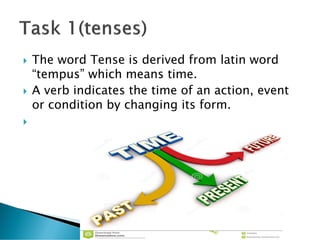
 The word Tense is derived from latin word
“tempus” which means time.
 A verb indicates the time of an action, event
or condition by changing its form.

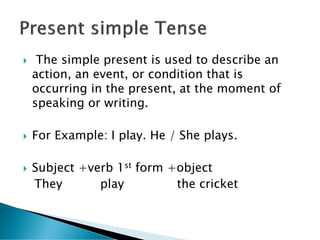
 The simple present is used to describe an
action, an event, or condition that is
occurring in the present, at the moment of
speaking or writing.
 For Example: I play. He / She plays.
 Subject +verb 1st form +object
They play the cricket
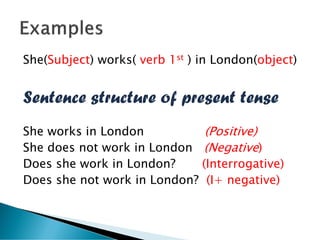
She(Subject) works( verb 1st ) in London(object)
Sentence structure of present tense
She works in London (Positive)
She does not work in London (Negative)
Does she work in London? (Interrogative)
Does she not work in London? (I+ negative)
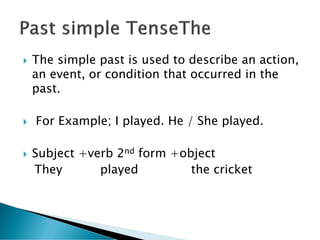
 The simple past is used to describe an action,
an event, or condition that occurred in the
past.
 For Example; I played. He / She played.
 Subject +verb 2nd form +object
They played the cricket
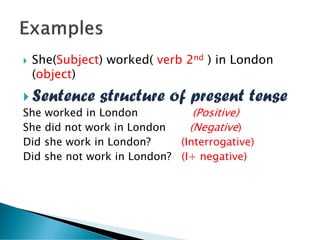
 She(Subject) worked( verb 2nd ) in London
(object)
 Sentence structure of present tense
She worked in London (Positive)
She did not work in London (Negative)
Did she work in London? (Interrogative)
Did she not work in London? (I+ negative)
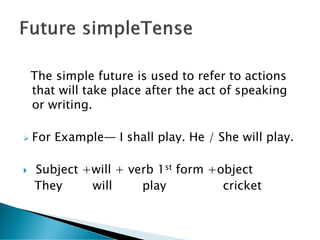
The simple future is used to refer to actions
that will take place after the act of speaking
or writing.
➢ For Example— I shall play. He / She will play.
 Subject +will + verb 1st form +object
They will play cricket
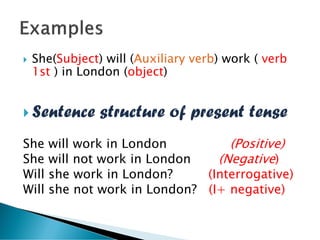
 She(Subject) will (Auxiliary verb) work ( verb
1st ) in London (object)
 Sentence structure of present tense
She will work in London (Positive)
She will not work in London (Negative)
Will she work in London? (Interrogative)
Will she not work in London? (I+ negative)
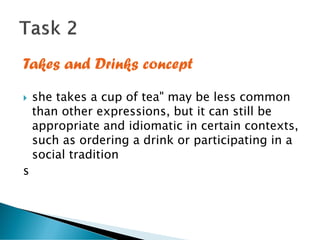
Takes and Drinks concept
 she takes a cup of tea" may be less common
than other expressions, but it can still be
appropriate and idiomatic in certain contexts,
such as ordering a drink or participating in a
social tradition
s
SPOKEN ENGLISH presentation slides.pdf

SPOKEN ENGLISH presentation slides.pdf

  • 2.
     The wordTense is derived from latin word “tempus” which means time.  A verb indicates the time of an action, event or condition by changing its form. 
  • 3.
     The simplepresent is used to describe an action, an event, or condition that is occurring in the present, at the moment of speaking or writing.  For Example: I play. He / She plays.  Subject +verb 1st form +object They play the cricket
  • 4.
    She(Subject) works( verb1st ) in London(object) Sentence structure of present tense She works in London (Positive) She does not work in London (Negative) Does she work in London? (Interrogative) Does she not work in London? (I+ negative)
  • 5.
     The simplepast is used to describe an action, an event, or condition that occurred in the past.  For Example; I played. He / She played.  Subject +verb 2nd form +object They played the cricket
  • 6.
     She(Subject) worked(verb 2nd ) in London (object)  Sentence structure of present tense She worked in London (Positive) She did not work in London (Negative) Did she work in London? (Interrogative) Did she not work in London? (I+ negative)
  • 7.
    The simple futureis used to refer to actions that will take place after the act of speaking or writing. ➢ For Example— I shall play. He / She will play.  Subject +will + verb 1st form +object They will play cricket
  • 8.
     She(Subject) will(Auxiliary verb) work ( verb 1st ) in London (object)  Sentence structure of present tense She will work in London (Positive) She will not work in London (Negative) Will she work in London? (Interrogative) Will she not work in London? (I+ negative)
  • 9.
    Takes and Drinksconcept  she takes a cup of tea" may be less common than other expressions, but it can still be appropriate and idiomatic in certain contexts, such as ordering a drink or participating in a social tradition s