UNDERSTANDING
Tenses:
Past, Present &
Future with All
Types
Presented By:
•ALI SHAHZAD (AI)
•SUMMAIYA ALAM (DS)
•MUZZMAIL SARWAR (DS)
1
Arts &
CO N T E N T S
2
Introduction to
tenses
Definition of
tense
Importance of
tense in English
grammar
Overview: Past ,
Present , Future
DEFINITION:
Tense in English grammar refers to the time of action
or state of being expressed by a verb. It shows when
something happens in the (PAST, PRESENT, OR FUTURE).
3
What is Tense?
• Tense is the form of a verb that shows the
time of an action or event. Tense helps us
understanding the timing of an event or
action.
• Without tenses, communication becomes
unclear and confusing.
• Tenses help us show when an action
happens Past, present and future
• They make our communication
clear ,organized and meaningful.
Why They're Important:
• Speaking:
To talk about daily routines, past
experiences, or future plans
Example:
I will visit my grandmother tomorrow.
• Writing:
In essays, letters, stories, and reports
4
PAST SIMPLE
TENSE:
BY MUZZMAIL SARWAR
• Use the Past Simple to describe an action
that happened and finished in the past.
This is the most common past tense
• Positive Subject + V2 + Object She went
to school
• Negative Subject + did not + V1 + Object
She did not go to school
• Question Did + Subject + V1 + Object?
Did she go to school
• Past Simple in Action Real Life
Examples:
• • She went to school yesterday. •
• They played football last night. •
• I visited my friend last week. Common
Time Phrases • yesterday, last night, last
year
• • two days ago, in 2020 • this morning,
earlier today
5
PAST CONTINUOUS TENSE:
6
Positive Subject + was/were + V-ing + Object She was reading a book.
Question Was/Were + Subject + V-ing + Object?
Was she reading a book?
Negative Subject + was/were not + V-ing + Object She
was not reading a book
Past Continuous:
Examples:
At a Specific Time, I was studying at 8 o'clock.
(The action was in progress at that exact moment.)
When Something Happened
They were playing cricket when it started raining. (One action interrupted
another.)
Duration and Background She was not studying for long when the power
went out.
(Shows how long the action lasted.
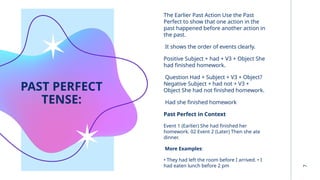
PAST PERFECT
TENSE:
The Earlier Past Action Use the Past
Perfect to show that one action in the
past happened before another action in
the past.
It shows the order of events clearly.
Positive Subject + had + V3 + Object She
had finished homework.
Question Had + Subject + V3 + Object?
Negative Subject + had not + V3 +
Object She had not finished homework.
Had she finished homework
Past Perfect in Context
Event 1 (Earlier) She had finished her
homework. 02 Event 2 (Later) Then she ate
dinner.
More Examples:
• They had left the room before I arrived. • I
had eaten lunch before 2 pm
7
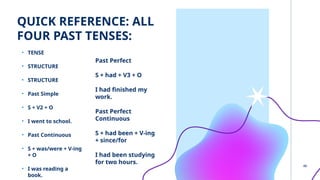
QUICK REFERENCE: ALL
FOUR PAST TENSES:
• TENSE
• STRUCTURE
• STRUCTURE
• Past Simple
• S + V2 + O
• I went to school.
• Past Continuous
• S + was/were + V-ing
+ O
• I was reading a
book.
Past Perfect
S + had + V3 + O
I had finished my
work.
Past Perfect
Continuous
S + had been + V-ing
+ since/for
I had been studying
for two hours.
8
PRESENT TENSE
BY ALI SHAHZAD
INTRODUCTION TO PRESENT
TENSES
DEFINITION:
• Is used to describe
actions that are
happening now,
habitual actions,
general truths, and
future scheduled
events. It helps us
express what is
currently true or
regularly occurs.
• FOUR TYPES of
Present Tense:
10
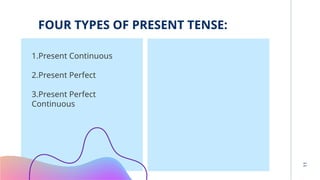
FOUR TYPES OF PRESENT TENSE:
1.Present Continuous
2.Present Perfect
3.Present Perfect
Continuous
11
12
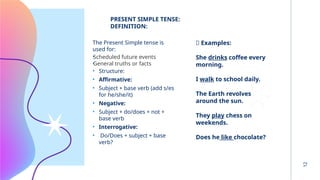
PRESENT SIMPLE TENSE:
DEFINITION:
The Present Simple tense is
used for:
•
Scheduled future events
•
General truths or facts
• Structure:
• Affirmative:
• Subject + base verb (add s/es
for he/she/it)
• Negative:
• Subject + do/does + not +
base verb
• Interrogative:
• Do/Does + subject + base
verb?
🔹 Examples:
She drinks coffee every
morning.
I walk to school daily.
The Earth revolves
around the sun.
They play chess on
weekends.
Does he like chocolate?
13
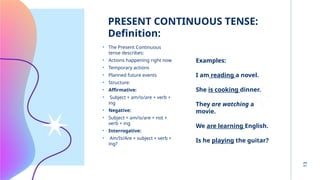
PRESENT CONTINUOUS TENSE:
Definition: :
• The Present Continuous
tense describes:
• Actions happening right now
• Temporary actions
• Planned future events
• Structure:
• Affirmative:
• Subject + am/is/are + verb +
ing
• Negative:
• Subject + am/is/are + not +
verb + ing
• Interrogative:
• Am/Is/Are + subject + verb +
ing?
Examples:
I am reading a novel.
She is cooking dinner.
They are watching a
movie.
We are learning English.
Is he playing the guitar?
14
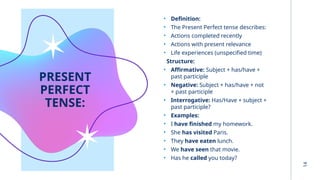
PRESENT
PERFECT
TENSE:
• Definition:
• The Present Perfect tense describes:
• Actions completed recently
• Actions with present relevance
• Life experiences (unspecified time)
Structure:
• Affirmative: Subject + has/have +
past participle
• Negative: Subject + has/have + not
+ past participle
• Interrogative: Has/Have + subject +
past participle?
• Examples:
• I have finished my homework.
• She has visited Paris.
• They have eaten lunch.
• We have seen that movie.
• Has he called you today?
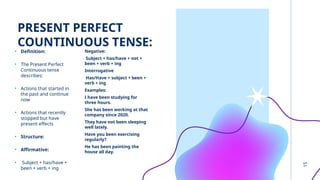
PRESENT PERFECT
COUNTINUOUS TENSE:
• Definition:
• The Present Perfect
Continuous tense
describes:
• Actions that started in
the past and continue
now
• Actions that recently
stopped but have
present effects
• Structure:
• Affirmative:
• Subject + has/have +
been + verb + ing
Negative:
Subject + has/have + not +
been + verb + ing
Interrogative
Has/Have + subject + been +
verb + ing
Examples:
I have been studying for
three hours.
She has been working at that
company since 2020.
They have not been sleeping
well lately.
Have you been exercising
regularly?
He has been painting the
house all day.
15
16
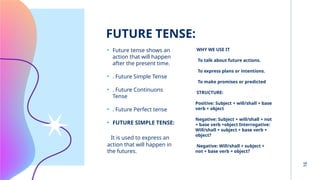
FUTURE TENSE:
• Future tense shows an
action that will happen
after the present time.
• . Future Simple Tense
• . Future Continuons
Tense
• . Future Perfect tense
• FUTURE SIMPLE TENSE:
It is used to express an
action that will happen in
the futures.
WHY WE USE IT
To talk about future actions.
To express plans or intentions.
To make promises or predicted
STRUCTURE:
Positive: Subject + will/shall + base
verb + object
Negative: Subject + will/shall + not
+ base verb +object Interrogative:
Will/shall + subject + base verb +
object?
Negative: Will/shall + subject +
not + base verb + object?
17
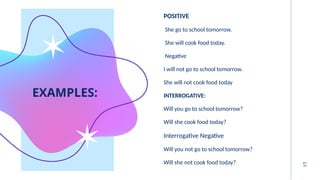
EXAMPLES:
POSITIVE
She go to school tomorrow.
She will cook food today.
Negative
I will not go to school tomorrow.
She will not cook food today
INTERROGATIVE:
Will you go to school tomorrow?
Will she cook food today?
Interrogative Negative
Will you not go to school tomorrow?
Will she not cook food today?
18
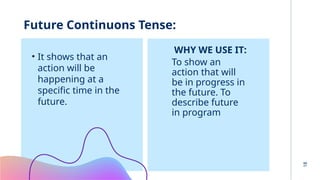
Future Continuons Tense:
• It shows that an
action will be
happening at a
specific time in the
future.
WHY WE USE IT:
To show an
action that will
be in progress in
the future. To
describe future
in program
19
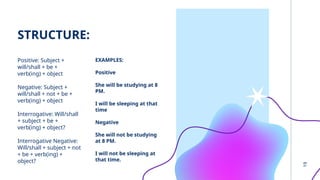
STRUCTURE:
Positive: Subject +
will/shall + be +
verb(ing) + object
Negative: Subject +
will/shall + not + be +
verb(ing) + object
Interrogative: Will/shall
+ subject + be +
verb(ing) + object?
Interrogative Negative:
Will/shall + subject + not
+ be + verb(ing) +
object?
EXAMPLES:
Positive
She will be studying at 8
PM.
I will be sleeping at that
time.
Negative
She will not be studying
at 8 PM.
I will not be sleeping at
that time.
20
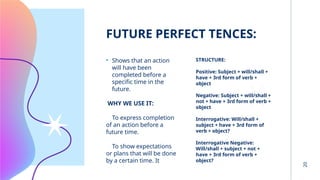
FUTURE PERFECT TENCES:
• Shows that an action
will have been
completed before a
specific time in the
future.
WHY WE USE IT:
To express completion
of an action before a
future time.
To show expectations
or plans that will be done
by a certain time. It
STRUCTURE:
Positive: Subject + will/shall +
have + 3rd form of verb +
object
Negative: Subject + will/shall +
not + have + 3rd form of verb +
object
Interrogative: Will/shall +
subject + have + 3rd form of
verb + object?
Interrogative Negative:
Will/shall + subject + not +
have + 3rd form of verb +
object?
21
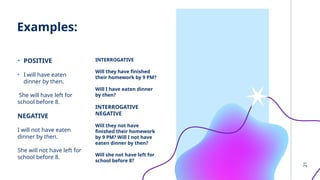
Examples:
• POSITIVE
• I will have eaten
dinner by then.
She will have left for
school before 8.
NEGATIVE
I will not have eaten
dinner by then.
She will not have left for
school before 8.
INTERROGATIVE
Will they have finished
their homework by 9 PM?
Will I have eaten dinner
by then?
INTERROGATIVE
NEGATIVE
Will they not have
finished their homework
by 9 PM? Will I not have
eaten dinner by then?
Will she not have left for
school before 8?
22
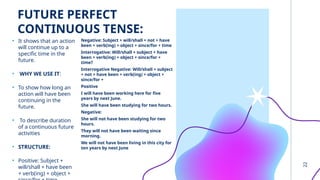
FUTURE PERFECT
CONTINUOUS TENSE:
• It shows that an action
will continue up to a
specific time in the
future.
• WHY WE USE IT:
• To show how long an
action will have been
continuing in the
future.
• To describe duration
of a continuous future
activities
• STRUCTURE:
• Positive: Subject +
will/shall + have been
+ verb(ing) + object +
Negative: Subject + will/shall + not + have
been + verb(ing) + object + since/for + time
Interrogative: Will/shall + subject + have
been + verb(ing) + object + since/for +
time?
Interrogative Negative: Will/shall + subject
+ not + have been + verb(ing) + object +
since/for +
Positive
I will have been working here for five
years by next June.
She will have been studying for two hours.
Negative:
She will not have been studying for two
hours.
They will not have been waiting since
morning.
We will not have been living in this city for
ten years by next June
Thank You

ENG PRESENTATION understanding tenses:past

  • 1.
    UNDERSTANDING Tenses: Past, Present & Futurewith All Types Presented By: •ALI SHAHZAD (AI) •SUMMAIYA ALAM (DS) •MUZZMAIL SARWAR (DS) 1
  • 2.
    Arts & CO NT E N T S 2 Introduction to tenses Definition of tense Importance of tense in English grammar Overview: Past , Present , Future
  • 3.
    DEFINITION: Tense in Englishgrammar refers to the time of action or state of being expressed by a verb. It shows when something happens in the (PAST, PRESENT, OR FUTURE). 3
  • 4.
    What is Tense? •Tense is the form of a verb that shows the time of an action or event. Tense helps us understanding the timing of an event or action. • Without tenses, communication becomes unclear and confusing. • Tenses help us show when an action happens Past, present and future • They make our communication clear ,organized and meaningful. Why They're Important: • Speaking: To talk about daily routines, past experiences, or future plans Example: I will visit my grandmother tomorrow. • Writing: In essays, letters, stories, and reports 4
  • 5.
    PAST SIMPLE TENSE: BY MUZZMAILSARWAR • Use the Past Simple to describe an action that happened and finished in the past. This is the most common past tense • Positive Subject + V2 + Object She went to school • Negative Subject + did not + V1 + Object She did not go to school • Question Did + Subject + V1 + Object? Did she go to school • Past Simple in Action Real Life Examples: • • She went to school yesterday. • • They played football last night. • • I visited my friend last week. Common Time Phrases • yesterday, last night, last year • • two days ago, in 2020 • this morning, earlier today 5
  • 6.
    PAST CONTINUOUS TENSE: 6 PositiveSubject + was/were + V-ing + Object She was reading a book. Question Was/Were + Subject + V-ing + Object? Was she reading a book? Negative Subject + was/were not + V-ing + Object She was not reading a book Past Continuous: Examples: At a Specific Time, I was studying at 8 o'clock. (The action was in progress at that exact moment.) When Something Happened They were playing cricket when it started raining. (One action interrupted another.) Duration and Background She was not studying for long when the power went out. (Shows how long the action lasted.
  • 7.
    PAST PERFECT TENSE: The EarlierPast Action Use the Past Perfect to show that one action in the past happened before another action in the past. It shows the order of events clearly. Positive Subject + had + V3 + Object She had finished homework. Question Had + Subject + V3 + Object? Negative Subject + had not + V3 + Object She had not finished homework. Had she finished homework Past Perfect in Context Event 1 (Earlier) She had finished her homework. 02 Event 2 (Later) Then she ate dinner. More Examples: • They had left the room before I arrived. • I had eaten lunch before 2 pm 7
  • 8.
    QUICK REFERENCE: ALL FOURPAST TENSES: • TENSE • STRUCTURE • STRUCTURE • Past Simple • S + V2 + O • I went to school. • Past Continuous • S + was/were + V-ing + O • I was reading a book. Past Perfect S + had + V3 + O I had finished my work. Past Perfect Continuous S + had been + V-ing + since/for I had been studying for two hours. 8
  • 9.
  • 10.
    INTRODUCTION TO PRESENT TENSES DEFINITION: •Is used to describe actions that are happening now, habitual actions, general truths, and future scheduled events. It helps us express what is currently true or regularly occurs. • FOUR TYPES of Present Tense: 10
  • 11.
    FOUR TYPES OFPRESENT TENSE: 1.Present Continuous 2.Present Perfect 3.Present Perfect Continuous 11
  • 12.
    12 PRESENT SIMPLE TENSE: DEFINITION: ThePresent Simple tense is used for: • Scheduled future events • General truths or facts • Structure: • Affirmative: • Subject + base verb (add s/es for he/she/it) • Negative: • Subject + do/does + not + base verb • Interrogative: • Do/Does + subject + base verb? 🔹 Examples: She drinks coffee every morning. I walk to school daily. The Earth revolves around the sun. They play chess on weekends. Does he like chocolate?
  • 13.
    13 PRESENT CONTINUOUS TENSE: Definition:: • The Present Continuous tense describes: • Actions happening right now • Temporary actions • Planned future events • Structure: • Affirmative: • Subject + am/is/are + verb + ing • Negative: • Subject + am/is/are + not + verb + ing • Interrogative: • Am/Is/Are + subject + verb + ing? Examples: I am reading a novel. She is cooking dinner. They are watching a movie. We are learning English. Is he playing the guitar?
  • 14.
    14 PRESENT PERFECT TENSE: • Definition: • ThePresent Perfect tense describes: • Actions completed recently • Actions with present relevance • Life experiences (unspecified time) Structure: • Affirmative: Subject + has/have + past participle • Negative: Subject + has/have + not + past participle • Interrogative: Has/Have + subject + past participle? • Examples: • I have finished my homework. • She has visited Paris. • They have eaten lunch. • We have seen that movie. • Has he called you today?
  • 15.
    PRESENT PERFECT COUNTINUOUS TENSE: •Definition: • The Present Perfect Continuous tense describes: • Actions that started in the past and continue now • Actions that recently stopped but have present effects • Structure: • Affirmative: • Subject + has/have + been + verb + ing Negative: Subject + has/have + not + been + verb + ing Interrogative Has/Have + subject + been + verb + ing Examples: I have been studying for three hours. She has been working at that company since 2020. They have not been sleeping well lately. Have you been exercising regularly? He has been painting the house all day. 15
  • 16.
    16 FUTURE TENSE: • Futuretense shows an action that will happen after the present time. • . Future Simple Tense • . Future Continuons Tense • . Future Perfect tense • FUTURE SIMPLE TENSE: It is used to express an action that will happen in the futures. WHY WE USE IT To talk about future actions. To express plans or intentions. To make promises or predicted STRUCTURE: Positive: Subject + will/shall + base verb + object Negative: Subject + will/shall + not + base verb +object Interrogative: Will/shall + subject + base verb + object? Negative: Will/shall + subject + not + base verb + object?
  • 17.
    17 EXAMPLES: POSITIVE She go toschool tomorrow. She will cook food today. Negative I will not go to school tomorrow. She will not cook food today INTERROGATIVE: Will you go to school tomorrow? Will she cook food today? Interrogative Negative Will you not go to school tomorrow? Will she not cook food today?
  • 18.
    18 Future Continuons Tense: •It shows that an action will be happening at a specific time in the future. WHY WE USE IT: To show an action that will be in progress in the future. To describe future in program
  • 19.
    19 STRUCTURE: Positive: Subject + will/shall+ be + verb(ing) + object Negative: Subject + will/shall + not + be + verb(ing) + object Interrogative: Will/shall + subject + be + verb(ing) + object? Interrogative Negative: Will/shall + subject + not + be + verb(ing) + object? EXAMPLES: Positive She will be studying at 8 PM. I will be sleeping at that time. Negative She will not be studying at 8 PM. I will not be sleeping at that time.
  • 20.
    20 FUTURE PERFECT TENCES: •Shows that an action will have been completed before a specific time in the future. WHY WE USE IT: To express completion of an action before a future time. To show expectations or plans that will be done by a certain time. It STRUCTURE: Positive: Subject + will/shall + have + 3rd form of verb + object Negative: Subject + will/shall + not + have + 3rd form of verb + object Interrogative: Will/shall + subject + have + 3rd form of verb + object? Interrogative Negative: Will/shall + subject + not + have + 3rd form of verb + object?
  • 21.
    21 Examples: • POSITIVE • Iwill have eaten dinner by then. She will have left for school before 8. NEGATIVE I will not have eaten dinner by then. She will not have left for school before 8. INTERROGATIVE Will they have finished their homework by 9 PM? Will I have eaten dinner by then? INTERROGATIVE NEGATIVE Will they not have finished their homework by 9 PM? Will I not have eaten dinner by then? Will she not have left for school before 8?
  • 22.
    22 FUTURE PERFECT CONTINUOUS TENSE: •It shows that an action will continue up to a specific time in the future. • WHY WE USE IT: • To show how long an action will have been continuing in the future. • To describe duration of a continuous future activities • STRUCTURE: • Positive: Subject + will/shall + have been + verb(ing) + object + Negative: Subject + will/shall + not + have been + verb(ing) + object + since/for + time Interrogative: Will/shall + subject + have been + verb(ing) + object + since/for + time? Interrogative Negative: Will/shall + subject + not + have been + verb(ing) + object + since/for + Positive I will have been working here for five years by next June. She will have been studying for two hours. Negative: She will not have been studying for two hours. They will not have been waiting since morning. We will not have been living in this city for ten years by next June
  • 23.