PROJECT PROFILE OF
ANBU FARMS
Survey No. 1091, Kayar Village, Kanchipuram - 603110.
1. Introduction
Spirulina is green algae. It is used as a natural health
food; slimming nutrient; and as a natural green colouring
matter. It cures anaemia, diabetes, helps in healing wounds and
lowers cholesterol. It is used as a protein supplement for
malnourished children and adults; in feeds for poultry, cattle, pig
and aquatic animals; in health foods; in medicine; in therapeutic
preparations; and in sericulture and horticulture media.
2. Market
The product is sold in powder form for pharma
and healthcare companies, who distribute them
in capsule form to retail market. It finds
placement in all medical shops in towns and
cities because of its therapeutic properties. It is
also exported to foreign countries. Since the
demand is growing for spirulina due to its high
nutrient value, its planned to sell some portion
of the cultivation in capsule form to direct
market and create a brand for the same.
3. Packaging
• Spirulina is packed in powder form and as capsules.
Powder is packed in 50 Grams to 1 Kg packets and
around 50 or 100 capsules(50 Mg) in a bottle and sold.
4. Production capacity
• Cultivation – One shift 8 hours duration.
• Drying - one shift of 8 hours duration.
• Annual production of Spirulina powder is 4000 Kg.(4
Ton)
• The time period required for achieving full capacity
utilisation is 6 Months.
5. Production process outline.
• Cultivation : Selected strains of algae are used for
cultivation in constant agitation of water. This is an
important parameter in the cultivation of spirulina.
Agitation of algae culture is necessary to keep nutrients
evenly dispersed and also to expose all the cells to sunlight.
• Harvesting : The algal biomass is carefully harvested using
specially made filters to recover the biomass. The special
filter has a mesh size is 0.5 Microns.
• Processing : The harvested biomass is dried using the cross
flow drier. The produce obtained is in the form of flakes. It
is ground in the pulveriser to get the powder of the desired
mesh size. To get an optimal yield, maintenance of required
nutrient level, cell density, culture depth etc., are some of
the critical parameters in the process of spirulina
cultivation. The yield of spirulina is expressed as grams per
cubic metre per day.
6. Quality specifications
• Moisture - 3%
• Protein - 65%
• Fat - 7%
• Crude fibre - 9%
• Carbohydrates - 16%
• Energy - 346 K cal / 100 grams
• Mold and fungus – absent
• Should be free from any fermented odour,
coliforms, salmonella and streptococci bacteria.
What is Spirulina?
Spirulina is blue - green algae that grow
naturally in warm, fresh water-bodies around
the world. It is considered a superfood due to its
powerful health benefits. It is often sold in
powder or pill form as a nutritional supplement
and many people add it to smoothies and green
drinks. It is especially ideal for a vegan diet due
to its high protein content.
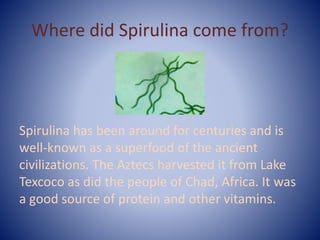
Where did Spirulina come from?
Spirulina has been around for centuries and is
well-known as a superfood of the ancient
civilizations. The Aztecs harvested it from Lake
Texcoco as did the people of Chad, Africa. It was
a good source of protein and other vitamins.
Where is Spirulina grown?
Wild spirulina grows in the alkaline lakes of
Mexico and on the African continent, although it
is commercially grown and harvested all over
the world. Spirulina grows in warm, fresh water-
bodies where there is abundant sunlight.
Is Spirulina good for you?
Spirulina is one of nature’s near-perfect foods.
Many studies have shown that spirulina is a very
healthy nutritional supplement. It helps your
immune system, provides a boost of energy
almost immediately, and is a natural detoxifier
as it helps cleanse your body of toxins and
impurities.
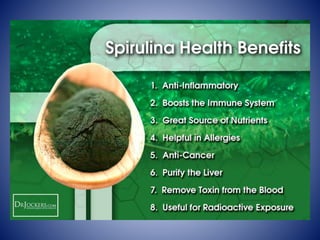
What are Spirulina’s main health
benefits?
• Better nutrition – Spirulina is a good source of
protein, vitamins, minerals, and essential fatty
acids, especially rich in beta-carotene and vitamin
K
• Boost Immune Function – Studies show that
spirulina may improve your immune system.
• Boost energy – After one smoothie packed with
spirulina, you’ll see that you get an energy boost.
• Natural detoxification – Spirulina attaches itself to
metals in your body and so that the metals exit
your body as waste.
What nutrients are in Spirulina?
Spirulina is 50-75% protein by weight, including all
essential amino acids, 15-30% carbohydrates, and
5-10% fat. There are about 30 calories in 10g of
spirulina. Spirulina is packed with protein and
amino acids including the essential fatty acid
gamma linolenic acis (GLA), omega 3, 6, and 9s,
chlorophyll, iron, vitamins B-1(thiamine), B-2
(riboflavin), B-3(nicotinamide), B-6 (pyridoxine), B-9
(folic acid), vitamin C, vitamin D, vitamin A and
vitamin E. It is also a source of potassium, calcium,
chromium, copper, iron, magnesium, manganese,
phosphorus, selenium, sodium and zinc.
Is Spirulina safe?
Studies on humans and animals have shown no
toxic side effects directly due to spirulina. There
have been no negative side-effects found in studies
on animals. Spirulina may not be safe if it is
contaminated with other toxic blue-green algae.
Because it is a dietary supplement in the US, there
is on active regulation of spirulina, but it is
considered safe, as long as it’s not contaminated
with other toxins. Each brand of spirulina will give
you detail on the safety of its products, but there is
generally no need for concern.
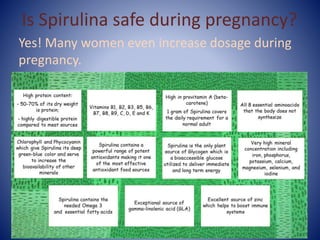
Is Spirulina safe during pregnancy?
Yes! Many women even increase dosage during
pregnancy.
Does spirulina heal radiation
exposure?
According to nutrex-hawaii.com, a
Polysaccharide found in spirulina shows chemo-
protective and radio-protective capabilities in
laboratory animals. And Spirulina reduced urine
radioactivity by 50% in only 20 days in children
who were exposed to radiation by the Chernobyl
nuclear meltdown. It appear to have detoxifying
effects for radiation exposure.
Why is spirulina a good source of
protein?
Spirulina is rich in protein, between 50-70
percent by weight. It contains ALL of the
essential amino acids. The protein in Spirulina is
also highly usable and has net protein utilization
rate of between 50-61%. An ounce of spirulina
powder (which is about 3 tablespoons) would
add a significant amount of protein, similar to
two jumbo eggs or a half a serving of chicken
breast.
How do people take Spirulina?
You can take Spirulina in table, powder,
or flake form. It is recommended to
take between 1tsp and 2 tbsp. per day,
but you can take more or less as you
like. People often add spirulina to
smoothies or green drinks, especially
since the taste of spirulina is not very
appealing by itself.
Should I eat organic spirulina?
It is always a good idea to eat natural, organic
food whenever possible. However, don’t be
scared of inorganic spirulina without exploring
the details. In fresh water ponds, spirulina is
naturally grown among inorganic fertilizer from
nature with phosphorus, nitrogen, and natrum.
How is Spirulina different from
Chlorella, other blue - green algae?
Spirulina and chlorella are both micro-algae and
both considered superfoods. Technically, spirulina is
a spiral-shaped, multi-cellular plant with no nucleus
and chlorella is a spherical-shaped single-celled
plant with a nucleus. Chlorella is much larger and
therefore more difficult to harvest. While they both
provide many health benefits, Spirulina has a higher
concentration of protein and iron, as well as all 8
amino acids, and a higher percentage of beta-
carotene. Chlorella has a greater level of
chlorophyll, hence the darker green colour.
Spirulina’s Healing Properties:
Spirulina is found all over the world in fresh
water, saltwater oceans & natural springs. It
was renowned for its healing properties and was
a staple part of the North African and Aztec
Indian (Mexico) diet many years ago. Today,
natural health experts all around the world
revere spirulina for its potential as a whole food
mega-nutrient and natural medicine.
Healing Continue…
Spirulina contains an incredible array of
nutrients that make them a functional whole
food for sustaining life without the need for
other foods. These algae contain pre-digested
protein (in the form of amino acids) for quick
absorption and high utilization rates. Spirulina
contains essential omega 3 fatty acids such as
EPA & DHA. Algae, in fact, are the very source
that fish, krill and other animals obtain their
omega 3’s.
Healing Continue…
Spirulina is a rich source of the tough to find
essential omega-6 fat GLA. It also provides
nucleic acids (DNA & RNA) that provide a mega
dose of raw materials for DNA repair. Spirulina
is a very rich source of critical B
vitamin methylation agents such as B6 and
folate. It also has an extraordinary array of anti-
oxidant phytonutrient anthocyanins. These
anthocyanins are renowned for their powerful
anti-carcinogenic properties.
Spirulina Enhances Gut Flora:
Spirulina has strong anti-microbial effects that help
create balance in the gut flora. It does this by
controlling the growth of pathogenic
bacteria and yeasts in the digestive system. This is
critical for optimal digestion and nutritional
absorption. Additionally, it is a very important part
of detoxification through the bowel systems.
Spirulina is a powerful blood cleanser due to its rich
source of chlorophyll. It contains roughly ten times
the amount of chlorophyll in green vegetables per
volume. Chlorophyll helps build red blood cells in
the body and provides easily absorbable form
of magnesium. This combination helps oxygenate
the blood stream and remove organic toxins.
Spirulina is loaded with Anti-Oxidants:
Spirulina is very rich in carotenoid anti-oxidants. It
has 10 times the amount of the beta carotene (a
form of vitamin A) per volume as carrots. It is also
loaded with zeaxanthin and lutein. These
antioxidants are extremely important for good
vision and overall eye health.
Spirulina contains polysaccharides that act to
improve the functional productivity of
the bone marrow, thymus and spleen
cells. Phycocyanin and allophycocanin which help
to form the blue colour within the algae (along with
anthocyanins) have been shown to increase white
blood cell counts.
Anti-Oxidants Continue…
One 2003 study investigated spirulina’s ability to
protect the organs from the free-radical damage
caused by lead. The study demonstrated that
spirulina had a significant effect on scavenging
free radicals, thereby protecting the organs from
damage caused by the exposure to lead.
Furthermore, Spirulina showed a significant
decrease in the deposition of lead in the brain.
Spirulina is great for the Skin:
Spirulina is also the world’s best source of the anti-
oxidant powerhouse superoxide dismutase (SOD). The
superoxide molecule is one of the most tissue damaging
substances within the body. SOD is a biological
adaptation specifically designed to destroy the
superoxide radical and protect against any subsequent
tissue damage. Inadequate superoxide dismutase
formation leads to accelerated aging and tissue
degeneration.
The combination of SOD and carotenoids within spirulina
make it very good for skin care. It is remarkable for
improving aging spots, eczema, acne, & rashes. This
combination also dramatically improves eye
health. Individuals with glaucoma, cataracts, & poor
vision should be sure to consume this regularly.
SWOT Analysis
Strength
Automation - Processes have been automated when compared with the other
cultivations which would give a higher edge. (Processes which will be
automated include Ph control, harvesting, dehydration, powdering, packing etc)
Since here the temperature is high when compared to many other countries,
and spirulina requires open to Sun environment, we have an edge from over
spending on controlled environment. Also maximum production can be
achieved over 80% around the year except during rainy days.
Weakness
Potential Customers have to be identified and maintained for continuous sales
without stock piling up. The spirulina cells die when exposed to higher
temperature above 38 degrees Celsius. So the temperature has to be monitored
during hot weather. However the spirulina does not get affected for lesser
temperature. But the activities and growth reduces under lesser temp. And
below 30 degrees it almost becomes inactive. This is not a threat because when
the temperature raises again the cells becomes active again. So the growth will
be more during the day when exposed to sun and lesser during the night.
Opportunities
Has a domestic as well as global market, and the demand is growing every year.
Used as health product as well as feed for chicken, fish, shrimp, and other live stocks.
With value addition like selling as capsules and directly reaching the consumer will
yield better revenue.
Threats
Maintenance of Temperature for Spirulina growth between 35 and 37 degree Celsius
- Being a tropical country the environmental temperature touches 42 degree Celsius
during summer. However, since Spirulina is grown in a liquid medium the chances of
temperature touching 37 and above is minimal.
Temperature shall be monitored by placing thermocouples and taking appropriate
corrective action. Chances of Contamination in the liquid medium used for Spirulina
growth which may affect the output quality and quantity.
Alkalinity of the medium helps in reduction of contamination. Ph value of 10 will be
maintained to control contamination. During rainy season, growth will be reduced -
Cover to be provided to the tanks to avoid the rain water mixing with the liquid in the
tank.
BREAK UP OF CAPITAL COST Total
1. LAND 1.00
2. BUILDING 4.70
3. PLANT & MACHINERY 13.93
4. MISCELLANEOUS FIXED ASSETS 1.70
5. SECURITIES 0.00
6. MARGIN FOR WORKING CAPITAL 5.21
TOTAL RS. 26.54
Revenue Realisation
The unit will produce Spirulina Powder and Capsules
Particulars Avg. Rates
1 Spirulina Powder 600.00
2 Spirulina Capsules 1000.00
1 Spirulina Powder Sales ( Kg) 4000.00 Kgs
2 Spirulina Capsules ( Kg) 20.00 Kgs
1 Annual Spirulina Powder Sales ( In Rupees ) 2400000 Sale per Annum (Rs. in Lacs)
2 Annual Spirulina Capsules ( In Rupees ) 20000
Total Annual Sales 2420000 24.20 Lacs
Capacity Utilization 80% 85% 90% 95% 100%
Annual Sales 19.36 20.57 21.78 22.99 24.20 Lacs

Spirulina

  • 1.
    PROJECT PROFILE OF ANBUFARMS Survey No. 1091, Kayar Village, Kanchipuram - 603110. 1. Introduction Spirulina is green algae. It is used as a natural health food; slimming nutrient; and as a natural green colouring matter. It cures anaemia, diabetes, helps in healing wounds and lowers cholesterol. It is used as a protein supplement for malnourished children and adults; in feeds for poultry, cattle, pig and aquatic animals; in health foods; in medicine; in therapeutic preparations; and in sericulture and horticulture media.
  • 2.
    2. Market The productis sold in powder form for pharma and healthcare companies, who distribute them in capsule form to retail market. It finds placement in all medical shops in towns and cities because of its therapeutic properties. It is also exported to foreign countries. Since the demand is growing for spirulina due to its high nutrient value, its planned to sell some portion of the cultivation in capsule form to direct market and create a brand for the same.
  • 3.
    3. Packaging • Spirulinais packed in powder form and as capsules. Powder is packed in 50 Grams to 1 Kg packets and around 50 or 100 capsules(50 Mg) in a bottle and sold. 4. Production capacity • Cultivation – One shift 8 hours duration. • Drying - one shift of 8 hours duration. • Annual production of Spirulina powder is 4000 Kg.(4 Ton) • The time period required for achieving full capacity utilisation is 6 Months.
  • 4.
    5. Production processoutline. • Cultivation : Selected strains of algae are used for cultivation in constant agitation of water. This is an important parameter in the cultivation of spirulina. Agitation of algae culture is necessary to keep nutrients evenly dispersed and also to expose all the cells to sunlight. • Harvesting : The algal biomass is carefully harvested using specially made filters to recover the biomass. The special filter has a mesh size is 0.5 Microns. • Processing : The harvested biomass is dried using the cross flow drier. The produce obtained is in the form of flakes. It is ground in the pulveriser to get the powder of the desired mesh size. To get an optimal yield, maintenance of required nutrient level, cell density, culture depth etc., are some of the critical parameters in the process of spirulina cultivation. The yield of spirulina is expressed as grams per cubic metre per day.
  • 5.
    6. Quality specifications •Moisture - 3% • Protein - 65% • Fat - 7% • Crude fibre - 9% • Carbohydrates - 16% • Energy - 346 K cal / 100 grams • Mold and fungus – absent • Should be free from any fermented odour, coliforms, salmonella and streptococci bacteria.
  • 6.
    What is Spirulina? Spirulinais blue - green algae that grow naturally in warm, fresh water-bodies around the world. It is considered a superfood due to its powerful health benefits. It is often sold in powder or pill form as a nutritional supplement and many people add it to smoothies and green drinks. It is especially ideal for a vegan diet due to its high protein content.
  • 7.
    Where did Spirulinacome from? Spirulina has been around for centuries and is well-known as a superfood of the ancient civilizations. The Aztecs harvested it from Lake Texcoco as did the people of Chad, Africa. It was a good source of protein and other vitamins.
  • 8.
    Where is Spirulinagrown? Wild spirulina grows in the alkaline lakes of Mexico and on the African continent, although it is commercially grown and harvested all over the world. Spirulina grows in warm, fresh water- bodies where there is abundant sunlight.
  • 9.
    Is Spirulina goodfor you? Spirulina is one of nature’s near-perfect foods. Many studies have shown that spirulina is a very healthy nutritional supplement. It helps your immune system, provides a boost of energy almost immediately, and is a natural detoxifier as it helps cleanse your body of toxins and impurities.
  • 11.
    What are Spirulina’smain health benefits? • Better nutrition – Spirulina is a good source of protein, vitamins, minerals, and essential fatty acids, especially rich in beta-carotene and vitamin K • Boost Immune Function – Studies show that spirulina may improve your immune system. • Boost energy – After one smoothie packed with spirulina, you’ll see that you get an energy boost. • Natural detoxification – Spirulina attaches itself to metals in your body and so that the metals exit your body as waste.
  • 12.
    What nutrients arein Spirulina? Spirulina is 50-75% protein by weight, including all essential amino acids, 15-30% carbohydrates, and 5-10% fat. There are about 30 calories in 10g of spirulina. Spirulina is packed with protein and amino acids including the essential fatty acid gamma linolenic acis (GLA), omega 3, 6, and 9s, chlorophyll, iron, vitamins B-1(thiamine), B-2 (riboflavin), B-3(nicotinamide), B-6 (pyridoxine), B-9 (folic acid), vitamin C, vitamin D, vitamin A and vitamin E. It is also a source of potassium, calcium, chromium, copper, iron, magnesium, manganese, phosphorus, selenium, sodium and zinc.
  • 13.
    Is Spirulina safe? Studieson humans and animals have shown no toxic side effects directly due to spirulina. There have been no negative side-effects found in studies on animals. Spirulina may not be safe if it is contaminated with other toxic blue-green algae. Because it is a dietary supplement in the US, there is on active regulation of spirulina, but it is considered safe, as long as it’s not contaminated with other toxins. Each brand of spirulina will give you detail on the safety of its products, but there is generally no need for concern.
  • 14.
    Is Spirulina safeduring pregnancy? Yes! Many women even increase dosage during pregnancy.
  • 15.
    Does spirulina healradiation exposure? According to nutrex-hawaii.com, a Polysaccharide found in spirulina shows chemo- protective and radio-protective capabilities in laboratory animals. And Spirulina reduced urine radioactivity by 50% in only 20 days in children who were exposed to radiation by the Chernobyl nuclear meltdown. It appear to have detoxifying effects for radiation exposure.
  • 16.
    Why is spirulinaa good source of protein? Spirulina is rich in protein, between 50-70 percent by weight. It contains ALL of the essential amino acids. The protein in Spirulina is also highly usable and has net protein utilization rate of between 50-61%. An ounce of spirulina powder (which is about 3 tablespoons) would add a significant amount of protein, similar to two jumbo eggs or a half a serving of chicken breast.
  • 17.
    How do peopletake Spirulina? You can take Spirulina in table, powder, or flake form. It is recommended to take between 1tsp and 2 tbsp. per day, but you can take more or less as you like. People often add spirulina to smoothies or green drinks, especially since the taste of spirulina is not very appealing by itself.
  • 18.
    Should I eatorganic spirulina? It is always a good idea to eat natural, organic food whenever possible. However, don’t be scared of inorganic spirulina without exploring the details. In fresh water ponds, spirulina is naturally grown among inorganic fertilizer from nature with phosphorus, nitrogen, and natrum.
  • 20.
    How is Spirulinadifferent from Chlorella, other blue - green algae? Spirulina and chlorella are both micro-algae and both considered superfoods. Technically, spirulina is a spiral-shaped, multi-cellular plant with no nucleus and chlorella is a spherical-shaped single-celled plant with a nucleus. Chlorella is much larger and therefore more difficult to harvest. While they both provide many health benefits, Spirulina has a higher concentration of protein and iron, as well as all 8 amino acids, and a higher percentage of beta- carotene. Chlorella has a greater level of chlorophyll, hence the darker green colour.
  • 21.
    Spirulina’s Healing Properties: Spirulinais found all over the world in fresh water, saltwater oceans & natural springs. It was renowned for its healing properties and was a staple part of the North African and Aztec Indian (Mexico) diet many years ago. Today, natural health experts all around the world revere spirulina for its potential as a whole food mega-nutrient and natural medicine.
  • 23.
    Healing Continue… Spirulina containsan incredible array of nutrients that make them a functional whole food for sustaining life without the need for other foods. These algae contain pre-digested protein (in the form of amino acids) for quick absorption and high utilization rates. Spirulina contains essential omega 3 fatty acids such as EPA & DHA. Algae, in fact, are the very source that fish, krill and other animals obtain their omega 3’s.
  • 24.
    Healing Continue… Spirulina isa rich source of the tough to find essential omega-6 fat GLA. It also provides nucleic acids (DNA & RNA) that provide a mega dose of raw materials for DNA repair. Spirulina is a very rich source of critical B vitamin methylation agents such as B6 and folate. It also has an extraordinary array of anti- oxidant phytonutrient anthocyanins. These anthocyanins are renowned for their powerful anti-carcinogenic properties.
  • 25.
    Spirulina Enhances GutFlora: Spirulina has strong anti-microbial effects that help create balance in the gut flora. It does this by controlling the growth of pathogenic bacteria and yeasts in the digestive system. This is critical for optimal digestion and nutritional absorption. Additionally, it is a very important part of detoxification through the bowel systems. Spirulina is a powerful blood cleanser due to its rich source of chlorophyll. It contains roughly ten times the amount of chlorophyll in green vegetables per volume. Chlorophyll helps build red blood cells in the body and provides easily absorbable form of magnesium. This combination helps oxygenate the blood stream and remove organic toxins.
  • 26.
    Spirulina is loadedwith Anti-Oxidants: Spirulina is very rich in carotenoid anti-oxidants. It has 10 times the amount of the beta carotene (a form of vitamin A) per volume as carrots. It is also loaded with zeaxanthin and lutein. These antioxidants are extremely important for good vision and overall eye health. Spirulina contains polysaccharides that act to improve the functional productivity of the bone marrow, thymus and spleen cells. Phycocyanin and allophycocanin which help to form the blue colour within the algae (along with anthocyanins) have been shown to increase white blood cell counts.
  • 28.
    Anti-Oxidants Continue… One 2003study investigated spirulina’s ability to protect the organs from the free-radical damage caused by lead. The study demonstrated that spirulina had a significant effect on scavenging free radicals, thereby protecting the organs from damage caused by the exposure to lead. Furthermore, Spirulina showed a significant decrease in the deposition of lead in the brain.
  • 29.
    Spirulina is greatfor the Skin: Spirulina is also the world’s best source of the anti- oxidant powerhouse superoxide dismutase (SOD). The superoxide molecule is one of the most tissue damaging substances within the body. SOD is a biological adaptation specifically designed to destroy the superoxide radical and protect against any subsequent tissue damage. Inadequate superoxide dismutase formation leads to accelerated aging and tissue degeneration. The combination of SOD and carotenoids within spirulina make it very good for skin care. It is remarkable for improving aging spots, eczema, acne, & rashes. This combination also dramatically improves eye health. Individuals with glaucoma, cataracts, & poor vision should be sure to consume this regularly.
  • 30.
    SWOT Analysis Strength Automation -Processes have been automated when compared with the other cultivations which would give a higher edge. (Processes which will be automated include Ph control, harvesting, dehydration, powdering, packing etc) Since here the temperature is high when compared to many other countries, and spirulina requires open to Sun environment, we have an edge from over spending on controlled environment. Also maximum production can be achieved over 80% around the year except during rainy days. Weakness Potential Customers have to be identified and maintained for continuous sales without stock piling up. The spirulina cells die when exposed to higher temperature above 38 degrees Celsius. So the temperature has to be monitored during hot weather. However the spirulina does not get affected for lesser temperature. But the activities and growth reduces under lesser temp. And below 30 degrees it almost becomes inactive. This is not a threat because when the temperature raises again the cells becomes active again. So the growth will be more during the day when exposed to sun and lesser during the night.
  • 31.
    Opportunities Has a domesticas well as global market, and the demand is growing every year. Used as health product as well as feed for chicken, fish, shrimp, and other live stocks. With value addition like selling as capsules and directly reaching the consumer will yield better revenue. Threats Maintenance of Temperature for Spirulina growth between 35 and 37 degree Celsius - Being a tropical country the environmental temperature touches 42 degree Celsius during summer. However, since Spirulina is grown in a liquid medium the chances of temperature touching 37 and above is minimal. Temperature shall be monitored by placing thermocouples and taking appropriate corrective action. Chances of Contamination in the liquid medium used for Spirulina growth which may affect the output quality and quantity. Alkalinity of the medium helps in reduction of contamination. Ph value of 10 will be maintained to control contamination. During rainy season, growth will be reduced - Cover to be provided to the tanks to avoid the rain water mixing with the liquid in the tank.
  • 32.
    BREAK UP OFCAPITAL COST Total 1. LAND 1.00 2. BUILDING 4.70 3. PLANT & MACHINERY 13.93 4. MISCELLANEOUS FIXED ASSETS 1.70 5. SECURITIES 0.00 6. MARGIN FOR WORKING CAPITAL 5.21 TOTAL RS. 26.54
  • 34.
    Revenue Realisation The unitwill produce Spirulina Powder and Capsules Particulars Avg. Rates 1 Spirulina Powder 600.00 2 Spirulina Capsules 1000.00 1 Spirulina Powder Sales ( Kg) 4000.00 Kgs 2 Spirulina Capsules ( Kg) 20.00 Kgs 1 Annual Spirulina Powder Sales ( In Rupees ) 2400000 Sale per Annum (Rs. in Lacs) 2 Annual Spirulina Capsules ( In Rupees ) 20000 Total Annual Sales 2420000 24.20 Lacs Capacity Utilization 80% 85% 90% 95% 100% Annual Sales 19.36 20.57 21.78 22.99 24.20 Lacs