Educational Challenges  After Childhood Cancer Treatment    Anne Mauck, CPNP  Alma Morgan, M.Ed 2007 AECMN Conference November 2007
Objectives Present a brief overview of childhood cancer Discuss physical, cognitive, social/emotional, spiritual, and academic challenges Identify educational plans to meet the needs of the child List common accommodations needed Explore critical transition periods
Background 1.3 million cases of cancer per year in United States 13,000 children under 21  7,500 children under 15
The Good News 80% cure rate for all comers 1 in 460 adults between 25 and 40 is childhood cancer survivor (CCS) Estimated by 2010, 1 in 250 adults will be a CCS
The Bad News 20% will not survive 2 of every 3 survivors have  at least 1 late effect 1 of 3 have 2 or more late effects 1 of 3 have a serious late effect Incidence of late effects increases with age May take decade or more to be visible
The Cost of Cure Physical Effects  Neurocognitive Deficits Psycho-Social Challenges Spiritual Challenges School/Vocation/Employment  Reproductive Issues Second Malignancy Risk Effects on Endocrine System Insurance Implications
Long-Term Effects After Cancer Treatment Adverse effects that do not resolve after completion of therapy Any new problem that becomes evident following cancer therapy Noted during maturation (puberty), growth, and normal aging
Influencing Factors Location and extent of disease Type of treatment Supportive Care Age and developmental status of patient at time of diagnosis Other Genetics Limited learning experiences
Types of Childhood Cancer Leukemia Brain Tumors Lymphoma Neuroblastoma Wilm’s Tumor Bone and Soft Tissue Sarcomas Osteosarcoma Ewing’s Family of Tumors Rhabdomyosarcoma
Treatments  Surgery Chemotherapy Radiation Hematopoietic Stem Cell Transplant Supportive Care Transfusion, antibiotics
Effects of therapy: Leukemia Short term: Immunocompromise, fatigue, mood swings, change in appearance, fever, low blood counts, infection, peripheral neuropathy, mouth sores, psycho-social impact Potential long term: Cognitive issues, osteoporosis, second malignancy, endocrine issues, sexual and fertility issues, cardiac damage, cataracts, and psycho-social impact
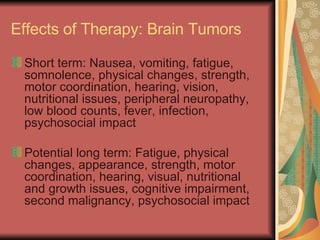
Effects of Therapy: Brain Tumors Short term: Nausea, vomiting, fatigue, somnolence, physical changes, strength, motor coordination, hearing, vision, nutritional issues, peripheral neuropathy, low blood counts, fever, infection, psychosocial impact Potential long term: Fatigue, physical changes, appearance, strength, motor coordination, hearing, visual, nutritional  and growth issues, cognitive impairment, second malignancy, psychosocial impact
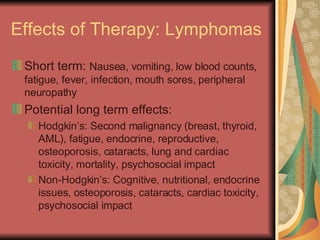
Effects of Therapy: Lymphomas Short term:  Nausea, vomiting, low blood counts, fatigue, fever, infection, mouth sores, peripheral neuropathy Potential long term effects: Hodgkin’s: Second malignancy (breast, thyroid, AML), fatigue, endocrine, reproductive, osteoporosis, cataracts, lung and cardiac toxicity, mortality, psychosocial impact  Non-Hodgkin’s: Cognitive, nutritional, endocrine issues, osteoporosis, cataracts, cardiac toxicity, psychosocial impact
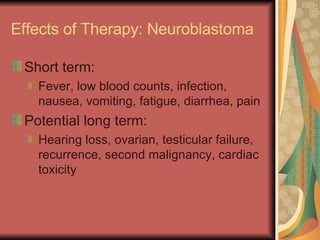
Effects of Therapy: Neuroblastoma Short term:  Fever, low blood counts, infection, nausea, vomiting, fatigue, diarrhea, pain Potential long term: Hearing loss, ovarian, testicular failure, recurrence, second malignancy, cardiac toxicity
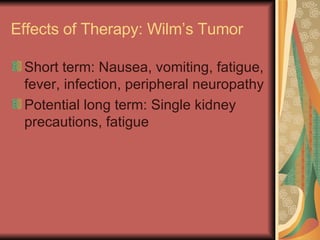
Effects of Therapy: Wilm’s Tumor Short term: Nausea, vomiting, fatigue, fever, infection, peripheral neuropathy Potential long term: Single kidney precautions, fatigue
Bone and Soft Tissue Sarcomas Short term: Low blood counts, fever, infection, pain, mouth sores, fatigue, body image changes Long term: Body image changes, gross or fine motor changes, lung and heart toxicities, fertility issues, cognitive issues, hearing loss, psychosocial impact
Physical Challenges Fatigue/muscle weakness/low stamina Nausea and vomiting  Mood Swings Altered physical appearance (Scarring, hair loss, weight loss/gain, amputation/limb salvage) Gross and fine motor deficits Peripheral Neuropathy Cataracts/Blurred vision Hearing Loss Endocrine/pulmonary/cardiac issues Sexuality and fertility issues
Cognitive Challenges Short-term memory deficits Difficulty with word retrieval Slower thinking, processing speed Poor organizational skills Difficulty with multi-tasking Attention problems including poor concentration and distractibility Fine motor skill deficits
Social/ Emotional Challenges Lack of exposure to play groups, sports, and other extra-curricular activities Loss of contact with friends/peers Variation in maturity level Desire for independence Need for acceptance and finding social group in which to belong Feelings of being “different” Feelings of: sadness guilt anger worry loss grief
Spiritual Challenges Why me? What did I do wrong to deserve this? Where is the all-loving God? Who is God? Why do bad things happen to good people? Am I meant to live this way? What will happen to my family? What is my quality of life?
Academic/Vocational Challenges Curriculum and scheduling  Standards of learning District and state-wide testing Transition issues Types of diplomas SAT and ACT testing Career Goals College or Vocational Training
What helps when faced with these challenges? Strong support system School health plans Educational plans In-service with staff and classmates Transition goals Networking with local and state agencies, non-profit organizations, and businesses in the community
Who serves as the support system for the child? School Team Medical Team Family  Friends
Our goals for children after treatment Find Normalcy Feel good- mind, body, and spirit Increase self-esteem Build confidence Increase independence Learn self-advocacy skills Experience academic success Develop to his/her maximum potential Find meaning in a world with so many unanswered questions
Why is  the school health plan crucial? Describes diagnosis, treatment, and side effects Lists medications given at school Outlines medical procedures Suggests accommodations that are needed for the medical condition
What educational plans are available? Section 504 of the Rehabilitation Act of 1973 Individuals with Disabilities Education Improvement Act (IDEA 2004)
What is Section 504? It is a civil right’s statue that prohibits discrimination based upon disability.
What constitutes a “disability”? A person who has a mental or physical impairment which substantially limits one or more major life activity. Has a record of such an impairment, or Is regarded as having such an “impairment”
What is defined as an “impairment”? Any disability, long-term illness, or disorder that “substantially” reduces or lessens a student’s ability to access learning in the educational setting because of a learning problem, behavioral issue, or health-related condition.
What are considered  “Major Life Activities?” Self-care Manual tasks Walking Seeing Hearing Speaking Sitting Thinking Learning Breathing Concentrating Interacting Working
What is IDEA? Individuals with Disabilities Education Act
IDEA was formerly known as Public Law 94-142; however, it was reauthorized in 1997 and has recently been revised again.  IDEA, Individuals with Disabilities Education Act, is a federal law that provides funding for special education.  It provides a “free and appropriate education” to all students who fall within the special education category.
November 17, 2004- Enacted by Congress December 31, 2004- Passed by the President July 1, 2004- Law went into effect IDEA 2004
-to insure that all children with disabilities have a free public education that emphasizes special education and related services designed to meet their unique needs and to prepare them for further education, employment, and independent living…and to ensure that the rights of children with disabilities and parents of such children are protected. Purpose of IDEA 2004
Who qualifies for special education services under IDEA? Any child 2-21 years of age, inclusive, who has a “disabling condition” which limits his or her progress in the regular classroom Any child who needs special education or related services to make progress or appropriate strides in education
What constitutes a  “disabling condition”? Autism Deaf-Blindness Developmental Delay Emotional Disturbance Hearing Impairment/Deaf Learning Disabilities Mental Retardation Multiple Disabilities Orthopedic Impairment Other Health Impairment Specific Learning Disability Severe Disabilities Speech/Language Impairment Traumatic Brain Injury Visual Impairment
Child Study Team will determine what evaluations are needed. Medical Psychological  Educational Social History Speech/Language Occupational Therapy Physical Therapy
Possible Accommodations to Include on the 504 Plan or the IEP Student will be allowed to have two sets of books, one for home and one for school Student will be assigned a desk suitable for his body frame/size Student will be given permission to carry a water bottle and drink throughout the school day Student will be given bathroom, guidance, or clinic passes when needed. Student will be exempt from all physical education activities requiring strenuous exercises, long distance running, and direct physical contact Student will be exempt from the presidential physical fitness testing
More Accommodations Student will be granted permission to wear layered clothing, both in the classroom and in gym class Student will excused from going outside for gym, recess, or play time during extreme temperatures Student will be granted permission to change gym clothes in a private stall or restroom if needed Student will be assigned a moderate workload with limited assignments requiring quality versus quantity Student will be granted extended time to complete classwork, quizzes, homework, and tests Student will be allowed to leave class 5 minutes early to get to his next class
And More Accommodations Students will be granted a shortened school day or rest period if needed Student will be granted a locker close to his or her classes Student will be assigned a parking space close to the school entrance Student will be granted special transportation when the bus stop is numerous blocks from the home Student will be assigned a peer buddy to take notes or scribe if necessary Student will be kept informed of class activities and school functions Student will be assigned an intermittent homebound teacher to assist when absent for bleeding episodes or clinic appointments Student will be granted extended school year during winter break, spring break, and summer if needed
In-service for School Staff and Peers Answers questions Makes one less curious Makes one less afraid Makes one feel more comfortable Offers helpful hints and suggestions on how to help
Transition The movement from one critical period in life to the next.
Critical Transition Periods Time of Diagnosis Elementary to middle school Middle school to high school High school to college/work Career changes Pediatric to adult services Major life changes
Who can help with these transition periods? Each and every person working with the child.
Networking Helps! Department of Vocational and Rehabilitation Services provides career assessments, testing, training, and job placement Offices of Students with Disabilities at colleges and universities provide accommodations for academic success Non-profit organizations for specific illnesses Specialized camps such as Camp Holiday Trails and Camp Comfort Zone  Local businesses and agencies provide internships and job training

After Childhood Cancer

  • 1.
    Educational Challenges After Childhood Cancer Treatment Anne Mauck, CPNP Alma Morgan, M.Ed 2007 AECMN Conference November 2007
  • 2.
    Objectives Present abrief overview of childhood cancer Discuss physical, cognitive, social/emotional, spiritual, and academic challenges Identify educational plans to meet the needs of the child List common accommodations needed Explore critical transition periods
  • 3.
    Background 1.3 millioncases of cancer per year in United States 13,000 children under 21 7,500 children under 15
  • 4.
    The Good News80% cure rate for all comers 1 in 460 adults between 25 and 40 is childhood cancer survivor (CCS) Estimated by 2010, 1 in 250 adults will be a CCS
  • 5.
    The Bad News20% will not survive 2 of every 3 survivors have at least 1 late effect 1 of 3 have 2 or more late effects 1 of 3 have a serious late effect Incidence of late effects increases with age May take decade or more to be visible
  • 6.
    The Cost ofCure Physical Effects Neurocognitive Deficits Psycho-Social Challenges Spiritual Challenges School/Vocation/Employment Reproductive Issues Second Malignancy Risk Effects on Endocrine System Insurance Implications
  • 7.
    Long-Term Effects AfterCancer Treatment Adverse effects that do not resolve after completion of therapy Any new problem that becomes evident following cancer therapy Noted during maturation (puberty), growth, and normal aging
  • 8.
    Influencing Factors Locationand extent of disease Type of treatment Supportive Care Age and developmental status of patient at time of diagnosis Other Genetics Limited learning experiences
  • 9.
    Types of ChildhoodCancer Leukemia Brain Tumors Lymphoma Neuroblastoma Wilm’s Tumor Bone and Soft Tissue Sarcomas Osteosarcoma Ewing’s Family of Tumors Rhabdomyosarcoma
  • 10.
    Treatments SurgeryChemotherapy Radiation Hematopoietic Stem Cell Transplant Supportive Care Transfusion, antibiotics
  • 11.
    Effects of therapy:Leukemia Short term: Immunocompromise, fatigue, mood swings, change in appearance, fever, low blood counts, infection, peripheral neuropathy, mouth sores, psycho-social impact Potential long term: Cognitive issues, osteoporosis, second malignancy, endocrine issues, sexual and fertility issues, cardiac damage, cataracts, and psycho-social impact
  • 12.
    Effects of Therapy:Brain Tumors Short term: Nausea, vomiting, fatigue, somnolence, physical changes, strength, motor coordination, hearing, vision, nutritional issues, peripheral neuropathy, low blood counts, fever, infection, psychosocial impact Potential long term: Fatigue, physical changes, appearance, strength, motor coordination, hearing, visual, nutritional and growth issues, cognitive impairment, second malignancy, psychosocial impact
  • 13.
    Effects of Therapy:Lymphomas Short term: Nausea, vomiting, low blood counts, fatigue, fever, infection, mouth sores, peripheral neuropathy Potential long term effects: Hodgkin’s: Second malignancy (breast, thyroid, AML), fatigue, endocrine, reproductive, osteoporosis, cataracts, lung and cardiac toxicity, mortality, psychosocial impact Non-Hodgkin’s: Cognitive, nutritional, endocrine issues, osteoporosis, cataracts, cardiac toxicity, psychosocial impact
  • 14.
    Effects of Therapy:Neuroblastoma Short term: Fever, low blood counts, infection, nausea, vomiting, fatigue, diarrhea, pain Potential long term: Hearing loss, ovarian, testicular failure, recurrence, second malignancy, cardiac toxicity
  • 15.
    Effects of Therapy:Wilm’s Tumor Short term: Nausea, vomiting, fatigue, fever, infection, peripheral neuropathy Potential long term: Single kidney precautions, fatigue
  • 16.
    Bone and SoftTissue Sarcomas Short term: Low blood counts, fever, infection, pain, mouth sores, fatigue, body image changes Long term: Body image changes, gross or fine motor changes, lung and heart toxicities, fertility issues, cognitive issues, hearing loss, psychosocial impact
  • 17.
    Physical Challenges Fatigue/muscleweakness/low stamina Nausea and vomiting Mood Swings Altered physical appearance (Scarring, hair loss, weight loss/gain, amputation/limb salvage) Gross and fine motor deficits Peripheral Neuropathy Cataracts/Blurred vision Hearing Loss Endocrine/pulmonary/cardiac issues Sexuality and fertility issues
  • 18.
    Cognitive Challenges Short-termmemory deficits Difficulty with word retrieval Slower thinking, processing speed Poor organizational skills Difficulty with multi-tasking Attention problems including poor concentration and distractibility Fine motor skill deficits
  • 19.
    Social/ Emotional ChallengesLack of exposure to play groups, sports, and other extra-curricular activities Loss of contact with friends/peers Variation in maturity level Desire for independence Need for acceptance and finding social group in which to belong Feelings of being “different” Feelings of: sadness guilt anger worry loss grief
  • 20.
    Spiritual Challenges Whyme? What did I do wrong to deserve this? Where is the all-loving God? Who is God? Why do bad things happen to good people? Am I meant to live this way? What will happen to my family? What is my quality of life?
  • 21.
    Academic/Vocational Challenges Curriculumand scheduling Standards of learning District and state-wide testing Transition issues Types of diplomas SAT and ACT testing Career Goals College or Vocational Training
  • 22.
    What helps whenfaced with these challenges? Strong support system School health plans Educational plans In-service with staff and classmates Transition goals Networking with local and state agencies, non-profit organizations, and businesses in the community
  • 23.
    Who serves asthe support system for the child? School Team Medical Team Family Friends
  • 24.
    Our goals forchildren after treatment Find Normalcy Feel good- mind, body, and spirit Increase self-esteem Build confidence Increase independence Learn self-advocacy skills Experience academic success Develop to his/her maximum potential Find meaning in a world with so many unanswered questions
  • 25.
    Why is the school health plan crucial? Describes diagnosis, treatment, and side effects Lists medications given at school Outlines medical procedures Suggests accommodations that are needed for the medical condition
  • 26.
    What educational plansare available? Section 504 of the Rehabilitation Act of 1973 Individuals with Disabilities Education Improvement Act (IDEA 2004)
  • 27.
    What is Section504? It is a civil right’s statue that prohibits discrimination based upon disability.
  • 28.
    What constitutes a“disability”? A person who has a mental or physical impairment which substantially limits one or more major life activity. Has a record of such an impairment, or Is regarded as having such an “impairment”
  • 29.
    What is definedas an “impairment”? Any disability, long-term illness, or disorder that “substantially” reduces or lessens a student’s ability to access learning in the educational setting because of a learning problem, behavioral issue, or health-related condition.
  • 30.
    What are considered “Major Life Activities?” Self-care Manual tasks Walking Seeing Hearing Speaking Sitting Thinking Learning Breathing Concentrating Interacting Working
  • 31.
    What is IDEA?Individuals with Disabilities Education Act
  • 32.
    IDEA was formerlyknown as Public Law 94-142; however, it was reauthorized in 1997 and has recently been revised again. IDEA, Individuals with Disabilities Education Act, is a federal law that provides funding for special education. It provides a “free and appropriate education” to all students who fall within the special education category.
  • 33.
    November 17, 2004-Enacted by Congress December 31, 2004- Passed by the President July 1, 2004- Law went into effect IDEA 2004
  • 34.
    -to insure thatall children with disabilities have a free public education that emphasizes special education and related services designed to meet their unique needs and to prepare them for further education, employment, and independent living…and to ensure that the rights of children with disabilities and parents of such children are protected. Purpose of IDEA 2004
  • 35.
    Who qualifies forspecial education services under IDEA? Any child 2-21 years of age, inclusive, who has a “disabling condition” which limits his or her progress in the regular classroom Any child who needs special education or related services to make progress or appropriate strides in education
  • 36.
    What constitutes a “disabling condition”? Autism Deaf-Blindness Developmental Delay Emotional Disturbance Hearing Impairment/Deaf Learning Disabilities Mental Retardation Multiple Disabilities Orthopedic Impairment Other Health Impairment Specific Learning Disability Severe Disabilities Speech/Language Impairment Traumatic Brain Injury Visual Impairment
  • 37.
    Child Study Teamwill determine what evaluations are needed. Medical Psychological Educational Social History Speech/Language Occupational Therapy Physical Therapy
  • 38.
    Possible Accommodations toInclude on the 504 Plan or the IEP Student will be allowed to have two sets of books, one for home and one for school Student will be assigned a desk suitable for his body frame/size Student will be given permission to carry a water bottle and drink throughout the school day Student will be given bathroom, guidance, or clinic passes when needed. Student will be exempt from all physical education activities requiring strenuous exercises, long distance running, and direct physical contact Student will be exempt from the presidential physical fitness testing
  • 39.
    More Accommodations Studentwill be granted permission to wear layered clothing, both in the classroom and in gym class Student will excused from going outside for gym, recess, or play time during extreme temperatures Student will be granted permission to change gym clothes in a private stall or restroom if needed Student will be assigned a moderate workload with limited assignments requiring quality versus quantity Student will be granted extended time to complete classwork, quizzes, homework, and tests Student will be allowed to leave class 5 minutes early to get to his next class
  • 40.
    And More AccommodationsStudents will be granted a shortened school day or rest period if needed Student will be granted a locker close to his or her classes Student will be assigned a parking space close to the school entrance Student will be granted special transportation when the bus stop is numerous blocks from the home Student will be assigned a peer buddy to take notes or scribe if necessary Student will be kept informed of class activities and school functions Student will be assigned an intermittent homebound teacher to assist when absent for bleeding episodes or clinic appointments Student will be granted extended school year during winter break, spring break, and summer if needed
  • 41.
    In-service for SchoolStaff and Peers Answers questions Makes one less curious Makes one less afraid Makes one feel more comfortable Offers helpful hints and suggestions on how to help
  • 42.
    Transition The movementfrom one critical period in life to the next.
  • 43.
    Critical Transition PeriodsTime of Diagnosis Elementary to middle school Middle school to high school High school to college/work Career changes Pediatric to adult services Major life changes
  • 44.
    Who can helpwith these transition periods? Each and every person working with the child.
  • 45.
    Networking Helps! Departmentof Vocational and Rehabilitation Services provides career assessments, testing, training, and job placement Offices of Students with Disabilities at colleges and universities provide accommodations for academic success Non-profit organizations for specific illnesses Specialized camps such as Camp Holiday Trails and Camp Comfort Zone Local businesses and agencies provide internships and job training