

Age of Majority   Karol Green, M.Ed. Hospital Education Program Richmond, Virginia
Age of Majority The age when a person acquires all the rights and responsibilities of being an adult. In most states the age is 18.
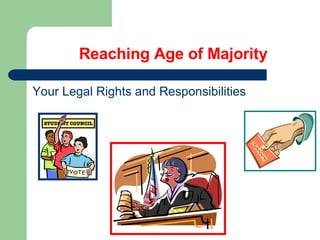
  Reaching Age of Majority Your Legal Rights and Responsibilities
When a student reaches age of majority, the rights of the parent legally transfer to the student.
In Under IDEA 2004 School divisions transfer all educational decisions and rights from the parent or guardian to the student with disabilities at age 18.
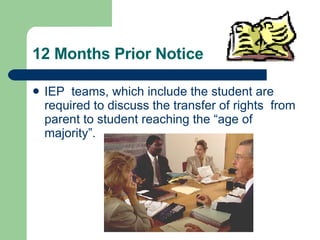
12 Months Prior Notice IEP  teams, which include the student are required to discuss the transfer of rights  from parent to student reaching the “age of majority”.
Notification The local educational agency shall notify the parents and the student of the following: Educational rights will transfer from the parents to the student upon reaching the age of majority. The procedures for appointing the parents or other appropriate individual, to represent the educational interests of the student if student is determined not to have the ability to provide informed consent.
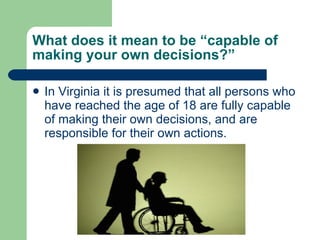
What does it mean to be “capable of making your own decisions?” In Virginia it is presumed that all persons who have reached the age of 18 are fully capable of making their own decisions, and are responsible for their own actions.
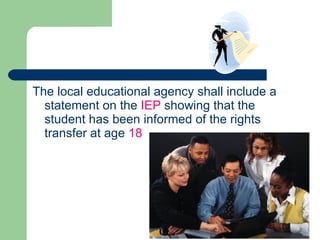
The local educational agency shall include a statement on the  IEP  showing that the student has been informed of the rights transfer at age  18
When a student reaches the age of 18, that adult student is presumed under Virginia law to be capable of making his or her own decisions - including educational decisions. That does not mean that parents cannot continue to be involved in their children’s education. It just means that, by law, schools respect the educational decisions of every adult student,  unless  that person has been determined to be incapable of making decisions.
What about students with special needs, or students who have a condition or illness which might impair their ability to make informed educational decisions ?
Decision-Making Options for supporting your child Guardian Power of Attorney Parent
The VDOE recognizes three ways for a parent, family member, or other person to be appointed to make educational decisions on behalf of an adult student. The parent requests being a court-appointed guardian and is given authority to make educational decisions at a guardianship hearing before a judge. The parent assists the adult student to appoint or designate, in writing,  his or her choice to make educational decisions through a power of attorney, signed and executed by the adult student and a Notary Public.  The parent or other competent adult pursues certification that the adult special education student is unable or incapable of providing informed consent in making educational decisions and is considered by the school division to be the “educational representative” to make educational decisions for the student.
Before a special education student can have an educational representative appointed, the student must be evaluated and determined to be “unable or incapable of providing informed consent for educational decisions made under the Individuals with Disabilities Education Act.” The procedure included specifies who must certify that a special education student is incapable of providing informed consent. The process of having an educational representative appointed is much easier and less expensive than a guardianship proceeding.  However, remember that an educational representative is authorized to make  educational decisions only .  The educational representative is not given any authority to make other decisions on behalf of an adult student.
Resources Age of Majority:  Preparing Your Child for Making Good Choices http://www.ncset.org/publications/viewdesc.  asp?id=318 National Guardianship Association www.guardianship.org http://www.penk12.va.us/VDOE

Age of Majority

  • 1.
    Age of Majority Karol Green, M.Ed. Hospital Education Program Richmond, Virginia
  • 2.
    Age of MajorityThe age when a person acquires all the rights and responsibilities of being an adult. In most states the age is 18.
  • 3.
    ReachingAge of Majority Your Legal Rights and Responsibilities
  • 4.
    When a studentreaches age of majority, the rights of the parent legally transfer to the student.
  • 5.
    In Under IDEA2004 School divisions transfer all educational decisions and rights from the parent or guardian to the student with disabilities at age 18.
  • 6.
    12 Months PriorNotice IEP teams, which include the student are required to discuss the transfer of rights from parent to student reaching the “age of majority”.
  • 7.
    Notification The localeducational agency shall notify the parents and the student of the following: Educational rights will transfer from the parents to the student upon reaching the age of majority. The procedures for appointing the parents or other appropriate individual, to represent the educational interests of the student if student is determined not to have the ability to provide informed consent.
  • 8.
    What does itmean to be “capable of making your own decisions?” In Virginia it is presumed that all persons who have reached the age of 18 are fully capable of making their own decisions, and are responsible for their own actions.
  • 9.
    The local educationalagency shall include a statement on the IEP showing that the student has been informed of the rights transfer at age 18
  • 10.
    When a studentreaches the age of 18, that adult student is presumed under Virginia law to be capable of making his or her own decisions - including educational decisions. That does not mean that parents cannot continue to be involved in their children’s education. It just means that, by law, schools respect the educational decisions of every adult student, unless that person has been determined to be incapable of making decisions.
  • 11.
    What about studentswith special needs, or students who have a condition or illness which might impair their ability to make informed educational decisions ?
  • 12.
    Decision-Making Options forsupporting your child Guardian Power of Attorney Parent
  • 13.
    The VDOE recognizesthree ways for a parent, family member, or other person to be appointed to make educational decisions on behalf of an adult student. The parent requests being a court-appointed guardian and is given authority to make educational decisions at a guardianship hearing before a judge. The parent assists the adult student to appoint or designate, in writing, his or her choice to make educational decisions through a power of attorney, signed and executed by the adult student and a Notary Public. The parent or other competent adult pursues certification that the adult special education student is unable or incapable of providing informed consent in making educational decisions and is considered by the school division to be the “educational representative” to make educational decisions for the student.
  • 14.
    Before a specialeducation student can have an educational representative appointed, the student must be evaluated and determined to be “unable or incapable of providing informed consent for educational decisions made under the Individuals with Disabilities Education Act.” The procedure included specifies who must certify that a special education student is incapable of providing informed consent. The process of having an educational representative appointed is much easier and less expensive than a guardianship proceeding. However, remember that an educational representative is authorized to make educational decisions only . The educational representative is not given any authority to make other decisions on behalf of an adult student.
  • 15.
    Resources Age ofMajority: Preparing Your Child for Making Good Choices http://www.ncset.org/publications/viewdesc. asp?id=318 National Guardianship Association www.guardianship.org http://www.penk12.va.us/VDOE