Group Tutoring Sessions Welcome!  Please type the following in the chat box to help us get started: What is your proficiency level for this language? Why are you learning this language? Is this your first tutoring session? First time using your headset or microphone? Click  Communicate   =>  VoIP Conference   =>  Leave VoIP conference Click  Communicate  =>  Audio Setup Wizard   to restart the Audio Setup Wizard. On the second screen of the Audio Setup Wizard select your new device Test your speakers and microphones on the following 2 screens, select Headphones and complete the Audio Setup Wizard.  Finally click  Communicate   =>  VoIp Conference   =>  Join VoIP conference   to be able to hear the tutor and speak to them. Problem Speaking? Press and hold down  the “ CTRL ” key when speaking. Technical Help F or additional help, visit the Group Tutoring Help Page:  http://www.livemocha.com/premium_courses/group_tutoring_help   Or email  [email_address]
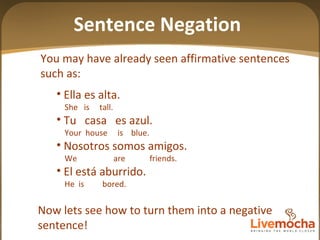
You may have already seen affirmative sentences such as: Ella es alta. She  is  tall. Tu  casa  es azul. Your  house  is  blue. Nosotros somos amigos. We  are  friends. El está aburrido. He  is  bored. Now lets see how to turn them into a negative sentence!  Sentence Negation
If it’s a simple affirmative sentence, insert a  no  before the verb. Examples: El  está  aburrido. He  is  bored. El  está  aburrido. He  no  is  bored. Ella  es  alta. She  is  tall. Ella  es   alta. She  no  is  tall. Verbs in bold Sentence Negation
If it’s a simple affirmative sentence, insert a  no  before the verb. Examples: no El  está  aburrido. He  is  bored. El  está  aburrido. He  no  is  bored. Ella  es  alta. She  is  tall. Ella  es   alta. She  no  is  tall. Verbs in bold no Sentence Negation
If we look at the literal translation, it could sound funny: She no  is  tall. He no  is  bored. Your house no  is  blue. But that’s the structure of Spanish. By placing a NO before the verb, the verb and entire sentence is negated. Verb Sentence Negation
Now you try it… How can these sentences be negated? Tú eres inteligente.  (You are smart.) Ellos están en casa.  (They are at home.) Yo estoy  feliz.  (I am happy.) Practice!
Now you try it… How can these sentences be negated? Tú eres inteligente.  Ellos están en casa. Yo   estoy   feliz .  (I am happy.) Practice!
Now you try it… How can these sentences be negated? Tú eres inteligente. Ellos están en casa. Practice! Yo   estoy   feliz .  (I am  not  happy.) no
Now you try it… How can these sentences be negated? Tú   eres   inteligente .  (You are smart.) Ellos están en casa. Practice! Yo  estoy  feliz.   (I am  not  happy.) no
Now you try it… How can these sentences be negated? Ellos están en casa. Practice! Yo  estoy  feliz.  (I am  not  happy.) no Tú   eres   inteligente .  (You are  not  smart.) no
Tú  eres inteligente.  (You are  not  smart.) Yo  estoy  feliz.  (I am  not  happy.) no no Now you try it… How can these sentences be negated? Ellos   están   en   casa . Practice!
Tú  eres inteligente.  (You are  not  smart.) Ellos   están   en   casa .  (They are  not  at home.) Yo  estoy  feliz.   (I am  not  happy.) no no no Now you try it… How can these sentences be negated? Practice!
Nosotros  vamos  a  ir  al cine. (We are going to go to the movie.) Those were easy!    How about these? Voy al trabajo.  (I go to work.) How about some more?
Nosotros  vamos  a  ir  al cine. (We are going to go to the movie.) Those were easy!    How about these? Voy   al   trabajo .  (I go to work.) How about some more?
Those were easy!    How about these? voy   al   trabajo .   (I  don’t  go to work.) No Nosotros  vamos  a  ir  al cine. (We are going to go to the movie.) How about some more?
Those were easy!    How about these? voy al trabajo.   (I  don’t  go to work.) No Nosotros   vamos   a   ir   al   cine . (We are going to go to the movie.) How about some more?
Nosotros  vamos  a  ir  al cine. (We are  not  going to go to the movie.) Those were easy!    How about these? voy al trabajo.   (I  don’t  go to work.) No no How about some more?
Another way to negate sentences is to use words such as:  nunca jam á s nadie tampoco ni ninguno  ninguna ningún nada never never ever nobody either negative and or nor none (male) none (female) none (male singular) nothing Other Negative Words
Voy al cine. Go  to the movies ( “I” is implied).  Ella hace la tarea. She  does  homework. El llamó por teléfono. He  called by  phone. Vino mi papá y mi mamá. Came  my  dad  and  my  mom. These words can be used in front of the verb and after too, if there is another negative description before the verb. We have these affirmative sentences: Negative Word Placement
These words can be used in front of the verb and after too, if there is another negative description before the verb. Negative Word Placement Nunca  voy al cine. (I) never  go  to the movies. Ella  nunca  hace la tarea. She  never  does  homework Nadie  llamó  nunca  por télefono. Nobody  called  never  the  telephone No  vino  ni  mi papá  ni  mi mamá. Did  not  come my dad  nor  my  mom Voy al cine . Go  to the movies ( “I” is implied).  Ella hace la tarea. She  does  homework. El llamó por teléfono. He  called by  phone. Vino mi papá y mi mamá. Came  my  dad  and  my  mom. Notice their change to negative, and how it can come before the verb:  We have these affirmative sentences:
These words can be used in front of the verb and after too, if there is another negative description before the verb. Negative Word Placement Nunca  voy al cine. (I) never  go  to the movies. Ella  nunca  hace la tarea. She  never  does  homework. Nadie  llamó  nunca  por télefono. Nobody  called  never  the  telephone No  vino  ni  mi papá  ni  mi mamá. Did  not  come my dad  nor  my  mom Voy al cine . Go  to the movies ( “I” is implied).  Ella hace la tarea . She  does  homework. El llamó por teléfono. He  called by  phone. Vino mi papá y mi mamá. Came  my  dad  and  my  mom. Notice their change to negative, and how it can come before the verb:  We have these affirmative sentences:
These words can be used in front of the verb and after too, if there is another negative description before the verb. Negative Word Placement Nunca  voy al cine. (I) never  go  to the movies. Ella  nunca  hace la tarea. She  never  does  homework. Nadie  llamó  nunca  por teléfono. Nobody  called  never  by  phone. No  vino  ni  mi papá  ni  mi mamá. Did  not  come my dad  nor  my  mom Voy al cine . Go  to the movies ( “I” is implied).  Ella hace la tarea. She  does  homework. El llamó por teléfono . He  called by  phone. Vino mi papá y mi mamá. Came  my  dad  and  my  mom. Notice their change to negative, and how it can come before the verb:  We have these affirmative sentences:
Notice their change to negative, and how it can come before the verb:  Nunca  voy al cine. (I) never  go  to the movies. Ella  nunca  hace la tarea. She  never  does  homework Nadie  llamó  nunca  por teléfono. Nobody  called  never  by  phone. No  vino  ni  mi papá  ni  mi mamá. Did  not  come my dad  nor  my  mom. Negative Word Placement These words can be used in front of the verb and after too, if there is another negative description before the verb. Voy al cine. Go  to the movies ( “I” is implied).  Ella hace la tarea. She  does  homework. El llamó por teléfono. He  called by  phone. Vino mi papá y mi mamá . Came  my  dad  and  my  mom. We have these affirmative sentences:
It is correct to use 2 negative words in the same sentence. The sentence stays in the negative.  No  encontré  nada  en la tienda. (I)  No  found  nothing in the store I didn’t find anything in the store. Nunca   hace  nada   de tarea. (He/she) Never does  nothing  of homework She never does any homework. El perro  no  hace  nada .  The dog  no  does  nothing The dog doesn’t do anything (does no harm). Double Negative
Create two simple sentences using the no particle. You can help yourself with the chart below. 1 2 3 4 5 Pronoun No Estar To Be Ser To be Habla Speak/ Call Correr Run 1 Yo no estoy - hablo corro en (at) a (to) la casa (home) Tú no estás - hablas corres el trabajo (work) El / Ella no está - habla corre el cine (movies) 2 Nosotros no estamos somos hablamos corremos - buenos (good)  Ustedes  no están son hablan corren rápidos (fast) Ellos no están son hablan corren juntos (together)
Lesson Complete Questions?   In this lesson, we covered affirmative sentences, and when we negate them.  Adding “no”!  Also  “double negatives.” Keep practicing! Flashcard Sets: Affirmative and Negative http://www.livemocha.com/flashcard_sets/view/246514/Spanish-Affirmative,-Negative http://www.livemocha.com/flashcard_sets/view/127563 Keep doing Livemocha Lessons Practice with native speakers on Livemocha Talk to native speakers and listen to how they negate sentences.  And have fun!  

Negation

  • 1.
    Group Tutoring SessionsWelcome! Please type the following in the chat box to help us get started: What is your proficiency level for this language? Why are you learning this language? Is this your first tutoring session? First time using your headset or microphone? Click Communicate => VoIP Conference => Leave VoIP conference Click Communicate => Audio Setup Wizard to restart the Audio Setup Wizard. On the second screen of the Audio Setup Wizard select your new device Test your speakers and microphones on the following 2 screens, select Headphones and complete the Audio Setup Wizard. Finally click Communicate => VoIp Conference => Join VoIP conference to be able to hear the tutor and speak to them. Problem Speaking? Press and hold down the “ CTRL ” key when speaking. Technical Help F or additional help, visit the Group Tutoring Help Page: http://www.livemocha.com/premium_courses/group_tutoring_help Or email [email_address]
  • 2.
    You may havealready seen affirmative sentences such as: Ella es alta. She is tall. Tu casa es azul. Your house is blue. Nosotros somos amigos. We are friends. El está aburrido. He is bored. Now lets see how to turn them into a negative sentence! Sentence Negation
  • 3.
    If it’s asimple affirmative sentence, insert a no before the verb. Examples: El está aburrido. He is bored. El está aburrido. He no is bored. Ella es alta. She is tall. Ella es alta. She no is tall. Verbs in bold Sentence Negation
  • 4.
    If it’s asimple affirmative sentence, insert a no before the verb. Examples: no El está aburrido. He is bored. El está aburrido. He no is bored. Ella es alta. She is tall. Ella es alta. She no is tall. Verbs in bold no Sentence Negation
  • 5.
    If we lookat the literal translation, it could sound funny: She no is tall. He no is bored. Your house no is blue. But that’s the structure of Spanish. By placing a NO before the verb, the verb and entire sentence is negated. Verb Sentence Negation
  • 6.
    Now you tryit… How can these sentences be negated? Tú eres inteligente. (You are smart.) Ellos están en casa. (They are at home.) Yo estoy feliz. (I am happy.) Practice!
  • 7.
    Now you tryit… How can these sentences be negated? Tú eres inteligente. Ellos están en casa. Yo estoy feliz . (I am happy.) Practice!
  • 8.
    Now you tryit… How can these sentences be negated? Tú eres inteligente. Ellos están en casa. Practice! Yo estoy feliz . (I am not happy.) no
  • 9.
    Now you tryit… How can these sentences be negated? Tú eres inteligente . (You are smart.) Ellos están en casa. Practice! Yo estoy feliz. (I am not happy.) no
  • 10.
    Now you tryit… How can these sentences be negated? Ellos están en casa. Practice! Yo estoy feliz. (I am not happy.) no Tú eres inteligente . (You are not smart.) no
  • 11.
    Tú eresinteligente. (You are not smart.) Yo estoy feliz. (I am not happy.) no no Now you try it… How can these sentences be negated? Ellos están en casa . Practice!
  • 12.
    Tú eresinteligente. (You are not smart.) Ellos están en casa . (They are not at home.) Yo estoy feliz. (I am not happy.) no no no Now you try it… How can these sentences be negated? Practice!
  • 13.
    Nosotros vamos a ir al cine. (We are going to go to the movie.) Those were easy!  How about these? Voy al trabajo. (I go to work.) How about some more?
  • 14.
    Nosotros vamos a ir al cine. (We are going to go to the movie.) Those were easy!  How about these? Voy al trabajo . (I go to work.) How about some more?
  • 15.
    Those were easy!  How about these? voy al trabajo . (I don’t go to work.) No Nosotros vamos a ir al cine. (We are going to go to the movie.) How about some more?
  • 16.
    Those were easy!  How about these? voy al trabajo. (I don’t go to work.) No Nosotros vamos a ir al cine . (We are going to go to the movie.) How about some more?
  • 17.
    Nosotros vamos a ir al cine. (We are not going to go to the movie.) Those were easy!  How about these? voy al trabajo. (I don’t go to work.) No no How about some more?
  • 18.
    Another way tonegate sentences is to use words such as: nunca jam á s nadie tampoco ni ninguno ninguna ningún nada never never ever nobody either negative and or nor none (male) none (female) none (male singular) nothing Other Negative Words
  • 19.
    Voy al cine.Go to the movies ( “I” is implied). Ella hace la tarea. She does homework. El llamó por teléfono. He called by phone. Vino mi papá y mi mamá. Came my dad and my mom. These words can be used in front of the verb and after too, if there is another negative description before the verb. We have these affirmative sentences: Negative Word Placement
  • 20.
    These words canbe used in front of the verb and after too, if there is another negative description before the verb. Negative Word Placement Nunca voy al cine. (I) never go to the movies. Ella nunca hace la tarea. She never does homework Nadie llamó nunca por télefono. Nobody called never the telephone No vino ni mi papá ni mi mamá. Did not come my dad nor my mom Voy al cine . Go to the movies ( “I” is implied). Ella hace la tarea. She does homework. El llamó por teléfono. He called by phone. Vino mi papá y mi mamá. Came my dad and my mom. Notice their change to negative, and how it can come before the verb: We have these affirmative sentences:
  • 21.
    These words canbe used in front of the verb and after too, if there is another negative description before the verb. Negative Word Placement Nunca voy al cine. (I) never go to the movies. Ella nunca hace la tarea. She never does homework. Nadie llamó nunca por télefono. Nobody called never the telephone No vino ni mi papá ni mi mamá. Did not come my dad nor my mom Voy al cine . Go to the movies ( “I” is implied). Ella hace la tarea . She does homework. El llamó por teléfono. He called by phone. Vino mi papá y mi mamá. Came my dad and my mom. Notice their change to negative, and how it can come before the verb: We have these affirmative sentences:
  • 22.
    These words canbe used in front of the verb and after too, if there is another negative description before the verb. Negative Word Placement Nunca voy al cine. (I) never go to the movies. Ella nunca hace la tarea. She never does homework. Nadie llamó nunca por teléfono. Nobody called never by phone. No vino ni mi papá ni mi mamá. Did not come my dad nor my mom Voy al cine . Go to the movies ( “I” is implied). Ella hace la tarea. She does homework. El llamó por teléfono . He called by phone. Vino mi papá y mi mamá. Came my dad and my mom. Notice their change to negative, and how it can come before the verb: We have these affirmative sentences:
  • 23.
    Notice their changeto negative, and how it can come before the verb: Nunca voy al cine. (I) never go to the movies. Ella nunca hace la tarea. She never does homework Nadie llamó nunca por teléfono. Nobody called never by phone. No vino ni mi papá ni mi mamá. Did not come my dad nor my mom. Negative Word Placement These words can be used in front of the verb and after too, if there is another negative description before the verb. Voy al cine. Go to the movies ( “I” is implied). Ella hace la tarea. She does homework. El llamó por teléfono. He called by phone. Vino mi papá y mi mamá . Came my dad and my mom. We have these affirmative sentences:
  • 24.
    It is correctto use 2 negative words in the same sentence. The sentence stays in the negative. No encontré nada en la tienda. (I) No found nothing in the store I didn’t find anything in the store. Nunca hace nada de tarea. (He/she) Never does nothing of homework She never does any homework. El perro no hace nada . The dog no does nothing The dog doesn’t do anything (does no harm). Double Negative
  • 25.
    Create two simplesentences using the no particle. You can help yourself with the chart below. 1 2 3 4 5 Pronoun No Estar To Be Ser To be Habla Speak/ Call Correr Run 1 Yo no estoy - hablo corro en (at) a (to) la casa (home) Tú no estás - hablas corres el trabajo (work) El / Ella no está - habla corre el cine (movies) 2 Nosotros no estamos somos hablamos corremos - buenos (good) Ustedes no están son hablan corren rápidos (fast) Ellos no están son hablan corren juntos (together)
  • 26.
    Lesson Complete Questions? In this lesson, we covered affirmative sentences, and when we negate them. Adding “no”! Also “double negatives.” Keep practicing! Flashcard Sets: Affirmative and Negative http://www.livemocha.com/flashcard_sets/view/246514/Spanish-Affirmative,-Negative http://www.livemocha.com/flashcard_sets/view/127563 Keep doing Livemocha Lessons Practice with native speakers on Livemocha Talk to native speakers and listen to how they negate sentences. And have fun! 