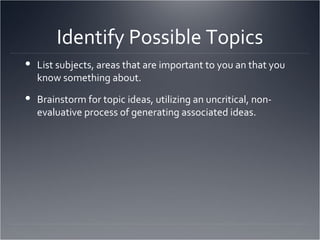
Identify Possible Topics List subjects, areas that are important to you an that you know something about. Brainstorm for topic ideas, utilizing an uncritical, non-evaluative process of generating associated ideas.
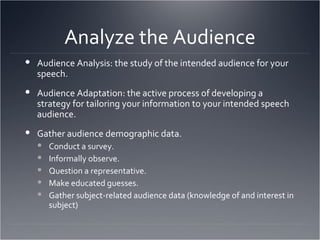
Analyze the Audience Audience Analysis: the study of the intended audience for your speech. Audience Adaptation: the active process of developing a strategy for tailoring your information to your intended speech audience. Gather audience demographic data. Conduct a survey. Informally observe. Question a representative. Make educated guesses. Gather subject-related audience data (knowledge of and interest in subject)
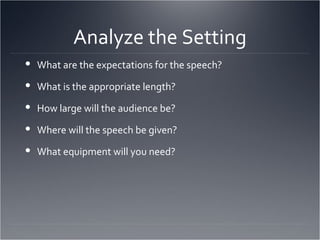
Analyze the Setting What are the expectations for the speech? What is the appropriate length? How large will the audience be? Where will the speech be given? What equipment will you need?
Select a Topic Select an audience appropriate topic. Consider the setting.
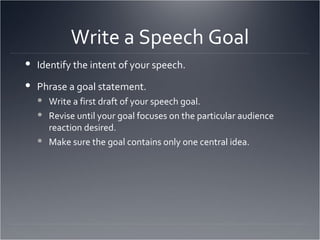
Write a Speech Goal Identify the intent of your speech. Phrase a goal statement. Write a first draft of your speech goal. Revise until your goal focuses on the particular audience reaction desired. Make sure the goal contains only one central idea.
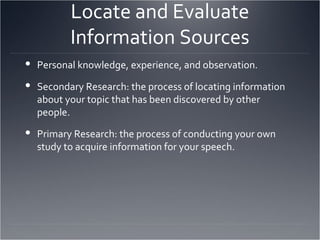
Locate and Evaluate Information Sources Personal knowledge, experience, and observation. Secondary Research: the process of locating information about your topic that has been discovered by other people. Primary Research: the process of conducting your own study to acquire information for your speech.
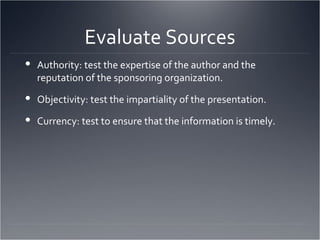
Evaluate Sources Authority: test the expertise of the author and the reputation of the sponsoring organization. Objectivity: test the impartiality of the presentation. Currency: test to ensure that the information is timely.
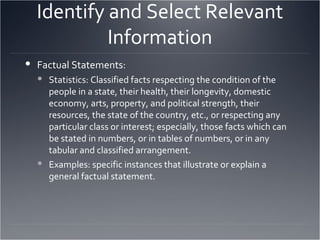
Identify and Select Relevant Information Factual Statements: Statistics: Classified facts respecting the condition of the people in a state, their health, their longevity, domestic economy, arts, property, and political strength, their resources, the state of the country, etc., or respecting any particular class or interest; especially, those facts which can be stated in numbers, or in tables of numbers, or in any tabular and classified arrangement. Examples: specific instances that illustrate or explain a general factual statement.
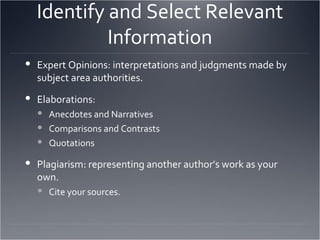
Identify and Select Relevant Information Expert Opinions: interpretations and judgments made by subject area authorities. Elaborations: Anecdotes and Narratives Comparisons and Contrasts Quotations Plagiarism: representing another author’s work as your own. Cite your sources.

Sph 106 Ch 12

  • 1.
  • 2.
    Identify Possible TopicsList subjects, areas that are important to you an that you know something about. Brainstorm for topic ideas, utilizing an uncritical, non-evaluative process of generating associated ideas.
  • 3.
    Analyze the AudienceAudience Analysis: the study of the intended audience for your speech. Audience Adaptation: the active process of developing a strategy for tailoring your information to your intended speech audience. Gather audience demographic data. Conduct a survey. Informally observe. Question a representative. Make educated guesses. Gather subject-related audience data (knowledge of and interest in subject)
  • 4.
    Analyze the SettingWhat are the expectations for the speech? What is the appropriate length? How large will the audience be? Where will the speech be given? What equipment will you need?
  • 5.
    Select a TopicSelect an audience appropriate topic. Consider the setting.
  • 6.
    Write a SpeechGoal Identify the intent of your speech. Phrase a goal statement. Write a first draft of your speech goal. Revise until your goal focuses on the particular audience reaction desired. Make sure the goal contains only one central idea.
  • 7.
    Locate and EvaluateInformation Sources Personal knowledge, experience, and observation. Secondary Research: the process of locating information about your topic that has been discovered by other people. Primary Research: the process of conducting your own study to acquire information for your speech.
  • 8.
    Evaluate Sources Authority:test the expertise of the author and the reputation of the sponsoring organization. Objectivity: test the impartiality of the presentation. Currency: test to ensure that the information is timely.
  • 9.
    Identify and SelectRelevant Information Factual Statements: Statistics: Classified facts respecting the condition of the people in a state, their health, their longevity, domestic economy, arts, property, and political strength, their resources, the state of the country, etc., or respecting any particular class or interest; especially, those facts which can be stated in numbers, or in tables of numbers, or in any tabular and classified arrangement. Examples: specific instances that illustrate or explain a general factual statement.
  • 10.
    Identify and SelectRelevant Information Expert Opinions: interpretations and judgments made by subject area authorities. Elaborations: Anecdotes and Narratives Comparisons and Contrasts Quotations Plagiarism: representing another author’s work as your own. Cite your sources.