Manajemen dan Kualitas Perangkat Lunak
              IKP321

             Pendahuluan
Administratif Perkuliahan

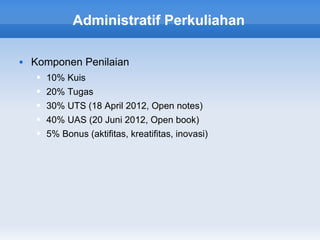
   Komponen Penilaian
       10% Kuis
       20% Tugas
       30% UTS (18 April 2012, Open notes)
       40% UAS (20 Juni 2012, Open book)
       5% Bonus (aktifitas, kreatifitas, inovasi)
Administratif Perkuliahan

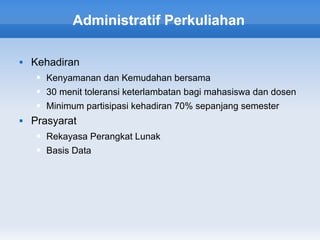
   Kehadiran
        Kenyamanan dan Kemudahan bersama
        30 menit toleransi keterlambatan bagi mahasiswa dan dosen
        Minimum partisipasi kehadiran 70% sepanjang semester
   Prasyarat
        Rekayasa Perangkat Lunak
        Basis Data
Administratif Perkuliahan

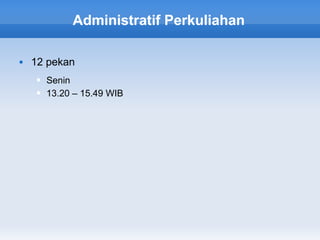
   12 pekan
       Senin
       13.20 – 15.49 WIB
Contoh Kejadian Nyata

   Denver International Airport (DIA)
        Opens February 1995
        Planned to serve 110 000 000 passengers annually by 2020
        Planned to handle 1750 flights daily
        200 gates
        12 operating runways
Contoh Kejadian Nyata

   Operations at DIA were delayed by 16 months,
        mainly due to the failure of the software-based baggage
         handling system
        estimated total losses of $2 billion
        the baggage handling system finally put into service
        substantially downscaled in comparison to the system
         originally specified
Contoh Lain

   Arianne
        Floating point rounding error
   Fukushima's power plant cooling system
        Backup system failed to work properly
        14 days to cool down
Software

   Software
       Quality Assurance
       Computer programs, procedures, and possibly associated
        documentation and data pertaining to the operation of
        computer systems
   Code
       Instruksi bahasa pemrograman
   Procedures
       Urutan langkah di dalam program (algoritme)
       Metode instalasi
       User role
Software

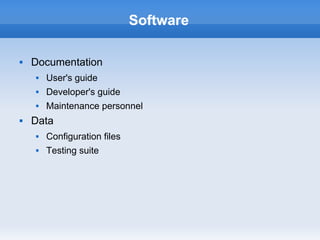
   Documentation
       User's guide
       Developer's guide
       Maintenance personnel
   Data
       Configuration files
       Testing suite
Software errors, faults and failures

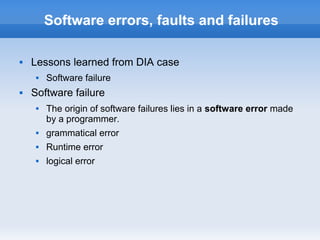
   Lessons learned from DIA case
        Software failure
   Software failure
        The origin of software failures lies in a software error made
         by a programmer.
        grammatical error
        Runtime error
        logical error
Software errors, faults and failures

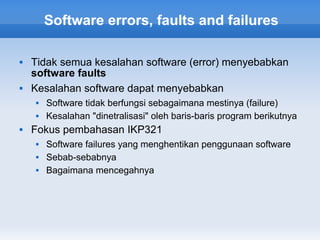
   Tidak semua kesalahan software (error) menyebabkan
    software faults
   Kesalahan software dapat menyebabkan
       Software tidak berfungsi sebagaimana mestinya (failure)
       Kesalahan "dinetralisasi" oleh baris-baris program berikutnya
   Fokus pembahasan IKP321
       Software failures yang menghentikan penggunaan software
       Sebab-sebabnya
       Bagaimana mencegahnya
Software Quality

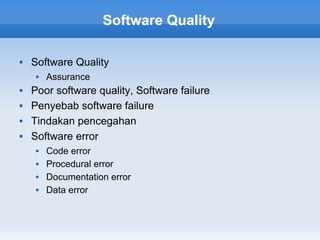
   Software Quality
        Assurance
   Poor software quality, Software failure
   Penyebab software failure
   Tindakan pencegahan
   Software error
        Code error
        Procedural error
        Documentation error
        Data error
Penyebab Software Error

   To Err is Human
       Alexander Pope, (1688-1744)
   Humans
       System analysts
       Programmer
       Software tester
       Documentation experts
       Clients and representatives
   Bagaimana dengan Kompilator?
Penyebab Software Error

   To Err is Human
       Alexander Pope, (1688-1744)
   Humans
       System analysts
       Programmer
       Software tester
       Documentation experts
       Clients and representatives
   Bagaimana dengan Kompilator?
       Compiler is software
       Made by humans
Munculnya Error dalam Tahapan
          Pengembangan Software

   Faulty requirements definition
   Client-developer communication failures
   Deliberate deviations from software requirements
   Logical design errors
   Coding errors
   Non-complieance with documentation and coding
    guidelines
   Shortcomings of testing process
   Procedure errors
   Documentation errors
Faulty software requirements

   Biasanya dibuat oleh klien
   Definisi kurang jelas atau salah
   Deskripsi kebutuhan tidak jelas
   Kebutuhan yang penting justru tidak terdokumentasi
   Kebutuhan yang tidak penting justru terdokumentasi
Client-developer communication failure

   Defective communication
        Perbedaan umur
        Perbedaan latar belakang ilmu
   Kesalahpahaman
        Salah memahami instruksi klien
        Salah memahami definisi klien
        Salah memahami permintaan perubahan
        Klien salah memahami keterbatasan development
        Disampaikan secara tertulis maupun lisan
Deliberate deviations from software
                requirements

   Software requirement sengaja tidak dipenuhi
   Time pressure, Budget pressure
   Situasi yang sering terjadi
        Reuse previous software, without sufficient analysis for
         changes
        Mengabaikan required functionality
        Menambahkan improvement yang tidak ada dalam software
         requirement
Logical design errors

   Sofware requirements dibuat oleh pihak developer
        Software architects
        System analysts
        Software engineers
   Situasi yang umum ditemukan
        Mendefinisikan software requirements dengan
         algoritma yang kurang tepat
        Definisi proses yang memuat kesalahan urutan
Logical design errors

   Definisi boundary kurang tepat
   Menghilangkan kondisi sistem yang justru penting
    untuk disertakan
   Menghilangkan definisi yang terkait dengan reaksi
    sistem terhadap illegal operation
Coding errors

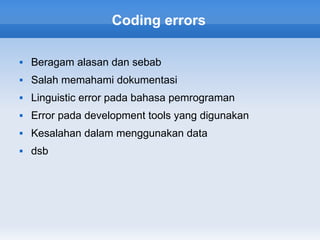
   Beragam alasan dan sebab
   Salah memahami dokumentasi
   Linguistic error pada bahasa pemrograman
   Error pada development tools yang digunakan
   Kesalahan dalam menggunakan data
   dsb
Non-compliance with docs and
        coding instructions
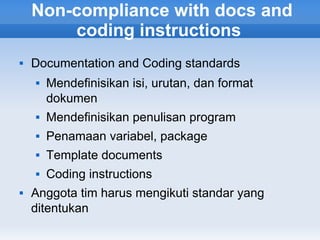
   Documentation and Coding standards
       Mendefinisikan isi, urutan, dan format
        dokumen
       Mendefinisikan penulisan program
       Penamaan variabel, package
       Template documents
       Coding instructions
   Anggota tim harus mengikuti standar yang
    ditentukan
Non-compliance with docs and
         coding instructions
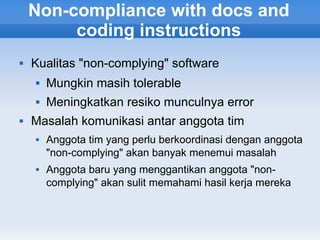
   Kualitas "non-complying" software
       Mungkin masih tolerable
       Meningkatkan resiko munculnya error
   Masalah komunikasi antar anggota tim
       Anggota tim yang perlu berkoordinasi dengan anggota
        "non-complying" akan banyak menemui masalah
       Anggota baru yang menggantikan anggota "non-
        complying" akan sulit memahami hasil kerja mereka
Non-compliance with docs and
    coding instructions
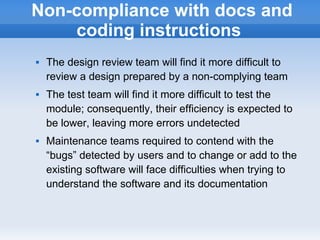
   The design review team will find it more difficult to
    review a design prepared by a non-complying team
   The test team will find it more difficult to test the
    module; consequently, their efficiency is expected to
    be lower, leaving more errors undetected
   Maintenance teams required to contend with the
    “bugs” detected by users and to change or add to the
    existing software will face difficulties when trying to
    understand the software and its documentation
Shortcomings of the testing process

   Testing process yang diabaikan membuat jumlah
    error yang undetected atau uncorrected
    bertambah besar
   Sebab-sebab testing process diabaikan
       Incomplete test plans
       Kegagalan mendokumentasikan dan melaporkan error
        dan fault yang sempat terdeteksi
       Negligence or time pressures
Procedure errors

   Procedures mengarahkan user untuk mengikuti
    tahapan-tahapan dalam menggunakan software
   Sangat penting perannya dalam sistem software
    yang kompleks
   Ada langkah-langkah yang harus dilakukan
    bertahap
   Setiap tahap bergantung kepada data yang
    dihasilkan dari tahap sebelumnya
Documentation errors

   Design documents
   Documentation integrated into the body of the
    software
   Memunculkan error baru dalam pengembangan
    berikutnya dan dalam pemeliharaan
Documentation errors

   User manuals yang kurang lengkap
   Online help yang kurang lengkap
   Software functions yang tidak terdokumentasi
   Kesalahan dalam memberikan penjelasan
   Kesalahan dalam memberikan instruksi
   Software functions yang belum terupdate di versi
    software yang baru
Pustaka

   Daniel Galin, "Software Quality Assurance: From Theory
    to Implementation"
   tjerdastangkas.blogspot.com/search/label/ikp321

ikp321-01

  • 1.
    Manajemen dan KualitasPerangkat Lunak IKP321 Pendahuluan
  • 2.
    Administratif Perkuliahan  Komponen Penilaian  10% Kuis  20% Tugas  30% UTS (18 April 2012, Open notes)  40% UAS (20 Juni 2012, Open book)  5% Bonus (aktifitas, kreatifitas, inovasi)
  • 3.
    Administratif Perkuliahan  Kehadiran  Kenyamanan dan Kemudahan bersama  30 menit toleransi keterlambatan bagi mahasiswa dan dosen  Minimum partisipasi kehadiran 70% sepanjang semester  Prasyarat  Rekayasa Perangkat Lunak  Basis Data
  • 4.
    Administratif Perkuliahan  12 pekan  Senin  13.20 – 15.49 WIB
  • 5.
    Contoh Kejadian Nyata  Denver International Airport (DIA)  Opens February 1995  Planned to serve 110 000 000 passengers annually by 2020  Planned to handle 1750 flights daily  200 gates  12 operating runways
  • 6.
    Contoh Kejadian Nyata  Operations at DIA were delayed by 16 months,  mainly due to the failure of the software-based baggage handling system  estimated total losses of $2 billion  the baggage handling system finally put into service  substantially downscaled in comparison to the system originally specified
  • 7.
    Contoh Lain  Arianne  Floating point rounding error  Fukushima's power plant cooling system  Backup system failed to work properly  14 days to cool down
  • 8.
    Software  Software  Quality Assurance  Computer programs, procedures, and possibly associated documentation and data pertaining to the operation of computer systems  Code  Instruksi bahasa pemrograman  Procedures  Urutan langkah di dalam program (algoritme)  Metode instalasi  User role
  • 9.
    Software  Documentation  User's guide  Developer's guide  Maintenance personnel  Data  Configuration files  Testing suite
  • 10.
    Software errors, faultsand failures  Lessons learned from DIA case  Software failure  Software failure  The origin of software failures lies in a software error made by a programmer.  grammatical error  Runtime error  logical error
  • 11.
    Software errors, faultsand failures  Tidak semua kesalahan software (error) menyebabkan software faults  Kesalahan software dapat menyebabkan  Software tidak berfungsi sebagaimana mestinya (failure)  Kesalahan "dinetralisasi" oleh baris-baris program berikutnya  Fokus pembahasan IKP321  Software failures yang menghentikan penggunaan software  Sebab-sebabnya  Bagaimana mencegahnya
  • 12.
    Software Quality  Software Quality  Assurance  Poor software quality, Software failure  Penyebab software failure  Tindakan pencegahan  Software error  Code error  Procedural error  Documentation error  Data error
  • 13.
    Penyebab Software Error  To Err is Human  Alexander Pope, (1688-1744)  Humans  System analysts  Programmer  Software tester  Documentation experts  Clients and representatives  Bagaimana dengan Kompilator?
  • 14.
    Penyebab Software Error  To Err is Human  Alexander Pope, (1688-1744)  Humans  System analysts  Programmer  Software tester  Documentation experts  Clients and representatives  Bagaimana dengan Kompilator?  Compiler is software  Made by humans
  • 15.
    Munculnya Error dalamTahapan Pengembangan Software  Faulty requirements definition  Client-developer communication failures  Deliberate deviations from software requirements  Logical design errors  Coding errors  Non-complieance with documentation and coding guidelines  Shortcomings of testing process  Procedure errors  Documentation errors
  • 16.
    Faulty software requirements  Biasanya dibuat oleh klien  Definisi kurang jelas atau salah  Deskripsi kebutuhan tidak jelas  Kebutuhan yang penting justru tidak terdokumentasi  Kebutuhan yang tidak penting justru terdokumentasi
  • 17.
    Client-developer communication failure  Defective communication  Perbedaan umur  Perbedaan latar belakang ilmu  Kesalahpahaman  Salah memahami instruksi klien  Salah memahami definisi klien  Salah memahami permintaan perubahan  Klien salah memahami keterbatasan development  Disampaikan secara tertulis maupun lisan
  • 18.
    Deliberate deviations fromsoftware requirements  Software requirement sengaja tidak dipenuhi  Time pressure, Budget pressure  Situasi yang sering terjadi  Reuse previous software, without sufficient analysis for changes  Mengabaikan required functionality  Menambahkan improvement yang tidak ada dalam software requirement
  • 19.
    Logical design errors  Sofware requirements dibuat oleh pihak developer  Software architects  System analysts  Software engineers  Situasi yang umum ditemukan  Mendefinisikan software requirements dengan algoritma yang kurang tepat  Definisi proses yang memuat kesalahan urutan
  • 20.
    Logical design errors  Definisi boundary kurang tepat  Menghilangkan kondisi sistem yang justru penting untuk disertakan  Menghilangkan definisi yang terkait dengan reaksi sistem terhadap illegal operation
  • 21.
    Coding errors  Beragam alasan dan sebab  Salah memahami dokumentasi  Linguistic error pada bahasa pemrograman  Error pada development tools yang digunakan  Kesalahan dalam menggunakan data  dsb
  • 22.
    Non-compliance with docsand coding instructions  Documentation and Coding standards  Mendefinisikan isi, urutan, dan format dokumen  Mendefinisikan penulisan program  Penamaan variabel, package  Template documents  Coding instructions  Anggota tim harus mengikuti standar yang ditentukan
  • 23.
    Non-compliance with docsand coding instructions  Kualitas "non-complying" software  Mungkin masih tolerable  Meningkatkan resiko munculnya error  Masalah komunikasi antar anggota tim  Anggota tim yang perlu berkoordinasi dengan anggota "non-complying" akan banyak menemui masalah  Anggota baru yang menggantikan anggota "non- complying" akan sulit memahami hasil kerja mereka
  • 24.
    Non-compliance with docsand coding instructions  The design review team will find it more difficult to review a design prepared by a non-complying team  The test team will find it more difficult to test the module; consequently, their efficiency is expected to be lower, leaving more errors undetected  Maintenance teams required to contend with the “bugs” detected by users and to change or add to the existing software will face difficulties when trying to understand the software and its documentation
  • 25.
    Shortcomings of thetesting process  Testing process yang diabaikan membuat jumlah error yang undetected atau uncorrected bertambah besar  Sebab-sebab testing process diabaikan  Incomplete test plans  Kegagalan mendokumentasikan dan melaporkan error dan fault yang sempat terdeteksi  Negligence or time pressures
  • 26.
    Procedure errors  Procedures mengarahkan user untuk mengikuti tahapan-tahapan dalam menggunakan software  Sangat penting perannya dalam sistem software yang kompleks  Ada langkah-langkah yang harus dilakukan bertahap  Setiap tahap bergantung kepada data yang dihasilkan dari tahap sebelumnya
  • 27.
    Documentation errors  Design documents  Documentation integrated into the body of the software  Memunculkan error baru dalam pengembangan berikutnya dan dalam pemeliharaan
  • 28.
    Documentation errors  User manuals yang kurang lengkap  Online help yang kurang lengkap  Software functions yang tidak terdokumentasi  Kesalahan dalam memberikan penjelasan  Kesalahan dalam memberikan instruksi  Software functions yang belum terupdate di versi software yang baru
  • 29.
    Pustaka  Daniel Galin, "Software Quality Assurance: From Theory to Implementation"  tjerdastangkas.blogspot.com/search/label/ikp321