PUBLIC SPEAKING:    THE BASICS
PUBLIC SPEAKING Public speaking is anytime you have to speak in public!  Speaking in public scares more people. Public  Speaking is an art of facing a group of people and communicating to them in a formal situation your thoughts and feelings by means of effective speech.
Importance of  Public Speaking Personal Benefits Professional Benefits Societal Benefits
What happens when you have to speak in public?
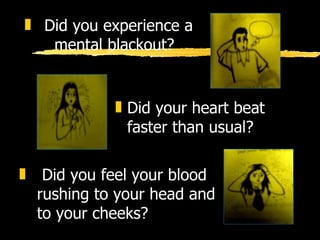
Did your heart beat  faster than usual? Did you experience a  mental blackout? Did you feel your blood  rushing to your head and to your cheeks?
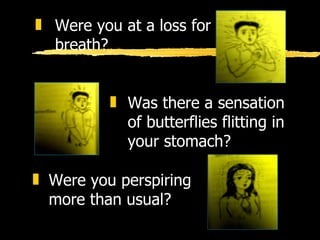
Was there a sensation of butterflies flitting in your stomach? Were you perspiring more than usual? Were you at a loss for breath?
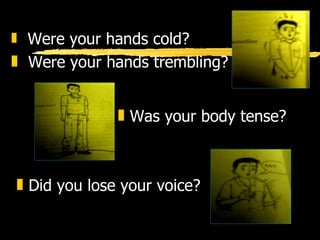
Did you lose your voice? Was your body tense? Were your hands cold? Were your hands trembling?
Anxiety It is an unusual fearful feeling that everyone goes through when faced with an important task.
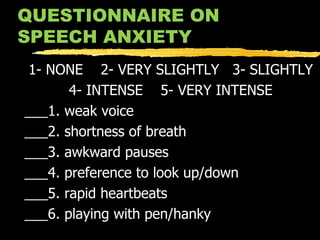
QUESTIONNAIRE ON SPEECH ANXIETY 1- NONE  2- VERY SLIGHTLY  3- SLIGHTLY 4- INTENSE  5- VERY INTENSE ___1. weak voice ___2. shortness of breath ___3. awkward pauses ___4. preference to look up/down ___5. rapid heartbeats ___6. playing with pen/hanky
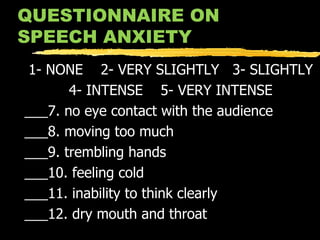
QUESTIONNAIRE ON SPEECH ANXIETY 1- NONE  2- VERY SLIGHTLY  3- SLIGHTLY 4- INTENSE  5- VERY INTENSE ___7. no eye contact with the audience ___8. moving too much ___9. trembling hands ___10. feeling cold ___11. inability to think clearly ___12. dry mouth and throat
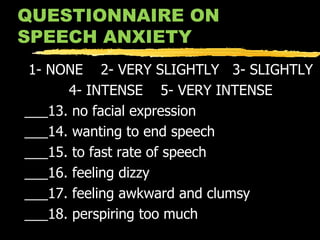
QUESTIONNAIRE ON SPEECH ANXIETY 1- NONE  2- VERY SLIGHTLY  3- SLIGHTLY 4- INTENSE  5- VERY INTENSE ___13. no facial expression ___14. wanting to end speech ___15. to fast rate of speech ___16. feeling dizzy ___17. feeling awkward and clumsy ___18. perspiring too much
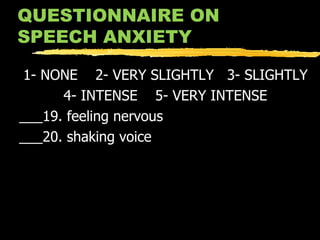
QUESTIONNAIRE ON SPEECH ANXIETY 1- NONE  2- VERY SLIGHTLY  3- SLIGHTLY 4- INTENSE  5- VERY INTENSE ___19. feeling nervous ___20. shaking voice
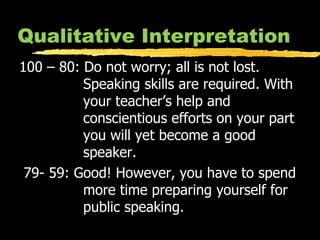
Qualitative Interpretation 100 – 80: Do not worry; all is not lost. Speaking skills are required. With your teacher’s help and conscientious efforts on your part you will yet become a good speaker. 79- 59: Good! However, you have to spend more time preparing yourself for public speaking.
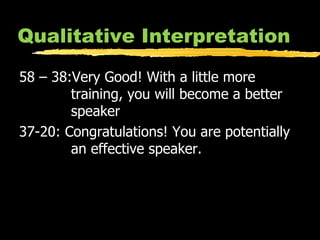
Qualitative Interpretation 58 – 38:Very Good! With a little more training, you will become a better speaker 37-20: Congratulations! You are potentially an effective speaker.
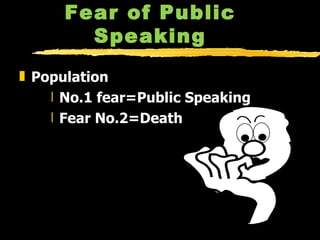
Fear of Public Speaking Population  No.1 fear=Public Speaking Fear No.2=Death
Why do we get Public Speaking anxiety? This is a normal reactions of the body to situations that are not usual in your life. The very fact that the spotlight is you is enough to trigger every fear, anxiety and phobia you've ever had about public speaking.
Here's why: You may be judged by all those  people, and judged badly  You may feel like a fool  You might make mistakes and lose your way
Here's why: You'll be completely humiliated  You'll never be as good as  _______(fill in the blank)  'They' won't like you  'They' won't 'get' what you're trying to say
Anatomy of Stage Fright Shyness Inexperience Unpreparedness Decisiveness of the Speech Fear of the Unknown
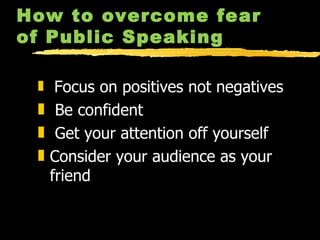
How to overcome fear of Public Speaking Focus on positives not negatives Be confident Get your attention off yourself Consider your audience as your friend
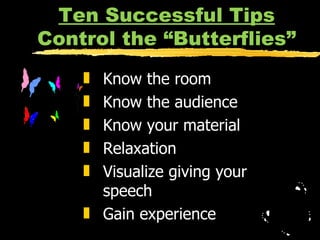
Ten Successful Tips Control the “Butterflies” Know the room Know the audience Know your material Relaxation Visualize giving your speech Gain experience
Control the “Butterflies” People want you to succeed Don’t apologize Concentrate on your message-not the medium.  Turn nervousness into positive energy
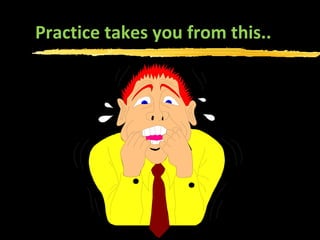
Practice takes you from this..
To this….
Harnessing Speech Anxiety to an Advantage Self – Improvement Program Identify your strengths and weaknesses in relation to public speaking. Make a list. Strength/s  Weakness/es Ex: I have a clear voice.  I am a bit shy.
Harnessing Speech Anxiety to an Advantage Self – Improvement Program 2.  Write a plan on how to overcome your weakness/es Weakness/es Action/s Ex: I am a bit shy  I will expose myself  more by taking an initiative to always communicate with others
Harnessing Speech Anxiety to an Advantage Self – Improvement Program 3.  Closely monitor your improvement as a speaker through writing it in your journal notebook.
Ex:  June 13 I discovered today that I can do something about my weak voice. I chanced upon some exercises in the book for improving the volume of the voice. I shall try doing these exercises so that I can improve my voice.
Ex:  July 4 Our teacher asked us to deliver our first speech today. I noticed that my voice had become louder. I should work harder on my speech. I promise to read up on the principles of the speech- making so that my speech will be more interesting next time.

Coping with speech anxiety

  • 1.
  • 2.
    PUBLIC SPEAKING Publicspeaking is anytime you have to speak in public! Speaking in public scares more people. Public Speaking is an art of facing a group of people and communicating to them in a formal situation your thoughts and feelings by means of effective speech.
  • 3.
    Importance of Public Speaking Personal Benefits Professional Benefits Societal Benefits
  • 4.
    What happens whenyou have to speak in public?
  • 5.
    Did your heartbeat faster than usual? Did you experience a mental blackout? Did you feel your blood rushing to your head and to your cheeks?
  • 6.
    Was there asensation of butterflies flitting in your stomach? Were you perspiring more than usual? Were you at a loss for breath?
  • 7.
    Did you loseyour voice? Was your body tense? Were your hands cold? Were your hands trembling?
  • 8.
    Anxiety It isan unusual fearful feeling that everyone goes through when faced with an important task.
  • 9.
    QUESTIONNAIRE ON SPEECHANXIETY 1- NONE 2- VERY SLIGHTLY 3- SLIGHTLY 4- INTENSE 5- VERY INTENSE ___1. weak voice ___2. shortness of breath ___3. awkward pauses ___4. preference to look up/down ___5. rapid heartbeats ___6. playing with pen/hanky
  • 10.
    QUESTIONNAIRE ON SPEECHANXIETY 1- NONE 2- VERY SLIGHTLY 3- SLIGHTLY 4- INTENSE 5- VERY INTENSE ___7. no eye contact with the audience ___8. moving too much ___9. trembling hands ___10. feeling cold ___11. inability to think clearly ___12. dry mouth and throat
  • 11.
    QUESTIONNAIRE ON SPEECHANXIETY 1- NONE 2- VERY SLIGHTLY 3- SLIGHTLY 4- INTENSE 5- VERY INTENSE ___13. no facial expression ___14. wanting to end speech ___15. to fast rate of speech ___16. feeling dizzy ___17. feeling awkward and clumsy ___18. perspiring too much
  • 12.
    QUESTIONNAIRE ON SPEECHANXIETY 1- NONE 2- VERY SLIGHTLY 3- SLIGHTLY 4- INTENSE 5- VERY INTENSE ___19. feeling nervous ___20. shaking voice
  • 13.
    Qualitative Interpretation 100– 80: Do not worry; all is not lost. Speaking skills are required. With your teacher’s help and conscientious efforts on your part you will yet become a good speaker. 79- 59: Good! However, you have to spend more time preparing yourself for public speaking.
  • 14.
    Qualitative Interpretation 58– 38:Very Good! With a little more training, you will become a better speaker 37-20: Congratulations! You are potentially an effective speaker.
  • 15.
    Fear of PublicSpeaking Population No.1 fear=Public Speaking Fear No.2=Death
  • 16.
    Why do weget Public Speaking anxiety? This is a normal reactions of the body to situations that are not usual in your life. The very fact that the spotlight is you is enough to trigger every fear, anxiety and phobia you've ever had about public speaking.
  • 17.
    Here's why: Youmay be judged by all those people, and judged badly You may feel like a fool You might make mistakes and lose your way
  • 18.
    Here's why: You'llbe completely humiliated You'll never be as good as _______(fill in the blank) 'They' won't like you 'They' won't 'get' what you're trying to say
  • 19.
    Anatomy of StageFright Shyness Inexperience Unpreparedness Decisiveness of the Speech Fear of the Unknown
  • 20.
    How to overcomefear of Public Speaking Focus on positives not negatives Be confident Get your attention off yourself Consider your audience as your friend
  • 21.
    Ten Successful TipsControl the “Butterflies” Know the room Know the audience Know your material Relaxation Visualize giving your speech Gain experience
  • 22.
    Control the “Butterflies”People want you to succeed Don’t apologize Concentrate on your message-not the medium. Turn nervousness into positive energy
  • 23.
    Practice takes youfrom this..
  • 24.
  • 25.
    Harnessing Speech Anxietyto an Advantage Self – Improvement Program Identify your strengths and weaknesses in relation to public speaking. Make a list. Strength/s Weakness/es Ex: I have a clear voice. I am a bit shy.
  • 26.
    Harnessing Speech Anxietyto an Advantage Self – Improvement Program 2. Write a plan on how to overcome your weakness/es Weakness/es Action/s Ex: I am a bit shy I will expose myself more by taking an initiative to always communicate with others
  • 27.
    Harnessing Speech Anxietyto an Advantage Self – Improvement Program 3. Closely monitor your improvement as a speaker through writing it in your journal notebook.
  • 28.
    Ex: June13 I discovered today that I can do something about my weak voice. I chanced upon some exercises in the book for improving the volume of the voice. I shall try doing these exercises so that I can improve my voice.
  • 29.
    Ex: July4 Our teacher asked us to deliver our first speech today. I noticed that my voice had become louder. I should work harder on my speech. I promise to read up on the principles of the speech- making so that my speech will be more interesting next time.