Using Punctuation Marks
http://www.how-to-study.com/punctuation.htm
Punctuation is the use of standard marks and signs in
writing to separate words into sentences, clauses, and
phrases in order to clarify meaning. The marks or signs are
called punctuation marks. Punctuation marks are signals to
readers. When you speak, you can pause, stop, or change
your tone of voice to make your meaning clear. You cannot
do this when you write. When writing, you must use
punctuation marks such as commas and question marks to
make your meaning clear.
The use of punctuation marks can be very complex. Each
punctuation mark can be used in many ways. Here are the
punctuation marks that are most commonly used when
writing and the most typical way or ways they are used.
Examples are provided for each.
Period (.)
- Use a period at the end of a declarative sentence (a
sentence which states an idea).
"That was a wonderful movie."
- Use a period to end an abbreviation.
"I think that Mr. Williams is a great teacher."
Question Mark (?)
- Use a question mark at the end of an interrogative
sentence (a sentence which asks a question).
"Did you like that movie?"
Comma (,)
- Use a comma to separate three or more items in a
series.
"My history class meets each Monday, Wednesday, and
Friday."
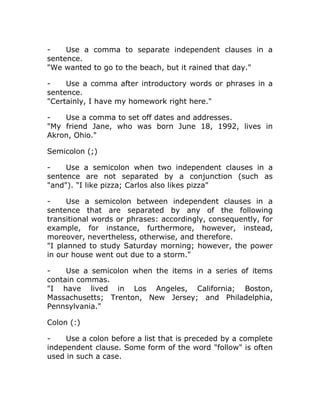
- Use a comma to separate independent clauses in a
sentence.
"We wanted to go to the beach, but it rained that day."
- Use a comma after introductory words or phrases in a
sentence.
"Certainly, I have my homework right here."
- Use a comma to set off dates and addresses.
"My friend Jane, who was born June 18, 1992, lives in
Akron, Ohio."
Semicolon (;)
- Use a semicolon when two independent clauses in a
sentence are not separated by a conjunction (such as
"and"). "I like pizza; Carlos also likes pizza"
- Use a semicolon between independent clauses in a
sentence that are separated by any of the following
transitional words or phrases: accordingly, consequently, for
example, for instance, furthermore, however, instead,
moreover, nevertheless, otherwise, and therefore.
"I planned to study Saturday morning; however, the power
in our house went out due to a storm."
- Use a semicolon when the items in a series of items
contain commas.
"I have lived in Los Angeles, California; Boston,
Massachusetts; Trenton, New Jersey; and Philadelphia,
Pennsylvania."
Colon (:)
- Use a colon before a list that is preceded by a complete
independent clause. Some form of the word "follow" is often
used in such a case.
"On our next vacation, we plan to visit the following
countries: England, France, Italy, and Greece."
- Use a colon to divide hours from minutes.
"I have an appointment with the doctor at 10:30 tomorrow
morning."
Exclamation Point (!) (sometimes called an Exclamation
Mark)
- Use an exclamation mark at the end of a sentence to
show strong emotion.
"I am very upset with him!"
- Use an exclamation mark at the end of a sentence for
emphasis.
"I have to go home right now!"
- Use an exclamation mark after an interjection at the
start of a sentence (an interjection is a word used to express
strong feeling or sudden emotion).
"Wow! That test was harder than I expected."
Apostrophe (')
- Use an apostrophe to indicate a missing letter or letters
in a contraction.
"I don't think she will win the election."
- Use an apostrophe plus the letter "s" to show
possession.
"Please take good care of Brad's dog."
Use punctuation marks to make the meaning of what you
write as clear as possible.
Useful Spelling Rules
Correct spelling is very difficult for many students
because the spellings of many words do not follow
rules.
Even when rules apply to the spellings of words:
 There are many rules to be learned.
 Many of the rules are very complicated.
 Many of the rules apply to a small number of
words.
 Almost every rule has exceptions.
Still, there are some rules that apply to the spellings
of words with few exceptions, and that are not
difficult to learn and remember. Learning and using
these rules can improve your spelling.
Here are eight spelling rules you should learn and use.
1. A word that ends with the sound of “v” is spelled
with the letters “ve” at its end.
*Examples: shave, above, effective
2. The letter “i” comes before “e” except after “c.”
*Examples: believe, field, tried (but not receive)
3. When a word ends with “y” preceded by a
consonant, form the plural of the word by
changing the “y” to “i” and adding “es.”
*Examples: countries, carries, ladies
4. Drop the final silent “e” when adding a suffix that
begins with a vowel.
*Examples: changing, notable, nervous
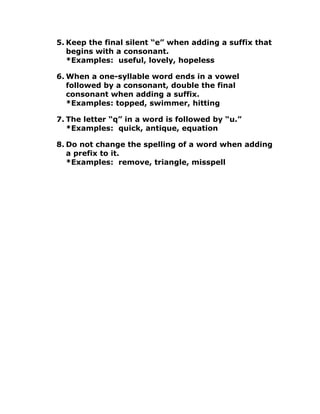
5. Keep the final silent “e” when adding a suffix that
begins with a consonant.
*Examples: useful, lovely, hopeless
6. When a one-syllable word ends in a vowel
followed by a consonant, double the final
consonant when adding a suffix.
*Examples: topped, swimmer, hitting
7. The letter “q” in a word is followed by “u.”
*Examples: quick, antique, equation
8. Do not change the spelling of a word when adding
a prefix to it.
*Examples: remove, triangle, misspell
5. Keep the final silent “e” when adding a suffix that
begins with a consonant.
*Examples: useful, lovely, hopeless
6. When a one-syllable word ends in a vowel
followed by a consonant, double the final
consonant when adding a suffix.
*Examples: topped, swimmer, hitting
7. The letter “q” in a word is followed by “u.”
*Examples: quick, antique, equation
8. Do not change the spelling of a word when adding
a prefix to it.
*Examples: remove, triangle, misspell

Punctuation marks

  • 1.
    Using Punctuation Marks http://www.how-to-study.com/punctuation.htm Punctuationis the use of standard marks and signs in writing to separate words into sentences, clauses, and phrases in order to clarify meaning. The marks or signs are called punctuation marks. Punctuation marks are signals to readers. When you speak, you can pause, stop, or change your tone of voice to make your meaning clear. You cannot do this when you write. When writing, you must use punctuation marks such as commas and question marks to make your meaning clear. The use of punctuation marks can be very complex. Each punctuation mark can be used in many ways. Here are the punctuation marks that are most commonly used when writing and the most typical way or ways they are used. Examples are provided for each. Period (.) - Use a period at the end of a declarative sentence (a sentence which states an idea). "That was a wonderful movie." - Use a period to end an abbreviation. "I think that Mr. Williams is a great teacher." Question Mark (?) - Use a question mark at the end of an interrogative sentence (a sentence which asks a question). "Did you like that movie?" Comma (,) - Use a comma to separate three or more items in a series. "My history class meets each Monday, Wednesday, and Friday."
  • 2.
    - Use acomma to separate independent clauses in a sentence. "We wanted to go to the beach, but it rained that day." - Use a comma after introductory words or phrases in a sentence. "Certainly, I have my homework right here." - Use a comma to set off dates and addresses. "My friend Jane, who was born June 18, 1992, lives in Akron, Ohio." Semicolon (;) - Use a semicolon when two independent clauses in a sentence are not separated by a conjunction (such as "and"). "I like pizza; Carlos also likes pizza" - Use a semicolon between independent clauses in a sentence that are separated by any of the following transitional words or phrases: accordingly, consequently, for example, for instance, furthermore, however, instead, moreover, nevertheless, otherwise, and therefore. "I planned to study Saturday morning; however, the power in our house went out due to a storm." - Use a semicolon when the items in a series of items contain commas. "I have lived in Los Angeles, California; Boston, Massachusetts; Trenton, New Jersey; and Philadelphia, Pennsylvania." Colon (:) - Use a colon before a list that is preceded by a complete independent clause. Some form of the word "follow" is often used in such a case.
  • 3.
    "On our nextvacation, we plan to visit the following countries: England, France, Italy, and Greece." - Use a colon to divide hours from minutes. "I have an appointment with the doctor at 10:30 tomorrow morning." Exclamation Point (!) (sometimes called an Exclamation Mark) - Use an exclamation mark at the end of a sentence to show strong emotion. "I am very upset with him!" - Use an exclamation mark at the end of a sentence for emphasis. "I have to go home right now!" - Use an exclamation mark after an interjection at the start of a sentence (an interjection is a word used to express strong feeling or sudden emotion). "Wow! That test was harder than I expected." Apostrophe (') - Use an apostrophe to indicate a missing letter or letters in a contraction. "I don't think she will win the election." - Use an apostrophe plus the letter "s" to show possession. "Please take good care of Brad's dog." Use punctuation marks to make the meaning of what you write as clear as possible. Useful Spelling Rules
  • 4.
    Correct spelling isvery difficult for many students because the spellings of many words do not follow rules. Even when rules apply to the spellings of words:  There are many rules to be learned.  Many of the rules are very complicated.  Many of the rules apply to a small number of words.  Almost every rule has exceptions. Still, there are some rules that apply to the spellings of words with few exceptions, and that are not difficult to learn and remember. Learning and using these rules can improve your spelling. Here are eight spelling rules you should learn and use. 1. A word that ends with the sound of “v” is spelled with the letters “ve” at its end. *Examples: shave, above, effective 2. The letter “i” comes before “e” except after “c.” *Examples: believe, field, tried (but not receive) 3. When a word ends with “y” preceded by a consonant, form the plural of the word by changing the “y” to “i” and adding “es.” *Examples: countries, carries, ladies 4. Drop the final silent “e” when adding a suffix that begins with a vowel. *Examples: changing, notable, nervous
  • 5.
    5. Keep thefinal silent “e” when adding a suffix that begins with a consonant. *Examples: useful, lovely, hopeless 6. When a one-syllable word ends in a vowel followed by a consonant, double the final consonant when adding a suffix. *Examples: topped, swimmer, hitting 7. The letter “q” in a word is followed by “u.” *Examples: quick, antique, equation 8. Do not change the spelling of a word when adding a prefix to it. *Examples: remove, triangle, misspell
  • 6.
    5. Keep thefinal silent “e” when adding a suffix that begins with a consonant. *Examples: useful, lovely, hopeless 6. When a one-syllable word ends in a vowel followed by a consonant, double the final consonant when adding a suffix. *Examples: topped, swimmer, hitting 7. The letter “q” in a word is followed by “u.” *Examples: quick, antique, equation 8. Do not change the spelling of a word when adding a prefix to it. *Examples: remove, triangle, misspell