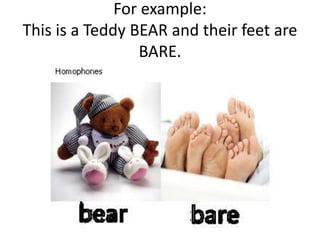
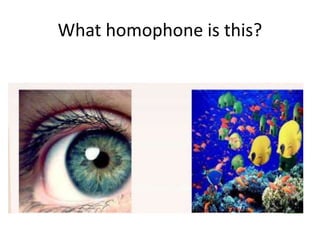
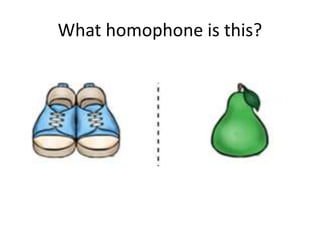
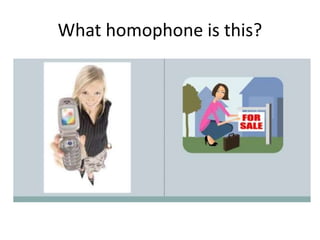
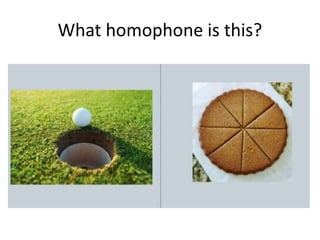
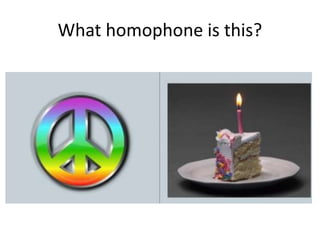
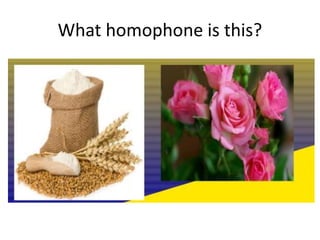
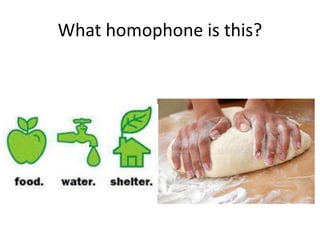
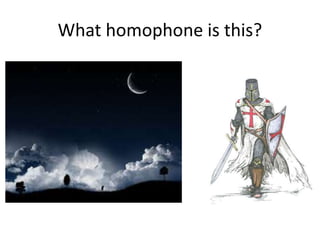
The document explains homophones, which are words that sound the same but have different meanings, and provides examples such as 'be/bee' and 'hole/whole.' It includes tongue twisters and writing activities to practice using homophones in sentences. Additionally, there is a listening activity where partners take turns using homophones to enhance comprehension.
Homophone tongue twister
Howmuch wood would a woodchuck
chuck if a woodchuck could chuck
wood? He would chuck, he would, as
much as he could, and chuck as much
wood as a woodchuck would if a
woodchuck could chuck wood.
Writing Activity
buy /bye /by Example: I will buy a car by next Tuesday, so I can say, “Bye” to
taking the bus.
hour /our
one / won
four / for
flour / flower
ate / eight
19.
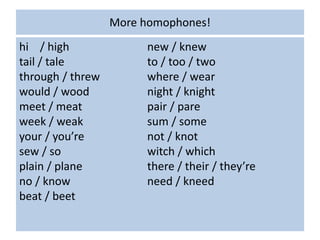
More homophones!
hi /high new / knew
tail / tale to / too / two
through / threw where / wear
would / wood night / knight
meet / meat pair / pare
week / weak sum / some
your / you’re not / knot
sew / so witch / which
plain / plane there / their / they’re
no / know need / kneed
beat / beet
20.
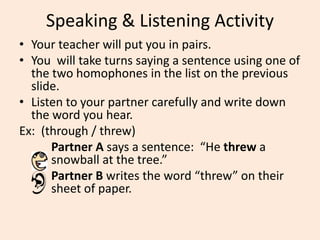
Speaking & ListeningActivity
• Your teacher will put you in pairs.
• You will take turns saying a sentence using one of
the two homophones in the list on the previous
slide.
• Listen to your partner carefully and write down
the word you hear.
Ex: (through / threw)
Partner A says a sentence: “He threw a
snowball at the tree.”
Partner B writes the word “threw” on their
sheet of paper.
#16 Plane (airplane / wood plane(r) / plain (a plain piece of toast / flat land = plain
#19 Give students a piece of paper or a copy of this paper.
Option 1: give students 8-10 minutes to write their own sentences, and then compare with a partner.
Option 2: Give students 5 minutes to talk with a partner; verbally making sentences for each grouping of words. Then give them time to write their sentences down.
The sentences can either be passed in for correction by the teacher / as a homework assignment OR they can be corrected in class depending on how much time you have.