Motion, Speed, Velocity
and Acceleration
and Acceleration
Motion
Motion
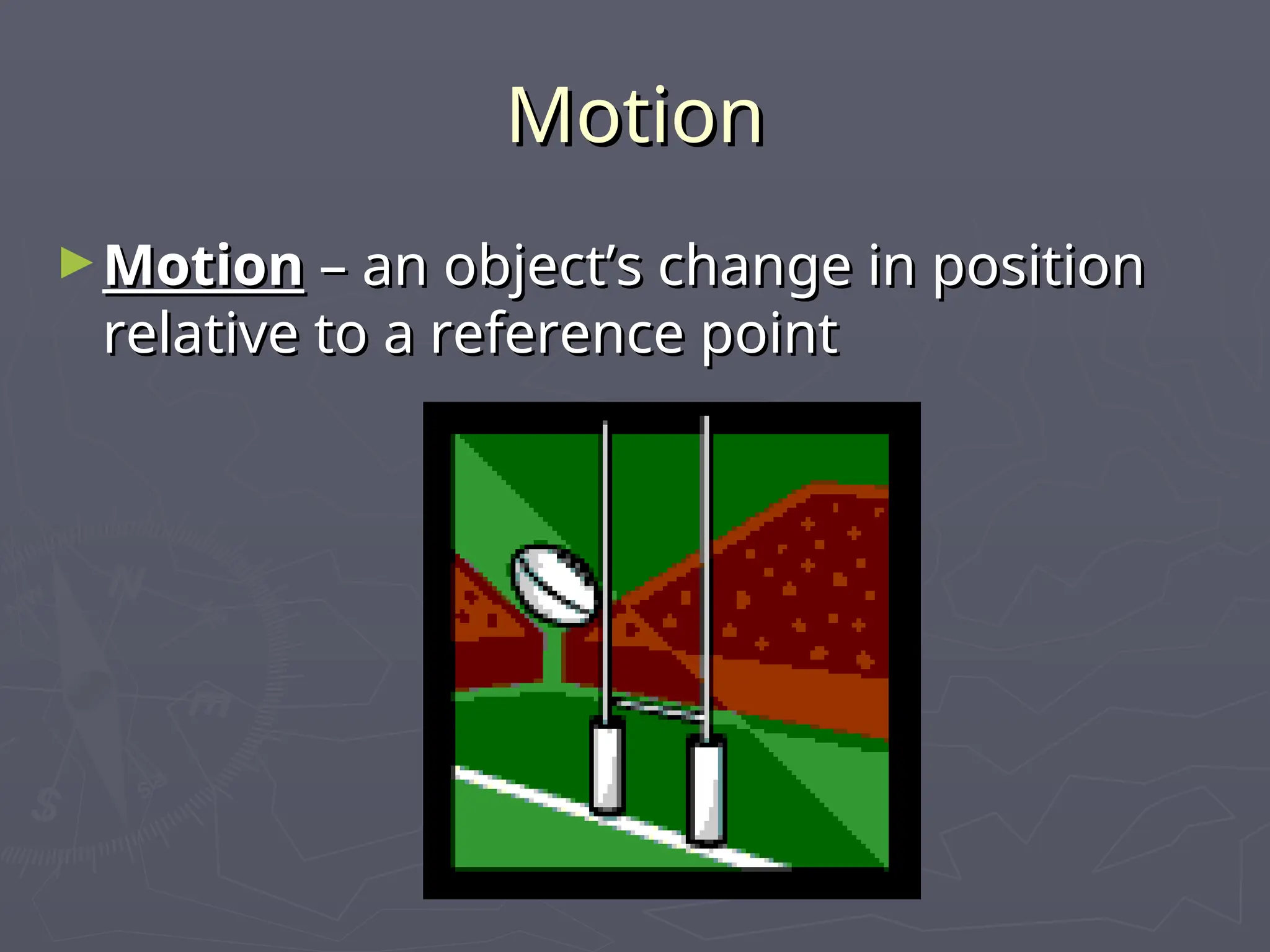
►Motion
Motion – an object’s change in position
– an object’s change in position
relative to a reference point
Reference Point
Reference Point
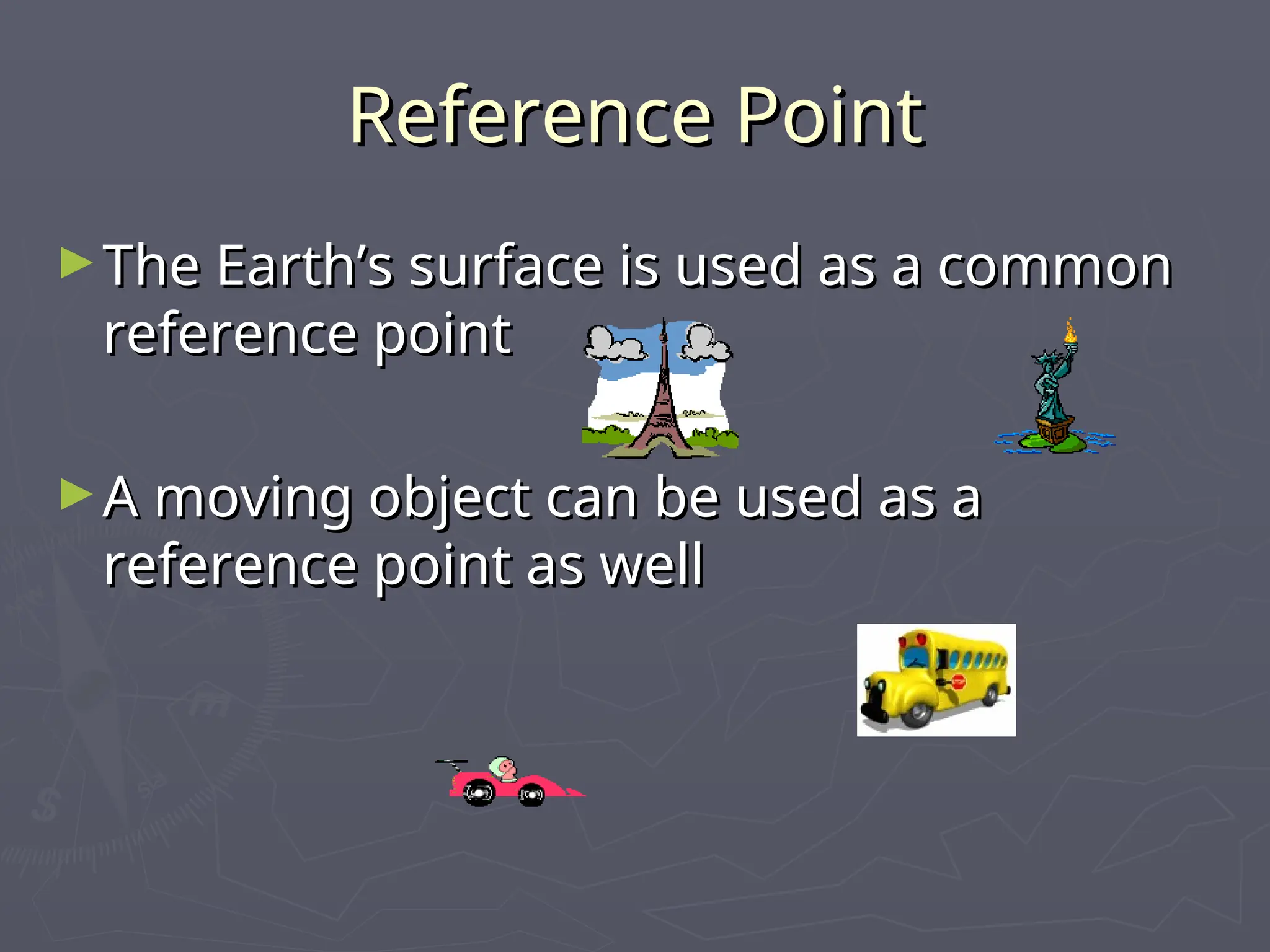
►The Earth’s surface is used as a common
The Earth’s surface is used as a common
reference point
reference point
►A moving object can be used as a
A moving object can be used as a
reference point as well
Speed
Speed
►Speed
Speed is the distance traveled divided by
is the distance traveled divided by
the time interval during which the motion
occurred
occurred
►Normally, objects do not travel at a
Normally, objects do not travel at a
constant speed
constant speed
►Average Speed -
Average Speed - total distance
total distance
total time
total time
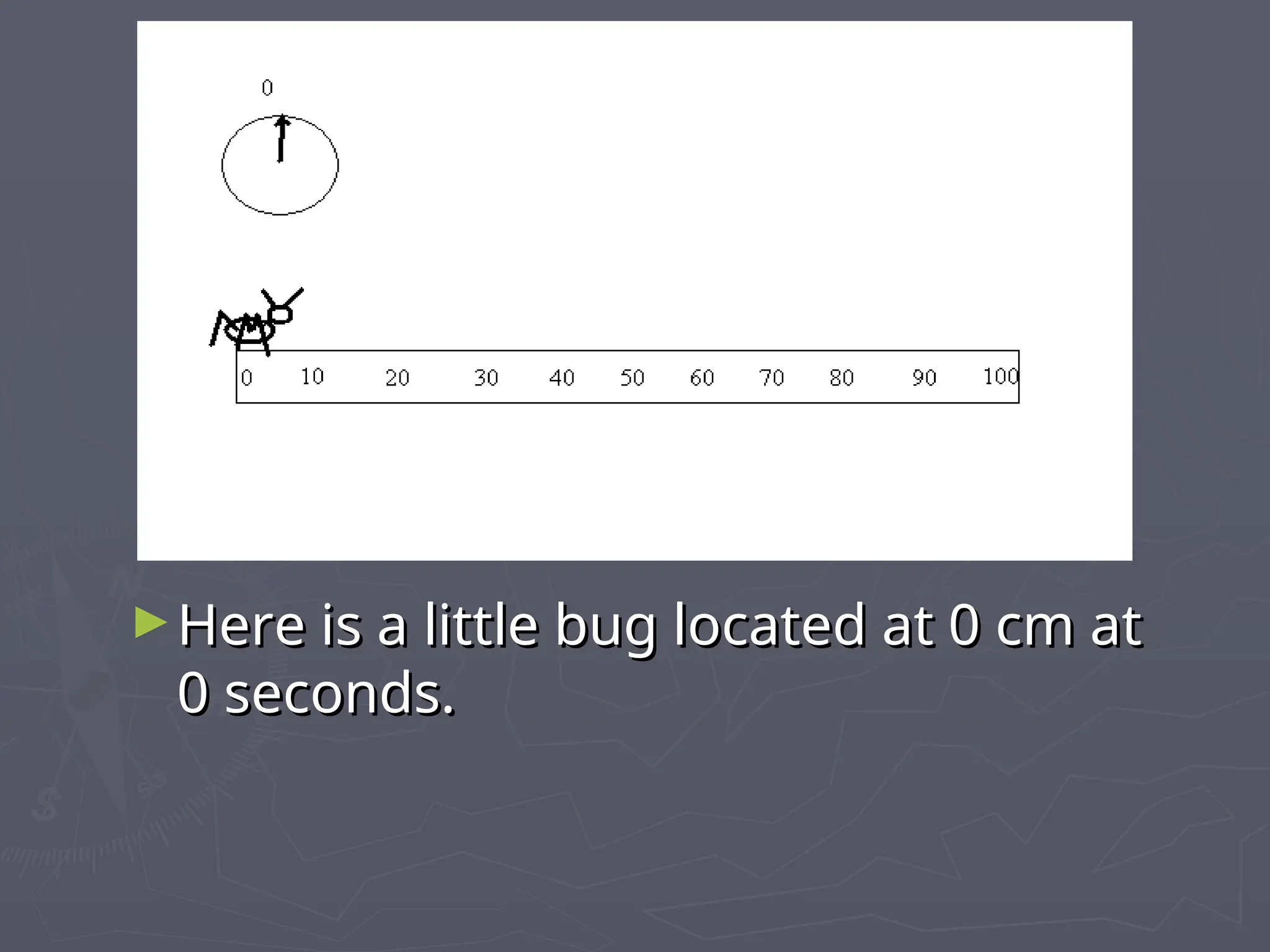
►Here is a little bug located at 0 cm at
Here is a little bug located at 0 cm at
0 seconds.
0 seconds.
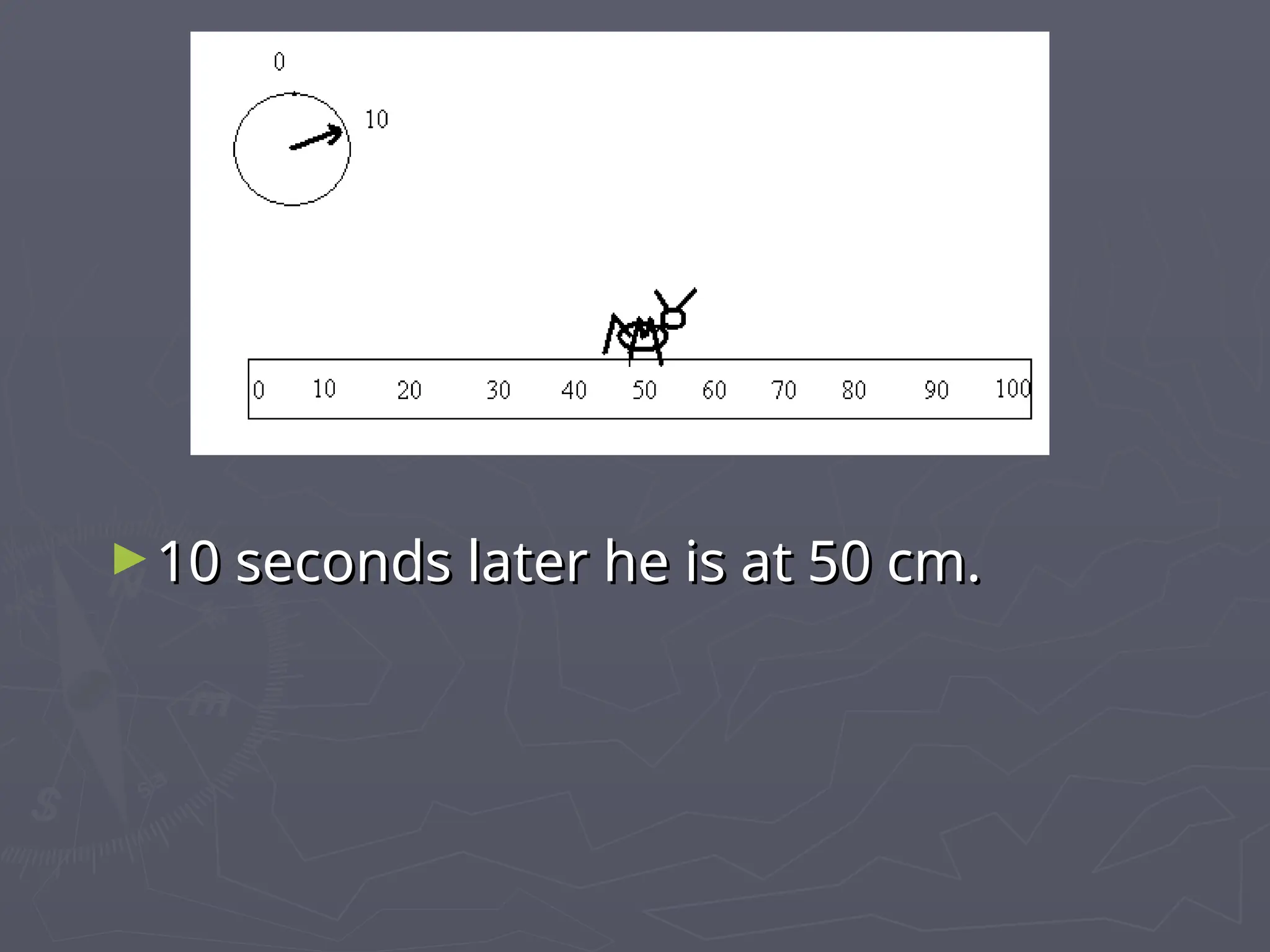
►10 seconds later he is at 50 cm.
10 seconds later he is at 50 cm.
SPEED
SPEED
►The speed of the bug is just his distance
The speed of the bug is just his distance
traveled divided by how long it takes.
►Speed = distance/time
Speed = distance/time
►Speed = 50 cm/10 s = 5 cm/s
Speed = 50 cm/10 s = 5 cm/s
Question
Question
►I travelled 25 km in 10 minutes. How
I travelled 25 km in 10 minutes. How
many meters have I travelled?
25 km * 1000m/km = 25000 m
Problem Solving: Calculating
Speed
What is the speed of a sailboat that is
traveling 120 meters in 60 seconds?
What is the speed of a car that is traveling
150 miles in 3 hours?
Velocity
Velocity
►Velocity
Velocity is the speed of an object in a
is the speed of an object in a
particular direction
►Imagine two birds leave the same tree at
Imagine two birds leave the same tree at
the same time. The both fly at 10km/hr
for 5 minutes. Why don’t they end up at
the same place?
the same place?
Velocity
Velocity
►Velocity
Velocity appears to be very similar to
appears to be very similar to
speed, however, when describing the
velocity of an object you need to provide
a magnitude and a direction
►Magnitude
Magnitude – the speed of the object
– the speed of the object
►Direction
Direction – the direction the object is
– the direction the object is
moving
moving
Velocity
Velocity
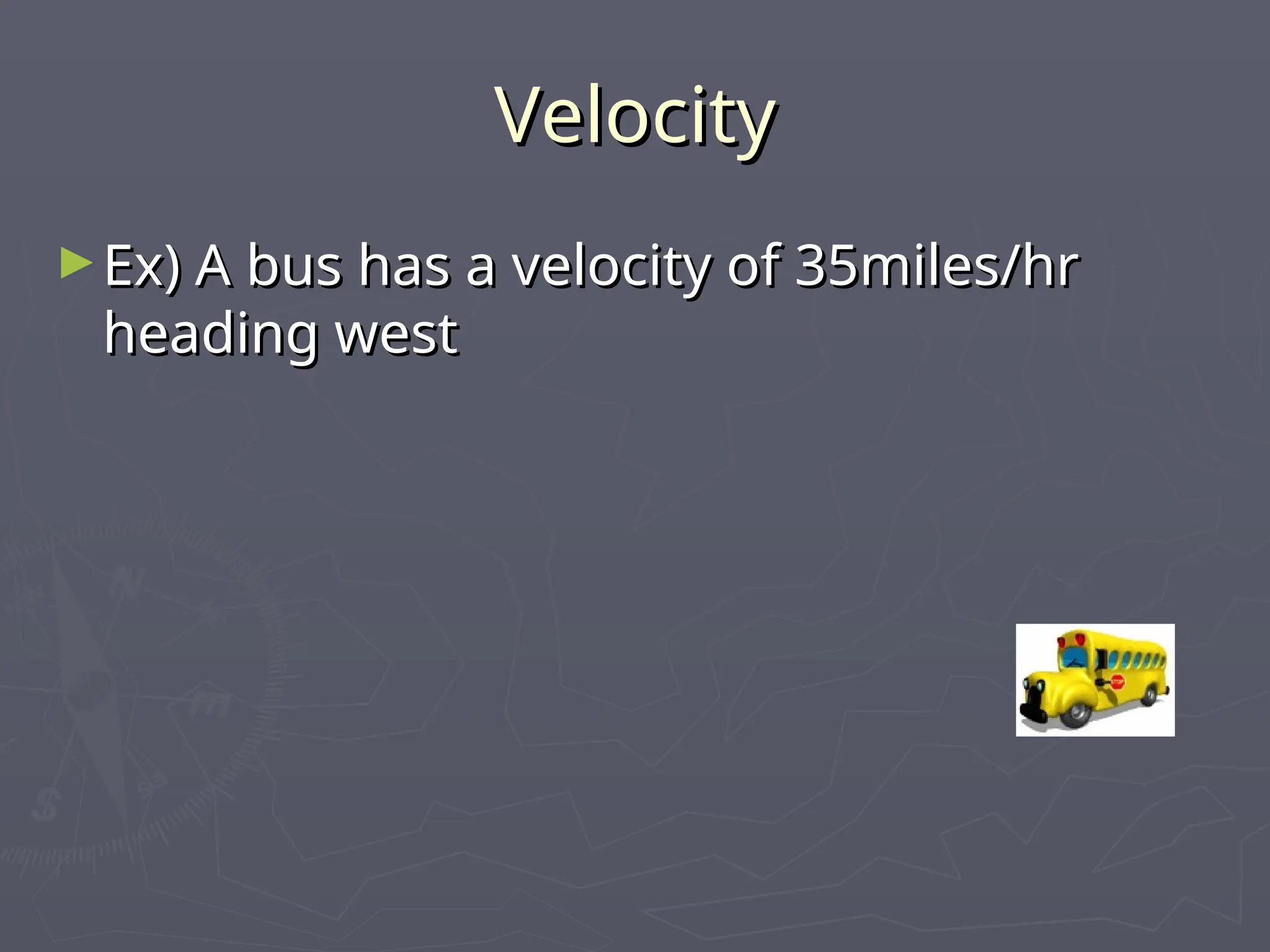
►Ex) A bus has a velocity of 35miles/hr
Ex) A bus has a velocity of 35miles/hr
heading west
heading west
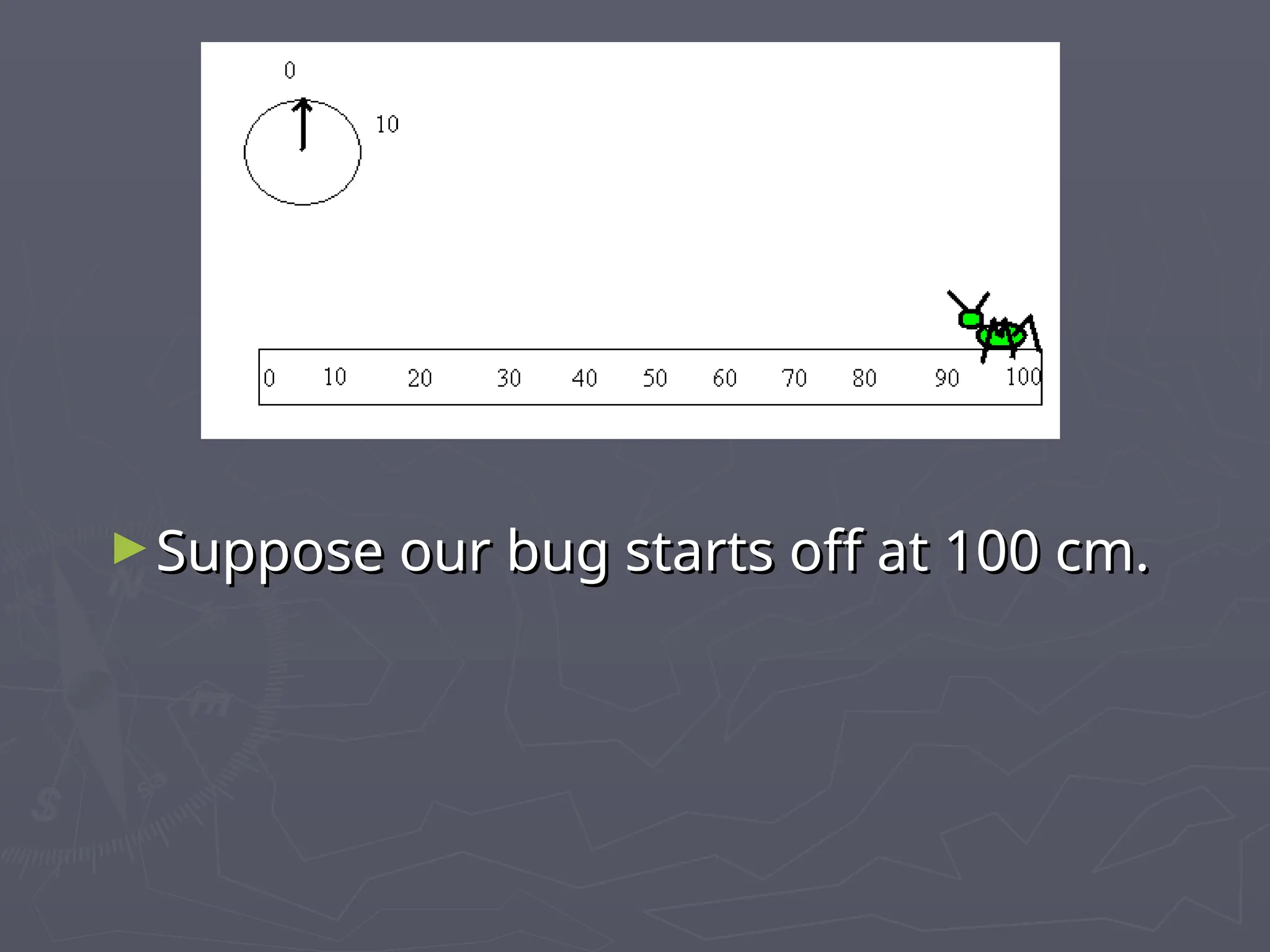
►Suppose our bug starts off at 100 cm.
Suppose our bug starts off at 100 cm.
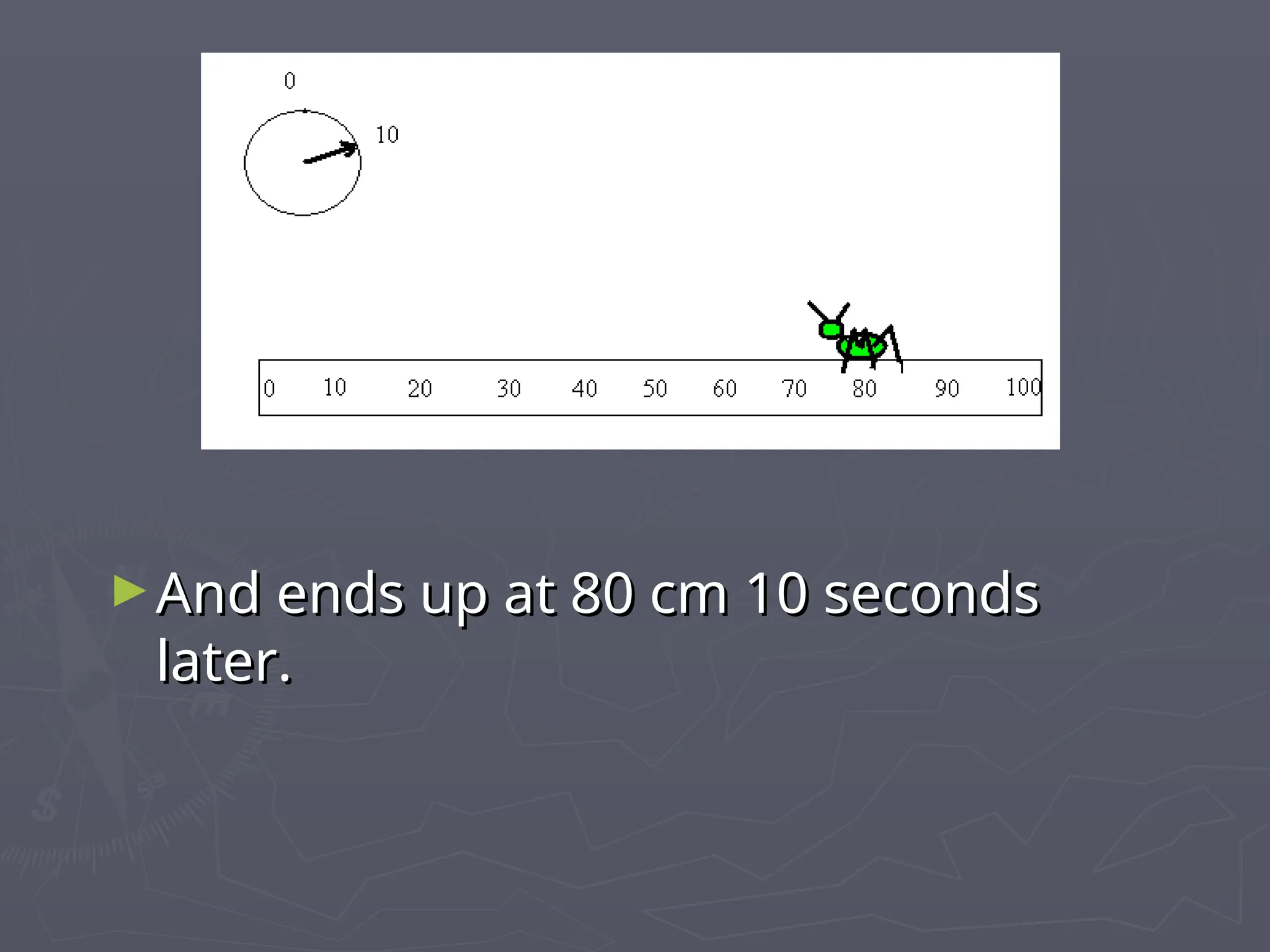
►And ends up at 80 cm 10 seconds
And ends up at 80 cm 10 seconds
later.
later.
►Calculating velocity is a little more
Calculating velocity is a little more
complicated than calculating speed.
►Velocity = change in position/time
Velocity = change in position/time
► Velocity = (final position – initial position)/time
Velocity = (final position – initial position)/time
► Velocity = (80cm – 100cm)/10 seconds
Velocity = (80cm – 100cm)/10 seconds
► Velocity = - 2 cm/s
Velocity = - 2 cm/s
►For objects moving along a straight
For objects moving along a straight
line
line
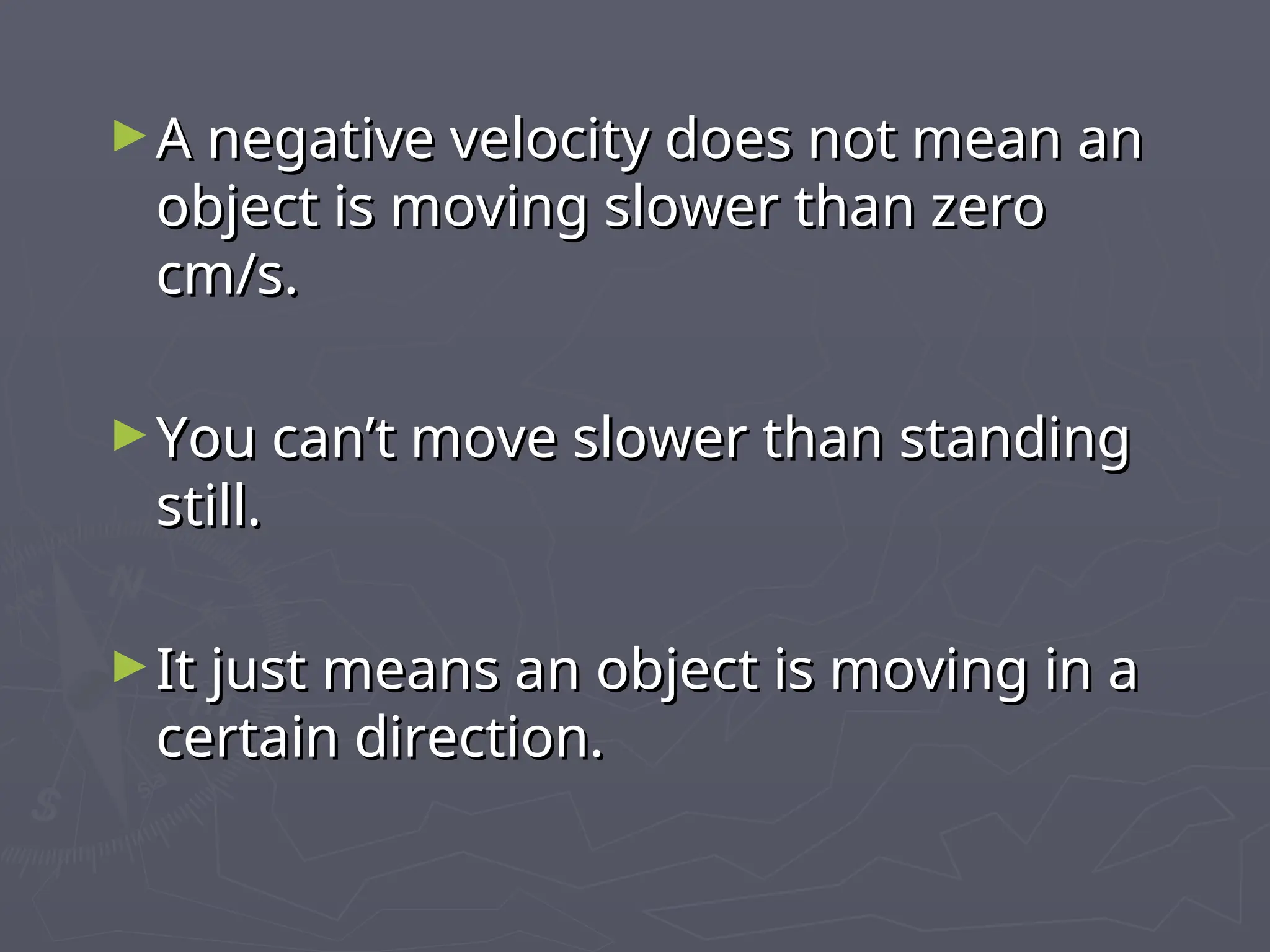
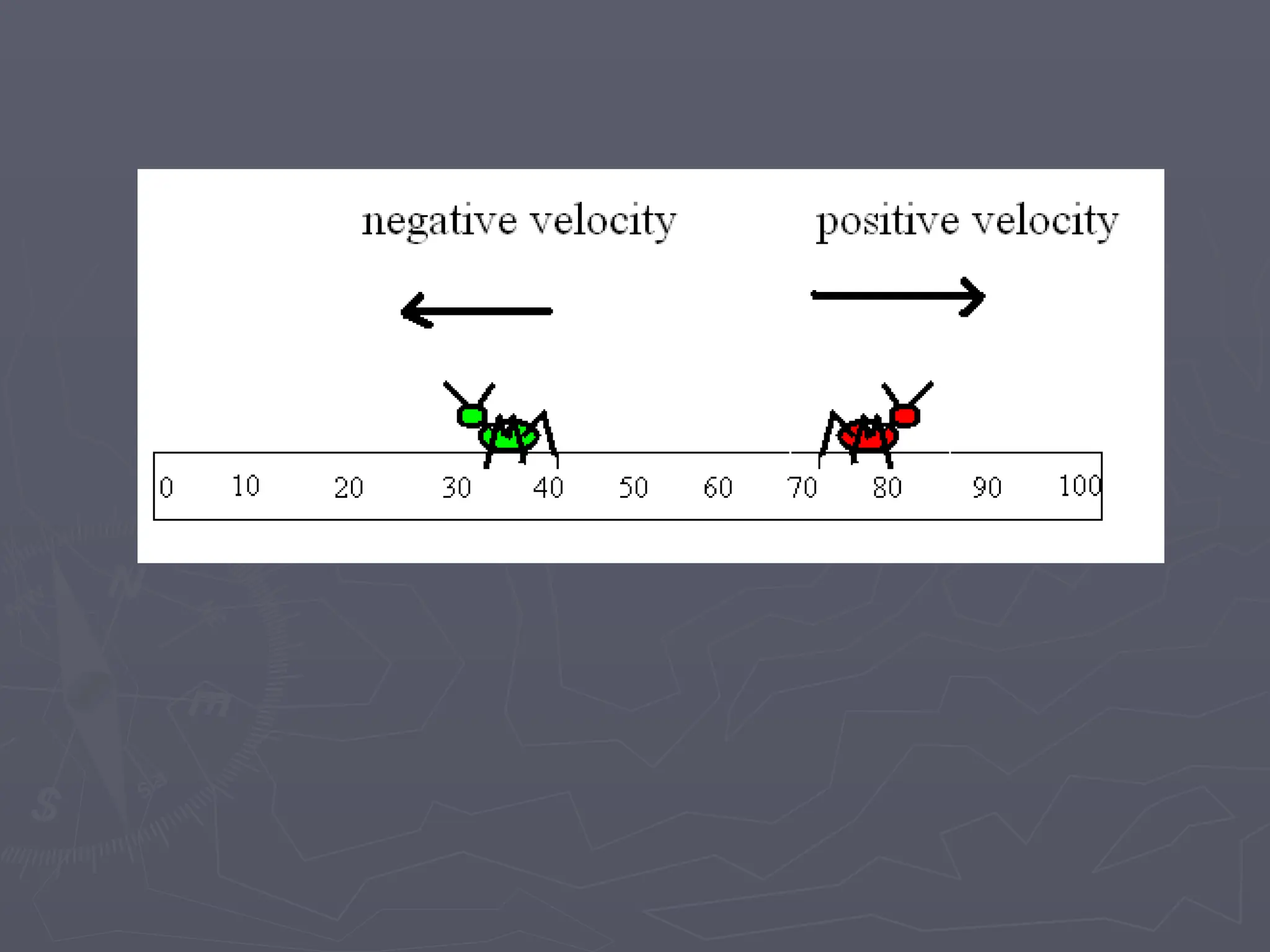
►A positive velocity means moving to
A positive velocity means moving to
the right. (usually)
►A negative means moving to the left.
A negative means moving to the left.
(usually)
(usually)
►A negative velocity does not mean an
A negative velocity does not mean an
object is moving slower than zero
cm/s.
cm/s.
►You can’t move slower than standing
You can’t move slower than standing
still.
still.
►It just means an object is moving in a
It just means an object is moving in a
certain direction.
certain direction.
Resultant Velocity
Resultant Velocity
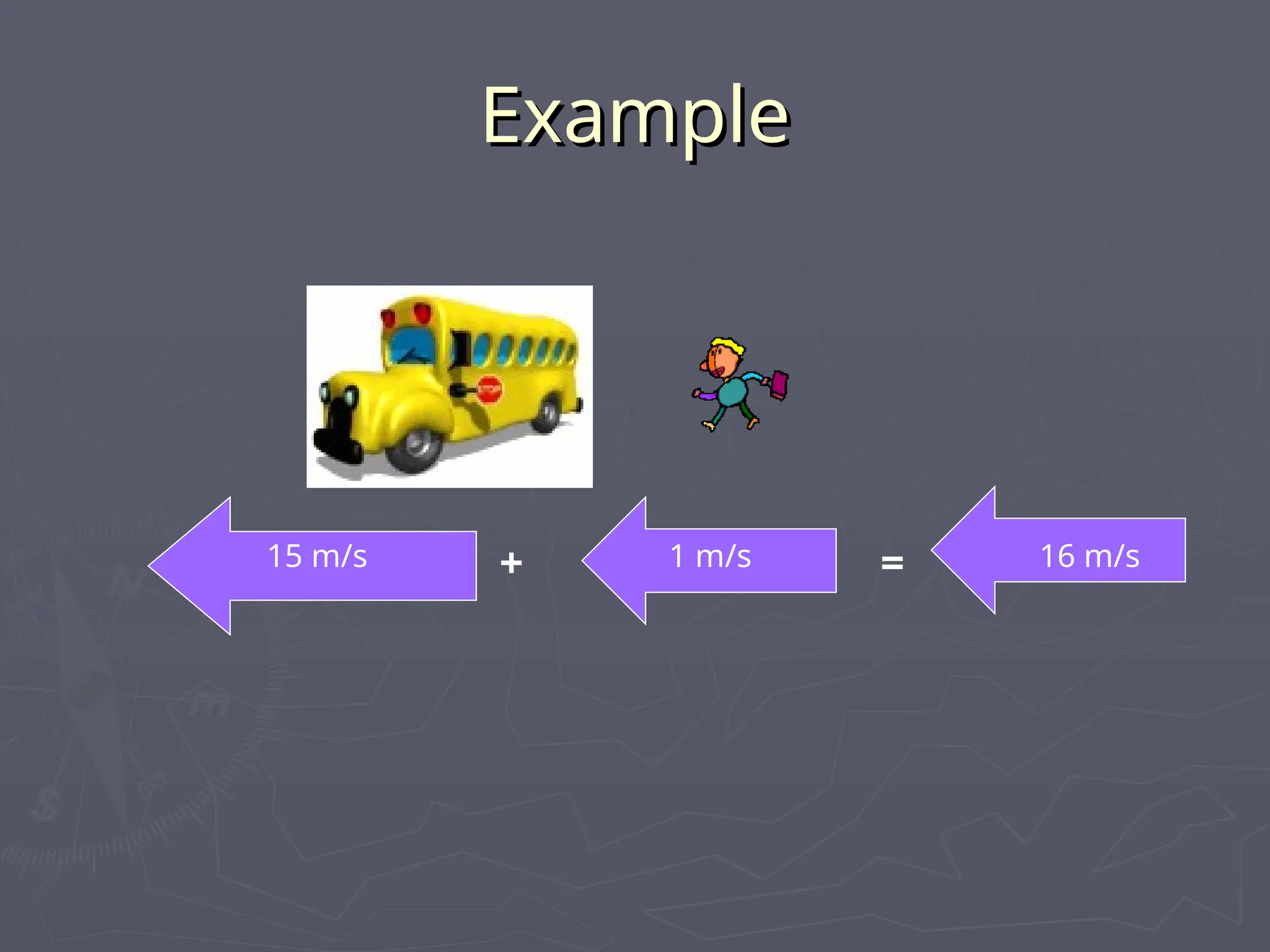
►An object can have a resultant velocity if it
An object can have a resultant velocity if it
is experiencing more than one motion.
►For example if a person walks down the
For example if a person walks down the
center of a bus while it is in motion there
are two velocities occurring.
 1. The movement of the bus
1. The movement of the bus
 2. The movement of the person inside the
2. The movement of the person inside the
bus
bus
Example
Example
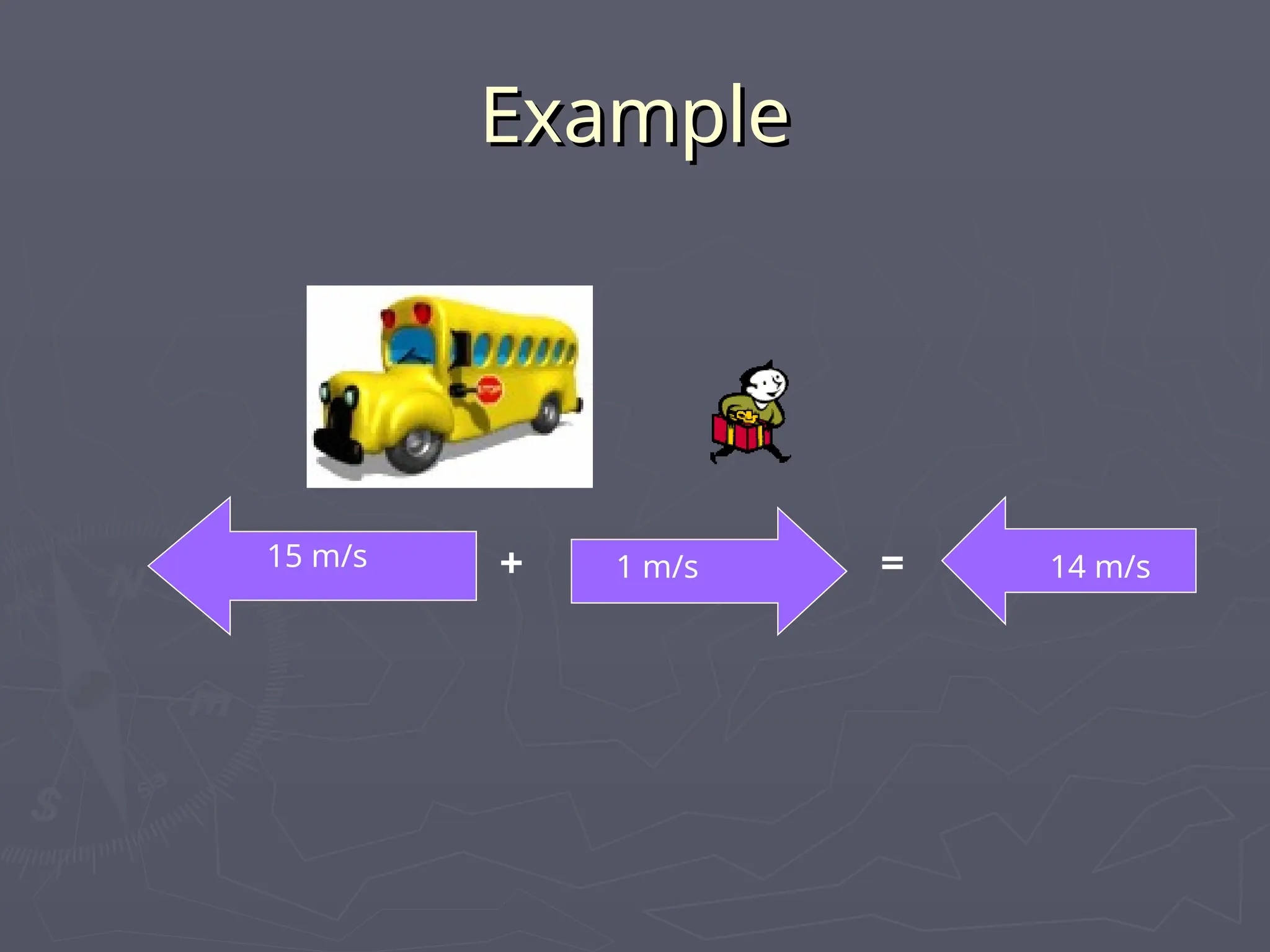
15 m/s + 1 m/s = 14 m/s
Example
Example
15 m/s + =
1 m/s 16 m/s
Acceleration
Acceleration
►Acceleration
Acceleration is the rate at which velocity
is the rate at which velocity
changes over time
changes over time
When an object is increasing in velocity over time
it is said to be accelerating.
(positive acceleration)
When an object is decreasing in velocity over time
it is said to be decelerating.
(negative acceleration)
If an object is moving at constant velocity it is said
to be moving with zero acceleration
Three Ways to “Accelerate”
►Speed Up
►Slow Down
►Change Direction
Acceleration
Acceleration
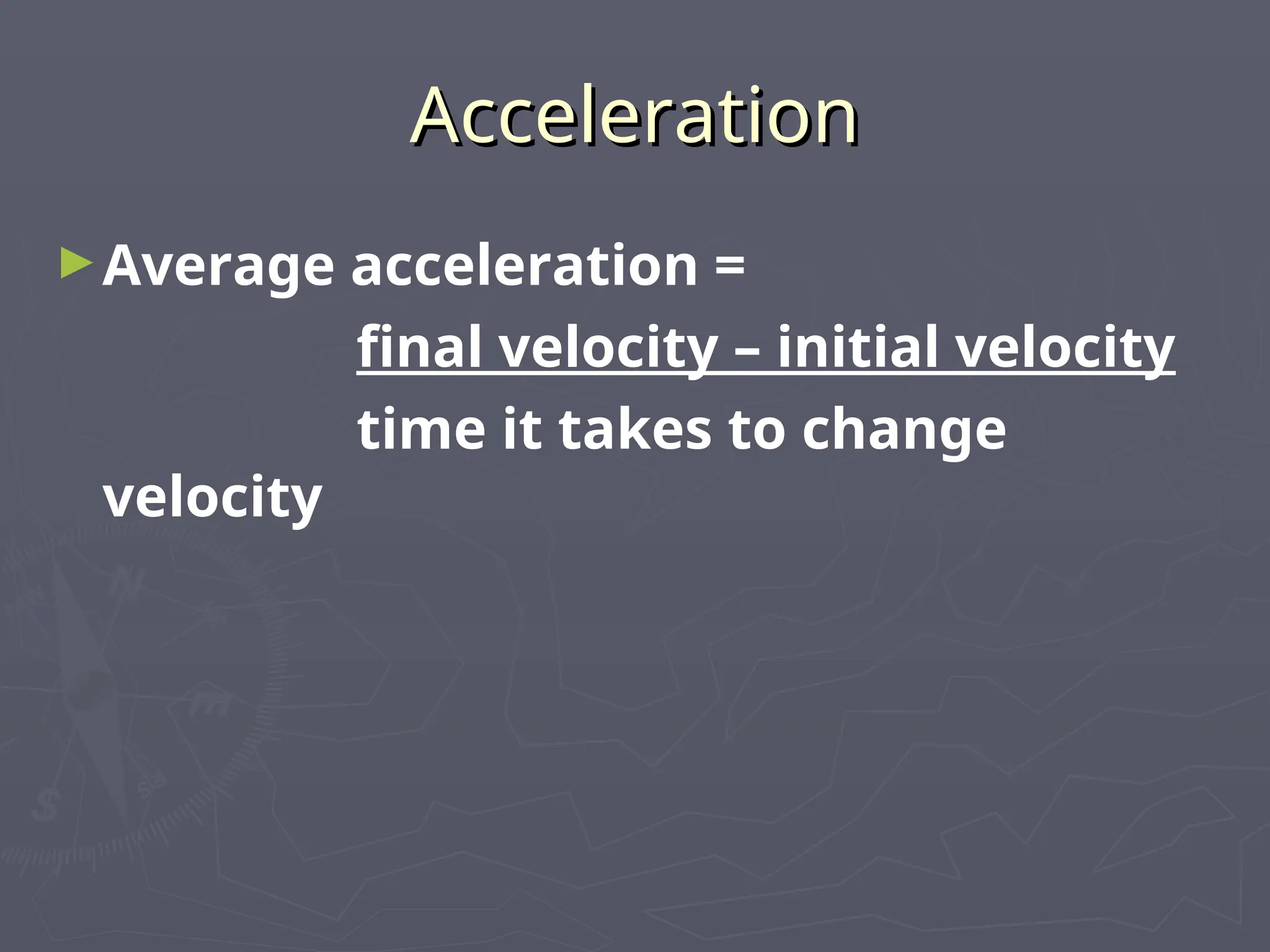
►Average acceleration =
final velocity – initial velocity
time it takes to change
velocity
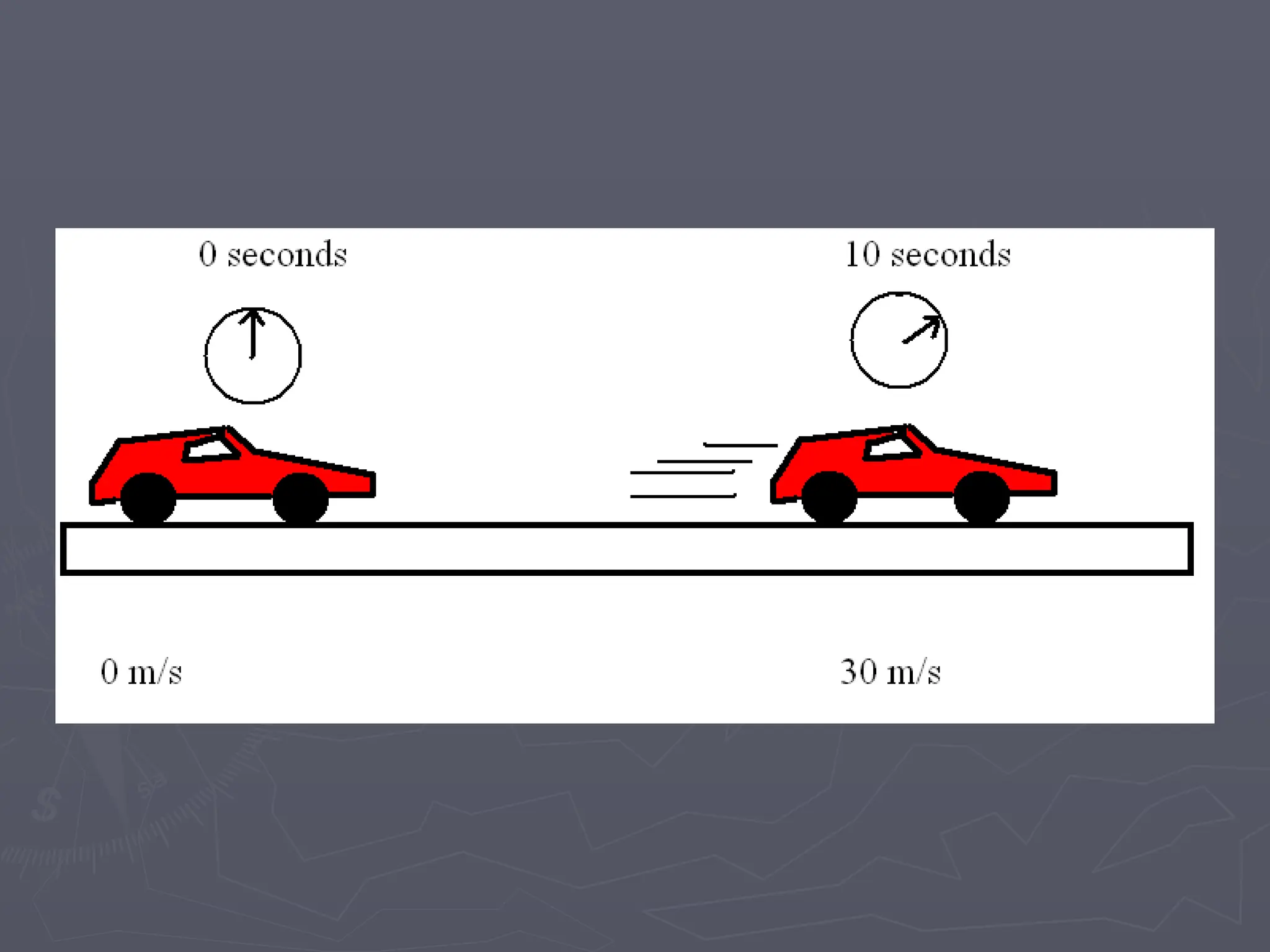
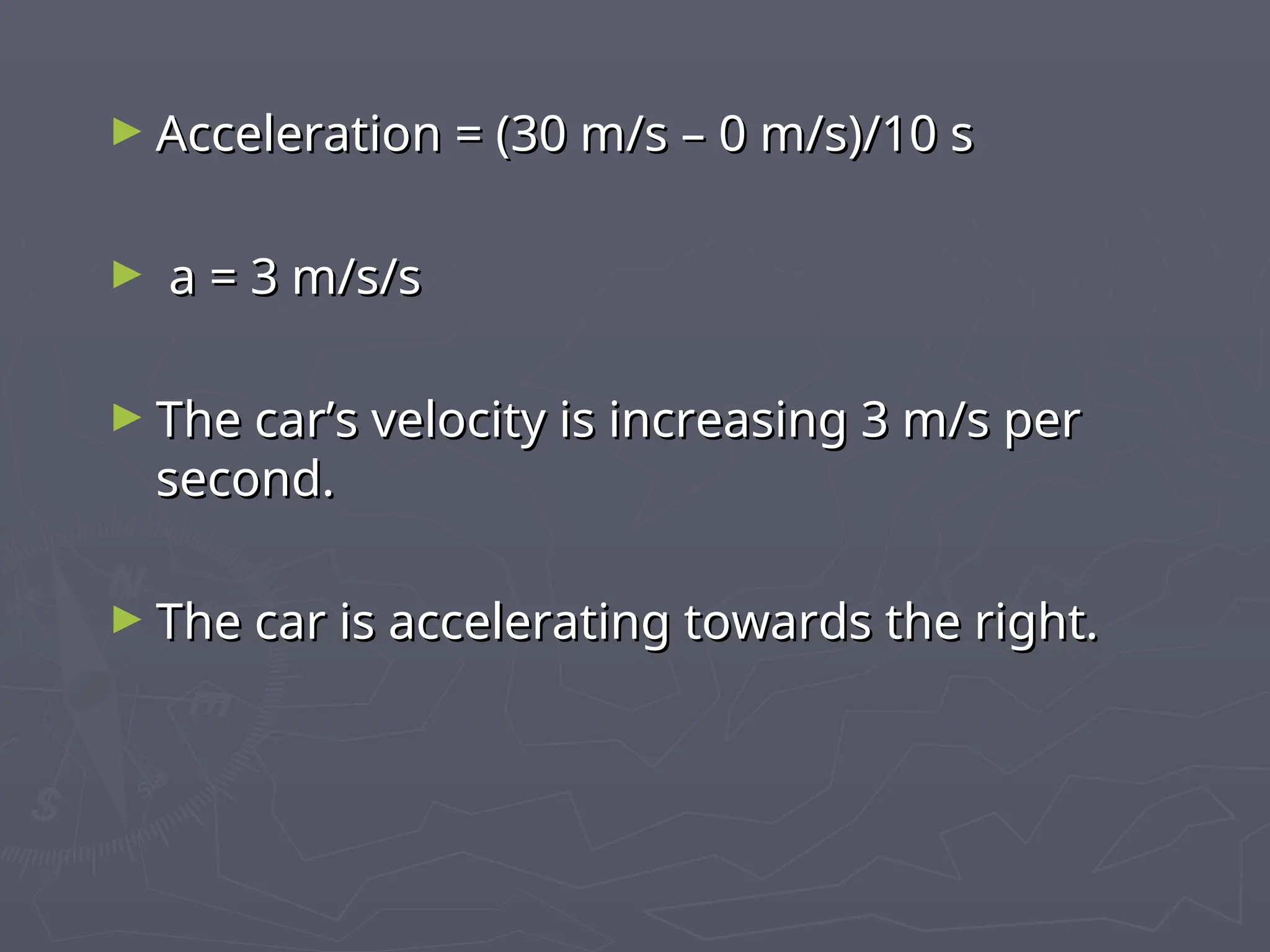
► Acceleration = (30 m/s – 0 m/s)/10 s
Acceleration = (30 m/s – 0 m/s)/10 s
► a = 3 m/s/s
a = 3 m/s/s
► The car’s velocity is increasing 3 m/s per
The car’s velocity is increasing 3 m/s per
second.
second.
► The car is accelerating towards the right.
The car is accelerating towards the right.
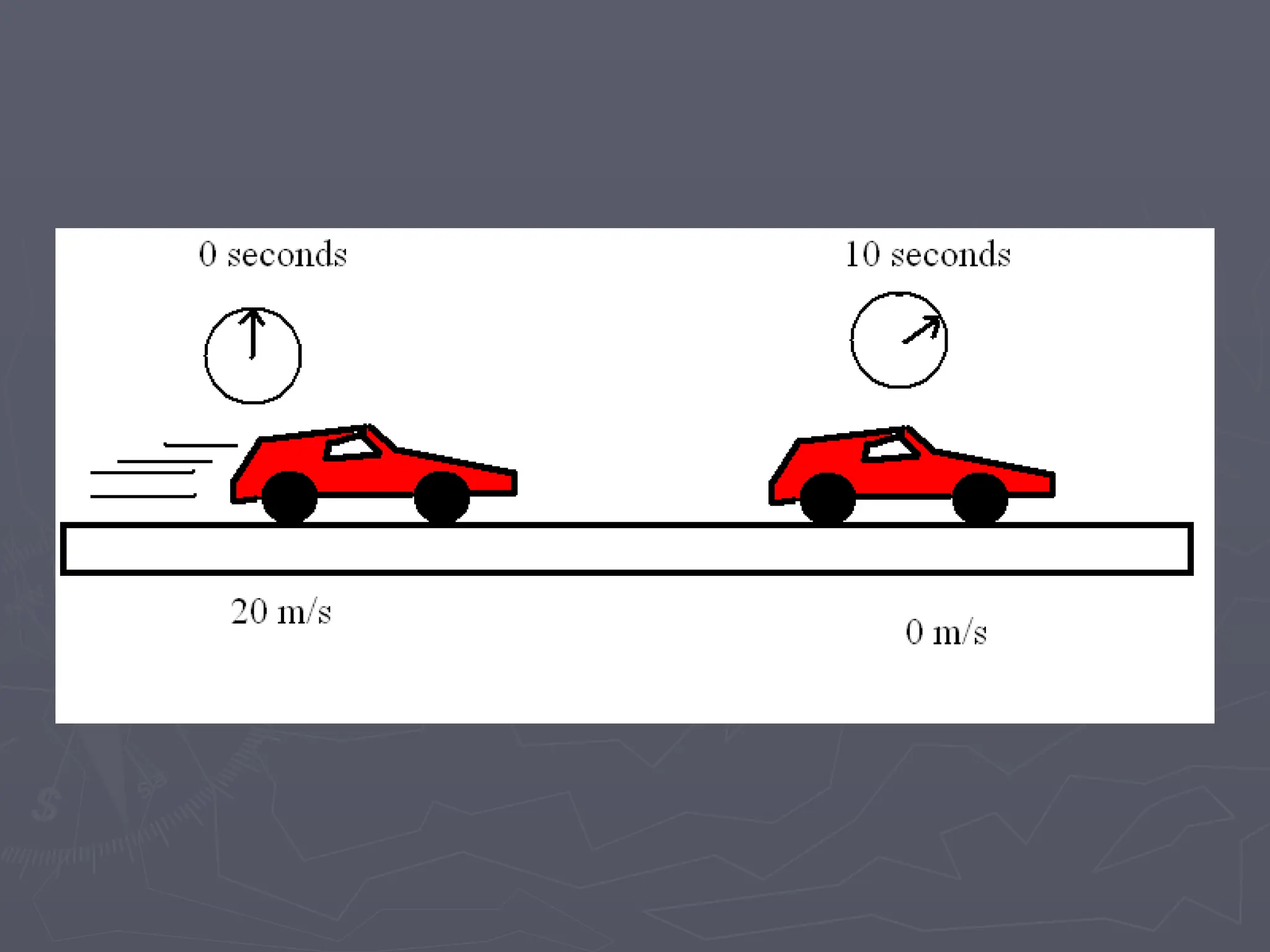
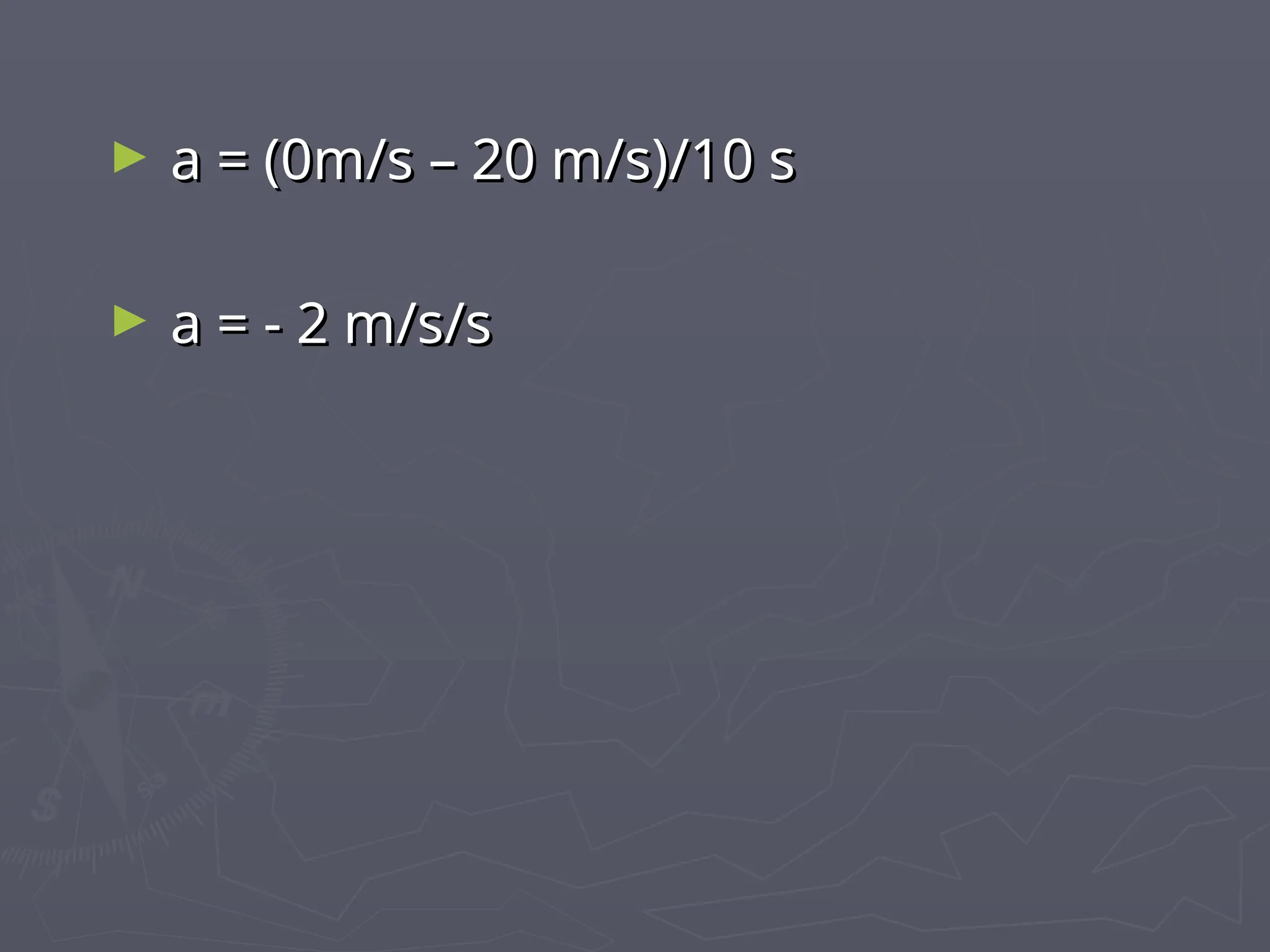
► a = (0m/s – 20 m/s)/10 s
a = (0m/s – 20 m/s)/10 s
► a = - 2 m/s/s
a = - 2 m/s/s
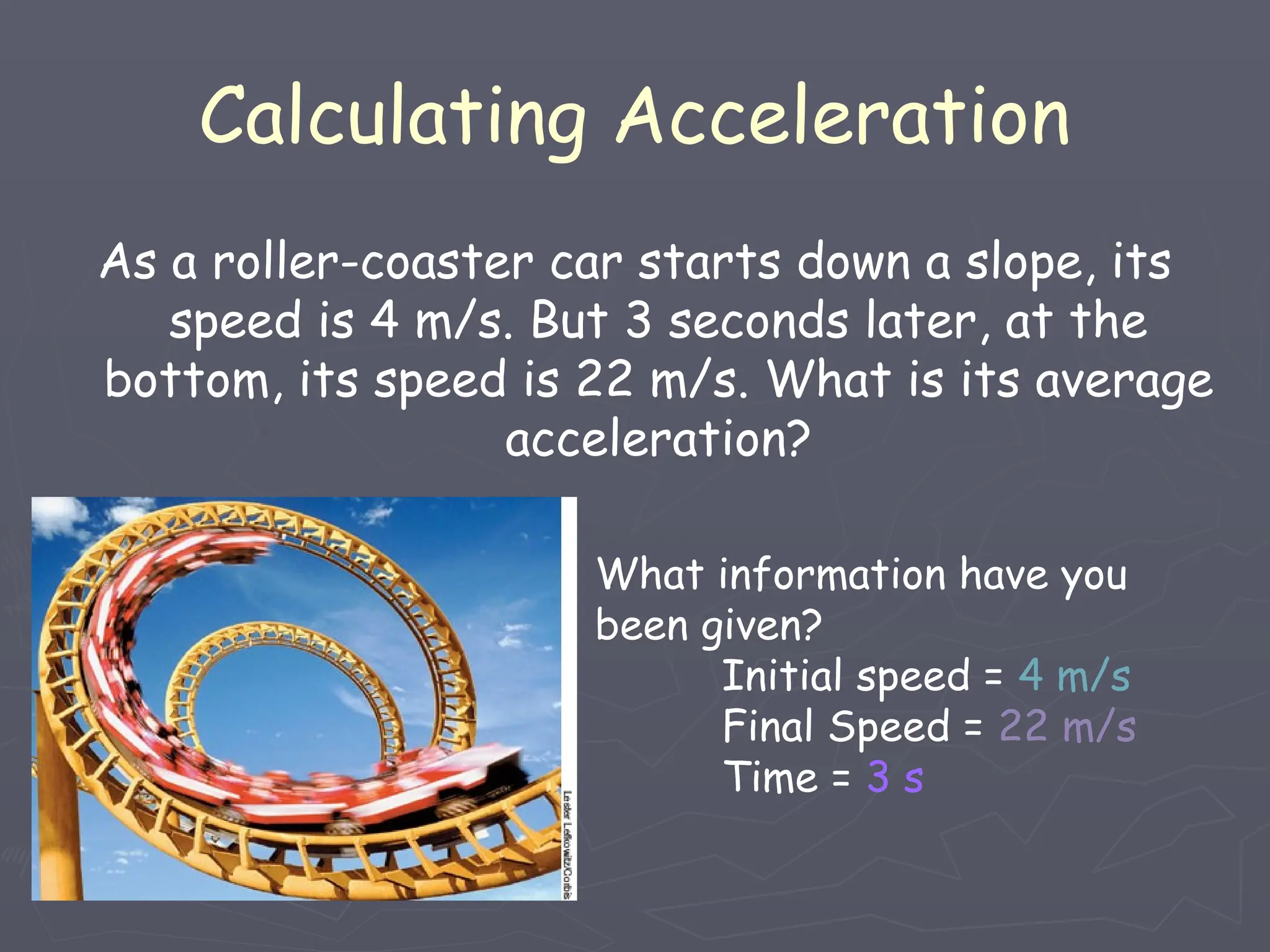
As a roller-coaster car starts down a slope, its
speed is 4 m/s. But 3 seconds later, at the
bottom, its speed is 22 m/s. What is its average
acceleration?
Calculating Acceleration
What information have you
been given?
Initial speed = 4 m/s
Final Speed = 22 m/s
Time = 3 s
A satellite’s original velocity is 10,000 m/s.
After 60 seconds it s going 5,000 m/s.
What is the acceleration?
If a speeding train hits the brakes
and it takes the train 39 seconds to
go from 54.8 m/s to 12 m/s what is
the acceleration?
Johny completes the bicycle ride with
the final velocity of 10 ms-1
and
acceleration 2 ms-2
within 3s.
Calculate the initial velocity.
You are driving on a highway that
has stop-and-go traffic for miles. It
finally clears up at a point when you
were going at a speed of 2m/s. how
fast will you be going after 9
seconds of constant acceleration at
3m/s^2?
A racehorse coming out of the gate
accelerates from rest to a velocity of
15.0 m/s due west in 1.80 s. What is its
average acceleration?
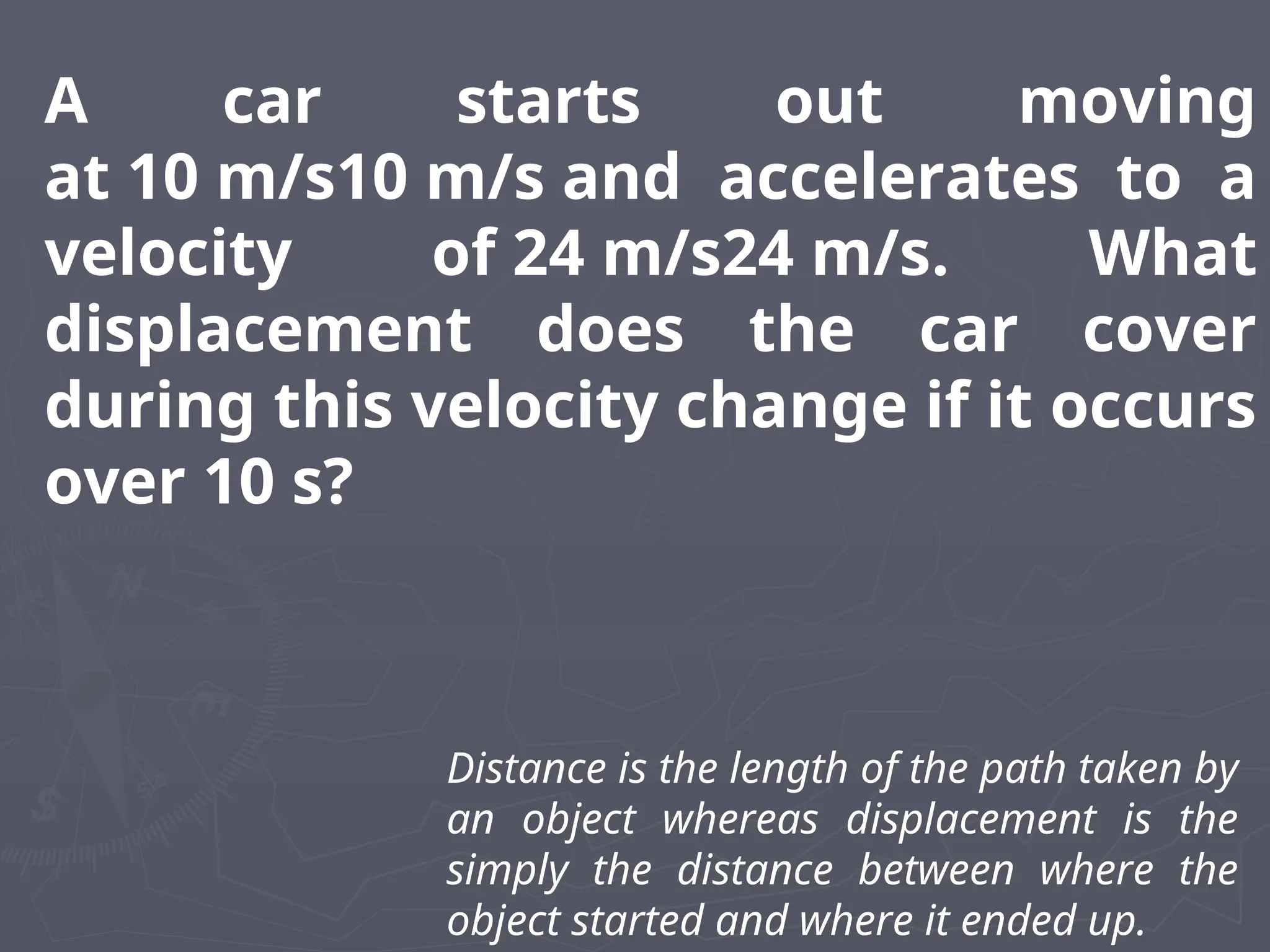
A car starts out moving
at 10 m/s10 m/s and accelerates to a
velocity of 24 m/s24 m/s. What
displacement does the car cover
during this velocity change if it occurs
over 10 s?
Distance is the length of the path taken by
an object whereas displacement is the
simply the distance between where the
object started and where it ended up.
A rocket is cruising through space
with a velocity of 50 m/s and burns
some fuel to create a constant
acceleration of 10 m/s2. How far will
it have traveled after 5 s?
Later in its journey, the rocket is moving
along at 20 m/s20 m/s when it has to fire
its thrusters again. This time it covers a
distance of 500 m500 m in 10 s10 s. What
was the rocket’s acceleration during this
thruster burn?
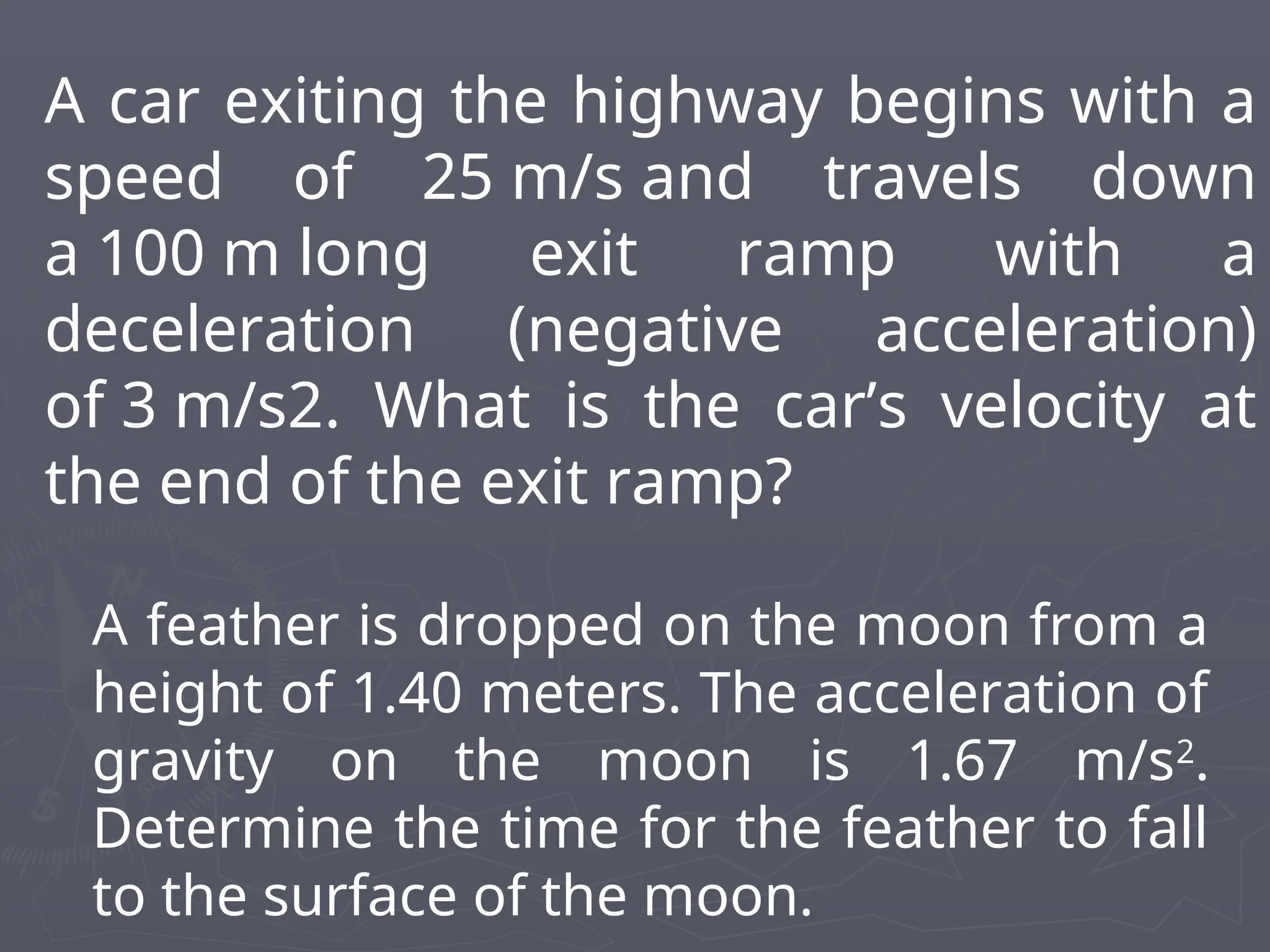
A car exiting the highway begins with a
speed of 25 m/s and travels down
a 100 m long exit ramp with a
deceleration (negative acceleration)
of 3 m/s2. What is the car’s velocity at
the end of the exit ramp?
A feather is dropped on the moon from a
height of 1.40 meters. The acceleration of
gravity on the moon is 1.67 m/s2
.
Determine the time for the feather to fall
to the surface of the moon.
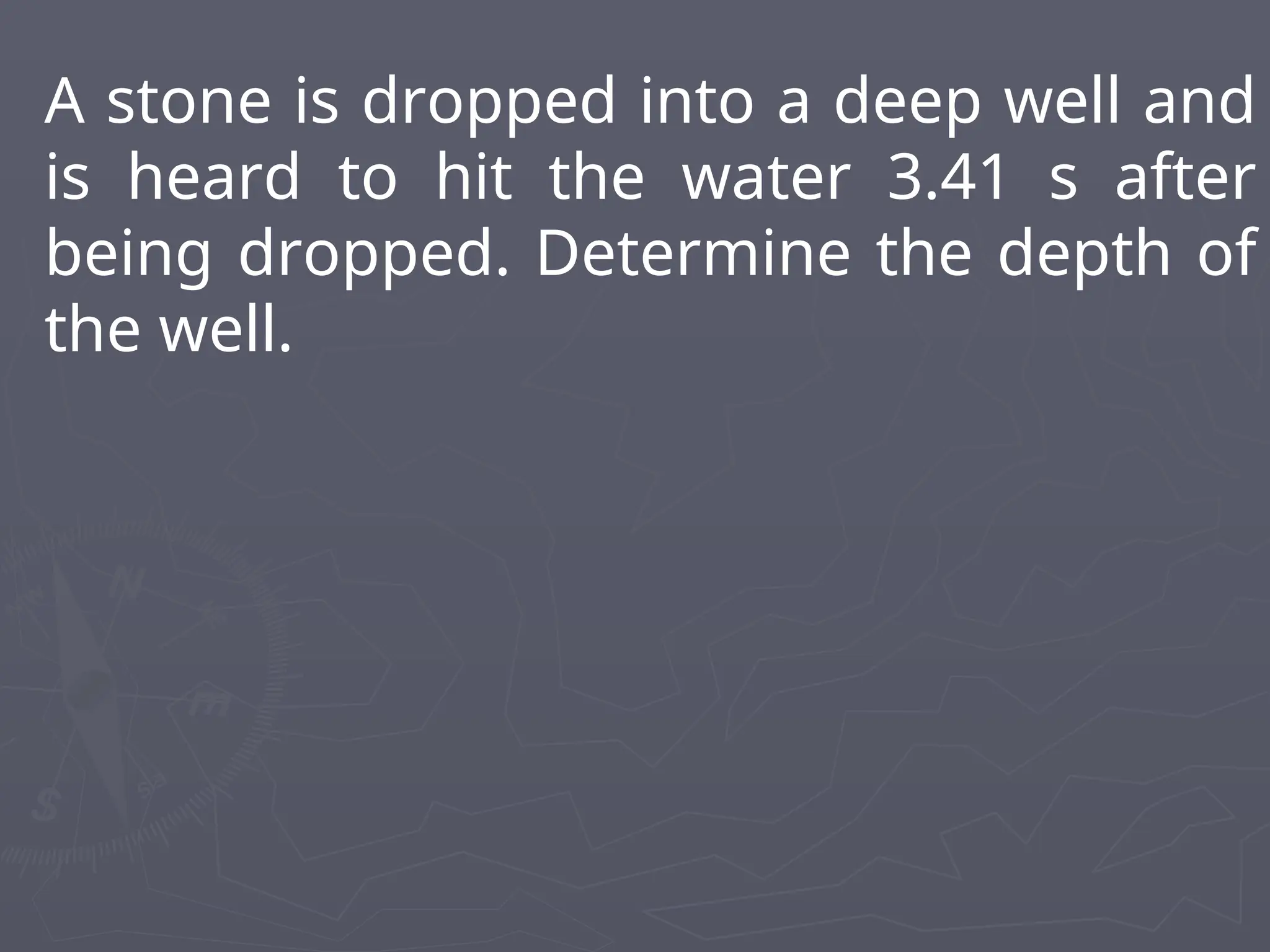
A stone is dropped into a deep well and
is heard to hit the water 3.41 s after
being dropped. Determine the depth of
the well.

KINEMATICS_Speed_Velocity_Acceleration (1).ppt

  • 1.
    Motion, Speed, Velocity Motion,Speed, Velocity and Acceleration and Acceleration
  • 2.
    Motion Motion ►Motion Motion – anobject’s change in position – an object’s change in position relative to a reference point relative to a reference point
  • 3.
    Reference Point Reference Point ►TheEarth’s surface is used as a common The Earth’s surface is used as a common reference point reference point ►A moving object can be used as a A moving object can be used as a reference point as well reference point as well
  • 4.
    Speed Speed ►Speed Speed is thedistance traveled divided by is the distance traveled divided by the time interval during which the motion the time interval during which the motion occurred occurred ►Normally, objects do not travel at a Normally, objects do not travel at a constant speed constant speed ►Average Speed - Average Speed - total distance total distance total time total time
  • 5.
    ►Here is alittle bug located at 0 cm at Here is a little bug located at 0 cm at 0 seconds. 0 seconds.
  • 6.
    ►10 seconds laterhe is at 50 cm. 10 seconds later he is at 50 cm.
  • 7.
    SPEED SPEED ►The speed ofthe bug is just his distance The speed of the bug is just his distance traveled divided by how long it takes. traveled divided by how long it takes. ►Speed = distance/time Speed = distance/time ►Speed = 50 cm/10 s = 5 cm/s Speed = 50 cm/10 s = 5 cm/s
  • 8.
    Question Question ►I travelled 25km in 10 minutes. How I travelled 25 km in 10 minutes. How many meters have I travelled? many meters have I travelled? 25 km * 1000m/km = 25000 m
  • 9.
    Problem Solving: Calculating Speed Whatis the speed of a sailboat that is traveling 120 meters in 60 seconds? What is the speed of a car that is traveling 150 miles in 3 hours?
  • 10.
    Velocity Velocity ►Velocity Velocity is thespeed of an object in a is the speed of an object in a particular direction particular direction ►Imagine two birds leave the same tree at Imagine two birds leave the same tree at the same time. The both fly at 10km/hr the same time. The both fly at 10km/hr for 5 minutes. Why don’t they end up at for 5 minutes. Why don’t they end up at the same place? the same place?
  • 12.
    Velocity Velocity ►Velocity Velocity appears tobe very similar to appears to be very similar to speed, however, when describing the speed, however, when describing the velocity of an object you need to provide velocity of an object you need to provide a magnitude and a direction a magnitude and a direction ►Magnitude Magnitude – the speed of the object – the speed of the object ►Direction Direction – the direction the object is – the direction the object is moving moving
  • 13.
    Velocity Velocity ►Ex) A bushas a velocity of 35miles/hr Ex) A bus has a velocity of 35miles/hr heading west heading west
  • 14.
    ►Suppose our bugstarts off at 100 cm. Suppose our bug starts off at 100 cm.
  • 15.
    ►And ends upat 80 cm 10 seconds And ends up at 80 cm 10 seconds later. later.
  • 16.
    ►Calculating velocity isa little more Calculating velocity is a little more complicated than calculating speed. complicated than calculating speed. ►Velocity = change in position/time Velocity = change in position/time ► Velocity = (final position – initial position)/time Velocity = (final position – initial position)/time ► Velocity = (80cm – 100cm)/10 seconds Velocity = (80cm – 100cm)/10 seconds ► Velocity = - 2 cm/s Velocity = - 2 cm/s
  • 17.
    ►For objects movingalong a straight For objects moving along a straight line line ►A positive velocity means moving to A positive velocity means moving to the right. (usually) the right. (usually) ►A negative means moving to the left. A negative means moving to the left. (usually) (usually)
  • 18.
    ►A negative velocitydoes not mean an A negative velocity does not mean an object is moving slower than zero object is moving slower than zero cm/s. cm/s. ►You can’t move slower than standing You can’t move slower than standing still. still. ►It just means an object is moving in a It just means an object is moving in a certain direction. certain direction.
  • 20.
    Resultant Velocity Resultant Velocity ►Anobject can have a resultant velocity if it An object can have a resultant velocity if it is experiencing more than one motion. is experiencing more than one motion. ►For example if a person walks down the For example if a person walks down the center of a bus while it is in motion there center of a bus while it is in motion there are two velocities occurring. are two velocities occurring.  1. The movement of the bus 1. The movement of the bus  2. The movement of the person inside the 2. The movement of the person inside the bus bus
  • 21.
  • 22.
  • 23.
    Acceleration Acceleration ►Acceleration Acceleration is therate at which velocity is the rate at which velocity changes over time changes over time When an object is increasing in velocity over time it is said to be accelerating. (positive acceleration) When an object is decreasing in velocity over time it is said to be decelerating. (negative acceleration) If an object is moving at constant velocity it is said to be moving with zero acceleration
  • 24.
    Three Ways to“Accelerate” ►Speed Up ►Slow Down ►Change Direction
  • 25.
    Acceleration Acceleration ►Average acceleration = finalvelocity – initial velocity time it takes to change velocity
  • 27.
    ► Acceleration =(30 m/s – 0 m/s)/10 s Acceleration = (30 m/s – 0 m/s)/10 s ► a = 3 m/s/s a = 3 m/s/s ► The car’s velocity is increasing 3 m/s per The car’s velocity is increasing 3 m/s per second. second. ► The car is accelerating towards the right. The car is accelerating towards the right.
  • 29.
    ► a =(0m/s – 20 m/s)/10 s a = (0m/s – 20 m/s)/10 s ► a = - 2 m/s/s a = - 2 m/s/s
  • 30.
    As a roller-coastercar starts down a slope, its speed is 4 m/s. But 3 seconds later, at the bottom, its speed is 22 m/s. What is its average acceleration? Calculating Acceleration What information have you been given? Initial speed = 4 m/s Final Speed = 22 m/s Time = 3 s
  • 31.
    A satellite’s originalvelocity is 10,000 m/s. After 60 seconds it s going 5,000 m/s. What is the acceleration? If a speeding train hits the brakes and it takes the train 39 seconds to go from 54.8 m/s to 12 m/s what is the acceleration?
  • 32.
    Johny completes thebicycle ride with the final velocity of 10 ms-1 and acceleration 2 ms-2 within 3s. Calculate the initial velocity. You are driving on a highway that has stop-and-go traffic for miles. It finally clears up at a point when you were going at a speed of 2m/s. how fast will you be going after 9 seconds of constant acceleration at 3m/s^2?
  • 33.
    A racehorse comingout of the gate accelerates from rest to a velocity of 15.0 m/s due west in 1.80 s. What is its average acceleration?
  • 35.
    A car startsout moving at 10 m/s10 m/s and accelerates to a velocity of 24 m/s24 m/s. What displacement does the car cover during this velocity change if it occurs over 10 s? Distance is the length of the path taken by an object whereas displacement is the simply the distance between where the object started and where it ended up.
  • 36.
    A rocket iscruising through space with a velocity of 50 m/s and burns some fuel to create a constant acceleration of 10 m/s2. How far will it have traveled after 5 s? Later in its journey, the rocket is moving along at 20 m/s20 m/s when it has to fire its thrusters again. This time it covers a distance of 500 m500 m in 10 s10 s. What was the rocket’s acceleration during this thruster burn?
  • 37.
    A car exitingthe highway begins with a speed of 25 m/s and travels down a 100 m long exit ramp with a deceleration (negative acceleration) of 3 m/s2. What is the car’s velocity at the end of the exit ramp? A feather is dropped on the moon from a height of 1.40 meters. The acceleration of gravity on the moon is 1.67 m/s2 . Determine the time for the feather to fall to the surface of the moon.
  • 38.
    A stone isdropped into a deep well and is heard to hit the water 3.41 s after being dropped. Determine the depth of the well.