Listening
Comprehension
Listening comprehension is a
receptive skill, as opposed to
speaking, which is productive. But
this does not mean it is a passive
skill. Much to the contrary,
listening comprehension is an
interactive process in which
listeners interact with the text, the
tasks and the context external
(situation) and internal
(background knowledge) to them.
Listening
Comprehension
Listening
comprehension is
a cognitive
activity in which
listeners, based
on their
schemata,
interpret
whatever they
listen.
An activity
related to the
acquisition of
knowledge
Schema (sing.) –
Schemata (pl.):
Mental scripts or
frames developed
along our lives based
on our experience.
Listening
Comprehension
Schema Theory
Listening comprehension used to
be viewed as a process which
involved the decoding of sounds
in a linear fashion, from the
smallest meaningful units
(phonemes) to larger ones.
This approach is known as
bottom-up information
processing mode.
Listening Comprehension
Schema Theory
Listening
comprehension
now is thought
of as depending
as much on the
reader as on the
text.
Bottom up and
top-down modes
of information
processing
interact.
Listening Comprehension
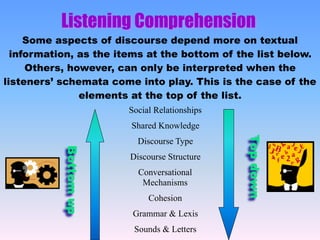
Social Relationships
Shared Knowledge
Discourse Type
Discourse Structure
Conversational
Mechanisms
Cohesion
Grammar & Lexis
Sounds & Letters
Bottomup
Topdown
Some aspects of discourse depend more on textual
information, as the items at the bottom of the list below.
Others, however, can only be interpreted when the
listeners’ schemata come into play. This is the case of the
elements at the top of the list.
Listening
Comprehension
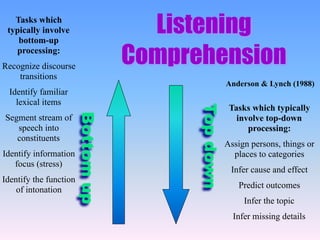
Tasks which typically
involve top-down
processing:
Assign persons, things or
places to categories
Infer cause and effect
Predict outcomes
Infer the topic
Infer missing details
Bottomup
Topdown
Tasks which
typically involve
bottom-up
processing:
Recognize discourse
transitions
Identify familiar
lexical items
Segment stream of
speech into
constituents
Identify information
focus (stress)
Identify the function
of intonation
Anderson & Lynch (1988)
There are some key
factors which
interact to
contribute to the
difficulty of
Listening. Among
them are text
function, text
features, processing
load, and some of
the features of oral
language.
Key Factors
Main Text Function
Transactional
Typical tasks focusing on the
transactional content of a
message:
Identify key information
Identify specific facts or details
Identify sequence of series of events
Carry out tasks (label, select, draw,
fill in forms, etc)
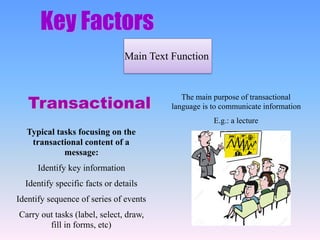
The main purpose of transactional
language is to communicate information
E.g.: a lecture
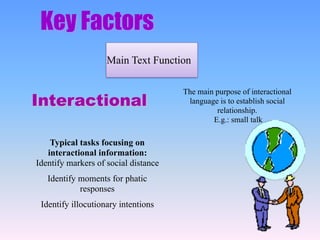
Key Factors
Main Text Function
Typical tasks focusing on
interactional information:
Identify markers of social distance
Identify moments for phatic
responses
Identify illocutionary intentions
Interactional
The main purpose of interactional
language is to establish social
relationship.
E.g.: small talk
Key Factors
Main Text Features:
Information organization
Topic
Amount of inferencing required and
amount of reference and reduced forms
employed.
Explicitness
Topic complexity and familiarity of the
listener with the topic
Logical structuring of ideas
Key Factors
Main Text Features:
Genre
Register
Sermons, chats, jokes etc.
Intimate, casual or formal language.
Text Type
Narratives, descriptions, explanations etc
Key Factors
Awareness of the Features of Oral Language
Colloquial vocabulary
Information staging
Unnecessary repetition of informationRedundancy
Incomplete sentences
Importance of shared knowledge
It’s very nice that road up through
Skipton to the Dales
Discourse markers You know, you see, anyway
Key Factors
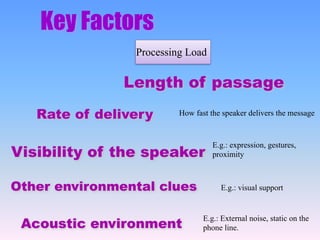
Processing Load
Length of passage
Rate of delivery How fast the speaker delivers the message
Visibility of the speaker
Other environmental clues
Acoustic environment
E.g.: visual support
E.g.: External noise, static on the
phone line.
E.g.: expression, gestures,
proximity
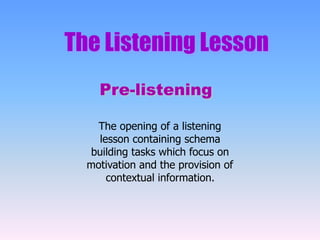
The Listening Lesson
Pre-listening
The opening of a listening
lesson containing schema
building tasks which focus on
motivation and the provision of
contextual information.
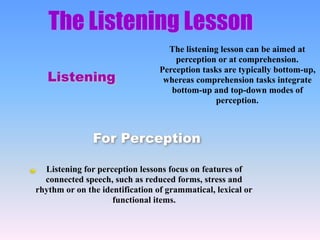
The Listening Lesson
Listening
Listening for perception lessons focus on features of
connected speech, such as reduced forms, stress and
rhythm or on the identification of grammatical, lexical or
functional items.
For Perception
The listening lesson can be aimed at
perception or at comprehension.
Perception tasks are typically bottom-up,
whereas comprehension tasks integrate
bottom-up and top-down modes of
perception.
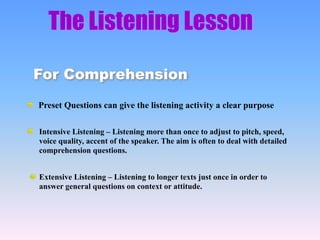
The Listening Lesson
Preset Questions can give the listening activity a clear purpose
Extensive Listening – Listening to longer texts just once in order to
answer general questions on context or attitude.
For Comprehension
Intensive Listening – Listening more than once to adjust to pitch, speed,
voice quality, accent of the speaker. The aim is often to deal with detailed
comprehension questions.
The Listening Lesson
Post-Listening
As a wrap-up to the Listening
lesson, features of the text can
serve as a starting point for
follow-up activities on
speaking, writing or language
analysis (identification of lexical
segmentation, functional
language, etc.).

Teaching Listening Comprehension

  • 1.
    Listening Comprehension Listening comprehension isa receptive skill, as opposed to speaking, which is productive. But this does not mean it is a passive skill. Much to the contrary, listening comprehension is an interactive process in which listeners interact with the text, the tasks and the context external (situation) and internal (background knowledge) to them.
  • 2.
    Listening Comprehension Listening comprehension is a cognitive activityin which listeners, based on their schemata, interpret whatever they listen. An activity related to the acquisition of knowledge Schema (sing.) – Schemata (pl.): Mental scripts or frames developed along our lives based on our experience.
  • 3.
    Listening Comprehension Schema Theory Listening comprehensionused to be viewed as a process which involved the decoding of sounds in a linear fashion, from the smallest meaningful units (phonemes) to larger ones. This approach is known as bottom-up information processing mode.
  • 4.
    Listening Comprehension Schema Theory Listening comprehension nowis thought of as depending as much on the reader as on the text. Bottom up and top-down modes of information processing interact.
  • 5.
    Listening Comprehension Social Relationships SharedKnowledge Discourse Type Discourse Structure Conversational Mechanisms Cohesion Grammar & Lexis Sounds & Letters Bottomup Topdown Some aspects of discourse depend more on textual information, as the items at the bottom of the list below. Others, however, can only be interpreted when the listeners’ schemata come into play. This is the case of the elements at the top of the list.
  • 6.
    Listening Comprehension Tasks which typically involvetop-down processing: Assign persons, things or places to categories Infer cause and effect Predict outcomes Infer the topic Infer missing details Bottomup Topdown Tasks which typically involve bottom-up processing: Recognize discourse transitions Identify familiar lexical items Segment stream of speech into constituents Identify information focus (stress) Identify the function of intonation Anderson & Lynch (1988)
  • 7.
    There are somekey factors which interact to contribute to the difficulty of Listening. Among them are text function, text features, processing load, and some of the features of oral language.
  • 8.
    Key Factors Main TextFunction Transactional Typical tasks focusing on the transactional content of a message: Identify key information Identify specific facts or details Identify sequence of series of events Carry out tasks (label, select, draw, fill in forms, etc) The main purpose of transactional language is to communicate information E.g.: a lecture
  • 9.
    Key Factors Main TextFunction Typical tasks focusing on interactional information: Identify markers of social distance Identify moments for phatic responses Identify illocutionary intentions Interactional The main purpose of interactional language is to establish social relationship. E.g.: small talk
  • 10.
    Key Factors Main TextFeatures: Information organization Topic Amount of inferencing required and amount of reference and reduced forms employed. Explicitness Topic complexity and familiarity of the listener with the topic Logical structuring of ideas
  • 11.
    Key Factors Main TextFeatures: Genre Register Sermons, chats, jokes etc. Intimate, casual or formal language. Text Type Narratives, descriptions, explanations etc
  • 12.
    Key Factors Awareness ofthe Features of Oral Language Colloquial vocabulary Information staging Unnecessary repetition of informationRedundancy Incomplete sentences Importance of shared knowledge It’s very nice that road up through Skipton to the Dales Discourse markers You know, you see, anyway
  • 13.
    Key Factors Processing Load Lengthof passage Rate of delivery How fast the speaker delivers the message Visibility of the speaker Other environmental clues Acoustic environment E.g.: visual support E.g.: External noise, static on the phone line. E.g.: expression, gestures, proximity
  • 14.
    The Listening Lesson Pre-listening Theopening of a listening lesson containing schema building tasks which focus on motivation and the provision of contextual information.
  • 15.
    The Listening Lesson Listening Listeningfor perception lessons focus on features of connected speech, such as reduced forms, stress and rhythm or on the identification of grammatical, lexical or functional items. For Perception The listening lesson can be aimed at perception or at comprehension. Perception tasks are typically bottom-up, whereas comprehension tasks integrate bottom-up and top-down modes of perception.
  • 16.
    The Listening Lesson PresetQuestions can give the listening activity a clear purpose Extensive Listening – Listening to longer texts just once in order to answer general questions on context or attitude. For Comprehension Intensive Listening – Listening more than once to adjust to pitch, speed, voice quality, accent of the speaker. The aim is often to deal with detailed comprehension questions.
  • 17.
    The Listening Lesson Post-Listening Asa wrap-up to the Listening lesson, features of the text can serve as a starting point for follow-up activities on speaking, writing or language analysis (identification of lexical segmentation, functional language, etc.).