DISCOURSE
ANALYSIS
Communication as action
Organon model
The linguistic sign. (Philosophy of grammar)
• Sender
• Receiver
• Objects
Organon model
• Sign
Symptom: (something about the sender) (intention)
Symbol: (objects and states)(real events)
Signal: (interpretation, reaction,an expected answer)
Organon model
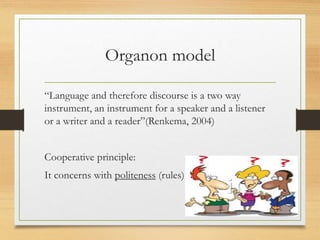
“Language and therefore discourse is a two way
instrument, an instrument for a speaker and a listener
or a writer and a reader”(Renkema, 2004)
Cooperative principle:
It concerns with politeness (rules)
Speech act theory
“Language is seen as a form of acting”(p.12) (ordinary
language philosophy)
This theory concerns about what people are doing
when they use language.
• UTTERANCES USED TO DO THINGS ARE
CALLED ‘PERFORMATIVE”….
• “CONSTATIVES” UTTERANCES USED TO STATE
THINGS ABOUT REALITY…
People do not only produce utterances containing
grammatical structures and words, they perform
actions via those utterances.
Speech act theory
• People do not only produce utterances
containing grammatical structures and words,
they perform actions via those utterances.
• Actions performed via utterances are called
SPEECH ACTS …
(apology, complaint, promise, or request)
• In many ways, the circumstances are the ones that
determine the interpretation of the Speech Act…
• e.g.
“The tea is really cold.”
Speech act theory
• The action performed by producing an utterance will
consist of three related acts:
Locution: What you say. The utterance itself
E.g. The coffee tastes great
Speech act theory
Illocution: Intention you have when you produce the
utterance. Request
E.g. The coffee tastes great
• to invite
• To offer
• or simply as statement of fact
Speech act theory
Perlocution: Reaction, response
The hearer, on hearing the sentence above might react
by accepting a cup of coffee if interprets the
perlocutionary act.
Speech act theory
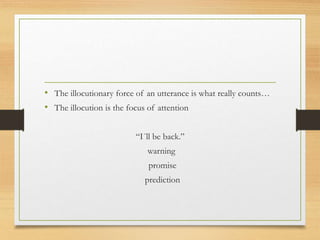
• The illocutionary force of an utterance is what really counts…
• The illocution is the focus of attention
“I´ll be back.”
warning
promise
prediction
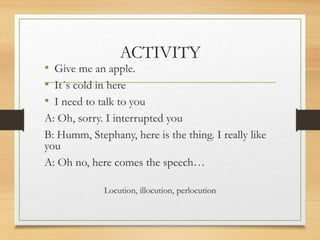
ACTIVITY
• Give me an apple.
• It´s cold in here
• I need to talk to you
A: Oh, sorry. I interrupted you
B: Humm, Stephany, here is the thing. I really like
you
A: Oh no, here comes the speech…
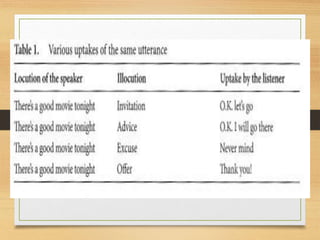
Locution, illocution, perlocution
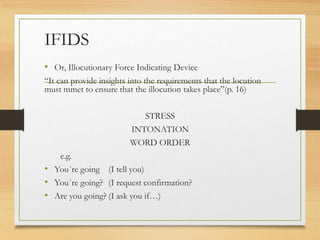
IFIDS
• Or, Illocutionary Force Indicating Device
“It can provide insights into the requirements that the locution
must mmet to ensure that the illocution takes place”(p. 16)
STRESS
INTONATION
WORD ORDER
e.g.
• You´re going (I tell you)
• You´re going? (I request confirmation?
• Are you going? (I ask you if…)
Speech acts

Speech acts

  • 1.
  • 2.
    Organon model The linguisticsign. (Philosophy of grammar) • Sender • Receiver • Objects
  • 3.
    Organon model • Sign Symptom:(something about the sender) (intention) Symbol: (objects and states)(real events) Signal: (interpretation, reaction,an expected answer)
  • 4.
    Organon model “Language andtherefore discourse is a two way instrument, an instrument for a speaker and a listener or a writer and a reader”(Renkema, 2004) Cooperative principle: It concerns with politeness (rules)
  • 5.
    Speech act theory “Languageis seen as a form of acting”(p.12) (ordinary language philosophy) This theory concerns about what people are doing when they use language.
  • 6.
    • UTTERANCES USEDTO DO THINGS ARE CALLED ‘PERFORMATIVE”…. • “CONSTATIVES” UTTERANCES USED TO STATE THINGS ABOUT REALITY… People do not only produce utterances containing grammatical structures and words, they perform actions via those utterances.
  • 7.
    Speech act theory •People do not only produce utterances containing grammatical structures and words, they perform actions via those utterances. • Actions performed via utterances are called SPEECH ACTS … (apology, complaint, promise, or request)
  • 8.
    • In manyways, the circumstances are the ones that determine the interpretation of the Speech Act… • e.g. “The tea is really cold.”
  • 9.
    Speech act theory •The action performed by producing an utterance will consist of three related acts: Locution: What you say. The utterance itself E.g. The coffee tastes great
  • 10.
    Speech act theory Illocution:Intention you have when you produce the utterance. Request E.g. The coffee tastes great • to invite • To offer • or simply as statement of fact
  • 11.
    Speech act theory Perlocution:Reaction, response The hearer, on hearing the sentence above might react by accepting a cup of coffee if interprets the perlocutionary act.
  • 12.
  • 13.
    • The illocutionaryforce of an utterance is what really counts… • The illocution is the focus of attention “I´ll be back.” warning promise prediction
  • 14.
    ACTIVITY • Give mean apple. • It´s cold in here • I need to talk to you A: Oh, sorry. I interrupted you B: Humm, Stephany, here is the thing. I really like you A: Oh no, here comes the speech… Locution, illocution, perlocution
  • 15.
    IFIDS • Or, IllocutionaryForce Indicating Device “It can provide insights into the requirements that the locution must mmet to ensure that the illocution takes place”(p. 16) STRESS INTONATION WORD ORDER e.g. • You´re going (I tell you) • You´re going? (I request confirmation? • Are you going? (I ask you if…)