Pragmatics and Discourse:Understanding Speech Acts
Pragmatics and Discourse: Understanding Speech Acts
3.
Introduction to Pragmatics
Pragmaticsis the branch of linguistics that studies how context contributes to
meaning. Unlike semantics, which examines literal meaning, pragmatics explores
how language is used in social contexts. It considers factors such as:
• The relationship between speakers
• Shared knowledge and assumptions
• Cultural and social norms
• Physical setting of communication
Intentions behind utterances
Pragmatics helps us understand why the same words can mean different things in
different contexts.
4.
Key Concepts inPragmatics
• Context: The circumstances in which language is used
• Deixis: Words that point to specific times, places, or people (e.g., here, now, I,
you)
• Presupposition: Assumptions embedded within utterances
• Implicature: Meanings implied but not explicitly stated
• Cooperative Principle: Grice's theory about how people interact in
conversation
• Politeness Theory: How language maintains social relationships
• Speech Acts: How we perform actions through language
5.
Introduction to SpeechActs
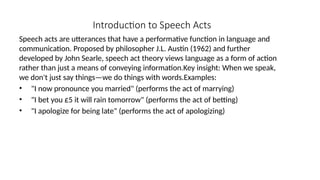
Speech acts are utterances that have a performative function in language and
communication. Proposed by philosopher J.L. Austin (1962) and further
developed by John Searle, speech act theory views language as a form of action
rather than just a means of conveying information.Key insight: When we speak,
we don't just say things—we do things with words.Examples:
• "I now pronounce you married" (performs the act of marrying)
• "I bet you £5 it will rain tomorrow" (performs the act of betting)
• "I apologize for being late" (performs the act of apologizing)
6.
Austin's Three Levelsof Speech Acts
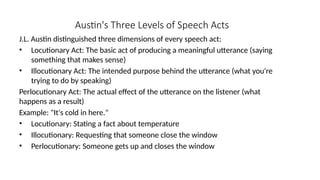
J.L. Austin distinguished three dimensions of every speech act:
• Locutionary Act: The basic act of producing a meaningful utterance (saying
something that makes sense)
• Illocutionary Act: The intended purpose behind the utterance (what you're
trying to do by speaking)
Perlocutionary Act: The actual effect of the utterance on the listener (what
happens as a result)
Example: "It's cold in here."
• Locutionary: Stating a fact about temperature
• Illocutionary: Requesting that someone close the window
• Perlocutionary: Someone gets up and closes the window
7.
Searle's Classification ofSpeech Acts
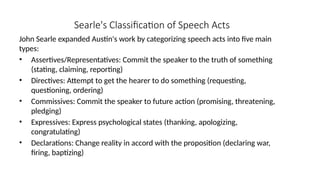
John Searle expanded Austin's work by categorizing speech acts into five main
types:
• Assertives/Representatives: Commit the speaker to the truth of something
(stating, claiming, reporting)
• Directives: Attempt to get the hearer to do something (requesting,
questioning, ordering)
• Commissives: Commit the speaker to future action (promising, threatening,
pledging)
• Expressives: Express psychological states (thanking, apologizing,
congratulating)
• Declarations: Change reality in accord with the proposition (declaring war,
firing, baptizing)
8.
Direct vs. IndirectSpeech Acts
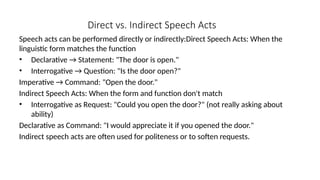
Speech acts can be performed directly or indirectly:Direct Speech Acts: When the
linguistic form matches the function
• Declarative → Statement: "The door is open."
• Interrogative → Question: "Is the door open?"
Imperative → Command: "Open the door."
Indirect Speech Acts: When the form and function don't match
• Interrogative as Request: "Could you open the door?" (not really asking about
ability)
Declarative as Command: "I would appreciate it if you opened the door."
Indirect speech acts are often used for politeness or to soften requests.
9.
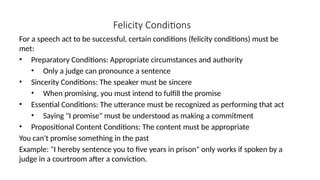
Felicity Conditions
For aspeech act to be successful, certain conditions (felicity conditions) must be
met:
• Preparatory Conditions: Appropriate circumstances and authority
• Only a judge can pronounce a sentence
• Sincerity Conditions: The speaker must be sincere
• When promising, you must intend to fulfill the promise
• Essential Conditions: The utterance must be recognized as performing that act
• Saying "I promise" must be understood as making a commitment
• Propositional Content Conditions: The content must be appropriate
You can't promise something in the past
Example: "I hereby sentence you to five years in prison" only works if spoken by a
judge in a courtroom after a conviction.
10.
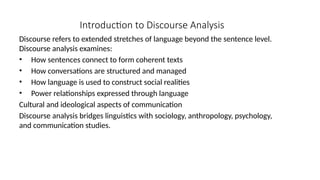
Introduction to DiscourseAnalysis
Discourse refers to extended stretches of language beyond the sentence level.
Discourse analysis examines:
• How sentences connect to form coherent texts
• How conversations are structured and managed
• How language is used to construct social realities
• Power relationships expressed through language
Cultural and ideological aspects of communication
Discourse analysis bridges linguistics with sociology, anthropology, psychology,
and communication studies.
11.
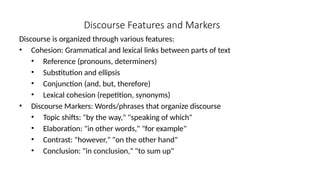
Discourse Features andMarkers
Discourse is organized through various features:
• Cohesion: Grammatical and lexical links between parts of text
• Reference (pronouns, determiners)
• Substitution and ellipsis
• Conjunction (and, but, therefore)
• Lexical cohesion (repetition, synonyms)
• Discourse Markers: Words/phrases that organize discourse
• Topic shifts: "by the way," "speaking of which"
• Elaboration: "in other words," "for example"
• Contrast: "however," "on the other hand"
• Conclusion: "in conclusion," "to sum up"
12.
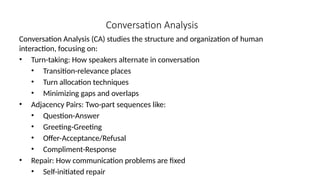
Conversation Analysis
Conversation Analysis(CA) studies the structure and organization of human
interaction, focusing on:
• Turn-taking: How speakers alternate in conversation
• Transition-relevance places
• Turn allocation techniques
• Minimizing gaps and overlaps
• Adjacency Pairs: Two-part sequences like:
• Question-Answer
• Greeting-Greeting
• Offer-Acceptance/Refusal
• Compliment-Response
• Repair: How communication problems are fixed
• Self-initiated repair
13.
The Cooperative Principle
H.P.Grice proposed that conversation is governed by a Cooperative Principle:
"Make your conversational contribution such as is required, at the stage at which
it occurs, by the accepted purpose or direction of the talk exchange."This
principle is elaborated through four maxims:
• Quantity: Give the right amount of information
• Not too little, not too much
• Quality: Be truthful
• Don't say what you believe is false
• Don't say things for which you lack evidence
• Relation: Be relevant
• Stay on topic
• Manner: Be clear
• Avoid obscurity and ambiguity
14.
Conversational Implicature
When maximsare apparently violated, listeners infer additional meanings
(implicatures):
• Conventional Implicature: Tied to specific words
• "She is poor but honest" (implies contrast between poverty and honesty)
• Conversational Implicature: Derived from context
• A: "Are you going to Paul's party?"
• B: "I have to work." (implies "No, I'm not going")
• Flouting a Maxim: Deliberately breaking a maxim to create meaning
• Irony: "What lovely weather!" (during a storm)
• Metaphor: "My lawyer is a shark"
• Understatement: "It's a bit warm" (during extreme heat)
15.
Politeness Theory
Politeness theory(Brown & Levinson) explains how language maintains social
relationships:
• Face: The public self-image everyone wants to claim
• Positive face: Desire to be appreciated and approved
• Negative face: Desire for freedom and autonomy
• Face-Threatening Acts (FTAs): Actions that threaten face
• Requests threaten negative face
• Criticism threatens positive face
• Politeness Strategies:
• Bald on-record: Direct speech acts ("Close the door")
• Positive politeness: Showing solidarity ("Could you close the door,
buddy?")
• Negative politeness: Showing deference ("I wonder if you could possibly
16.
Applying Pragmatics andSpeech Act Theory
Practical applications of these concepts:
• Cross-cultural Communication: Understanding how speech acts vary across
cultures
• Directness vs. indirectness
• Politeness conventions
• Taboo topics
• Language Teaching: Teaching pragmatic competence
• How to make requests appropriately
• Understanding implied meanings
• Recognizing cultural differences in speech acts
• Legal Contexts: Analyzing language in courtrooms and legal documents
• Performative utterances in contracts
• Interpreting threats and promises
17.
Conclusion and KeyTakeaways
• Pragmatics explores how context shapes meaning beyond literal semantics
• Speech acts show how we perform actions through language (promising,
requesting, etc.)
• Direct speech acts match form with function; indirect ones don't
• Discourse analysis examines language beyond the sentence level
• The Cooperative Principle and politeness strategies guide effective
communication
Understanding pragmatics and speech acts improves communication across
contexts
Remember: What we say is often less important than what we do with what we
say!