Types of
Speech Acts
Learning Targets
 I can define speech acts.
 I can distinguish types of speech acts.
 I can recognize that communicative competence requires
understanding of speech acts.
 I can demonstrate effective use of communicative strategy in
various speech situations.
Speech Act
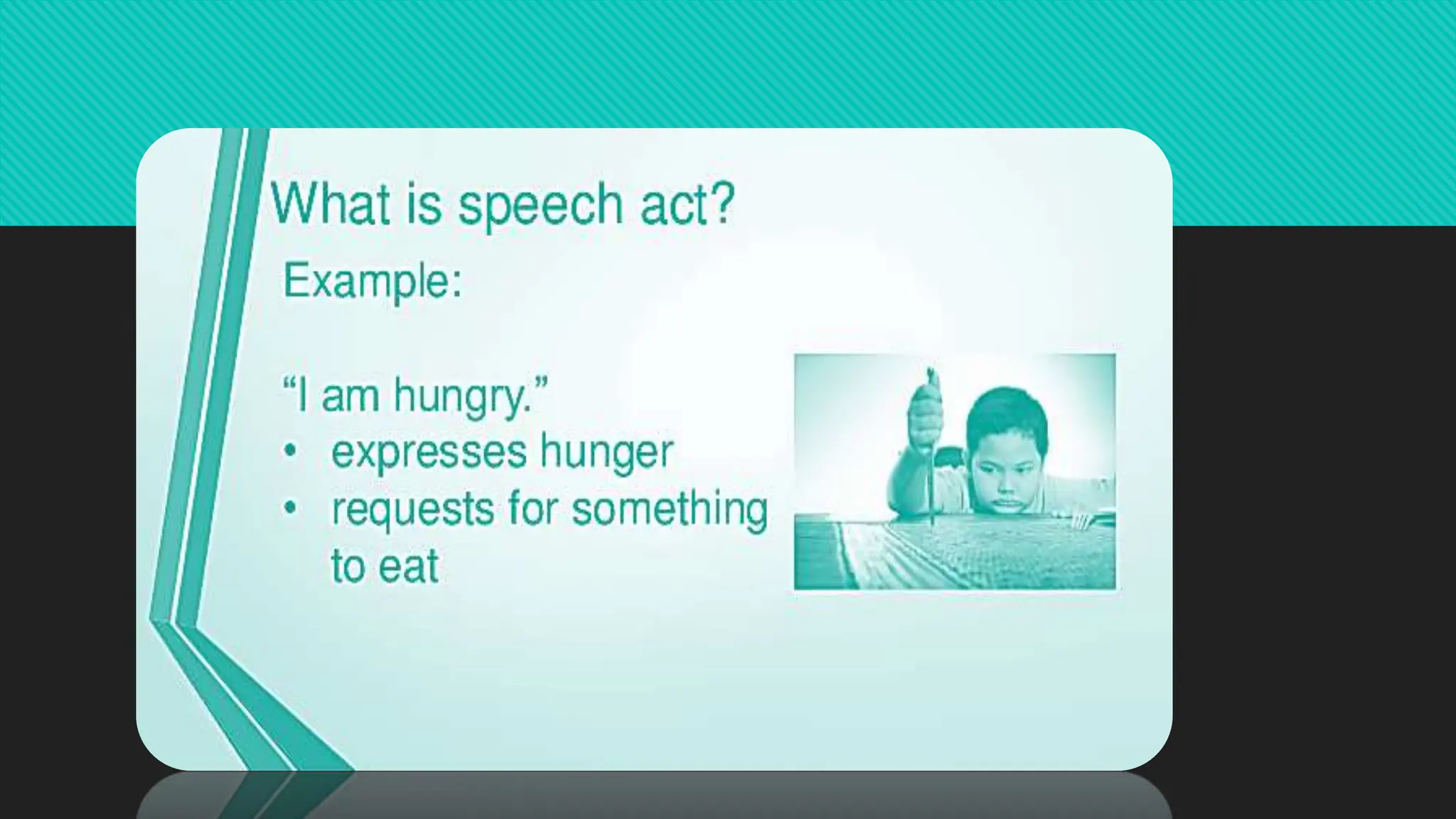
 A speech act is an utterance that a speaker makes to
achieve an intended effect.
 It is the speaker’s utterances that convey meaning and
make listeners do specific things.
 Its functions are to offer an apology, greeting, request,
complaint, invitation, compliment or refusal.
 It may contain just one word or several words or
sentences.
Indirect Speech Act
 Happens when the utterance has no direct connection with
the intended meaning
 Examples:
“Can you check the cabinet for my phone?” - indirectly
asks the listener to check the cabinet.
“Can you pass the wine?” – you are not asking if the
person has the ability to pass the wine, but you want the
wine or you want that person to pass the wine.
Three Types of Speech Acts
Locutionary Act is the actual act of uttering. A locutionary speech act
occurs when the speaker performs an utterance (locution), which has
a meaning in the traditional sense.
Examples:
• “Please do the dishes.”
• “Can you please hand me my pen?”
Three Types of Speech Acts
 Illocutionary act is the social function of what is said. It is not just saying
something itself, but the act of saying something with the intention of:
 stating an opinion, confirming, or denying something;
 making a prediction, a promise, a request;
 issuing an order or a decision; or
 giving an advice or permission.
Examples:
• By uttering the locution “Please do the dishes,” the speaker requests the addressee to wash the
dishes.
• By saying “Can you please hand me my pen”?, though it is in interrogative , is an imperative – a
request to hand over the pen.
Three Types of Speech Acts
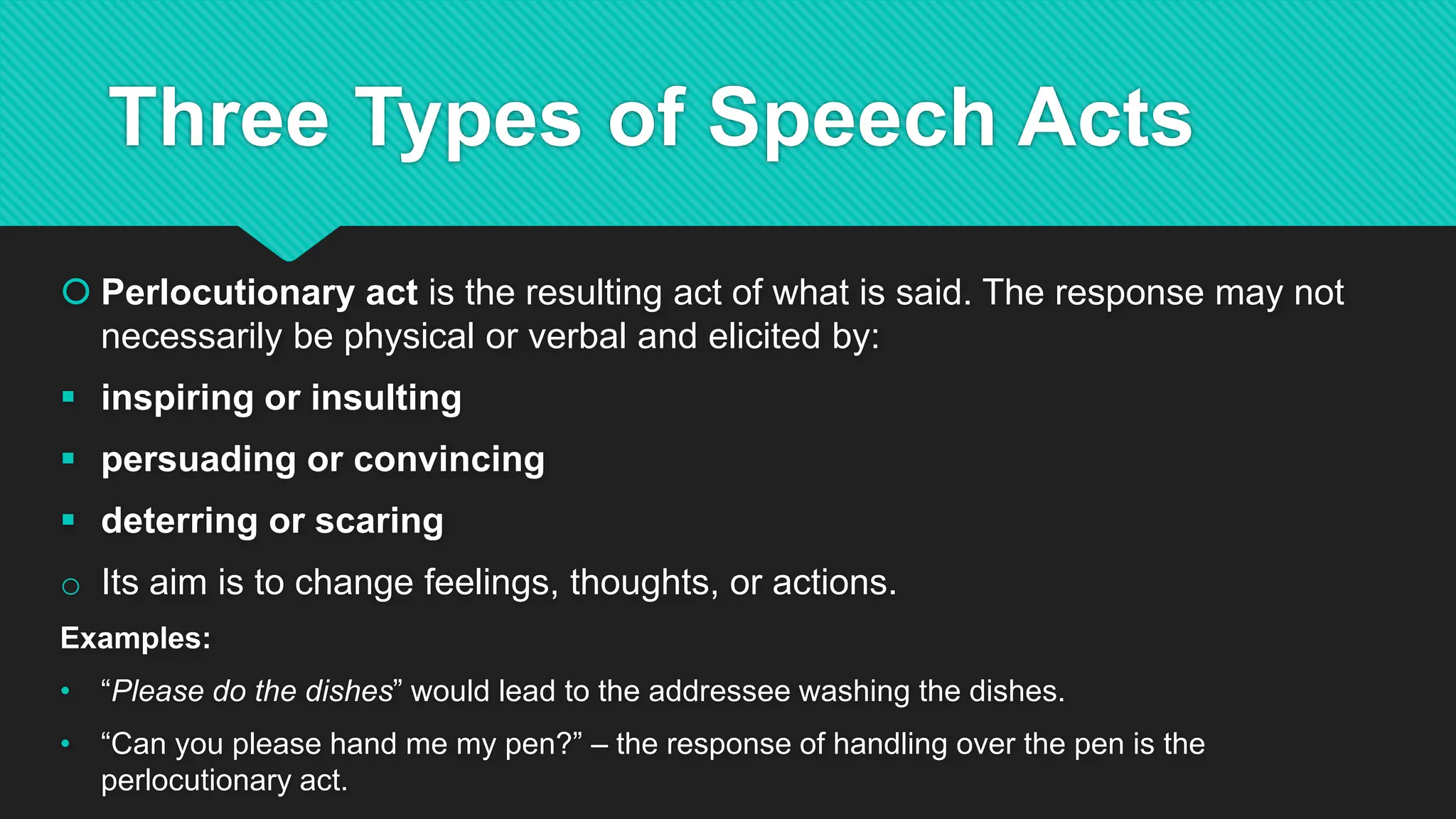
 Perlocutionary act is the resulting act of what is said. The response may not
necessarily be physical or verbal and elicited by:
 inspiring or insulting
 persuading or convincing
 deterring or scaring
o Its aim is to change feelings, thoughts, or actions.
Examples:
• “Please do the dishes” would lead to the addressee washing the dishes.
• “Can you please hand me my pen?” – the response of handling over the pen is the
perlocutionary act.
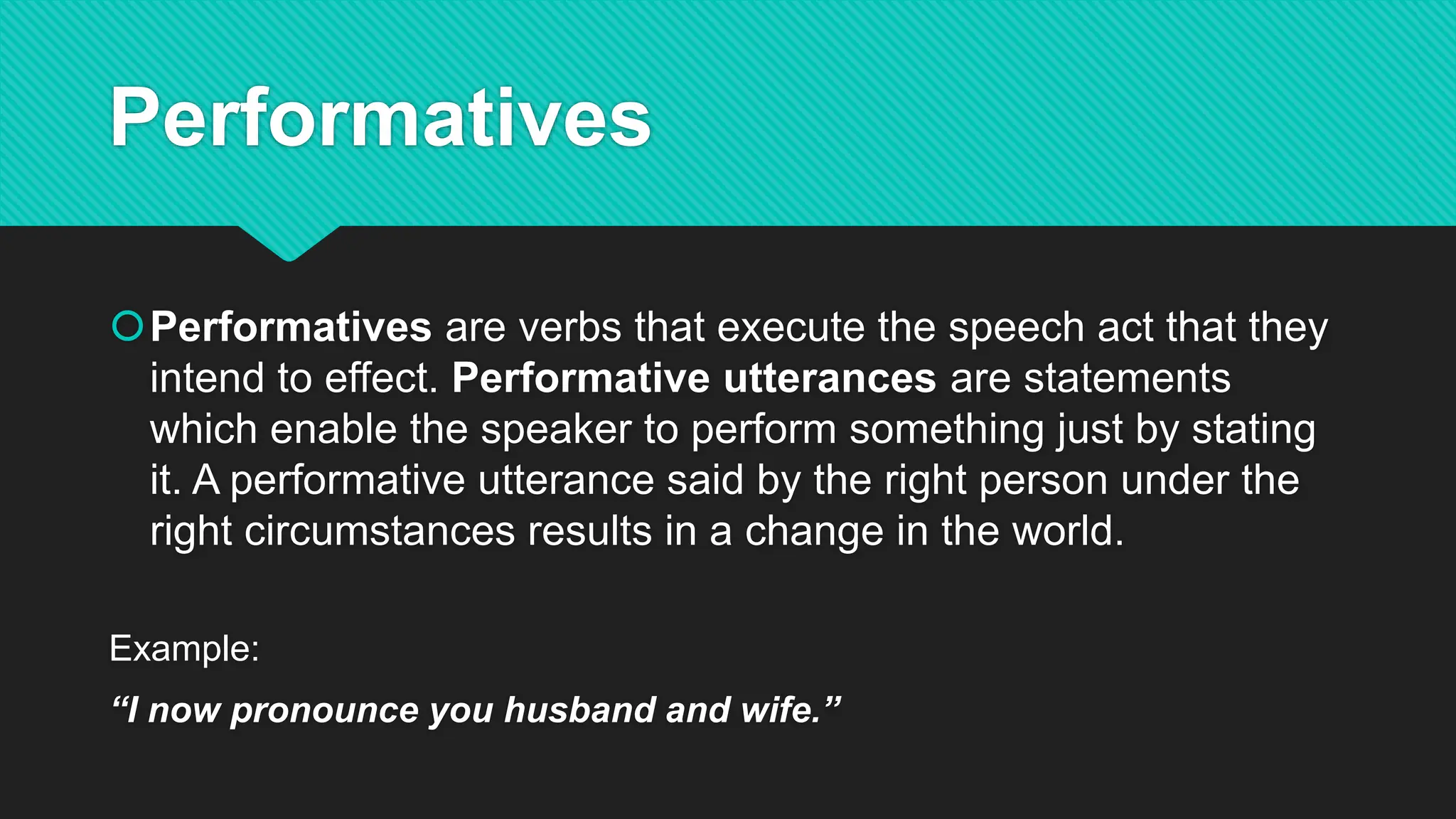
Performatives
Performatives are verbs that execute the speech act that they
intend to effect. Performative utterances are statements
which enable the speaker to perform something just by stating
it. A performative utterance said by the right person under the
right circumstances results in a change in the world.
Example:
“I now pronounce you husband and wife.”
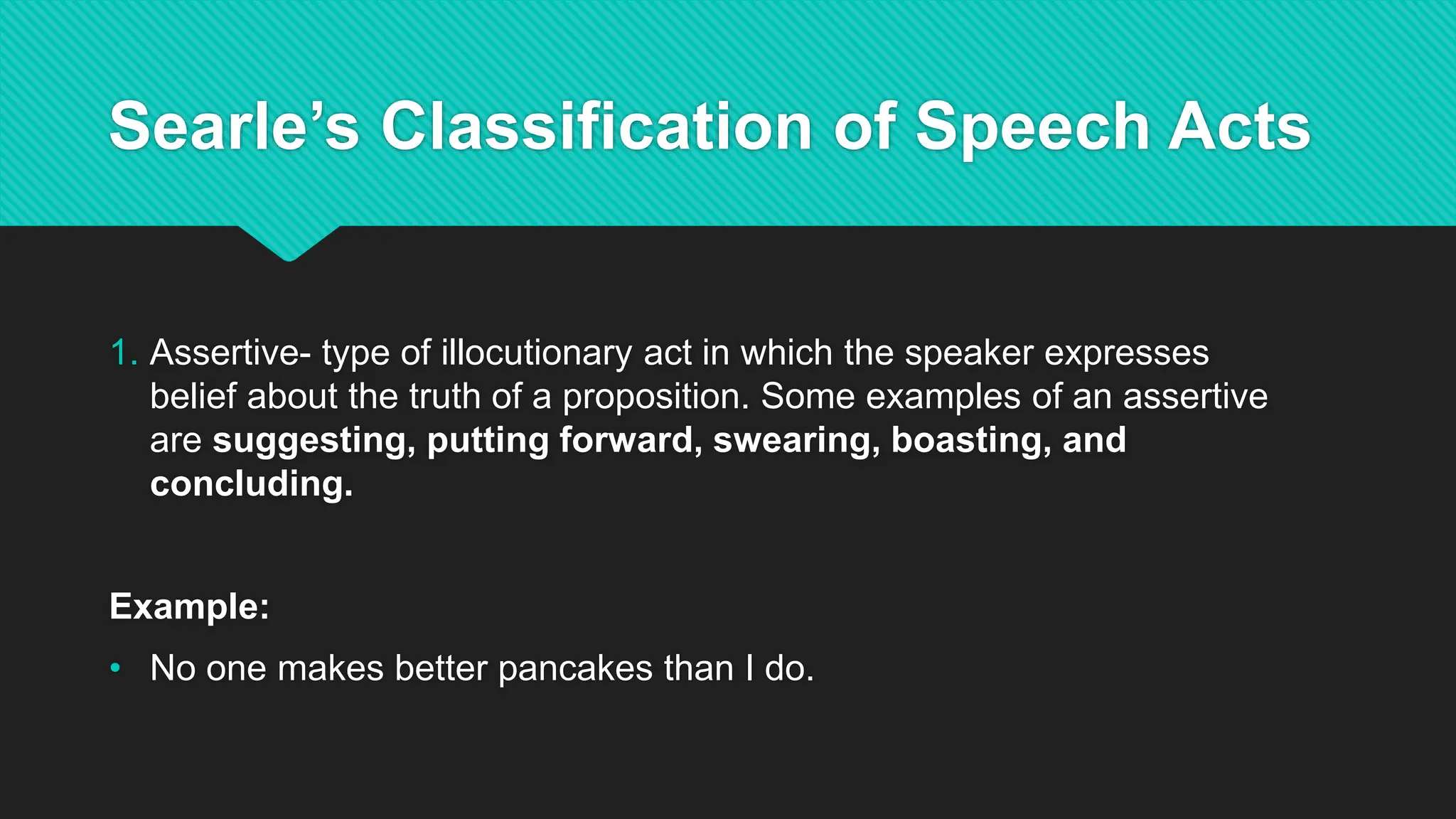
Searle’s Classification of Speech Acts
1. Assertive- type of illocutionary act in which the speaker expresses
belief about the truth of a proposition. Some examples of an assertive
are suggesting, putting forward, swearing, boasting, and
concluding.
Example:
• No one makes better pancakes than I do.
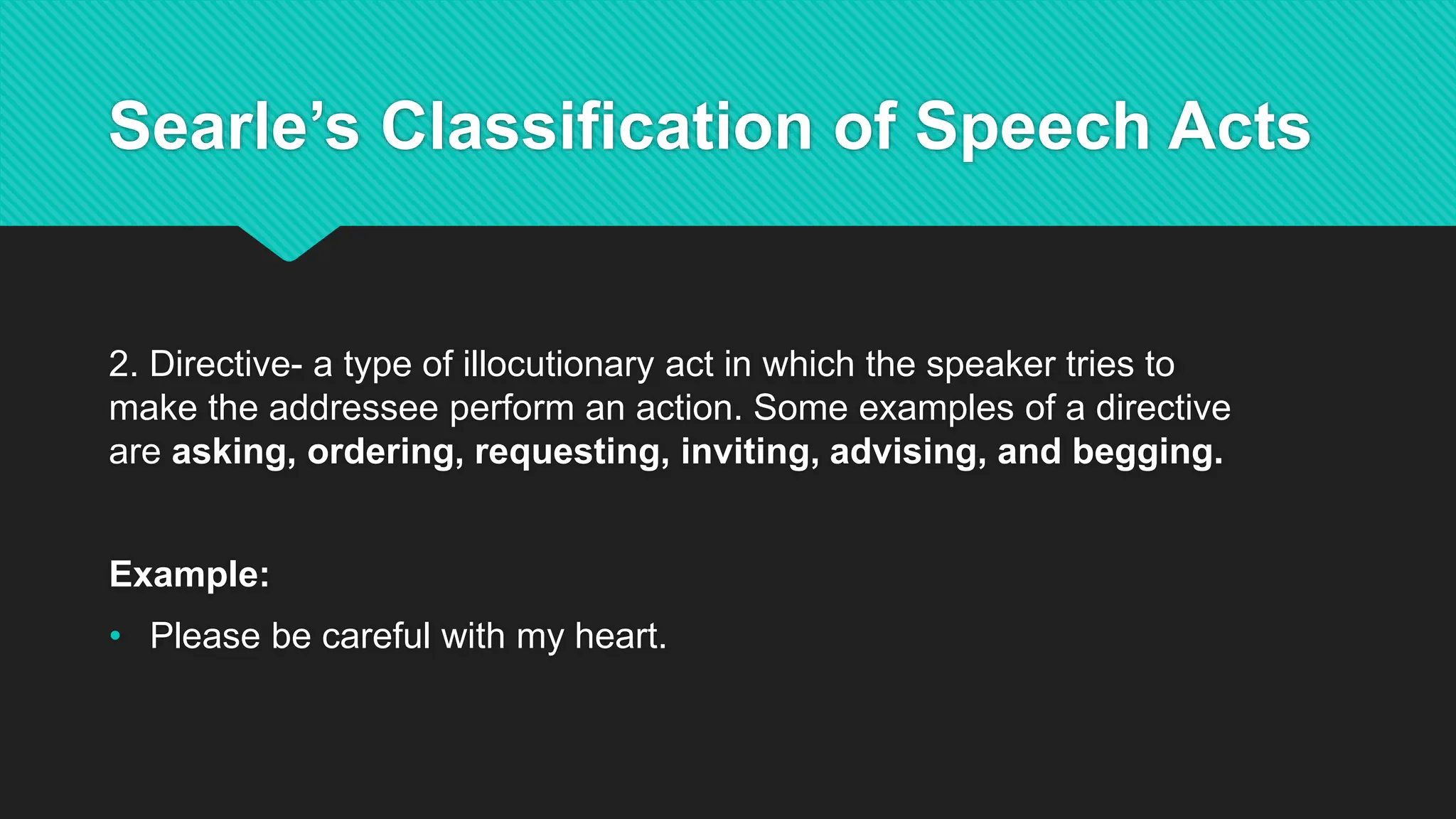
Searle’s Classification of Speech Acts
2. Directive- a type of illocutionary act in which the speaker tries to
make the addressee perform an action. Some examples of a directive
are asking, ordering, requesting, inviting, advising, and begging.
Example:
• Please be careful with my heart.
Searle’s Classification of Speech Acts
3. Commissive- a type of illocutionary act which commits the speaker to
doing something in the future. Examples of commissive are promising,
planning, vowing, and betting.
Example:
• From now on, I will participate in our group activity.
Searle’s Classification of Speech Acts
4. Expressive- a type of illocutionary act in which the speaker expresses
his/her feelings or emotional reactions. Some examples of an expressive
are thanking, apologizing, welcoming, deploring.
Example:
• I am so sorry for not helping out in our group projects and letting you do
all the work.
Searle’s Classification of Speech Acts
5. Declaration- a type of illocutionary act which brings a change in the
external situation. Some examples of declaration are blessing, firing,
baptizing, bidding, passing a sentence, and excommunicating.
Example:
• You are fired!
By saying that someone is fired, an employer causes or brings about the
person’s unemployment, thus changing his external situation.

LESSON- 4- Types- of - Speech- Acts.pptx

  • 1.
  • 2.
    Learning Targets  Ican define speech acts.  I can distinguish types of speech acts.  I can recognize that communicative competence requires understanding of speech acts.  I can demonstrate effective use of communicative strategy in various speech situations.
  • 4.
    Speech Act  Aspeech act is an utterance that a speaker makes to achieve an intended effect.  It is the speaker’s utterances that convey meaning and make listeners do specific things.  Its functions are to offer an apology, greeting, request, complaint, invitation, compliment or refusal.  It may contain just one word or several words or sentences.
  • 6.
    Indirect Speech Act Happens when the utterance has no direct connection with the intended meaning  Examples: “Can you check the cabinet for my phone?” - indirectly asks the listener to check the cabinet. “Can you pass the wine?” – you are not asking if the person has the ability to pass the wine, but you want the wine or you want that person to pass the wine.
  • 7.
    Three Types ofSpeech Acts Locutionary Act is the actual act of uttering. A locutionary speech act occurs when the speaker performs an utterance (locution), which has a meaning in the traditional sense. Examples: • “Please do the dishes.” • “Can you please hand me my pen?”
  • 8.
    Three Types ofSpeech Acts  Illocutionary act is the social function of what is said. It is not just saying something itself, but the act of saying something with the intention of:  stating an opinion, confirming, or denying something;  making a prediction, a promise, a request;  issuing an order or a decision; or  giving an advice or permission. Examples: • By uttering the locution “Please do the dishes,” the speaker requests the addressee to wash the dishes. • By saying “Can you please hand me my pen”?, though it is in interrogative , is an imperative – a request to hand over the pen.
  • 9.
    Three Types ofSpeech Acts  Perlocutionary act is the resulting act of what is said. The response may not necessarily be physical or verbal and elicited by:  inspiring or insulting  persuading or convincing  deterring or scaring o Its aim is to change feelings, thoughts, or actions. Examples: • “Please do the dishes” would lead to the addressee washing the dishes. • “Can you please hand me my pen?” – the response of handling over the pen is the perlocutionary act.
  • 10.
    Performatives Performatives are verbsthat execute the speech act that they intend to effect. Performative utterances are statements which enable the speaker to perform something just by stating it. A performative utterance said by the right person under the right circumstances results in a change in the world. Example: “I now pronounce you husband and wife.”
  • 11.
    Searle’s Classification ofSpeech Acts 1. Assertive- type of illocutionary act in which the speaker expresses belief about the truth of a proposition. Some examples of an assertive are suggesting, putting forward, swearing, boasting, and concluding. Example: • No one makes better pancakes than I do.
  • 12.
    Searle’s Classification ofSpeech Acts 2. Directive- a type of illocutionary act in which the speaker tries to make the addressee perform an action. Some examples of a directive are asking, ordering, requesting, inviting, advising, and begging. Example: • Please be careful with my heart.
  • 13.
    Searle’s Classification ofSpeech Acts 3. Commissive- a type of illocutionary act which commits the speaker to doing something in the future. Examples of commissive are promising, planning, vowing, and betting. Example: • From now on, I will participate in our group activity.
  • 14.
    Searle’s Classification ofSpeech Acts 4. Expressive- a type of illocutionary act in which the speaker expresses his/her feelings or emotional reactions. Some examples of an expressive are thanking, apologizing, welcoming, deploring. Example: • I am so sorry for not helping out in our group projects and letting you do all the work.
  • 15.
    Searle’s Classification ofSpeech Acts 5. Declaration- a type of illocutionary act which brings a change in the external situation. Some examples of declaration are blessing, firing, baptizing, bidding, passing a sentence, and excommunicating. Example: • You are fired! By saying that someone is fired, an employer causes or brings about the person’s unemployment, thus changing his external situation.

Editor's Notes

  • #5 For example, you asked your classmate to wait for you. Another is when your friend did you a favor, and you will thank him/her.
  • #6 For example,
  • #7 “Do you know if he/she got a 100 on the recent exam?” - indirectly asks the listener what someone’s grade is.
  • #11 Austin also introduced the concept of performative utterances: statements which enable the speaker to perform something just by stating it. In this manner, verbs that execute the speech act that they intend to effect are called performatives. A performative utterance said by the right person under the right circumstances results in a change in the world. Note that certain conditions have to be met when making a performative utterance. For example, the phrase “I now pronounce you husband and wife,” when uttered by an authorized person such as a judge will have the actual effect of binding a couple in marriage. However, if the same statement is uttered to the same couple in the same place by someone who is not authorized to marry them—as in the case of the accompanying picture, a robot—then there is no effect whatsoever because a condition was not met.
  • #12 As a response to Austin’s Speech Act Theory, John Searle (1976), a professor from the University of California, Berkeley, classified illocutionary acts into five distinct categories.