Process Control:
Sample Management
Sample Management-Module 5 2
Learning Objectives
At the end of this activity, participants will be able
to:
 name sample collection errors that could lead to incorrect
laboratory examination results;
 list contents that should be included in a handbook designed
for people who collect samples off-site;
 provide a rationale for rejecting unsatisfactory samples;
 describe a system for sample handling, including collection,
transport, storage, and disposal;
 explain the importance of maintaining sample integrity and
assuring that all regulations and requirements are met when
transporting samples.
Sample Management-Module 5 3
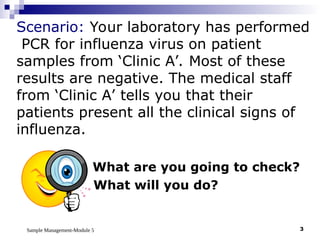
What are you going to check?
What will you do?
Scenario: Your laboratory has performed
PCR for influenza virus on patient
samples from ‘Clinic A’. Most of these
results are negative. The medical staff
from ‘Clinic A’ tells you that their
patients present all the clinical signs of
influenza.
Sample Management-Module 5 4
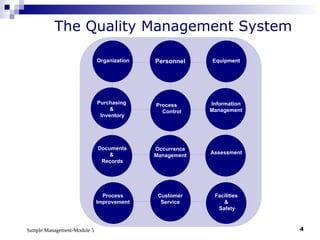
The Quality Management System
Organization Personnel Equipment
Purchasing
&
Inventory
Process
Control
Information
Management
Documents
&
Records
Occurrence
Management
Assessment
Process
Improvement
Customer
Service
Facilities
&
Safety
Sample Management-Module 5 5
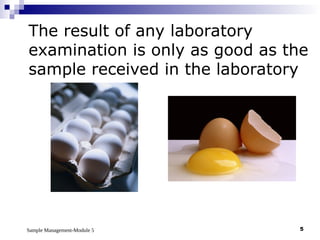
The result of any laboratory
examination is only as good as the
sample received in the laboratory
Sample Management-Module 5 6
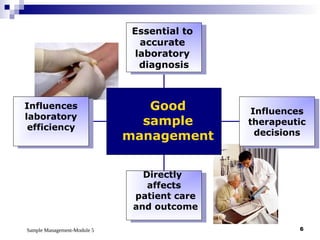
Influences
laboratory
efficiency
Directly
affects
patient care
and outcome
Influences
therapeutic
decisions
Essential to
accurate
laboratory
diagnosis
Good
sample
management
Good
sample
management
Sample Management-Module 5 7
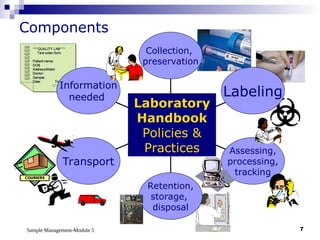
Components
Information
needed
Transport
Retention,
storage,
disposal
Assessing,
processing,
tracking
Labeling
Collection,
preservation
Laboratory
Handbook
Policies &
Practices
Sample Management-Module 5 8
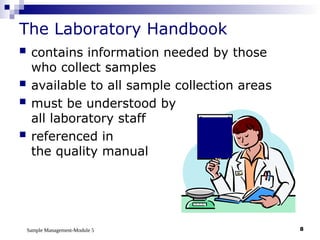
The Laboratory Handbook
 contains information needed by those
who collect samples
 available to all sample collection areas
 must be understood by
all laboratory staff
 referenced in
the quality manual
Sample Management-Module 5 9
Laboratory Handbook Contents
 name and address of laboratory
 contact names and telephone numbers
 hours of operation
 list of tests that can be ordered
 sample collection procedures
 sample transport procedures
 expected turn around times (TAT)
 how urgent requests are handled
Sample Management-Module 5 10
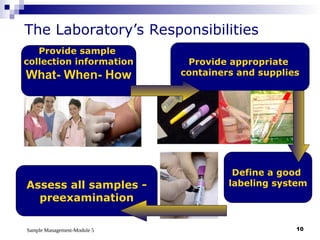
Define a good
labeling system
Assess all samples -
preexamination
Provide sample
collection information
What- When- How
The Laboratory’s Responsibilities
Provide appropriate
containers and supplies
Sample Management-Module 5 11
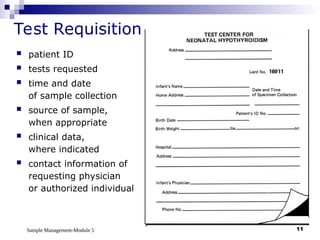
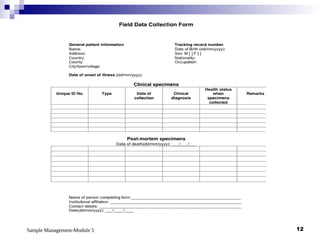
Test Requisition
 patient ID
 tests requested
 time and date
of sample collection
 source of sample,
when appropriate
 clinical data,
where indicated
 contact information of
requesting physician
or authorized individual
Sample Management-Module 5 12
Sample Management-Module 5 13
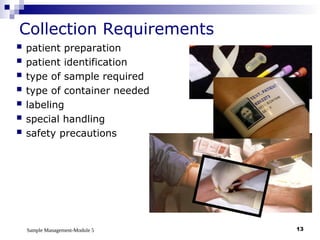
Collection Requirements
 patient preparation
 patient identification
 type of sample required
 type of container needed
 labeling
 special handling
 safety precautions
Sample Management-Module 5 14
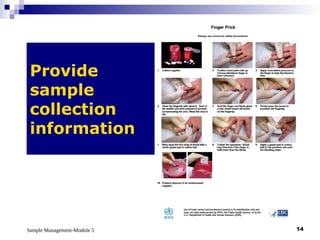
Provide
sample
collection
information
Sample Management-Module 5 15
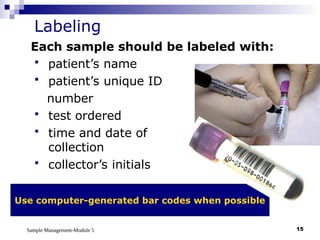
Labeling
Each sample should be labeled with:
 patient’s name
 patient’s unique ID
number
 test ordered
 time and date of
collection
 collector’s initials
Use computer-generated bar codes when possible
Sample Management-Module 5 16
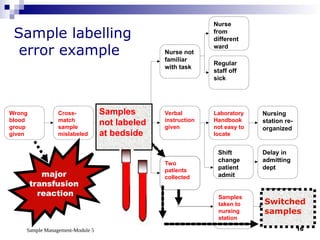
Wrong
blood
group
given
Cross-
match
sample
mislabeled
Shift
change
patient
admit
Nurse not
familiar
with task
Nurse
from
different
ward
Verbal
instruction
given
Laboratory
Handbook
not easy to
locate
Regular
staff off
sick
Delay in
admitting
dept
Nursing
station re-
organized
Samples
taken to
nursing
station
Two
patients
collected
major
transfusion
reaction
Samples
not labeled
at bedside
Switched
samples
Sample labelling
error example
Sample Management-Module 5 17
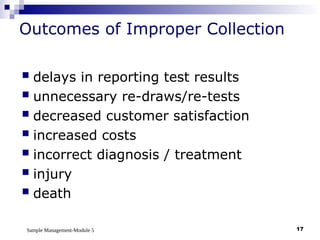
Outcomes of Improper Collection
 delays in reporting test results
 unnecessary re-draws/re-tests
 decreased customer satisfaction
 increased costs
 incorrect diagnosis / treatment
 injury
 death
Sample Management-Module 5 18
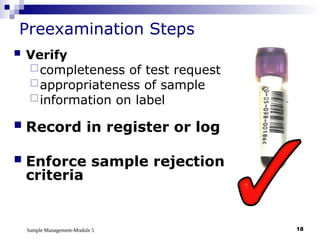
Preexamination Steps
 Verify
completeness of test request
appropriateness of sample
information on label
 Record in register or log
 Enforce sample rejection
criteria
Sample Management-Module 5 19
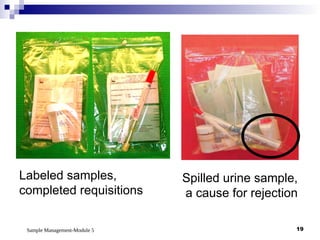
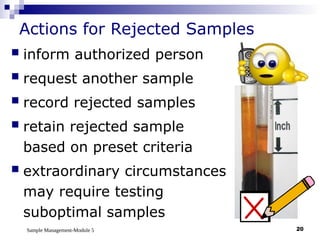
Spilled urine sample,
a cause for rejection
Labeled samples,
completed requisitions
Sample Management-Module 5 20
Actions for Rejected Samples
 inform authorized person
 request another sample
 record rejected samples
 retain rejected sample
based on preset criteria
 extraordinary circumstances
may require testing
suboptimal samples
Sample Management-Module 5 21
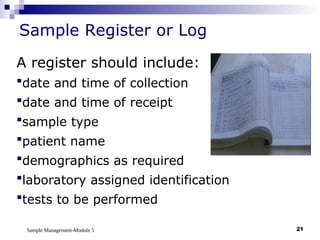
Sample Register or Log
A register should include:
date and time of collection
date and time of receipt
sample type
patient name
demographics as required
laboratory assigned identification
tests to be performed
Sample Management-Module 5 22
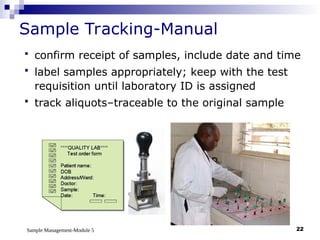
Sample Tracking-Manual
 confirm receipt of samples, include date and time
 label samples appropriately; keep with the test
requisition until laboratory ID is assigned
 track aliquots–traceable to the original sample
Sample Management-Module 5 23
Sample Tracking-Computer
Database entries include:
 identification number
 patient information
 collection date and time
 type of sample
 tests to be performed
 name of health care provider
 location of patient, e.g., ward, clinic, outpatient
 diagnostic test results
 time and date results are reported
Sample Management-Module 5 24
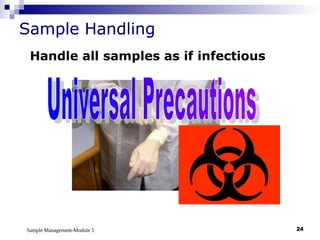
Sample Handling
Handle all samples as if infectious
Sample Handling
Sample Management-Module 5 25
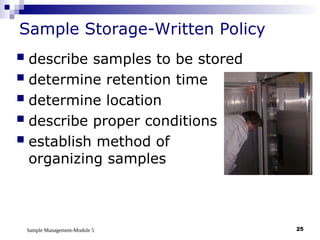
Sample Storage-Written Policy
 describe samples to be stored
 determine retention time
 determine location
 describe proper conditions
 establish method of
organizing samples
Sample Management-Module 5 26
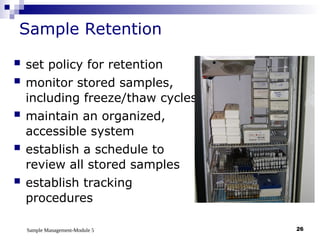
Sample Retention
 set policy for retention
 monitor stored samples,
including freeze/thaw cycles
 maintain an organized,
accessible system
 establish a schedule to
review all stored samples
 establish tracking
procedures
Sample Management-Module 5 27
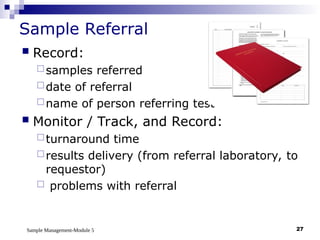
Sample Referral
 Record:
samples referred
date of referral
name of person referring test
 Monitor / Track, and Record:
turnaround time
results delivery (from referral laboratory, to
requestor)
 problems with referral
Sample Management-Module 5 28
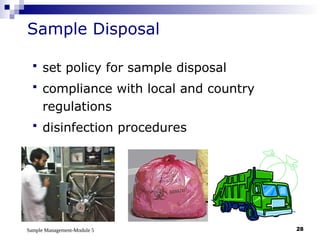
Sample Disposal
 set policy for sample disposal
 compliance with local and country
regulations
 disinfection procedures
Sample Management-Module 5 29
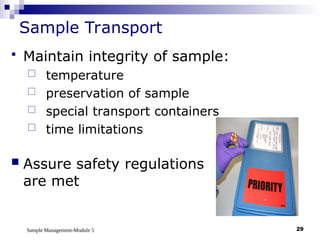
Sample Transport
 Maintain integrity of sample:
 temperature
 preservation of sample
 special transport containers
 time limitations
 Assure safety regulations
are met
Sample Management-Module 5 30
Transport Regulations
Where do they come from?
Who develops them?
 National transport regulations
 ICAO/IATA transport regulations (air)
 rail, road, and sea traffic agencies
 postal services
 private couriers
Sample Management-Module 5 31
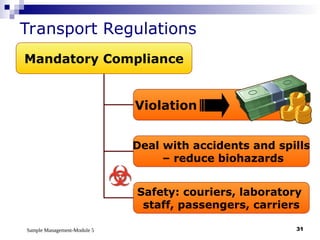
Transport Regulations
Mandatory Compliance
Violation
Deal with accidents and spills
– reduce biohazards
Safety: couriers, laboratory
staff, passengers, carriers
Sample Management-Module 5 32
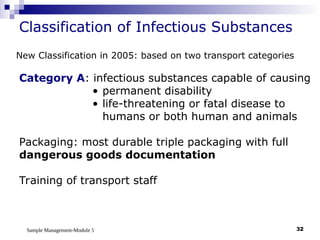
Classification of Infectious Substances
New Classification in 2005: based on two transport categories
Category A: infectious substances capable of causing
• permanent disability
• life-threatening or fatal disease to
humans or both human and animals
Packaging: most durable triple packaging with full
dangerous goods documentation
Training of transport staff
Sample Management-Module 5 33
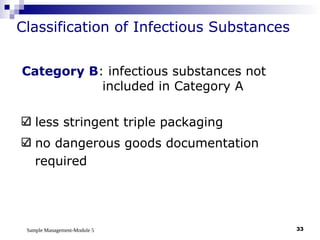
Classification of Infectious Substances
Category B: infectious substances not
included in Category A
less stringent triple packaging
no dangerous goods documentation
required
Sample Management-Module 5 34
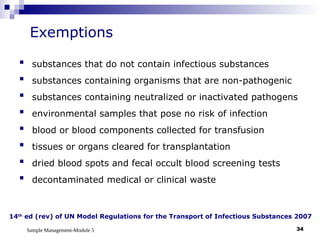
14th
ed (rev) of UN Model Regulations for the Transport of Infectious Substances 2007
Exemptions
 substances that do not contain infectious substances
 substances containing organisms that are non-pathogenic
 substances containing neutralized or inactivated pathogens
 environmental samples that pose no risk of infection
 blood or blood components collected for transfusion
 tissues or organs cleared for transplantation
 dried blood spots and fecal occult blood screening tests
 decontaminated medical or clinical waste
Sample Management-Module 5 35
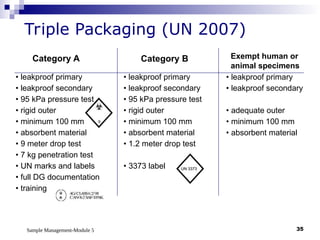
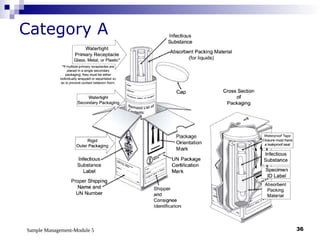
Triple Packaging (UN 2007)
• leakproof primary
• leakproof secondary
• 95 kPa pressure test
• rigid outer
• minimum 100 mm
• absorbent material
• 9 meter drop test
• 7 kg penetration test
• UN marks and labels
• full DG documentation
• training
• leakproof primary
• leakproof secondary
• 95 kPa pressure test
• rigid outer
• minimum 100 mm
• absorbent material
• 1.2 meter drop test
• 3373 label
Category A Category B
UN 3373
UN 3373
6
Exempt human or
animal specimens
• leakproof primary
• leakproof secondary
• adequate outer
• minimum 100 mm
• absorbent material
Sample Management-Module 5 36
Category A
Sample Management-Module 5 37
Managing Sample Transport
 meet all applicable regulations
 train personnel in all transport procedures
 assure sample is protected:
 temperature
 transport time
 packaging and preservation
Sample Management-Module 5 38
Summary
 provide a laboratory handbook with collection
information to all users
 have a system for tracking samples as they move
through the laboratory
 establish and implement a policy for sample storage
and sample disposal
 maintain sample integrity
 assure that all transport regulations and requirements
are met
Always follow universal precautions
Sample Management-Module 5 39
Key Messages
 the laboratory must have good
samples in order to ensure accuracy
and reliability of testing and
confidence in results
 sample management directly affects
patient care and outcome
Sample Management-Module 5 40
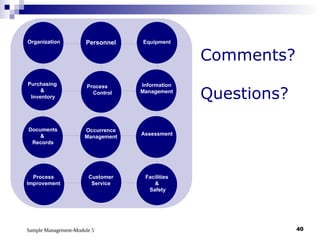
Comments?
Questions?
Organization Personnel Equipment
Purchasing
&
Inventory
Process
Control
Information
Management
Documents
&
Records
Occurrence
Management
Assessment
Process
Improvement
Customer
Service
Facilities
&
Safety

5_e_sample_management_0.ppt Presentation

  • 1.
  • 2.
    Sample Management-Module 52 Learning Objectives At the end of this activity, participants will be able to:  name sample collection errors that could lead to incorrect laboratory examination results;  list contents that should be included in a handbook designed for people who collect samples off-site;  provide a rationale for rejecting unsatisfactory samples;  describe a system for sample handling, including collection, transport, storage, and disposal;  explain the importance of maintaining sample integrity and assuring that all regulations and requirements are met when transporting samples.
  • 3.
    Sample Management-Module 53 What are you going to check? What will you do? Scenario: Your laboratory has performed PCR for influenza virus on patient samples from ‘Clinic A’. Most of these results are negative. The medical staff from ‘Clinic A’ tells you that their patients present all the clinical signs of influenza.
  • 4.
    Sample Management-Module 54 The Quality Management System Organization Personnel Equipment Purchasing & Inventory Process Control Information Management Documents & Records Occurrence Management Assessment Process Improvement Customer Service Facilities & Safety
  • 5.
    Sample Management-Module 55 The result of any laboratory examination is only as good as the sample received in the laboratory
  • 6.
    Sample Management-Module 56 Influences laboratory efficiency Directly affects patient care and outcome Influences therapeutic decisions Essential to accurate laboratory diagnosis Good sample management Good sample management
  • 7.
    Sample Management-Module 57 Components Information needed Transport Retention, storage, disposal Assessing, processing, tracking Labeling Collection, preservation Laboratory Handbook Policies & Practices
  • 8.
    Sample Management-Module 58 The Laboratory Handbook  contains information needed by those who collect samples  available to all sample collection areas  must be understood by all laboratory staff  referenced in the quality manual
  • 9.
    Sample Management-Module 59 Laboratory Handbook Contents  name and address of laboratory  contact names and telephone numbers  hours of operation  list of tests that can be ordered  sample collection procedures  sample transport procedures  expected turn around times (TAT)  how urgent requests are handled
  • 10.
    Sample Management-Module 510 Define a good labeling system Assess all samples - preexamination Provide sample collection information What- When- How The Laboratory’s Responsibilities Provide appropriate containers and supplies
  • 11.
    Sample Management-Module 511 Test Requisition  patient ID  tests requested  time and date of sample collection  source of sample, when appropriate  clinical data, where indicated  contact information of requesting physician or authorized individual
  • 12.
  • 13.
    Sample Management-Module 513 Collection Requirements  patient preparation  patient identification  type of sample required  type of container needed  labeling  special handling  safety precautions
  • 14.
    Sample Management-Module 514 Provide sample collection information
  • 15.
    Sample Management-Module 515 Labeling Each sample should be labeled with:  patient’s name  patient’s unique ID number  test ordered  time and date of collection  collector’s initials Use computer-generated bar codes when possible
  • 16.
    Sample Management-Module 516 Wrong blood group given Cross- match sample mislabeled Shift change patient admit Nurse not familiar with task Nurse from different ward Verbal instruction given Laboratory Handbook not easy to locate Regular staff off sick Delay in admitting dept Nursing station re- organized Samples taken to nursing station Two patients collected major transfusion reaction Samples not labeled at bedside Switched samples Sample labelling error example
  • 17.
    Sample Management-Module 517 Outcomes of Improper Collection  delays in reporting test results  unnecessary re-draws/re-tests  decreased customer satisfaction  increased costs  incorrect diagnosis / treatment  injury  death
  • 18.
    Sample Management-Module 518 Preexamination Steps  Verify completeness of test request appropriateness of sample information on label  Record in register or log  Enforce sample rejection criteria
  • 19.
    Sample Management-Module 519 Spilled urine sample, a cause for rejection Labeled samples, completed requisitions
  • 20.
    Sample Management-Module 520 Actions for Rejected Samples  inform authorized person  request another sample  record rejected samples  retain rejected sample based on preset criteria  extraordinary circumstances may require testing suboptimal samples
  • 21.
    Sample Management-Module 521 Sample Register or Log A register should include: date and time of collection date and time of receipt sample type patient name demographics as required laboratory assigned identification tests to be performed
  • 22.
    Sample Management-Module 522 Sample Tracking-Manual  confirm receipt of samples, include date and time  label samples appropriately; keep with the test requisition until laboratory ID is assigned  track aliquots–traceable to the original sample
  • 23.
    Sample Management-Module 523 Sample Tracking-Computer Database entries include:  identification number  patient information  collection date and time  type of sample  tests to be performed  name of health care provider  location of patient, e.g., ward, clinic, outpatient  diagnostic test results  time and date results are reported
  • 24.
    Sample Management-Module 524 Sample Handling Handle all samples as if infectious Sample Handling
  • 25.
    Sample Management-Module 525 Sample Storage-Written Policy  describe samples to be stored  determine retention time  determine location  describe proper conditions  establish method of organizing samples
  • 26.
    Sample Management-Module 526 Sample Retention  set policy for retention  monitor stored samples, including freeze/thaw cycles  maintain an organized, accessible system  establish a schedule to review all stored samples  establish tracking procedures
  • 27.
    Sample Management-Module 527 Sample Referral  Record: samples referred date of referral name of person referring test  Monitor / Track, and Record: turnaround time results delivery (from referral laboratory, to requestor)  problems with referral
  • 28.
    Sample Management-Module 528 Sample Disposal  set policy for sample disposal  compliance with local and country regulations  disinfection procedures
  • 29.
    Sample Management-Module 529 Sample Transport  Maintain integrity of sample:  temperature  preservation of sample  special transport containers  time limitations  Assure safety regulations are met
  • 30.
    Sample Management-Module 530 Transport Regulations Where do they come from? Who develops them?  National transport regulations  ICAO/IATA transport regulations (air)  rail, road, and sea traffic agencies  postal services  private couriers
  • 31.
    Sample Management-Module 531 Transport Regulations Mandatory Compliance Violation Deal with accidents and spills – reduce biohazards Safety: couriers, laboratory staff, passengers, carriers
  • 32.
    Sample Management-Module 532 Classification of Infectious Substances New Classification in 2005: based on two transport categories Category A: infectious substances capable of causing • permanent disability • life-threatening or fatal disease to humans or both human and animals Packaging: most durable triple packaging with full dangerous goods documentation Training of transport staff
  • 33.
    Sample Management-Module 533 Classification of Infectious Substances Category B: infectious substances not included in Category A less stringent triple packaging no dangerous goods documentation required
  • 34.
    Sample Management-Module 534 14th ed (rev) of UN Model Regulations for the Transport of Infectious Substances 2007 Exemptions  substances that do not contain infectious substances  substances containing organisms that are non-pathogenic  substances containing neutralized or inactivated pathogens  environmental samples that pose no risk of infection  blood or blood components collected for transfusion  tissues or organs cleared for transplantation  dried blood spots and fecal occult blood screening tests  decontaminated medical or clinical waste
  • 35.
    Sample Management-Module 535 Triple Packaging (UN 2007) • leakproof primary • leakproof secondary • 95 kPa pressure test • rigid outer • minimum 100 mm • absorbent material • 9 meter drop test • 7 kg penetration test • UN marks and labels • full DG documentation • training • leakproof primary • leakproof secondary • 95 kPa pressure test • rigid outer • minimum 100 mm • absorbent material • 1.2 meter drop test • 3373 label Category A Category B UN 3373 UN 3373 6 Exempt human or animal specimens • leakproof primary • leakproof secondary • adequate outer • minimum 100 mm • absorbent material
  • 36.
  • 37.
    Sample Management-Module 537 Managing Sample Transport  meet all applicable regulations  train personnel in all transport procedures  assure sample is protected:  temperature  transport time  packaging and preservation
  • 38.
    Sample Management-Module 538 Summary  provide a laboratory handbook with collection information to all users  have a system for tracking samples as they move through the laboratory  establish and implement a policy for sample storage and sample disposal  maintain sample integrity  assure that all transport regulations and requirements are met Always follow universal precautions
  • 39.
    Sample Management-Module 539 Key Messages  the laboratory must have good samples in order to ensure accuracy and reliability of testing and confidence in results  sample management directly affects patient care and outcome
  • 40.
    Sample Management-Module 540 Comments? Questions? Organization Personnel Equipment Purchasing & Inventory Process Control Information Management Documents & Records Occurrence Management Assessment Process Improvement Customer Service Facilities & Safety