COLLECTION, TRANSPORTATION, PREPARATION,
PROCESSING, AND STORAGE OF LABORATORY SAMPLES
FOR THE DIAGNOSIS AND MONITORING OF DISEASES
A SEMINAR PREPARED
BY
LAWAL, BELLO DANCHADI
ADM NO: 22210705001
DEPARTMENT OF CHEMICAL PATHOLOGY AND IMMUNOLOGY
USMANU DANFODIYO UNIVERSITY, SOKOTO
FEBRUARY, 2023
Sample
• Is a small quantity of substances taken from a patient or brought to
laboratory for clinical analysis or examination, (Malami, 2005).
Examples of laboratory samples
• Some examples of samples/specimens includes
• Blood • Semen. • Gastric juice
• Urine • Feces • Sweat
• Saliva • Pleural fluids • Synovial fluid
• CSF and many other body fluids
Collection of samples
• Is the process or act designed in receiving specimens for laboratory
analysis, (Campbell J.D. et al., 2008)
Sample collection requirements
1. patient preparation
2. Patient identification
3. Type of sample required
4. Type of Container
5. Sample labelling
6. Special handling
Potential outcomes of collection errors
Proper sample collection is an important element for good laboratory practice.
Improper collection of samples can lead to poor outcomes, such as:
• Delays in reporting test results • Unnecessary re-draws/re-tests
• Decreased customer satisfaction • Increased costs
• Incorrect diagnosis / treatment • Injury • Death.
Objectives of samples collection
• Research purposes,
• Diagnosis diseases,
• Treatment and management of diseases,
Methods of sample collection
• There are different methods of collecting samples depending on the nature and
the types of the samples, some examples are:
1. Blood sample
Methods of blood collection
• Venipuncture method
• syringe and needle, tourniquet, methylated spirit, cotton wool, specimen container,
• Capillary method( Fingerprint puncture) require the use of plain or heparinized
tube.
2. Urine
• A fluid excreted by the kidney through the urethra
• Timely urine (24hr urine involved the use of preservatives)
• Mid stream urine
• Early morning urine
• Catheter urine
• Random urine
Collection of urine samples
Precautions taken
• Give patient wide mouth leak and proof container
• Tell a patient the type of urine sample needed
• Instruct a patient to clean his/her private part.
• Ask him to pass urine sample in to the container and recap immediately (Falstar C, et al.,
2020)
• NB: For 24 urine, instruct him to empty his bladder be the starting time (e.g 9:00pm to
9:00am)
Processing and Storage
• Because urine is an unstable fluid that “changes composition as soon as it is eliminated
through micturition, accurate collection, storage, and handling are crucial to maintaining
the sample’s integrity.”
• Ideally, labs should test urine within the first hour after collection, but if not possible, the
sample should be refrigerated at 4°C for up to 24 hours. “Any specimen older than 24
hours cannot be used for urinalysis, (Queremel and Jialal 2022).
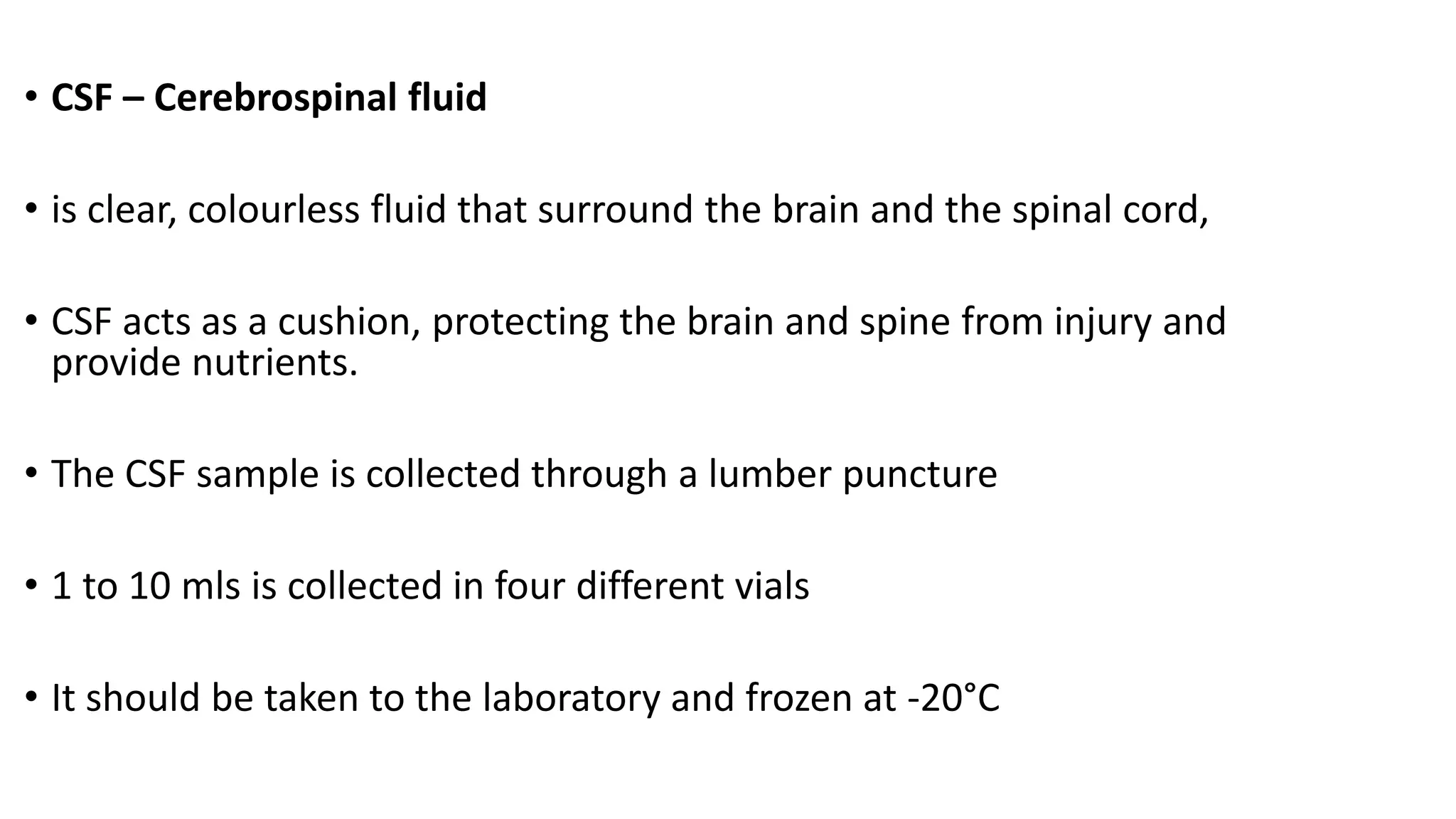
• CSF – Cerebrospinal fluid
• is clear, colourless fluid that surround the brain and the spinal cord,
• CSF acts as a cushion, protecting the brain and spine from injury and
provide nutrients.
• The CSF sample is collected through a lumber puncture
• 1 to 10 mls is collected in four different vials
• It should be taken to the laboratory and frozen at -20°C
Transportation of specimens
All specimen containers must be transported in a self-sealing
polythene bag with two compartments:
1. for the laboratory request form and
2. for the specimen (Brekle and Hartley, 2014).
Specimens should be sent to the laboratory as soon as possible after
collection as a delay may adversely affect the results. If immediate
transportation is not possible, it is important to consult local guidelines
about storage of specimens (Giavarina D, and Lippi G, 2017)
• LABELING THE SAMPLE
• A properly labeled sample is essential so that the results of the test match the
patient. The key elements in labeling are:
• Patient’s full name, lab number, date and time of collection
• The above must match the same on the requisition form.
Preparation and processing of blood sample
• Whole Blood processing in to Plasma/serum
Plasma: A virtually cell-free supernatant of blood containing anticoagulant (heparin, EDTA,
Fluoride oxalate, Sodium citrate, etc) obtained after centrifugation at 2000g to 3000g for
15mins, contains clotting factors.
Serum: The undiluted, extracellular portion of blood after adequate coagulation is complete
or centrifuge at 1500g for 10mins, contains no clotting factors.
NOTE:
Serum or plasma should be separated from red blood cells as soon as possible, a maximum
limit of two hours from the time of collection is recommended. A contact time of less than
two hours is recommended for Glucose, potassium, Viral load, ACTH, cortisol,
catecholamine, lactic acid and homocysteine, (Malaysian J. Pathol., 2005).
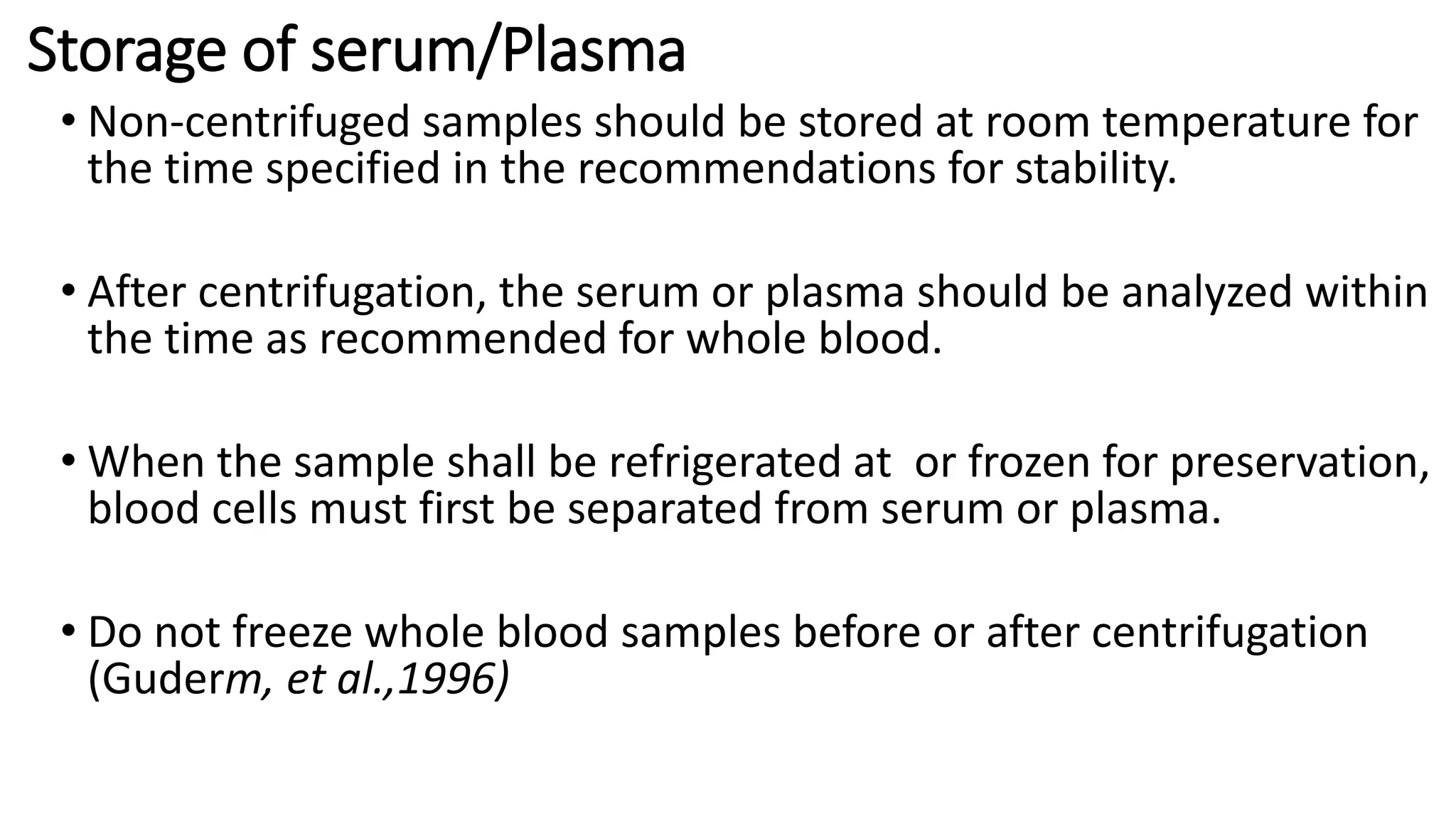
Storage of serum/Plasma
• Non-centrifuged samples should be stored at room temperature for
the time specified in the recommendations for stability.
• After centrifugation, the serum or plasma should be analyzed within
the time as recommended for whole blood.
• When the sample shall be refrigerated at or frozen for preservation,
blood cells must first be separated from serum or plasma.
• Do not freeze whole blood samples before or after centrifugation
(Guderm, et al.,1996)
References
• Brekle B, Hartley J (2014) Specimen Collection: Microbiology and Virology. Bit.ly/GOSHSpecimen
• Campbell JD, Skubitz APN, Somiari SB et al. (2008). International Society for Biological and Environmental Repositories (ISBER). 2008
Best practices for repositories: collection, storage, retrieval and distribution of biological materials for research. Cell Preserv Technol,
6:3–58.
• Falster C, Poulsen SS, Ferløv-Schwensen S. (2020) Urine samples produced at patients’ own home rarely meet recommendations for
analysis. Dan Med J.67(4):A08190475.
• Giavarina D, Lippi G. (2017) Blood venous sample collection: Recommendations overview and a checklist to improve quality. Clin
Biochem.;50 (10-11):568-573.
• Guder WG, da Fonseca-Wollheim F, Heil W, Müller-Plathe O, Töpfer G, Wisser H, et al. (1996) Wahldes optimalen Probenvolumens. Klin
Chem Mitt; 27: 106-7.
• Malami D.T and Salisu G., (2005). Laboratory diagnostic services, (2):2.
• Queremel Milani D.A, Jialal I. Urinalysis. [Updated May 8,2022]. In: StatPearls [Internet]. Treasure Island (FL): StatPearls Publishing; 2022
Jan. Accessed September 6, 2022.

Seminar file.pptx

  • 1.
    COLLECTION, TRANSPORTATION, PREPARATION, PROCESSING,AND STORAGE OF LABORATORY SAMPLES FOR THE DIAGNOSIS AND MONITORING OF DISEASES A SEMINAR PREPARED BY LAWAL, BELLO DANCHADI ADM NO: 22210705001 DEPARTMENT OF CHEMICAL PATHOLOGY AND IMMUNOLOGY USMANU DANFODIYO UNIVERSITY, SOKOTO FEBRUARY, 2023
  • 2.
    Sample • Is asmall quantity of substances taken from a patient or brought to laboratory for clinical analysis or examination, (Malami, 2005). Examples of laboratory samples • Some examples of samples/specimens includes • Blood • Semen. • Gastric juice • Urine • Feces • Sweat • Saliva • Pleural fluids • Synovial fluid • CSF and many other body fluids Collection of samples • Is the process or act designed in receiving specimens for laboratory analysis, (Campbell J.D. et al., 2008)
  • 3.
    Sample collection requirements 1.patient preparation 2. Patient identification 3. Type of sample required 4. Type of Container 5. Sample labelling 6. Special handling Potential outcomes of collection errors Proper sample collection is an important element for good laboratory practice. Improper collection of samples can lead to poor outcomes, such as: • Delays in reporting test results • Unnecessary re-draws/re-tests • Decreased customer satisfaction • Increased costs • Incorrect diagnosis / treatment • Injury • Death. Objectives of samples collection • Research purposes, • Diagnosis diseases, • Treatment and management of diseases,
  • 4.
    Methods of samplecollection • There are different methods of collecting samples depending on the nature and the types of the samples, some examples are: 1. Blood sample Methods of blood collection • Venipuncture method • syringe and needle, tourniquet, methylated spirit, cotton wool, specimen container, • Capillary method( Fingerprint puncture) require the use of plain or heparinized tube. 2. Urine • A fluid excreted by the kidney through the urethra • Timely urine (24hr urine involved the use of preservatives) • Mid stream urine • Early morning urine • Catheter urine • Random urine
  • 5.
    Collection of urinesamples Precautions taken • Give patient wide mouth leak and proof container • Tell a patient the type of urine sample needed • Instruct a patient to clean his/her private part. • Ask him to pass urine sample in to the container and recap immediately (Falstar C, et al., 2020) • NB: For 24 urine, instruct him to empty his bladder be the starting time (e.g 9:00pm to 9:00am) Processing and Storage • Because urine is an unstable fluid that “changes composition as soon as it is eliminated through micturition, accurate collection, storage, and handling are crucial to maintaining the sample’s integrity.” • Ideally, labs should test urine within the first hour after collection, but if not possible, the sample should be refrigerated at 4°C for up to 24 hours. “Any specimen older than 24 hours cannot be used for urinalysis, (Queremel and Jialal 2022).
  • 6.
    • CSF –Cerebrospinal fluid • is clear, colourless fluid that surround the brain and the spinal cord, • CSF acts as a cushion, protecting the brain and spine from injury and provide nutrients. • The CSF sample is collected through a lumber puncture • 1 to 10 mls is collected in four different vials • It should be taken to the laboratory and frozen at -20°C
  • 7.
    Transportation of specimens Allspecimen containers must be transported in a self-sealing polythene bag with two compartments: 1. for the laboratory request form and 2. for the specimen (Brekle and Hartley, 2014). Specimens should be sent to the laboratory as soon as possible after collection as a delay may adversely affect the results. If immediate transportation is not possible, it is important to consult local guidelines about storage of specimens (Giavarina D, and Lippi G, 2017) • LABELING THE SAMPLE • A properly labeled sample is essential so that the results of the test match the patient. The key elements in labeling are: • Patient’s full name, lab number, date and time of collection • The above must match the same on the requisition form.
  • 8.
    Preparation and processingof blood sample • Whole Blood processing in to Plasma/serum Plasma: A virtually cell-free supernatant of blood containing anticoagulant (heparin, EDTA, Fluoride oxalate, Sodium citrate, etc) obtained after centrifugation at 2000g to 3000g for 15mins, contains clotting factors. Serum: The undiluted, extracellular portion of blood after adequate coagulation is complete or centrifuge at 1500g for 10mins, contains no clotting factors. NOTE: Serum or plasma should be separated from red blood cells as soon as possible, a maximum limit of two hours from the time of collection is recommended. A contact time of less than two hours is recommended for Glucose, potassium, Viral load, ACTH, cortisol, catecholamine, lactic acid and homocysteine, (Malaysian J. Pathol., 2005).
  • 9.
    Storage of serum/Plasma •Non-centrifuged samples should be stored at room temperature for the time specified in the recommendations for stability. • After centrifugation, the serum or plasma should be analyzed within the time as recommended for whole blood. • When the sample shall be refrigerated at or frozen for preservation, blood cells must first be separated from serum or plasma. • Do not freeze whole blood samples before or after centrifugation (Guderm, et al.,1996)
  • 10.
    References • Brekle B,Hartley J (2014) Specimen Collection: Microbiology and Virology. Bit.ly/GOSHSpecimen • Brekle B, Hartley J (2014) Specimen Collection: Microbiology and Virology. Bit.ly/GOSHSpecimen • Campbell JD, Skubitz APN, Somiari SB et al. (2008). International Society for Biological and Environmental Repositories (ISBER). 2008 Best practices for repositories: collection, storage, retrieval and distribution of biological materials for research. Cell Preserv Technol, 6:3–58. • Falster C, Poulsen SS, Ferløv-Schwensen S. (2020) Urine samples produced at patients’ own home rarely meet recommendations for analysis. Dan Med J.67(4):A08190475. • Giavarina D, Lippi G. (2017) Blood venous sample collection: Recommendations overview and a checklist to improve quality. Clin Biochem.;50 (10-11):568-573. • Guder WG, da Fonseca-Wollheim F, Heil W, Müller-Plathe O, Töpfer G, Wisser H, et al. (1996) Wahldes optimalen Probenvolumens. Klin Chem Mitt; 27: 106-7. • Malami D.T and Salisu G., (2005). Laboratory diagnostic services, (2):2. • Queremel Milani D.A, Jialal I. Urinalysis. [Updated May 8,2022]. In: StatPearls [Internet]. Treasure Island (FL): StatPearls Publishing; 2022 Jan. Accessed September 6, 2022.