Specialized Vegetative Structures
Dr. S.ANANDHI
Assistant Professor (Horticulture)
SRM College of Agricultural Sciences
Chengalpattu
Specialized Vegetative Structures
• Herbaceous perennials - the shoot die at the end of a growing
season but the fleshy vegetative structure usually do not die
and remains in the soil, which put forth new vegetative growth in
the next season.
• Functions - storage of food, nutrients and water during adverse
environmental conditions.
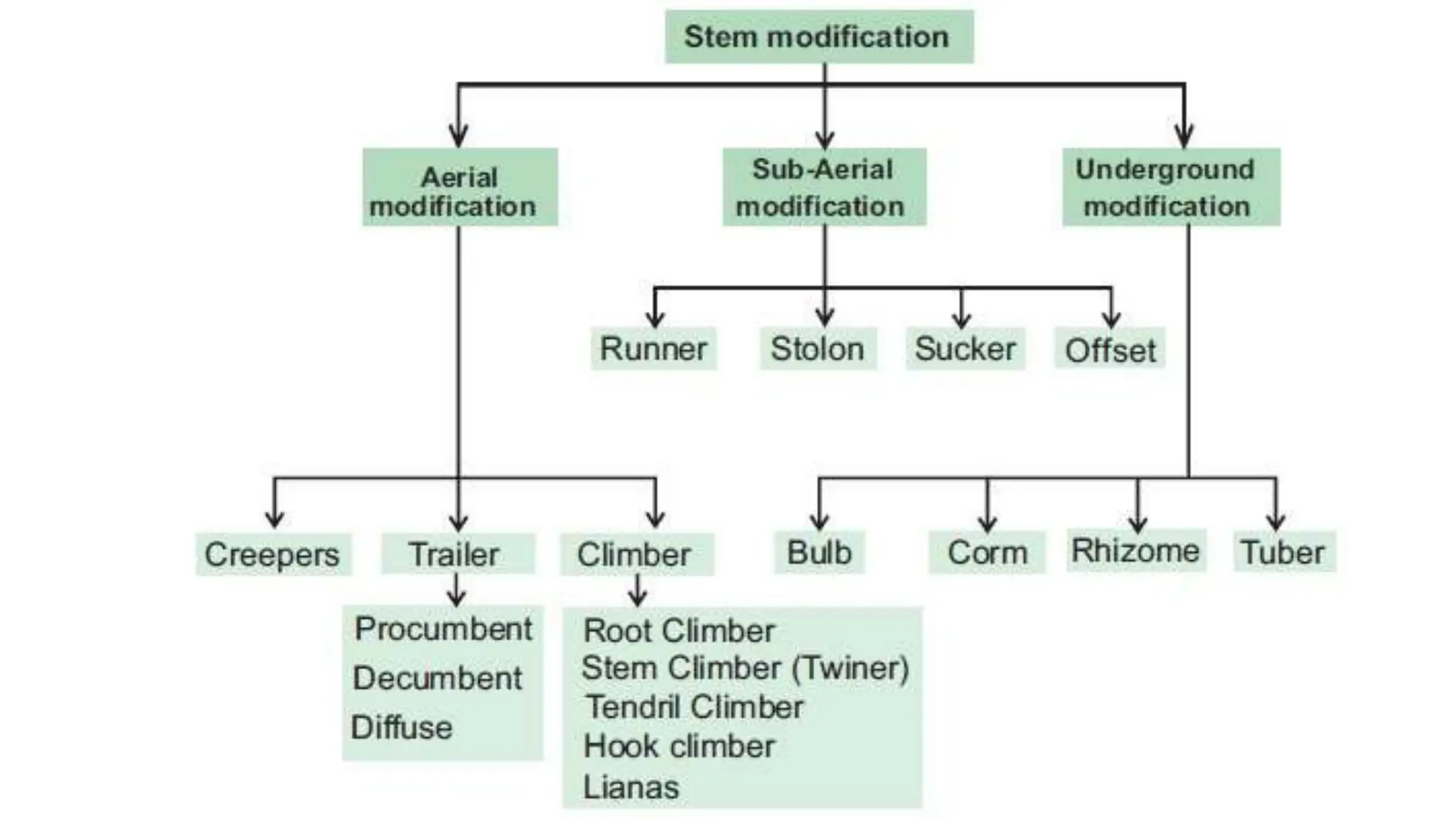
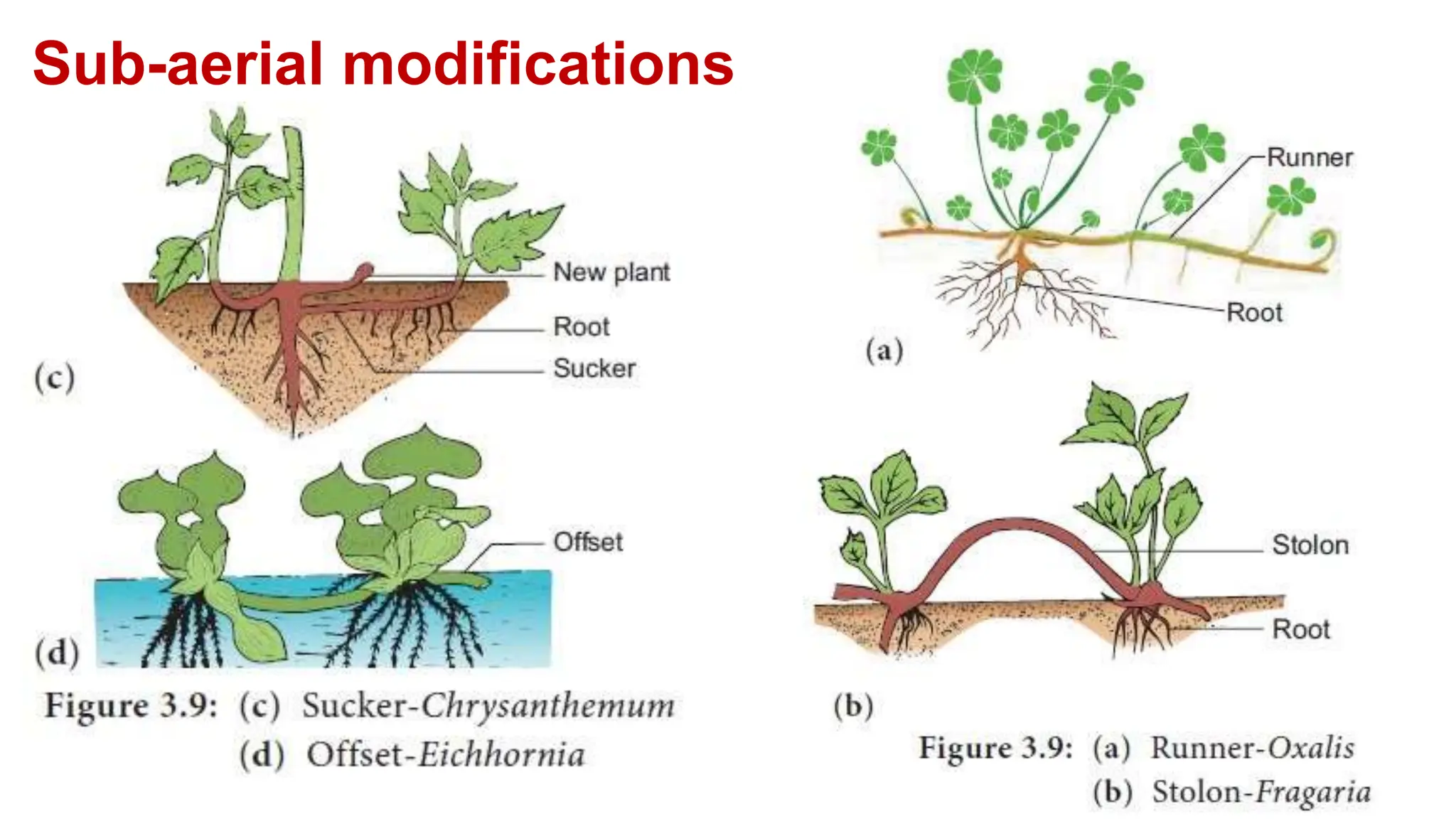
Sub-aerial modifications
Bulb
• A bulb is a complicated structure, which
consists of a short thickened stem bearing
roots on the underside and thick fleshy
leaves on the upper side.
• Bulbs - produced by monocotyledonous
plants [Oxalis, is the one dicot genus]
• Bulbs generally consist of bulb scales
• Outer bulb scales - fleshy, which contain
reserve food materials
• Inner scales - do not function as storage
organs and are leaf like.
• In the centre of the bulb, there is either a
vegetative meristem or an unexpanded
flowering shoot.
• Meristem develops in the axil of these
scales to produce miniature bulbs,
known as bulblets, which when grown to
full size are known as offsets.
• In some species (e.g. Lilies), the bulblets
are produced in the underground organs
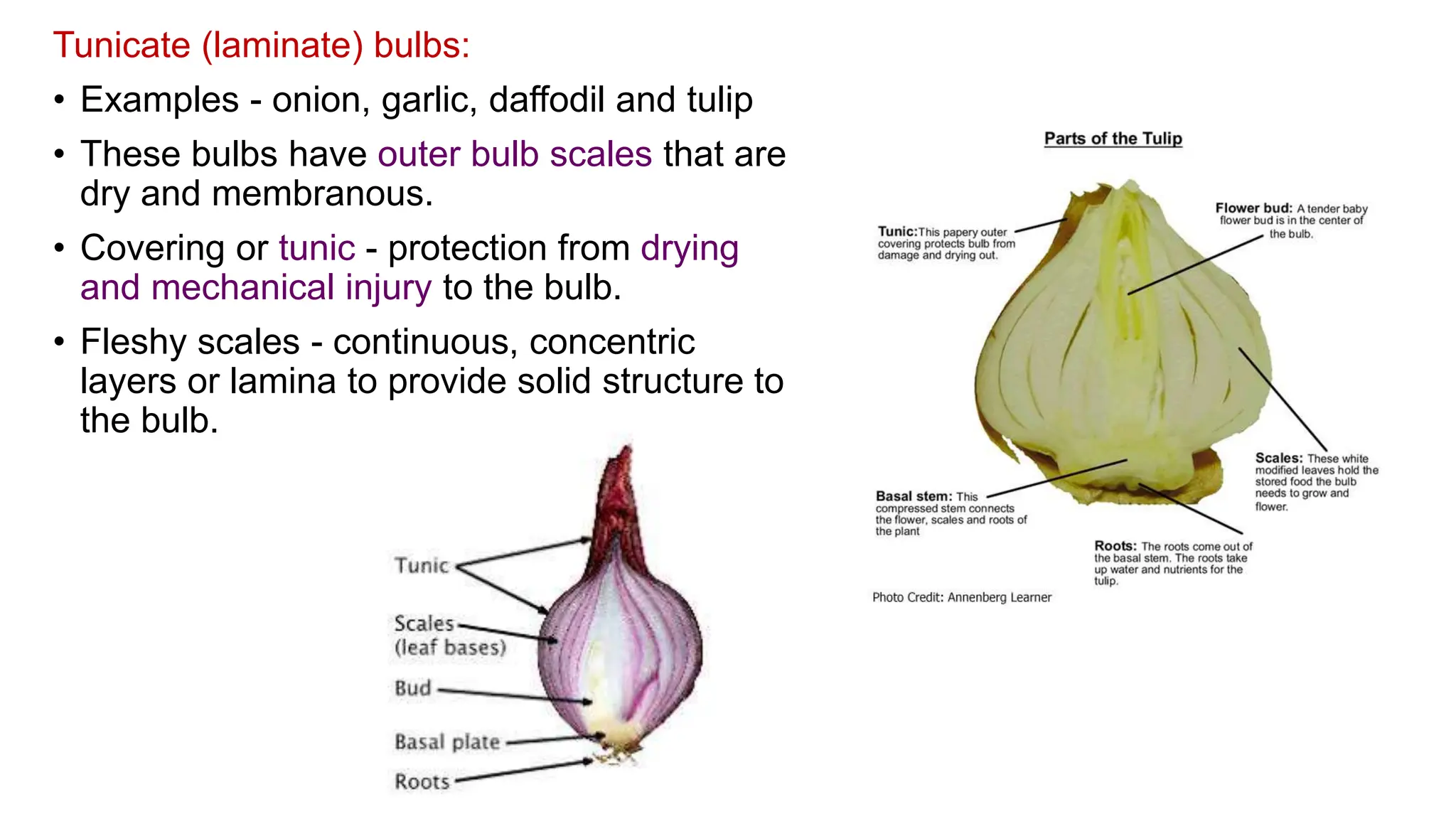
Tunicate (laminate) bulbs:
• Examples - onion, garlic, daffodil and tulip
• These bulbs have outer bulb scales that are
dry and membranous.
• Covering or tunic - protection from drying
and mechanical injury to the bulb.
• Fleshy scales - continuous, concentric
layers or lamina to provide solid structure to
the bulb.
Non-tunicate (scaly) bulbs:
• Non-tunicate bulbs are represented by the lily, have dry coverings, loosely
arranged like the petals of a flower overlapping each other.
• Easily damaged and must be handled more carefully.
• They must be kept moist because they are injured by drying.
• The bulbs are propagated through offsets, bulb cuttings, scaling, scoring,
stem cuttings, leaf cuttings, leaf buds and bulbils.
Bulbs of lily-non tunicate
• A tuber is a swollen, modified underground stem, which primarily function
as the storage organ of the plant.
• Examples : potato, Caladuim, Yam, Jesusalem artichoke
• The tuber has nodes (eyes), internodes, lateral and terminal buds
• The eyes (nodes) of a tuber are spirally arranged, consisting of one or
more small buds. Usually one bud in the eye sprouts and suppresses the
growth of others, which shows the phenomenon of apical dominance.
Tubers
Dioscorea
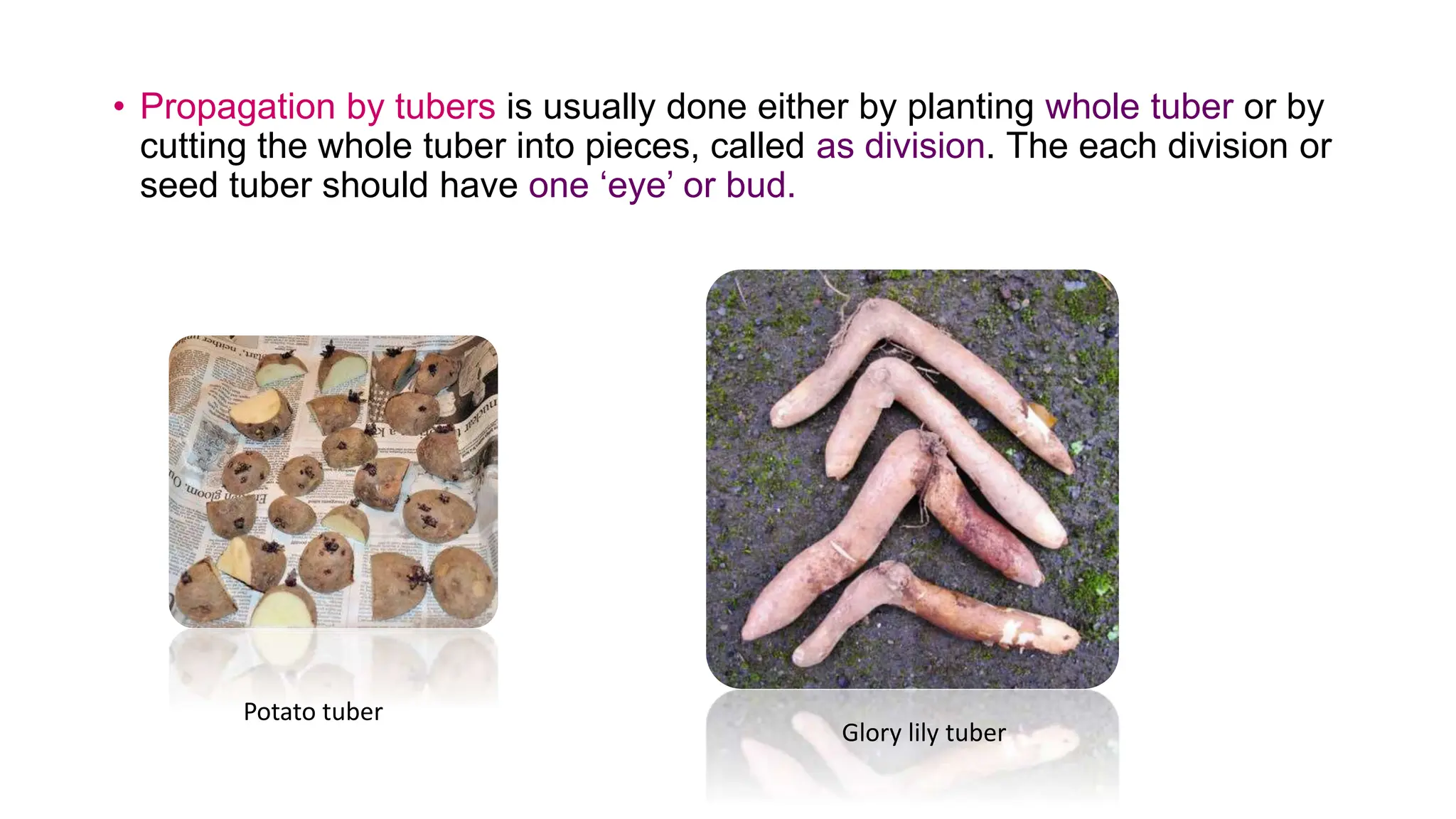
• Propagation by tubers is usually done either by planting whole tuber or by
cutting the whole tuber into pieces, called as division. The each division or
seed tuber should have one ‘eye’ or bud.
Potato tuber
Glory lily tuber
• Tubers of Begonia and Dioseorea vines produce aerial tubers
called as tubercles.
• These tubercles can also be used for raising new plants.
Amorphophallus bulbifera
Dioscorea batatas
Specialized Vegetative Structures
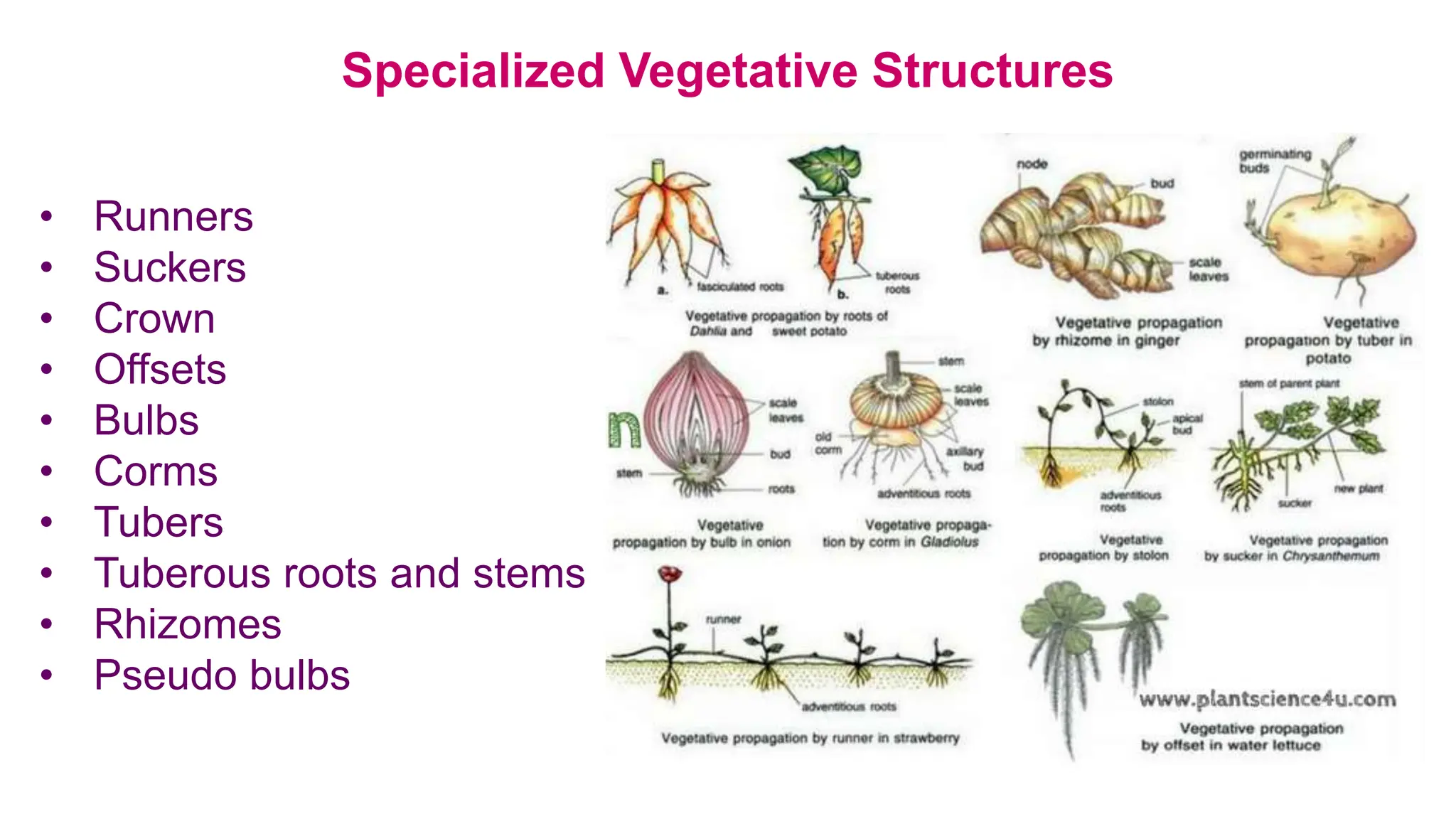
• Runners
• Suckers
• Crown
• Offsets
• Bulbs
• Corms
• Tubers
• Tuberous roots and stems
• Rhizomes
• Pseudo bulbs
Rhizome
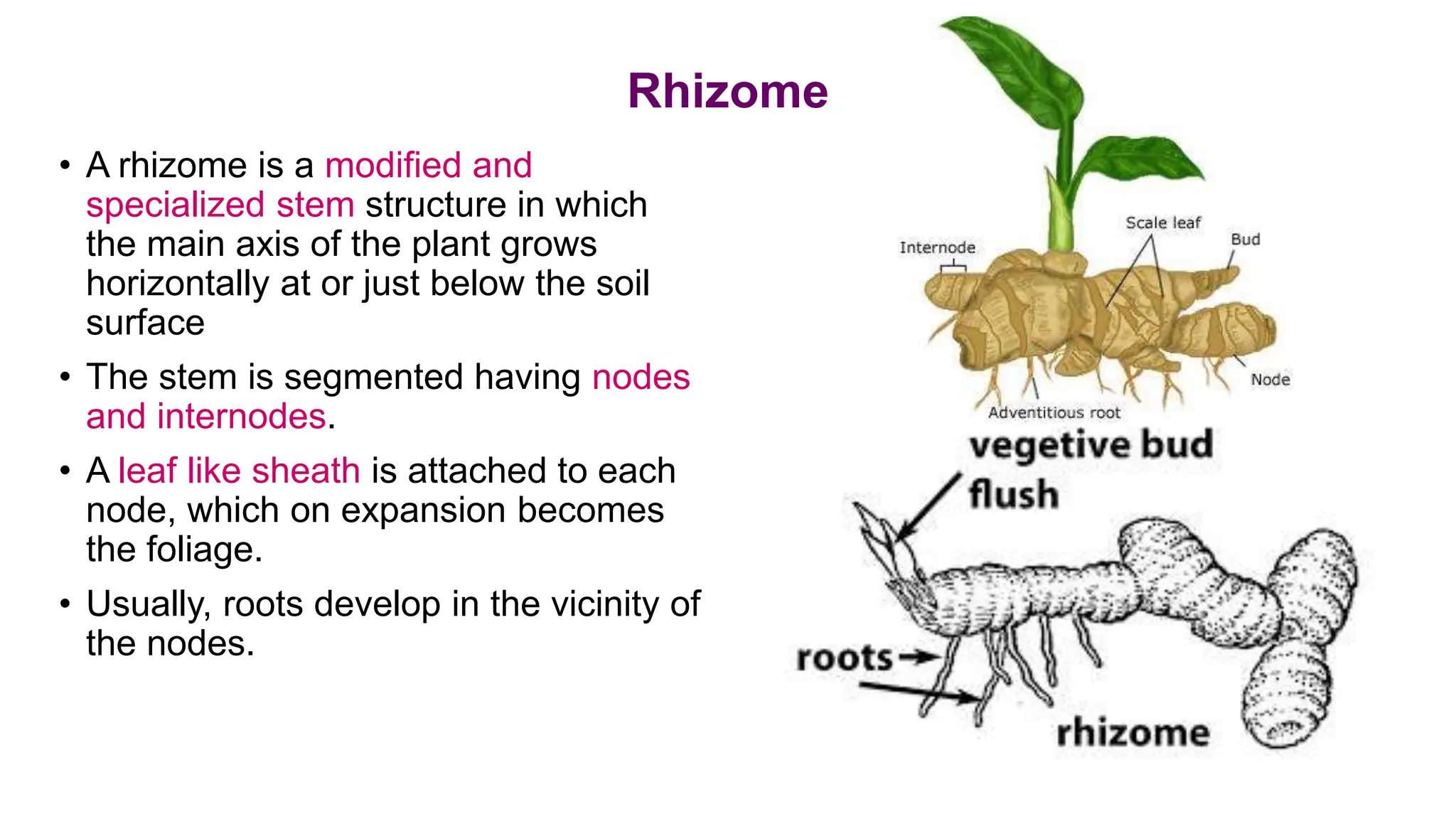
• A rhizome is a modified and
specialized stem structure in which
the main axis of the plant grows
horizontally at or just below the soil
surface
• The stem is segmented having nodes
and internodes.
• A leaf like sheath is attached to each
node, which on expansion becomes
the foliage.
• Usually, roots develop in the vicinity of
the nodes.
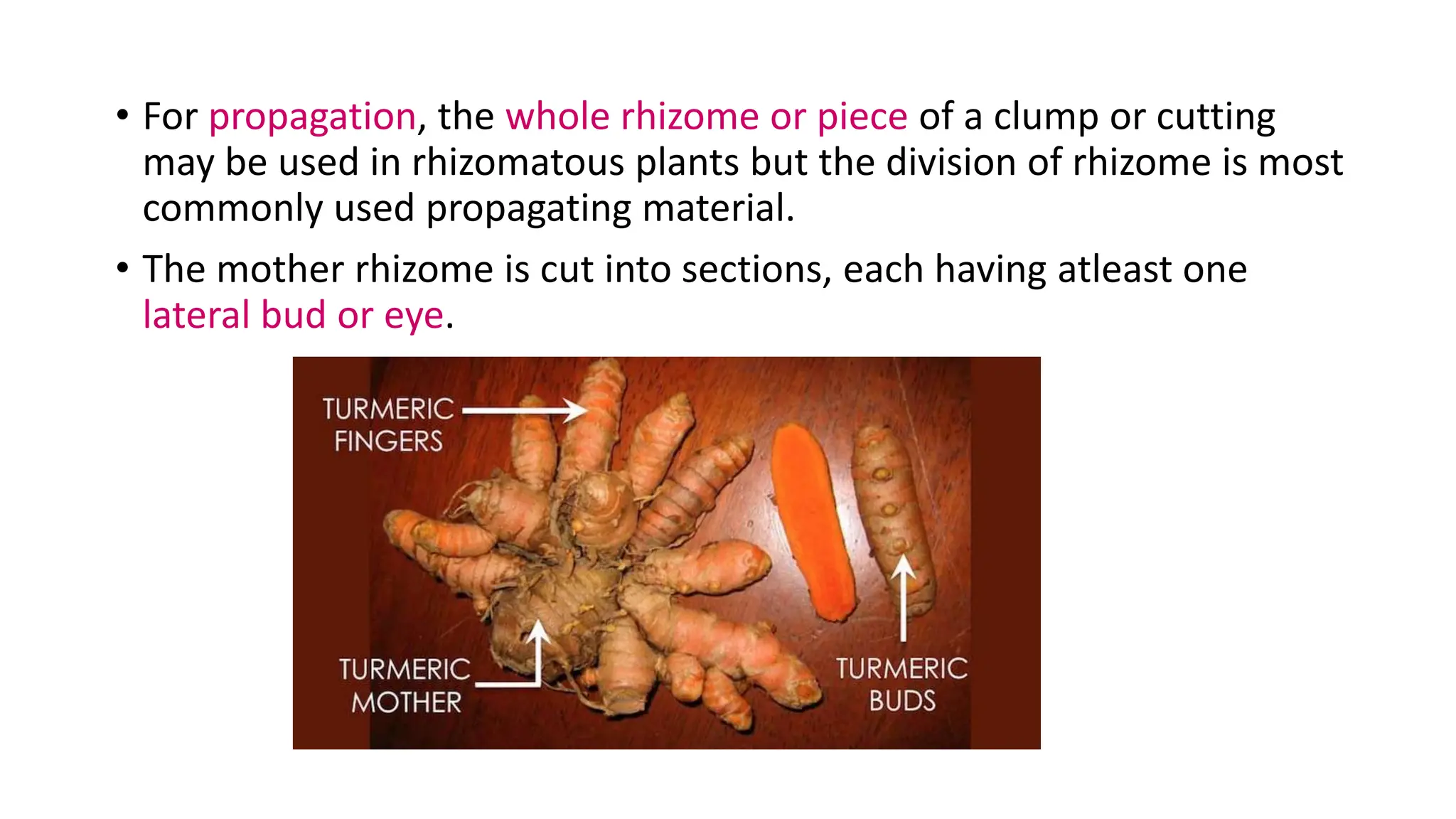
• For propagation, the whole rhizome or piece of a clump or cutting
may be used in rhizomatous plants but the division of rhizome is most
commonly used propagating material.
• The mother rhizome is cut into sections, each having atleast one
lateral bud or eye.
Corms
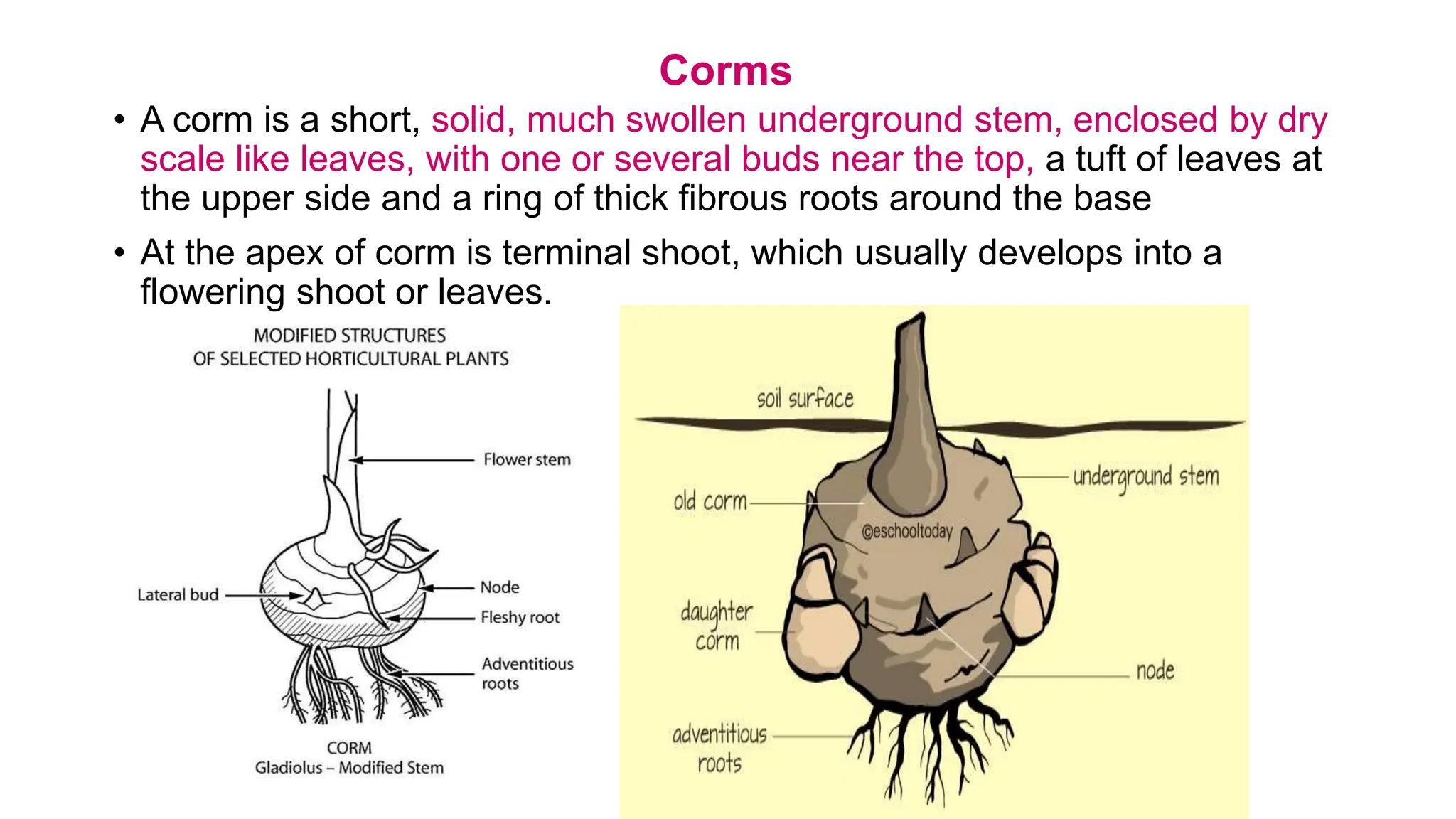
• A corm is a short, solid, much swollen underground stem, enclosed by dry
scale like leaves, with one or several buds near the top, a tuft of leaves at
the upper side and a ring of thick fibrous roots around the base
• At the apex of corm is terminal shoot, which usually develops into a
flowering shoot or leaves.
• Gladiolus, crocus and water chestnut are examples of some typical cormous
plants.
• Cormous plants can be propagated through new corms, cormels or corm
segments.
• Usually, a mother corm produces 2-3 new corms and 15-20 cormlets, the
miniature corms.
Runners
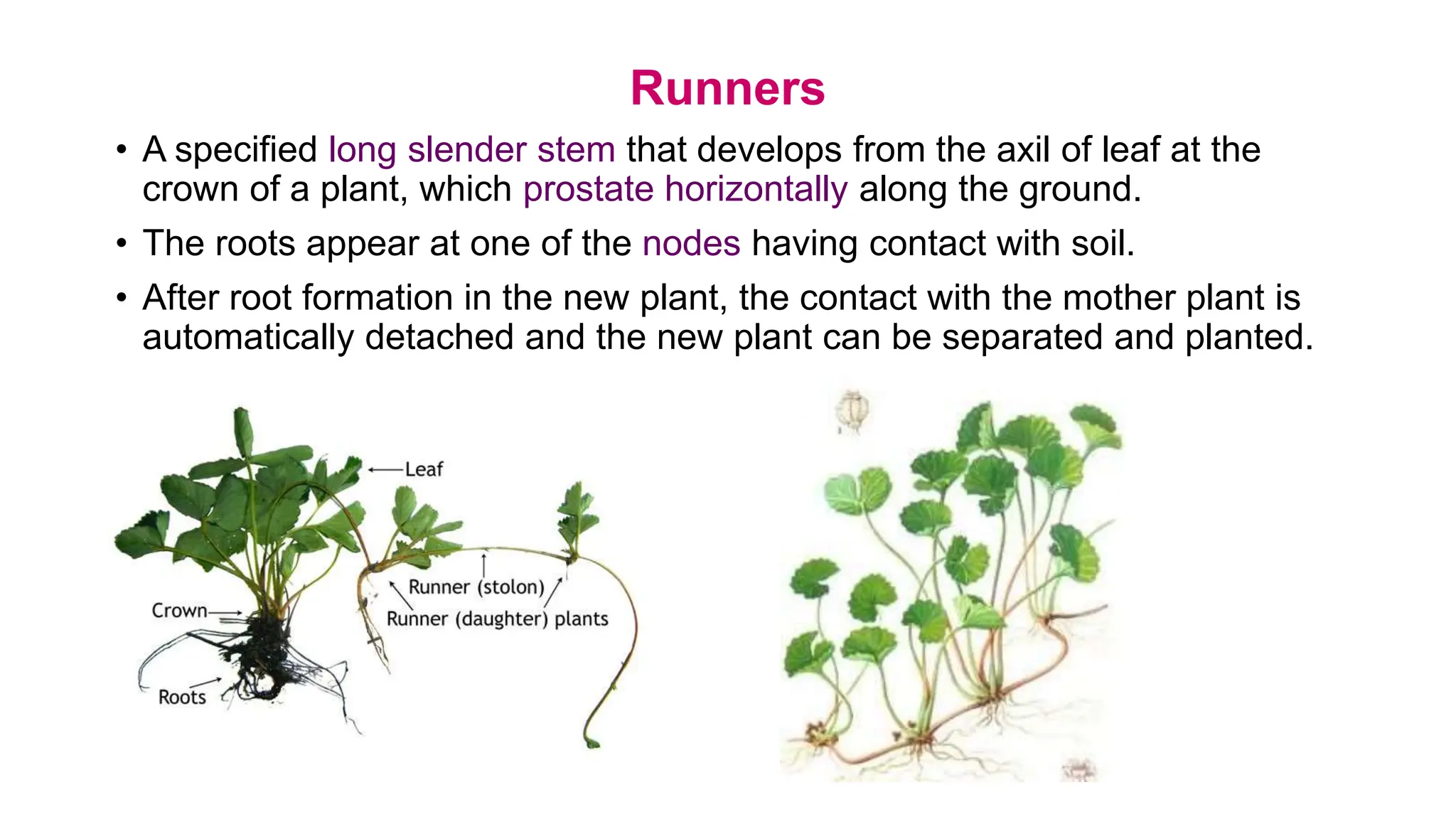
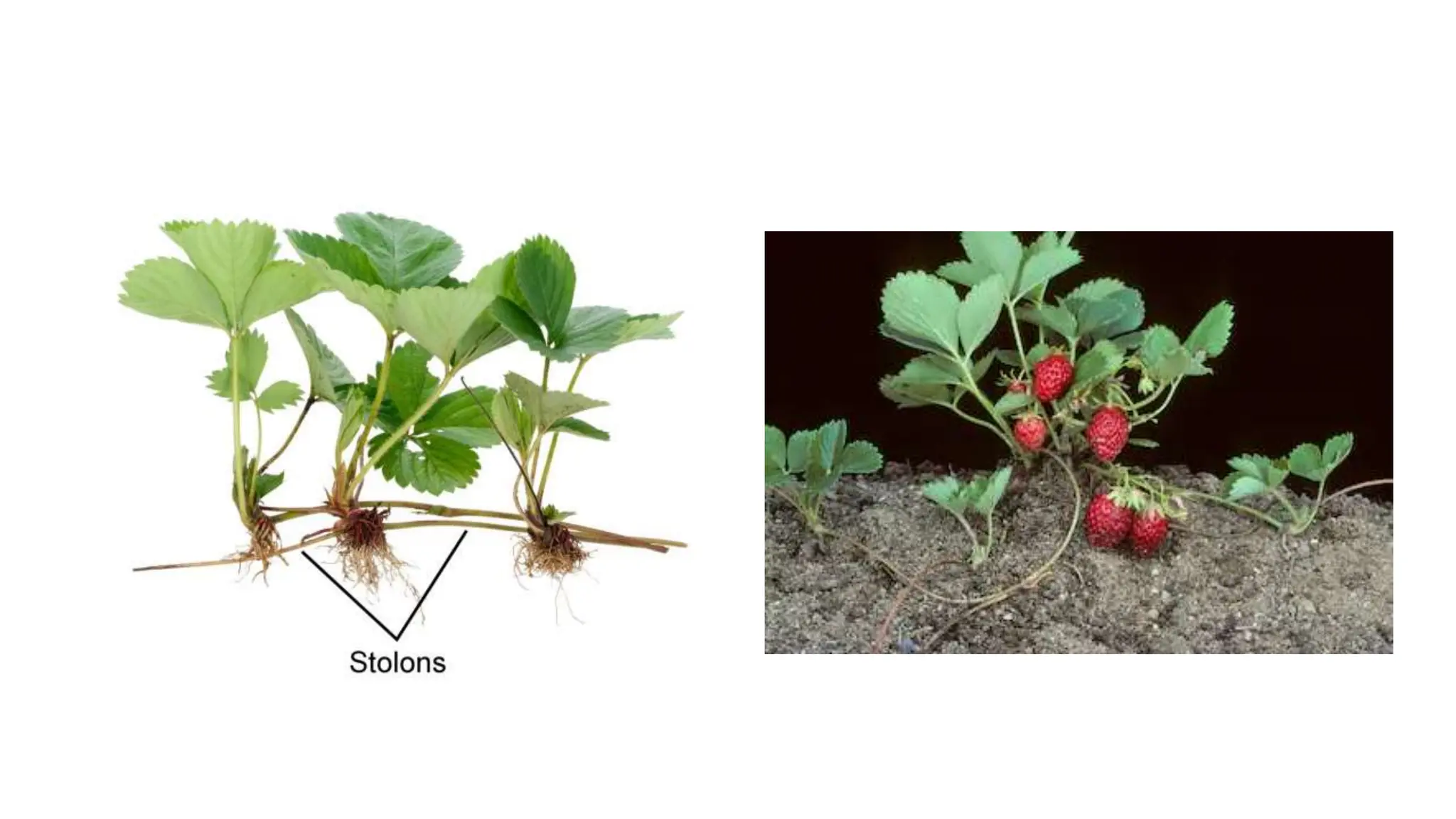
• A specified long slender stem that develops from the axil of leaf at the
crown of a plant, which prostate horizontally along the ground.
• The roots appear at one of the nodes having contact with soil.
• After root formation in the new plant, the contact with the mother plant is
automatically detached and the new plant can be separated and planted.
• Strawberry is a typical runner
• Example: Oxalis corniculata, Bosten fern, bugle (Ajuga) and
spider plant (Chlorophytum comosum)
Suckers
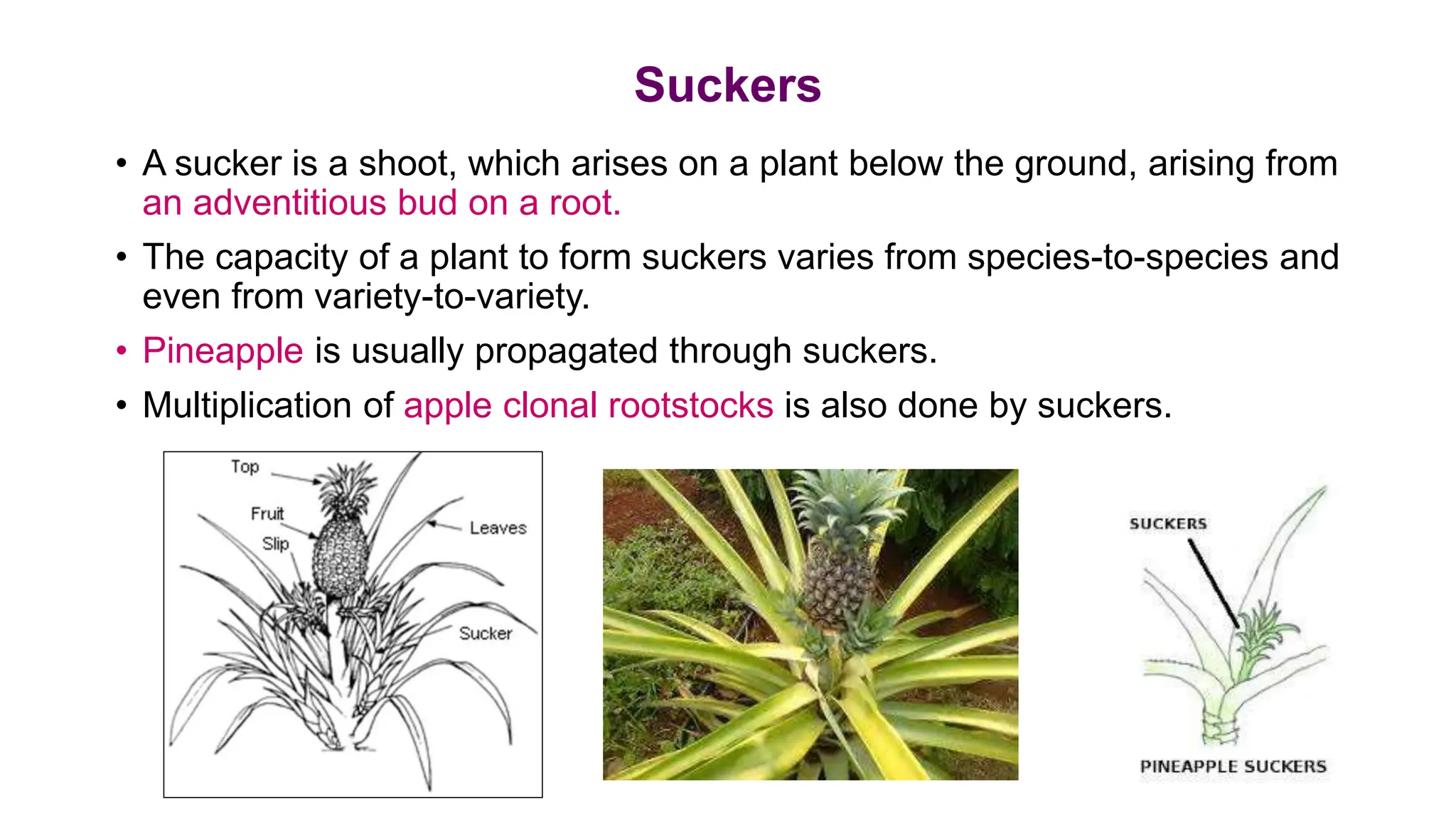
• A sucker is a shoot, which arises on a plant below the ground, arising from
an adventitious bud on a root.
• The capacity of a plant to form suckers varies from species-to-species and
even from variety-to-variety.
• Pineapple is usually propagated through suckers.
• Multiplication of apple clonal rootstocks is also done by suckers.
• In banana two types of suckers are produced water suckers and sword
suckers
• Water suckers are broad leaved, whereas, sword suckers are pointed and
have sword shape. For propagation purpose, sword suckers are preferred
over the water suckers.
Off-sets (off-shoots)
• An offshoot is a young plant produced
laterally by the parent plant or branch
that develops from the base of main
stem in some plants, which can easily be
detached from it.
• Offset - shortened, thickened stem of
rosette like appearance
• Lateral shoots arising on the stems of
monocotyledonous fruit plants, like date
palm, pineapple or banana.
• Similarly, some cacti and succulents also
produce a cluster of small plants around
the base and these offsets merely need
separation.
• The flowering stems, called as
culms, are either produced from
the rhizome tip or from the lateral
branches.
• The banana is a typical example of
rhizome.
• Other rhizomatous plants are
ginger, bamboo, iris, sugarcane
and many grasses.
Pseudobulb (false bulb)
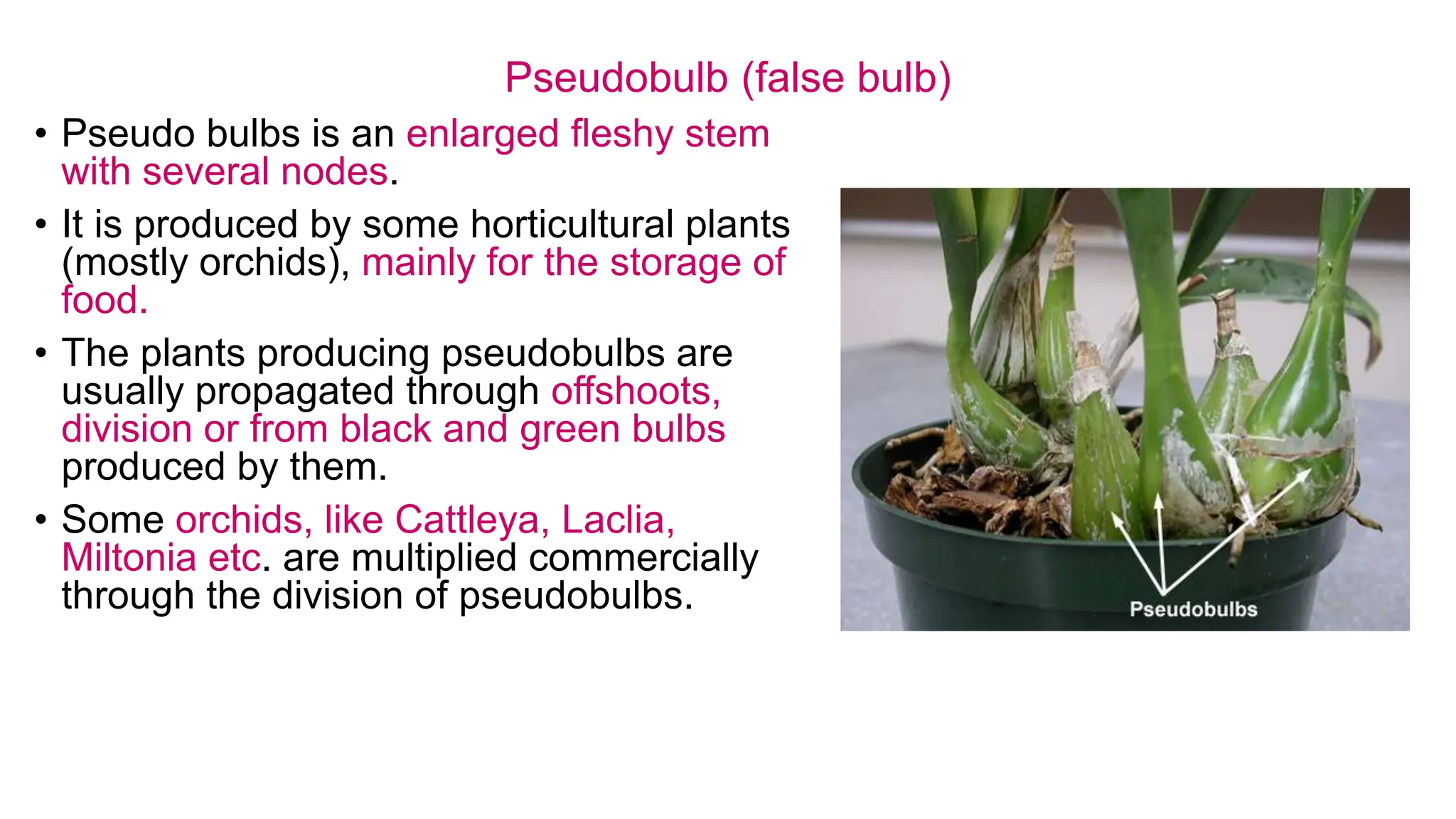
• Pseudo bulbs is an enlarged fleshy stem
with several nodes.
• It is produced by some horticultural plants
(mostly orchids), mainly for the storage of
food.
• The plants producing pseudobulbs are
usually propagated through offshoots,
division or from black and green bulbs
produced by them.
• Some orchids, like Cattleya, Laclia,
Miltonia etc. are multiplied commercially
through the division of pseudobulbs.
• The bulb is cut into different sections by a sharp knife during
dormant season.
• Each section is sown and new growth begins at the nodes.
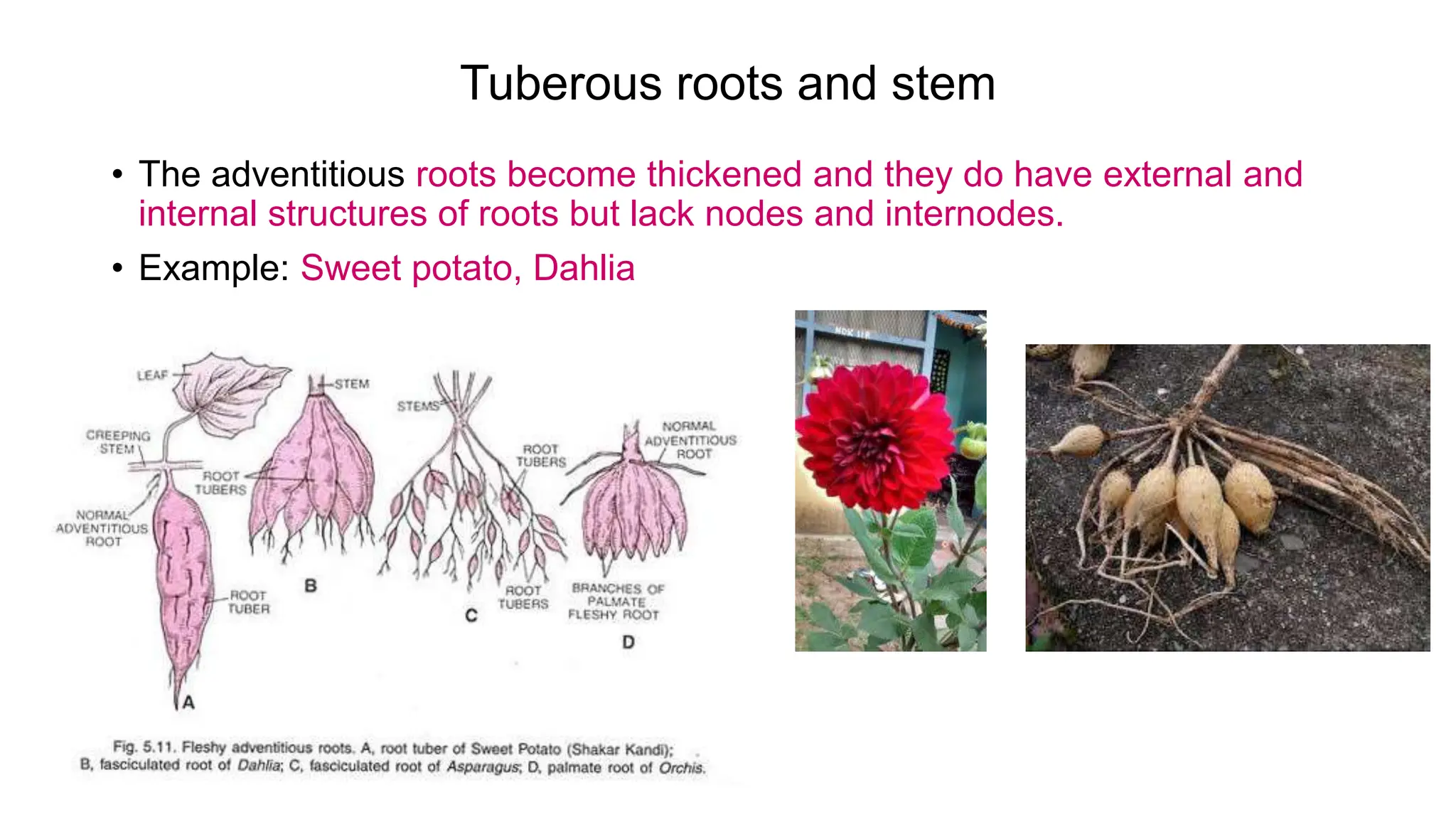
Tuberous roots and stem
• The adventitious roots become thickened and they do have external and
internal structures of roots but lack nodes and internodes.
• Example: Sweet potato, Dahlia
Special Vegetative Structures

Special Vegetative Structures

  • 1.
    Specialized Vegetative Structures Dr.S.ANANDHI Assistant Professor (Horticulture) SRM College of Agricultural Sciences Chengalpattu
  • 2.
    Specialized Vegetative Structures •Herbaceous perennials - the shoot die at the end of a growing season but the fleshy vegetative structure usually do not die and remains in the soil, which put forth new vegetative growth in the next season. • Functions - storage of food, nutrients and water during adverse environmental conditions.
  • 6.
  • 7.
    Bulb • A bulbis a complicated structure, which consists of a short thickened stem bearing roots on the underside and thick fleshy leaves on the upper side. • Bulbs - produced by monocotyledonous plants [Oxalis, is the one dicot genus] • Bulbs generally consist of bulb scales • Outer bulb scales - fleshy, which contain reserve food materials • Inner scales - do not function as storage organs and are leaf like.
  • 8.
    • In thecentre of the bulb, there is either a vegetative meristem or an unexpanded flowering shoot. • Meristem develops in the axil of these scales to produce miniature bulbs, known as bulblets, which when grown to full size are known as offsets. • In some species (e.g. Lilies), the bulblets are produced in the underground organs
  • 9.
    Tunicate (laminate) bulbs: •Examples - onion, garlic, daffodil and tulip • These bulbs have outer bulb scales that are dry and membranous. • Covering or tunic - protection from drying and mechanical injury to the bulb. • Fleshy scales - continuous, concentric layers or lamina to provide solid structure to the bulb.
  • 11.
    Non-tunicate (scaly) bulbs: •Non-tunicate bulbs are represented by the lily, have dry coverings, loosely arranged like the petals of a flower overlapping each other. • Easily damaged and must be handled more carefully. • They must be kept moist because they are injured by drying. • The bulbs are propagated through offsets, bulb cuttings, scaling, scoring, stem cuttings, leaf cuttings, leaf buds and bulbils. Bulbs of lily-non tunicate
  • 12.
    • A tuberis a swollen, modified underground stem, which primarily function as the storage organ of the plant. • Examples : potato, Caladuim, Yam, Jesusalem artichoke • The tuber has nodes (eyes), internodes, lateral and terminal buds • The eyes (nodes) of a tuber are spirally arranged, consisting of one or more small buds. Usually one bud in the eye sprouts and suppresses the growth of others, which shows the phenomenon of apical dominance. Tubers Dioscorea
  • 13.
    • Propagation bytubers is usually done either by planting whole tuber or by cutting the whole tuber into pieces, called as division. The each division or seed tuber should have one ‘eye’ or bud. Potato tuber Glory lily tuber
  • 14.
    • Tubers ofBegonia and Dioseorea vines produce aerial tubers called as tubercles. • These tubercles can also be used for raising new plants. Amorphophallus bulbifera Dioscorea batatas
  • 15.
    Specialized Vegetative Structures •Runners • Suckers • Crown • Offsets • Bulbs • Corms • Tubers • Tuberous roots and stems • Rhizomes • Pseudo bulbs
  • 16.
    Rhizome • A rhizomeis a modified and specialized stem structure in which the main axis of the plant grows horizontally at or just below the soil surface • The stem is segmented having nodes and internodes. • A leaf like sheath is attached to each node, which on expansion becomes the foliage. • Usually, roots develop in the vicinity of the nodes.
  • 17.
    • For propagation,the whole rhizome or piece of a clump or cutting may be used in rhizomatous plants but the division of rhizome is most commonly used propagating material. • The mother rhizome is cut into sections, each having atleast one lateral bud or eye.
  • 18.
    Corms • A cormis a short, solid, much swollen underground stem, enclosed by dry scale like leaves, with one or several buds near the top, a tuft of leaves at the upper side and a ring of thick fibrous roots around the base • At the apex of corm is terminal shoot, which usually develops into a flowering shoot or leaves.
  • 19.
    • Gladiolus, crocusand water chestnut are examples of some typical cormous plants. • Cormous plants can be propagated through new corms, cormels or corm segments. • Usually, a mother corm produces 2-3 new corms and 15-20 cormlets, the miniature corms.
  • 20.
    Runners • A specifiedlong slender stem that develops from the axil of leaf at the crown of a plant, which prostate horizontally along the ground. • The roots appear at one of the nodes having contact with soil. • After root formation in the new plant, the contact with the mother plant is automatically detached and the new plant can be separated and planted.
  • 22.
    • Strawberry isa typical runner • Example: Oxalis corniculata, Bosten fern, bugle (Ajuga) and spider plant (Chlorophytum comosum)
  • 23.
    Suckers • A suckeris a shoot, which arises on a plant below the ground, arising from an adventitious bud on a root. • The capacity of a plant to form suckers varies from species-to-species and even from variety-to-variety. • Pineapple is usually propagated through suckers. • Multiplication of apple clonal rootstocks is also done by suckers.
  • 24.
    • In bananatwo types of suckers are produced water suckers and sword suckers • Water suckers are broad leaved, whereas, sword suckers are pointed and have sword shape. For propagation purpose, sword suckers are preferred over the water suckers.
  • 25.
    Off-sets (off-shoots) • Anoffshoot is a young plant produced laterally by the parent plant or branch that develops from the base of main stem in some plants, which can easily be detached from it. • Offset - shortened, thickened stem of rosette like appearance • Lateral shoots arising on the stems of monocotyledonous fruit plants, like date palm, pineapple or banana. • Similarly, some cacti and succulents also produce a cluster of small plants around the base and these offsets merely need separation.
  • 26.
    • The floweringstems, called as culms, are either produced from the rhizome tip or from the lateral branches. • The banana is a typical example of rhizome. • Other rhizomatous plants are ginger, bamboo, iris, sugarcane and many grasses.
  • 27.
    Pseudobulb (false bulb) •Pseudo bulbs is an enlarged fleshy stem with several nodes. • It is produced by some horticultural plants (mostly orchids), mainly for the storage of food. • The plants producing pseudobulbs are usually propagated through offshoots, division or from black and green bulbs produced by them. • Some orchids, like Cattleya, Laclia, Miltonia etc. are multiplied commercially through the division of pseudobulbs.
  • 28.
    • The bulbis cut into different sections by a sharp knife during dormant season. • Each section is sown and new growth begins at the nodes.
  • 29.
    Tuberous roots andstem • The adventitious roots become thickened and they do have external and internal structures of roots but lack nodes and internodes. • Example: Sweet potato, Dahlia