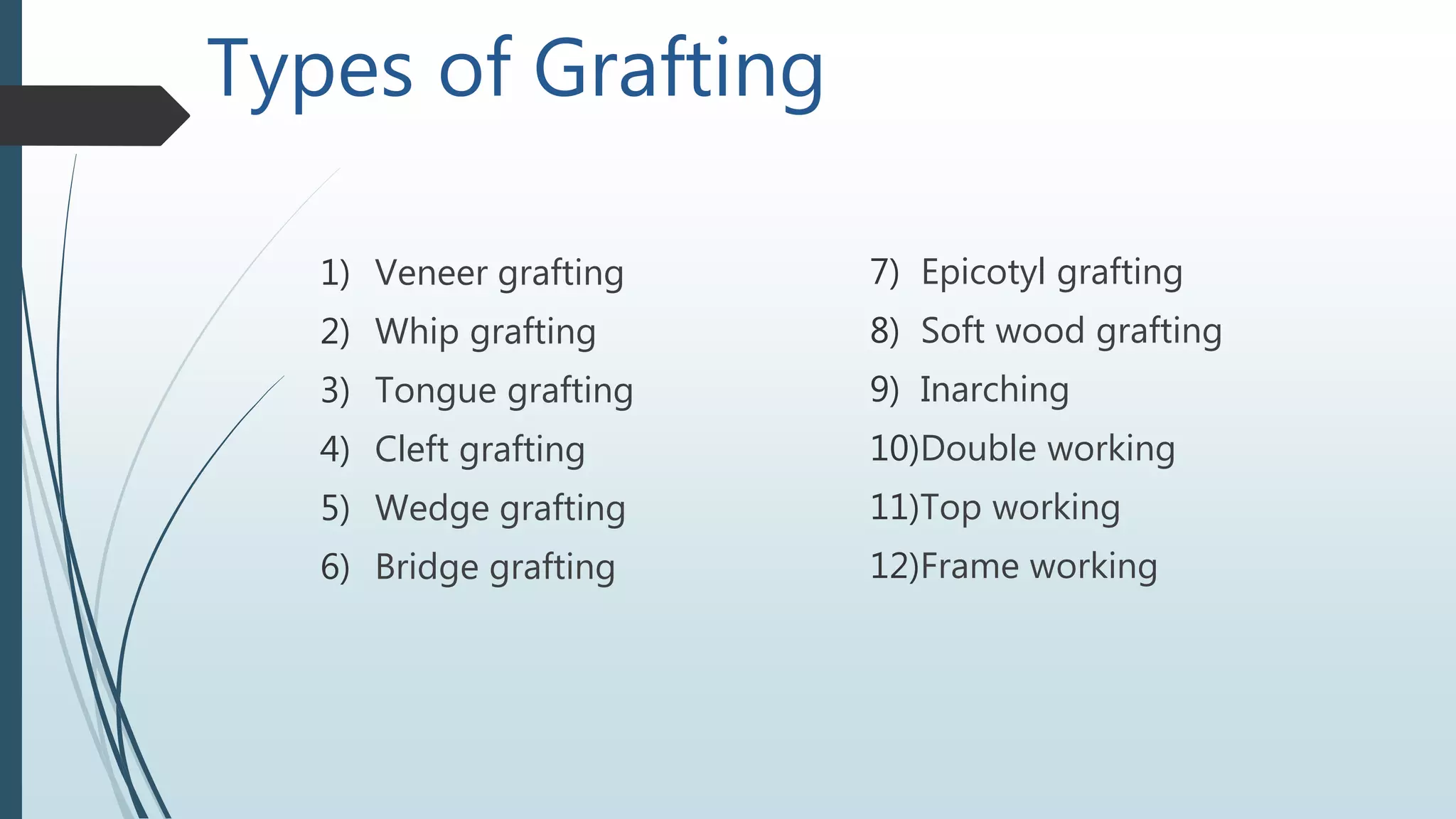
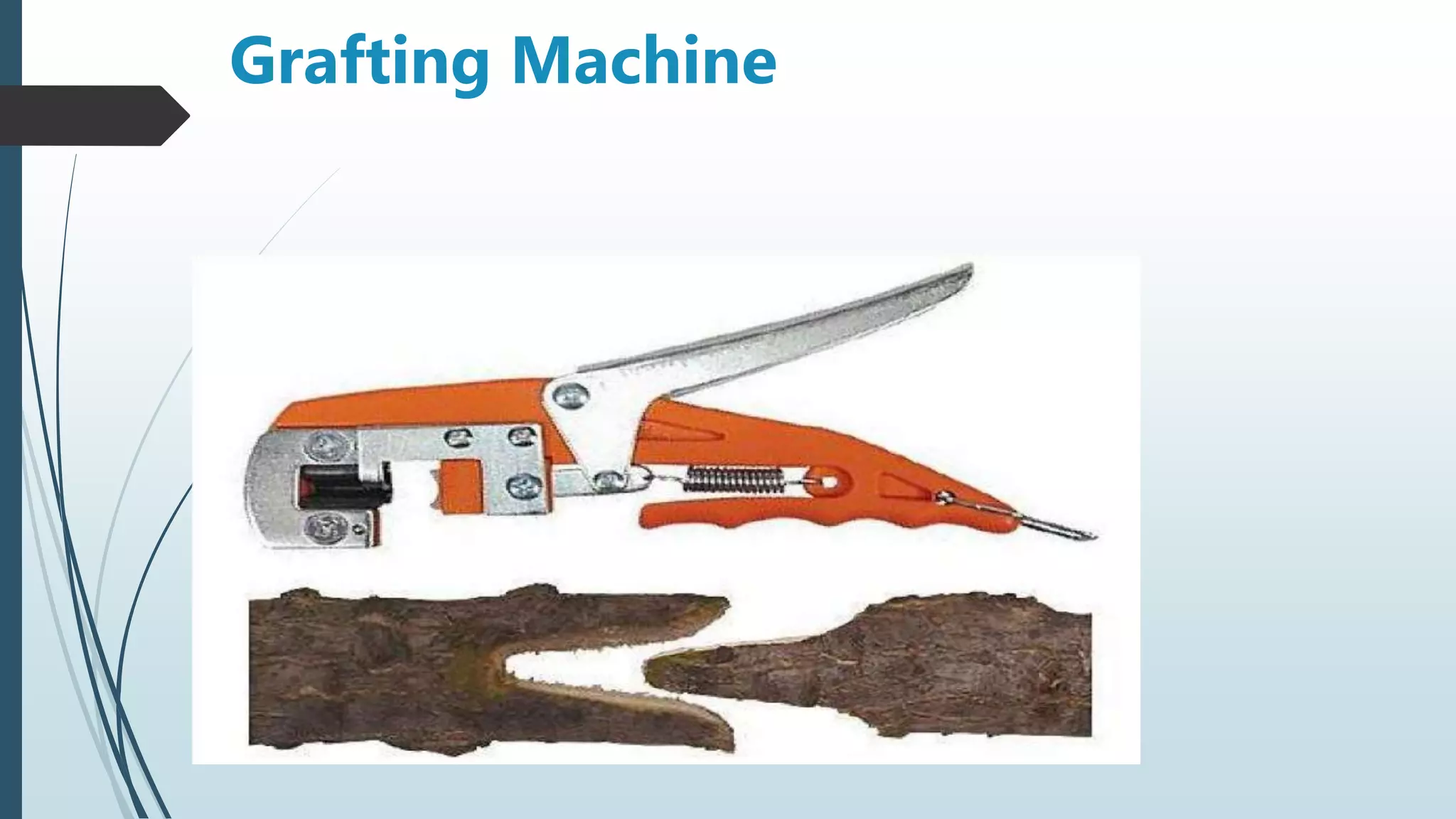
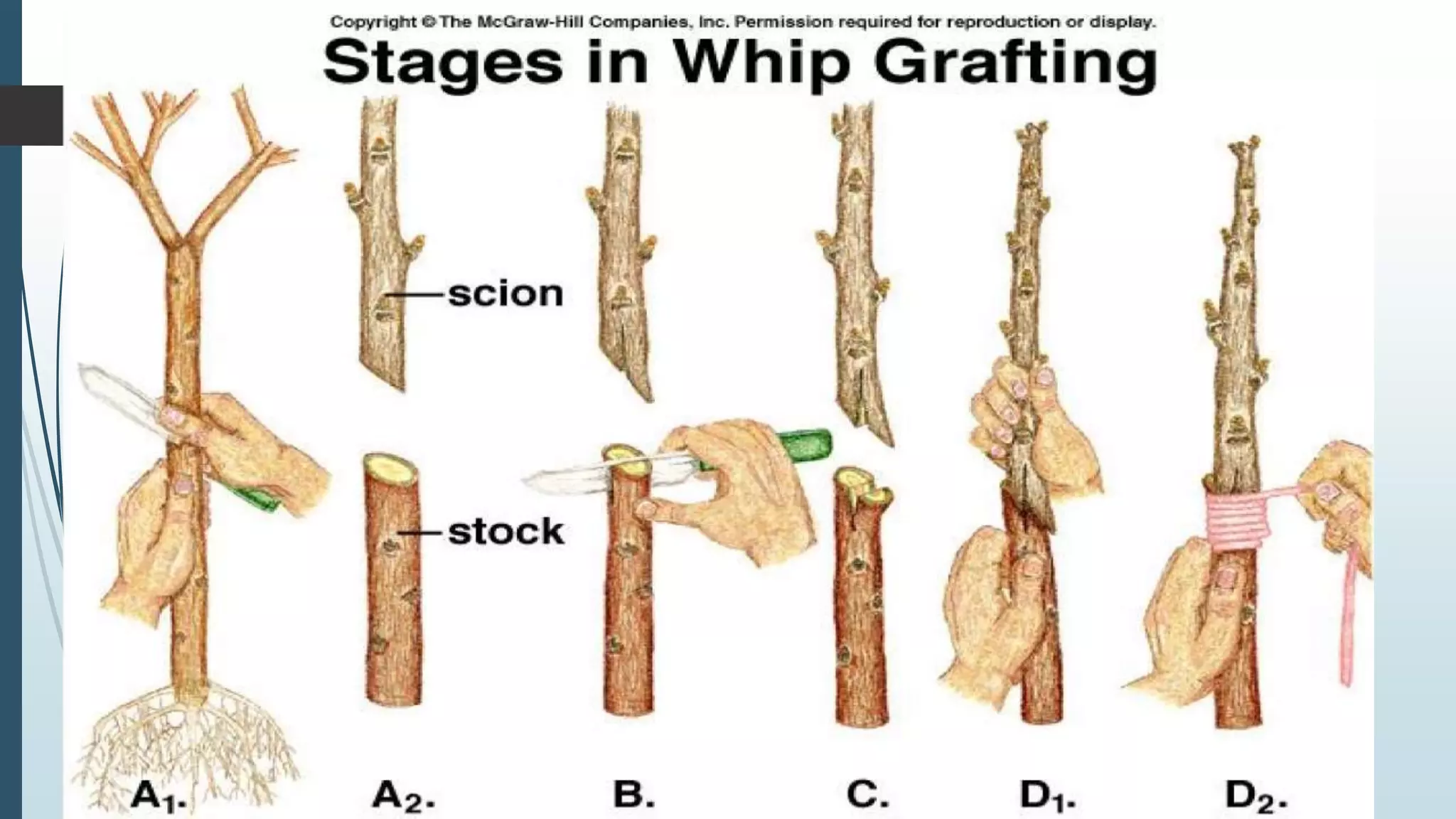
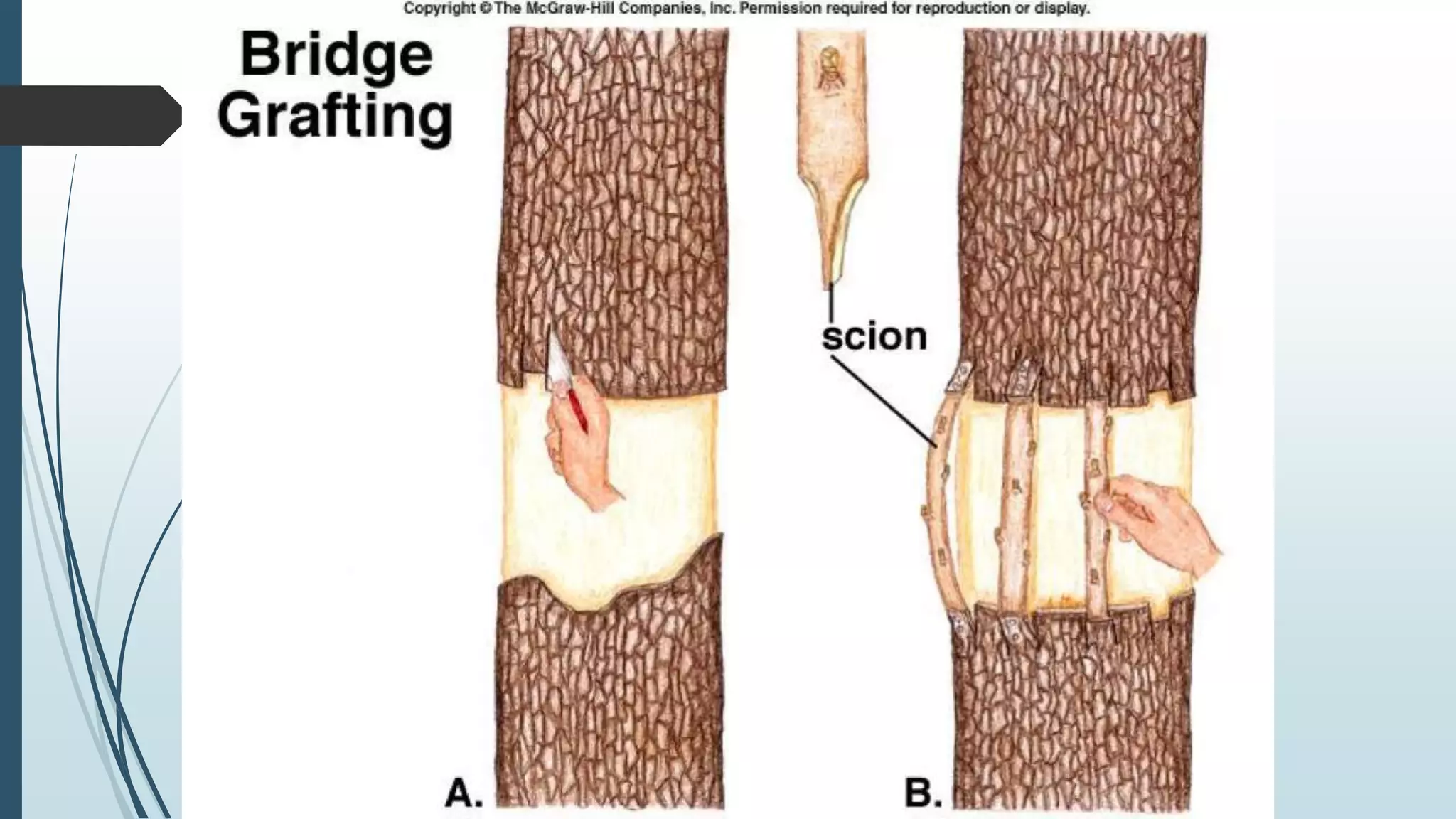
Grafting and budding are methods of asexual plant propagation that join parts from two different plants so they will grow as one. Grafting is used to propagate plants where other methods won't work, change cultivars on established plants, repair damaged tree parts, and produce fruit faster. Successful grafting requires aligning the cambium layers between the stock and scion for the tissues to fuse. Common grafting tools include knives, shears, and tying materials. Common grafting types include wedge, cleft, and whip grafting. Budding involves transplanting a bud with a small section of bark onto a rootstock plant. Layering induces adventitious root formation on stems that are then detached to form new
What Is aGraft?
Grafting and budding are methods of asexual
plant propagation that join parts from two
different plants so they will grow as one plant.
3.
Why do wedo graft?
Propagate the plants where other methods would
not worked
Change cultivar on established plant
Repair damage tree parts
Faster production of new fruit 2/3 vs 5/7 years
Novelties – more than one cultivar on one tree
4.
Grafting terms
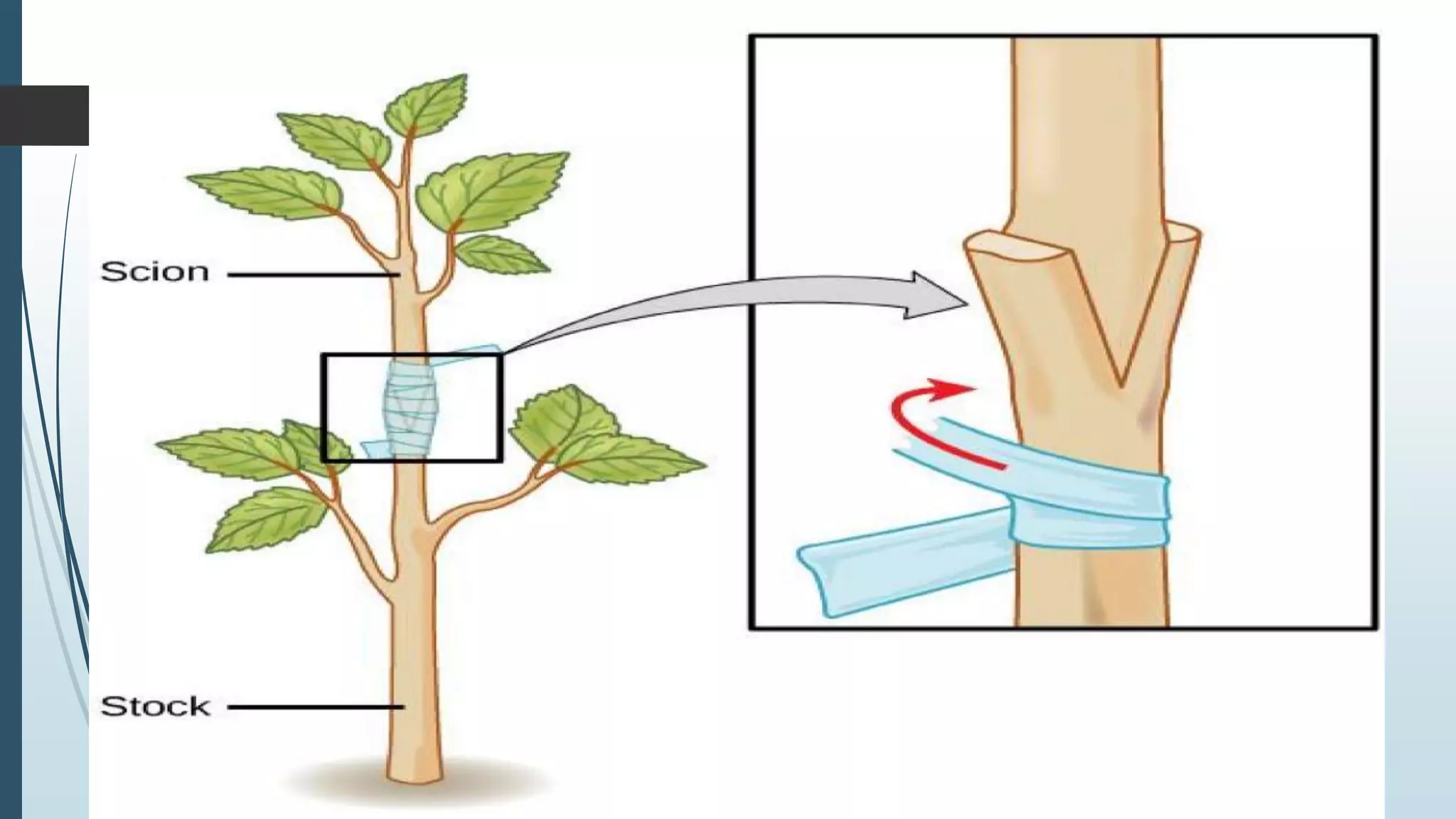
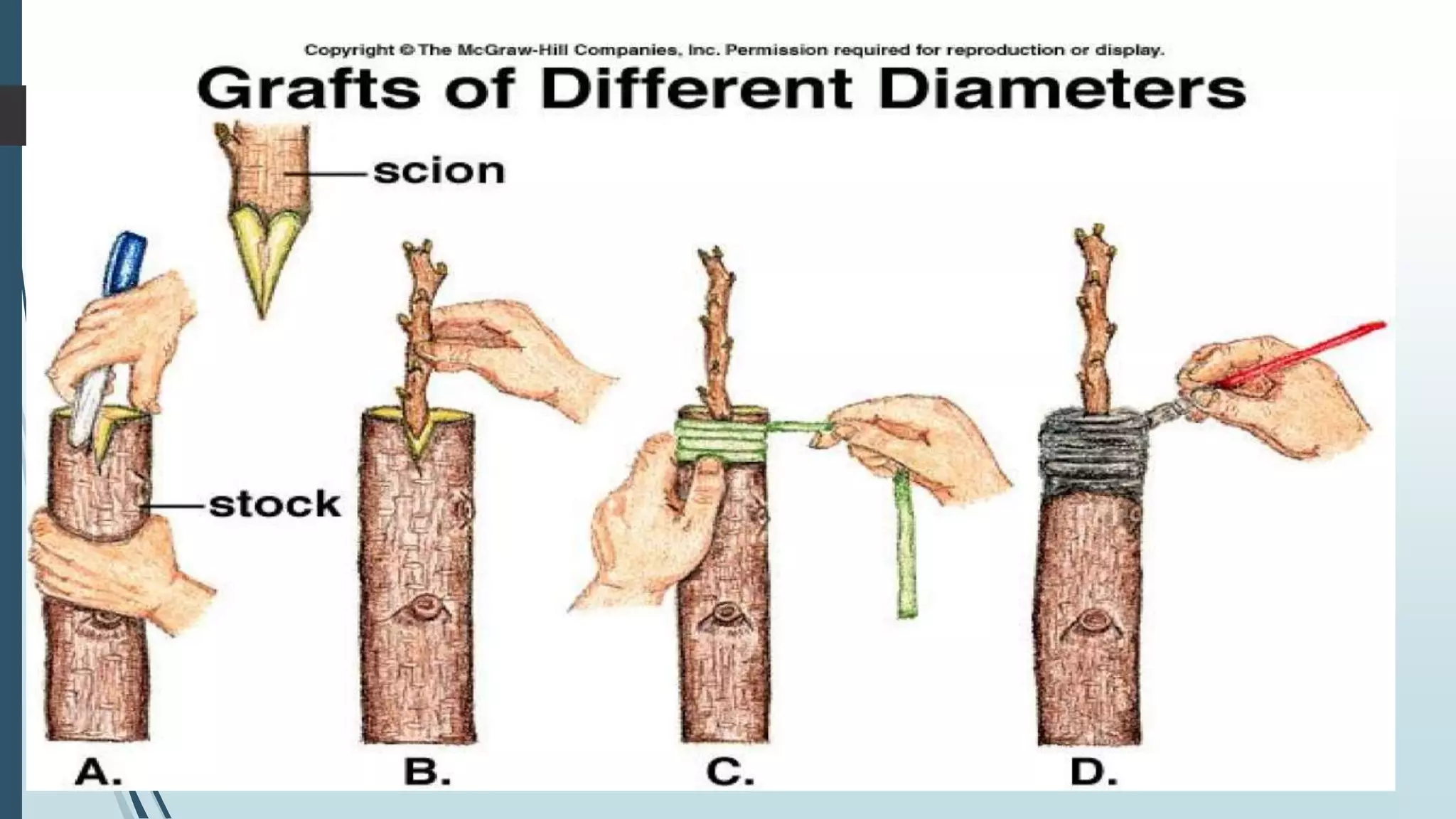
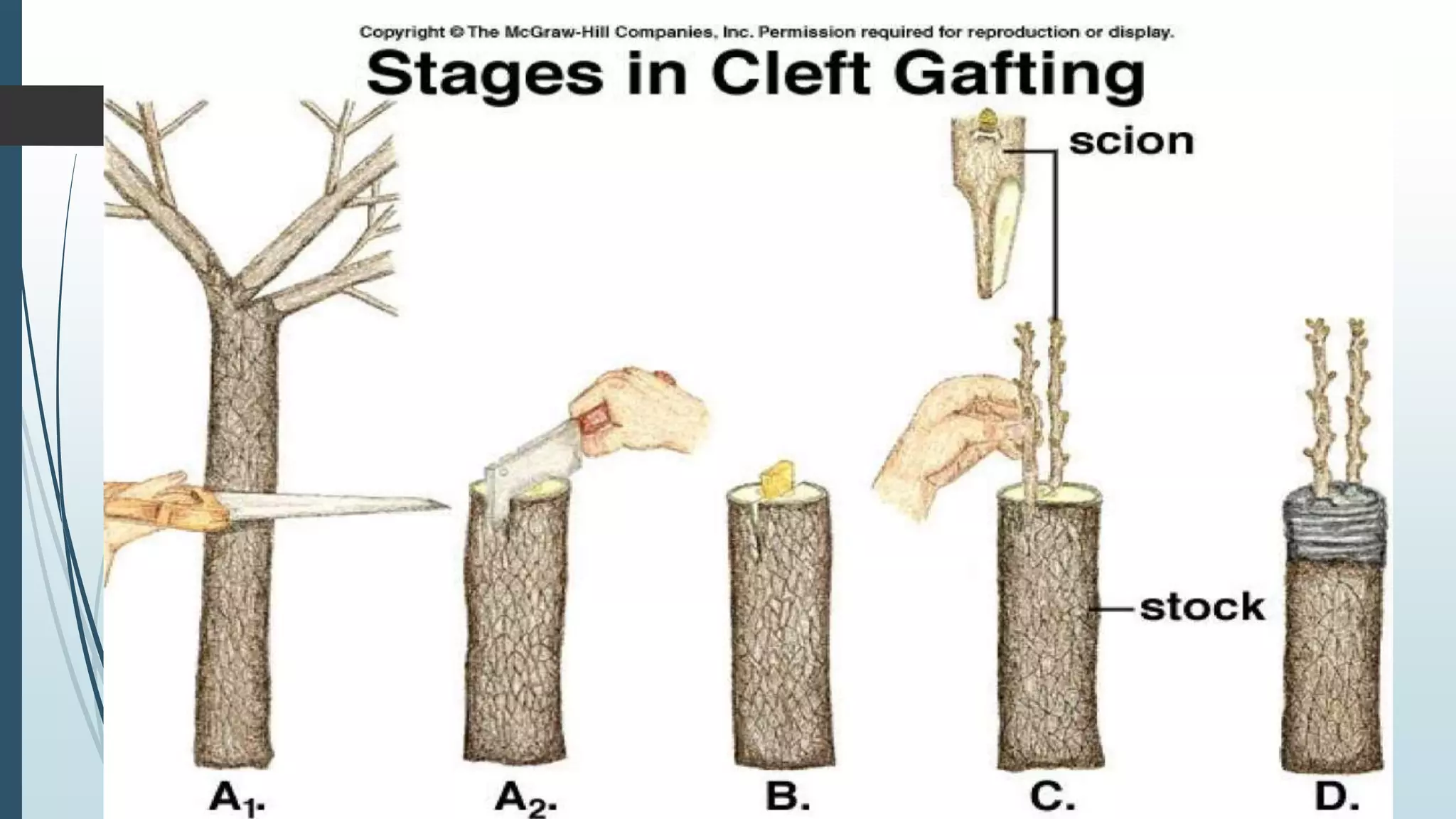
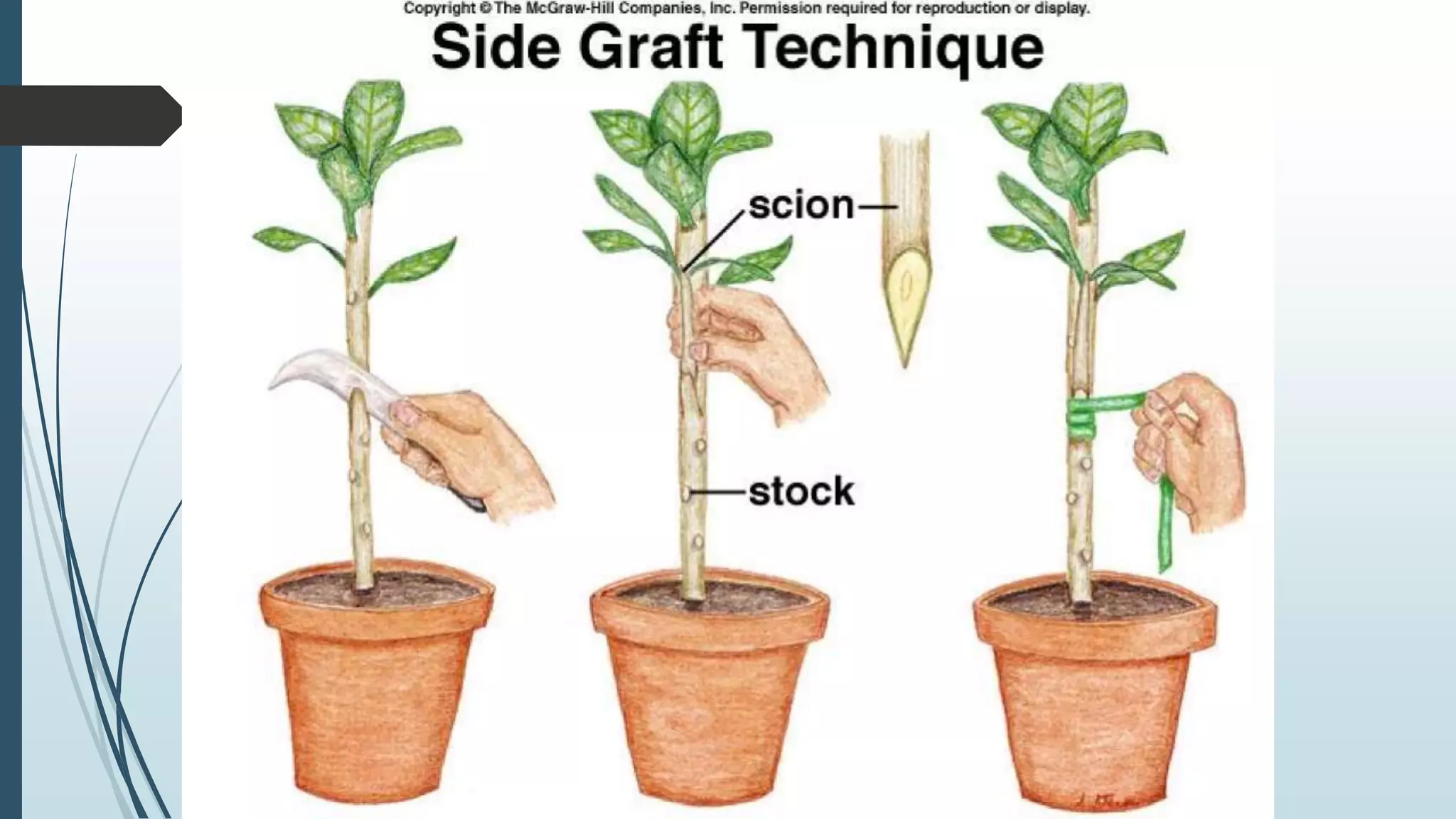
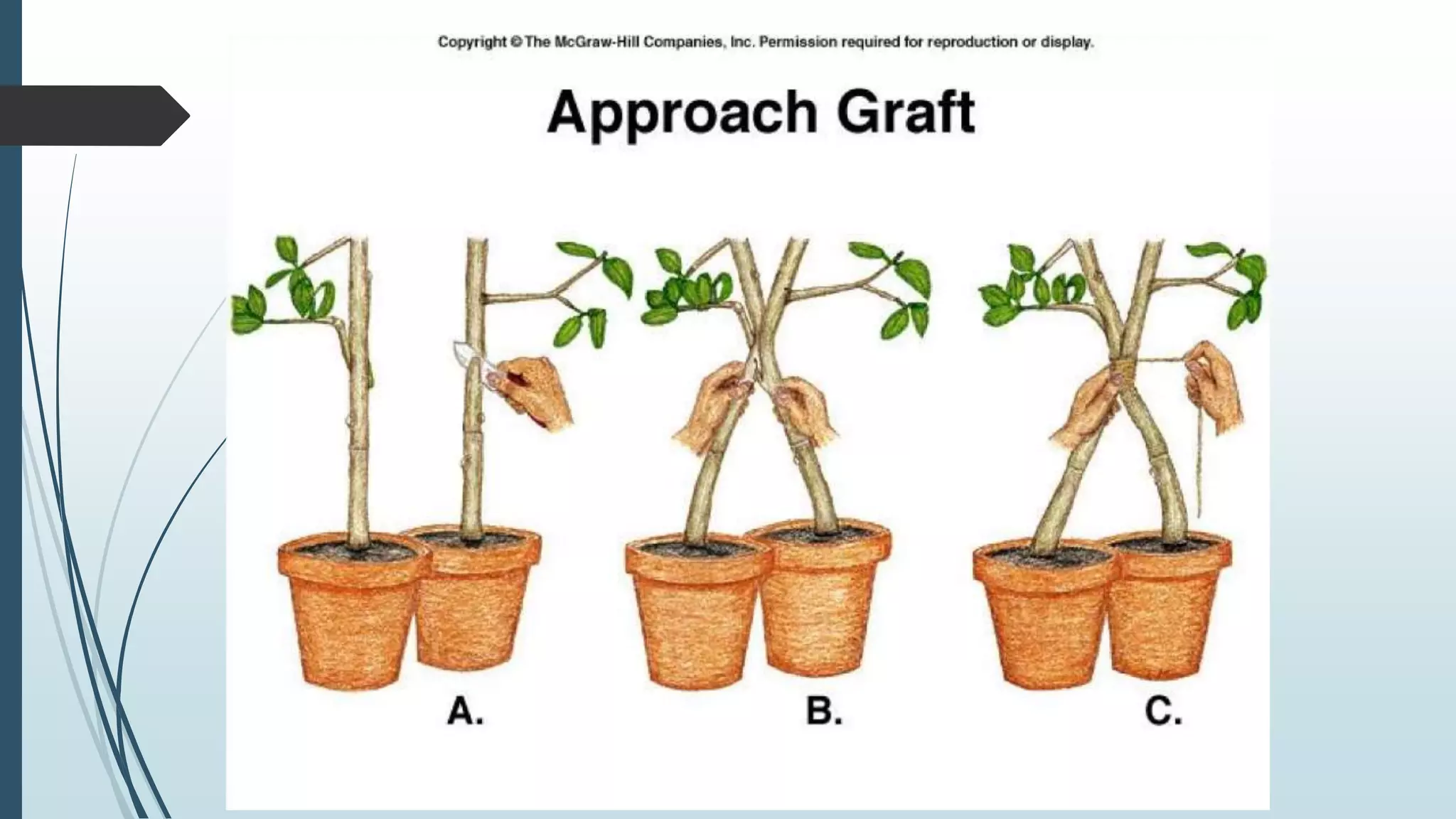
Grafting: Joiningtwo plant pieces to make one
plant
Scion: Detached shoot from last year’s growth
with dormant buds, upper graft part.
Stock: Basal part of the graft (understock or
rootstock)
5.
Interstock: Stem piecesadded between stock &
scion
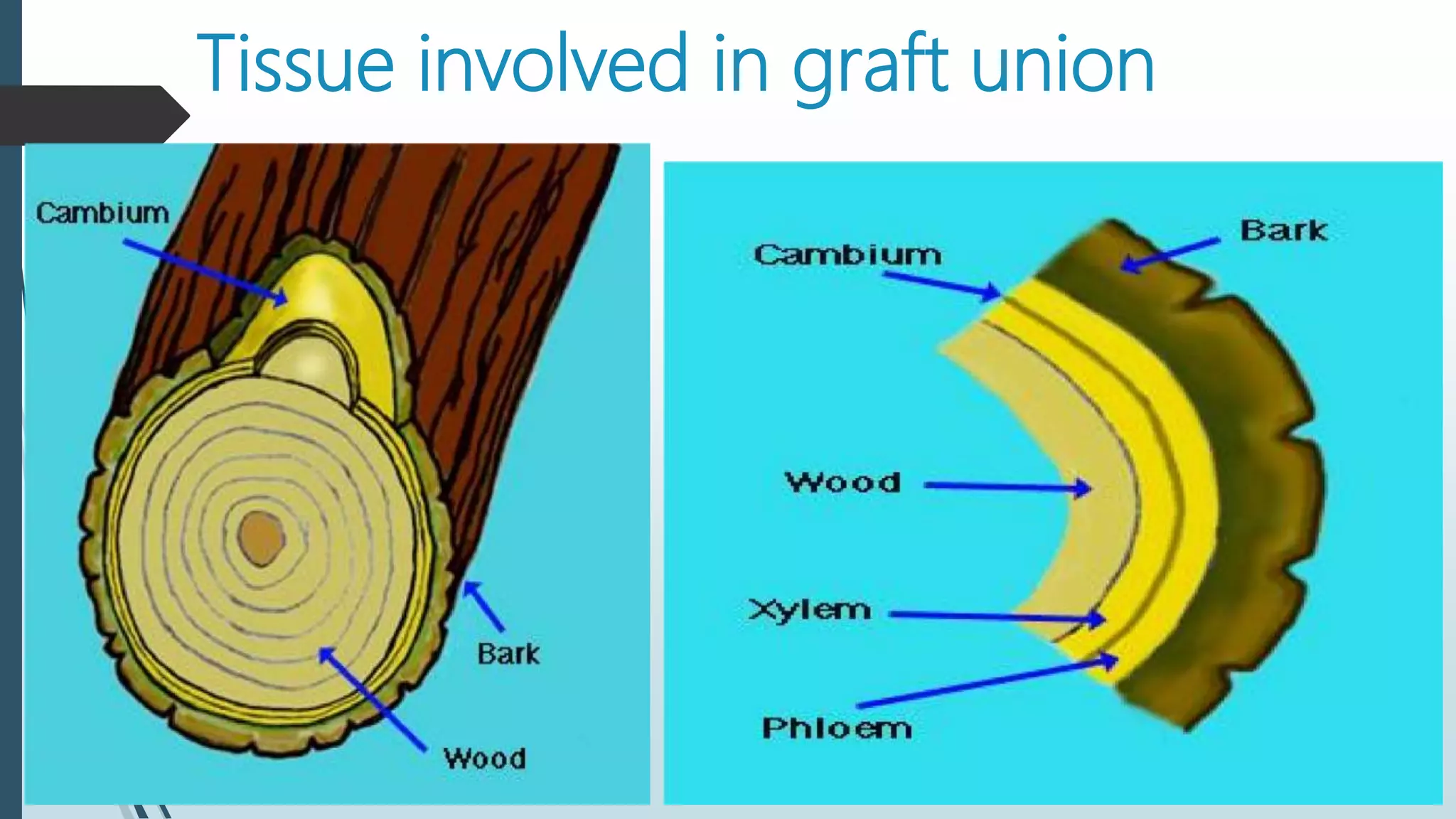
Cambium: This is a single layer of cells between
the wood and bark. It must be lined up for a
good graft union.
6.
Steps in Healing
Tissuesinvolved are the Xylem, Phloem and
Cambium
Callus from stock & scion fill the space and interlock
to form “callusbridge”
Callus cells in line between stock & scion cambium
change into cambium cells
New cambium produce Xylem & Phloem in wound
to establish a vascular connection.
Field Preparation forMango
Dig Pits of 1m X 1m X 1m
Fill with top soil mixed with 10kg FYM
and 100g Lindane 1.3% dust per pit
20.
Planting Mango Graft
Oneyear old Grafts are planted in the centre of
the pit with ball of earth intact followed by
watering and staking.
The graft union must be 15cm above the
ground level
The spacing followed in mango orchard is 10 X
10m, in high density planting that can be
reduced to 6m X 6m/ 5m X 5m
21.
Manures and Fertilizers
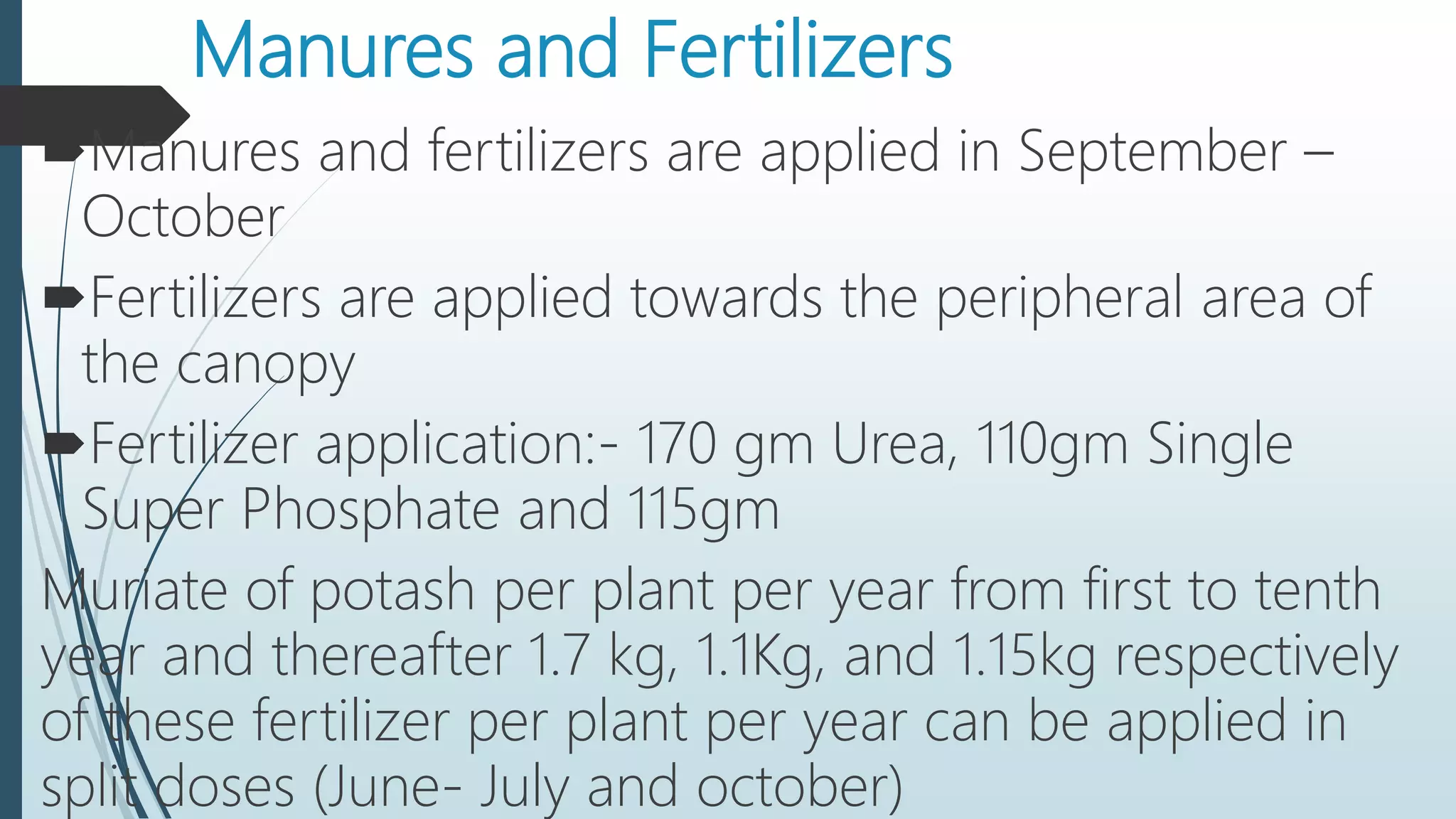
Manuresand fertilizers are applied in September –
October
Fertilizers are applied towards the peripheral area of
the canopy
Fertilizer application:- 170 gm Urea, 110gm Single
Super Phosphate and 115gm
Muriate of potash per plant per year from first to tenth
year and thereafter 1.7 kg, 1.1Kg, and 1.15kg respectively
of these fertilizer per plant per year can be applied in
split doses (June- July and october)
22.
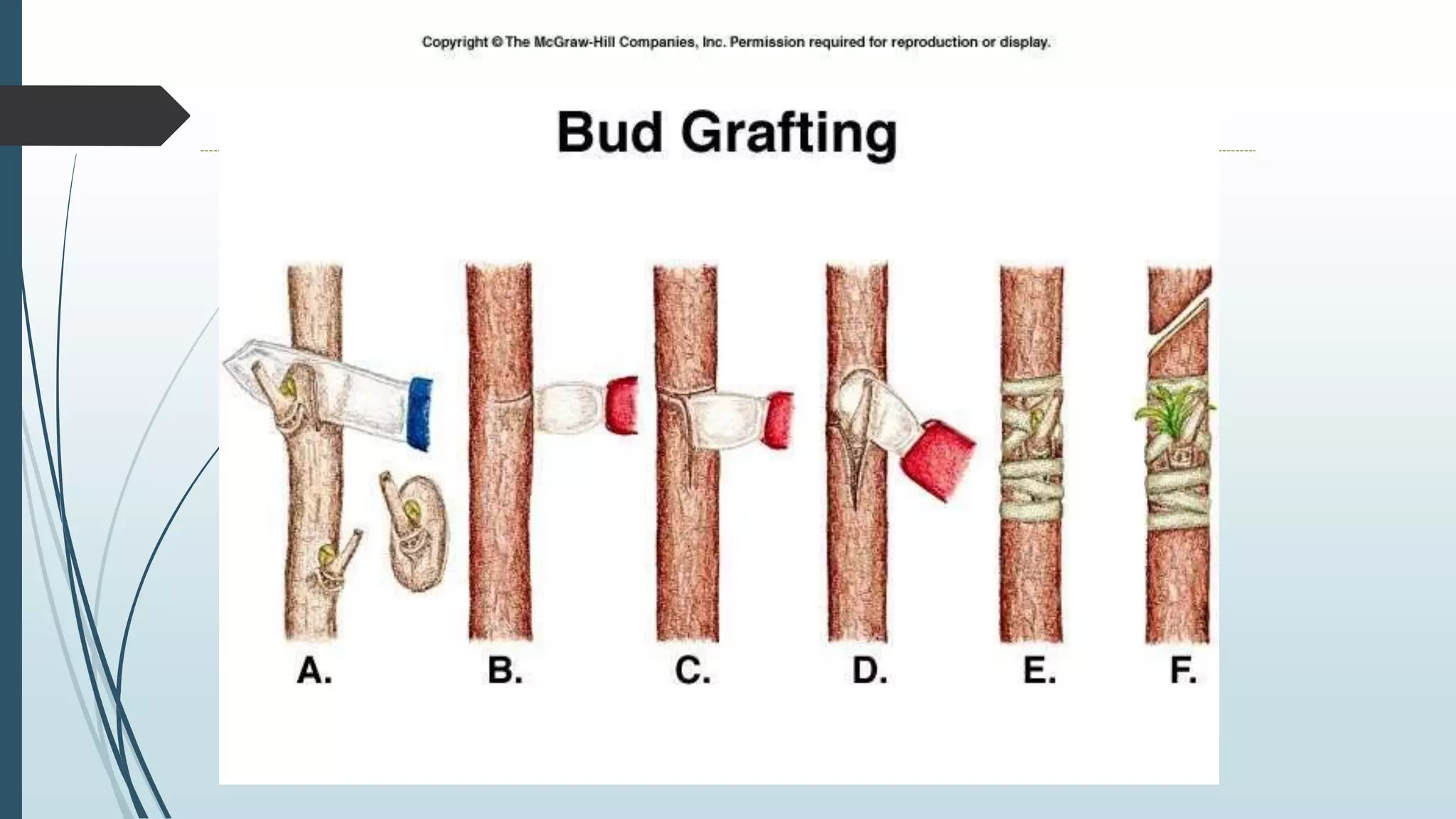
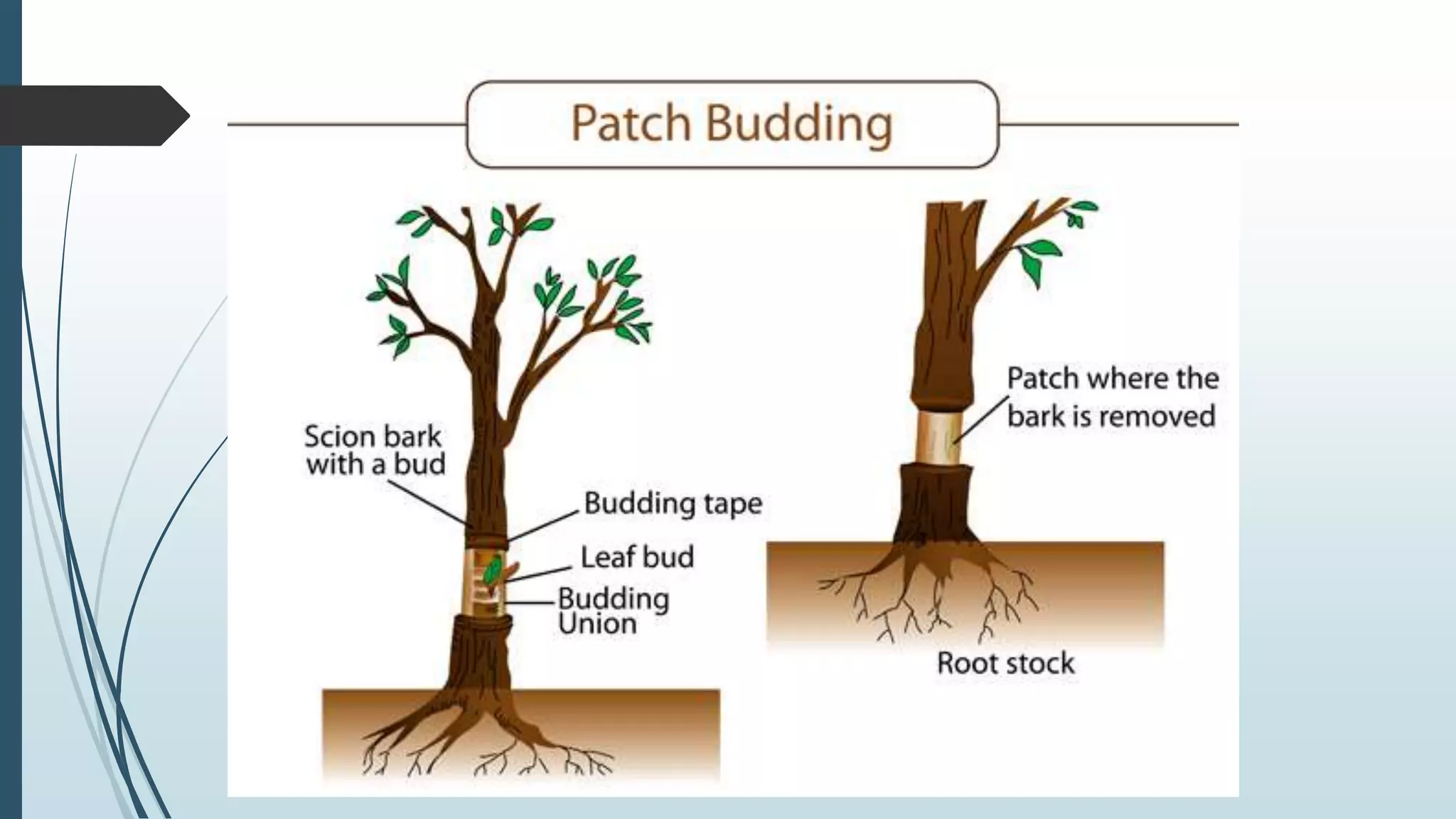
Budding
It is theform of grafting in which one bud and
a small section of bark with or without wood is
used.
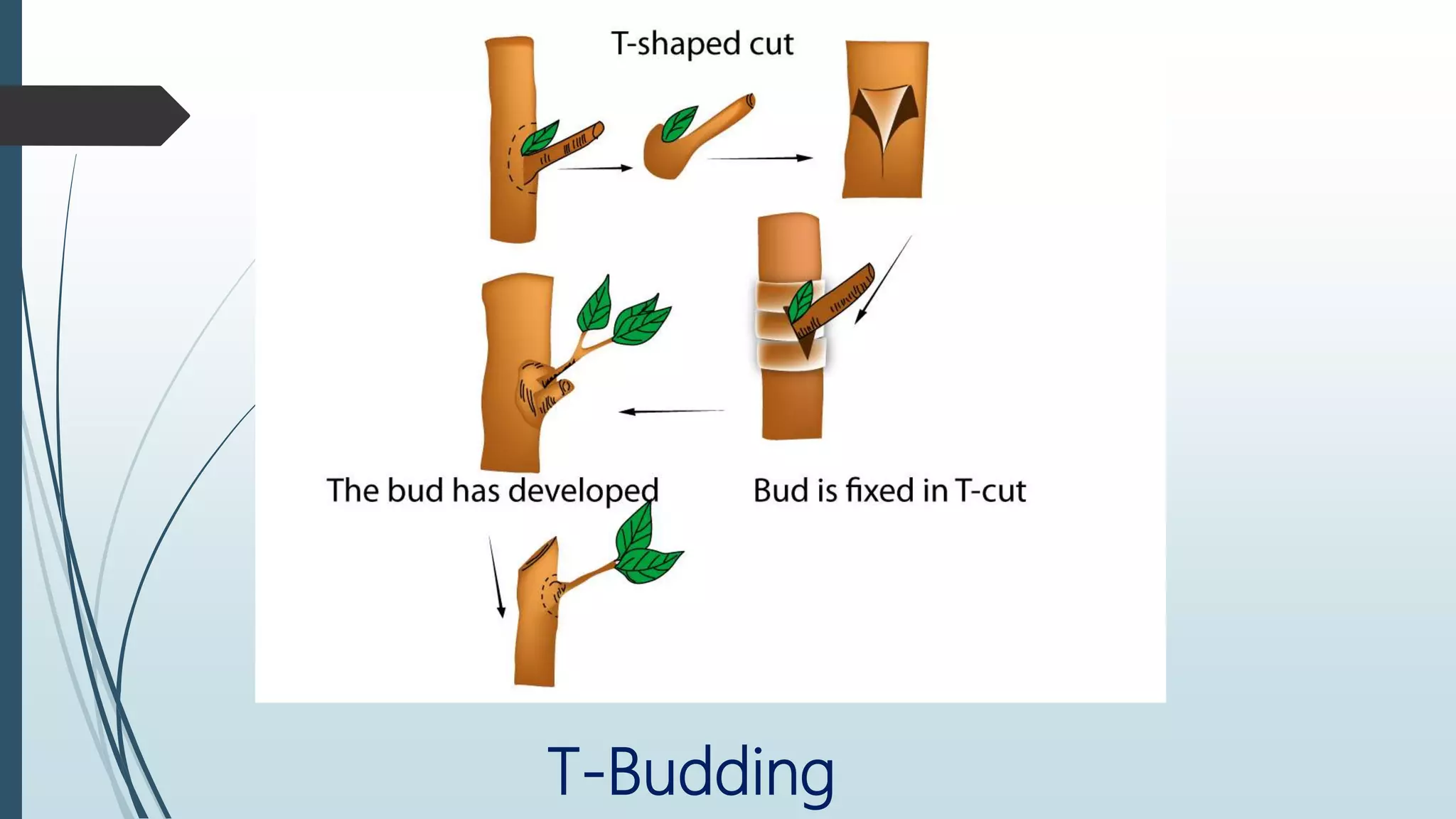
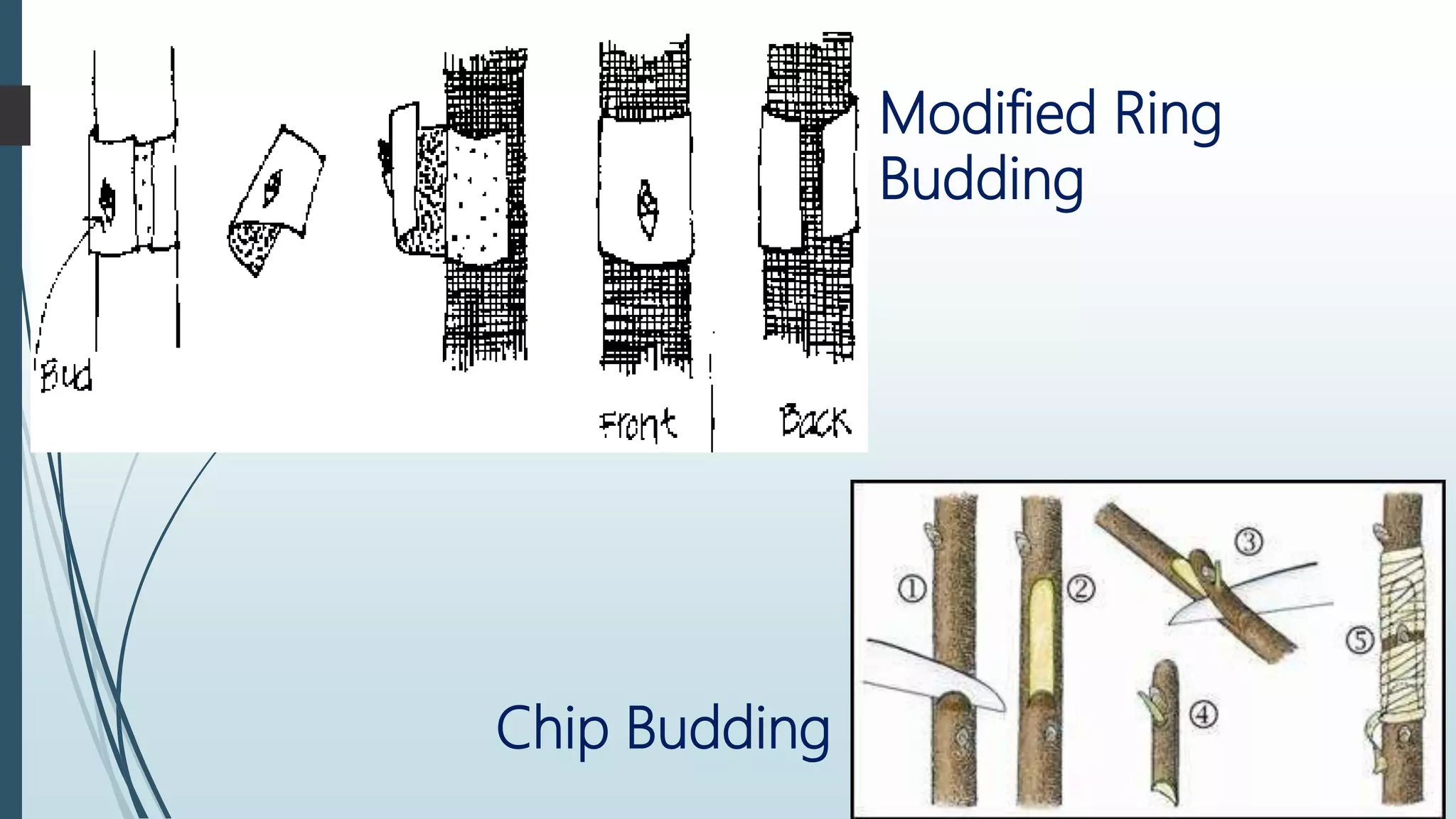
Chip budding and T-budding are the most
important types of budding for fruit crops and
woody ornamentals.
23.
Types of Budding
1.Shield budding or T-budding
2.Patch budding
3.Chip budding
4.Ring budding
5.Modified ring budding
Grafting and Budding
Precautions
Cambiallayers of stock and scion must meet
Parts must be held securely keep air out —
Union heals by callus production Adequate
temperature for cell division There are limitations!
All the equipment's should be well sterilized
29.
Layering
It is theform of rooting of cuttings in which
adventitious roots are initiated on a stem(layer)
is then detached, transplanted, while later
becomes a separate plant on its own roots.
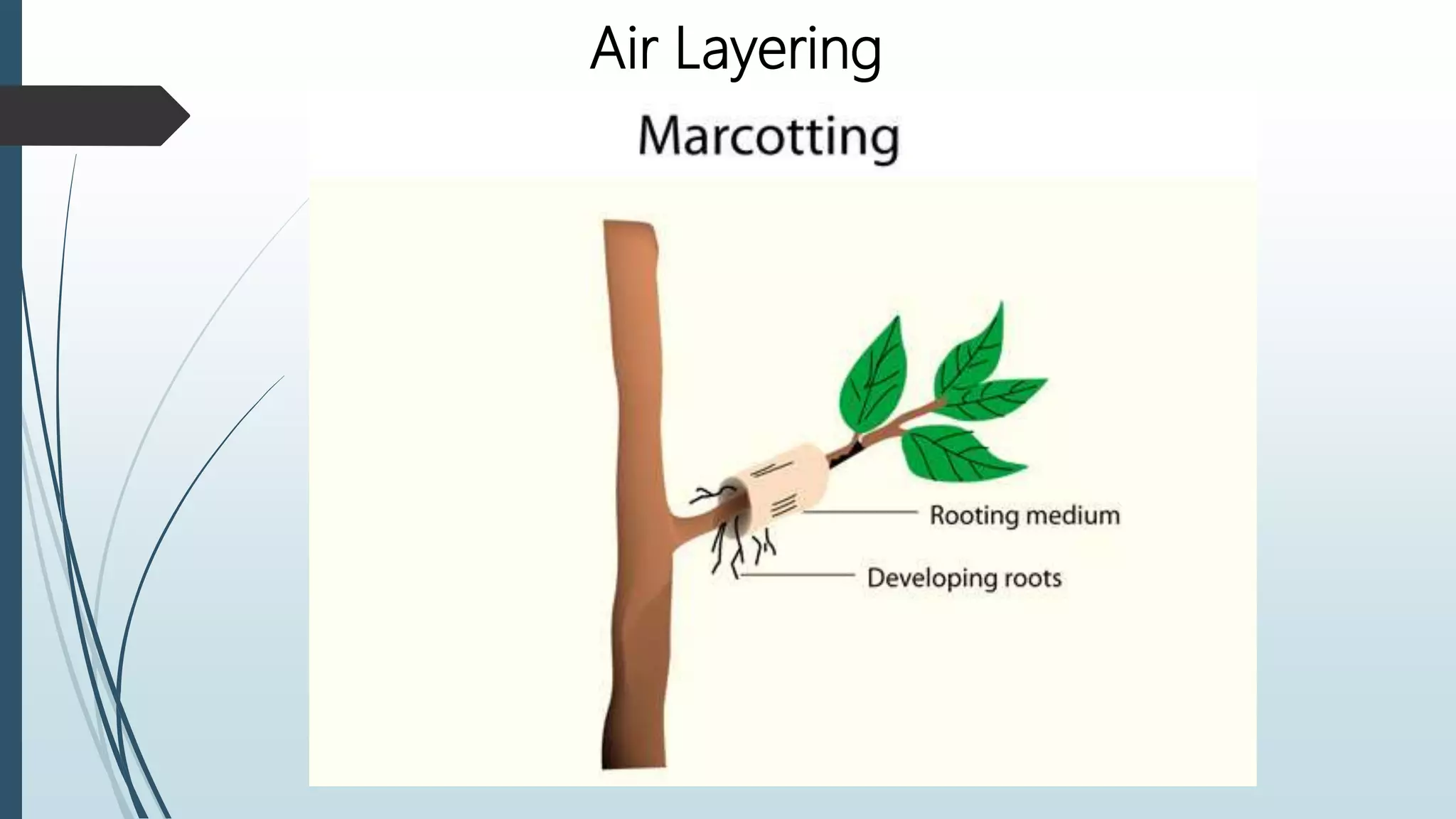
Air layering is mostly preferred in
Sapota(chickoo), Guava,etc.
30.
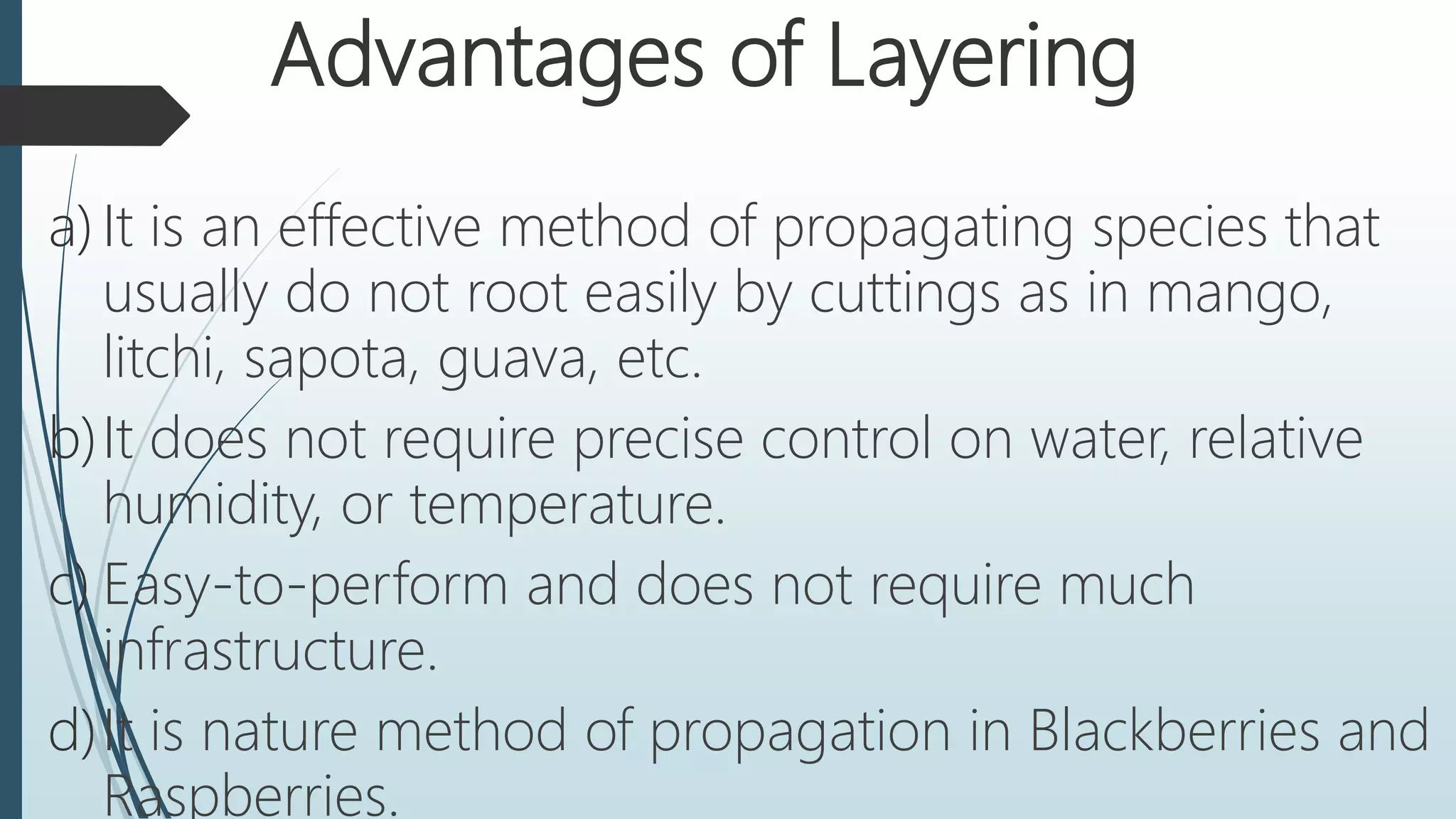
Advantages of Layering
a)It is an effective method of propagating species that
usually do not root easily by cuttings as in mango,
litchi, sapota, guava, etc.
b)It does not require precise control on water, relative
humidity, or temperature.
c) Easy-to-perform and does not require much
infrastructure.
d)It is nature method of propagation in Blackberries and
Raspberries.
31.
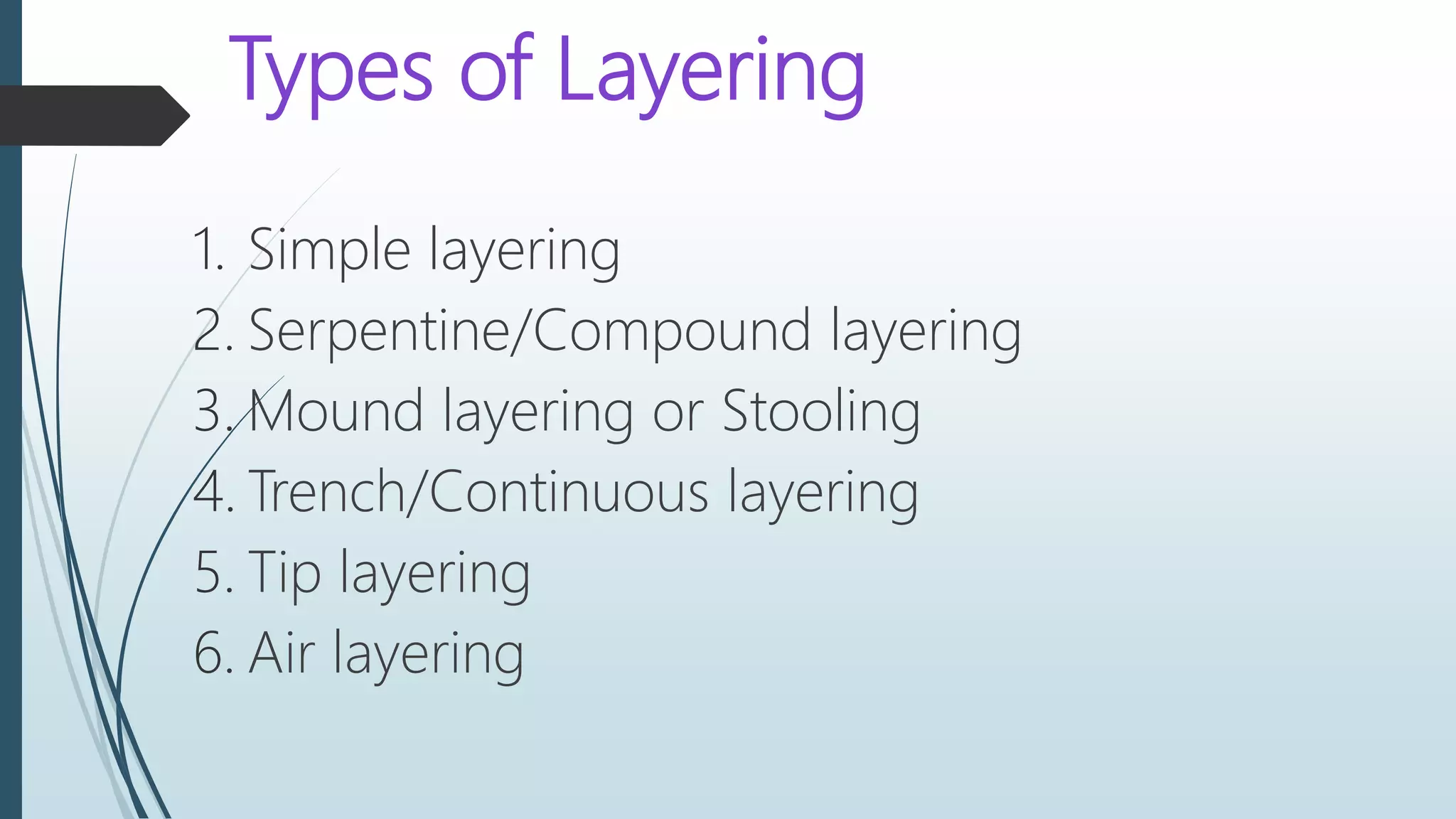
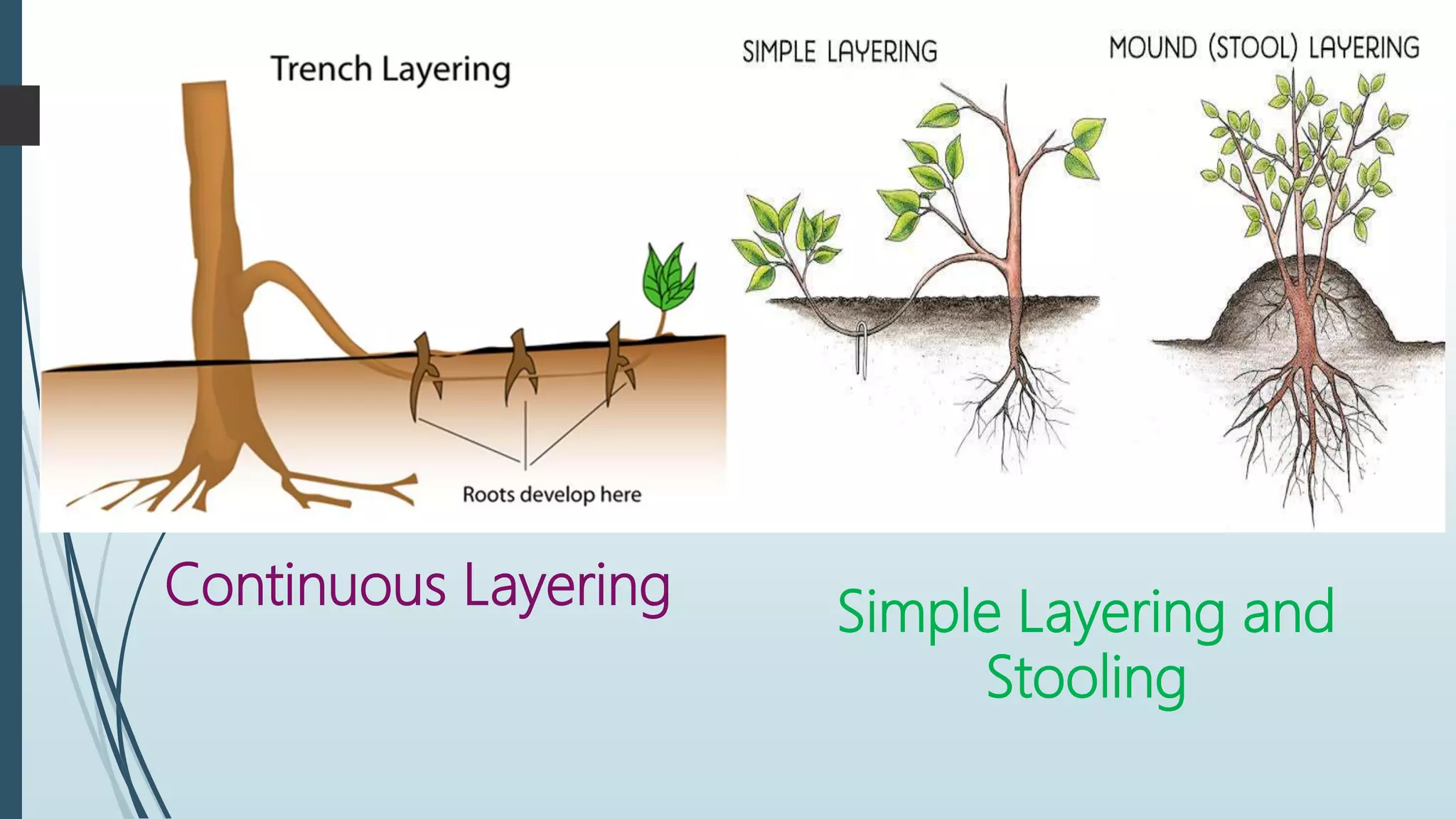
Types of Layering
1.Simple layering
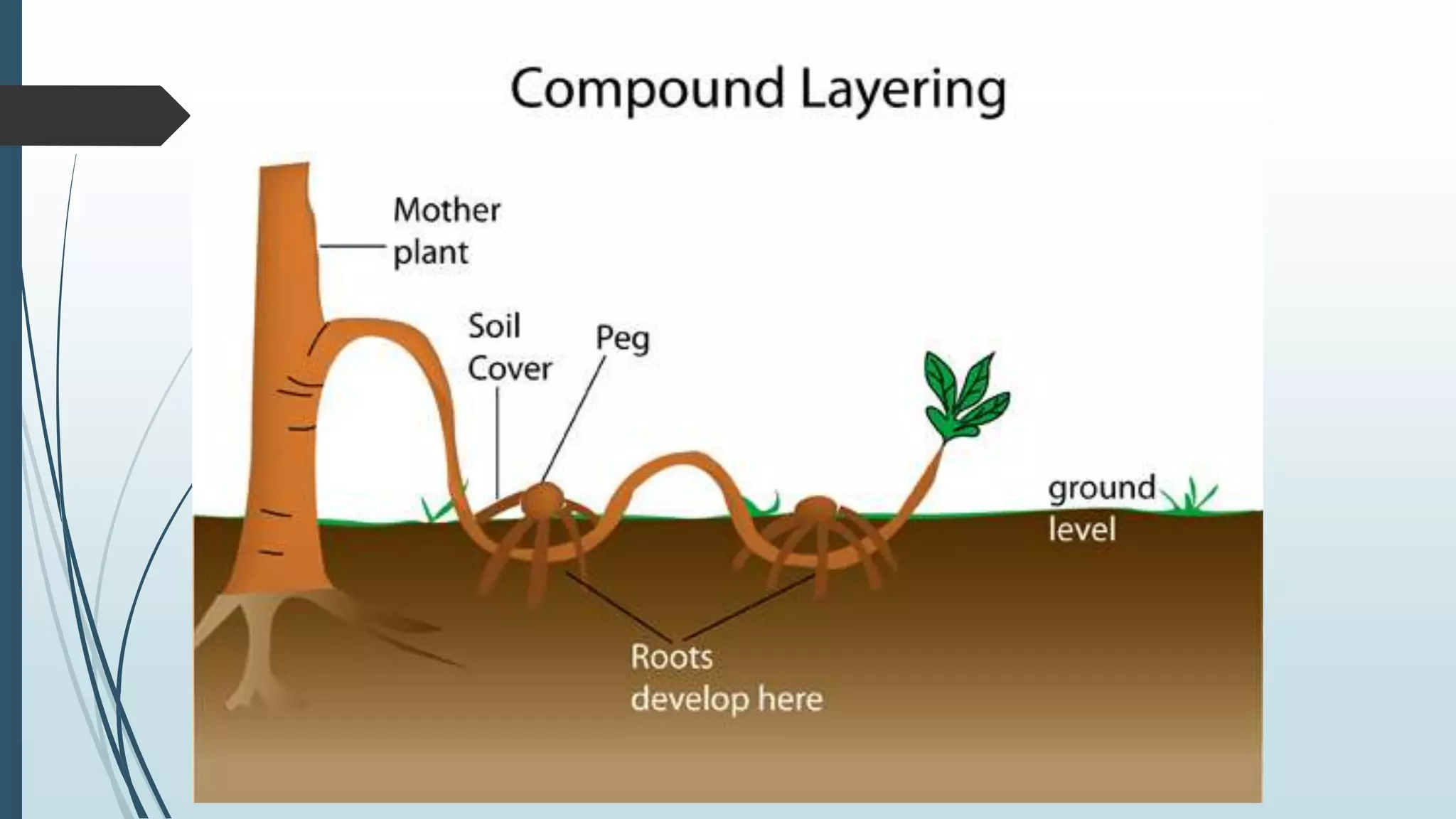
2. Serpentine/Compound layering
3. Mound layering or Stooling
4. Trench/Continuous layering
5. Tip layering
6. Air layering




![Principle & different method of cutting & layering]](https://cdn.slidesharecdn.com/ss_thumbnails/principledifferentmethodofcuttinglayering-160528152633-thumbnail.jpg?width=640&height=640&fit=bounds)


![grafting and budding [Autosaved]....pptx](https://cdn.slidesharecdn.com/ss_thumbnails/graftingandbuddingautosaved-250508034509-fb3fab88-thumbnail.jpg?width=640&height=640&fit=bounds)


