Special Tracking System Specialized Solution for Field-Operation Management
The Special Tracking System is a specially designed system for the Management, Command and Control of remote field operations, such as: Military operations which require accurate information on the location and status of the soldiers on the field. Field operation of paramilitary forces such as SWAT-Teams and VIP protection teams. Field Operation of Undercover Tracking Missions. Special Tracking System
Special Tracking System Elements The system is comprised of the following elements: Miniature Tracking Units that are placed on the soldier/agents that operate on the field. Tracking Units that are mounted on vehicles that should be tracked and monitored. Different types of Command and Control (C4I) Stations – for Management, Command and Control of the forces on the field.
Military Operation Soldiers Equipped with  Personnel Tracking Unit Central Command Stations Mobile Command Stations Combat Vehicles Equipped With Ruggedized Units Cellular Network Combat Vehicles Equipped with Friendly Vehicle Units
S.W.A.T. Team Operation SWAT  Fighters  Equipped with  Personnel Tracking Unit SWAT Vehicles  Equipped with  Tracking Units Central Command Stations Mobile Command Stations Hostile Terorists Cellular Network
V.I.P. Protection Operation Secret Agents  Equipped with  Personnel Tracking Unit Central Command Stations Mobile Command Stations V.I.P. Convoy Equipped With Tracking Units  Cellular Network Vehicles of the Organization Equipped with  Friendly Vehicle Units Uniform Policemen Equipped with  Personnel Tracking Unit
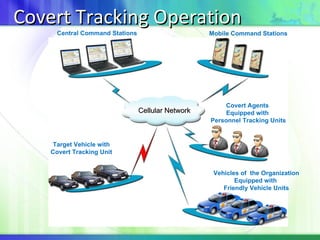
Covert Tracking Operation Central Command Stations Mobile Command Stations Covert Agents  Equipped with  Personnel Tracking Units Vehicles of  the Organization Equipped with  Friendly Vehicle Units Target Vehicle with Covert Tracking Unit Cellular Network
The Units Weatherproof V6 Unit Weatherproof V8 Unit V10 Unit Weatherproof V10 Unit Friendly Vehicle Unit
The Tracking and location Units contain the following components: GPS Receiver Cellular Modem Motion Sensor Internal Memory for Data Logging Audio Microphone (in some of the units) The Tracking Units Structure
The V10 Unit A compact location unit carried by soldiers or mounted on the bodies of Covert Agents. The unit can send continuous information regarding the precise location of Soldiers/Covert-Agents on the field. Enables to open an Audio Session towards the soldier/covert-agent, in order to monitor his situation and listen to conversations he is having with different persons on the field. The unit comes in two possible cases : Rigid Weatherproof Case, sealed for weather conditions Thin Unsealed Case, enables to better conceal the unit on the body of the Covert Agent. It is possible to have the unit equipped with a Panic Button.
The V6 Unit Specially designed unit for Covert Tracking after Target Vehicles. A compact and autonomous unit, with internal battery house. The unit’s case is totally sealed against weather conditions. The unit includes powerful magnets for easy installation on Target Tracked Vehicles.
The V8 Unit Specially designed unit for Covert Tracking after Target Vehicles. The unit’s case is even smaller than the V6 unit; however it does not contain an internal battery. It is possible to feed the unit with power by either: A waterproof External Battery Pack with strong magnets. A Power Cable that can be connected to the Vehicle’s Power System (12V/24V). The unit is totally sealed against weather conditions. The unit includes powerful magnets for easy installation on Target Tracked Vehicles.
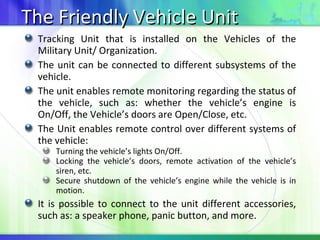
The Friendly Vehicle Unit Tracking Unit that is installed on the Vehicles of the Military Unit/ Organization. The unit can be connected to different subsystems of the vehicle. The unit enables remote monitoring regarding the status of the vehicle, such as: whether the vehicle’s engine is On/Off, the Vehicle’s doors are Open/Close, etc. The Unit enables remote control over different systems of the vehicle: Turning the vehicle’s lights On/Off. Locking the vehicle’s doors, remote activation of the vehicle’s siren, etc. Secure shutdown of the vehicle’s engine while the vehicle is in motion. It is possible to connect to the unit different accessories, such as: a speaker phone, panic button, and more.
The System’s Command Stations The system can be operated by a Single Command Center, or by several Command Centers that can monitor the same operation simultaneously. The system has two types of Command Centers: Central Command Center - mounted on a PC/Server Computer. Mobile Command Center - mounted on a Smart Phone. The Central Command Centers are often mounted on Laptops, in order to enable full mobility. It is also possible to install the Command Center on regular Desktop or Server-Computers – according to the required architecture of the system.
The Command Center Structure:   The Communication Module Manages the communication between the Command Center and the different End Units on the field. The Maps Module (GIS) Enables the display of the End Units on Digital Maps. It is possible to integrate to the Command Center different types of Digital Maps, such as:  Raster Maps Vector Maps Aerial Photo Maps Topographical Maps City Maps, etc. The Database Module Registers all the messages sent by the End Units. Enables to store and restore all the movements of people and vehicles on the field.
Operation Of The End-Units The End-Units support two possible modes of tracking, that can be operated in parallel:  Real-Time Tracking – The units send immediate location messages to the Command Center. Log Tracking – The location data is registered into the internal memory of the unit, and can be later downloaded to the Command Center. The complete setting and command of the units is done by remote control. The units can send the location messages over the data channel of the cellular network, or by SMS messages. The communication between the End-Units and the Command Center is encrypted  in order to protect the nature of data.
The Location Messages Each location message that is sent from the End-Units to the Command Center, contain the following information: The location data. Timestamp of the location. Number of available GPS satellites. Speed and direction of movement. The battery status. Bitmap of all the unit’s alerts. The Cell ID to which the unit is registered. The serial number of the message. The data above is sent over a special binary protocol, with the length of only 35 Bytes! (a quarter of an SMS). The compressed structure of the protocol saves transmission time and therefore contributes to the prolonged time of operation of the units.
The System’s Design The System’s Units were designed with the intent to give a solution to three main operational demands: Ease of Use : The extremely compact size of the units does not restrict the movements of the soldier/ agent on the field. The size of the units avoids the detection of the units installed on Covert Agents and Target Tracked Vehicles. Extended time of operation: The unit's design includes special hardware and software developments that enable the unit to work for a prolonged period of time in reference to the energy pack in use. The Unit's prolonged operational time surpasses the performance of any similar system in the world. Operation Reliability in harsh field conditions: The units are designed to reliably work under hash field conditions. The units are currently being used in combat operations by NATO military forces in known conflicting areas around the world.
 

Special tracking system

  • 1.
    Special Tracking SystemSpecialized Solution for Field-Operation Management
  • 2.
    The Special TrackingSystem is a specially designed system for the Management, Command and Control of remote field operations, such as: Military operations which require accurate information on the location and status of the soldiers on the field. Field operation of paramilitary forces such as SWAT-Teams and VIP protection teams. Field Operation of Undercover Tracking Missions. Special Tracking System
  • 3.
    Special Tracking SystemElements The system is comprised of the following elements: Miniature Tracking Units that are placed on the soldier/agents that operate on the field. Tracking Units that are mounted on vehicles that should be tracked and monitored. Different types of Command and Control (C4I) Stations – for Management, Command and Control of the forces on the field.
  • 4.
    Military Operation SoldiersEquipped with Personnel Tracking Unit Central Command Stations Mobile Command Stations Combat Vehicles Equipped With Ruggedized Units Cellular Network Combat Vehicles Equipped with Friendly Vehicle Units
  • 5.
    S.W.A.T. Team OperationSWAT Fighters Equipped with Personnel Tracking Unit SWAT Vehicles Equipped with Tracking Units Central Command Stations Mobile Command Stations Hostile Terorists Cellular Network
  • 6.
    V.I.P. Protection OperationSecret Agents Equipped with Personnel Tracking Unit Central Command Stations Mobile Command Stations V.I.P. Convoy Equipped With Tracking Units Cellular Network Vehicles of the Organization Equipped with Friendly Vehicle Units Uniform Policemen Equipped with Personnel Tracking Unit
  • 7.
    Covert Tracking OperationCentral Command Stations Mobile Command Stations Covert Agents Equipped with Personnel Tracking Units Vehicles of the Organization Equipped with Friendly Vehicle Units Target Vehicle with Covert Tracking Unit Cellular Network
  • 8.
    The Units WeatherproofV6 Unit Weatherproof V8 Unit V10 Unit Weatherproof V10 Unit Friendly Vehicle Unit
  • 9.
    The Tracking andlocation Units contain the following components: GPS Receiver Cellular Modem Motion Sensor Internal Memory for Data Logging Audio Microphone (in some of the units) The Tracking Units Structure
  • 10.
    The V10 UnitA compact location unit carried by soldiers or mounted on the bodies of Covert Agents. The unit can send continuous information regarding the precise location of Soldiers/Covert-Agents on the field. Enables to open an Audio Session towards the soldier/covert-agent, in order to monitor his situation and listen to conversations he is having with different persons on the field. The unit comes in two possible cases : Rigid Weatherproof Case, sealed for weather conditions Thin Unsealed Case, enables to better conceal the unit on the body of the Covert Agent. It is possible to have the unit equipped with a Panic Button.
  • 11.
    The V6 UnitSpecially designed unit for Covert Tracking after Target Vehicles. A compact and autonomous unit, with internal battery house. The unit’s case is totally sealed against weather conditions. The unit includes powerful magnets for easy installation on Target Tracked Vehicles.
  • 12.
    The V8 UnitSpecially designed unit for Covert Tracking after Target Vehicles. The unit’s case is even smaller than the V6 unit; however it does not contain an internal battery. It is possible to feed the unit with power by either: A waterproof External Battery Pack with strong magnets. A Power Cable that can be connected to the Vehicle’s Power System (12V/24V). The unit is totally sealed against weather conditions. The unit includes powerful magnets for easy installation on Target Tracked Vehicles.
  • 13.
    The Friendly VehicleUnit Tracking Unit that is installed on the Vehicles of the Military Unit/ Organization. The unit can be connected to different subsystems of the vehicle. The unit enables remote monitoring regarding the status of the vehicle, such as: whether the vehicle’s engine is On/Off, the Vehicle’s doors are Open/Close, etc. The Unit enables remote control over different systems of the vehicle: Turning the vehicle’s lights On/Off. Locking the vehicle’s doors, remote activation of the vehicle’s siren, etc. Secure shutdown of the vehicle’s engine while the vehicle is in motion. It is possible to connect to the unit different accessories, such as: a speaker phone, panic button, and more.
  • 14.
    The System’s CommandStations The system can be operated by a Single Command Center, or by several Command Centers that can monitor the same operation simultaneously. The system has two types of Command Centers: Central Command Center - mounted on a PC/Server Computer. Mobile Command Center - mounted on a Smart Phone. The Central Command Centers are often mounted on Laptops, in order to enable full mobility. It is also possible to install the Command Center on regular Desktop or Server-Computers – according to the required architecture of the system.
  • 15.
    The Command CenterStructure: The Communication Module Manages the communication between the Command Center and the different End Units on the field. The Maps Module (GIS) Enables the display of the End Units on Digital Maps. It is possible to integrate to the Command Center different types of Digital Maps, such as: Raster Maps Vector Maps Aerial Photo Maps Topographical Maps City Maps, etc. The Database Module Registers all the messages sent by the End Units. Enables to store and restore all the movements of people and vehicles on the field.
  • 16.
    Operation Of TheEnd-Units The End-Units support two possible modes of tracking, that can be operated in parallel: Real-Time Tracking – The units send immediate location messages to the Command Center. Log Tracking – The location data is registered into the internal memory of the unit, and can be later downloaded to the Command Center. The complete setting and command of the units is done by remote control. The units can send the location messages over the data channel of the cellular network, or by SMS messages. The communication between the End-Units and the Command Center is encrypted in order to protect the nature of data.
  • 17.
    The Location MessagesEach location message that is sent from the End-Units to the Command Center, contain the following information: The location data. Timestamp of the location. Number of available GPS satellites. Speed and direction of movement. The battery status. Bitmap of all the unit’s alerts. The Cell ID to which the unit is registered. The serial number of the message. The data above is sent over a special binary protocol, with the length of only 35 Bytes! (a quarter of an SMS). The compressed structure of the protocol saves transmission time and therefore contributes to the prolonged time of operation of the units.
  • 18.
    The System’s DesignThe System’s Units were designed with the intent to give a solution to three main operational demands: Ease of Use : The extremely compact size of the units does not restrict the movements of the soldier/ agent on the field. The size of the units avoids the detection of the units installed on Covert Agents and Target Tracked Vehicles. Extended time of operation: The unit's design includes special hardware and software developments that enable the unit to work for a prolonged period of time in reference to the energy pack in use. The Unit's prolonged operational time surpasses the performance of any similar system in the world. Operation Reliability in harsh field conditions: The units are designed to reliably work under hash field conditions. The units are currently being used in combat operations by NATO military forces in known conflicting areas around the world.
  • 19.

Editor's Notes

  • #2 10/19/11 17:23 © 2007 Microsoft Corporation. All rights reserved. Microsoft, Windows, Windows Vista and other product names are or may be registered trademarks and/or trademarks in the U.S. and/or other countries. The information herein is for informational purposes only and represents the current view of Microsoft Corporation as of the date of this presentation. Because Microsoft must respond to changing market conditions, it should not be interpreted to be a commitment on the part of Microsoft, and Microsoft cannot guarantee the accuracy of any information provided after the date of this presentation. MICROSOFT MAKES NO WARRANTIES, EXPRESS, IMPLIED OR STATUTORY, AS TO THE INFORMATION IN THIS PRESENTATION.
  • #20 10/19/11 17:23 © 2007 Microsoft Corporation. All rights reserved. Microsoft, Windows, Windows Vista and other product names are or may be registered trademarks and/or trademarks in the U.S. and/or other countries. The information herein is for informational purposes only and represents the current view of Microsoft Corporation as of the date of this presentation. Because Microsoft must respond to changing market conditions, it should not be interpreted to be a commitment on the part of Microsoft, and Microsoft cannot guarantee the accuracy of any information provided after the date of this presentation. MICROSOFT MAKES NO WARRANTIES, EXPRESS, IMPLIED OR STATUTORY, AS TO THE INFORMATION IN THIS PRESENTATION.