FLIGHT MANAGEMENT
SYSTEM
FMS
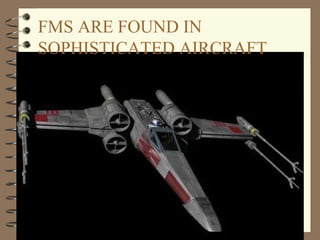
FMS ARE FOUND IN
SOPHISTICATED AIRCRAFT
FLIGHT MANGAGEMENT
SYSTEM
Modern aircraft are filled with the latest
technology.
Technology which greatly reduces workload if the
systems are understood and used properly.
The heart of all these systems is the FMS.
The FMS works to integrate the information from
aircraft navigation, performance, and flight
parameters to provide consolidated navigation and
auto flight control which maximizes aircraft and
route efficiency.
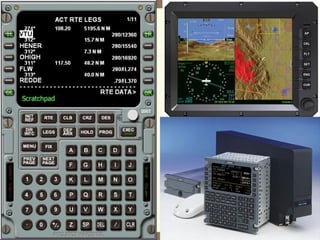
COMPONENTS
A typical FMS consists of:
–Flight Management Computer
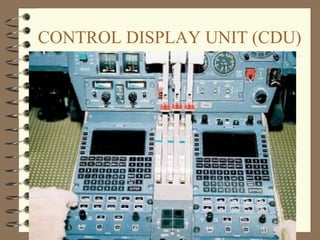
–Control Display Unit
–Visual Display (EFIS)
CONTROL DISPLAY UNIT (CDU)
HOW IT WORKS
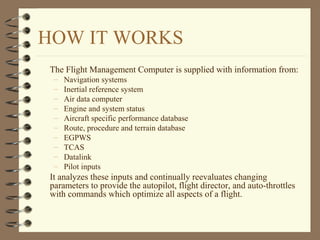
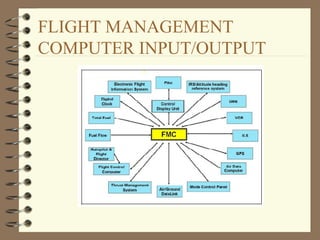
The Flight Management Computer is supplied with information from:
– Navigation systems
– Inertial reference system
– Air data computer
– Engine and system status
– Aircraft specific performance database
– Route, procedure and terrain database
– EGPWS
– TCAS
– Datalink
– Pilot inputs
It analyzes these inputs and continually reevaluates changing
parameters to provide the autopilot, flight director, and auto-throttles
with commands which optimize all aspects of a flight.
FLIGHT MANAGEMENT
COMPUTER INPUT/OUTPUT
OPERATION
The pilot must initialize and program the FMS with relevant route
information.
The navigation and aircraft performance database must be verified as
current and correct. (performance must reflect the specific aircraft)
An initial position must be entered. (Lat and Long)
A GPS augmented system will take less time to initialize.
The required route must be entered. This can include specific
departure, en-route, arrival, and approach procedures. (manually
entered or previously stored)
Routing must be confirmed accurate and correct and any ATC changes
to expected routing must be entered manually en-route.
The pilot becomes a manager of this sophisticated system, monitoring
progress and updating or changing parameters as necessary.
WHAT IT DOES
The FMS is capable of :
– Calculating optimum rate of climb/descent, altitude,
power setting.
– Controlling the aircraft to meet these optimum
parameters through autopilot and auto-throttle.
– Guiding pilot controlled flight path through a flight
director, and target speed and engine setting bugs.
– Cross referencing multiple navigation sources to
continually update position.
– Automatically tuning en-route navaids.
– Alerting pilots of systems status and malfunctions.
ADVANTAGES
The workload reduction associated allows
pilots more time to analyze and make
decisions. (drink coffee too)
Computer generated efficiency profiles are
more accurate.
Navigation accuracy is improved through
integration and cross referencing of
multiple sources.
Improves situational awareness.
DISADVANTAGES
Reliant on pilot input.
Intricacies of system leave room for
misinterpretation or erroneous data entry.
Loss of situational awareness. Pilots may
become so involved in operating and
monitoring the system that they forget to
look outside.
Expensive.

Flight Management System

  • 1.
  • 2.
    FMS ARE FOUNDIN SOPHISTICATED AIRCRAFT
  • 3.
    FLIGHT MANGAGEMENT SYSTEM Modern aircraftare filled with the latest technology. Technology which greatly reduces workload if the systems are understood and used properly. The heart of all these systems is the FMS. The FMS works to integrate the information from aircraft navigation, performance, and flight parameters to provide consolidated navigation and auto flight control which maximizes aircraft and route efficiency.
  • 4.
    COMPONENTS A typical FMSconsists of: –Flight Management Computer –Control Display Unit –Visual Display (EFIS)
  • 6.
  • 7.
    HOW IT WORKS TheFlight Management Computer is supplied with information from: – Navigation systems – Inertial reference system – Air data computer – Engine and system status – Aircraft specific performance database – Route, procedure and terrain database – EGPWS – TCAS – Datalink – Pilot inputs It analyzes these inputs and continually reevaluates changing parameters to provide the autopilot, flight director, and auto-throttles with commands which optimize all aspects of a flight.
  • 8.
  • 9.
    OPERATION The pilot mustinitialize and program the FMS with relevant route information. The navigation and aircraft performance database must be verified as current and correct. (performance must reflect the specific aircraft) An initial position must be entered. (Lat and Long) A GPS augmented system will take less time to initialize. The required route must be entered. This can include specific departure, en-route, arrival, and approach procedures. (manually entered or previously stored) Routing must be confirmed accurate and correct and any ATC changes to expected routing must be entered manually en-route. The pilot becomes a manager of this sophisticated system, monitoring progress and updating or changing parameters as necessary.
  • 10.
    WHAT IT DOES TheFMS is capable of : – Calculating optimum rate of climb/descent, altitude, power setting. – Controlling the aircraft to meet these optimum parameters through autopilot and auto-throttle. – Guiding pilot controlled flight path through a flight director, and target speed and engine setting bugs. – Cross referencing multiple navigation sources to continually update position. – Automatically tuning en-route navaids. – Alerting pilots of systems status and malfunctions.
  • 11.
    ADVANTAGES The workload reductionassociated allows pilots more time to analyze and make decisions. (drink coffee too) Computer generated efficiency profiles are more accurate. Navigation accuracy is improved through integration and cross referencing of multiple sources. Improves situational awareness.
  • 12.
    DISADVANTAGES Reliant on pilotinput. Intricacies of system leave room for misinterpretation or erroneous data entry. Loss of situational awareness. Pilots may become so involved in operating and monitoring the system that they forget to look outside. Expensive.