EFFICIENCY OF MUSCLE WORK
Kinesiology
FEBRUARY 27, 2017
SCHOOL OF PHYSIOTHERAPY
KING EDWARD MEDICAL UNIVERSITY, LAHORE
Efficiency
The efficiency is defined as the ratio of mechanical work output to the
total metabolic cost, as can be calculated from oxygen consumption.
Human Muscle:
The efficiency of human muscle has beenmeasured (in the context of
rowing and cycling) at 18% to 26%.
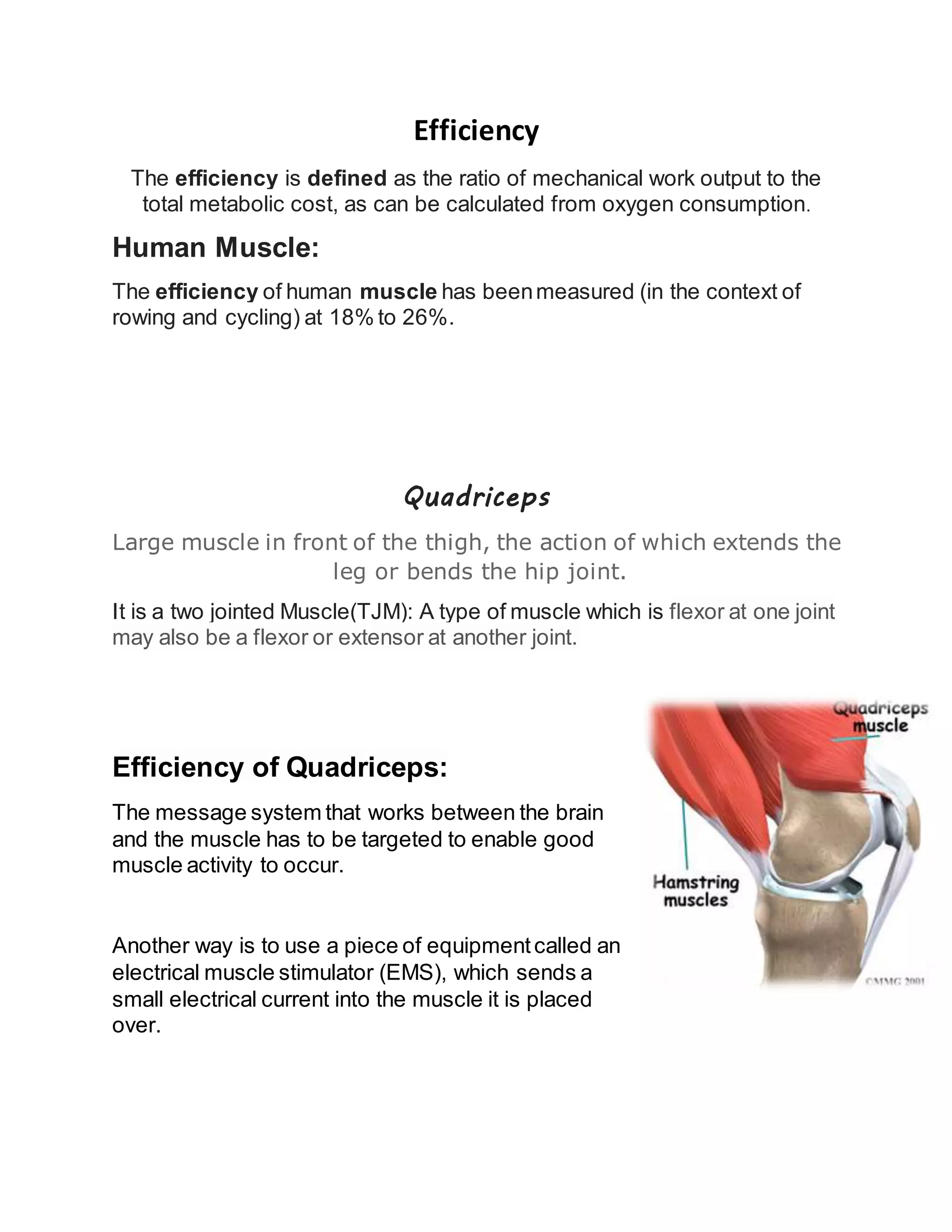
Quadriceps
Large muscle in front of the thigh, the action of which extends the
leg or bends the hip joint.
It is a two jointed Muscle(TJM): A type of muscle which is flexor at one joint
may also be a flexor or extensor at another joint.
Efficiency of Quadriceps:
The message system that works between the brain
and the muscle has to be targeted to enable good
muscle activity to occur.
Another way is to use a piece of equipmentcalled an
electrical muscle stimulator (EMS), which sends a
small electrical current into the muscle it is placed
over.
Quadriceps muscle contributions to energy generation and dissipationat
the knee joint during stance, swing and flight
phases of level running
Mechanical Efficiency
Exercise and is one of the most common
resistance training type of exercise used to
enhance performance in sports and in knee
rehabilitation as it produces greatestneural activation than the majority of
weight-bearing knee extension exercises.
Exercise at a constant work rate have estimated that ATP utilization per
work unit either decreased or increased over time during exercise.
The blood flow to the exercising muscle and the lactate released from
muscle to the blood stream is highly restricted,power output declines over
time and the external mechanical work produced during each muscle
contraction remains constant.
In hip flexion during standing and sustained stance-phase knee flexion
during walking, may be critical for balance control with trunk-flexed
postures

Efficiency of muscle work

  • 1.
    EFFICIENCY OF MUSCLEWORK Kinesiology FEBRUARY 27, 2017 SCHOOL OF PHYSIOTHERAPY KING EDWARD MEDICAL UNIVERSITY, LAHORE
  • 2.
    Efficiency The efficiency isdefined as the ratio of mechanical work output to the total metabolic cost, as can be calculated from oxygen consumption. Human Muscle: The efficiency of human muscle has beenmeasured (in the context of rowing and cycling) at 18% to 26%. Quadriceps Large muscle in front of the thigh, the action of which extends the leg or bends the hip joint. It is a two jointed Muscle(TJM): A type of muscle which is flexor at one joint may also be a flexor or extensor at another joint. Efficiency of Quadriceps: The message system that works between the brain and the muscle has to be targeted to enable good muscle activity to occur. Another way is to use a piece of equipmentcalled an electrical muscle stimulator (EMS), which sends a small electrical current into the muscle it is placed over.
  • 3.
    Quadriceps muscle contributionsto energy generation and dissipationat the knee joint during stance, swing and flight phases of level running Mechanical Efficiency Exercise and is one of the most common resistance training type of exercise used to enhance performance in sports and in knee rehabilitation as it produces greatestneural activation than the majority of weight-bearing knee extension exercises. Exercise at a constant work rate have estimated that ATP utilization per work unit either decreased or increased over time during exercise. The blood flow to the exercising muscle and the lactate released from muscle to the blood stream is highly restricted,power output declines over time and the external mechanical work produced during each muscle contraction remains constant. In hip flexion during standing and sustained stance-phase knee flexion during walking, may be critical for balance control with trunk-flexed postures