








Recycled Paper
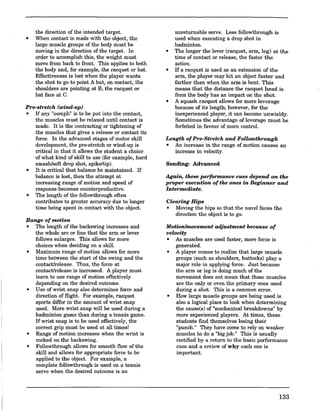
Saskatchewan
Learning
ill
f
't
I
Instructional Physical
Education 20 and 30
A Curriculum Guide for the
Secondary Level
August 1994
Instructional Physical Education
20 and 30
A Curriculum. Guide for the Secondary Level
Saskatchewan Education,
Training and Employment
August 1994
ISBN 0-921291-42-q
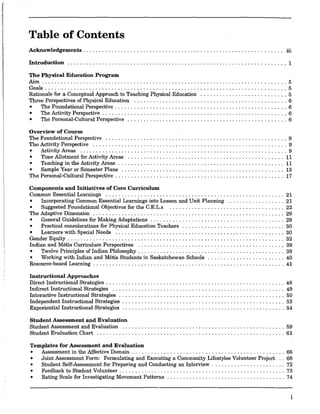
Table of Contents
Acknowledgements. . . . . . . . . . . . . . . . . . . . . . . . . . . . . . . . . . . . . . . . . . . . . . . . . . . . . . . . . . . . . .. iii
Introduction ............................................ . . . . . . . . . . . . . . . . . . . . . . . . . 1
The Physical Education Program
Aim ............................................................................. 5
Goals ............................................................................ 5
Rationale for a Conceptual Approach to Teaching Physical Education ........................... 5
Three Perspectives of Physical Education ................................................ 6
• The Foundational Perspective . . . . . . . . . . . . . . . . . . . . . . . . . . . . . . . . . . . . . . . . . . . . . . . . . . . . . . 6
• The Activity Perspective . . . . . . . . . . . . . . . . . . . . . . . . . . . . . . . . . . . . . . .  . . . . . . . . . . . . . . . . . . 6
• The Personal-Cultural Perspective ................. '................................. 6
Overview of Course
The Foundational Perspective ......................................................... 9
The Activity Perspective ............................................................. 9
• Activity Areas ............................................. '.................... 9
• Time Allotment for Activity Areas ................................................. 11
• Teaching in the Activity Areas .................................................... 11
• Sample Year or Semester Plans .......................... . . . . . . . . . . . . . . . . . . . . . . . . . 13
The Personal-Cultural Perspective . . . . . . . . . . . . . . . . . . . . . . . . . . . . . . . . . . . . . . . . . . . . . . . . . . . . . 17
Components and Initiatives of Core Curriculum
Common Essential Learnings ........................................................ 21
• Incorporating Common Essential Learnings into Lesson and Unit Planning .................. 21
• Suggested Foundational Objectives for the C.E.L.s .................................... 22
The Adaptive Dimension ....................... ,............................... . . . . . 29
• General Guidelines for Making Adaptations . . . . . . . . . . . . . . . . . . . . . . . . . . . . . . . . . . . . . . . . . . 29
• Practical considerations for Physical Education Teachers ................................ 30
• Learners with Special Needs ..................................................... 30
Gender Equity . . . . . . . . . . . . . . . . . . . . . . . . . . . . . . . . . . . . . . . . . . . . . . . . . . . . . . . . . . . . . . . . . . . . 32
Indian and Metis Curriculum Perspectives .............................................. 39
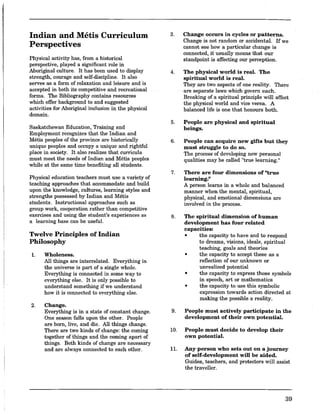
• Twelve Principles of Indian Philosophy ......................... '. . . . . . . . . . . . . . . . . . . . . 39
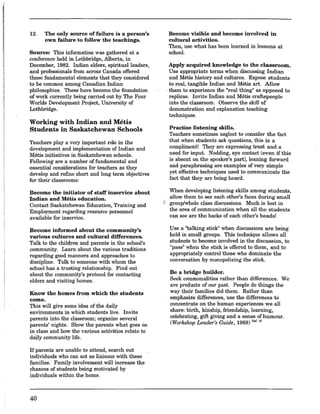
• Working with Indian and Metis Students in Saskatchewan Schools ........................ 40
Resource-based Learning . . . . . . . . . . . . . . . . . . . . . . . . . . . . . . . . . . . . . . . . . . . . . . . . . . . . . . . . . . . . 41
Instructional Approaches
Direct Instructional Strategies . . . . . . . . . . . . . . . . . . . . . . . . . . . . . . . . . . . . . . . . . . . . . . . . . . . . . . . . 48
Indirect Instructional Strategies ...................................................... 49
Interactive Instructional Strategies ............................................... . . . . . 50
Independent Instructional Strategies . . . . . . . . . . . . . . . . . . . . . . . . . . . . . . . . . . . . . . . . . . . . . . . . . . . 53
Experiential Instructional Strategies . . . . . . . . . . . . . . . . . . . . . . . . . . . . . . . . . . . . . . . . . . . . . . . . . . . 54
Student Assessment and Evaluation
Student Assessment and Evaluation ................................................... 59
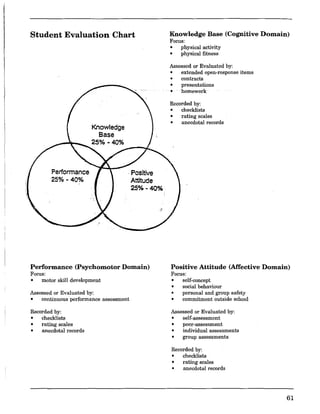
Student Evaluation Chart ........................................................... 61
Templates for Assessment and Evaluation
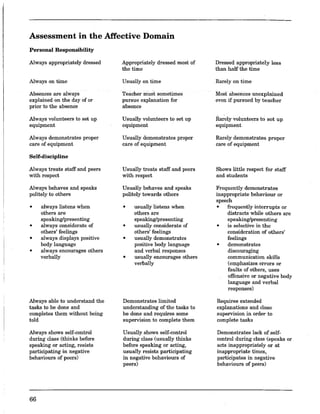
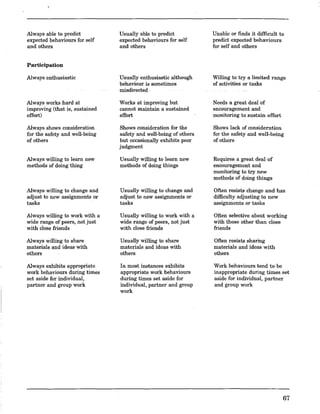
• Assessment in the Mfective Domain . . . . . . . . . . . . . . . . . . . . . . . . . . . . . . . . . . . . . . . . . . . . . . . . 66
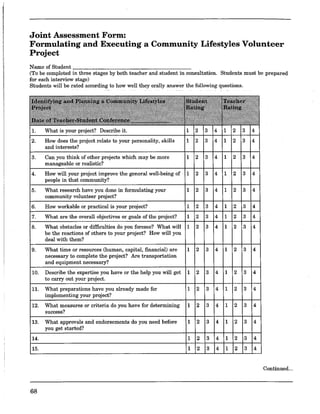
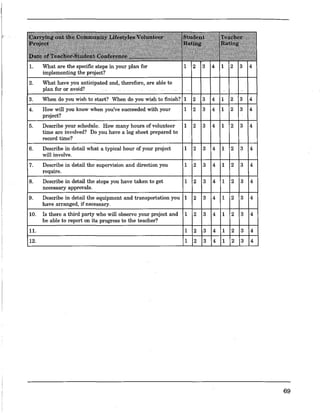
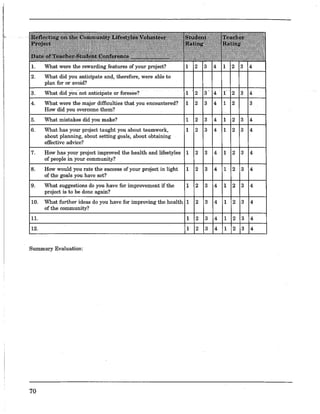
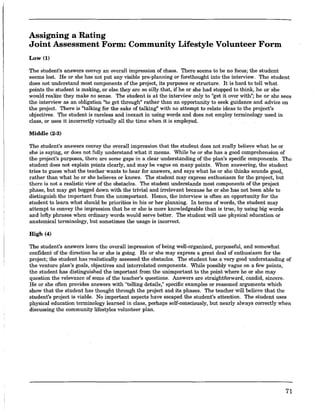
• Joint Assessment Form: Formulating and Executing a Community Lifestyles Volunteer Project .. 68
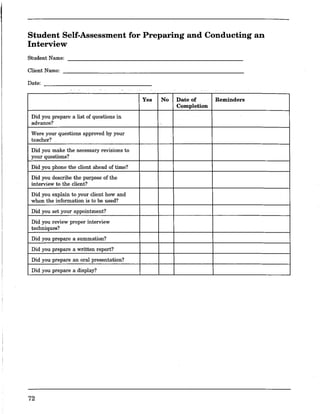
• Student Self-Assessment for Preparing and Conducting an Interview . . . . . . . . . . . . . . . . . . . . . . . 72
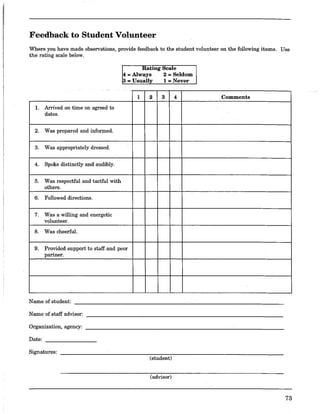
• Feedback to Student Volunteer ............................'. . . . . . . . . . . . . . . . . . . . . . . . 73
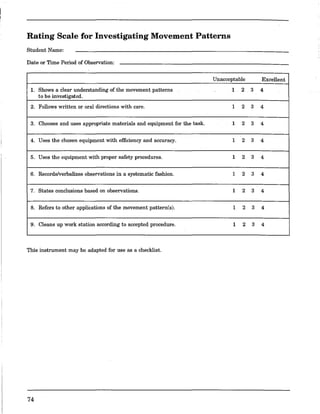
• Rating Scale for Investigating Movement Patterns ... . . . . . . . . . . . . . . . . . . . . . . . . . . . . . . . . . . 74
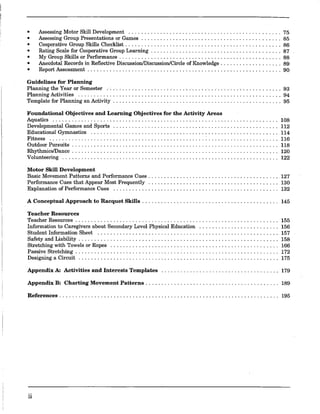
1
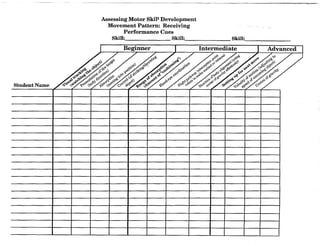
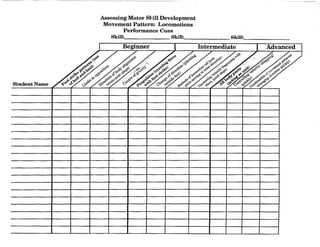
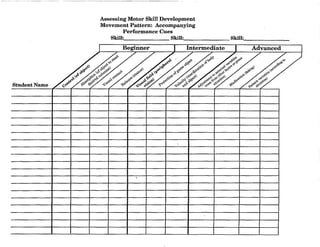
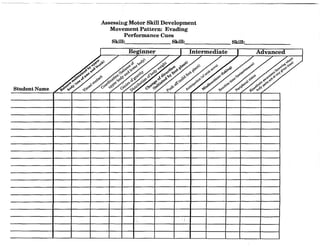
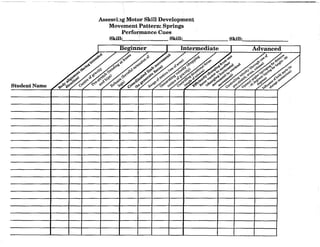
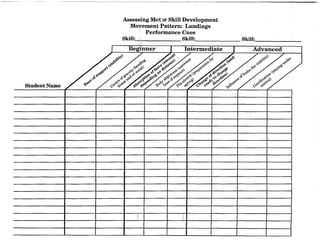
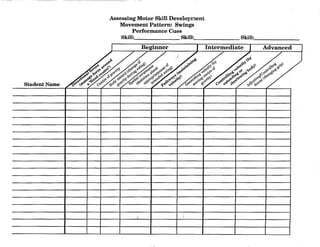
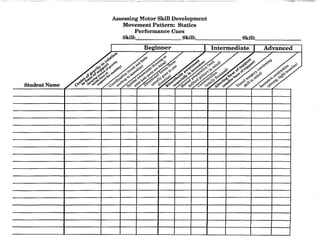
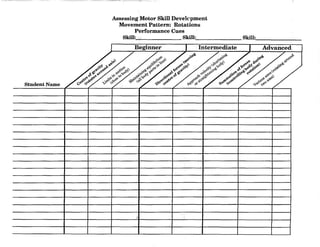
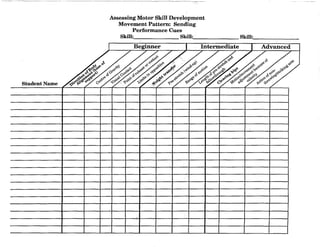
• Assessing Motor Skill Development ................................................ 75
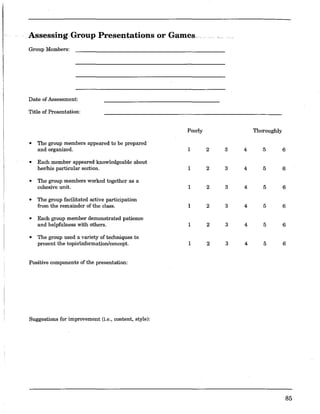
• Assessing Group Presentations or Games . . . . . . . . . . . . . . . . . . . . . . . . . . . . . . . . . . . . . . . . . . . . 85
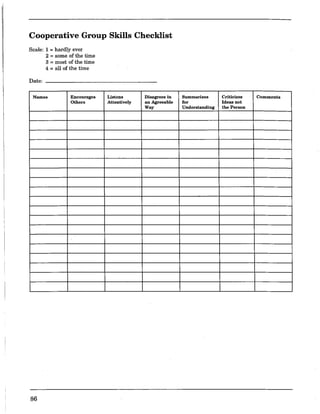
• Cooperative Group Skills Checklist . . . . . . . . . . . . . . . . . . . . . . . . . . . . . . . . . . . . . . . . . . . . . . . . . 86
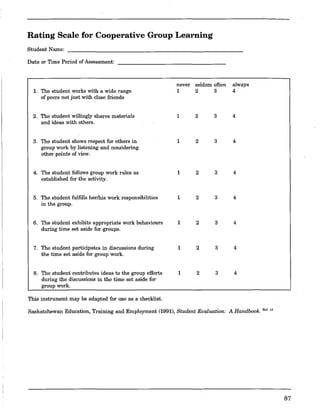
• Rating Scale for Cooperative Group Learning ......................................... 87
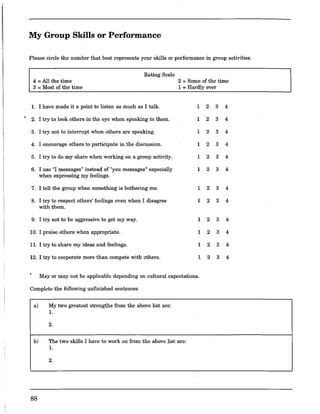
• My Group Skills or Performance . . . . . . . . . . . . . . . . . . . . . . . . . . . . . . . . . . . . . . . . . . . . . . . . . . . 88
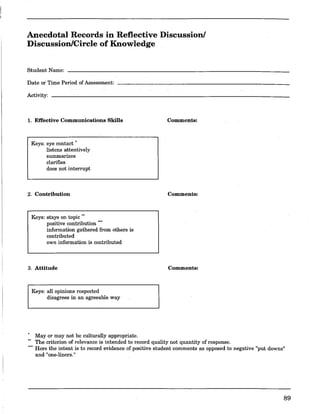
• Anecdotal Records in Reflective DiscussionlDiscussioniCircle of Knowledge. . . . . . . . . . . . . . . . . . . 89
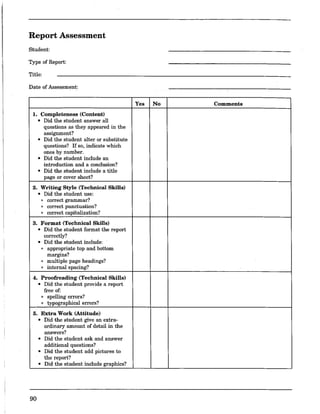
• Report Assessment . . . . . . . . . . . . . . . . . . . . . . . . . . . . . . . . . . . . . . . . . . . . . . . . . . . . . . . . . . . . . 90
Guidelines for Planning
Planning the Year or Semester ....................................................... 93
Planning Activities ................................................................ 94
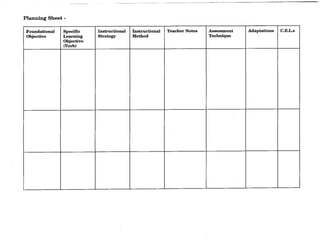
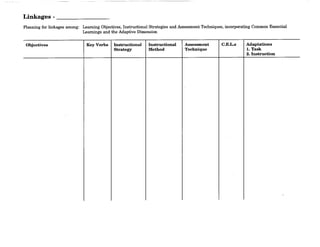
Template for Planning an Activity . . . . . . . . . . . . . . . . . . . . . . . . . . . . . . . . . . . . . . . . . . . . . . . . . . . . . 95
Foundational Objectives and Learning Objectives for the Activity Areas
Aquatics ....................................................................... 108
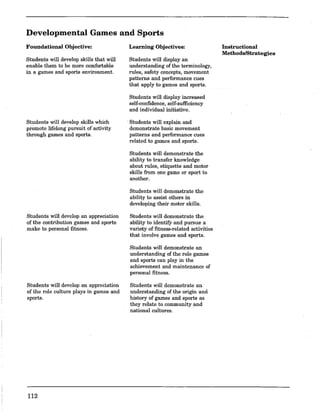
Developmental Games and Sports ............................................... . . . .. 112
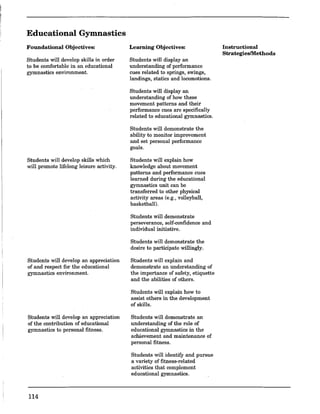
Educational Gymnastics ........................................................... 114
Fitness ................................................. :...................... 116
Outdoor Pursuits . . . . . . . . . . . . . . . . . . . . . . . . . . . . . . . . . . . . . . . . . . . . . . . . . . . . . . . . . . . . . . . .. 118
RhythmicsJDance . . . . . . . . . . . . . . . . . . . . . . . . . . . . . . . . . . . . . . . . . . . . . . . . . . . . . . . . . . . . . . . .. 120
Volunteering .................................................................... 122
Motor Skill Development
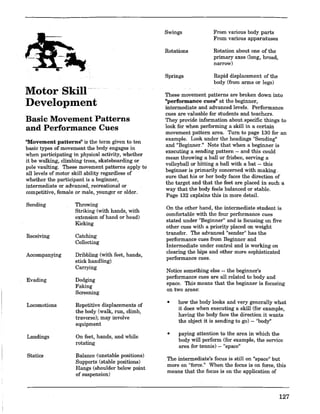
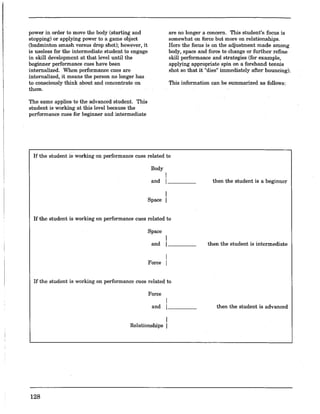
Basic Movement Patterns and Performance Cues. . . . . . . . . . . . . . . . . . . . . . . . . . . . . . .. . . . . . . . .. 127
Performance Cues that Appear Most Frequently ......................................... 130
Explanation of Performance Cues .................................................... 132
A Conceptual Approach to Racquet Skills . . . . . . . . . . . . . . . . . . . . . . . . . . . . . . . . . . . . . . . . . .. 145
Teacher Resources
Teacher Resources . . . . . . . . . . . . . . . . . . . . . . . . . . . . . . . . . . . . . . . . . . . . . . . . . . . . . . . . . . . . . . .. 155
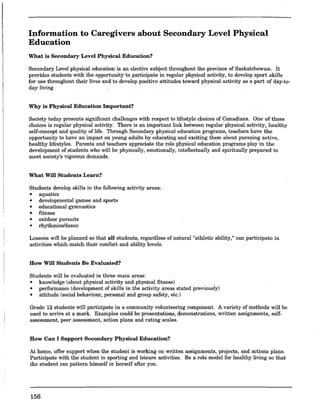
Information to Caregivers about Secondary Level Physical Education ......................... 156
Student Information Sheet ......................................................... 157
Safety and Liability . . . . . . . . . . . . . . . . . . . . . . . . . . . . . . . . . . . . . . . . . . . . . . . . . . . . . . . . . . . . . .. 158
Stretching with Towels or Ropes . . . . . . . . . . . . . . . . . . . . . . . . . . . . . . . . . . . . . . . . . . . . . . . . . . . .. 166
Passive Stretching . . . . . . . . . . . . . . . . . . . . . . . . . . . .. . . . . . . . . . . . . . . . . . . . . . . . . . . . . . . . . . .. 172
Designing a Circuit ............................................................... 175
Appendix A: Activities and Interests Templates ..................................... 179
Appendix B: Charting Movement Patterns. . . . . . . . . . . . . . . . . . . . . . . . . . . . . . . . . . . . . . . . .. 189
References . . . . . . . . . . . . . . . . . . . . . . . . . . . . . . . . . .. . . . . . . . . . . . . . . . . . . . . . . . . . . . . . . . . .. 195
11
Acknowledgements
Saskatchewan Education, Training and Employment gratefully acknowledges the commitment
demonstrated by the following members of the Physical Education Curriculum Advisory Committee:
Saskatchewan Institute of Applied Sciences and Technology
Mr. Roy Rowley
Saskatchewan Teachers' Federation
Ms Kathy Fowler
Mr. Terry Kikcio
Ms Marta Kroupa
Mr. Craig Oman
Mr. Tony Colley
Special Education
Ms Debbie Blash
University of Regina
Dr. Ray Petracek
University of Saskatchewan
Dr. Len Gusthart
Indian and Metis Education Advisory Committee
Mr. Colin Sutherland
League of Educational Administrators, Directors, and Supervisors
Mr. Denis Tetu
Member at Large
Mr. Ken Loehndorf
Official Minority Languages Office
Mr. Robert Cousin
Mr. Marcel Asselin
Saskatchewan Education, Training and Employment
Ms Joan Wittal
Dr. Paulette Van der Linde
HI
, ,~ I
Introduction
Physical education is an integral part of the
educational process and contributes to the
physical, intellectual, social and spiritual
development of every student. The mission of
physical education in Saskatchewan schools is
the development of autonomous, lifelong learners
who readily participate in meaningful physical
activity on a regular basis.
Researchers show a positive link between regular
physical activity, enhanced self-concept and
quality of life. Through physical education
programs in schools, teachers can educate and
excite students about pursuing active, healthy
lifestyles. Teachers can help students realize the
benefits of fitness activities and understand the
concepts they will use to develop personal
programs. In addition, teachers can guide
students to develop the knowledge, skills and
attitudes they will need to maintain healthy
lifestyles. Through physical education programs,
students will understand the importance of living
what they have learned.
Canadians generally recognize and accept the
importance of fitness and well-being. They are
becoming increasingly fitness conscious; however,
they are faced daily with many lifestyle choices.
Physical educators are in a position to help
Canadians learn to make wise decisions. Schools
-- and physical education programs in particular
-- are charged with the responsibility of assisting
students in the development of attitudes,
knowledge and skills necessary to initiate and
maintain appropriate fitness programs.
Participation in physical education gives students
the opportunity to live what they have learned.
The benefits of physical education include:
• increased fitness levels
• improved motor development
• tendency toward more active lifestyles
• positive correlation between the learning of
physical and mental skills
• increased performance in other subjects, even
though less time is spent on those subjects
-increased attentiveness and alertness
throughout the school day
• long term improvement in body image
Educators worldwide recognize the importance of
physical education in preparing students to meet
society's vigorous demands. Physical education
programs endeavour to equip all students,
regardless of gender, race, cultural background or
ability, with the physical skills and social
attitudes necessary to reach their maximum
potential.
1
The Physical Education Program
The Physical
Education Program
Aim
The aim of physical education is lifelong
participation.
Skill development and participation will foster
the development of positive attitudes toward a
lifetime commitment to physical activity.
Goals
Goals of the physical education program arEi:
• Concept-based skill development
• Development of positive attitudes
These attitudes will focus on:
o physical activity
o fitness
o self-concept
o relationships with others
o social behaviour
o personal and group safety
• A lifestyle oriented to overall well-being
Rationale for a Conceptual
Approach to Teaching
Physical Education
The physical education program must empower
the learner to take advantage of participation in
future physical activities even though such
opportunities may not be evident or known at
present. The conceptual approach will enable
learners to participate successfully in a physical
activity even though it may not have been
specifically included in the program.
In physical education, the conceptual approach is
based on the "how" and, as importantly, the
"why" of movement. Instead of looking at each
activity as a separate entity, concepts are
introduced which stress the commonalities
among them. This serves to enhance the
students' understanding of movement and its
underlying principles. Students come to
understand the workings of their bodies in all
three domains (affective, cognitive, psychomotor).
Educators know that students learn at different
rates and in different ways. A vast majority of
learners are of two types: those who want to see
"the big picture" first and then break down and
assimilate the smaller parts, and those who want
access to the smaller parts first and then work
up to the "big picture."
The conceptual approach recognizes learning as
an evolutionary process. This means that, from
birth, human beings have the ability to process
information, beginning with rudimentary skills
and progressing to higher, more complex levels of
thinking. Infants, children, and adults all have
,the ability to select and use higher ordered
thinking skills.
In order to accommodate various learning styles
and levels of thinking, educators must possess a
wide repertoire of teaching methods. By having
a firm foundation in teaching methods and a
willingness to use more than one, teachers can be
more confident that students' needs are being
met. It is critical that teachers fit instructional
approaches to the students' learning styles and
not the other way around.
Use of a conceptual approach allows teachers to
plan for the learning outcomes of students. It is
possible to prepare lessons in such a way that
one learning outcome is planned to lead into the
next. Many educators assume this to be an
automatic occurrence. For example, a teacher
may assume that once the students understand
the benefits of fitness, they will choose lifestyles
that display their knowledge in this area. Yet,
all we have to do is look at the number of
"knowledgeable" but unfit and unhealthy adults
in our society to see this is not so. Such
outcomes do not simply happen. They must be
planned and then practised.
This is not to say that there is no room in a
physical educator's teaching repertoire for the
"explanation/demonstration/practice" or
"traditional" method. Such a teaching method is
a definite asset when presenting students with a
knowledge base from which to begin learning;
however, used in isolation, the traditional
approach, where the teacher explains and
demonstrates and the students attempt to mimic
the teacher, encourages "passive activity" on the
part of the students. There is no ownership for
5
skills learned, no creativity, no joy of discovery
and little opportunity for transfer of learning.
A teacher working in the conceptual realm is a
facilitator, focusing on the students and their
needs while preparing objectives stated in terms
of behavioral outcomes. Students who are
working at a beginner's level may do so without
fear of keeping more able students from pursuing
higher skill levels. The converse'is also true.
Fortunately, with the conceptual approach,
students may also work and achieve success
at various levels during any class period,
regardless of the teacher's skill level.
The conceptual approach gives students the
freedom to explore and discover
action/consequence relationships independently.
They discover that winning and losing are not
the only consequences of physical activity. They
reach the conclusion, by themselves, that there is
much to be learned about one's ability to control
and predict certain aspects of the environment.
It is an obvious statement that, in a physical
education class, the psychomotor domain is of
primary importance; however, we want our
students to also grow into adults who react
quickly and decisively (cogoitive domain) and
display such traits as sportsmanship and
teamwork (affective domain). The use of a
variety of teaching methods attends to all three
domains and shows promise of producing skilled
performers who move with meaning and
understanding.
Inclusions of alternate teaching methods in order
to accommodate students' varied learning styles
in no way challenges the fact that the study of
human movement is largely through an activity
program; nor does it deny that physical education
is more concerned with the motor domain than is
any other subject area, Instead, it recognizes
that attention to the individual learner's
emotions, feelings, and inherent personality will
produce the best result: a meaningfully
physically educated individual rather than a
physically trained one.
The section entitled A Conceptual Approach
to Teaching Racquet Skills has been included
to illustrate the use of the conceptual approach to
teaching motor skills,
6
The Three Perspectives of
Physical Education
Physical education programs in Saskatchewan
strive to achieve the mission of developing active,
autonomous learners; they also complement
physical educatiou's aim of lifelong participation
through the incorporation of the following
perspectives:
• The Foundational Perspective
• The Activity Perspective
• The Personal-Cultural Perspective
The foundational perspective includes
development in the area of basic movement
patterns, performance cues (motor skill
development) and physical fitness. The activity
perspective includes aquatics, developmental
games and sports, educational gymnastics,
fitness, outdoor pursuits and rhythmics and/or
dance. The personal-cultural perspective refers
to knowledge and understanding, appreciations
and attitudes, social skills and cultural
awareness.
These perspectives are not taught as entities
unto themselves; rather, they are the common
ground from which lessons and units are
planned. They become a part of the activities in
which the students engage. For example, as
students are working on a racquets unit
(foundational and activity perspectives), they are
also participating in peer coaching (personal-
cultural perspective). The Grade 12 volunteering
component might include development related to
the foundational and activity perspectives, but
the major focus may be on the personal-cultural
perspective (social skills). These examples
illustrate the fact that different emphases can be
placed on each of the perspectives at any given
time, depending on the purpose of the activity
and the desired outcome. Each perspective is
explained in more detailed in Overview of
Course.
Overview of Course
Overview of Course
The Foundational
Perspective
Physical Fitness
One of the primary goals of physical edncation in
Saskatchewan is to provide each student with
the opportunity to develop an optimal level of
fitness. Physical fitness instruction is a
necessary component of a balanced physical
education program. Participating in physical
fitness, developing positive attitudes about
exercise and physical fitness and continuously
applying this knowledge to everyday life outside
the classroom should be an integral part of each
student's learning experiences in physical
education at all grade levels.
It is becoming increasingly clear that students
move into their adult years continuing to choose
lifestyles that include little physical activity.
Physical education can make a difference.
Through a well balanced program, with emphasis
on continued integration. of fitness activities and
information, physical educators can play a
significant role in encouraging the pursuit of
healthy, active lifestyles.
At the same time, teachers must be aware that
with approximately thirty minutes a day
currently devoted to physical education, and
often far less, it is unrealistic to expect
students to reach optimal levels of fitness
by merely attending class. With this in mind,
it is crucial that teachers strive to influence
students beyond class periods. With the
thoughtful assistance of physical educators,
students can be motivated to participate in
self-directed activity that will enable them to
lead healthy, active lifestyles throughout life.
Teachers must not only provide class time
for activity, but require that out-of-class
time be spent on lifestyle-related activities.
Motor Skill Development
Students who participate in physical education
programs are given ample opportunity to begin
skill development from "where they are at" and
proceed from there. This increases their chances
of experiencing success which, in turn, increases
the probability that they will continue with
physical activity for a lifetime. As physical
educators, it is our responsibility to plan lessons
and units around objectives that will help
students achieve the aim of all physical
education programs in Saskatchewan -- lifelong
participation. The section called Motor Skill
Development provides valuable information
about movement patterns and performance cues
and how they are useful in planning lessons and
assessing or evaluating students.
The Activity Perspective
The Saskatchewan physical education program
consists of six activity components. The major
goals of physical education can be met through
student involvement in these areas.
Activity Areas
Aquatics
Aquatics refers to water-related skills and
abilities that enable the participant to develop
confidence in an aquatic environment. Aquatic
skills promote and provide opportunities for
lifelong recreational activity.
Developmental Games and Sports
Individual, dual and team activities provide the
learner with the opportunity -to progress from low
organized to more formalized games and sports.
These activities incorporate movement skills
developed in a progressive manner.
Educational Gymnastics
Educational gymnastics focuses on individuals
and how they move, learn and develop, as
contrasted to the more formal competitive or
Olympic style.
9
With this approach, the content becomes more
student centred, the actual skills performed
being at the discretion of the student rather than
being imposed by the teacher. The primary
intention is to assist students in developing and
refining movement skills through dynamic
movement. Ref. 1
Regardless of ability, body shape or size,
experience or confidence, all·students will be able
to succeed and continue to grow at their own
rates. The teacher's role is to facilitate the
development of skills.
Fitness
The Saskatchewan physical education curriculum
will focus on health-related fitness capacities
essential to health and well-being plus motor
ability capacities where skill is required.
Fitness programs will emphasize knowledge,
assessment, interpretation, goal setting and
application.
Outdoor Pursuits
Outdoor pursuits involve a variety of activities
utilizing an interaction with the natural
environment. Each activity presents a degree of
uncertainty in its outcome; however, that
10
outcome can be influenced by both participant
and circumstance. Ref. 2
Rhythmics/Dance
"Rhythm is the ability to repeat an action or
movement with regularity and in time to a
particular rhythmic pattern."""'-3
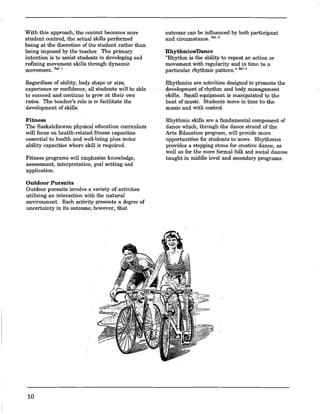
Rhythmics are activities designed to promote the
development· of rhythm and body management
skills. Small equipment is manipulated to the
beat of music. Students move in time to the
music and with control.
Rhythmic skills are a fundamental component of
dance which, through the dance strand of the
Arts Education program, will provide more
opportunities for students to move. Rhythmics
provides a stepping stone for creative dance, as
well as for the more formal folk and social dances
taught in middle level and secondary programs.
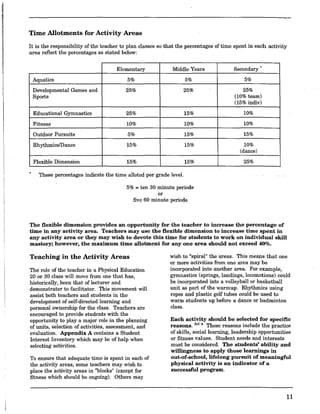
Time Allotments for Activity Areas
It is the responsibility of the teacher to plan classes so that the percentages of time spent in each activity
area reflect the percentages as stated below:
Elementary Middle Years Secondary •
Aquatics 5% 5% 5%
Developmental Games and 25% 25% 25%
Sports (10% team)
(15% indiv)
Educational Gymnastics 25% 15% .. 10%
Fitness 10% 10% 10%
Outdoor Pursuits 5% 15% 15%
RhythmicsJDance 15% 15% 10%
(dance)
Flexible Dimension 15% 15% 25%
These percentages indicate the time alloted per grade level.
5% = ten 30 minute periods
or
five 60 minute periods
The flexible dimension provides an opportunity for the teacher to increase the percentage of
time in any activity area. Teachers may use the flexible dimension to increase time spent in
any activity area or they may wish to devote this time for students to work on individual skill
mastery; however, the maximum time allotment for anyone area should not exceed 40%.
Teaching in the Activity Areas
The role of the teacher in a Physical Education
20 or 30 class will move from one that has,
historically, been that oflecturer and
demonstrator to facilitator. This movement will
assist both teachers and students in the
development of self-directed learning and
personal ownership for the class. Teachers are
encouraged to provide students with the
opportunity to playa major role in the planning
of units, selection of activities, assessment, and
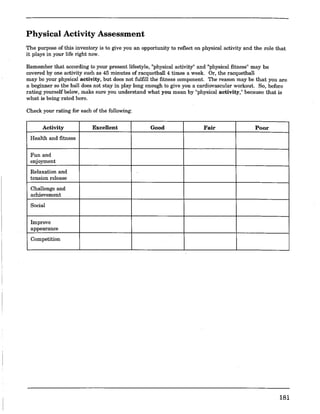
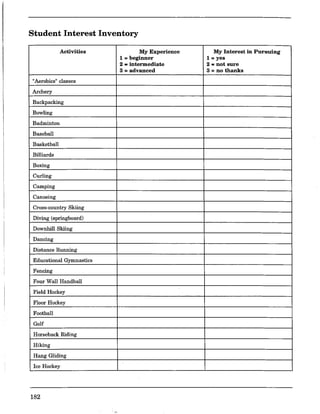
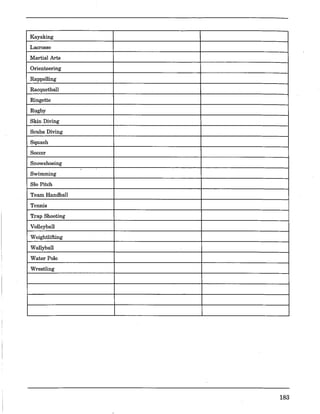
evaluation. Appendix A contains a Student
Interest Inventory which may be of help when
selecting activities.
To ensure that adequate time is spent in each of
the activity areas, some teachers may wish to
place the activity areas in "blocks" (except for
fitness which should be ongoing). Others may
wish to "spiral" the areas. This means that one
or more activities from one area may be
incorporated into another area. For example,
gymnastics (springs, landings, locomotions) could
be incorporated into a volleyball or basketball
unit as part of the warmup. Rhythmics using
ropes and plastic golf tubes could be used to
warm students up before a dance or badminton
class.
Each activity should be selected for specific
reasons. R,f.4 These reasons include the practice
of skills, social learning, leadership opportunities
or fitness values. Student needs and interests
must be considered. The students' ability and
willingness to apply those learnings in
out-of-school, lifelong pursuit of meaningful
physical activity is an indicator of a
successful program.
11
Physical Education 20 will include extensive
study in at least one selected activity from each
of the six areas described on the previous page.
These activities may be different from the ones
that might be chosen if the student continues
into Physical Education the following year or
semester. For example, a grade 11 student may
concentrate on tennis in the activity area of
developmental games and sports; in grade 12,
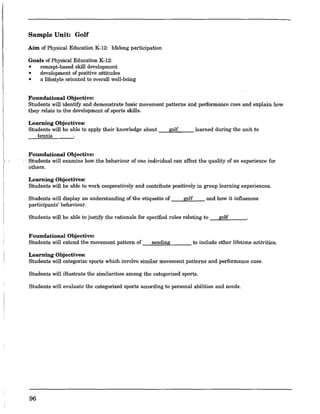
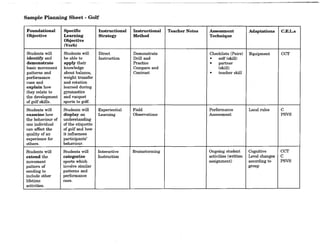
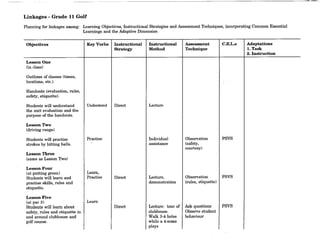
this student may pursue golf.
In addition, students may have the opportunity
of extensive study in at least two areas that have
been introduced throughout the course. This
means that as or after students have had time to
participate in all six areas, they may choose two
areas in which to "specialize." As the year or
semester progresses, a student may have quite a
"list" from which to choose: golf, swimming,
diving, sailing, bowling, skiing, weightlifting,
hiking, canoeing ...
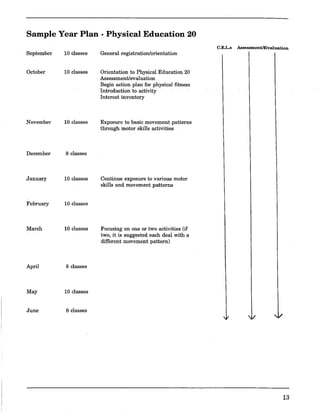
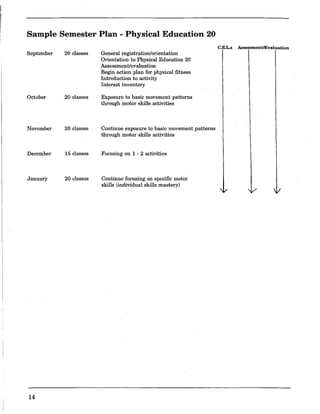
The next four pages contain sample year and
semester plans for Physical Education 20 and 30.
These may help teachers when planning "the big
picture.II
12
Sample Year Plan - Physical Education 20
September
October
November
December
January
February
March
April
May
June
10 classes
10 classes
10 classes
8 classes
10 classes
10 classes
10 classes
8 classes
10 classes
8 classes
General registration/orientation
Orientation to Physical Education 20
Assessment/evaluation
Begin action plan for physical fitness
Introductiorito activity
Interest inventory
Exposure to basic movement patterns
through motor skills activities
Continue exposure to various motor
skills and movement patterns
Focusing on one or two activities (if
two, it is suggested each deal with a
different movement pattern)
C.E.L.s AssessmentlEvaluation
13
Sample Semester Plan - Physical Education 20
September 20 classes
October 20 classes
November 20 classes
December 15 classes
January 20 classes
14
General registration/orientation
Orientation to Physical Education 20
Assessment/evaluation
Begin action plan for physical fitness
Introduction to activity
Inh,rest inventory
Exposure to basic movement patterns
through motor skills activities
Continue exposure to basic movement patterns
through motor skills activities
Focusiug on 1 - 2 activities
Continue focusing on specific motor
skills (individual skills mastery)
C.E.L.s AssessmentlEvaluation
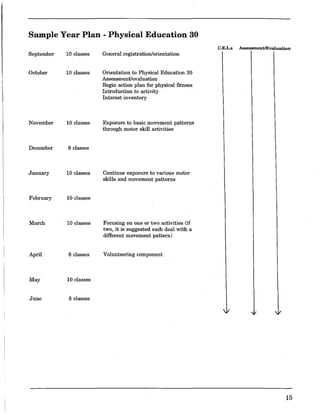
Sample Year Plan - Physical Education 30
September
October
November
December
Jannary
February
March
April
May
June
10 classes
10 classes
10 classes
8 classes
10 classes
10 classes
10 classes
8 classes
10 classes
8 classes
General registration/orientation
Orientation to Physical Education 30
Assessment/evaluation
Begin action plan for physical fitness
Introduction to activity
Interest inventory
Exposure to basic movement patterns
through motor skill activities
Continue exposure to various motor
skills and movement patterns
Focusing on one or two activities (if
two, it is suggested each deal with a
different movement pattern)
Volunteering component
C.E.L.s AssessmentlEvaluation
15
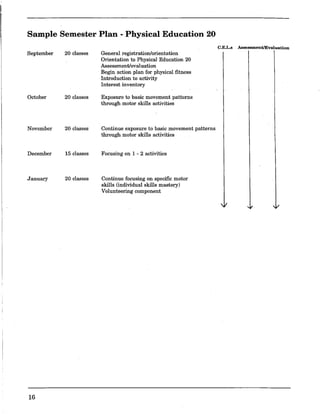
Sample Semester Plan - Physical Education 20
September 20 classes
October 20 classes
November 20 classes
December 15 classes
January 20 classes
16
General registration/orientation
Orientation to Physical Education 20
Assessment/evaluation
Begin action plan for physical fitness
Introduction to activity
Interest inventory
Exposure to basic movement patterns
through motor skills activities
Continue exposure to basic movement patterns
through motor skills activities
Focusing on 1 - 2 activities
Continue focusing on specific motor
skills (individual skills mastery)
Volunteering component
C.E.L.s AssessmentlEvaluation
The Personal-Cultural
Perspective
Components of the Personal-
Cultural Perspective
Affective Component
Physical education exposes students to situations
which develop emotional control and social
adjustment. Physical education is concerned
with developing an appreciation for and
enjoyment of activity for its own sake. It
endeavours to help students realize the
importance of physical activity in the
maintenance of personal well-being.
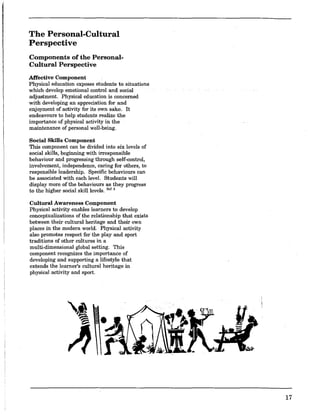
Social Skills Component
This component can be divided into six levels of
social skills, beginning with irresponsible
behaviour and progressing through self-control,
involvement, independence, caring for others, to
responsible leadership. Specific behaviours can
be associated with each level. Students will
display more of the behaviours as they progress
to the higher social skill levels. "'f. 5
Cultural Awareness Component
Physical activity enables learners to develop
conceptualizations of the relationship that exists
between their cultural heritage and their own
places in the modem world. Physical activity
also promotes respect for the play and sport
traditions of other cultures in a
multi-dimensional global setting. This
component recognizes the importance of
developing and supporting a lifestyle that
extends the leamer's cultural heritage in
physical activity and sport.
17
Components and Initiatives of
Core Curriculum
Components and
Initiatives of Core
Curriculum
Common Essential Learnings
Secondary Level physical education offers many
opportunities to incorporate the Common
Essential Learnings (C.E.L.s) into instruction.
Such incorporation helps students better
understand the subject matter and prepares
them for future learning, both within and outside
the K-12 educational system.
The decision to focus on one or more C.E.L.s
within a lesson is guided by the needs and
abilities of individual students and by the
particular demands of the subject area.
Throughout each unit, each C.E.L. should be
developed to the extent possible.
It is important to incorporate the C.E.L.s in an
authentic manner. For example, some subject
matter may offer many opportunities to develop a
number of C.E.L.s; however, the development of a
particular C.E.L. area may be limited by the
nature of the subject matter being studied. For
example, the area of personal and socialvalues
and skills "fits" more readily into Physical
Education 20 and 30 than does technological
literacy.
The C.E.L.s are intended to be developed and
evaluated within the entire Physical Education
20 and 30 curriculum; therefore, foundational
objectives for the C.E.L.s must be included in
unit overviews because they provide the basis for
lesson planning, assessment and evaluation.
The C.E.L.s are not necessarily separate and
discrete categories. Teachers will sometimes find
that working toward the achievement of one
foundational·objective may contribute to the
development of others. For example, many of the
processes, skills, understandings and abilities
required for the C.E.L.s of Communication,
Critical and Creative 'Thinking, and Personal
and Social Values and Skills are also needed for
the development ofIndependent Learning.
Incorporating the Common Essential Learnings
into instruction has implications for the
assessment and evaluation of student learning.
A unit which has focused on developing the
C.E.L.s of Communication and Critical and
Creative Thinking should reflect this focus when
students are being assessed or evaluated.
Exams or assignments should allow students to
demonstrate their understanding of important
concepts in the unit and how these concepts are
related to each other or to previous learning.
Questions must be structured so that evidence or
reasons must accompany student explanations.
If students are to be taught and encouraged to
think critically and creatively throughout a unit,
then teachers need to develop assessment and
evaluation strategies for the unit which require
students to do precisely these things.
Throughout this curriculum guide, the following
symbols will be used to refer to the Common
Essential Learnings:
C
CCT
IL
N
PSVS
TL
Communication
Critical and Creative Thinking
Independent Learning
Numeracy
Personal and Social Values and
Skills
Technological Literacy
Incorporating C.E.L.s into Lesson
and Unit Planning
Incorporating the C.E.L.s into daily, weekly,
monthly and year or semester planning is not
nearly as difficult as it first may appear. The
21
following pages contain C.E.L.s foundational and
learning objectives that apply specifically to
Physical Education 20 and 30.
If teachers are still at the point where they are
developing basic skills around the. incorporation
of C.E.L.s into unit and lesson planning, the
following approach might be used:
•
•
•
•
•
•
Choose one of the C.E.L.s on which to·focus.
Read over the general information for that
C.E.L. only. This information is found
directly under the title of each C.E.L. It will
help "set the scene" for the types of
experiences to be planned.
Choose one foundational objective on which
to focus.
From within that foundational objective,
choose one learning objective. Teachers may
focus on that learning objective for any
number of classes. The objective has been
met when evaluation tells them so.
Note: It may become apparent that more
than one objective may be incorporated into
any given lesson. As well, teachers may find
themselves designing new learning
objectives for the chosen foundational
objective. Great!
Design lessons and units for this
foundational objective and the chosen
learning objective(s). .
Teachers should continuously monitor their
students and themselves as they proceed
through the lessons. Refer to the section in
this document called Student Assessment
arid Evaluation for suggestions on how this
can be done.
As confidence grows, teachers will be prepared to
take more risks: working with more than one
foundational objective, incorporating a number of
learning objectives and designing their own.
22
Suggested Foundational Objectives
for the C.E.L.s
Communication
In order to achieve the foundational objectives
related to the C.E.L. called Communication, the
students must have the opportunity to:
• use first-hand expenences, whenever
possible
• .deal with problems and concerns which they
perceive as relevant
• participate in activities that focus on the
important understandings and which
provide links to previous experiences and
present knowledge (Examples of such
activities would be pre-reading, pre-writing
and pre-viewing.)
• use expressive langnage, which means using
their own langnage in order to better
understand the material being studied
Foundational Objective:
Use a wide range of language experiences
for developing students' knowledge of
physical education.
Learning Objectives:
Students will demonstrate their abilities to:
• show their understanding of ideas presented
by providing an alternate way
• identifY the message and its purpose in a
variety of media, such as television, radio
and print material
• summarize important understandings from
oral presentations, films, text material,
dance performances and discussions
• synthesize ideas from current reading,
discussion, viewing and oral presentations
with prior knowledge and understanding
• use outlining, concept mapping and
diagramming for the purposes of
understanding and organizing ideas; use
questions as tools to further their own and
others' understanding
• explore the influence of media in shaping
knowledge, culture and values
• use a variety of resources to cover the
breadth and depth of a topic
Foundational Objective:
Enable students to use language (listening,
speaking, reading, writing) for differing
audiences and purposes which are relevant
to the students and to physical education.
Learning Objectives:
Stndents will demonstrate the ability to:
• use their own words to make notes
• use writing as a means of recording their
thoughts
• interview persons, using prearranged
questions to acquire information
• use the langoage and concepts of physical
education to develop an argoment or present
information in formal public modes, such as
letters, essays and debates
• develop and use point-form notes
• identifY and understand persuasion and
propaganda techniques in all media
• demonstrate a cultural sensitivity to the
langoage of others
• use dictionary, encyclopedia, thesaurus,
atlas, fiction, non-fiction, periodicals,
periodical indexes, newspapers, pamphlets,
materials, style manuals and government
publications as resources
Foundational Objective:
Enable students to understand and use the
vocabulary, structures and forms of
expression which characterize physical
education.
Learning Objectives:
Students will demonstrate the ability to:
• gradually incorporate the vocabulary of
physical education into their talking and
writing
• use text aids, such as diagrams, graphs,
tables of contents and headings
• use marginal notes and footnotes
• use headings and subheadings
• compose reference lists and bibliographies
Numeracy
To achieve the foundational objectives, students
must be given the opportunity to:
• participate in activities which focus on real
world situations related to physical
education
• use a variety of concrete experiences to
demonstrate their understanding of concepts
and principles
• learn from activities and examples which
acknowledge their genders and cultural
experiences
Foundational Objective:
Strengthen students' knowledge and
understanding of how to compute, measure,
estimate and interpret numerical data,
when to apply these skills and techniques
and why these processes apply within the
particular framework of physical education.
Learning Objectives:
Students will demonstrate the ability to:
• understand that divergent thinking and
reasoning (reaching a variety of possible
solutions) often precede convergent thinking
(reaching the most rational conclusion) and
solutions to real life problems
• recognize situations where ratios and
23
proportions can be applied, such as when
handling percentages, determining the
better buy and interpreting scales
Foundational Objective:
Develop students' understanding of the uses
and abuses of mathematical concepts in
everyday life.
Learning Objectives:
Students will demonstrate the ability to:
• transfer knowledge of mathematical concepts
to everyday applications, such as applying
the concept of area to the cost of carpeting
an aerobics dance studio
• understand how statistics can be used to
support an argument or claim and be aware
that the same statistical figures can lead to
different conclusions
• critically examine statements based on
percentage increase or decrease
• develop an awareness of the reporting
techniques commonly used by special
interest groups to increase the impact of
data and influence the uncritical individual
• read and interpret quantitative information
found in newspapers, magazines, political
and business publications and evaluate
arguments based on such information
24
Critical and Creative Thinking
For the foundational objectives to be achieved,
the students must have the opportunity to:
• touch, handle, manipulate and experiment
with materials first-hand so that they can
discuss their observations from an
experiential point of view
• participate in activities which focus upon
different points of view
• participate in activities and assignments
which focus their thinking on the purposes
which knowledge, decisions and actions
serve (Students are encouraged to ask the
question rtWby?n)
• use discussion, journal writings and other
activities to create awareness of their
thought processes and their understanding
of physical education
Foundational Objective:
Contribute to the development of "strong
sense" critical and creative thinkers.
"Strong sense" thinkers are committed to
using their abilities to seek out the most
accurate and fair positions, regardless of or
in spite of their own particular interests or
desires.
Learning Objectives:
Students will demonstrate the ability to:
• develop an understanding of their own needs
in relation to the needs of others
• explore the implications or consequences of
actions
• participate in decisions about classroom
management and evaluation
• understand the role human values play in
critical thinking
• be aware of the motives, interests,
knowledge base and justifications for their
own positions and be able to act for the good
of all
• understand the barriers to critical and
creative thinking, such as lack of knowledge,
fear of criticism, fear of failure and loss of
friends
Foundational Objective:
Develop an understanding of how
knowledge is created, evaluated, refined
and changed in the area of physical
education.
Learning Objectives:
Students will demonstrate the ability to:
• focus their attention on their knowledge and
gaps in their knowledge related to a specific
topic (What do I know? What don't I know?)
Foundational Objective:
Promote both intuitive and imaginative
thought plus the ability to evaluate ideas,
processes, experiences and objects in
meaningful contexts.
Learning Objectives:
Students will demonstrate the ability to:
• understand that problems often have more
than one solution
• generate and evaluate a number of
alternative solutions to problems
• discover relationships and patterns
• relate, compare, contrast and evaluate what
is being read, heard or viewed
• recognize common errors in reasoning, such
as misuse of statistics, hasty generalization
and false analogy
• identifY sources of information used to solve
problems plus consider the authority of
sources employed
• consider all available evidence before
drawing conclusions and developing
generalizations
• withhold judgment when the evidence or
reasons are insufficient
Foundational Objective:
Enable students to think for themselves, to
recognize the limits of individual reflection
and the need to contribute to and build
upon mutual understanding.
Learning Objectives:
Students will demonstrate the ability to:
• recognize and accept well-supported
differences of opinions and ideas
• develop their own perspectives and give
reasons for their positions
• criticize rather than passively accept ideas
• generate new ideas
• change positions when more acceptable
arguments based on evidence and reasoning
are presented
• understand the destructiveness of
stereotyping, bias and discrimination
• acquire knowledge of the importance of
accurate and unbiased information
• examine knowledge in terms of its
relationship to other knowledge and their
own experiences and understanding
25
Technological Literacy
"Contemporary technology" refers to an
understanding of technology within the political,
cultural and economic frameworks of our society.
Foundational Objective:
Develop a contemporary view of technology.
Learning Objectives:
Students will demonstrate the ability to:
• understand the influence of underlying
values or assumptions which support or
supported a technological development
• understand the existence and influence of
decision makers both inside and outside
technology
• explore the evolution of technological
innovations in physical education with a
focus on. the political and social forces that
spawned the innovation and the steps
involved in the development
• understand how public policy shapes
technology
Foundational Objective:
Develop an understanding that technology
both shapes and is shaped by society.
Learning Objectives:
Students will demonstrate the ability to:
• explore how technology has affected family
and community life, past and present
• explore how human needs shape the
direction and development of technological
innovations within the framework of
students' own experiences
• critique various media and their influence
on values, cultures and ideas
Foundational Objective:
Develop students' appreciation of the value
and limitations of technology within our
society.
26
Learning Objectives:
Students will develop the ability to:
• understand the benefits and limitations of
technological tools used in physical
education
• explore how various forms of electronic
media such as television, video, radio and
audio recordings affect the impact of the
message
Foundational Objective:
Provide opportunities for students' active
involvement in making decisions related to
technological developments.
Learning Objectives:
Students will develop the ability to:
• generate and discuss alternatives to
particular technological innovations
participate in decision-making processes•
•
•
•
•
with regard to technological developments
that touch their lives
discuss, explore or debate the
appropriateness of a technological
innovation in relation to risklbenefit
analysis
examine personal decision-making processes
and risklbenefit frameworks as consumers of
products of technological innovations
critically examine technological development
with respect to:
o arguments presented by developers of
technology in support of the innovation
o pros and cons of development
o social forces
suggest solutions related to technological
issues and make decisions regarding their
solutions
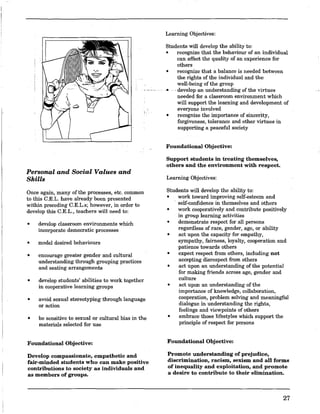
Personal and Social Values and
Skills
Once again, many of the processes, etc. common
to this C.E.L. have already been presented
within preceding C.E.L.s; however, in order to
develop this C.E.L., teachers will need to:
•
•
•
•
•
•
develop classroom environments which
incorporate democratic processes
model desired behaviours
encourage greater gender and cultural
understanding through grouping practices
and seating arrangements
develop students' abilities to work together
in cooperative learning groups
avoid sexual stereotyping through language
or action
be sensitive to sexual or cultural bias in the
materials selected for use
Foundational Objective:
Develop compassionate, empathetic and
fair-minded students who can make positive
contributions to society as individuals and
as members of groups.
Learning Objectives:
Students will develop the ability to:
• recognize that the behaviour of an individual
can affect the quality of an experience for
others
• recognize that a balance is needed between
the rights of the individual and the
well-being ofthe group
.• .-. develop an understanding -of the virtues
needed for a classroom environment which
will support the learning and development of
everyone involved
• recognize the importance of sincerity,
forgiveness, tolerance and other virtues in
supporting a peaceful society
Foundational Objective:
Support students in treating themselves,
others and the environment with respect.
Learning Objectives:
Students will develop the ability to:
• work toward improving self-esteem and
•
•
•
•
•
•
•
. self-confidence in themselves and others
work cooperatively and contribute positively
in group learning activities
demonstrate respect for all persons
regardless of race, gender, age, or ability
act upon the capacity for empathy,
sympathy, fairness, loyalty, cooperation and
patience towards others
expect respect from others, including not
accepting disrespect from others
act upon an understanding of the potential
for making friends across age, gender and
culture
act upon an understanding of the
importance of knowledge, collaboration,
cooperation, problem solving and meaningful
dialogue in understanding the rights,
feelings and viewpoints of others
embrace those lifestyles which support the
principle of respect for persons
Foundational Objective:
Promote understanding of prejudice,
discrimination, racism, sexism and all forms
of inequality and exploitation, and promote
a desire to contribute to their elimination.
27
Learning Objectives:
Students will develop the ability to:
• analyze print and non-print resources for
stereotyping and bias
• understand the positive and negative
influences of peer pressure upon one's
beliefs, values and actions
• understand what it means to be exploited
• understand tlie positive Tole that indignation .
can play in situations which are exploitative
and racist
•
•
•
choose and use materials in physical
education which support balanced, fair,
accurate portrayals of sexes, races and
cultural groups
understand that negative expectations and
treatment will affect others' achievements
and behaviours
recognize and understand that prejudice,
racism, sexism and other forms of
discrimination are a destruction of one's own
humanness as well as that of others
Independent Learning
In addition to what has been previously stated,
independent learning is facilitated when students
are provided with opportunities to:
• function in a climate that promotes
self-esteem, curiosity, competence and trust
• explore issues or topics which address their
28
interests or concerns
• participate in experiences which require
them to go beyond what the class lesson
provides
• share what they have discovered on their
own about a particular concept
.•.. participate in classroom decision-making
processes
• choose among learning options
• grow in confidence and skill in their use of
various types of resources .
Foundational Objective:
Support the development of a positive
disposition toward lifelong learning.
Learning Objectives:
Students will develop the ability to:
• discover how their efforts can affect their
learning
• cooperate with and help each other in order
to enhance their understanding through
sharing information
• move from choosing among teacher-directed
activities toward self-directed activities that
require more and more student planning
• work on in-depth studies of their choice
• develop a willingness to take risks
• value learning for its own sake and as a
means to other ends
• recognize that learning is continuous from
birth to death
Foundational Objective:
Develop students' abilities to meet their
own learning needs.
Learning Objectives:
Students will develop the ability to:
• connect what they already know with what
they are learning
• analyze and understand consequences of
decisions and results of learning experiences
• take responsibility for their own learning by
setting goals, designing plans, managing
activities, evaluating success and reviewing
the process as capabilities develop
• construct clear, achievable goals and plan to
meet them
• select learning methods appropriate for each
task and personal learning style
• exercise choice with respect to structuring
assignment, topics, group processes and
timelines
• transform their reflections into strategies for
action
• relate learning outcomes to prior and futu~e
needs
• take more responsibility regarding planning,
monitoring of learning tasks, using contracts
and conferencing (with teachers, peers and
others)
Foundational Objective:
Develop students' abilities to access
knowledge.
Learning Objectives:
Students will develop the ability to:
• identifY and appropriately use a variety of
available resources such as human, print,
audio/visual, video/film and electronic
database
• develop a personal catalogue of available
resources, such as people, equipment, sites
and experiences
(The previous information relating to the
Common Essential Learnings was adapted Jrom
Objectives for the Common Essential Learnings
(C.E.L.sJ.) R'f.6
,: .
The Adaptive Dimension
In order to start students from "where they are
at" on an individual basis and give them
guidance regarding choices related to physical
activity and motor skill development, it will be
necessary to find out where their expertise and
interests lie.
The interest inventory found in Appendix A
might serve as a starting point. It could give
both teachers and students a common point from
which to develop individual programs.
As well as helping teachers and students decide
which activities should be included in the
program; this information should be helpful in
providing experiences so that students may select
and begin development in one or two activity
areas.
General Guidelines for Making
Adaptations
In order to incorporate the Adaptive Dimension,
teachers can:
• Alter the pace of the lesson to ensure that
students understand the concept being
presented and to ensure they are being
challenged by the presentation. Some
students may be more successful pursuing
an activity in small groups; others may find
working alone more suitable. The pace can
be altered by using various arrangements
such as moving from individual work to
pairs to fours, then sixes.
• Monitor the use of vocabulary. For example,
it is possible to use advanced and simple
vocabulary in the same lesson by
incorporating words into sentences: "She is
proficient, or good, at racquet skills." This
helps satisfY the needs of some students,
expand the vocabularies of others and make
the situation meaningful to both.
• Alter the method of instruction to meet
individual student needs. Students who are
mostly auditory learners might benefit from
a circle of knowledge or brainstorm. Visual
learners might find concept mapping or
writing thoughts on flipchart paper helpful.
29
•
•
•
•
•
•
•
30
Alter the manner in which the students are
required to 'respond to the teacher or to the
instructional approach: in written form, by
oral presentation, making a video, drawing a
picture.
Change materials regularly so they enhance
rather than impede learning. Use a variety
of books and pamphlets. Plan for students
to work in notebooks, on bristol board and .
on the chalkboard. A change is as good as a
rest.
Have advanced or more challenging tasks
available for students who become proficient
at one level. In physical education, students
must be able to "start where they are" and
proceed from there. Those who are
proficient at the beginner level in golf should
be able to move on to other more challenging
activities at the intermediate level.
Beginners should not be expected to
move on to intermediate levels before
they are ready; advanced students
should be able to work at that level
without having to wait for the others to
"catch Up}1
Use interactive techniques that allow close
monitoring of each student's progress (for
example, peer practice, discussion and
cooperative learning groups). These
instructional methods allow the facilitator to
move about more freely, observing each
student for longer periods of time.
Consider adaptations in instruction and
content when planning for evaluation.
Encourage as much student participation as
possible in planning, instruction, assessment
and evaluation. One intent of Physical
Education 20 and 30 is that students become
self-directed learners. They will be more
willing to assume that role if they feel
ownership for the class.
Use support systems extensively. Physical
educators cannot be expected to be experts
in everything. Use personnel from within
and around the community to enhance the
program.
Practical Considerations for
Physical Education 20 and 30
Teachers
•
•
•
•
•
Some families cannot afford the cost of
physical education clothes. Ensure that the
school has a plan to make certain that all
students will have appropriate clothing
when the first formal class begins. Avoid
student embarrassment at all cost.
Some students have low energy due to
malnutrition, hunger, sleeplessness or
general poor health. Become aware of
signals and ensure that demands are
appropriate.
Some students have low self-esteem and use
all ~o~s of avoidauce behaviours regardiug
actlvItles that may call attention to their
"ineptness." Plan for student success.
Ensure a percentage of class time involves
sma!l group, self-directed tasks. Something
as SImple as background music can help
detract from feelings of inferiority.
Build awareness of past and current feats of
physical strength, endurance and skills of
various cultures. Historically, for example,
Indian men were often expected to put in a
pre-dawn, pre-breakfast run of at least 15
kilometres each day!
Learners with Special Needs
Educational law in Saskatchewan guarantees a
free and appropriate public education for all
school-aged children, regardless of ability. The
vast majority of Saskatchewan children with
exceptionalities are educated with their peers in
regular classrooms. This means that in any
given classroom, there may be one or more
students who are gifted or disabled.
The Adaptive Dimension of the curriculum is
intended to allow the classroom teacher
flexibility so that all students are given every
opportunity to learn and to perform to their full
potential. Teachers should make use of
appropriate supplemental materials as well as
school or division based resource teachers and
consultative personnel in planning suitable
activities.
Incorporating the Adaptive Dimension for
Physically and Mentally Disabled Students
The Bibliography supplies information on
resources that will greatly assist you in the
integration of physically and mentally disabled
students into the regular classroom. What
follows here are examples of simple yet effective
things that can make this integration work for
everyone.
By using the resources listed in the Bibliography,
resource personnel, plus some common sense and
creativity, teachers will be able to deal with the
wide range of abilities so commonly encountered
within a classroom.
Because there is a good chance that Physical
Education 20 and 30 students may choose to
develop skills in an activity area related to
racquet sports, the adaptation examples
described below relate largely to racquet sports.
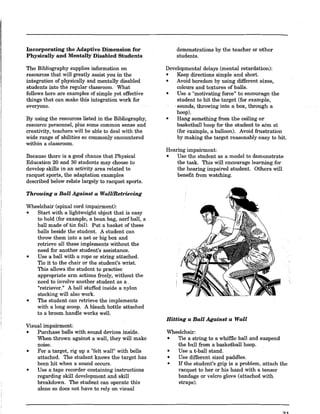
Throwing a Ball Against a Wall/Retrieving
Wheelchair (spinal cord impairment):
o Start with a lightweight object that is easy
to hold (for example, a bean bag, nerf ball, a
ball made of tin foil). Put a basket of these
balls beside the student. A student can
throw them into a net or big box and
retrieve all these implements without the
need for another student's assistance.
o Use a ball with a rope or string attached.
Tie it to the chair or the student's wrist.
This allows the student to practise
appropriate arm actions freely, without the
need to involve another student as a .
"retriever." A ball stuffed inside a nylon
stocking will also work.
o The student can retrieve the implements
with a long scoop. A bleach bottle attached
to a broom handle works welL
Visual impairment:
o Purchase balls with sound devices inside.
When thrown against a wall, they will make
noise.
o For a target, rig up a "felt wall" with bells
attached. The student knows the target has
been hit when a sound occurs.
o Use a tape recorder containing instructions
regarding skill development and skill
breakdown. The student can operate this
alone so does not have to rely on visual
demonstrations by the teacher or other
students.
Developmental delays (mental retardation):
o Keep directions simple and short.
o Avoid boredom by using different sizes,
colours and textures of balls.
• Use a "motivating foreell
to encourage the
student to hit the target (for example,
sounds, throwing into a box, through a
hoop).
o Hang something from the ceiling or
basketball hoop for the student to aim at
(for example, a balloon). Avoid frustration
by making the target reasonably easy to hit.
Hearing impairment:
o Use the student as a model to demonstrate
the task. This will encourage learning for
the hearing impaired student. Others will
benefit from watching.
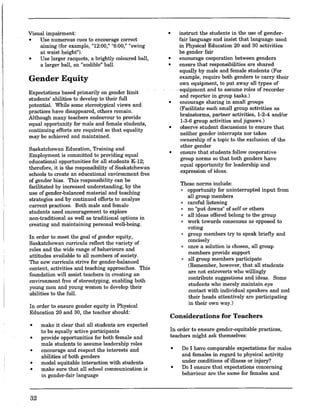
Hitting a Ball Against a Wall
Wheelchair:
o Tie a string to a whiffle ball and suspend
the ball from a basketball hoop.
o Use a t-ball stand.
o Use different sized paddles.
o If the student's grip is a problem, attach the
racquet to her or his hand with a tensor
bandage or velcro glove (attached with
straps).
31
Visual impairment:
• Use numerous cues to encourage correct
aiming (for example, 1112:00," "6:00," "swing
at waist height").
• Use larger racquets, a brightly coloured ball,
a larger ball, an "audible" ball.
Gender Equity
Expectations based primarily on genderlimit
students' abilities to develop to their full
potential. While some stereotypical views and
practices have disappeared, others remain.
Although many teachers endeavour to provide
equal opportunity for male and female students
continuing efforts are required so that equality
may be achieved and maintained.
Saskatchewan Education, Training and
Employment is committed to providing equal
educational opportunities for all students K-12'. ,
,
therefore, it is the responsibility of Saskatchewan
schools to create an educational environment free
of gender bias. This responsibility can be
facilitated by increased understanding, by the
use of gender-balanced material and teaching
strategies and by continued efforts to analyze
current practices. Both male and female
students need encouragement to explore
non-traditional as well as traditional options in
creating and maintaining personal well-being.
In order to meet the goal of gender equity,
Saskatchewan curricula reflect the variety of
roles and the wide range of behaviours and
attitudes available to all members of society.
The new curricula strive for gender-balanced
content, activities and teaching approaches. This
foundation will assist teachers in creating an
environment free of stereotyping, enabling both
young men and young women to develop their
abilities to the full.
In order to ensure gender equity in Physical
Education 20 and 30, the teacher should:
•
•
•
•
•
32
make it clear that all students are expected
to be equally active participants
provide opportunities for both female and
male students to assume leadership roles
encourage and respect the interests and
abilities of both genders
model equitable interaction with students
make sure that all school communication is
in gender-fair language
•
•
•
•
•
•
instruct the students in the use of gender-
fair' language and insist that language used
in Physical Education 20 and 30 activities
be gender fair
encourage cooperation between genders
ensure that responsibilities are shared
equally by male and female students (For
example, require both genders to carry their
own equipment, to put away all types of
. equipment and to assume roles of recorder
and reporter in group tasks.)
encourage sharing in small groups
(Facilitate such small group activities as
brainstorms, partner activities, 1-2-4 and/or
1-3-6 group activities and jigsaws.)
observe student discussions to ensure that
neither gender interrupts nor takes
ownership of a topic to the exclusion of the
other gender
ensure that students follow cooperative
group norms so that both genders have
equal opportunity for leadership and
expression of ideas.
These norms include:
, opportunity for uninterrupted input from
all group members
, careful listening
, no "put downs" of self or others
, all ideas offered belong to the group
, work towards consensus as opposed to
voting
, group members try to speak briefly and
concisely
, once a solution is chosen, all group
members provide support
, all group members participate
(Remember, however, that all students·
are not extroverts who willingly
contribute suggestions and ideas. Some
students who merely maintain eye
contact with individual speakers and nod
their heads attentively are participating
in their own way.)
Considerations for Teachers
In order to ensure gender-eqnitable practices,
teachers might ask themselves:
•
•
Do I have comparable expectations for males
and females in regard to physical activity
under conditions of illness or injury?
Do I ensure that expectations concerning
behaviour are the same for females and
males?
• Do I ensure that discipline practices are
comparable for males and females?
• Do I avoid using feminine terminology when
addressing male students in order to
motivate them to be "tougher"?
• Do I ensure that responsibilities are shared
equally by female and male students?
• Do I ensure that all students avoid
developing an attitude of "learned
helplessness"?
• Do I make it clear to all students that all
physical activities are gender neutral? For
example, both genders can play football,
wrestle and dance.
(Adapted from Gender Equity Policy and
Guidelines for Implementation, Saskatchewan
Education, 1991.) Rof.7
33
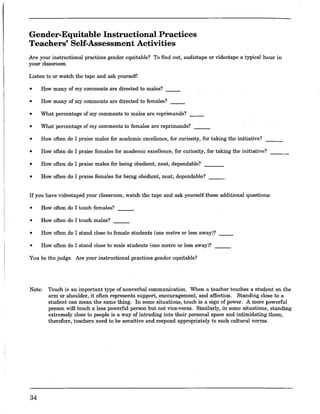
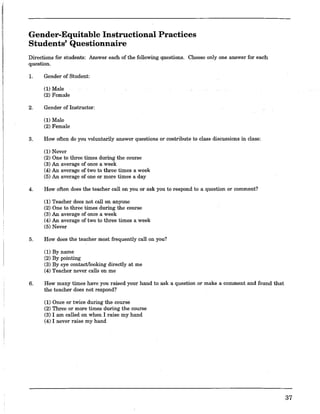
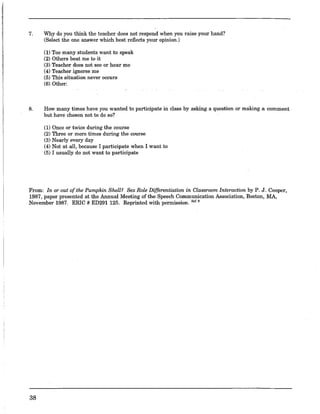
Gender-Equitable Instructional Practices
Teachers' Self-Assessment Activities
Are your instructional practices gender equitable? To find out, audiotape or videotape a typical hour in
your classroom.
Listen to or watch the tape and ask yourself:
• How many ofmy comments are directed to males?
• How many of my comments are directed to females? __
• What percentage of my comments to males are reprimands?
• What percentage of my comments to females are reprimands? ___
• How often do I praise males for academic excellence, for curiosity, for taking the initiative?
• How often do I praise females for academic excellence, for curiosity, for taking the initiative?
• How often do I praise males for being obedient, neat, dependable?
• How often do I praise females for being obedient, neat, dependable?
If you have videotaped your classroom, watch the tape and ask yourself these additional questions:
• How often do I touch females?
• How often do I touch males?
• How often do I stand close to female students (one metre or less away)?
• How often do I stand close to male students (one metre or less away)?
You be the judge. Are your instructional practices gender equitable?
Note: Touch is an important type of nonverbal communication. When a teacher touches a student on the
arm or shoulder, it often represents support, encouragement, and affection. Standing close to a
student can mean the same thing. In some situations, touch is a sigo of power. A more powerful
person will touch a less powerful person but not vice-versa. Similarly, in some situations, standing
extremely close to people is a way of intruding into their personal space and intimidating them;
therefore, teachers need to be sensitive and respond appropriately to such cultural norms.
34
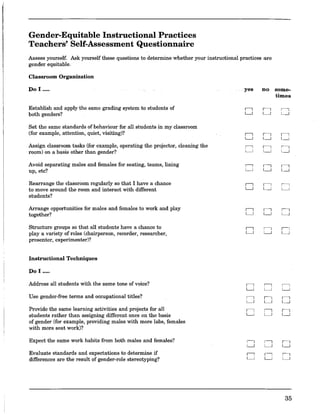
Gender-Equitable Instructional Practices
Teachers' Self-Assessment Questionnaire
Assess yourself. Ask yourself these questions to determine whether your instructional practices are
gender equitable.
Classroom Organization
Do I .....
Establish and apply the same grading system to students of
both genders?
Set the same standards of behaviour for all students in my classroom
(for example, attention, quiet, visiting)?
Assign classroom tasks (for example, operating the projector, cleaning the
room) on a basis other than gender?
Avoid separating males and females for seating, teams, lining
up, etc?
Rearrange the classroom regularly so that I have a chance
to move around the room and interact with different
students?
Arrange opportunities for males and females to work and play
together?
Structure groups so that all students have a chance to
playa variety of roles (chairperson, recorder, researcher,
presenter, experimenter)?
Instrnctional Techniques
Do I .....
Address all students with the same tone of voice?
Use gender·free terms and occupational titles?
Provide the same learning activities and projects for all
students rather than assigning different ones on the basis
of gender (for example, providing males with more labs, females
with more seat work)?
Expect the same work habits from both males and females?
Evaluate standards and expectations to determine if
differences are the result of gender-role stereotyping?
yes no some..
times
" " "L.J L...J L...J
" " "L.J L.J L.J
" " "L.J L.J L.J
" " "L.J L.J L.J
35
Pay close attention to classroom interaction patterns?
" ,----,
L.J ~
Give equitable attention to students of both genders
" ,----,
(instead of more criticism for males and more support L.J ~
for females)?
Ask both males and females divergent or opinion questions
" ,----,
(for example, explain the theory, describe your reaction)? L.J ~
Student Interaction
Do I .....
Encourage students to consider a broader range of program
"
,----,
and career options? L.J ~
Encourage all students to use all of the equipment
"
,----,
in the activity area? L.J ~
Recognize skill areas that may require extra encouragement
" "(for example, math for females, drama for males)? L.J ~
Avoid saying things that would make students think that
" ,----,
males must act one way and females another way (for example, L.J ~
"Boys will be boys," "Act like a lady")?
Have the same grooming and dress standards for both
" "genders? L.J ~
Recognize all athletic achievements and events?
" "L.J ~
Support students in behaviour that is not limited by their gender
" "stereotype (for example, males who are sensitive, caring, artistic)? L.J ~
Provide a good role model for students (for example, ensure that my
" "behaviour is not gender stereotyped)? L.J ~
Help both males and females to share feelings and cope with
" "stress in a healthy manner? L.J ~
Accept emotional expression from both genders?
" "L.J ~
Set the same standards for behaviour and administer the same
" "disciplinary actions to males and females? L.J ~
Avoid comparisons of males and females with respect to classroom
" "behaviour, attitudes and accomplishments? L.J ~
Ask students to tell me when I am treating male and female
" "students differently? L.J ~
These gender-equitable instructional practices instruments have been adapted from: Sex Equity in
Education: Readings and strategies (pp. 139-144), ed. A. O. Carelli, 1988, Springfield, IL: Charles C.
Thomas. Reprinted with permission. lW.8
36
,----,
~
"L.J
"~
"~
"~
"~
"~
"L.J
"~
"~
"~
"~
"L.J
"~
"L.J
"~
Gender-Equitable Instructional Practices
Students' Questionnaire
Directions for students: Answer each of the following questions. Choose only one answer for each
question.
1. Gender of Student:
(1) Male
(2) Female
2. Gender of Instructor:
(1) Male
(2) Female
3. How often do you voluntarily answer questions or contribute to class discussions in class:
(1) Never
(2) One to three times during the course
(3) An average of once a week
(4) An average of two to three times a week
(5) An average of one or more times a day
4. How often does the teacher call on you or ask you to respond to a question or comment?
(1) Teacher does not calion anyone
(2) One to three times during the course
(3) An average of once a week
(4) An average of two to three times a week
(5) Never
5. How does the teacher most frequently call on you?
(1) By name
(2) By pointing
(3) By eye contact!looking directly at me
(4) Teacher never calls on me
6. How many times have you raised your hand to ask a question or make a comment and found that
the teacher does not respond?
(1) Once or twice during the course
(2) Three or more times during the course
(3) I am called on when I raise my hand
(4) I never raise my hand
37
7. Why do you think the teacher does not respond when you raise your hand?
(Select the one answer which best reflects your opinion.)
(1) Too many students want to speak
(2) Others beat me to it
(3) Teacher does not see or hear me
(4) Teacherignores me
(5) This situation never occurs
(6) Other:
8. How many times have you wanted to participate in class by asking a question or making a comment
but have chosen not to do so?
(1) Once or twice during the course
(2) Three or more times during the course
(3) Nearly every day
(4) Not at all, because I participate when I want to
(5) I usually do not want to participate
From: In or out of the Pumpkin Shell? Sex Role Differentiation in Classroom Interaction by P. J. Cooper,
1987, paper presented at the Annual Meeting of the Speech Communication Association, Boston, MA,
November 1987. ERIC # ED291125. Reprinted with permission. 1M.'
38
Indian and Metis Curriculum
Perspectives
Physical activity has, from a historical
perspective, played a significant role in
Aboriginal culture. It has been used to display
strength, courage and self-discipline. It also
serves as a form of relaxation and leisure and is
accepted in both its ·competitiveand recreational
forms. The Bibliography contains resources
which offer background to and suggested
activities for Aboriginal inclusion in the physical
domain.
Saskatchewan Education, Training and
Employment recognizes that the Indian and
Metis peoples of the province are historically
unique peoples and occupy a unique and rightful
place in society. It also realizes that curricula
must meet the needs of Indian and Metis peoples
while at the same time benefiting all students.
Physical education teachers must use a variety of
teaching approaches that accommodate and build
upon the knowledge, cultures, learning styles and
strengths possessed by Indian and Metis
students. Instructional approaches such as
group work, cooperation rather than competitive
exercises and using the student's experiences as
a learning base can be useful.
Twelve Principles of Indian
Philosophy
1. Wholeness.
2.
All things are interrelated. Everything in
the universe is part of a single whole.
Everything is connected in some way to
everything else. It is only possible to
understand something if we understand
how it is connected to everything else.
Change.
Everything is in a state of constant change.
One season falls upon the other. People
are born, live, and die. All things change.
There are two kinds of change: the coming
together of things and the coming apart of
things. Both kinds of change are necessary
and are always connected to each other.
3. Change occurs in cycles or patterns.
Change is not random or accidental. If we
cannot see how a particular change is
connected, it usually means that our
standpoint is affecting our perception.
4. The physical world is real. The
spiritual world is real.
They are two aspects of one reality. There
are separate laws·which govern each.
Breaking of a spiritual principle will affect
the physical world and vice versa. A
balanced life is one that honours both.
5. People are physical and spiritual
beings.
6. People can acquire new gifts but they
must struggle to do so.
The process of developing new· personal
qualities may be called "true learning."
7. There are four dimensions of "true
learning."
A person learns in a whole and balanced
manner when the mental, spiritual,
physical, and emotional dimensions are
involved in the process.
8. The spiritual dimension of human
development has four related
capacities:
• the capacity to have and to respond
to dreams, visions, ideals, spiritual
teaching, goals and theories
• the capacity to accept these as a
reflection of our unknown or
unrealized potential
• the capacity to express these symbols
in speech, art or mathematics
• the capacity to use this symbolic
expression towards action directed at
making the possible a reality.
9. People must actively participate in the
development of their own potential.
10. People must decide to develop their
own potential.
11. Any person who sets out on a journey
of self-development will be aided.
Guides, teachers, and protectors will assist
the traveller.
39
12. The only source of failure is a person's
own failure to follow the teachings.
Source: This information was gathered at a
conference held in Lethbridge, Alberta, in
December, 1982. Indian elders, spiritual leaders,
and professionals from across Canada offered
these fundamental elements that they considered
to be common among Canadian Indian
philosophies. These' have become the foundation
of work currently being carried out by The Four
Worlds Development Project, University of
Lethbridge.
Working with Indian and Metis
Students in Saskatchewan Schools
Teachers playa very important role in the
development and implementation of Indian and
Metis initiatives in Saskatchewan schools.
Following are a number of fundamental and
essential considerations for teachers as they
develop and refine short and long term objectives
for their classrooms:
Become the initiator of staff inservice about
Indian and Metis education.
Contact Saskatchewan Education, Training and
Employment regarding resource personnel
available for inservice.
Become informed about the community's
various cultures and cultural differences.
Talk to the children and parents in the school's
community. Learn about the various traditions
regarding good manners and approaches to
discipline. Talk to someone with whom the
school has a trusting relationship. Find out
about the community's protocol for contacting
elders and visiting homes.
Know the homes from which the students
come.
This will give some idea of the daily
environments in which students live. Invite
parents into the classroom; organize several
parents' nights. Show the parents what goes on
in class and how the various activities relate to
daily community life.
If parents are unable to attend, search out
individuals who can act as liaisons with these
families. Family involvement will increase the
chances of students being motivated by
individuals within the home.
40
Become visible and become involved in
cultural activities.
Then, use what has been learned in lessons at
schoo!.
Apply acquired knowledge to the classroom.
Use appropriate terms when discussing Indian
and Metis history and cultures. Expose students
to real,.tangible Indian and Metis art. Allow
. them to experience the "real thing" as opposed to
replicas. Invite Indian and Metis craftspeople
into the classroom. Observe the skill of
demonstration and explanation teaching
techniques.
Practise listening skills.
Teachers sometimes neglect to consider the fact
that when students ask questions, this is a
compliment! They are expressing trust and a
need for input. Nodding, eye contact (even if this
is absent on the speaker's part), leaning forward
and paraphrasing are examples of very simple
yet effective techniques used to communicate the
fact that they are being heard.
When developing listening skills among students,
allow them to see each other's faces during small
{ group/whole class discussions. Much is lost in
the area of communication when allthe students
can see are the backs of each other's heads!
Use a "talking stick" when discussions are being
held in small groups. This technique allows all
students to become involved in the discussion, to
"pass" when the stick is offered to them, and to
appropriately control those who dominate the
conversation by monopolizing the stick.
Be a bridge builder.
Seek commonalities rather than differences. We
are products of our past. People do things the
way their families did them. Rather than
emphasize differences, use the differences to
concentrate on the human experiences we all
share: birth, kinship, friendship, learning,
celebrating, gift giving and a sense of humour.
(Workshop Leader's Guide, 1989) R,f.lO
Resource-Based Learning
and Library Resource
Centres
Resource-based teaching and learning is a means
by which teachers can greatly assist the
development of attitudes and abilities for
independent, lifelong learning.
It is no longer possible to adopt a single textbook
approach to teaching. Saskatchewan Education,
Training and Employment's policy document,
Resource-based learning: Policy, guidelines and
responsibilities for Saskatchewan learning
resource centres, states that in order to meet the
needs of individual learners and to develop in
students the necessary skins of information
processing, resource-based teaching is a
recommended method of instruction.
Resource-based instruction involves teacher and,
if possible, teacher-librarian cooperation in
planning units that integrate resources with
classroom assignments and teach students the
processes needed to find, analyze and present
information.
Advantages of Resource-Based
Instruction
Resource-based instruction is student-centred. It
offers students opportunities to choose, to explore
and to discover. The opportunity to make choices
in an environment rich in resources, where the
thoughts and feelings of students are respected,
is vital to the development of autonomous
learners.
This kind of program requires the active
commitment of an staff. Teachers benefit as
much as students when the whole staff supports
a strong school library program. To learn more
about the components of an effective school
library, refer to the document Learning resource
centres in Saskatchewan: A guide for development
(1988).
Fonowing are ways in which resource centres
support the curriculum:
•
•
•
•
•
•
Provide warm,· caring staff members who
prize, model and support curiosity,
open-ended investigation and the free
exchange of ideas.
Provide reference materials, books, current
magazines, pamphlet and clipping files,
filmstrips, audio and video recordings,
software, pictures and displays, an of
which are up-to-date and appealing to
students. A place may be reserved for
displaying activity and fitness related
materials.
Help classroom teachers by teaching
information skins. Skills might include
understanding and using a variety of
indexing systems used in books,
periodicals, reference materials and
databases; summarizing and organizing;
writing reports; constructing bibliographies
and preparing presentations in various
media, to name a few. Written and audio-
visual work is often a part of physical
education. Students must know how to
access information and then use this
information effectively.
Provide resources for students at all levels
of ability.
Create a learning environment which
anows for the library to be a place for
active learning. The library may have
learning centres planned to support
classroom topics as wen as posters and
information bunetins which advertise
events, research activities, television
programs and films. In the area of
physical education, new information is
constantly emerging and should be
displayed.
Provide interdisciplinary learning to help
students comprehend and anticipate the
complex interrelationship of disciplines.
41
•
•
•
•
Physical Education 20 and 30 integrates
easily and naturally with a uumber of
disciplines, including science, mathematics
and English language arts.
Provide and structure activities for both
individual and small group work.
Make students familiar with modern
information technology, including
instructional software and databases.
Many fitness and leisure resources are
currently being produced on computer disk.
Provide relevant enrichment materials
which anticipate students' interests, such
as periodicals, information on recreational
activities and special interests or concerns,
biographies, information on careers related
to physical activity and various community
resources.
Provide a link to information and materials
from other libraries, the central board
office, universities, governments, industry
and other commuuity resources involved
with physical activity, physical fitness and
leisure.
The following guidelines will be of help to the
teacher in using resource-based teaching and
learning:
• Set the objectives for units of instruction
and correlate needed research skills with
the activities in the unit so that skills are
always taught in the context of application.
•
•
42
Access resource lists and bibliographies of
materials when needed. Ask the resource
person to offer personal guidance to ..
students during the course of each actIVIty
and assignment. Physical Education 20
and 30 research assignments will vary.
Support the essential role of the library
resource centre and the teacher-librarian
in your talks with colleagnes, principals
and directors.
Questions Most Often Asked About
Implementing Resource-based
Learning
It should be emphasized at this point that
Resource-based Learning must go hand in hand
with planning for instructional strategies and
evaluation techniques for each lesson.
It is not possible for me to plan for all of the
changes needed to incorporate
Resource-based Learning into my already
too busy teaching schedule. How can I be
expected to do this when there is already
too little time in the day?
• Everyone must realize that change usually
takes time. To change our teaching styles
will take time. Even though a person may
not be able to change totally to
Resource-based Learning in a short time,
gradual steps can be taken toward the
desired goal. A realistic goal might be to
do two resource-based units a year.
Teachers might attempt to do one unit
before Christmas and one after.
How can I have a variety of resources
available to the students when I have little
money to buy them?
Various strategies for acquiring resources could
be employed:
•
•
•
In the index section of most bibliographies
there is a section listing free or inexpensive
items.
Some of the bibliographies also provide an
"other uses" section so that schools can buy
resources that will meet the needs of more
than one specific grade or subject area.
For example, many Physical Education 20
and 30 resources complemeut the Wellness
10 curriculum.
Media House provides videos at a nominal
cost of one dollar per program and a blank
tape. (You can provide the tape or
purchase it from Media House.) 16 mm
films and kits may be borrowed as well.
• Many people forget that humans are also
resources we should be using for
Resource-based Learning. Often there is
•
someone knowledgeable on a certain
subject right in your own community who
may be willing to speak to the students.
Guest speakers can also be located by
using the blue pages of the telephone
directory. Often government offices have
personnel who will come to speak to
schools free of charge. Other service
groups will provide a speaker if the school
supplies the gas money. Students can
raise this money through various activities.
Free or inexpensive items can often be
obtained from departments listed in the
"blue pages" of the telephone book.
• Some schools are shipping equipment to
other schools where teachers want to do
the same topic. Reciprocal agreements are
made involving these .resources. Print and
AN items could also be circulated in the
same way.
• Networking can also be useful in sharing
ideas whether this is within a school or
between schools. If there is a
teacher-librarian available, this person can
be helpful when coordinating themes and
units. Cooperative planning with the
teacher-librarian or fellow teacher helps
give ideas for using resources already
available.
Joint planning also puts teachers in
contact with others to share ideas.
Teachers could use some time at their staff
meetings to explain what they are
planning. Time spent supervising students
at recess or noon is being used by some
educators to do their cooperative planning.
Teachers using innovative ideas in one
school could also be invited to share their
ideas in other schools.
Once I find a list of resources I want to
order out of a bibliography, for example,
there are so many different places to order
from I do not know where to begin!
• Many bookstores in Saskatchewan will
provide this service. The Book Bureau will
do a special ordering service as well.
Materials from the United States can be
purchased through the Book Bureau if
there is a Canadian distributor.
Why doesn't someone put together a book
with ideas on Resource-based Learning so
teachers could use the ideas?
• The Saskatchewan School Library
Association (SSLA) has published
documents on this subject. The 4th R is
one; there is also a document on
cooperative planning. The SSLA
periodical, The Medium, has articles on
implementing Resource-based Learning in
specific curriculum areas as well as units
on specific curriculum topics utilizing
Resource-based Learning.
43
Instructional Approaches
Instructional
Approaches
Effective secondary teachers know they are
teaching students as well as content. They also
know that, in every class, there will be a
diversity of students, each of whom will bring to
the activity euvironment different pe~ceptions,
prior knowledge, attitudes and learning styles.
It is the teacher's responsibility to make use of a
variety of instructional approaches to ensure that
all "types" of students and their various needs
are being met.
The following information reinforces the
importance of using a variety of instructional
approaches:
Retention Rate
Lecture
Reading
Audio-Visual
Demonstration
Discussion Group
Practice by Doing
Teach Others!
Immediate Use of Learning
5%
10%
20%
30%
50%
75%
90%
Of what we know we learn approximately
1% through Taste
2% through Touch
4% through Smell
10% through Hearing
83% through Sight
Of what we learn we retain approximately
10% of what we Read
·20% of whatwe·Hear .
30% of what we See
50% of what we Hear And See
70% of what we Say
90% of what we Say As We Do
(From Fundamental principles and practices of
teaching: A practical theory-based approach to
planning and instruction by H. Lang and A.
l};1;c~eath. (In Progress). Fort Worth: HBJ-Holt.)
The following pages discuss five main types of
instructional approaches:
•
•
•
•
•
Direct Instructional Strategies
Indirect Instrnctional Strategies
Interactive Instructional Strategies
Independent Study Instructional Strategies
Experiential Instructional Strategies
47
I
I
The instructional strategies and methods which
most readily complement this curriculum guide
are given. Each strategy is briefly defined. This
is followed by a description ofthe respective
methods and suggested ways of assessing or
evaluating students.
Direct Instruction Strategies
Direct instruction strategies are highly teacher
centred. The lecture method is a direct
instruction example, Mini-lectures can be
effectively used throughout Physical Education
20 and 30.
Mini-lecture
The mini-lecture is a one-way type of
communication. It is an efficient way of
providing a small amount of information in a
short period of time.
Mini-lectures are effective when they are:
• 10-15 minutes in duration, never longer than
20 minutes
• mixed with group discussion and
demonstrations
• accompanied with such aids as overheads and
flipcharts
Example: presenting information on heart rate
range before students calculate their own.
Appropriate Assessment and Evaluation
Techniques:
The purpose of a mini-lecture is to impart
knowledge. The most appropriate way of
assessing understanding is a combination of test
items such as essay, short answer, multiple
choice, true and false.
Structured Overview
This strategy refers to organizing and arranging
topics or concepts to makethem meaningful to
students.
Example: unit overview and how it fits into the
rest of the year or semester.
Appropriate Assessment and Evaluation
Techniques:
As this is usually used as an organizer, teachers
are not likely to assess it.
48
Explicit Teaching
This strategy involves six teaching functions:
• daily review
• presenting new material
• conducting guided practice
• providing feedback and correctives
• conductillg independent practice
• weekly and monthly review
Example: progression ofa racquets unit.
Appropriate Assessment and Evaluation
Techniques:
As explicit teaching involves students interacting
with content, the most appropriate way of
assessing may be with a combination of test
items, including performance tests.
Drill and Practice
This strategy refers to the structured, repetitive
review of previously learned concepts to a
predetermined level of mastery.
Example: golf "circuit" using gymnasium and
field.
Appropriate Assessment and Evaluation
Techniques:
This strategy tends to focus on skills. In this
curriculum the focus is on both physical and non-
physical skills. To assess level of skill, teachers
will need to use performance assessments or
performance tests.
An example of a drill and practice assessment
may be in movement patterns. The performance
cues for each movement pattern are located in
the Motor Skills Development section of this
document. These performance cues can be
inserted as criteria on a template for anecdotal
records, checklists or rating scales.
Teachers need to establish criteria indicating
what students are to do. The criteria are
inserted into the templates for anecdotal records,
rating scales, and checklists.
Compare and Contrast
This strategy involves looking for similarities and
differences. Students:
• observe details and develop criteria
• identify similarities
• search and sort out differences based on
criteria
• summarize
Example: hockey slapshot versus golf 7-iron
shot.
Appropriate Assessment and Evaluation
Techniques:
This strategy reaches the application level and
higher on Bloom's Taxonomy. The four
components of compare and contrast as listed
above can be used as criteria in the templates for
anecdotal records, checklists and rating scales.
Didactic Questions
These are questions that tend to be convergent
(they tend to focus on one topic) and factual.
They often begin with "what/' "where,II IIwhen,II
"how." (Saskatchewan Education, Training and
Employment (1991), Instructional
Approaches) 1M. 12
Examples: How would you improve your
forehand stroke? What is the top end of your
heart rate range?
Appropriate Assessment and Evaluation
Techniques:
The teacher is able to observe both content and
process through this activity. As a written
assignment or an oral presentation or interview
(live or taped) may be the ongoing student
activity used for assessment, the teacher will
record student progress using a rating scale,
checklist or anecdotal records.
Content criteria may include:
• the match between the student's goal and the
plan of action to achieve that goal
• inclusion of time frame
• inclusion of support system
• inclusion of regular checkpoints
Process criteria may include:
• evidence of planning
• gathering of information
• organization of information
• analysis of information for applicability
• making a judgment
• creating whole from series of parts
• revising
Demonstrations
These refer to teacher activities and talks that
show students llhow,n
Demonstrations apply primarily to skills and
processes and are useful for helping students
acquire procedural knowledge.
Example: how to enter personal skinfold
measurements into a computer.
Appropriate Assessment and Evaluation
Techniques:
Demonstrations feature the teacher as performer;
therefore the students are not involved and no
assessment is necessary.
II
Indirect Instruction
Strategies
Indirect instruction strategies are student
centred. Indirect instruction methods are very
effective when:
• thinking outcomes are desired
• attitudes, values or interpersonal outcomes
are desired
• process is as important as product
• the focus is personalized understanding and
. long term retention of concepts or
generalizations
• lifelong learning capability is desired
(Instructional Approaches: A Framework for
Professional Practice, 1991, p. 19) R,f.12
Concept Mapping
This instructional method can promote creative,
meaningful, long-term learning. In the Physical
Education 20 and 30 curriculum, concept
mapping can be used to have students see the
relationships between new information and what
they already know.
Concept mapping:
• is a technique used to identify key concepts
or to show the relationships between
concepts
• can facilitate learning and recall
• can make clear to students the key ideas to
learn
• can be used to review subject matter
49
o can provide a summary of a unit or lesson
(From C.E.L. Staff Development Program,
1988) "'.13
Example: showing the relationship between the
movement pattern "sending" and the subsequent
performance cues related to beginner,
intermediate and advanced.
Appropriate Assessment and Evaluation
Techniques:
As concept mapping is used as an engaging
activity and synthesis activity or one that
supplies diagnostic information, teachers may
consider the type of information they wish to
collect in assessing students' concept maps.
Anecdotal records may be the most appropriate
data recording method. Possible criteria to direct
anecdotal comments may be:
o inclusion of required concepts
o depth of relationships between concepts
o student background information
o rationale or logic involved in the concept map
structure
Problem Solving
This strategy refers to a process of decision-
making or a series of steps used by individuals or
groups to arrive at answers to questions or the
solution of a problem.
Example: planning a school fitness promotion
video.
Appropriate Assessment and Evaluation
Techniques:
Teachers may insert these steps into a checklist,
rating scale or anecdotal record template in order
to record student information. These steps
become the criteria.
Reflective Discussion
This strategy involves students individually or as
a group in thinking more deeply about a topic
through discussion.
Example: choosing a workout partner.
Appropriate Assessment and Evaluation
Techniques:
Effective communication skills and contributions
are criteria to be evaluated here. A sample
assessment tool, Anecdotal Records in Reflective
Discussion is provided in the Templates for
Assessment and Evaluation section of this
50
guide.
Concept Attainment
Concept attainment is an inductive way to teach
a concept in which examples and non-examples
are provided in order to develop students'
understanding of the particular concept.
Example: obese versus overweight.
Appropriate Assessment and Evaluation
Techniques:
In assessing student learning, teachers may wish
to focus on the following criteria recorded on an
anecdotal record template:
o student method of categorization
o demonstrated knowledge of content elements
o relationships between the content elements
o formulation of a general statement based on
the above-mentioned elements
Interactive Instruction
Strategies
Interactive instruction strategies employ groups
of learners. Before the group members "set to
work" it is important for them to be aware of
what they are to accomplish, how much time
they have, and what the recording or reporting
procedures are.
Successful use of interactive instruction methods
in Physical Education 20 and 30 requires
students to be aware of particular group process
skills. A few basics include respect for the
opinions of others, attentive listening skills,
recording and reporting skills.
Peer Practice
This strategy involves each student rehearsing
skills or conceptual information with a peer.
Example: motor skills.
Appropriate Assessment and Evaluation
Techniques:
Teachers may use an anecdotal recording
instrument that highlights student participation
and contributions.
Discussion
A problem or issue is chosen that either does not
require a particular response or that requires
students to discover an answer.
Discussion is based on material familiar to
students and should conclude with consensus, a
solution, clarification of insights gained or a
summary. (Saskatchewan Education, Training
and Employment (1991), Instructional
Approaches, p. 23.) Ref. 12
Example: assessing individual fitness programs.
Appropriate Assessment and Evaluation
Techniques:
It is the teacher's decision whether discussion is
assessed. Should teachers wish to evaluate
discussion, what is to be looked for must be
determined and shared with students ahead of
time.
Problem Solving
This strategy refers to a process of decision-
making or a series of steps used by individuals or
groups to arrive at answers to questions or the
solution of a problem.
Example: setting evaluation criteria for an
assignment.
Appropriate Assessment and Evaluation
Techniques:
Teachers may insert these steps into a checklist,
rating scale or anecdotal record template in order
to record student information. These steps
become the criteria.
Cooperative Learning Groups
These groups are heterogeneous with respect to
student characteristics and have two to six
members sharing the various roles. Group
members are interdependent in achieving the
group learning goal. The jigsaw, explained next
in this section,;s an example of a cooperative
learning group activity. (Saskatchewan
Education, Training and Employment (1991).
Instructional Approaches) Ref. 12
Example: planning a fitness presentation.
Appropriate Assessment and Evaluation
Techniques:
The self-evaluation instrument My Group Skills
or Performance (p. 88) is provided for your use.
Jigsaw
. Aronson (1978) developed this method whereby
students become "experts" on a topic and then
meet with other "experts" to study the assigned
topic.
To conduct a jigsaw:
• each student receives a portion of the
materials to be introduced
• students leave their IIhome" or l1mixed"
groups and meet in "expert" groups
• expert groups discuss the material and
brainstorm ways in which to present their
understandings to the other members of
their mixed group
• the experts return to their mixed groups to
teach their portion of the materials and to
learn from the other members of their mixed
group
For more information see the Resource Package
that is included with the Staff Development
Program which accompanies the Instructional
Approaches document.
ExampIe: learning about power training
principles.
Appropriate Assessment and Evaluation
Techniques:
The rating scale Cooperative Group Skills can be
inserted into each student's portfolio and used
over time. It is located in the Templates for
Assessment and Evaluation section of this
document.
Brainstorming
This strategy is used to generate ideas and
imaginative solutions. The teacher acts as
facilitator and records learners' comments.
51
Brainstorming is most effective when:
• all statements are accepted
• quantity rather than quality is emphasized
• no criticism, anything goes (no matter how
outrageous or farfetched)
• no discussion or judgments except for
clarification purposes
• people can build on other ideas
(piggybacking/cross stimulation is
encouraged)
• a fixed time is allocated
• once ideas have generated they can be
combined or ordered
Example: Physical Education 30 - discussing
possible volunteering sites.
Appropriate Assessment and Evaluation
Techniques:
Teachers may decide to assess brainstorming
when it is used in the context of cooperative
learning groups. Auecdotal records may be the
preferred method of recording data. A template
is provided in the next section.
Circle of Knowledge
This strategy involves each student in thinking
and discussing with a peer before sharing ideas
with a large group.
Example: Physical Education 30 - volunteering
component.
Appropriate Assessment and Evaluation
Techniques:
In this curriculum, the circle of knowledge
method is used in the same manner as Reflective
Discussion. To assess student learning, teachers
may wish to use the Anecdotal Record Form for
Reflective Discussion /Discussion / Circle of
Knowledge as a data recording method. It is
found in the section called Templates for
Assessment and Evaluation.
Tutorial Group
A tutorial group is a group formed to receive
remediation or enrichment as directed by a
teacher or peer tutor.
Example: motor skills.
Appropriate Assessment and Evaluation
Techniques:
This method reflects the organization of student
groupings; therefore, teachers will need to choose
52
assessment techniques that are appropriate to
the instructional method used. For example,
tutorial groups may be used with didactic
questions. The teacher would then reference the
appropriate assessment techniques for didactic
questions.
Interviewing
Interviewing is the meeting of people face to face
to confer about a topic or issue.
Example: Physical Education 30 - volunteering
component. .
Appropriate Assessment and Evaluation
Techniques: .
A Student Self-Assessment for Preparing and
Conducting an Interview is found in the
Templates for Assessment and Evaluation
section.
Independent Study
Instruction Strategies
Independent learning has implications for
responsible decision-making. Individuals are
expected to analyze problems, reflect, make
decisions and take purposeful actions. To take
responsibility for their lives in times ofrapid
social change, students need to acquire life-long
learning capability. As most aspects of our daily
lives are likely to undergo profound changes,
independent learning will enable individuals to
respond to the changing demands of work, family
and society. (Saskatchewan Education, Training
and Employment, Instructional Approaches: A
Framework for Professional Practice, 1988,
p.53) Rof. 12
Learning Contracts
Learning contracts can be used throughout
Physical Education 20 and 30. Students and
teacher work together during the designing,
running and evaluation of personal contracts.
Example: specializing in one activity.
Appropriate Assessment and Evaluation
Techniques:
You may wish to refer to Rating Scale for
Investigating Movement Patterns found in the
Templates for Assessment and Evaluation
section.
Templates for Assessment and Evaluation
section ofthis guide.
Research Projects
Students are involved in research projects
individually, as partners, and as members of
small groups.
Example: investigating various fitness centres.
Appropriate Assessment and Evaluation
Techniques:
Consult the Templates for Assessment and
Evaluation section to locate a sample checklist,
A Framework for Marking a Project or a·Written
Assignment.
Essays
Essays are exercises that require students to
respond comprehensively in written form to an
assigned topic. (Saskatchewan Education,
Training and Employment (1991). Student
evaluation: A teacher handbook, p. 105) Ref. 14
Example: in place of a formal exam.
Computer-Assisted Instruction
This strategy refers to any instructional program
in which the computer performs, manages or
supports some or all ofthe teacher or provider
functions.
Example: personalized fitness programs.
Appropriate Assessment and Evaluation
Techniques:
If teachers access such a resource, student
learnings are to be assessed in ways that
correspond to the initial purpose or intent. In
other words, teachers ask themselves the
questions: "Why did I have this student working
with a particular software package?" "What
learning objectives are the students to
accomplish by working through this package?"
Teachers will then assess students on those
learning objectives.
Reports
Reports may be written, graphic or oral in nature
and involve the students in expressing their
learnings about a chosen topic.
Examples: an advanced player's breakdown of a
golf swing.
Appropriate Assessment and Evaluation
Techniques:
A written report can be assessed by using Report
Assessment located in the Templates for
Assessment and Evaluation section of this
guide. A graphic report can certainly be
assessed. The teacher and student need to
determine the criteria on which the graphic will
be assessed ahead of time. The criteria would
then be inserted into a template for a checklist,
rating scale or anecdotal records.
Homework
This refers to assignments students are given
that are to be completed during their time away
from the classroom.
Homework is both an assessment technique and
an instructional method. (Saskatchewan
Education, Training and Employment (1991),
53
Student evaluation: A teacher handbook,
p. 93) 1M. 14
Example: calculating metabolic rate with this
information to be used during next day's class.
Appropriate Assessment and Evaluation
Techniques:
Homework applies to both the cognitive and
motor skill domains. If the purpose ofthe
homework is motor skill improvement, a checklist
or rating scale is appropriate. If the purpose is
cognitive or attitudinal, instruments can be
designed accordingly.
Assigned Questions
Assigned questions are those prepared by the
teacher to be answered by individuals or small
groups of students with the students discussing
their responses among themselves or with the
teacher. (Saskatchewan Education, Training and
Employment (1991), Instructional
Approaches R".12
Example: questions related to purchasing a
worthwhile piece of workout equipment.
Appropriate Assessment and Evaluation
Techniques:
If the questions are designed at the koowledge
level, a recall style test, using a variety of types
of questions, can be used to assess student
learnings. If the questions are designed to be at
the application level or higher then complex
criteria are established.
Experiential Instruction
Strategies
These strategies are student centred. The
emphasis is on process, not product.
Experiential instruction strategies are very
useful because:
• they greatly increase understanding and
retention
• students are more motivated because they
54
actively participate and teach one another by
describing what they are doing
• they are inductive - illustrations or examples
are given and a rule, concept or
generalization is then formulated
• they are activity oriented
• students reflect about an experience and
apply what they have concluded to other
contexts
There are five phases:
• experiencing (an activity occurs)
• sharing (reactions and observations are
shared)
• analyzing (patterns are determined)
• inferring (concepts are developed)
• applying (plans are made to use learnings in
new situations)
Games
Games are learning or training activities that
include conflict, control and rules for winning
and terminating the activ:ities. They are
structured or contrived activities.
Example: creating games which focus on specific
movement patterns.
Appropriate Assessment and Evaluation
Techniques:
Games may be assessed using Assessing Group
Presentations or Games found in the Templates
for Assessment and Evaluation section ofthis
goide.
Focused Imaging
This strategy is the process of internally
visualizing an object, event or situation. It
enables students to relax and allow their
imaginations to take them on journeys, to
"experience" situations first hand and to respond
with their senses to the mental images formed.
(Saskatchewan Education, Training and
. Employment (1991), Instructional
Approaches) R,f.12
Example: motor skill development.
Appropriate Assessment and Evaluation
Techniques:
Perhaps student self-assessment would be the
focus because this instructional method is
difficult for an observer to assess. The self-
assessment might involve the teacher to the
extent that the teacher instructs the students to
concentrate on one or two sensations throughout
the experience. These key sensations might be
recorded using a checklist or anecdotal record
completed by the student.
55
Instruction Plan
Objectives Instructional Strategies & Methods Assessment Techniques Time- !
lines
Strategies Methods of Methods of Ongoing Student Quizzes and Tests
IOrganization Data Recording Activities
IF'oundational
Indirect Experiential Independent
I
nd Direct Interactive
!Learning Objectives E
1l ~ I
{l • 1l • ~
*
.~ • • S " •
*
S 0
~ • 1l ,!l ,!l ~
a e
!:i $l • :lj • ,!l
J
• • • • ~" ~
"E
" ,!l •
~ • • s
~ <! • E • e
~ 8 -"
.~ • ~
" '13Q • ~ • " ,!l.;: • ~
" • • s
~
~
• ,!l -"
" • r:;
"
0 0
• 0
•
" ~
0
.;:
"' § -" • •
i
•• ] • ~ "' 0
" • • "" '" -li
*
, "" ~ • '" "
l! e 0
~ e •
i "] " ~ gp
" • "" :§ ~"- 13 • ,§ 11 • • " • " "• ,
'"
•
~ ~ • .8 e "l!
.8 2l OiMethods
~ ~ " :; • II • " 0': ~Ii
0
• ~ - • ~ ril -" :E :EQ-'"
"- 0
" " 0
'"
Student Assessment and Evaluation
Student Assessment
and Evaluation
Definition of Terms
The terms "assessment" and "evaluation" are
often used interchangeably. This sometimes
causes confusion. Assessment is a continuous
phase within the evaluation process. Various
techniques are used to gather information about
student progress. Evaluation is the weighing of
assessment information against a standard such
as learning objectives in order to make a
judgment or decision.
There are three types of student evaluation and
sound teaching requires that all three types be
conducted during the course of the school year or
semester.
• Diagnostic: usually occurs at the beginning
of the school year or before a unit of
instruction. It identifies "where students
are at" and helps the teacher plan
appropriate lessons.
Formative: an ongoing classroom process
that keeps students and teachers informed
about students' progress towards meeting
·learning objectives.. Its main purpose is to
improve teacher instruction and student
learning. It allows students to keep track of
their progress while at the same time
allowing teachers the opportunity to make
program modifications based on students'
progress.
• Summative: occurs most often at the end of
a unit of study. Its primary purpose is to
determine what students have learned over
a period of time in relation to learning
objectives. This progress is reported to
students, parents and appropriate school
personnel.
Following are gniding principles to assist in
planning for student evaluation:
• Evaluation should help students. It should
provide positive feedback and encourage
students to actively participate in their own
learning.
•
•
•
•
Evaluation should be a planned, continuous
activity that is closely linked to both
curriculum and instruction.
Evalnation should be guided by the learning
objectives of the curriculum and a variety of
assessment strategies should be used.
Examples specific to Physical Education 20
and 30 are found in the Templates for
Assessment and Evaluation section of this
curriculum.
Evaluation plans should be communicated in
advance. Students in Physical Education 20
and 30 should have input regarding the
evaluation process. The type and weighting
of criteria can be negotiated between teacher
and student.
Evaluation must be fair and equitable. It
should be sensitive to family, classroom,
school and community situations. It should
59
be free of bias. Students should be given
opportunities to demonstrate what they do
know as opposed to demonstrating what
they do not know.
Relating Assessment and
Evaluation to the Goals of
Physical Education
Focusing on the goals of physical education will
help teachers "stay on track" when planning
learning objectives, lesson and unit plans, and
when preparing appropriate assessment and
evaluation strategies. All planning, presenting,
facilitating and judging revolves around the goals
of the Physical Education 20 and 30 programs.
One of the goals of physical education in
Saskatchewan schools is concept.based skill
development. In order to reach this goal, .
teachers will have to consider a number of
factors when developing learning objectives,
lessons and units. For example, students in the
same class may have objectives that aim for
different levels of achievement. A beginner golfer
may have objectives related to learning the basic
swing and putting skills. The intermediate golfer
may wish to improve skills related to approach
shots and learn more sophisticated game
strategy. The advanced golfer may wish to refine
skills related to more unusual game situations
such as uphill ·bunker shots or playing a shot out
of shallow water.
Taking such an individualized approach to skill
development requires the use of entry level
assessments. These assessments will allow
students to establish a starting point and
reference upon which to determine improvement.
Teachers will find them necessary to prepare
activities that meet the needs of these students.
Entry level assessments will also provide a
baseline from which to eventually evaluate motor
skill improvement. The Templates for
Assessment and Evaluation section contains
samples of such assessments.
Teaching conceptually will also enable teachers
and students to make continuous connections and
comparisons between the activity being pursued
in class and other physical activities from
previous experience, as well as activities
developed in future units. Conceptually based
motor skill development also prepares students
60
for successful participation in activities which do
not even exist'at the present time.
The second goal of physical education is
development of positive attitudes. These
attitudes focus on physical activity, fitness,
self-concept, relationships with others, social
behaviour and personal and group safety. To
accurately and fairly assess and evaluate
students with this goalin mind, specific
techniques such as rating scales, anecdotal
records and peer assessments would be very
helpful. Samples can be found in the Templates
for Assessment and Evaluation section.
The third goal of physical education is developing
lifestyles oriented to overall well.being. To
assess and evaluate students in this area, lessons
would include planned opportunities for each
student to demonstrate the development or
maintenance of such a lifestyle. Physical
education students will be required to actually
live this lifestyle both in and out ofregular class
time. Students' lifestyles are more likely to
change when they begin to live what they have
learned.
Assessment and evaluation reflect this goal by
looking at student evaluation in terms of three
areas of student learning: knowledge,
performance and positive attitudes (the cognitive,
psychomotor, and affective domains). The chart
on the next page depicts, ,a range of 25%-40% for
evaluating each domain. This range allows
ample flexibility to change the "weight" of each
section as the year or semester progresses. For
example, a weighting of 40% might be given for
attitude in September but by November things
are running smoothly in that department so for
the next reporting period the weighting decreases
to 20% ... or the attitude weighting might stay at
40% but the criteria change because expectations
have increased.
Student Evaluation Chart
Knowledge
Base
25% -40%
Performance
25% - 40%
.Positive
Attitude
25%-40%
Performance (Psychomotor Domain)
Focus:
• motor skill development
Assessed or Evaluated by:
• continuous performance assessment
Recorded by:
• checklists
• rating scales
• anecdotal records
,
Knowledge Base (Cognitive Domain)
Focus:
• physical activity
• physical fitness
Assessed or Evaluated by:
• extended open-response items
• contracts
• presentations
• homework
Recorded by:
• checklists
• rating scales
• anecdotal records
Positive Attitude (Affective Domain)
Focus:
• self-concept
• social behaviour
• personal and group safety
• commitment outside school
Assessed or Evaluated by:
• self-assessment
• peer-assessment
• individual assessments
• group assessments
Recorded by:
• checklists
• rating scales
• anecdotal records
61
Templates for Assessment and
Evaluation
Templates for Assessment and Evaluation
The following pages contain samples of instruments which can be used in the three areas of knowledge,
performance and positive attitude. Feel free to make adjustments so that your needs and the students'
needs can be accommodated.
65
Assessment in the Affective Domain
Personal Responsibility
Always appropriately dressed
Always on time
Absences are always
explained on the day of or
prior to the absence
Always volunteers to set up
equipment
Always demonstrates proper
care of equipment
Self-discipline
Always treats staff and peers
with respect
Always behaves and speaks
politely to others
o always listens when
others are
speaking/presenting
o always considerate of
others' feelings
o always displays positive
body language
o always encourages others
verbally
Always able to understand the
tasks to be done and
completes them without being
told
Always shows self-control
during class (thinks before
speaking or acting, resists
participating in negative
behaviours of peers)
66
Appropriately dressed most of
the time
Usually on time
.Teacher must sometimes
pursue explanation for
absence
Usually volunteers to set up
equipment
Usually demonstrates proper
care of equipment
Usually treats staff and peers
with respect
Usually behaves and speaks
politely towards others
o usually listens when
others are
speaking/presenting
o usually considerate of
others' feelings
o usually demonstrates
positive body language
and verbal responses
o usually encourages others
verbally
Demonstrates limited
understanding of the tasks to
be done and requires some
supervision to complete them
Usually shows self-control
during class (usually thinks
before speaking or acting,
usually resists participating
in negative behaviours of
peers)
Dressed appropriately less
than half the time
Rarely on time
Most absences unexplained
even if pursued by teacher
Ra;ely volunteers to set up
equipment
Rarely demonstrates proper
care of equipment
Shows little respect for staff
and students
Frequently.demonstrates
inappropriate behaviour or
speech
o frequently interrupts or
distracts while others are
speaking/presenting
o is selective in the
consideration of others'
feelings
o demonstrates
discouraging
communication skills
(emphasizes errors or
faults of others, uses
offensive or negative body
language and verbal
responses)
Requires extended
explanations and close
supervision in order to
complete tasks
Demonstrates lack of self-
control during class (speaks or
acts inappropriately or at
inappropriate times,
participates in negative
behaviours of peers)
Always able to predict
expected behaviours for self
and others
Participation
Always enthusiastic
Always works hard at
improving (that is, sustained
effort)
Always shows consideration
for the safety and well-being
of others
Always willing to learn new
methods of doing thing
Always willing to change and
adjust to new assignments or
tasks
Always willing to work with a
wide range of peers, not just
with close friends
Always willing to share
materials and ideas with
others
Always exhibits appropriate
work behaviours during times
set aside for individual,
partner and group work
Usually able to predict
expected behaviours for self
and others
Usually enthusiastic although
behaviour is sometimes
misdirected
Works at improving but
cannot maintain a sustained
effort
Shows consideration for the
safety and well-being of others
but occasionally exhibits poor
judgment
Usually willing to learn new
methods of doing things
Usually willing to change and
adjust to new assignments or
tasks
Usually willing to work with a
wide range of peers, not just
with close friends
Usually willing to share
materials and ideas with
others
In most instances exhibits
appropriate work behaviours
during times set aside for
individual, partner and group
work
Unable or finds it difficult to
predict expected behaviours
for self and others
Willing to try a limited range
of activities or tasks
Needs a great deal of
encouragement and
monitoring to sustain effort
Shows lack of consideration
for the safety and well-being
of others
Requires a great deal of
encouragement and
monitoring to try new
methods of doing things
Often resists change and has
difficulty adjusting to new
assignments or tasks
Often selective about working
with those other than close
friends
Often resists sharing
materials and ideas with
others
Work behaviours tend to be
inappropriate during times set
aside for individual, partner
and group work
67
Joint Assessment Form:
Formulating and Executing a Community Lifestyles Volunteer
Project
NameofStudent~~__~__~__~~__~____~~~~___
(To be completed in three stages by both teacher and student in consultation. Students must be prepared
for each interview stage)
Students will be rated according to how well they orally answer the following questions.
2. How does the project relate to your personality, skills 1 2 3 2 3 4
and interests?
3. Can you think of other projects which may be more 1 2 3 4 1 2 3 4
manageable or realistic?
4. How will your project improve the general well-being of 1 2 3 4 1 2 3 4
people in that community?
5. What research have you done in formulating your 1 2 3 4 1 2 3 4
community volunteer project?
6. How workable or practical is your project? 1 2 3 4 1 2 3 4
7. What are the overall objectives or goals of the project? 1 2 3 4 1 2 3 4
8. What obstacles or difficulties do you foresee? What will 1 2 3 4 1 2 3 4
be the reactions of others to your project? How will you
deal with them?
9. What time or resources (human, capital, financial) are 1 2 3 4 1 2 3 4
necessary to complete the project? Are transportation
and equipment necessary?
10. Describe the expertise you have or the help you will get 1 2 3 4 1 2 3 4
to carry out your project.
11. What preparations have you already made for 1 2 3 4 1 2 3 4
implementing your project?
12. What measures or criteria do you have for determining 1 2 3 4 1 2 3 4
success?
13. What approvals and endorsements do you need before 1 2 3 4 1 2 3 4
you get started?
14. 1 2 3 4 1 2 3 4
15. 1 2 3 4 1 2 3 4
Continued...
68
l. What are the specific steps in your plan for 1 2 3 4 1 2 3 4
implementing the project?
2. What have you anticipated and, therefore, are able to
plan for or avoid?
3. When do you wish to start? When do you wish to finish? 1 3 4 1 3 4
4. How will you know when you've succeeded with your 1 2 3 4 1 3 4
project?
5. Describe your schedule. How many hours of volunteer 1 2 3 4 1 2 3 4
time are involved? Do you have a log sheet prepared to
record time?
6. Describe in detail what a typical hour of your project 1 2 3 4 1 2 3 4
will involve.
7. Describe in detail the supervision and direction you 1 2 3 4 1 2 3 4
require.
8. Describe in detail the steps you have taken to get 1 2 3 4 1 2 3 4
necessary approvals.
9. Describe in detail the equipment and transportation you 1 2 3 4 1 2 3 4
have arranged, if necessary.
10. Is there a third party who will observe your project and 1 3 4 1 2 3 4
be able to report on its progress to the teacher?
11. 1 2 3 4 1 2 3 4
12. 1 2 3 4 1 2 3 4
69
What were the rewarding features of your project?
2. What did you anticipate and, therefore, were able to
plan for or avoid?
3. What did you not anticipate or foresee? 1 2 3
4. What were the major difficulties that you encountered? 1 2 3 4 1 2 3
How did you overcome them?
5. What mistakes did you make? 1 2 3 4 1 2 3 4
6. What has your project taught you about teamwork, 1 2 3 4 1 2 3 4
about planning, about setting goals, about obtaining
effective advice?
7. How has your project improved the health and lifestyles 1 2 3 4 1 2 3 4
of people in your community?
B. How would you rate the success of your project in light 1 2 3 4 1 2 3 4
of the goals you have set?
9. What suggestions do you have for improvement if the 1 2 3 4 1 3 4
project is to be done again?
10. What further ideas do you have for improving the health 1 2 3 4 1 2 3 4
of the community?
11. 1 2 3 1 2 3 4
12. 1 2 3 4 1 2 3 4
Summary Evaluation:
70
Assigning a Rating
Joint Assessment Form: Community Lifestyle Volunteer Form
Low (1)
The student's answers convey an overall impression of chaos. There seems to be no focus; the student
seems lost. He or she has not put any visible pre-planning or forethought into the interview. The student
does not understand most components of the project, its purposes or structure. It is hard to tell what
points the student ismaking,or"elsethey are so sillythat, ifhe or she had stopped to think, he or she
would realize they make no sense. The student is at the interview only to "get it over with"; he or she sees
the interview as an obligation "to get through" rather than an opportunity to seek guidance and advice on
the project. There is "talking for the sake of talking" with no attempt to relate ideas to the project's
objectives. The student is careless and inexact in using words and does not employ terminology used in
class, or uses it incorrectly virtually all the time when it is employed.
Middle (2-3)
The student's answers convey the overall impression that the student does not really believe what he or
she is saying, or does not fully understand what it means. While he or she has a good comprehension of
the project's purposes, there are some gaps in a clear understanding of the plan's specific components. The
student does not explain points clearly, and may be vague on many points. When answering, the student
tries to guess what the teacher wants to hear for answers, and says what he or she thinks sounds good,
rather than what he or she believes or knows. The student may express enthusiasm for the project, but
there is not a realistic view of the obstacles. The student understands most components of the project
phase, but may get bogged down with the trivial and irrelevant because he or she has not been able to
distinguish the important from the unimportant. Hence, the interview is often an opportunity for the
student to learn what should be priorities in his or her planning. In terms of words, the student may
attempt to convey the impression that he or she is more knowledgeable than is true,by using big words
and lofty phrases when ordinary words would serve better. The student will use physical education or
anatomical terminology, but sometimes the usage is incorrect.
High (4)
The student's answers leave the overall impression of being well-organized, purposeful, and somewhat
confident of the direction he or she is going. He or she may express a great deal of enthusiasm for the
project; the student has realistically assessed the obstacles. The student has a very good understanding of
the venture plan's goals, objectives and interrelated components. While possibly vague on a few points,
the student has distinguished the important from the unimportant to the point where he or she may
question the relevance of SOme of the teacher's questions. Answers are straightforward, candid, sincere.
He or she often provides answers with "telling details," specific examples or reasoned arguments which
show that the student has thought through the project and its phases. The teacher will believe that the
student's project is viable. No important aspects have escaped the student's attention. The student uses
physical education terminology learned in class, perhaps self-consciously, but nearly always correctly when
discussing the community lifestyles volunteer plan.
71
Student Self-Assessment for Preparing and Conducting an
Interview
Student Name: _______________________________________________________
Client Name: _______________________________________________________
Date: ________________________________
..
Yes No Date of Reminders
Completion
Did you prepare a list of questions in
advance?
Were your questions approved by your
teacher?
Did you make the necessary revisions to
your questions?
Did you phone the client ahead of time?
Did you describe the purpose of the
interview to the client?
Did you explain to your client how and
when the information is to be used?
Did you set your appointment?
Did you review proper interview
techniques?
Did you prepare a summation?
Did you prepare a written report?
Did you prepare an oral presentation?
Did you prepare a display?
72
Feedback to Student Volunteer
Where you have made observations, provide feedback to the student volunteer on the following items. Use
the rating scale below.
Rating Scale
4 = Always 2 = Seldom
3 = Usually 1 = Never
1 2 3 4 Comments
1. Arrived on time on agreed to
dates.
2. Was prepared and informed.
3. Was appropriately dressed.
4. Spoke distinctly and audibly.
5. Was respectful and tactful with
others.
6. Followed directions.
7. Was a willing and energetic
volunteer.
8. Was cheerful.
9. Provided support to staff and peer
partner.
Name of student:
Name of staff advisor: _______________________________
Organization, agency:
Date:
Signatures:
(student)
(advisor)
73
Rating Scale for Investigating Movement Patterns
Student Name:
Date or Time Period of Observation:
Unacceptable Excellent
l. Shows a clear understanding.ofthe movement .patterns I 2 3 4
to be investigated.
2. Follows written or oral directions with care. I 2 3 4
3. Chooses and uses appropriate materials and equipment for the task. I 2 3 4
4. Uses the chosen equipment with efficiency and accuracy. I 2 3 4
.
5. Uses the equipment with proper safety procedures. I 2 3 4
6. Records/verbalizes observations in a systematic fashion. I 2 3 4
7. States conclusions based on observations. I 2 3 4
8. Refers to other applications of the movementpattern(s). I 2 3 4
9. Cleans up work station according to accepted procedure. I 2 3 4
This instrument may be adapted for use as a checklist.
74
I
Student Name
Assessing Motor Skill Development
Movement Pattern: Receiving
Performance Cues
Skill: Skill: Skill:,_______
Beginner I Intermediate I Advanced
Student Name
Assessing Motor Shill Development
Movement Pattern: Locomotions
Performance Cues
Skill: Skill: Skill:,_______
r Beginner 1 Intermediate L Advanced
I
Student Name
Assessing Motor Skill Development
Movement Pattern: Accompanying
Performance Cues
Skill: Skill: Skill:______
Beginner I
,
Intermediate J
'<f'~'"
0""~':".o~
~,..
.;#&#,0
~"",f' 0<'"
,f!""',.,...,,0<>
Advanced
1;>5',,-""
...'b-t,.:9~
o~ ?!u""o'" o.::?'b
"!!;.;~e,~r.s0~ ~()~
~-o.<::i v'l;<:p .~v~
1!,.p<:J
·0'>
0<'"
. i.,~o~
0>"'>
~ I,Si ~...
+...,~
~~4. 'i:>0~
"'I...v:f'$'<>..
Student Name
Assessillg Motor Skill Development
Movement Pattern: Evading
Performance Cues
Skill: Skill: Skill:
'-------
Beginner I Intermediate 1 Advanced
"
Student Name
,~-- --"..--''-""~~--~~~------------
Assessbg Motor Skill Development
Movement Pattern: Springs
Performance Cues
Skill: Skill: Skill:,_______
[ Beginner 1 Intermediate I Advanced
'i§'
<IV'''9~-<$'-.,0" .('.0
c0 e,V
",_"'-?¢J
<".,<$ iP
Student Name
- - - - - -..--.-.~-.---.
Assessing Met:>r Skill Development
Movement Pattern: Landings
Performance Cues
Skill: . Skill: Skill:,______
I
.~'I
.:;>'I>~
"'~0"~<l~
0'1.
'9~'O0
Beginner I Intermediate 1 Advanced
•..;'1
.~
",:if)
0.",<,
$
<&0<'
'!,~~~
#
•:,><10
"'0.:;>1'
",0
<J
~v.0~
~o-<>
","#'b'~~
,p0 .,p:'>v
Assessing Motor Skill Development
Movement Pattern: Swings
Performance Cues
Skill: Skill: Skill:,______
) Beginner
/! Intermedi~ Advanced
/77 /J> Z.1~'; "
I
Student Name
Assessing Motor Skill Development
Movement Pattern: Statics
Performance Cues
Skill: ... Skill: Skill:______
Beginner I Intermediate J Advanced
Student Name
Assessing Motor Skill Develcpment
Movement Pattern: Rotations
Performance Cues
Skill: ."., Skill:· Skill:,______
Beginner I Intermediate I Advanced
.~.j."'-; ~~ . ~~0 ,,,'I.
«'b' ",# " 0;. ~ -..;.<:' ",,,Y
.,,'I.
~",e~
.~o ~"l"'
.~ -0'"
~'I. ~
:I.e,';' ~-$"" .;5-0#
"'........'"'(!'~-;-<>"'~ ,,-$"'1.
"'~;" 'b'o(; ",o~~~ eor-x~-.,<> .;.~"'~ ",,,'0 "-$"Y -0" ",<>'1. .,<'" :I.'" .~"'0"-9' ",,,,'b' :S>" '"><S' "p~~"l~ ~....'" ~-t>'1$ .:;y-$" .<>o~ ~~.;.-0'" e,-<>"'~"'....'11"
~o~~ ~..<>'b
4. ~0~Y
0"'<P-~~
'1";'<~<;0<',,><
...:..~IZ! ,p"'~
v' <I"
"'''-'''-9'#'1. ~",,,,,,. <so><:/>
~... ;$'" e"Co.#'. ",-9' .~<$9.,g,;;-'
" 1..'" "<-.0'" ...,"4'¥ ><:f
0
(i
Student Name
Assessing Motor SkilJ Development
Movement Pattern: Sending
Performance Cues
Skill: Skill: Skill:
r Beginner 1 Intermediate I
-------
Advanced
~
,,#,<10
Assessing Group Presentations or Garnes.
Group Members:
Date of Assessment:
Title of Presentation:
Poorly Thoroughly
• The group members appeared to be prepared
and organized. 1 2 3 4 5 6
• Each member appeared knowledgeable about
herlhis particular section. 1 2 3 4 5 6
• The group members worked together as a
cohesive unit. 1 2 3 4 5 6
• The group facilitated active participation
from the remainder of the class. 1 2 3 4 5 6
• Each group member demonstrated patience
and helpfulness with others. 1 2 3 4 5 6
• The group used a variety of techniques to
present the topic/information/concept. 1 2 3 4 5 6
Positive components of the presentation:
Suggestions for improvement (Le., content, style):
85
Cooperative Group Skills Checklist
Scale: 1 = hardly ever
Date:
2 = some of the time
3 = most of the time
4 =all of the time
Names Encourages
Others
86
Listens Disagrees in
Attentively an Agreeable
Way
.
Summarizes Criticizes Comments
for Ideas not
Understanding the Person
.
Rating Scale for Cooperative Group Learning
Student Name:
Date or Time Period of Assessment: _________________
never seldom often always
1. The student works with a wide range 1 2 3 4
of peers not just with close friends
2. The student willingly shares materials 1 2 3 4
and ideas with others.
3. The student shows respect for others in 1 2 3 4
group work by listening and considering
other points of view.
4. The student follows group work rules as 1 2 3 4
established for the activity.
5. The student fulfills herlhis work responsibilities 1 2 3 4
in the group.
6. The student exhibits appropriate work behaviours 1 2 3 4
during time set aside for groups.
7. The student participates in discussions during 1 2 3 4
the time set aside for group work.
8. The student contributes ideas to the group efforts 1 2 3 4
during the discussions in the time set aside for
group work.
This instrument may be adapted for use as a checklist.
Saskatchewan Education, Training and Employment (1991), Student Evaluation: A Handbook. lWf.14
87
My Group Skills or Performance
Please circle the number that best represents your skills or performance in group activities.
Rating Scale
4 =All the time 2 =Some of the time
3 =Most of the time 1 =Hardly ever
1. I have made it a point to listen as much as I talk. 1
2. I try to look others in the eye when speaking to them. 1
3. I try not to interrupt when others are speaking. 1
4. I encourage others to participate in the discussion. 1
5. I try to do my share when working on a group activity. 1
6. I use "I messages" instead of "you messages" especially 1
when expressing my feelings.
7. I tell the group when something is bothering me. 1
8. I try to respect others' feelings even when I disagree 1
with them.
9. I try not to be aggressive to get my way. 1
10. I praise others when appropriate. 1
11. I try to share my ideas and feelings. 1
12. I try to cooperate more than compete with others. 1
• Mayor may not be applicable depending on cultural expectations.
Complete the following unfmished sentences
a) My two greatest strengths from the above list are:
1.
2.
b) The two skills I have to work on from the above list are:
1.
2.
88
2 3
2 3
2 3
2 3
2 3
2 3
2 3
2 3
2 3
2 3
2 3
2 3
4
4
4
4
4
4
4
4
4
4
4
4
Anecdotal Records in Reflective Discussion/
Discussion/Circle of Knowledge
Student Name:
Date or Time Period of Assessment:
Activity:
1. Effective Communications Skills
Keys: eye contact •
listens attentively
summarizes
clarifies
does not interrupt
2. Contribution
Keys: stays on topic ..
positive contribution n*
information gathered from others is
contributed
own information is contributed
3. Attitude
Keys: all opinions respected
disagrees in an agreeable way
• Mayor may not be culturally appropriate.
Comments:
Comments:
Comments:
.. The criterion of relevance is intended to record quality not quantity of response.
... Here the intent is to record evidence of positive student comments as opposed to negative "put downs"
and "one-liners.1t
89
Report Assessment
Student:
Type of Report:
Title:
Date of Assessment:
Yes No Comments
1. Completeness (Content)
• Did the student answer all
questions as they appeared in the
assignment?
• Did the student alter or substitute
questions? If so, indicate which
ones by number.
• Did the student include an
introduction and a conclusion?
• Did the student include a title
page or cover sheet?
2. Writing Style (Technical Skills)
• Did the student nse:
0 correct grammar?
0 correct punctuation?
0 correct capitalization?
3. Format (Technical Skills)
• Did the student format the report
correctly?
• Did the student include:
0 appropriate top and bottom
margins?
0 multiple page headings?
0 internal spacing?
4. Proofreading (Technical Skills)
• Did the student provide a report
free of:
0 spelling errors?
0 typographical errors?
5. Extra Work (Attitude)
• Did the student give an extra-
ordinary amount of detail in the
answers?
• Did the student ask and answer
additional questions?
• Did the student add pictures to
the report?
• Did the student include graphics? .
90
Guidelines for Planning
Guidelines for
Planning
Planning the Year or
Semester
A well thought out "game plan" for the year or
semester will help teachers get a simse of "the
big picture." A clear view of "the big picture" will
help with planning and organizing. It will also
help guide students towards the aim and goals of
the physical education program.
Following is a suggestion about planning for
success over the course of the year or semester:
1. Have a clear sense of the aim and goals of
Physical Education 20 and 30. This will
help the program "stay on track" with
regards to planning lessons, assigmnents,
and soon. Remember that lesson and unit
objectives will develop from the aim and
goals and, ultimately, so will assessments
and evaluations.
2. Consider how to plan to reach each of the
goals of the program. Questions to ask
might be:
• Have I developed foundational objectives
which will help link the aim and goals of
my program to my learning objectives
and, eventually, to my assessment and
evaluation strategies?
Foundational objectives are outcomes which
are achieved over a fairly long period of time
such as one or two months, a semester, or a
year. They are different from learning
objectives in that they are broader and less
specific in nature. They describe the skills
and understandings to be acquired by
students.
Specific learning objectives describe what
students doto come to an understanding or
how they WIll acquire that ability.
Foundational objectives form the basis
for curriculum assessment and student
evaluation. No matter what strategies
are used, foundational objectives should
be the main focus of evaluation.
• How can I encourage students to take
ownership of the class by involving them
in choosing, planning and assessing or
evaluating activities, assignments and so
on?
• How am I going to ensure that positive
attitudes are developed? How will I
assess my own development in that area
plus that of my students? Which C.E.L.s
could be incorporated?
93
• How can I tell if my students are making
lifestyle changes as a result of
participation in my class?
3. Develop learning objectives that tie directly
into the foundational objectives. Learning
objectives should clearly connect to the
foundational objectives. The instructional
approaches used and the assessment and
evaluation techniques chosen are direct
results of what the foundational and
learning objectives state. That is why it is
so very important for planning to begin with
the steps stated above.
Refer to the section called Foundational
Objectives and Learning Objectives for
the Activity Areas for recommended
foundational and learning objectives.
Teachers will also wish to add their own.
Foundational and learning objectives for the
C.E.L.s are found in the section called
Components and Initiatives of Core
Curriculum.
4. Plan for activities and assignments that will
help students meet the desired aim, goals
and objectives. It is easiest to hit a target
that is standing still! Once again, teachers
might ask some important questions:
• What about student involvement in the
decision-making process?
• Will the chosen assessment and
evaluation techniques help students?
• Is everything directed towards increasing
the chances that students will become
lifelong participants in regular physical
activity?
Planning Activities
Every activity planned for students, every mark
assigned for "participation," every assessment
done for cooperative skills must directly reflect
the aim, goals, foundational and learning
objectives of the program. It is from this type of
information that planning of lessons, units and
the year or semester will begin.
On the following page is a very useful template
which might help in the planning of the activity
portion of the program. It can act as a guide
94
when planning activities, assiguments, etc. for
any unit in Physical Education 20 or 30.
At the top of the page is a blank line. Here the
name of the unit or activity is entered.
Examples would be canoeing, walking, tennis.
Next is stated the aim of Physical Education K-
12 and the goals. Note that each of the goals
relates directly to the aim. In other words, if
-these goals are met, then the aim will be met.
For each-of the goals there is one corresponding
foundational objective. For each foundational
objective, there are one or more learning
objectives. If the learning objectives are met,
then the foundational objectives will be met. If
the foundational objectives are met, then so are
the goals and the aim.
A sample for golf has been provided on the
following pages to show how the page "reads"
after the blanks have been filled in. Also
provided is a more detailed breakdown of how a
thoughtfully planned golf unit would look.
Sample planning sheets for canoeing and fitness
walking are also included. This section ends
with a template planning sheet for teachers to
use in planning any activity.
Template for Planning an Activity
Unit:
Aim of Physical Education K-12: lifelong participation
Goals of Physical Education K-12:
• concept-based skill development
• development of positive atti.tudes
• a lifestyle oriented to overall well-being
Foundational Objective:
Students will identify and demonstrate basic movement patterns and performance cues and explain how
they relate to the development of sports skills.
Learning Objectives:
Students will be able to apply their knowledge about _______ (and ______)
learned during the unit to ________
Foundational Objective:
Students will examine how the behaviour of one individual can affect the quality of an experience for
others. .
Learning Objectives:
Students will be able to work cooperatively and contribute positively in group learning experiences.
Students will display an understanding of the etiquette of ______ and how it influences
participants' behaviour.
Students will be able to justify the rationale for specified rules relating to _________
Foundational Objective:
Students will extend the movement pattern(s) of _--'---______ (and _________) to
include other lifetime activities.
Learning Objectives:
Students will categorize sports which involve similar movement patterns and performance cues.
Students will illustrate the similarities among the categorized sports.
Students will evaluate the categorized sports according to personal abilities and needs.
95
Sample Unit: Golf
Aim of Physical Education K-12: lifelong. participation
Goals of Physical Education K-12:
• concept-based skill development
• development of positive attitudes
• a lifestyle oriented to overall well-being.
Foundational Objective:
Students will identify and demonstrate basic movement patterns and performance cues and explain how
they relate to the development of sports skills.
Learning Objectives:
Students will be able to apply their knowledg.e about _----<gi!!o:!!lf~__ learned during. the unit to
tennis
Foundational Objective:
Students will examine how.the~hehaviour of one individual can affect the quality of an experience for
others.
Learning Objectives:
Students will be able to work cooperatively and contribute positively in group learning experiences.
Students will display an understanding. of the etiquette of __.Qg",ol!.!f~_ and how it influences
participants' behaviour.
Students will be able to justifY the rationale for specified rules relating. to golf
Foundational Objective:
Students will extend the movement pattern of _--E:se~n~d~i~n'J;g,-___ to include other lifetime activities.
Learning Objectives:
Students will categ.orize sports which involve similar movement patterns and performance cues.
Students will illustrate the similarities among. the categorized sports.
Students will evaluate the categ.orized sports according. to personal abilities and needs.
96
Smnple Planning Sheet - Golf
Foundational Specific Instructional Instructional Teacher Notes Assessment Adaptations C.E.L.s
Objective Learning Strategy Method Technique
Objective
(Verb)
Students will Students will Direct Demonstrate Checklists (Pairs) Equipment CCT
identify and be able to Instruction Drill and • self (skill)
demonstrate apply their Practice • partner
basic movement knowledge Compare and (skill)
patterns and about balance, Contrast • teacher skill
performance weight transfer
cues and and rotation
explain how learned during
they relate to gymnastics
the development and racquet
of golf skills. sports to golf.
Students will Students will Experiential Field Performance Local rules C
examine how display an Learning Observations Assessment PSVS
the behaviour of understanding
one individual of the etiquette
can affect the of golf and how
quality of an it influences
experience for participants'
others. behaviour.
Students will Students will Interactive Brainstorming Ongoing student Cognitive CCT
extend the categorize Instruction activities (written Level changes C
movement sports which assignment) according to PSVS
pattern of involve similar group
sending to patterns and
include other performance
lifetime cues.
activities.
Linkages - Grade 11 Golf
Planning for linkages among: Learning Objectives, Instructional Strategies and Assessment Techniques, incorporating Common Essential
Learnings and the Adaptive Dimension
Objectives Key Verbs Instructional Instructional Assessment C.E.L.s Adaptations
Strategy Method Technique 1. Task
2. Instruction
Lesson One
(in class)
Outlines of classes (times,
locations, etc.).
Handouts (evaluation, rules,
safety, etiquette).
Students will understand Understand Direct Lecture
the unit evaluation and the
purpose of the handouts.
Lesson Two
(driving range)
Students will practise Practise Individual Observation PSVS
strokes by hitting bails. assistance (safety,
courtesy)
Lesson Three
(same as Lesson Two)
Lesson Four
(at putting green) Learn,
Students will learn and Practise Direct Lecture, Observation PSVS
practise skiils, rules and demonstration (rules, etiquette)
etiquette.
Lesson Five
(at par 3) Learn
Students will learn about Direct Lecture: tour of Ask questions PSVS
safety, rules and etiquette in clubhouse. Observe student
and around clubhouse and Walk 3-4 holes behaviour
golf course. while a 4-some
plays
~
Linkages - Grade 11 Golf (con't)
Objectives Key Verbs Instructional Instructional Assessment e.EL.s Adaptations
Strategy Method Technique 1. Task
2. Instruction
Lesson Six
(at Par 3)
Students will practise what Practise Individual Observation PSVS
was learned last class. assistance (effort, safety,
courtesy)
Lesson Seven
(at Par 3)
(same as Lesson Six)
Lesson Eight
(at regulation course)
Students will learn about Learn Direct Lecture and Observation PSVS
rules, safety and etiquette. demonstration (student
(have behaviour:
experienced attentiveness,
players play 1-2 courtesy)
holes)
Lesson Nine
(at regulation course or Par
3 - students' choice)
Students will practise what Practise Individual Observation PSVS
they have learned. assistance (student
behaviour)
Lesson Ten
Students will demonstrate in Demonstrate Written exam:
writing what they know. short answer,
essay
Sample Planning Sheet - Canoeing
Foundational Specific Instructional Instructional Teacher Notes Assessment Adaptations C.E.L.s
Objective Learning Strategy Method Technique
Objective (Verb)
Students will Students will be Direct Instruction Mastery Lecture
identify and able to apply Interactive Compare and
demonstrate basic their knowledge Instruction Contrast Rating Scale
movement patterns about balance, Experiential Discussion
and performance weight transfer Learning Simulation Checklist
cues and explain and rotation (presentation)
how they relate to learned during Checklist Self-
the development of gymnastics and Assessment and Peer
canoeing skills. racquet sports to Assessment
canoeing.
Students will Students will Interactive Peer Practice Observation
examine how the display an Instruction Problem Solving Checklists, Anecdotal
behaviour of one understanding of Circle of Records, Rating
individual can affect the etiquette of Knowledge Scales, Peer and Self-
the quality of an canoeing and how Tutorial Groups Assessments
experience for it influences
others. participants'
behaviour.
Students will be Independent Research Project Teacher and Self-
able to justify the Learning EssaylReport Assessment Rating
rationale for Assigned Scales
specified rules Questions Rating Scales
relating to Learning Activity
canoeing. Package
Interactive Report/Essay Observation
Instruction Circle of Checklist, Anecdotal
Knowledge Records, Rating
Didactic Scales
Sample Planning Sheet - Canoeing (continued)
Students will Students will Independent ReportJEssay
extend the categorize sports Learning
movement which involve
patterns of similar movement Interactive Circle of
balance, weight patterns and Instruction Knowledge
transfer and performance cues. Problem Solving
rotation to include Discussion
other lifetime
activities.
Students will Independent Report/Essay
illustrate the Learning
similarities among Interactive Peer Practice
the categorized Instruction
sports.
Students will Indirect Inquiry
evaluate the Instruction
categorized sports Problem Solving
according to Reflective
personal abilities Discussion
and needs.
Sample Planning Sheet - Fitness Walking
Foundational Specific Instructional Instructional Teacher Notes Assessment Adaptations C.E.L.s
Objective Learning Strategy Method Technique
Objective (Verb)
Students will Students will Interactive Brainstorming Observation Checklist Rehabilitate C
identify and apply their Instruction students (lower
demonstrate knowledge about limb problems)
basic movement balance, weight For the eXtremely
patterns and transfer and skilled and fit
performance cues rotation learned athlete (aqua
and explain how during gymnastics walking)

they relate to the and racquet sports
development of to fitness walking.
walking skills.
Students will Students will be Interactive Cooperative Video with Rating CCT
. examine how the able to work co- Instruction Learning Group Scale
behaviour of one operatively and Circle of
individual can contribute Knowledge Peer and Teacher PSVS
affect the quality positively in group Assessment
of an experience learning
for others. experiences.
Students will Interactive
display an Instruction
understanding of
the etiquette of
fitness walking
and how it
influences
participants'
behaviour.
Students will Students will Interactive Brainstorming Teacher Assessment Cognitive CCT
extend the categorize sports Instruction Concept Mapping Level changes C
movement according to Indirect according to
patterns of personal abilities Instruction group
balance, weight and needs.
transfer and
rotation to include
other lifetime Students will Experiential Field Observations Written Assignment lL
activities. illustrate the Learning with Checklist
similarities among Teacher and Self-
the categorized Assessment Video
sports.
Oral Presentation - C
Students will Indirect Reflective Rating Scale
evaluate the Instruction Discussion Teacher and Self-
categorized sports Assessment
according to
personal abilities
and needs.
Planning Sheet -
Foundational Specific Instructional Instructional Teacher Notes Assessment Adaptations C.E.L.s
Objective Learning Strategy Method Technique
Objective
(Verb)
Linkages - ________
Planning for linkages among: Learning Objectives, Instructional Strategies and Assessment Teclmiques, incorporating Common Essential
Learnings and the Adaptive Dimension
Objectives Key Verbs Instructional Instructional Assessment C.E.L.s Adaptations
Strategy Method Technique 1. Task
2. Instruction
Foundational Objectives and Learning
Objectives for the Activity Areas
Foundational
Objectives and
Learning Objectives
for the Activity Areas
Introduction
The following pages contain foundational
objectives and learning objectives which, when
used as the main focus for lesson planning, will
assist in meeting the aim and goals of Physical
Education 20 and 30. Each activity area has
been formatted "spreadsheet" style (that is, the
pages are laid out across both pages of the
binder). Room has been provided for detailed
planning. It is not necessary to attempt to meet
all the objectives stated on these pages. In
consultation with students, teachers will be able
to determine which objectives best deal with
individual and group needs.
107
Aquatics
Foundational Objective:
Students will develop water-related
skills in order to be comfortable in an
aquatic environment.
Students will develop skills which
will promote lifelong recreational
activity.
Students will develop an appreciation
of and respect for the water
environment.
Students will develop an appreciation
of the contribution of aquatics to
personal fitness.
108
Learning Objectives:
Students will display an
understanding of performance
cues related to locomotions.
Students will display an
understanding of how locomotions
performance cues are specifically
related to swimming.
Students will display an
understanding of performance
cues related to springs, rotations
and landings.
Students will display an
understanding of how
performance cues pertaining to
spring, rotations and landings are
specifically related to diving.
Students will explain how
knowledge about movement
patterns and performance cues
learned during the aquatics unit
can be transferred to other
physical activity areas (e.g.,
educational gymnastics).
Students will explain and
demonstrate an understanding of
techniques related to self-rescue
skills.
Students will explain how to
assist those in danger near or in
the water.
Students will explain and
demonstrate an understanding of
safety and lifesaving skills
associated with water activities.
Students will explain the benefits
of choosing water-related
.activities to increase or maintain
physical fitness levels.
Students will participate in
physical fitness-related aquatics
activities.
Instructional
Strategies/Methods
Teacher Notes Assessment and Evaluation
109
Aquatics (continued...)
Foundational Objective:
Students will understand and use the
vocabulary associated with
water-related activity.
Students will strengthen their
understanding of numbers and their
interrelationships.
Students will develop intuitive and
imaginative thought.
110
Learning Objectives:
Students will explain the meaning
of new terms (e.g., performance
cue, movement pattern,
locomotions, centre of gravity).
Students will demonstrate an
understanding of new vocabulary
through the use of concept maps
and peer coaching.
Students will use concepts of
probability (e.g., chance, risk,
likelihood, odds) to enhance their
understandings in the area of
aquatics and safety.
Students will consider available
evidence before drawing
conclusions and developing
generalizations.
Students will apply
generalizations and conclusions to
new situations.
Instructional
St,;ategieslMethods:
Teacher Notes Assessment and Evaluation
111
Developmental Games and Sports
Foundational Objective:
Students will develop skills that will
enable them to be more comfortable
in a games and sports environment.
Students will develop skills which
promote lifelong pursuit of activity
through games and sports.
Students will develop an appreciation
of the contribution games and sports
make to personal fitness.
Students will develop an appreciation
of the role culture plays in games and
sports.
112
Learning Objectives:
Students will display an
understanding of the terminology,
rules, safety concepts, movement
patterns and performance cues
that apply to games and sports.
Students will display increased
self-confidence, self-sufficiency
and individual initiative.
. Students will explain and
demonstrate basic movement
patterns and performance cues
related to games and sports.
Stndents will demonstrate the
ability to transfer knowledge
about rules, etiquette and motor
skills from one game or sport to
another.
Students will demonstrate the
ability to assist others in
developing their motor skills.
Students will demonstrate the
ability to identify and pursue a
variety of fitness-related activities
that involve games and sports.
Students will demonstrate an
understanding of the role games
and sports can play in the
achievement and maintenance of
personal fitness.
Students will demonstrate an
understanding of the origin and
history of games and sports as
they relate to community and
national cultures.
Instructional
Methods/Strategies
Teacher Notes Assessment and Evaluation
113
Educational Gymnastics
Foundational Objectives:
Students will develop skills in order
to be comfortable in an educational
gymnastics environment.
Students will develop skills which
will promote lifelong leisure activity.
Students will develop an appreciation
of and respect for the educational
gymnastics environment.
Students will develop an appreciation
of the contribution of educational
gymnastics to personal fitness.
114
Learning Objectives:
Students will display an
understanding of performance
cues related to springs, swings,
landings, statics and locomotions.
Students will display an
understanding of how these
movement patterns and their
performance cues are specifically
related to educational gymnastics.
Students will demonstrate the
ability to monitor improvement
and set personal performance
goals.
Students will explain how
knowledge about movement
patterns and performance cues
learned during the educational
gymnastics unit can be
transferred to other physical
activity areas (e.g., volleyball,
basketball).
Students will demonstrate
perseverance, self-confidence and
individual initiative.
Students will demonstrate the
desire to participate willingly.
Students will explain and
demonstrate an understanding of
the importance of safety, etiquette
and the abilities of others.
Students will explain how to
assist others in the development
of skills.
Students will demonstrate an
understanding of the role of
educational gymnastics in the
achievement and maintenance of
personal fitness.
Students will identify and pursue
a variety of fitness-related
activities that complement
educational gymnastics.
Instructional
StrategieslMethods
Teacher Notes Assessment and Evaluation
115
Fitness
Foundational Objective:
Students will develop an appreciation
of the role physical fitness plays in
achieving and maintaining a personal
sense of well-being.
116
Learning Objectives:
Students will explain and use
new terminology related to
physical fitness.
Students will demonstrate the
desire to participate willingly in
vigorous physical activities.
Students will demonstrate an
understanding of how one's level
of personal fitness is related to
stress management, healthy
eating and choice ofleisure
activities.
Students will demonstrate the
ability to assess and apply
acceptable training principles in
designing personal programs to
improve the health-related
components of
cardiovascular/respiratory
efficiency, muscular strength,
muscular endurance, flexibility,
body composition and posture.
Instructional
Methods/Strategies
Teacher Notes Assessment and Evaluation
117
Outdoor Pursuits
Foundational Objective:
Students will develop skills related to
the outdoors which will make them
more comfortable iu au outdoor
environment.
Students will develop skills which
promote lifeloug outdoor leisure
pursuits.
Students will develop au appreciation
of and respect for the outdoor
environment.
Students will develop an appreciation
of the contribution outdoor pursuits
make to personal fitness.
• •
..t~
118
Learning Objectives:
Students will display au
understanding of the terminology,
rules, safety concepts, mechanical
principles and current
developments that apply to
outdoor pursuits.
Students will display increased
self-confidence, self-sufficiency
and individual initiative.
Students will develop the basic
movement patterns and
performance cues related to
outdoor pursuits.
Students will develop an
awareness of the potential of the
natural environment for
worthwhile lifetime outdoor
pursuits in all seasons.
Students will develop an
appreciation and respect for the
natural environment.
Students will develop social skills
that promote acceptable
standards of behaviour and
positive relationships with each
other and the environment.
Students will develop the ability
to identify and pursue a variety of
fitness-related activities that
complement selected outdoor
pursuits.
Students will develop au
appreciation of the role of outdoor
pursuits in the achievement and
maintenance of personal fitness.
Instructional
Methods/Strategies
Teacher Notes Assessment and Evaluation
119
Rhythmics/Dance
Foundational Objective:
Students will develop skills in order
to be comfortable in a dance or
rhythmics environment.
Students will develop skills that
promote lifelong leisure activity.
Students will develop an appreciation
of the role culture plays in dance or
rhythmics.
Students will develop an appreciation
of the contribution of dance or
rhythmics to personal fitness.
Students will develop intuitive and
imaginative thought.
120
Learning Objectives:
Students will display an
understanding of performance
cues related to locomotions,
springs, landings and statics.
Students will display an
understanding of how these
movement patterns and
performance cues are specifically
related to dance or rhythmics.
Students will explain the meaning
of new terms and use them
appropriately.
Students will explain how
knowledge abont movement
patterns and performance cues
learned during the dance unit can
be transferred to other physical
activities.
Students will demonstrate the
ability to assist others in
improving their skills.
Students will demonstrate an
understanding of the origin and
history of dance as they relate to
community and national identity.
Students will explain the benefits
of choosing dance or rhythmics
related activities to increase or
maintain physical fitness levels.
Students will demonstrate the
desire to participate willingly in
dance or rhythmics activities.
Students will consider available
evidence before drawing
conclusions and developing
generalizations.
Students will apply
generalizations and conclusions to
new situations.
Instructional
Methods/Strategies
Teacher Notes Assessment and Evaluation
121
Volunteering
Physical Education 30 contains a volunteering component. The foundational and learning objectives below
state the purpose and expected outcomes of this component. Teachers are encouraged to communicate
with colleagues in other subject areas. It may be possible for students to complete one project that meets
the requirements for more than one class; however, it is important that the foundational objectives and
learning objectives as stated here are met.
Foundational Objective:
Students will develop an appreciation
for the role that young adults can
play in the promotion of healthy
lifestyles within the community.
122
Learning Objectives:
Students will design a project
that has the community as its
focus with the intent ofimproving
community life.
Students will implement the plan
for the project and run it for a
specified period of time.
Students will evaluate the project
with regard to its success and
offer suggestions for improvement
if it were to be run again.
Instructional
StrategieslMethods
Teacher Notes Assessment and Evaluation
123
Motor Skill Development
Motor Skill·······
Development
Basic Movement Patterns
and Performance Cues
"Movement patterns" is the term given to ten
basic types of movement the body engages in
~hen participating in physical activity, whether
It be walking, climbing trees, skateboarding or
pole vaulting. These movement patterns apply to
all levels of motor skill ability regardless of
whether the participant is a beginner,
intermediate or advanced, recreational or
competitive, female or male, younger or older.
Sending
Receiving
Accompanying
Evading
Locomotions
Landings
Statics
Throwing
Striking (with hands, with
extension of hand or head)
Kicking
Catching
Collecting
Dribbling (with feet, hands,
stick handling)
Carrying
Dodging
Faking
Screening
Repetitive displacements of
the body (walk, run, climb,
traverse); may involve
equipment
On feet, hands, and while
rotating
Balance (unstable positions)
Supports (stable positions)
Hangs (shoulder below point
of suspension)
Swings From various body parts
From various apparatuses
Rotations Rotation about one of the
primary axes (long, broad,
narrow)
Springs Rapid displacement of the
body (from arms or legs)
These movement patterns are broken down into
''performance cues" at the beginner,
intermediate and advanced levels. Performance
cues are valuable for students and teachers.
They provide information about.specific things to
look for when performing a skill in a certain
movement pattern area. Turn to page 130 for an
example. Look under the headings "Sending"
and "Beginner." Note that when a beginner is
executing a sending pattern -- and this could
mean throwing a ball or frisbee, serving a
volleyball or hitting a ball with a bat -- this
beginner is primarily concerned with making
sure that his or her body faces the direction of
the target and that the feet are placed in such a
way that the body feels balanced or stable.
Page 132 explains this in more. detail.
On the other hand, the intermediate student is
comfortable with the four performance cues
stated under "Beginner" and is focusing on five
other cues with a priority placed on weight
transfer. The advanced "sender" has the
performance cues from Beginner and
Intermediate under control and is working on
clearing the hips and other more sophisticated
performance cues.
Notice something else -- the beginner's
performance cues are all related to body and
space. This means that the beginner is focusing
on two areas:
•
•
how the body looks and very generally what
It d~es when executing a skill (for example,
haVlng the body face the direction it wants
the object it is sending to go) -- "body"
paying attention to the area in which the
body will perform (for example, the service
area for tennis) -- IIspace"
.The intermediate's focus is still on "space" but
more on IIforce.1I When the focus is on force, this
means that the focus is on the application of
127
power in order to move the body (starting and
stopping) or applying power to a game object
(badminton smash versus drop shot); however, it
is nseless for the intermediate student to engage
in skill development at that level until the
beginner performance cues have been
internalized. When performance cues are
internalized, it means the person no longer has
to consciously think about and concentrate on
them.
The same applies to the advanced student. This
student is working at this level because the
performance cues for beginner and intermediate
are no longer a concern. This student's focus is
somewhat on force but more on relationships.
Here the focus is on the adjustment made among
body, space and force to change or further refine
skill performance and strategies (for example,
applying appropriate spin on a forehand tennis
shot so that it "dies" immediately after bouncing).
This information can be summarized as follows:
If the student is working on performance cues related to
Body
1
and 1---- then the student is a beginner
1
Space 1
If the student is working on performance cues related to
Space
and then the student is intermediate
Force
If the student is working on performance cues related to
Force
and then the student is advanced
Relationships
128
Movement patterns and performance cues have
major implications for teaching physical
education:
• They provide a quick assessment tool for
determining the starting point for each
student "" excellent use of the adaptive
dimension!
• They provide a template for selecting and
creating activities 'geared specifically for
classes that typically contain students who
are working at various levels,
• They allow students the opportunity to take
control of their own learning and progress.
Students are able to determine where they
are developmentally and why and are able
to use this information to help themselves
and others improve. This in turn frees the
teacher to become more of a facilitator for
student learning as opposed to the being the
main focus in each class.
• They allow for more objective assessment
and evaluation of student progress in the
motor skill domain. Physical educators will
be more confident marking in this area.
This eliminates the fear of what is often
perceived as the unfair practice of
evaluating "athletic ability."
• They fit perfectly with the conceptual
approach to teaching motor skills. The
conceptual approach enables students to
take what they know about one activity and
transfer this knowledge to another activity.
mtimately, this means that students will be
able to enjoy activities that were not
specifically taught in class. It also means
they will be able to participate successfully
in activities that do not even exist at this
point in time!
Lessons and units involving motor skill
development are planned through the use of
movement patterns and performance cues.
Planning this way will increase the chances of
students becoming physically educated as
opposed to becoming physically trained.
Appendix B contains a graph which may be
photocopied and used to chart the predominant
movement patterns for any activity. This will
help teachers determine whether all movement
patterns are being developed adequately over the
course of the year or semester. Samples
depicting the movement patterns for tennis and
educational gymnastics are provided for
illustration.
129
Performance Cues That Appear Most Frequently
Sending
Beginner
• Direction of body
alignment (base of
support)
• Centre of gravity
• Visual contact
• Point of release or contact
• Limbs in opposition
Receiving
Beginner
• Visual tracking
• Presentation of target
• Absorption
• Control
Accompanying
Beginner
• Control
• Visual contact
• Balance
• Absorption
Evading
Beginner
• Balance maintained by
upper body
• Visual contact
• Coordination
• Centre of gravity
• Distribution of body
weight
Locomotions
Beginner
• Foot strike patterns
• Limbs in opposition
• Direction of body
alignment
• Centre of gravity
130
Intermediate
• Weight transfer
• Pre-stretch (wind-up)
• Range of motion
• Length of pre-stretch and
followthrough
Intermediate
• Range of absorption
• Hand-eye coordination
• Flight pathway
interception point
• Direction of body
alignment (base of
support)
Intermediate
• Visual field
• Protection of game object
• Velocity (coordination of
body and game object)
Intermediate
• Change of direction
(initiated by foot plant)
• Push off
• . Anticipation
Intermediate
• Propulsion
• Change of direction
• Methods of locomotion
(developmental movement
patterns)
• Generating velocity
Advanced
• Clearing hips
• Motion/movement
adjustment because of
velocity
• Action of non-
throwing/striking arm
Advanced
• Setting up for next
move
• Velocity of motion
• Centre of gravity
Advanced
• Adjustment to external
variables
• Pattern variation
• Misdirection (faking)
Advanced
• Misdirections
• Reaction time
• Peripheral vision
• Kinesthetic awareness
Advanced
·. All body parts
• Controlling velocity
• Combination of movement
patterns
Landings
Beginner
o Base of support
o Centre of gravity
Statics
Beginner
o Centre of gravity in
relation to base of
support
o Coordination
o Spatial awareness
o Directional forces (force
vectors)
Swings
Beginner
o Directional forces
(force vectors)
o Centre of gravity
o Body control
o Spatial awareness
Rotations
Beginner
o Centre of gravity
o Limbs in motion
o Maintaining equilibrium
Springs
Beginner
o Body alignment
o Centre of gravity
o Pre-stretch
o Release
Intermediate
o Absorption of body
force/force vectors
o Body alignment (base of
support)
o Pre-stretch (preparation
for spring)
Intermediate
o Kinesthetic awareness
(especially in
inversion)
o Mental preparation
o Concentration
Intermediate
o Pathways
o Generating velocity
Intermediate
o Directional forces
(force vectors)
o Approach velocity
Intermediate
o Coordinated limb
movement to generate
force
o Range of motion
o Generating velocity
o Controlling directional
forces (force vectors)
Advanced
o Change of direction
o Influence of limbs
o Coordination
Advanced
o Altering base of
support
o Visual imagery
• Isometric contraction
Advanced
o Controlling velocity
o Adjusting/controlling
directional forces (force
vectors)
Advanced
o Summation of forces
o Various axes
Advanced
o Efficiently changing
from one force vector
to another
o Controlling velocity
o Optimal angles
o Influence of body parts to
.change momentum within
a force vector
131
Explanation of Performance
Cues
Sending
Sending: Beginner
Direction ofBody Alignment
o The body faces in the direction of the target.
o The base of support is wide enough to provide
stability. "Base of support" means thebody
parts in contact with the floor; in this case,
the feet.
o Things to know about stability and mobility:
o When a person is standing, the
concentration of body weight is in the
upper body. That is, tbe upper body is
heavier than the lower body. This
decreases stability because tbe body is
tltop heavy.11
o In order to increase stability, the weight
would have to be more evenly distributed
over the body. This is done by moving
the centre of gravity closer to the base of
support, namely the feet.
o Centre of gravity is an imaginary point at
which the body weight is equally
distributed or balanced. Generally
speaking, with males this point is found
around the navel. With, females, it is
about 5 cm lower.
o Mobility is the ability to initiate
movement quickly.
o Stability is the body firmly fixed, not
easily moved.
o Narrow base of support - less stability,
more mobility.
o Wider base of support - more stability,
less mobility.
132
Limbs (working) in opposition
o This means that a right-handed person will
have tbe left foot forward; a left-handed
person will have the right foot forward.
o This allows for more stability during the
contact. (The students often say they "feel
more comfortable" or tbat this "feels better"
than same arm/same foot.) Try hitting a
tennis ball or a badminton shuttle with a
"same side"contact or standing with your
feet beside each other and you'll see what
they mean!
Visual contact
o "Ya cain't hit what ya ain't lookin' at!" In
otber words, beginner students must actually
see the object as it is being struck or thrown.
o Beginners tend to "peek." They look to see
where the object has gone before they have
contacted it.
o Students who have progressed to the
intermediate or advanced stages will
sometimes get "sloppy" with this performance
cue. This requires a return to the basics to
find out what has broken down. It may very
well be right here.
Point ofrelease or contact
o Beginners need to spend time discovering
where the best place is to contact the object.
o The direction an object takes is a line tangent
to that in which the racquet face is moving at
impact. .
o This direction is controlled to a large degree
by the wrist ... another reason correct grip is
so very, very important.
Sending: Intermediate
Note that these performance cues are based
on a progression from beginner cues. It is
pointless for a student to move from
beginner to intermediate activities when the
latter depends so closely on the former!
Students need to be provided with activities
that allow them to perform at levels
appropriate to their abilities. Remember,
the class is planned around the students
and not the other way around.
Weight Transfer
o The base of support is enlarged by moving
the feet into a forwardlbackward or
"staggered" position. An enlarged base of
support allows for the transfer of weight in
the direction of the intended target.
o When contact is made with the object, the
large muscle groups of the body must be
moving in the direction of the target. In
order to accomplish this, the weight must
move from back to front. This applies to both
the body and, for example, the racquet or bat.
Effectiveness is lost when the player wants
the shot to go to point A but, on contact, the
shoulders are pointing at B, the racquet or
bat face at C.
Pre-stretch (wind-up)
o If any "oomph" is to be put into the contact,
the muscles must be relaxed until contact is
made. It is the contracting or tightening of
the muscles that gives a release or contact its
force. In the advanced stages of motor skill
development, the pre-stretch or wind-up is
critical in that it allows the student a choice
of what kind of skill to use (for example, hard
smash/soft drop shot, spike/tip).
o It is critical that balance be maintained. If
balance is lost, then the attempt at
increasing range of motion and speed of
response becomes counterproductive.
o The length of the followthrough often
contributes to greater accuracy due to longer
time being spent in contact with the object.
Range ofmotion
o The length of the backswing increases and
the whole arc or line that the arm or lever
follows enlarges. This allows for more
choices when deciding on a skilL
o Maximum range of motion allows for more
time between the start of the swing and the
contact/release. Thus, the force at
contact/release is increased. A player must
learn to use range of motion effectively
depending on the desired outcome.
o Use of wrist snap also determines force and
direction of flight. For example, racquet
sports differ in the amount of wrist snap
used. More wrist snap will be used during a
badminton game than during a tennis game.
If wrist snap is to be used effectively, the
correct grip must be used at all times!
o Range of motion increases when the wrist is
cocked on the backswing.
o Followthrough allows for smooth flow of the
skill and allows for appropriate force to be
applied to the object. For example, a
complete followthrough is used on a tennis
serve when the desired outcome is an
unreturnable serve. Less followthrough is
. used when executing a drop shot in
badminton.
o The longer the lever (racquet, arm, leg) at the
time of contact or release, the faster the
action.
o If a racquet is used as an extension of the
arm, the player may hit an object faster and
farther than when the arm is bent. This
means that the distance the racquet head is
from the body has an impact on the shot.
o A squash racquet allows for more leverage
because of its length; however, for the
inexperienced player, it can become unwieldy.
Sometimes the advantage of leverage must be
forfeited in favour of more control.
Length ofPre-Stretch and Followthrough
• An increase in the range of motion causes an
increase in velocity.
Sending: Advanced
Again, these performance cues depend on the
proper execution ofthe ones in Beginner and
Intermediate.
Clearing Hips
• Moving the hips so that the navel faces the
direction the object is to go.
Motion/movement adjustment because of
velocity
• As muscles are used faster, more force is
generated.
• A player comes to realize that large muscle
groups (such as shoulders, buttocks) playa
major role in applying force. Just because
the arm or leg is doing much of the
movement does not mean that those muscles
are the only or even the primary ones used
during a shot. This is a common error.
• How large muscle groups are being used is
also a logical place to look when determining
the cause(s) of "mechanical breakdowns" by
more experienced players. At times, these
students find themselves losing their
"punch." They have come to rely on weaker
muscles to do a "big job." This is usually
rectified by a return to the basic performance
cues and a review of why each one is
important.
133
Action ofNon-throwing/Striking Arm
• This arm acts by "pulling" or exerting force in
a direction opposite to the throwing/striking
arm. This helps with shoulder rotation and
adds more force on release/contact. An
example would be the volleyball spike.
Receiving
Receiving: Beginner
Visual Tracking
• The eyes must be kept on the approaching
object. No peeking. As the eyes watch the
object, the body will make adjustments
(moving laterally, forward and back). This
usually means moving the feet to get into
position!
Presentation oftarget
• The body faces the direction from which the
object is coming.
Absorption
• The body moves ioto position before the
object arrives, in preparation for contact.
• Moving the feet to the approaching object
instead of simply reaching for it allows for
better contact and a faster recovery. Moving
the feet keeps the centre of gravity inside the
base of support, thereby maintaining
stability. More advanced players may
develop a "lunge" technique which, unlike a
reach, allows the centre of gravity to stay
inside the base of support.
Control
• The face of the bat, racquet or stick must not
deviate from facing the direction the object is
to go once received.
• Proper grip is critical!
134
Receiving: Intermediate
Range ofAbsorption
• Refers to the range of motion along the force
path before changing the direction of the
force. For example, when playing at the net
in tennis, if the racquet is held firmly, the
ball will go much further when it leaves the
racquet than if the shot is "cushioned" a bit.
When receiving a ground ball at shortstop in
baseball, the ball is "cushioned" in the glove.
Hand-eye coordination
• The student has a better idea of where the
object is in relation to the body and racquet,
stick or foot. The racquet/stick/foot (instead
of the body) ends up being positioned in the
space where contact with the object is to
occur. Notice how beginners often overrun
the object, swing with the racquet/stick/foot
too close to the body or end up having to
really reach to make contact with the object.
Flight pathway interception point
• Intermediate students are able to judge at
what point during the flight of the object
contact should be made. A high clear in
badminton is contacted while the shuttle is
towards the top of the arc; a forehand in
tennis is contacted after the ball has bounced
and close to the top of its flight path.
• For maximum force, the object must be
contacted at the point of highest/farthest
reach.
• The player must consider the racquet to be
an extension of the arm and make
adjustments accordingly. If maximum force
is achieved with full extension of the arm,
what would the player do to decrease the
amount of force? Is there more than one
thing a player could do?
Direction ofbody alignment (base of
support)
• With experience and increasing confidence,
students are able to gather information from
an opponent's body language as well as
assessing which shots are the opponent's
"favourites." This allows them to use centre
of gravity principles more effectively.
• As the centre of gravity moves closer to the
edge of the base of support (that is, as the
body leans to either side or leans forward or
backward), stability is decreased. This factor
becomes increasingly important when
students are moving into the advanced stages
of motor skill development. They begin to
anticipate shots and angles and "cheat" to
certain sides of their bodies in order to move
quickly in certain directions. They have
made a decision to give up some stability in
order to become more mobile.
Receiving: Advanced
Setting up for Next Move
• Is the player setting up for rapid execution of
his or her next shot? Deception? This
decision is made based on "body language"
telegraphed from the opposing player plus
knowledge of the opposition's strengths and
weaknesses. At this level, the player must be
able to "read the situation."
Velocity ofmotion
• With increased velocity, the more exact the
reception must be. For example, to receive
and return a potential kill shot in
racquetball, all performance cues previously
discussed will come into play, plus accurate
anticipation and reaction on the part of the
receiver.
Centre ofgravity
• At this level, the player may have to begin
absorption of the shot in an off-balance
manner.
Accompanying
Accompanying: Beginner
Control
• The student is able to keep the object under
control as she or he moves.
• The student understands, for instance, how
hard to contact the soccer ball with the side.
of the foot without letting it "get away." She
or he understands that, when dribbling a
basketball and moving quickly down the
floor, the player must push the ball a bit
ahead each time to prevent bumping into or
over-running the balL
Visual Contact
• nYa cain't control what ya ain't lookin' at!"
In other words, beginning students must .
actually see the hand contact the ball and/or
the foot contact the soccer balL
• beginners tend to "peek". This means they
tend to direct their attention towards other
stimuli (the player trying to take the ball
away, the goal posts at the end of the field)
instead of watching, at least peripherally, the
object being manipulated. Use of peripheral
vision is probably an indicator that the
student has moved to the "upper" beginner
level for this pattern and possibly even to the
intermediate leveL
• You may find, too, that students who have
progressed to the intermediate or advanced
stages will sometimes get "sloppy" with this
performance cue. This requires a return to
the basics to find out what has broken down.
It may very well be right here.
Balance
• The student retains a "balanced" stance so
that it is possible to stop quickly, start or
change direction while maintaining control of
the game object. She or he should be able to
stick handle to the left or right and maintain
control of the object.
Absorption
• Beginning students will need time to
experiment and practise with equipment to
see how much absorption is reqnired for
certain skill-related outcomes. For example,
beginning basketball players tend to slap at
the ball instead of allowing the ball to move
smoothly upwards from the floor into the
softer, slightly cupped hand. Football players
need practise to discover that when carrying
a football down the field, they must relax
when being tackled -- absorbing the force of
the hit -- just like the hand absorbed the
basketbalL
135
Accompanying: Intermediate
Visual Field
o At the intermediate stage, a student should
be able to track the object using peripheral
vision while maintaining a broad field of
vision (panoramic view of the playing field).
It should not be necessary for an
intermediate student to have eye contact
with the object at all times in order to control
or manipulate it properly.
Protection of Game Object
o The game object should be kept close to the
body whether it is being carried, kicked or
dribbled. The farther the game object is
allowed to get away from the body, the
greater the chance of the student losing
control or possession.
o The student also practises keeping his or her
body in between the game object and the
closest opposing player.
Velocity Coordination ofBody and Game
Object
o The body and the game object must work
together as a unit. They must move along
the playing surface at a rate that keeps the
skill being executed uuder control. For
example, the basketball player who is
dribbling the ball down the court must keep
it not only out in front but dribble it at a rate
quickly enough so she or he does not overrun
the ball or get too far behind it.
o The player must now be able to change
speeds as well as direction while maintaining
control of the game object.
Accompanying: Advanced
Adjustment to External Variables
o An advanced student will be able to use cues
provided from other players or the specific
situation itself to make judgments and then
take action. That is, he or she will be able to
plan the next move on a proactive rather
than reactive basis.
Pattern Variation
o The player adjusts the accompanying pattern
according to various factors and game
situations. These factors might include game
conditions (for example, late in the period in
ice hockey when there is a greater snow bnild
up on the ice) or teammate or opponent
136
actions.
o The soccer player can vary the distance of the
kick as he or she dribbles it down the field.
The basketball player may switch from one
side of an opponent to the other with a spin
dribble and another time use a behind the
back dribble.
Misdirection (faking)
o The advanced player is able to assess
external cues and use his or her centre of
gravity, visual tracking and velocity to fake
movement in one directionand go in another.
Evading
Evading: Beginner
Balance Maintained by Upper Body
o The participant will use arm extension and
trunk angle to assist in controlling the body
during an evasive movement.
Visual Contact
o Beginners will often keep their eyes focused
on the direction they intend to go. As their
skills develop, they learn to focus on the
person they are attempting to evade and use
peripheral vision when planning the evasive
tactic.
......,
Coordination
• Upper body tilt will "balance out"
(compensate) for lower body direction and
relative position of the body's centre of
gravity.
• Upper limbs will often be operating in
opposition to lower limbs. If the left leg is
forward, the right arm will often be forward.
The upper body generally "reacts" to the
lower body.
Distribution ofBody Weight
• Beginners tend to "telegraph" the evasive
manoeuvre by moving the centre of gravity to
the side they intend to go. They soon learn
to keep their weight evenly distributed over
their feet until the evasive move begins. This
equal weight distribution also allows for more
effective faking to one side before moving to
the other.
Evading: Intermediate
Change ofDirection (initiated by foot plant)
• A square corner is sharper and faster than a
round one. When planning to change
direction of movement, the change in
direction is initiated by a definite foot plant.
The foot plant creates a pivot point around
which the body can move. The foot plant is
executed by the foot on the non-evading side.
Push off
• The foot plant assists the body in initiating
momentum and direction by allowing a solid
point from which to push. The push off helps
the student maintain speed while changing
direction.
Anticipation
• Intermediate students are performing at a
level where they can begin to "read" the
situation, picking up cues about the
situation. These cues allow them to make
informed decisions about what type of evasive
manoeuvre to use and when. They are also
better able to adjust the speed or force of the
evasive manoeuvre.
Evading: Advanced
Misdirections
• The advanced student is able to assess
external cues such as the opposition's body
language and use his or her centre of gravity,
visual tracking and velocity to fake
movement in one direction and then go in
another.
Reaction Time
• The advanced student is able to react
instantaneously to external cues by
processing a lot of information at one time.
This information may come in the form of
body language from the opposition and past
experiences in similar situations. The
student uses it to make appropriate
decisions. This is commonly called "playing
smart.1t
• Quick reactions allow the participant to
maintain his or her overall execution speed.
Peripheral Vision
• The student can use peripheral vision to
assess game situations and make decisions.
Use of peripheral vision enables the student
to appear to give total visual attention to one
thing when planning to do something else.
For example, the offensive ringette player
may focus on an imaginary or real receiver to
the left thus giving the defensive player the
cue that the ring or the player is preparing to
move that way. Anticipating this, the
defensive player adjusts his or her position
accordingly. This frees up the right side of
the ice which, in reality, is the direction the
offensive player intended to go in the first
place.
Kinesthetic Awareness
• The advanced student has the ability to "feel"
where his or her body parts are in relation to
the rest without actually looking at them. As
the student's skills develop, this awareness
extends to include a "feel" for the object
(stick, ball, puck) in relation to the body as
well as an awareness of other players and
their relation to his or her personal space.
137
Locomotions
Locomotions: Beginner
Foot strike patterns
• moving forward: heellball
• moving backward: ball
• moving sideways: ballfheellball
Limbs in opposition
• the dominant foot is the power foot (push oft).
Direction of body alignment
• The number of cross-over steps used.
Centre ofgravity
• The centre of gravity is kept over the base of
support.
Locomotions: Intermediate
Propulsion
• Foot strike occurs in the direction of intended
movement and occurs with force and "strong
intention.It
Change ofdirection
• Plant the foot that is away from the intended
direction of movement. This is often called
"planting the outside foot."
• Pivoting.
Methods oflocomotion
• Get all the limbs moving in the direction the
body needs to go.
Generating velocity
• Begin the movement with short, quick steps.
Locomotions: Advanced
All body parts
• Must act as a unit (gracefully).
Controlling velocity
• Stopping quickly.
Combination ofmovement
• Changing direction quickly.
138
Landings
Landings: Beginner
Base ofSupport
• The wider the base of support, the more
stability. Beginners often perform landings
with both feet or hands contacting the
supporting surface (ground, floor, beam) at
the same time. The feet are usually spaced
about shoulder width apart.
Centre ofGravity
• Upon contact with the supporting surface,
the student bends at the waist (drops his or
her centre of gravity). Remember, the closer
the centre of gravity is to the base of support
(the closer the mid-section is to the feet or
hands) the greater the stability.
• At the beginner level the centre of gravity is
usually over the base of support. If for some
reason this is not the case, the arms or upper
body tilt often compensate to maintain
balance.
Landings: Intermediate
Absorption ofBody Force/Force Vectors
• Typically, the greater the force vector to be
absorbed, the greater the range of motion to
absorb that force. For example, a person will
often lower the centre of gravity more by
bending at the knees and hips when landing
from a height of 2 metres than when landing
from a 1/3 metre height.
Body Alignment (base of support)
• The student is able to perform successfully
with a narrower base of support. This is
most often achieved by "extending" the base
of support in the direction of the horizontal
force vector (a one-foot stop (landing) or
changing direction with a foot plant when
evading).
Pre-stretch (preparation for spring)
• Mter the landing has occurred, there is a .
relaxing of large and small muscle groups.
This relaxation phase is necessary as the
studeut often is immediately preparing for
another move such as a spring. In order for
the student to generate any kind of "oomph,"
the muscles must be relaxed so that they can
then contract and generate force.
Landings: Advanced
Change ofDirection
• The advanced participant will often land so
that he or she is ready to change direction.
This change of direction frequently involves
vertical and horizontal force vectors
(approach to volleyball spike, second
basemen's pivot on a double play throw to
first base).
Influence ofLimbs
• At the advanced level, the student learns to
use his or her limbs for stability on the
landing. For example, holding the arms out
in front of the body while absorbing the force
of the landing increases the likelihood that
the individual will maintain balance. This is
often demonstrated in vaulting activities, ski
jumping, long and triple jumping.
Coordination
• This refers to coordinating the various body
parts so that the body stays under control
without a significant loss in speed or force.
This is especially important when preparing
to change the direction of a force vector (from
horizontal to vertical or vertical to
horizontal).
Statics
Statics: Beginner
Centre ofGravity in Relation to Base of
Support
• Beginners need to focus on keeping the
centre of gravity well inside the base of
support for maximum stability.
• The larger the base of support, the easier it
is to maintain balance.
• An example would be a headstand where a
triangle formed by the head and hands forms
the base of support and the hips are kept in
an area above that triangle.
Coordination
• The trunk and all limbs must be coordinated
and work in opposition in order to maintain a
static or dynamic .balance.
Spatial Awareness
• The beginner finds it necessary to focus on
where his or her trunk and limbs are in
relation to a confined space. The beginner
finds it easier to perform statics that keep all
139
parts of the body close to each other.
Directional Forces (force vectors)
o At the beginner level the force vectors are
usually unidirectional (if they are horizontal
they all go in the same horizontal direction).
Statics: Intermediate
Kinesthetic Awareness (especially in
inversion)
o The intermediate student focuses on what the
trunk and limbs are doing in relation to each
other and space in general.
o Kinesthetic awareness is particularly
important when performing in the inverted
or trupside down" position. It is not
uncommon for students to experience a sense
of confusion when working in the inverted
position due to new visual and sensory cues.
o The limbs are often operating in opposition to
each other (left foot and right arm forward).
Mental Preparation
o Statics at the intermediate level require
students to have a well defined picture in
their minds of the activity to be performed.
Visualization helps the students make a
mental commitment to the skill and increases
the chances of success.
Concentration
o Because the intermediate student is working
with an increasing number of variables, it is
critical that she or he focus totally on what is
to be performed. Outside distractions are
generally counterproductive.
Statics: Advanced
Altering Base ofSupport
o An advanced student is able to maintain his
or her centre of gravity over a smaller base of
support and still maintain balance.
o An example would be a one-handed
handstand. The base of support (the size of
the supporting hand) is very small.
o Hanging rearways (buttocks facing up) on the
rings with the body parallel to the floor puts
the centre of gravity below the base of
support (the hands clasping the rings).
Regardless, the premise remains the same:
the centre of gravity must remain over the
base of support to maintain balance.
140
Visual Imagery
o A mental picture of the performance is
created by the student. She or he visualizes
the proper execution of the activity, often
reviewing it a number of times. -
o This prepares the muscles to perform an
activity which the mind has already
rehearsed.
-Isometric Contraction
o Statics are both motionless and sustained.
The student learns to use strong, tight
muscles to hold the trunk and limbs in an
immobile position.
Swings
Swings: Beginner
Directional Forces (force vectors)
o "Fixed centre" refers to the point(s) where the
body is in contact with the bar.
o The student is aware of the centrifugal force
that pulls his or her body away from the
"fixed" centre of the swing and is able to
manage that force:
Centre ofGravity
o The centre of gravity is kept as far from the
base as possible to maximize the effect of
gravitational pull.
o At the height of a 360' swing the centre of
gravity is kept at the maximum height of the
bar.
Body Control
o The beginner is able to control force vectors
by changing the centre of gravity during the
swing.
Spatial Awareness
o The beginner is able to discern where the
swing will "take" him or her. Is the space
large enough for the swing? Will the swing
be suitable for the desired effect?
Swings: Intermediate
Pathways
o In order to maintain a pathway, velocity
must be maintained.
Generating Velocity
o Swing velocity Increases as the centre of
gravity moves closer to the "fIxed centre" of
swing.
• Swing velocity can be generated by pivoting
the body at major joints (hips and knees).
Swings: Advanced
Controlling Velocity
• The advanced student is able to increase or
decrease velocity by extending or shortening
the body (piking or bending at the knees and
hips).
Adjusting/Controlling Directional Forces
(force vectors)
• Changing grip at the same time the swing
velocity dissipates allows for a
change/reversal in swing direction.
Rotations
Rotations: Beginner
Centre of Gravity
• The centre of gravity must rotate around the
axis of rotation.
Limbs in Motion
• Keeping limbs close to the body helps to
stabilize the rotation.
Maintaining Equilibrium
• All body parts must remain in rotational line
in order to maintain the dynamic balance or
"equilibrium" of the rotation.
Rotations: Intermediate
Directional Forces (force vectors)
• The closer the centre of gravity is to the
rotational axis the greater will be the
rotational velocity.
Approach Velocity
• The effect of approach velocity can be
increased by "tightening"the rotation
(making the body smaller). This effect can be
lessened by lengthening the rotation
(straightening the body).
Rotations: Advanced
Summation ofForces
• Centrifugal force increases as rotational ,
velocity increases. As these two forces
increase, control of the body during rotation
is more demanding.
Various Axes
• In order to rotate successfully around two
axes simultaneously (for example, a twisting
flip) pathways and velocity are critical
considerations.
141
Springs
Springs: Beginner
Body Alignment
• The body should be in a ready position facing
the intended direction of the spring.
Centre of Gravity
• The body's centre of gravity should be
positioned over the base of support.
Pre-Stretch
• The student will bend at the knees and hips
so that the quadriceps are stretched. Heels
may be raised off the contact surface.
Release
• The legs are forcefully straightened to propel
the body upward.
Springs: Intermediate
Coordinated Limb Movement to Generate
Force
• The legs extending and the arms moving
142
through a full range of motion (from back to
front) will assist the student with generation
of force. The pre-stretch is simultaneously,
forcefully released in these body parts. The
arms drive upward as the legs are
straightened.
Range ofMotion
• The arms are used to assist the body into and
through the spring. The greater the range of
motion of the arms and the more acute the
angles at the hips and knees, the greater will
be the range of motion.
Generating Velocity
• The centre of gravity is dropped prior to the
spring.
• The greater the range of motion the greater
is the velocitylheight or distance of the spring
potentiaL
Controlling Directional Forces (force
vectors)
• The angle of release or projection will assist
in determining the direction of the spring.
Springs: Advanced
Efficiently Changing from one Force Vector
to Another
• A participant often absorbs some of the
horizontal force vector by going into a partial
crouch (pre-stretching) before springing for
height (vertical force vector). Examples
would be spiking in volleyball, approach and
take off in high jump.
Controlling Velocity
• Velocity can be controlled by the extent of
pre-stretch, arm action and explosiveness of
release.
Optimal Angles
• The optimal angle of release when springing
for distance (45") is different than when
springing for height (90").
Influence ofBody Parts to Change
Momentum Within a Force Vector
• The motion of limbs can assist in extending
the force vector (for example, followthrough
when performing a sending skill or the
"running in the air" action during the long
jump).
A Conceptual Approach to Teaching
Racquet Skills
A Conceptual
Approach to Teaching
Racquet Skills
Considerations for Effective
Teaching
Anyone who has ever participated in a number of
different sports, whether competitively or on a
recreational level, eventually discovers that there
is considerable "overlap" from one activity to
another. That is, there are certain principles of
movement, certain rules and etiquette and so on,
that carryover from activity to activity.
Overlap enables a person to participate in a
"new" activity (such as racquetball) by
transferring what is known about a familiar
activity (such as badminton). Taking that one
step further, this overlap enables people to more
easily use what they know about one activity (for
example, golf) and apply it to one that does not,
at first glance, seem at all similar (for example,
ringette). It is not necessary for a person to
have instruction in every single sport
before being able to experience success in
at least a few of them. It is this conceptual
framework that must be focused upon when
designing lessons related to learning racquet
skills.
By the conclusion of a racquets unit, students
should be able to enjoy participating in various
activities requiring the use of a racquet (for
example, badminton, tennis, squash, racquetball,
··pickleball). This is accomplished without having
to receive instruction in each sport. Students
should be able to transfer much of what has been
learned .. "the basics" .. from one specific sport to
others. This is referred to as "transfer of
learning."
lftransfer oflearning is to take place, it is
critical that we incorporate into our lessons
opportunities for students to receive basic
instruction. More than that, however, our
students need the chance to discover what
works for them and why. Transfer of
learning results when an individual
understands what is happening and, just as
importantly, why. In this way, a movement
pattern or performance cue can be taken from
the specific setting in which it was learned and
transferred to another setting.
When we isolate one activity from another
without planning for the connections to be made
from one to the next, we deprive our students of
the basis to transfer previous learning to the
next new activity. In a "typical" badminton unit,
for example, we often begin with the stance, grip
and footwork. From there, we move to various
strokes, including technique and use these
during a game situation. Somewhere along the
line, rules and etiquette are added. At the end of
the badminton unit the students put away their
racquets and shuttles, often forgetting everything
they know as soon as "The Exam" is written ...
and, 10 and behold, when the tennis unit begins
some time later, what does the unit consist of?
That's right: the stance, the grip ... you get the
picture. Often, many students get a sense of,
"Haven't I been here before?" but are not quite
sure why the tennis unit "feels" a lot like the
badminton one. Transfer oflearning is trying to
happen; it simply hasn't had the chance.
Yes, stance, grip and so on are the skills students
must be familiar with in order to playa game
that is both enjoyable to themselves and to those
with whom they play; however, we can do so
145
much more than simply prepare students to play
one game: we can provide them with the
movement patterns and performance cues
necessary to participate in a number of activities,
thus more effectively broadening their knowledge
base in the area oflifetime activity.
Let us look at this more specifically. The "basics"
of the ready position for racquetball ate quite
similar to those for squash; badminton and other
racquet sports. The grip for badminton is very
similar to that used in pickleball. There are
many similarities. So, what does all this mean
when it comes to planning lessons? It means
when the students are learning about getting
ready to receive or return a moving object, we
plan for them to experience this in and through
a variety of sports areas.
The class whose equipment includes badminton
racquets and racquetball racquets and pickleball
racquets uses all of them during the racquets
unit, sometimes during the same class period.
The students experience' the fact that the.ready
position is the ready position is the ready
position. It does not have to be "retaught" over
and over. A racquetball racquet is simply traded
for a badminton racquet when working on grip
and so on. (This approach obviously applies to a
multitude of skill-related situations.)
On the other hand, the class with less equipment
makes arrangements, well ahead of time, to use
another school's or arranges for students to view
films on the unaccessible activities, discussing
and analyzing what they see ... whatever it
takes. This is called "dryland training."
Another important consideration is the fact
that a conceptual approach to teaching
allows students to progress at their own
rates. Gone is the need for the less talented or
less experienced student to "keep up" with the
more gifted. Conversely, the student who has
been a provincial badminton champion can
participate in a "basics" review with the rest of
the class, become familiar with the vocabulary
and skills needed for peer coaching, and then
move on to bigger challenges. She or he even has
the option (perhaps "encouraged" by the teacher)
of working on new skills, using equipment from
another activity area. The badminton champion
may want to work on basic fundamentals using
racquetball equipment. This makes the student
a beginner all over again and the challenges are
146
almost endless.
A strength of this type of approach is that
students are able to build on what they already
know plus incorporate new skills they have had a
role in discovering, adapting and practising.
This results in students who are motivated by
previous successes to pursue further challenges.
These individuals truly become lifelong learners,
·capable of using physical activity to achieve and
maintain healthy, active lifestyles.
In this racquets package you have been provided
with the movement patterns and performance
cues basic to racquet sports in general. You have
also been provided with access to sample drills
and activities. Some very important resources
containing information that will help you "flesh
out" your lesson outlines are found in the
Bibliography.
Familiarize yourself with available material first.
This will give you a far better idea of where you
are headed. Once your unit has been developed
and classes have begun, you will begin to see the
results of your efforts: students who are
beginning to internalize and use what they know,
even when confronted with challenges that, at
first glance, seem qnite foreigo to them.
Incorporating the Adaptive
Dimension into the Racquets
Package
The information under Learners with Special
Needs in the Components and Initiatives of
Core Curriculum section gives examples of
things a teacher can do to assist in integrating
physically and mentally disabled students into
the regular class.
By using the resources found in your
Bibliography, available resource personnel, plus
some common sense and creativity, you will be
able to deal with the wide range of abilities so
commonly encountered within a classroom.
Planning A Racquets Unit
Below is a sequenced planning outline for a
racquets unit. It will provide a template from
which to develop lessons and future units.
1. Share with the students the purposes of
this racquets unit. For example:
introduction to new lifelong physical•
•
•
•
•
activities - -- ----
transfer oflearning (via the use of
performance cues) from one racquet sport to
the others
transferring movement patterns and
performance cues from racquet sports to
other activities
observable and measurable improvement in
motor skills performance
learning of skills necessary in helping others
improve their performances (peer coaching)
In order to peer coach, students will need a
working vocabulary from which to begin. (Avoid
being misled into thinking that the
naturally'motor gifted or more experienced
players are automatically able to peer
coach. Being able to execute a skill and
being able to teach someone else are two
entirely different things! As a matter of
fact, teachers may well find that their best
"coaches" will come from the students who
really had to struggle with their skills
development.)
Students will probably have to spend the first
few classes together as a group while the teacher
continuously reviews and reinforces what is
meant by "peer coaching," how students will be
seeing improvement in their own skill levels
their responsibilities to their coaching partn~rs
and necessary vocabulary.
Also, as students begin to understand the
rationale for everyone beginning from the points
they are currently at, the teacher will be able to
spend time simply having them hit balls up
against the wall, rally with shuttles and so on ...
whatever it takes to see each person make a
large number of contacts.
~ile developing skills using racquets, students
wIll have several responsibilities, a major
one being the ability to help others improve
their skill levels. While facilitating their skill
development, the teacher will be able to inform
them ahead of time of the criteria upon which
communication and Rocial skills will be assessed
and evaluated.
2. Assess students' starting points.
The purpose here is to determine students'
starting points: pre-control, transition,
control, utilization, proficiency. Surprisingly
enough, this does not take long. The pre-
-control students will be obvious almost
immediately, as will the utilization and
proficiency individuals. This will give
teachers time to concentrate on the transition
and control students. Classes will not
necessarily consist of the same number of
students in each group. Numbers will be
dependent on students' past experiences and
familiarity with the activity.
In order to classifY each student, try using the
following definitions:
Pre-control (Beginner)
• virtually no control
• haphazard
• accidental successes
• no two attempts look alike
Transition (Fluctuates between pre-control
and control)
• fluctuation between pre-control and control
but with an observable tendency to execute
more actions in the control mode
Control (Novice)
• more frequent successes
• attempts begin to look alike
• still requires intense concentration
Utilization (Intermediate)
• skill ready to use in-combination with other
skills
• consistent performance
Proficiency (Advanced)
• high level of ability
• fluid
•
•
uses skills in a variety of situations
movements seem effortless
When classifications have been completed, take
the tImIl to make sure that students understand
the advantages of starting and working at their
own rates and -how this necessitates the teacher
taking the responsibility for finding their
147
starting points. (Once students become
comfortable with the terms and their meanings,
they can help a lot when it comes to their own
classifications for future activities.)
3. Plan activities to accommodate the
students' various starting points.
Once students understand the vocabulary
they will be using during peer coaching, the
purposes of peer coaching and the-teacher's
role in the whole scheme of things, it is time
for the students to look at how their own
bodies are doing in relation to the
performance cues that apply to their own
starting points. Allow them time -- time to
develop some sort of kinesthetic awareness,
which is the body's awareness of what
various parts of the body (such as arms,
hands, trunk) are doing at any given time
and what they are doing in _relation to each
other.
Allow students time to work with their peer
coaches, analyzing their motor skill strengths
and weaknesses according to appropriate
vocabulary. There is some advantage to pairing
students up according to identical starting
points, as both will be able to engage in the same
activity; however, depending on availability of
space, length of class, and equipment, there is
also something to be said about the pairs being
made up of individuals with two different
starting points: for instance, teachers will be
able to tell if the proficiency player really knows
what he or she is doing, and why, by pairing that
student with a transition player. Listen to and
watch the communication between the two ...
there's nothing like trying to teach something to
a "beginner" to find out if a person really knows
what he or she is talking about!
4. Assessment and Evaluation.
Teachers should remember that they are
facilitating this class! If teachers resist the
temptation to constantly run in and "fix"
things for students, whether it be incorrect
weight transfer or a communication problem
during a peer coaching situation, then they
can spend time using checklists, rating scales
and anecdotal records to assess students'
progress. Use of a video camera as a
feedback instrument can be a great asset.
Students can tape their movements and then
discuss what they see according to
performance cues.
148
Video tapes can also be used for more formal
evaluation. For instance, students may be
instructed to take X number of swings, serves,
whatever, and then select the three best and
explain, in writing, why these three were chosen.
This gives teachers more time to look at each
student's skills outside class time. Take things
one step further. Quality of evaluation could be
further improved if the students could tape
themselves at the start of the unit and at the
end. Simple observation and correct use of a
performance checklist would effectively indicate
improvement.
The following information includes activities that
could be used in moving students from one
starting point to a more sophisticated level of
performance. In addition, suggested instruments
on the assessment of communication skills,
cooperation and more are provided in the
Templates for Assessment and Evaluation
section of this guide.
When working with motor skills related largely
to sending, receiving and locomotions -- racquet
sports being a prime example -- we must
remember to deal with two very important
skills that occur before contact with the object
every occurs. These are grip and preparing to
move. Many students would have much less
trouble making quality contacts if they only
knew how to get there to make the contact! Both
of these skills are related to body and space.
Keeping this in mind, every student in the class
will be included somewhere in the developmental
scheme ofthings. Teachers will likely find that
students in any class will often fall into three
general ability categories: those who are "out of
control" (pre-control or beginner); those at the
other end of the range who are already very
adept at certain motor skills and can benefit
from more refinement (proficiency or advanced);
and finally, those in the middle who have had
some previous experience in that motor skill area
or simply have a "feel" for what should be
happening with their bodies as they perform
skills (control or intermediate).
One of teachers' major responsibilities is to
provide these students with a plan of action
through activity that will allow for
observable, measurable improvement and
feelings of success; however, knowing that the
"typical" class is usually made up of three
classifications of students, this should put to rest
the frightening perception of a class where 30
students are doing 30 different activities, all at
the same time!
When selecting activities to match the abilities of
students, be very conscious of the performance
cues being worked on by the beginner,
intermediate and advanced student. These
performance cues are the keys to selecting
appropriate activities for your students. Refer to
the Motor Skill Development section for
additional information.
Grip
Success with racquet sports begins right
here!
Self-discipline on the part of the student and
perseverance on the teacher's part, plus
practise, practise, practise with the proper
grip will certainly improve performance and
increase the amount of fun and degree of
personal satisfaction.
When working on grip, beginners or those who
have developed poor habits may find the proper
techniques uncomfortable for the first while.
Insist that the students "stick with it"! Do
not allow undesirable grips to creep into
students' skill repertoires.
Keep in mind that more experienced players will
have developed their own little "techuiques"
when performing certain skills. If such a student
is experiencing success and teachers do not
anticipate any problems with the
development of future skills (this can be
determined by checking the student's
performance cues), avoid making major changes.
Remember: "if it isn't broken, don't fix it."
Points to teach, review and reinforce:
• Proper grip is critical. It allows for correct
rotation of the wrist when needed and allows
for the necessary relaxed state before contact.
• How an object reacts after it has been hit
depends on how stable the striking surface is.
The racquet face must be firm. ·Firmness is
determined by the strings and by the grip.
Note that firmness is important, not
tightness. Beginners often use a "death grip"
on their racquets. This is a tension so tight
that the muscles in the wrist and forearm are
not able to relax. This can often be detected
by the white colour of the knuckles.
Sample Activities:
Balloonminton
Simply substitute a balloon for a shuttle. This
slows the game down so that the beginner has
the time to concentrate on grip and preparation
for hitting the object.
Following is a tennis activity for those making
the transition from beginner into intermediate.
Here space and force become important.
Hit the Target
The object of this game is for players to use
racquets to hit a ball over a net onto the wall
and keep it going for a specified time period or
number of hits. Players should be encouraged to
move the feet into a position so that the majority
of shots are forehand; second choice is backhand;
discourage overhead shots as they are difficult to
control and are not as "game related."
Alternatives:
• use a variety of balls (nylon, Nerf, tennis)
• change the height of the net or rope
• increase the distance between the net or rope
and wall
What if you placed a target on the wall?
Could you allow only volley shots over the net or
rope?
What would happen if you added a second net or
rope parallel to the first one?
Here is an activity for "intermediate-moving-into-
advanced" (transition) racquetball players.
Success relies heavily on relationships (the
relationships between the body, object, racquet
and court).
149
Back Wall Play Test
This helps the player assess her or his ability to
play balls that have rebounded off the back walL
Set up the front wall like this:
fROMT WAll
flOOR
Instructions to student:
You are to stand in the three-quarter court
position facing the front wall. Your partner will
provide you with 10 set-up shots by either hitting
the ball onto the front wall hard enough to
rebound off the back wall after one bounce on the
floor or by tossing the ball at a 45 degree angle
onto the floor about 1 metre from the back walL
Your task is to move into position and return the
ball offensively (kill shot) to the front wall. The
ball may strike either side wall during the flight
to the front wall as long as it does not strike the
floor before reaching the front wall.
Scoring:
Total your eight highest scores. The point value
for each shot is the value indicated where the
ball strikes the front walL Shots landing on .a
line should be awarded the higher point value.
150
Basic Movement Patterns and Performance Cues Related to
Racquet Sports
Sending
Beginner
o direction of body
alignment (base of
support)
o centre of gravity
o visual contact
o point of release or contact
Receiving
Beginner
o visual tracking
o presentation of target
o absorption
o control
Locomotions
Beginner
o foot strike patterns
o limbs in opposition
o direction of body
alignment
o centre of gravity
Intermediate
o weight transfer
o limbs in opposition
o pre-stretch (wind-up)
orange ofmotion
o length of pre-stretch and
followthrough
Intermediate
o range of absorption
o hand-eye coordination
o flight pathway interception
point
o direction of body alignment
(base of support)
Intermediate
o propulsion
o change of direction
o methods oflocomotion
o generating velocity
Advanced
o clearing hips
o motion/movement
adjustment because of
velocity
o action of non-
throwing/striking arm
Advanced
o setting up for next move
o velocity of motion
o centre of gravity
Advanced
o all body parts
o controlling velocity
o combination of movement
patterns
See the Motor Skill Development section for detailed explanations of each performance cue.
151
Teacher Resources
Teacher Resources
This section contains information which may prove helpful during the year or semester:
• The page entitled Information to Caregivers about Secondary Level Physical Education may be used as
a mailout or handout to parents. This information will help them understand the context around
which classes will be planned, assessed and evaluated.
• The Student Information.Sheet will provide teachers with health-related.information.about students.
• The Safety and Liability section gives general guidance to teachers about issues dealing with
transporting students, parent waiver forms and so on.
• Stretching With Towels or Ropes and Passive Stretching prov.ide current information on appropriate
individual and partner stretching techniques.
• Designing a Circuit gives teachers guidelines and suggestions for planning a cardiovascular circuit.
155
Information to Caregivers about Secondary Level Physical
Education
What is Secondary Level Physical Education?
Secondary Level physical education is an elective subject throughout the province of Saskatchewan. It
provides students with the opportunity to participate in regular physical activity, to develop sport skills
for use throughout their lives and to develop positive attitudes toward physical activity as a part of day-to-
day living.
Why is Physical Education Important?
Society today presents significant challenges with respect to lifestyle choices of Canadians. One of these
choices is regular physical activity. There is an important link between regular physical activity, healthy
self-concept and quality of life. Through Secondary physical education programs, teachers have the
opportunity to have an impact on young adults by educating and exciting them about pursuing active,
healthy lifestyles. Parents and teachers appreciate the role physical education programs play in the
development of students who will be physically, emotionally, intellectually and spiritually prepared to
meet society's vigorous demands.
What Will Students Learn?
Students develop skills in the following activity areas:
• aquatics
• developmental games and sports
• educational gymnastics
• fitness
• outdoor pursuits
• rhythmics/dance
Lessons will be planned so that all students, regardless of natural "athletic ability," can participate in
activities which match their comfort and ability levels.
How Will Students Be Evaluated?
Students will be evaluated in three main areas:
• knowledge (about physical activity and physical fitness)
• performance (development of skills in the activity areas stated previously)
• attitude (social behaviour, personal and group safety, etc.)
Grade 12 students will participate in a community volunteering component. A variety of methods will be
used to arrive at a mark. Examples could be presentations, demonstrations, written assignments, self-
assessment, peer assessment, action plans and rating scales.
How Can I Support Secondary Physical Education?
At home, offer support when the student is working on written assignments, projects, and actions plans.
Participate with the student in sporting and leisure activities. Be a role model for healthy living so that
the student can pattern himself or herself after you.
156
Student Information Sheet
Student Name:
Teacher Name:
Date:
Age:
Address:
Phone: ________________________________________________________________________
Name(s) of parent(s)/guardian(s):
Address:
Phone: (Home) (Work) ______________
Ask for:
Family Doctor Name:
Phone: ________________________________________________________________________
Hospitalization Number:
Other medical coverage:
Siguificant allergies, illnesses, injuries, medications:
157
Safety and Liability
NOTE: The information in this section is to be taken as general information only. It is not to
be considered as legal advice. School personnel are encouraged to consult a solicitor regarding
specific concerns.
Safety
A physical education program provides an excellent opportunity to promote good health practices as well
as to develop suitable attitudes towards regular physical activity. Following is a sample illness or injury
report form and a discussion. of safeguards and liability. Teachers of physical education.are encouraged to
contact their administrations about policies relating to suitable attire, personal hygiene, illness and injury
and general safety regulations. This information should be made known to students and their parents.
Adequate first aid supplies should be kept in every school. Teachers and students should know where
these supplies are kept and how to use them. The school should have an accident procedure policy.
Schools wishing to arrange for further instruction in first aid might contact organizations such as St. John
Ambulance or the Canadian Red Cross.
158
Sample Dlness/lnjury Report Form
School _____________ Phone # _________
Principal _____________
Teacher ________________
Doci~ _______________ Phone# _________
Dear Doctor:
Our school's physical education program is geared towards student participation on a regular basis. We
offer a wide range of activities from traditional sports such as volleyball and basketball to cross country
skiing, cycling and hiking. Each class contains a warmup and a cooldown.
The Canadian Medical Association recommends that dociors handle student or parent requests in such a
way as to promote the student's continued participation in physical education classes. You can assist our
program and contribute to its importance by avoiding blanket statements which would excuse this
student from all parts of the class unless necessary.
Please answer the following:
1. Name of Student _____________
2. Date of Appointment ____________
3. Activities student may participate in:
Stretching
Light cardiovascular
Moderate cardiovascular
Strengthening (eg. sit-ups,
push-ups)
Running
Jumping
Throwing
Comments:
Please indicate how long this is in effect: from ____ to ______
4. Other Comments:
5. Student's next appointment date _____________
Doctor's signature ______________
159
Preventive Safeguards
NOTE: The information in this section is to be taken as general information only. It is not to be
considered as legal advice. School personnel are encouraged to consnlt a solicitor regarding specific
concerns.
All students require physical activity. Attainment of objectives as set out in this document and careful
adherence to safety procedures established by the school will provide both a safe environment and the
opportunity for lots of activity. There are general implications relating to injury prevention that are
applicable to all grades. Ifthefollowingbasic·measures.are taken,.chances of injury will decrease:
• Maintain playground and gymnasiuro equipment in proper working order. Immediately repair
defective equipment or remove it from the play area. Provide safe instructional play areas. The size
of the instructional area should meet the standards established by provincial and local authorities and
be free from physical hazards and known nuisances. When it is impossible to remove potential
hazards, safety rules should be established and enforced.
• Introduce activities appropriate to the skill level of the participant. Follow educationally sound
teaching practices; never require a student to perform a skill beyond his or her capabilities.
• Provide adequate supervision for any scheduled physical education activity. This implies that recess
and noon hour activities are adequately supervised according to a desirable pupil-teacher ratio. These
matters should be addressed by school or school board policy.
• Become informed about the school's procedures regarding sufficient notice about the special needs and
abilities of your students.
By its very nature, physical education is at a higher risk for student injury. Because activity is vital to
the normal growth and development of every student, avoid eliminating activities from the program
because of a fear of injury. Instead, use wisdom and prudence in the selection and supervision of
activities and choice(s) of instruction.
School boards might require that physical educators hold proper qualifications for instruction in the
physical domain. These qualifications might include professional training in the core areas of the
curriculum. Simply having teaching certification is no guarantee of the skills necessary to teach physical
education. Hiring practices and local regulations can improve the qualifications of teachers of physical .
education. Local regulations can include required teacher inservice programs and regular teacher up-
grading.
Liability
Limitations of Liability
Because physical education often involves taking students out of the classroom and into situations
differing from more traditional school patterns, the matter of legal responsibility for injury to students is
of more than passing interest. Keep in mind that there is a degree of hazard involved with merely
participating in the activities of life. This cannot be avoided and except where the law finds someone else
legally liable, each individual must bear his or her own loss or injury. Nothing, including the law, can
guarantee that a person will be completely safe at all times from loss or injury.
This basic principle also applies to school affairs and without it, school activities might grind to a halt due
to an overabundance of caution. The law will, under some circumstances, find a school board or teacher
liable for loss or injury suffered by a pupil or other individual. It would be impractical in this document to
review the whole law as it relates to these circumstances. What this document does contain are general
guidelines as to the manner in which the school board and teachers can minimize the possibility of being
160
found liable but, if found liable, how they might have the subsequent financial responsibility assumed by
an insurance company.
NOTE: The information in this section is to be taken as general information only. It is not to be
considered as legal advice. School personnel are encouraged to consult a solicitor regarding specific
concerns.
The Immunity of the Teacher
Saskatchewan teachers,.to whom The Education.Act.applies, are given a wide degree of immunity from
personal financial responsibility for school accidents. The Education Act provides that a teacher or any
other person responsible for the conduct of pupils shall not be liable for injuries suffered by pupils or
property damage caused by pupils during activities approved or sponsored by the school board, principal or
teacher during school hours or at other times. This does not exempt teachers from being sued for
negligence or being held responsible for an accident; however, it should prevent a court from levying
damages against a teacher personally.
This provision may not be as all-encompassing as it first appears. It is difficult to foresee what a court
might conclude, for instance, if injury to a pupil was maliciously caused or permitted by a teacher or if the
activity was so bizarre as to fall clearly beyond the scope of what anyone might expect to be an
appropriate school activity. Fortunately, no such situation has been recorded to date; nevertheless, what
seems to be clear is that a teacher is normally protected from financial liability for certain damages or
injuries occurring during approved or sponsored school activities. Once again, check school board policy
regarding authority; that is, who is authorized to sanction activities. Then make sure to follow those
procedures and regulations so that immunity can apply.
The immunity of a teacher does not necessarily mean that a pupil who has been injured as the result of
negligence on the teacher's part has no legal recourse. In general, employers are vicariously liable for the
"torts" (a civil as opposed to criminal wrong) of their employees when these employees are acting within
the scope of their duties. The school board, as employer, may be held liable for damages even when
teachers are personally protected from the effects of their negligence.
Standard of Care
Where a student is injured while participating in school activities, the pupil has no claim for damages
against the teacher or the school board unless there has been negligence on the part of the teacher or the
board and the student has been injured. (Note: For the purposes of this document, any question of
malicious or intentional injury will be disregarded.)
Negligence exists only if the teacher or the school board has failed to meet the standard of care which the
law prescribes under those circumstances. The standard of care the courts are most likely to apply is that
exercised by "the careful parent" (although in some cases lower courts have applied the standard of the
competent coach or qualified instructor. There are less rigorous standards related to the duty of an owner
or occupier of property toward an invitee or with the duty a driver of a motor vehicle owes to a gratuitous
passenger. Depending on the circumstances, these standards might be held appropriate by the courts;
however, it would be prudent to expect the courts to apply the higher standard because of the
vulnerability of children and due to the teacher's professional qualifications. Because of this, the school
board, the administration, and teachers must attempt to put themselves in the place of careful parents
and make decisions accordingly.
The Function of Insurance
In planning and executing physical education programs, the knowledge that adequate insurance is carried
permits a degree of flexibility and confidence that would not otherwise be possible. Insurance cannot and
must not be viewed as a satisfactory substitute for care and foresight and can never erase the pain,
embarrassment and grief of an accident; however, it can in some circumstances shift the financial burden
161
from the shoulders of the school board, the teacher, a pupil, or vehicle operator to an insurance company
that, for a premium, is prepared to take the risk.
NOTE: The information in this section is to be taken as general information only. It is not to be
considered as legal advice. School personnel are encouraged to consnlt a solicitor regarding specific
concerns.
With regards to physical education, there are two types of relevant insurance:
• Liability insurance -this type ofpolicy protects the insured to a certain limit from the financial
implications of being at fault or legally "liable" for injury or loss suffered by someone else. Examples
would be the general liability insurance carried by all school boards and third party liability insurance
carried by all automobile owners.
• No-fault insurance - this type pays a benefit due to loss or injury regardless of who, if anyone, is at
fault. Common examples are the collision coverage individuals must carry on their automobiles and
sickness or accident policies.
Note: The law varies somewhat from the ordinary with regards to motor vehicle accidents and negligence
as contrasted to other types of accidents and negligence.
Insurance Protection for Teacher and/or Vehicle
Physical education programs may require transportation from place to place by school bus, public bus, taxi
or by the teacher's vehicle or that of a pupil or parent. There is no reason to believe that the immunity
granted teachers under Section 228 of The Education Act would not extend to injuries occurring while a
teacher or another authorized person were the driver of the vehicle.
There is, of course, the possibility that in some situations the courts might hold that a student was injured
in the teacher's vehicle while travelling to or from an activity but not as part of the activity; or it may
happen that someone other than the teacher (for example, a spouse or a pupil) was the driver of the car
and does not have the protection of The Education Act. Under those circumstances, the type of automobile
insurance carried by the teacher or on the teacher's behalf is critical.
A feature of the law relating to vehicular accidents must be considered at this time. Normally, a driver or
owner of a vehicle is not legally liable for injuries suffered by a passenger unless there has been gross
negligence on the part of the driver; however, the courts have frequently required a higher standard of
care with respect to students and we must consider the possibility of the "careful parent" principle being
applied here. This is especially true if teachers are relying on Section 228 for immunity.
Every school board is required to carry general liability insurance. Teachers and the school board are
jointly liable for torts including negligence, providing teachers were acting within the scope of their duties
(for example, chaperoning a team trip). The board's general liability insurance would protect it and,
indirectly, the teacher as well if the teacher were found legally liable in the operation of the vehicle. This
means that if teachers were driving their own vehicles on a school activity and were found negligent, an
injured passenger's claim would likely be made against the teacher and the school board jointly. This is of
no help if the spouse was driving the vehicle; there might also be some question as to whether a school
activity was actually involved even if teachers were driving.
There is another gap which may not be filled by the general liability insurance carried by a school board.
There is a special limitation period under The Education Act during which actions against a school board
must begin (that is, within one year of the cause of action, with a possible extension of one year). The
limitation period for automobile clairos under The Vehicles Act is also one yeai but where a fatality
eventually occurs, it may be much longer under The Fatal Accidents Act. This means there could be
situations where there has been delay to the 'extent that the plaintiff may not be able to claim against the
school board as the employer and will subsequently lay claim against the teacher alone.
162
NOTE: The information in this section is to be taken as general information only. It is not to be
considered as legal advice. School personnel are encouraged to consult a solicitor regarding specific
concerns.
At least one insurance company offers an extension on non-owned automobile insurance to cover not only
teachers but parents, pupils or anyone else regardless of whose vehicle was being used (excluding school
board vehicles), provided that the claim arises out of an accident occurring during authorized school
activities. This is a new type of coverage. It is not known how many school boards carry it and again
there is the problem that some activity may, in the future, be ruled not to be an authorized school activity.
Many school boards, as employers, carry standard non·owned automobile coverage that, in effect, puts a
floor (often $500,000) on the protection against third party liability. This includes an employee driving
someone else's vehicle while on school business. Again there is the difficulty that the accident may have
occurred on what is held not to be a school activity or when someone other than a teacher was operating
the vehicle. It has no effect if the teacher's own car was involved.
Taking everything into consideration, there seems to be only one sure way for teachers to be thoroughly
protected. Carry an automobile "package policy." Under the compulsory "license plate insurance," the
third party liability coverage for injury or death is only $30,000. This is not adequate to cover any serious
accident. The compulsory insurance does not give any "passenger hazard" coverage; in the event of
liability for injuries to a passenger, the driver would have no protection. A package policy raising the
third party liability to $1,000,000.00, reducing the deductible on collision coverage and including some
accident benefits might be worth considering. Apart from any question of student transportation, a person
relying entirely on the compulsory coverage is assuming a serious financial risk.
Insurance Protection for Teachers and School Boards
With respect to injuries to pupils during school activities not involving transportation, the teacher seems
to have adequate protection as a result of The Education Act. Most school boards carry employer's
liability insurance to cover claims by employees for damages suffered as a result of the negligence of the
school board. As the employer, the school board must not expose the teacher as an employee to
unnecessary risks. This would certainly cover situations where the facilities provided by the school board
are defective; however, the normal rule -- that the employer (the board) is liable for the torts of its
employees (teachers) does not necessarily always apply.
Under the doctrine of common employment, if the person causing and the person suffering an injury are
fellow employees engaged in common employment for the same employer, the employer -- provided it has
taken reasonable care in the selection of employees -- is not liable for the consequences of the injury. This
means that a teacher injured through another teacher's negligence may not be able to recover from that
school board's insurer. Certainly teachers could purchase a personal liability policY to protect themselves
in the event of a claim by another teacher; however, this is a hazard to which almost everyone is exposed
and comparatively few insurance policies of this type are written. Teachers are not normally exposed to
the effects of other teachers' negligence but in certain types of outdoor environmental educational
programs, the risk may be more substantiaL
Teachers may negligently injure some third party (not a pupil) during a school activity. The school board's
comprehensive general liability policy normally would give teachers protection against financial
responsibility, s~bject to the limitations mentioned earlier with respect to vehicle accidents.
Note: Regarding sick leave provisions, short and long term Saskatchewan Teachers' Federation disability
plans and personal life insurance coverage, these are considerations teachers might wish to pursue on
their own.
163
NOTE: The information in this section is to be taken as general information only. It is not to be
considered as legal advice. School personnel are encouraged to consnlt a solicitor regarding specific
concerns.
Insurance Protection for the Pupil
Claims for damage due to negligence are not likely to be made against pupils, teachers or other persons
suffering injury. There is no reason to suggest that pupils should carry liability insurance. The greatest
benefit of insurance from the pupil's point of view is when school boards, teachers, vehicle operators, and
others involved in the.school program carry sufficient liabilityinsurance so that in the event the pupil is
injured through someone else's negligence, the pupil has an adequate remedy at law.
Liability insurance has its limitations. All liability insurance is based on the concept oflegal fault,
usually negligence on the part of the school board, teacher or driver. For the pupil who has, for instance,
lost an eye in a school accident, the important issue is that an eye has been lost and the pupil will be
permanently disabled. Whether someone has been negligent or not is only important to the pupil in that
society mayor may not award him or her a sum of money to help offset in part the effects of the disability.
The term "society" is used because even if the money comes from an insurance company, society has
contributed in the form of premiums. For the pupil who acquires a disability, the extremely fine and
sometimes arbitrary line between the fact of negligence or otherwise on the part of some insured person
can make a vast and sometimes tragic difference.
Many school boards carry and pay for a form of school accident insurance for their pupils that provides
modest payments as a result of injury or death. There are paid on a "no fault" basis. The question of
negligence is immaterial. If the loss is suffered, the benent is paid. As mentioned, the benefits payable
under the usual type of school accident policy carried for the pupils by school boards is modest. Where
pupils are not covered under a general accident benefit policy and a somewhat hazardous activity is
planned, it might be advisable to take out a special short-term group accident policy effective for the
duration of the activity only.
Bus Driver's Liability
This is liability coverage a board may wish to carry for additional protection of its employees or
independent contractors operating school buses. Like non-owned auto insurance and its extensions, it does
not afford extra protection to school boards but is designed to protect employees or independent
contractors. Directly, it is of benefit to pupils in that in the event of an accident, adequate insurance is
carried, and this might be of interest to boards.
Many school boards also carry a "no fault" type of accident policy providing modest benefits for pupils
injured or killed during school activities. This is not liability insurance. The benefit is paid regardless of
whether there has or has not been negligence on anyone's part.
Insurance for School Boards
• General Comprehensive Liability
This coverage insures a board against liability for loss of injuries to pupils or other persons (excluding
employees) by the negligence of the board itself or of its employees (including teachers) arising during
authorized school activities on school premises or elsewhere. It does not cover accidents involving
vehicles belonging to the board. There are other minor exclusions.
• Employer Liability
This coverage insures a board against liability for loss or damage suffered by employees of the board
due to the negligence of the board.
164
NOTE: The information in this section is to be taken as general information only. It is not to be
considered as legal advice. School personnel are encouraged to consult a solicitor regarding specific
concerns.
• Non-Owned Auto
This coverage does not give the school board any additional protection but as a matter of employer-
employee relations might be considered a benefit to school boards. It gives employees a greater degree
of liability protection when operating vehicles other than employee or board-owned vehicles.
• Extensions to Non-Owned Auto
An extended coverage is available and may be attractive to boards for the same reason as non-owned
auto insurance. It gives additional liability protection to anyone operating any vehicle (other than a
board-owned one) on school business.
• Automobile or Fleet Coverage
This coverage gives liability protection to the owner or operator of a board-owned vehicle supplemental
to that provided under The Automobile Accident Insurance Act (license plate insurance).
Other Aspects of Liability and Insurance
Recovery' by a Board from a Teacher
The teacher's immunity provided under The Education Act exists whether the claim is by a pupil injured
as the result of the teacher's negligence or by the school board which, as employer of the teacher, has been
held liable for the teacher's negligence. A teacher's negligence may give rise to a claim by some person
other than a pupil or may be in regard to property damage not caused by pupils. As employer of the
teacher, a board may be held liable in damages under such a claim.
Claims by an employer to recover from an employee damages the employer has been required to pay as a
result of being held vicariously liable are extremely rare. Generally speaking, the employee has a good
defence against such a claim provided the negligent action occurred only within the scope of the duties the
teacher presented himself or herself as being qualified and competent to perform. If the teacher went
beyond that scope, an employer might be able to recover from the employee.
Guest Insurance
Although no legal decisions are on record regarding a school board's liability for injuries or damages
arising from the negligence of a guest instructor, it is thought the school board would be held to have the
same liability as for the negligence of an employee.
Waiver Forms, Permission Slips
Consult the school board regarding its policy about the use of parent waivers and permission slips.
165
Stretching with Towels or Ropes
Towels and ropes allow for the use of longer levers during a stretch. Students who are less flexible are
better able to keep their bodies in anatomically correct positions while stretching. Towels and ropes also
allow them to relax more fully during the stretch.
During each of the following stretches, remember to:
• Gently pull with the arms while relaxing the rest of the body.
• Whenever one or hoth legs are straight (whether sitting or standing), keep the knees soft, which
means slightly bent. Never lock the knees.
• Hold each stretch for at least 10 seconds.
• Breathe continuously and evenly. Do not hold your breath.
The shaded area(s) in each picture illustrate(s) the musc!e(s) being stretched.
Keep knee soft (that is, slightly bent)
Bend sideways as opposed to bending forward.
Keep knees soft.
Place hands on towel an "easy" distance apart.
"Walk" the hands up/down the towel until a comfortable stretch is
felt.
166
Keep knees soft.
Keep knees close together.
Do not pull bent leg back!
Instead, push hip forward.
Toes up. This means that, whenever the soles ofthe
feet are to be perpendicular to the floor, keep the
toes pointed at the roof. Do not allow them to
roll outwards.
Keep knees soft.
167
Toes up.
Knees soft.
Knees soft.
Place hands on towel whatever distance allows all four steps to be completed.
168
Knees soft.
The bent leg is crossed no farther up than the knee of the
straight leg.
Toes up.
Knees soft.
Toes up.
Knees soft.
169
170
Toes up.
Knees soft.
Toes up.
Knees soft.
Hold foot in place with towel while pressing hip (on bent knee side)
forward.
Toes up.
Knees soft.
Toes up.
Knees soft.
Bend to the side, not forward.
171
Passive Stretching
The main benefit of passive stretching is that
muscle fibres are relaxed before the stretch
begins and continue to stay relaxed throughout
the stretch. This effectively decreases the
chances ofthe stretch reflex being activated. The
stretch reflex is triggered when a muscle is
, forced to go beyond a comfortable length. At that
point, it automatically tries to shorten in an
attempt to "protect" itselffrom injury.
Triggering the stretch reflex negates the positive
effects of stretching and is potentially dangerous.
During any kind of stretching, the individual
should feel, at most, mild discomfort, but
certainly not pain. The pain is a result of the
muscle trying to shorten.
During passive stretching, each partner plays
one of two roles:
• either that of the "active participant" (that
is, the one who will actually stretch the
muscles of the other)
• or the "passive participant" (that is, the one
who completely relaxes and allows his or her
muscles to be stretched)
In order for passive stretching to be effective, a
number of criteria must be met:
•
172
As in any relationship, there must exist both
trust and confidence in the other's abilities.
There is a definite opportunity for injury to
occur here if one or both of the partners does
not take this activity seriously. Ballistic
(bouncing) types of movements or taking the
muscle or joint farther than it can
comfortably go defeats the purposes of
partner stretching and puts the physical
welfare of the passive partner in jeopardy.
Do not tolerate any fooling around!
This does not mean the class atmosphere
must be one of "doom and gloom." Simply
make sure the participants understand the
teachers' expectations.
•
•
•
•
•
•
Another comment about the trust
relationship: when working with the arms
or legs, the active partner must pick the
limb up and set it down slowly and gently.
If the passive partner feels like his or her
partner is about to simply let the limb go, he
or she will quickly react by contracting those
muscles. This poor individual is receiving
mixed messages: 11Trust me, relax, I won't
hurt you.",... Bang-- down goes the limb
onto the hardwood floor!
The active partner does the work; the
passive partner must totally relax. Often
unconsciously, the passive partner tries to
"help" with the stretch. This only serves to
hinder the efforts of the active partner. The
active partner will be able to feel the passive
partner tensing up when the "helping"
starts; the active person feels like he or she
is working against some sort of resistance.
What the active person should feel under his
or her hands is a muscle that is relatively
soft and yielding.
If (probably when for those who are new to
passive stretching) the passive person tries
to "help," the active partner must totally
release the stretch and begin again when
the passive individual has relaxed.
The active partner performs the stretch only
until the passive person tells him or her to
stop. The stretch should be stopped when
the passive person can definitely feel the
stretch, but has not experienced pain. Pain
triggers the stretch reflex.
After the active partner has stopped the
stretch, he or she releases just a little bit
and then holds that position for
approximately five seconds while the passive
partner pushes intensely against the active
partner.
Then the stretch is done again, beginning
from the "hold" position. Do not totally
release the stretch.
In total, the same stretch is performed three
or four times. After one arm has been
stretched, do the other one completely before
changing partner roles. The same goes for
stretching the legs.
173
174
Designing a Circuit
Regardless of the type of circuit being designed
(cardiovascular, strength, power, muscular
endurance), there are certain guidelines that
should be followed. This will ensure that the
circuit will do what it was designed to do and
chances of injury will be miuimized.
• Circuits can be performed in three "spaces":
o high (standing up)
o medium (sitting on a chair, semi-squat)
o or low (kneeling, sitting on the floor,
lying down)
When designing the stations, always insert a
medium station in between a high and a
low. Blood pressure can fluctuate
significantly when an individual moves
quickly from a high space to a low or vice
versa. This often results in nausea or
fainting. Example: An eight station circuit
could begin with a high space and, from
there, move to medium, low, medium, high,
medium, low, medium.
• If groups of students are starting at various
stations, this should be no problem. If the
circuit is designed properly, at no time will
any student be moving immediately from
high to low or low to high without working
at a medium station first.
• Understand the purpose of the circuit. If,
for example, the purpose is to develop
cardiovascular endurance, then the fitness
principles for this parameter must be met.
Strength and power are developed in other
ways. It is important that teachers
understand what each of these means and
how each component is developed. There
are books listed in the Bibliography that can
be of help. As well, this information is
available in most libraries.
• Before the circuit begins, a proper warmup
is critical, as is a cooldown at the conclusion
of the workout.
• Allow students unrestricted access to water
during the workout. -Encourage them to
bring their own plastic water containers to
class. Particularly during a "cardio"
workout, the overload principle loses its
effectiveness when time is spent in line at
the water fountain. Discourage students
from sharing containers.
Special Notes about
Cardiovascular/Cardiorespiratory
Circuits
• Use a ratio of 1:2, which means 1 minute of
activity to 2 minutes of rest, 2 minutes of
activity to 4 minutes of rest.
• During the rest phase, keep participants
moving. Walking is an appropriate activity.
Do not allow anyone to sit, lie down or
stand still. The result may be nausea,
dizziness, or fainting ... perhaps all three.
• During the rest phase, sips of water may be
taken, data recorded, and/or information on
the next station read.
• Strength activities such as situps and
pushups may be included in cardiovascular
circuits, as long as the activity can be
done for the entire required time. The
activity must be continuous during the 1:2
ratio. During this time, strength will be
developed, but the cardiovascular component
will defiuitely be attended to, as well.
• Heart rate: Use the following simple
formula to have participants determine their
low and high ranges before the workout
begins:
220-age=_
The target range will be between 65% and
75% of that number. Remember:
o Fat is burned to a greater degree at the
lower end of the range.
o Moving into the 80% to 85% range and
above develops anaerobic fitness, which is
quite different from aerobic fitness.
Aerobic fitness is more useful in day to
day living and should be the focus.
Anaerobic fitness develops a different
system in the body, one that is used when
performing highly intense activities over
a short period of time (such as sprinting).
If participants want to work a bit in that
area, work very hard for the last couple
of stations. This will cause the anaerobic
system to cut in.
175
• Use the warmup prior to the circuit to raise
participants' heart rates. Do a heart rate
check after the fifth station and, again, after
the tenth. Students monitor and make
adjustments to the circuit accordingly. For
example, the students who find their heart
rates to be below the desired range would
increase the number of repetitions done at
each station or increase the time, depending
on which type of circuit is being done.
Students working outside the range on the high
end would do the opposite, unless what is desired
is an anaerobic workout. (Students who want
mainly an aerobic workout but also want to
develop the anaerobic system to a small degree
will take their heart rates before doing the last
couple of stations.)
Sample: Ten Station Cardiovascular Circuit
Station Space Activity
1 High Vertical jumps
2 minute rest - keep walking
2 Medium Slide steps (stay low!)
2 minute rest - keep walking
3 Low Crunches
2 minute rest - keep walking
4 Medium Triceps dips
2 minute rest - keep walking
5 High Skipping
2 minute rest - keep walking
6 Medium Bench press (light weight)
2 minute rest - keep walking
7 Low Push ups
2 minute rest - keep walking
8 Medium Quadriceps extension (light weight)
2 minute rest - keep walking
9 High Bench stepping
2 minute rest - keep walking
10 Medium Biceps curls
176
Time or Repetitions
1 minute 30
1 minute 112 lap (facing inside)
112 lap (facing outside)
1 minute 40
1 minute 30
1 minute 60
1 minute 30
1 minute 30
1 minute 30
1 minute 30
1 minute 30
Sample of a Circuit Poster
Station 1
Skipping
Skip continuously for _____ seconds.
Avoid "bouncing" in between rope revolutions. That is, turn the rope quickly so that your feet barely have
time to touch the floor before you are again jumping in the air.
or
Skipping
Skip continuously for ___ revolutions of the rope.
Avoid "bouncing" in between rope revolutions. That is, turn the rope quickly so that your feet barely have
time to touch the floor before you are again jumping the rope in the air.
Note: This sample illustrates that circuits may be performed for a specific number of seconds per station
or the participant stays at a station until the required number of repetitions has been completed.
Be aware of any activities that may require a certain degree of skill, as practice beforehand may
be necessary. For example, some people have difficulty with skipping, others have difficulty
running along low, narrow benches.
177
Circuit Record Sheet
NaEne _____________________________________
Date Station
1 2 3 4 5 6 7 8 9 10
..
178
Appendix A: Activities and Interests
Templates
Physical Activity Assessment
The purpose of this inventory is to give you an opportunity to reflect on physical activity and the role that
it plays in your life right now.
Remember that according to your present lifestyle, "physical activity" and "physical fitness" may be
covered by one activity such as 45 minutes of racquetball 4 times a week. Or, the racquetball
may be your physical activity, but does not fulfill the fitness component. The reason may be that you are
a beginner so the ball does not stay in play long enough to give you a cardiovascular workout. So, before
rating yourself below, make sure you understand what you mean by "physical activity," because that is
what is being rated here.
Check your rating for each of the following:
Activity Excellent Good Fair Poor
Health and fitness
Fun and
enjoyment
Relaxation and
tension release
Challenge and
achievement
Social
Improve
appearance
Competition
181
Student Interest Inventory
Activities My Experience My Interest in Pursuing
1 =beginner 1 = yes
2 =intermediate 2 =not sure
3 =advanced 3 =no thanks
I1Aerobicsrr
classes
Archery
Backpacking
Bowling
Badminton
Baseball
Basketball
Billiards
Boxing
Curling
Camping
Canoeing
Cross-country Skiing
Diving (springboard)
Downhill Skiing
Dancing
Distance Running
Educational Gymnastics
Fencing
Four Wall Handball
Field Hockey
Floor Hockey
Football
Golf
Horseback Riding
Hiking
Hang Gliding
Ice Hockey
182
Kayaking
Lacrosse
Martial Arts
Orienteering
Rappelling
Racquetball
Ringette
Rugby
Skin Diving
.
Scuba Diving
Squash
Soccer
Snowshoeing
,
Swimming
Slo Pitch
Team Handball
Tennis
Trap Shooting
Volleyball
Weightlifting
Wallyball
Water Polo
Wrestling
183
Test Which Sports Match Your Personality
The toughest part of physical activity can be staying with it. One big reason we slack off is that we pick
sports that fit our bodies but not necessarily our minds. Researchers show that a good match between
your personality and your physical activity sharply increases the chances you'll stay with it. Finding this
match is important to your physical activity program.
But how do you know which sport fits you best? Dr. James Gavin developed a test that defines fitness
personality in terms of seven Psychosocial Activity Dimensions (PADs). To work up your own profile, read
the description of each dimension and then rate yoursel:f on the scorecard below.
Sociability: Do you prefer doing things on your own or with other people? Do you make friends easily?
Do you enjoy parties?
Spontaneity: Do you make spur-of-the moment decisions or do you plan in great detail? Can you change
direction easily or do you get locked in once you make up your mind?
Discipline: Do you have trouble sticking with things you fmd unpleasant or trying? Or do you persist
regardless of the obstacles? Do you need a lot of support or do you just push on alone?
Aggressiveness: Do you try to control situations by being forceful? Do you like pitting yourself against
obstacles or do you shy away when you must assert yourself physically or emotionally?
Competitiveness: Are you bothered by situations that produce winners and losers? Does your
adrenaline flow when you're challenged or do you back off?
Mental Focus: Do you find it easy to concentrate or do you have a short attention span? Can you be
single-minded? How good are you at clearing your mind of distractions?
Risk Taking: Are you generally adventurous, physically and emotionally? Or do you prefer to stick to
what you know?
184
· i
Scorecard
Fill in the appropriate circles and connect them with a line.
Very high <-------------------------------------------------------------------------------> Very low
Sociability o o o o o
Spontaneity o o o o o
Discipline o o o o o
Aggressiveness o o o o o
Competitiveness o o o o o
Mental Focus o o o o o
Risk taking o o o o o
185
Walking PADs Profile Running PADs Profile
Very High Very Low Very High Very Low
Sociability 0 0 0 0 Sociability 0 0 0 0
Spontaneity 0 0 0 0 Spontaneity 0 0
Discipline 0 0 0 0 Discipline 0
Aggressiveness 0 0 0 0
• Aggressiveness 0
Competitiveness 0 0 0 0 Competitiveness 0
Mental Focus 0 0 0 0 Mental Focus 0 0 0 0
Risk-Taking 0 0 0 0 Risk-Taking 0 0 0 0
Cycling PADs Profile Bodybuilding PADs Profile
Very High Very Low Very High Very Low
Sociability 0 0 0 0 Sociability 0 0 0 0
Spontaneity 0 0 0 Spontaneity 0 0 0
Discipline 0 0 0 Discipline 0 0 0 0
Aggressiveness 0 0 0 Aggressiveness 0
Competitiveness 0 0 0 Competitiveness 0
Mental Focus 0 0 0 0 Mental Focus 0 0 0 0
Risk-Taking 0 0 0 0 Risk-Taking 0 0 0 0
Understanding Your Score
To see how well your PADs profile matches your sport or exercise activity, look at the four sample profiles
above and at the chart on the following pages. If you have the typical personality of a runner, walker,
cyclist or bodybuilder, your PADs profile should look similar to one of these profiles. If your preference
lies elsewhere, turn to "Your Personality/Your Sport" chart to see where your activities rank on each PADs
characteristic. Then compare these rankings with how you scored yourself.
Compared to running, for example, walking is more spontaneous and less aggressive. (It is also safer, in
terms of physical stress.) Racquet sports are high in sociability, spontaneity, competitiveness and focus
but low in discipline. Swimming is fairly high in discipline and low in sociability, spontaneity and
aggressiveness.
If you've been having trouble sticking to an activity program, these charts may help explain why. If you're
still looking for a sport, use your findings as a guide.
186
Your PersonalitylYour Sport
Very High Sociability Very Low
Golf~Tennis~Martial Arts~Downhill~Aerobics~Dance~Bodybnilding~Cross Conntry~Walking~Rnnning~Cycling~Swimming
Shling Shling
Very High Spontaneity Very Low
Tennis~Downhill~Martial Arts~Dance~Aerobics~Walhlng~Cross Conntry~Cycling~Bodybnilding~Swimming~Rnnning~Golf
Shling Shling
Very High Discipline Very Low
Running~Bodybnilding~Cycling~Swimming~Cross Conntry~Martial Arts~Dance~Walhlng~Aerobics~Tennis~Golf~Downhill
Shling Shling
Very High Aggressiveness Very Low
Martial Arts~Bodybnilding~Tennis~Downhill~Golf~Cycling~Rnnning~Cross Conntry~Aerobics~Dance~Swimming~Walhlng
Shling Shling
Very High Competitiveness Very Low
Tennis~Golf~Downhill~Martial Arts~Dance~Rnnning~Bodybuilding~Cycling~Cross Conntry~Swimming~Aerobics~Walhlng
Shling Shling
Very High Mental Focus Very Low
Tennis~Golf~Dance~Martial Arts~Downhill~Bodybnilding~Cycling~Aerobics~Cross Conntry~Swimming~Rnnning~Walhlng
Shling Shling
Very High Risk Taking Very Low
Downhill~Martial Arts~Tennis~Golf~Cycling~Bodybnilding~Dance~Cross Country~Aerobics~Swimming~Rnnning~Walhlng
Shling Shling
How Sports Can Help You Change'
Simply defining your activity personality accurately is fine as long as you are satisfied with the way you
are -- sociable or quiet, disciplined or easygoing. But if you'd like to make a change (for example, be more
outgoing or less competitive), you can choose a sport that helps you accomplish this by balancing what you
are with what you want to be. Driven executives, for example, may enjoy walking to relax their tensions.
It can even be worth taking up an activity that doesn't initially appeal to you in order to alter your life.
Susan is a good example. She felt used and abused as a result of a destructive relationship and her sense
of self-worth plummeted. When she went for help, the therapist surprised her by prescribing exercise --
and not just any exercise, but bodybuilding. Before Susan started working out, her slumped shoulders
accentuated her feelings of powerlessness. She looked and felt like a victim. But as her body began to
shape up through weight training, people began treating her differently.
If you decide to try this kind of mismatched activity to help you change, be sure to build in enough
support to keep you on track until the change becomes its own incentive. In Susan's case, weight-lifting
was far from her first choice. Her friend worked hard to keep her going. But once she saw how much she
gained in self-respect and the respect of others, self-motivation took effect.
Fortunately, exercise oLall kinds offers something you do not often find in personal development programs
-- built-in help in managing tension and anxiety. If you feel uptight doing some new kind of exercise, the
exercise itself brings relief.
Two final thoughts: Jumping from one extreme to another is not likely to work very well. Picking a risky
sport to overcome fearfulness, for example, may be too dramatic. Better to use small changes to move
gradually from your present program to one that is more psychologically helpful.
And finally, picking a particular activity simply for its psychological effects is not enough and may even
backfire. How you do what you do makes a big difference. If you are a meditating runner, you will help
focus your mind as you train your body. If you are an undisciplined bodybuilder, this characteristic will be
reinforced even by that disciplined sport. To make a change, you may not need to adjust your activity as
much as your way of going about it.
188
James Gavin, Ph.D., is a professor of applied social science and Concordia University in Montreal. His book, Body Moves: The
Psychology ofExercise, was published by Stackpole Books in 1988.
Appendix B: Charting Movement
Patterns
Charting Movement Patterns
When planning for the activity component, you might want to use this chart to diagram the movement
patterns. This will serve as a check to make sure that your students are receiving a well rounded
exposure to all movement patterns according to the percentages given on page 11 of this document.
Samples appear on the next two pages.
Activity:
High 5
4
3
Emphasis 2
1
Low 0
~
'".~
.::
bJ) § '"
0
'"bJ)
.~
bJ)
~
:0 g
;@ s: .S '" '"
0
'";a <> bJ) s :g bJ)
'$ 0 '1:S :0
.~ 0 .@.:: <> <>
" §
"
<> ...,
" .
~ .;;] rt 00 0
~ ~rn
'""
rn
'""
191
Activity: Educational Gymnastics
High 5 x X X X X X
4
3
Emphasis 2
1
Low 0
X X X X
~
'".~
<=I
bJl
~ ffo
0
'"bJl
.~ bJl :g §
.S
P-
.S <=I
'"
00
ffos ;a " bJl S .~
"'"
'$ 0
11 :g .~ 0 iil .S
~ " " <=I
"
..., ...
" < > tIS ..., 0
~ P-
00 ~ r.1 H 00 00 H 00
192
I
Activity: ---..!T,!c:!n!!n!!i!!s__________________________
High 5 x X X
4
3
Emphasis 2
1
Low 0
X X X X X X X
...~ '"<i
.. § 0
'".. .~ .. gj, :j3
§.13 S' .13 <i
'" '"
0
gj,
:a " .. S ~ .tj"" ·01 0
"" :j3
.~ 0
<i
" " '" §
'" "
...,Q) Q)
~ > ...,
.s 0 p.[JJ ~ r:.1 >-l [JJ [JJ ~ [JJ
193
References
References
1. Logsdon, B. J. (1986). Physical education for children: A focus on the teaching process.
Philadelphia, PA: Lea & Febiger.
2. Ewart, A. (1989). Outdoor adventure pursuits: Foundations, models, and theories. Worthington,
OH: Publishing Horizons, Inc.
3. Kirchner, G, (1982). Physical education for elementary school children. Dubuque, IA: Wm. C.
Brown Company Publishers.
4. Schurr, E. L. (1975). Movement experiences for children. Englewood Cliffs, NJ: Prentice-Hall Inc.
5. Hellison, D. R. (1988). Cause of death: Physical education a sequeL Journal of Physical Education
Recreation and Dance (59) 4.
6. Saskatchewan Education, Training and Employment. (1993). Objectives for the Common Essential
Learnings (C.E.L.s). Regina, SK: Author.
7. Saskatchewan Education. (1991). Gender Equity Policy and Guidelines for Implementation. Regina,
SK: Author.
8. Carelli, A. (1988). Sex equity in education: Readings and strategies. Springfield,IL.: Charles C.
Thomas.
9. Cooper, P. (1987). In or out of the pumpkin shell? Sex role differentiation in classroom interaction.
Paper presented at Boston, MA.
10. Saskatchewan Education. (1989). Workshop leader's guide. Regina, SK: Author
11. Lang, H. and A. McBeath. (In progress). Fundamental principles and practices of teaching: A
practical theory-based approach to planning and instruction. Toronto, ON: Harcourt Brace.
12. Saskatchewan Education, Training and Employment. (1991). Instructional Approaches: A
Framework for Professional Practice. Regina, SK: Author.
13. Saskatchewan Education. (1988). G.E.L. Development Program. Regina, SK: Author.
14. Saskatchewan Education, Training and Employment. (1991). Student evaluation: A teacher
handbook. Regina, SK: Author.
197

Spe 111 physical education manual

  • 1.
    Recycled Paper Saskatchewan Learning ill f 't I Instructional Physical Education20 and 30 A Curriculum Guide for the Secondary Level August 1994
  • 3.
    Instructional Physical Education 20and 30 A Curriculum. Guide for the Secondary Level Saskatchewan Education, Training and Employment August 1994 ISBN 0-921291-42-q
  • 5.
    Table of Contents Acknowledgements.. . . . . . . . . . . . . . . . . . . . . . . . . . . . . . . . . . . . . . . . . . . . . . . . . . . . . . . . . . . . .. iii Introduction ............................................ . . . . . . . . . . . . . . . . . . . . . . . . . 1 The Physical Education Program Aim ............................................................................. 5 Goals ............................................................................ 5 Rationale for a Conceptual Approach to Teaching Physical Education ........................... 5 Three Perspectives of Physical Education ................................................ 6 • The Foundational Perspective . . . . . . . . . . . . . . . . . . . . . . . . . . . . . . . . . . . . . . . . . . . . . . . . . . . . . . 6 • The Activity Perspective . . . . . . . . . . . . . . . . . . . . . . . . . . . . . . . . . . . . . . . . . . . . . . . . . . . . . . . . . 6 • The Personal-Cultural Perspective ................. '................................. 6 Overview of Course The Foundational Perspective ......................................................... 9 The Activity Perspective ............................................................. 9 • Activity Areas ............................................. '.................... 9 • Time Allotment for Activity Areas ................................................. 11 • Teaching in the Activity Areas .................................................... 11 • Sample Year or Semester Plans .......................... . . . . . . . . . . . . . . . . . . . . . . . . . 13 The Personal-Cultural Perspective . . . . . . . . . . . . . . . . . . . . . . . . . . . . . . . . . . . . . . . . . . . . . . . . . . . . . 17 Components and Initiatives of Core Curriculum Common Essential Learnings ........................................................ 21 • Incorporating Common Essential Learnings into Lesson and Unit Planning .................. 21 • Suggested Foundational Objectives for the C.E.L.s .................................... 22 The Adaptive Dimension ....................... ,............................... . . . . . 29 • General Guidelines for Making Adaptations . . . . . . . . . . . . . . . . . . . . . . . . . . . . . . . . . . . . . . . . . . 29 • Practical considerations for Physical Education Teachers ................................ 30 • Learners with Special Needs ..................................................... 30 Gender Equity . . . . . . . . . . . . . . . . . . . . . . . . . . . . . . . . . . . . . . . . . . . . . . . . . . . . . . . . . . . . . . . . . . . . 32 Indian and Metis Curriculum Perspectives .............................................. 39 • Twelve Principles of Indian Philosophy ......................... '. . . . . . . . . . . . . . . . . . . . . 39 • Working with Indian and Metis Students in Saskatchewan Schools ........................ 40 Resource-based Learning . . . . . . . . . . . . . . . . . . . . . . . . . . . . . . . . . . . . . . . . . . . . . . . . . . . . . . . . . . . . 41 Instructional Approaches Direct Instructional Strategies . . . . . . . . . . . . . . . . . . . . . . . . . . . . . . . . . . . . . . . . . . . . . . . . . . . . . . . . 48 Indirect Instructional Strategies ...................................................... 49 Interactive Instructional Strategies ............................................... . . . . . 50 Independent Instructional Strategies . . . . . . . . . . . . . . . . . . . . . . . . . . . . . . . . . . . . . . . . . . . . . . . . . . . 53 Experiential Instructional Strategies . . . . . . . . . . . . . . . . . . . . . . . . . . . . . . . . . . . . . . . . . . . . . . . . . . . 54 Student Assessment and Evaluation Student Assessment and Evaluation ................................................... 59 Student Evaluation Chart ........................................................... 61 Templates for Assessment and Evaluation • Assessment in the Mfective Domain . . . . . . . . . . . . . . . . . . . . . . . . . . . . . . . . . . . . . . . . . . . . . . . . 66 • Joint Assessment Form: Formulating and Executing a Community Lifestyles Volunteer Project .. 68 • Student Self-Assessment for Preparing and Conducting an Interview . . . . . . . . . . . . . . . . . . . . . . . 72 • Feedback to Student Volunteer ............................'. . . . . . . . . . . . . . . . . . . . . . . . 73 • Rating Scale for Investigating Movement Patterns ... . . . . . . . . . . . . . . . . . . . . . . . . . . . . . . . . . . 74 1
  • 6.
    • Assessing MotorSkill Development ................................................ 75 • Assessing Group Presentations or Games . . . . . . . . . . . . . . . . . . . . . . . . . . . . . . . . . . . . . . . . . . . . 85 • Cooperative Group Skills Checklist . . . . . . . . . . . . . . . . . . . . . . . . . . . . . . . . . . . . . . . . . . . . . . . . . 86 • Rating Scale for Cooperative Group Learning ......................................... 87 • My Group Skills or Performance . . . . . . . . . . . . . . . . . . . . . . . . . . . . . . . . . . . . . . . . . . . . . . . . . . . 88 • Anecdotal Records in Reflective DiscussionlDiscussioniCircle of Knowledge. . . . . . . . . . . . . . . . . . . 89 • Report Assessment . . . . . . . . . . . . . . . . . . . . . . . . . . . . . . . . . . . . . . . . . . . . . . . . . . . . . . . . . . . . . 90 Guidelines for Planning Planning the Year or Semester ....................................................... 93 Planning Activities ................................................................ 94 Template for Planning an Activity . . . . . . . . . . . . . . . . . . . . . . . . . . . . . . . . . . . . . . . . . . . . . . . . . . . . . 95 Foundational Objectives and Learning Objectives for the Activity Areas Aquatics ....................................................................... 108 Developmental Games and Sports ............................................... . . . .. 112 Educational Gymnastics ........................................................... 114 Fitness ................................................. :...................... 116 Outdoor Pursuits . . . . . . . . . . . . . . . . . . . . . . . . . . . . . . . . . . . . . . . . . . . . . . . . . . . . . . . . . . . . . . . .. 118 RhythmicsJDance . . . . . . . . . . . . . . . . . . . . . . . . . . . . . . . . . . . . . . . . . . . . . . . . . . . . . . . . . . . . . . . .. 120 Volunteering .................................................................... 122 Motor Skill Development Basic Movement Patterns and Performance Cues. . . . . . . . . . . . . . . . . . . . . . . . . . . . . . .. . . . . . . . .. 127 Performance Cues that Appear Most Frequently ......................................... 130 Explanation of Performance Cues .................................................... 132 A Conceptual Approach to Racquet Skills . . . . . . . . . . . . . . . . . . . . . . . . . . . . . . . . . . . . . . . . . .. 145 Teacher Resources Teacher Resources . . . . . . . . . . . . . . . . . . . . . . . . . . . . . . . . . . . . . . . . . . . . . . . . . . . . . . . . . . . . . . .. 155 Information to Caregivers about Secondary Level Physical Education ......................... 156 Student Information Sheet ......................................................... 157 Safety and Liability . . . . . . . . . . . . . . . . . . . . . . . . . . . . . . . . . . . . . . . . . . . . . . . . . . . . . . . . . . . . . .. 158 Stretching with Towels or Ropes . . . . . . . . . . . . . . . . . . . . . . . . . . . . . . . . . . . . . . . . . . . . . . . . . . . .. 166 Passive Stretching . . . . . . . . . . . . . . . . . . . . . . . . . . . .. . . . . . . . . . . . . . . . . . . . . . . . . . . . . . . . . . .. 172 Designing a Circuit ............................................................... 175 Appendix A: Activities and Interests Templates ..................................... 179 Appendix B: Charting Movement Patterns. . . . . . . . . . . . . . . . . . . . . . . . . . . . . . . . . . . . . . . . .. 189 References . . . . . . . . . . . . . . . . . . . . . . . . . . . . . . . . . .. . . . . . . . . . . . . . . . . . . . . . . . . . . . . . . . . .. 195 11
  • 7.
    Acknowledgements Saskatchewan Education, Trainingand Employment gratefully acknowledges the commitment demonstrated by the following members of the Physical Education Curriculum Advisory Committee: Saskatchewan Institute of Applied Sciences and Technology Mr. Roy Rowley Saskatchewan Teachers' Federation Ms Kathy Fowler Mr. Terry Kikcio Ms Marta Kroupa Mr. Craig Oman Mr. Tony Colley Special Education Ms Debbie Blash University of Regina Dr. Ray Petracek University of Saskatchewan Dr. Len Gusthart Indian and Metis Education Advisory Committee Mr. Colin Sutherland League of Educational Administrators, Directors, and Supervisors Mr. Denis Tetu Member at Large Mr. Ken Loehndorf Official Minority Languages Office Mr. Robert Cousin Mr. Marcel Asselin Saskatchewan Education, Training and Employment Ms Joan Wittal Dr. Paulette Van der Linde HI
  • 9.
    , ,~ I Introduction Physicaleducation is an integral part of the educational process and contributes to the physical, intellectual, social and spiritual development of every student. The mission of physical education in Saskatchewan schools is the development of autonomous, lifelong learners who readily participate in meaningful physical activity on a regular basis. Researchers show a positive link between regular physical activity, enhanced self-concept and quality of life. Through physical education programs in schools, teachers can educate and excite students about pursuing active, healthy lifestyles. Teachers can help students realize the benefits of fitness activities and understand the concepts they will use to develop personal programs. In addition, teachers can guide students to develop the knowledge, skills and attitudes they will need to maintain healthy lifestyles. Through physical education programs, students will understand the importance of living what they have learned. Canadians generally recognize and accept the importance of fitness and well-being. They are becoming increasingly fitness conscious; however, they are faced daily with many lifestyle choices. Physical educators are in a position to help Canadians learn to make wise decisions. Schools -- and physical education programs in particular -- are charged with the responsibility of assisting students in the development of attitudes, knowledge and skills necessary to initiate and maintain appropriate fitness programs. Participation in physical education gives students the opportunity to live what they have learned. The benefits of physical education include: • increased fitness levels • improved motor development • tendency toward more active lifestyles • positive correlation between the learning of physical and mental skills • increased performance in other subjects, even though less time is spent on those subjects -increased attentiveness and alertness throughout the school day • long term improvement in body image Educators worldwide recognize the importance of physical education in preparing students to meet society's vigorous demands. Physical education programs endeavour to equip all students, regardless of gender, race, cultural background or ability, with the physical skills and social attitudes necessary to reach their maximum potential. 1
  • 11.
  • 13.
    The Physical Education Program Aim Theaim of physical education is lifelong participation. Skill development and participation will foster the development of positive attitudes toward a lifetime commitment to physical activity. Goals Goals of the physical education program arEi: • Concept-based skill development • Development of positive attitudes These attitudes will focus on: o physical activity o fitness o self-concept o relationships with others o social behaviour o personal and group safety • A lifestyle oriented to overall well-being Rationale for a Conceptual Approach to Teaching Physical Education The physical education program must empower the learner to take advantage of participation in future physical activities even though such opportunities may not be evident or known at present. The conceptual approach will enable learners to participate successfully in a physical activity even though it may not have been specifically included in the program. In physical education, the conceptual approach is based on the "how" and, as importantly, the "why" of movement. Instead of looking at each activity as a separate entity, concepts are introduced which stress the commonalities among them. This serves to enhance the students' understanding of movement and its underlying principles. Students come to understand the workings of their bodies in all three domains (affective, cognitive, psychomotor). Educators know that students learn at different rates and in different ways. A vast majority of learners are of two types: those who want to see "the big picture" first and then break down and assimilate the smaller parts, and those who want access to the smaller parts first and then work up to the "big picture." The conceptual approach recognizes learning as an evolutionary process. This means that, from birth, human beings have the ability to process information, beginning with rudimentary skills and progressing to higher, more complex levels of thinking. Infants, children, and adults all have ,the ability to select and use higher ordered thinking skills. In order to accommodate various learning styles and levels of thinking, educators must possess a wide repertoire of teaching methods. By having a firm foundation in teaching methods and a willingness to use more than one, teachers can be more confident that students' needs are being met. It is critical that teachers fit instructional approaches to the students' learning styles and not the other way around. Use of a conceptual approach allows teachers to plan for the learning outcomes of students. It is possible to prepare lessons in such a way that one learning outcome is planned to lead into the next. Many educators assume this to be an automatic occurrence. For example, a teacher may assume that once the students understand the benefits of fitness, they will choose lifestyles that display their knowledge in this area. Yet, all we have to do is look at the number of "knowledgeable" but unfit and unhealthy adults in our society to see this is not so. Such outcomes do not simply happen. They must be planned and then practised. This is not to say that there is no room in a physical educator's teaching repertoire for the "explanation/demonstration/practice" or "traditional" method. Such a teaching method is a definite asset when presenting students with a knowledge base from which to begin learning; however, used in isolation, the traditional approach, where the teacher explains and demonstrates and the students attempt to mimic the teacher, encourages "passive activity" on the part of the students. There is no ownership for 5
  • 14.
    skills learned, nocreativity, no joy of discovery and little opportunity for transfer of learning. A teacher working in the conceptual realm is a facilitator, focusing on the students and their needs while preparing objectives stated in terms of behavioral outcomes. Students who are working at a beginner's level may do so without fear of keeping more able students from pursuing higher skill levels. The converse'is also true. Fortunately, with the conceptual approach, students may also work and achieve success at various levels during any class period, regardless of the teacher's skill level. The conceptual approach gives students the freedom to explore and discover action/consequence relationships independently. They discover that winning and losing are not the only consequences of physical activity. They reach the conclusion, by themselves, that there is much to be learned about one's ability to control and predict certain aspects of the environment. It is an obvious statement that, in a physical education class, the psychomotor domain is of primary importance; however, we want our students to also grow into adults who react quickly and decisively (cogoitive domain) and display such traits as sportsmanship and teamwork (affective domain). The use of a variety of teaching methods attends to all three domains and shows promise of producing skilled performers who move with meaning and understanding. Inclusions of alternate teaching methods in order to accommodate students' varied learning styles in no way challenges the fact that the study of human movement is largely through an activity program; nor does it deny that physical education is more concerned with the motor domain than is any other subject area, Instead, it recognizes that attention to the individual learner's emotions, feelings, and inherent personality will produce the best result: a meaningfully physically educated individual rather than a physically trained one. The section entitled A Conceptual Approach to Teaching Racquet Skills has been included to illustrate the use of the conceptual approach to teaching motor skills, 6 The Three Perspectives of Physical Education Physical education programs in Saskatchewan strive to achieve the mission of developing active, autonomous learners; they also complement physical educatiou's aim of lifelong participation through the incorporation of the following perspectives: • The Foundational Perspective • The Activity Perspective • The Personal-Cultural Perspective The foundational perspective includes development in the area of basic movement patterns, performance cues (motor skill development) and physical fitness. The activity perspective includes aquatics, developmental games and sports, educational gymnastics, fitness, outdoor pursuits and rhythmics and/or dance. The personal-cultural perspective refers to knowledge and understanding, appreciations and attitudes, social skills and cultural awareness. These perspectives are not taught as entities unto themselves; rather, they are the common ground from which lessons and units are planned. They become a part of the activities in which the students engage. For example, as students are working on a racquets unit (foundational and activity perspectives), they are also participating in peer coaching (personal- cultural perspective). The Grade 12 volunteering component might include development related to the foundational and activity perspectives, but the major focus may be on the personal-cultural perspective (social skills). These examples illustrate the fact that different emphases can be placed on each of the perspectives at any given time, depending on the purpose of the activity and the desired outcome. Each perspective is explained in more detailed in Overview of Course.
  • 15.
  • 17.
    Overview of Course TheFoundational Perspective Physical Fitness One of the primary goals of physical edncation in Saskatchewan is to provide each student with the opportunity to develop an optimal level of fitness. Physical fitness instruction is a necessary component of a balanced physical education program. Participating in physical fitness, developing positive attitudes about exercise and physical fitness and continuously applying this knowledge to everyday life outside the classroom should be an integral part of each student's learning experiences in physical education at all grade levels. It is becoming increasingly clear that students move into their adult years continuing to choose lifestyles that include little physical activity. Physical education can make a difference. Through a well balanced program, with emphasis on continued integration. of fitness activities and information, physical educators can play a significant role in encouraging the pursuit of healthy, active lifestyles. At the same time, teachers must be aware that with approximately thirty minutes a day currently devoted to physical education, and often far less, it is unrealistic to expect students to reach optimal levels of fitness by merely attending class. With this in mind, it is crucial that teachers strive to influence students beyond class periods. With the thoughtful assistance of physical educators, students can be motivated to participate in self-directed activity that will enable them to lead healthy, active lifestyles throughout life. Teachers must not only provide class time for activity, but require that out-of-class time be spent on lifestyle-related activities. Motor Skill Development Students who participate in physical education programs are given ample opportunity to begin skill development from "where they are at" and proceed from there. This increases their chances of experiencing success which, in turn, increases the probability that they will continue with physical activity for a lifetime. As physical educators, it is our responsibility to plan lessons and units around objectives that will help students achieve the aim of all physical education programs in Saskatchewan -- lifelong participation. The section called Motor Skill Development provides valuable information about movement patterns and performance cues and how they are useful in planning lessons and assessing or evaluating students. The Activity Perspective The Saskatchewan physical education program consists of six activity components. The major goals of physical education can be met through student involvement in these areas. Activity Areas Aquatics Aquatics refers to water-related skills and abilities that enable the participant to develop confidence in an aquatic environment. Aquatic skills promote and provide opportunities for lifelong recreational activity. Developmental Games and Sports Individual, dual and team activities provide the learner with the opportunity -to progress from low organized to more formalized games and sports. These activities incorporate movement skills developed in a progressive manner. Educational Gymnastics Educational gymnastics focuses on individuals and how they move, learn and develop, as contrasted to the more formal competitive or Olympic style. 9
  • 18.
    With this approach,the content becomes more student centred, the actual skills performed being at the discretion of the student rather than being imposed by the teacher. The primary intention is to assist students in developing and refining movement skills through dynamic movement. Ref. 1 Regardless of ability, body shape or size, experience or confidence, all·students will be able to succeed and continue to grow at their own rates. The teacher's role is to facilitate the development of skills. Fitness The Saskatchewan physical education curriculum will focus on health-related fitness capacities essential to health and well-being plus motor ability capacities where skill is required. Fitness programs will emphasize knowledge, assessment, interpretation, goal setting and application. Outdoor Pursuits Outdoor pursuits involve a variety of activities utilizing an interaction with the natural environment. Each activity presents a degree of uncertainty in its outcome; however, that 10 outcome can be influenced by both participant and circumstance. Ref. 2 Rhythmics/Dance "Rhythm is the ability to repeat an action or movement with regularity and in time to a particular rhythmic pattern."""'-3 Rhythmics are activities designed to promote the development· of rhythm and body management skills. Small equipment is manipulated to the beat of music. Students move in time to the music and with control. Rhythmic skills are a fundamental component of dance which, through the dance strand of the Arts Education program, will provide more opportunities for students to move. Rhythmics provides a stepping stone for creative dance, as well as for the more formal folk and social dances taught in middle level and secondary programs.
  • 19.
    Time Allotments forActivity Areas It is the responsibility of the teacher to plan classes so that the percentages of time spent in each activity area reflect the percentages as stated below: Elementary Middle Years Secondary • Aquatics 5% 5% 5% Developmental Games and 25% 25% 25% Sports (10% team) (15% indiv) Educational Gymnastics 25% 15% .. 10% Fitness 10% 10% 10% Outdoor Pursuits 5% 15% 15% RhythmicsJDance 15% 15% 10% (dance) Flexible Dimension 15% 15% 25% These percentages indicate the time alloted per grade level. 5% = ten 30 minute periods or five 60 minute periods The flexible dimension provides an opportunity for the teacher to increase the percentage of time in any activity area. Teachers may use the flexible dimension to increase time spent in any activity area or they may wish to devote this time for students to work on individual skill mastery; however, the maximum time allotment for anyone area should not exceed 40%. Teaching in the Activity Areas The role of the teacher in a Physical Education 20 or 30 class will move from one that has, historically, been that oflecturer and demonstrator to facilitator. This movement will assist both teachers and students in the development of self-directed learning and personal ownership for the class. Teachers are encouraged to provide students with the opportunity to playa major role in the planning of units, selection of activities, assessment, and evaluation. Appendix A contains a Student Interest Inventory which may be of help when selecting activities. To ensure that adequate time is spent in each of the activity areas, some teachers may wish to place the activity areas in "blocks" (except for fitness which should be ongoing). Others may wish to "spiral" the areas. This means that one or more activities from one area may be incorporated into another area. For example, gymnastics (springs, landings, locomotions) could be incorporated into a volleyball or basketball unit as part of the warmup. Rhythmics using ropes and plastic golf tubes could be used to warm students up before a dance or badminton class. Each activity should be selected for specific reasons. R,f.4 These reasons include the practice of skills, social learning, leadership opportunities or fitness values. Student needs and interests must be considered. The students' ability and willingness to apply those learnings in out-of-school, lifelong pursuit of meaningful physical activity is an indicator of a successful program. 11
  • 20.
    Physical Education 20will include extensive study in at least one selected activity from each of the six areas described on the previous page. These activities may be different from the ones that might be chosen if the student continues into Physical Education the following year or semester. For example, a grade 11 student may concentrate on tennis in the activity area of developmental games and sports; in grade 12, this student may pursue golf. In addition, students may have the opportunity of extensive study in at least two areas that have been introduced throughout the course. This means that as or after students have had time to participate in all six areas, they may choose two areas in which to "specialize." As the year or semester progresses, a student may have quite a "list" from which to choose: golf, swimming, diving, sailing, bowling, skiing, weightlifting, hiking, canoeing ... The next four pages contain sample year and semester plans for Physical Education 20 and 30. These may help teachers when planning "the big picture.II 12
  • 21.
    Sample Year Plan- Physical Education 20 September October November December January February March April May June 10 classes 10 classes 10 classes 8 classes 10 classes 10 classes 10 classes 8 classes 10 classes 8 classes General registration/orientation Orientation to Physical Education 20 Assessment/evaluation Begin action plan for physical fitness Introductiorito activity Interest inventory Exposure to basic movement patterns through motor skills activities Continue exposure to various motor skills and movement patterns Focusing on one or two activities (if two, it is suggested each deal with a different movement pattern) C.E.L.s AssessmentlEvaluation 13
  • 22.
    Sample Semester Plan- Physical Education 20 September 20 classes October 20 classes November 20 classes December 15 classes January 20 classes 14 General registration/orientation Orientation to Physical Education 20 Assessment/evaluation Begin action plan for physical fitness Introduction to activity Inh,rest inventory Exposure to basic movement patterns through motor skills activities Continue exposure to basic movement patterns through motor skills activities Focusiug on 1 - 2 activities Continue focusing on specific motor skills (individual skills mastery) C.E.L.s AssessmentlEvaluation
  • 23.
    Sample Year Plan- Physical Education 30 September October November December Jannary February March April May June 10 classes 10 classes 10 classes 8 classes 10 classes 10 classes 10 classes 8 classes 10 classes 8 classes General registration/orientation Orientation to Physical Education 30 Assessment/evaluation Begin action plan for physical fitness Introduction to activity Interest inventory Exposure to basic movement patterns through motor skill activities Continue exposure to various motor skills and movement patterns Focusing on one or two activities (if two, it is suggested each deal with a different movement pattern) Volunteering component C.E.L.s AssessmentlEvaluation 15
  • 24.
    Sample Semester Plan- Physical Education 20 September 20 classes October 20 classes November 20 classes December 15 classes January 20 classes 16 General registration/orientation Orientation to Physical Education 20 Assessment/evaluation Begin action plan for physical fitness Introduction to activity Interest inventory Exposure to basic movement patterns through motor skills activities Continue exposure to basic movement patterns through motor skills activities Focusing on 1 - 2 activities Continue focusing on specific motor skills (individual skills mastery) Volunteering component C.E.L.s AssessmentlEvaluation
  • 25.
    The Personal-Cultural Perspective Components ofthe Personal- Cultural Perspective Affective Component Physical education exposes students to situations which develop emotional control and social adjustment. Physical education is concerned with developing an appreciation for and enjoyment of activity for its own sake. It endeavours to help students realize the importance of physical activity in the maintenance of personal well-being. Social Skills Component This component can be divided into six levels of social skills, beginning with irresponsible behaviour and progressing through self-control, involvement, independence, caring for others, to responsible leadership. Specific behaviours can be associated with each level. Students will display more of the behaviours as they progress to the higher social skill levels. "'f. 5 Cultural Awareness Component Physical activity enables learners to develop conceptualizations of the relationship that exists between their cultural heritage and their own places in the modem world. Physical activity also promotes respect for the play and sport traditions of other cultures in a multi-dimensional global setting. This component recognizes the importance of developing and supporting a lifestyle that extends the leamer's cultural heritage in physical activity and sport. 17
  • 27.
    Components and Initiativesof Core Curriculum
  • 29.
    Components and Initiatives ofCore Curriculum Common Essential Learnings Secondary Level physical education offers many opportunities to incorporate the Common Essential Learnings (C.E.L.s) into instruction. Such incorporation helps students better understand the subject matter and prepares them for future learning, both within and outside the K-12 educational system. The decision to focus on one or more C.E.L.s within a lesson is guided by the needs and abilities of individual students and by the particular demands of the subject area. Throughout each unit, each C.E.L. should be developed to the extent possible. It is important to incorporate the C.E.L.s in an authentic manner. For example, some subject matter may offer many opportunities to develop a number of C.E.L.s; however, the development of a particular C.E.L. area may be limited by the nature of the subject matter being studied. For example, the area of personal and socialvalues and skills "fits" more readily into Physical Education 20 and 30 than does technological literacy. The C.E.L.s are intended to be developed and evaluated within the entire Physical Education 20 and 30 curriculum; therefore, foundational objectives for the C.E.L.s must be included in unit overviews because they provide the basis for lesson planning, assessment and evaluation. The C.E.L.s are not necessarily separate and discrete categories. Teachers will sometimes find that working toward the achievement of one foundational·objective may contribute to the development of others. For example, many of the processes, skills, understandings and abilities required for the C.E.L.s of Communication, Critical and Creative 'Thinking, and Personal and Social Values and Skills are also needed for the development ofIndependent Learning. Incorporating the Common Essential Learnings into instruction has implications for the assessment and evaluation of student learning. A unit which has focused on developing the C.E.L.s of Communication and Critical and Creative Thinking should reflect this focus when students are being assessed or evaluated. Exams or assignments should allow students to demonstrate their understanding of important concepts in the unit and how these concepts are related to each other or to previous learning. Questions must be structured so that evidence or reasons must accompany student explanations. If students are to be taught and encouraged to think critically and creatively throughout a unit, then teachers need to develop assessment and evaluation strategies for the unit which require students to do precisely these things. Throughout this curriculum guide, the following symbols will be used to refer to the Common Essential Learnings: C CCT IL N PSVS TL Communication Critical and Creative Thinking Independent Learning Numeracy Personal and Social Values and Skills Technological Literacy Incorporating C.E.L.s into Lesson and Unit Planning Incorporating the C.E.L.s into daily, weekly, monthly and year or semester planning is not nearly as difficult as it first may appear. The 21
  • 30.
    following pages containC.E.L.s foundational and learning objectives that apply specifically to Physical Education 20 and 30. If teachers are still at the point where they are developing basic skills around the. incorporation of C.E.L.s into unit and lesson planning, the following approach might be used: • • • • • • Choose one of the C.E.L.s on which to·focus. Read over the general information for that C.E.L. only. This information is found directly under the title of each C.E.L. It will help "set the scene" for the types of experiences to be planned. Choose one foundational objective on which to focus. From within that foundational objective, choose one learning objective. Teachers may focus on that learning objective for any number of classes. The objective has been met when evaluation tells them so. Note: It may become apparent that more than one objective may be incorporated into any given lesson. As well, teachers may find themselves designing new learning objectives for the chosen foundational objective. Great! Design lessons and units for this foundational objective and the chosen learning objective(s). . Teachers should continuously monitor their students and themselves as they proceed through the lessons. Refer to the section in this document called Student Assessment arid Evaluation for suggestions on how this can be done. As confidence grows, teachers will be prepared to take more risks: working with more than one foundational objective, incorporating a number of learning objectives and designing their own. 22 Suggested Foundational Objectives for the C.E.L.s Communication In order to achieve the foundational objectives related to the C.E.L. called Communication, the students must have the opportunity to: • use first-hand expenences, whenever possible • .deal with problems and concerns which they perceive as relevant • participate in activities that focus on the important understandings and which provide links to previous experiences and present knowledge (Examples of such activities would be pre-reading, pre-writing and pre-viewing.) • use expressive langnage, which means using their own langnage in order to better understand the material being studied Foundational Objective: Use a wide range of language experiences for developing students' knowledge of physical education. Learning Objectives: Students will demonstrate their abilities to: • show their understanding of ideas presented by providing an alternate way • identifY the message and its purpose in a variety of media, such as television, radio and print material • summarize important understandings from oral presentations, films, text material, dance performances and discussions • synthesize ideas from current reading, discussion, viewing and oral presentations with prior knowledge and understanding • use outlining, concept mapping and diagramming for the purposes of understanding and organizing ideas; use questions as tools to further their own and others' understanding • explore the influence of media in shaping knowledge, culture and values • use a variety of resources to cover the
  • 31.
    breadth and depthof a topic Foundational Objective: Enable students to use language (listening, speaking, reading, writing) for differing audiences and purposes which are relevant to the students and to physical education. Learning Objectives: Stndents will demonstrate the ability to: • use their own words to make notes • use writing as a means of recording their thoughts • interview persons, using prearranged questions to acquire information • use the langoage and concepts of physical education to develop an argoment or present information in formal public modes, such as letters, essays and debates • develop and use point-form notes • identifY and understand persuasion and propaganda techniques in all media • demonstrate a cultural sensitivity to the langoage of others • use dictionary, encyclopedia, thesaurus, atlas, fiction, non-fiction, periodicals, periodical indexes, newspapers, pamphlets, materials, style manuals and government publications as resources Foundational Objective: Enable students to understand and use the vocabulary, structures and forms of expression which characterize physical education. Learning Objectives: Students will demonstrate the ability to: • gradually incorporate the vocabulary of physical education into their talking and writing • use text aids, such as diagrams, graphs, tables of contents and headings • use marginal notes and footnotes • use headings and subheadings • compose reference lists and bibliographies Numeracy To achieve the foundational objectives, students must be given the opportunity to: • participate in activities which focus on real world situations related to physical education • use a variety of concrete experiences to demonstrate their understanding of concepts and principles • learn from activities and examples which acknowledge their genders and cultural experiences Foundational Objective: Strengthen students' knowledge and understanding of how to compute, measure, estimate and interpret numerical data, when to apply these skills and techniques and why these processes apply within the particular framework of physical education. Learning Objectives: Students will demonstrate the ability to: • understand that divergent thinking and reasoning (reaching a variety of possible solutions) often precede convergent thinking (reaching the most rational conclusion) and solutions to real life problems • recognize situations where ratios and 23
  • 32.
    proportions can beapplied, such as when handling percentages, determining the better buy and interpreting scales Foundational Objective: Develop students' understanding of the uses and abuses of mathematical concepts in everyday life. Learning Objectives: Students will demonstrate the ability to: • transfer knowledge of mathematical concepts to everyday applications, such as applying the concept of area to the cost of carpeting an aerobics dance studio • understand how statistics can be used to support an argument or claim and be aware that the same statistical figures can lead to different conclusions • critically examine statements based on percentage increase or decrease • develop an awareness of the reporting techniques commonly used by special interest groups to increase the impact of data and influence the uncritical individual • read and interpret quantitative information found in newspapers, magazines, political and business publications and evaluate arguments based on such information 24 Critical and Creative Thinking For the foundational objectives to be achieved, the students must have the opportunity to: • touch, handle, manipulate and experiment with materials first-hand so that they can discuss their observations from an experiential point of view • participate in activities which focus upon different points of view • participate in activities and assignments which focus their thinking on the purposes which knowledge, decisions and actions serve (Students are encouraged to ask the question rtWby?n) • use discussion, journal writings and other activities to create awareness of their thought processes and their understanding of physical education Foundational Objective: Contribute to the development of "strong sense" critical and creative thinkers. "Strong sense" thinkers are committed to using their abilities to seek out the most accurate and fair positions, regardless of or in spite of their own particular interests or desires. Learning Objectives: Students will demonstrate the ability to: • develop an understanding of their own needs in relation to the needs of others • explore the implications or consequences of actions • participate in decisions about classroom management and evaluation • understand the role human values play in critical thinking • be aware of the motives, interests, knowledge base and justifications for their own positions and be able to act for the good of all • understand the barriers to critical and creative thinking, such as lack of knowledge, fear of criticism, fear of failure and loss of friends
  • 33.
    Foundational Objective: Develop anunderstanding of how knowledge is created, evaluated, refined and changed in the area of physical education. Learning Objectives: Students will demonstrate the ability to: • focus their attention on their knowledge and gaps in their knowledge related to a specific topic (What do I know? What don't I know?) Foundational Objective: Promote both intuitive and imaginative thought plus the ability to evaluate ideas, processes, experiences and objects in meaningful contexts. Learning Objectives: Students will demonstrate the ability to: • understand that problems often have more than one solution • generate and evaluate a number of alternative solutions to problems • discover relationships and patterns • relate, compare, contrast and evaluate what is being read, heard or viewed • recognize common errors in reasoning, such as misuse of statistics, hasty generalization and false analogy • identifY sources of information used to solve problems plus consider the authority of sources employed • consider all available evidence before drawing conclusions and developing generalizations • withhold judgment when the evidence or reasons are insufficient Foundational Objective: Enable students to think for themselves, to recognize the limits of individual reflection and the need to contribute to and build upon mutual understanding. Learning Objectives: Students will demonstrate the ability to: • recognize and accept well-supported differences of opinions and ideas • develop their own perspectives and give reasons for their positions • criticize rather than passively accept ideas • generate new ideas • change positions when more acceptable arguments based on evidence and reasoning are presented • understand the destructiveness of stereotyping, bias and discrimination • acquire knowledge of the importance of accurate and unbiased information • examine knowledge in terms of its relationship to other knowledge and their own experiences and understanding 25
  • 34.
    Technological Literacy "Contemporary technology"refers to an understanding of technology within the political, cultural and economic frameworks of our society. Foundational Objective: Develop a contemporary view of technology. Learning Objectives: Students will demonstrate the ability to: • understand the influence of underlying values or assumptions which support or supported a technological development • understand the existence and influence of decision makers both inside and outside technology • explore the evolution of technological innovations in physical education with a focus on. the political and social forces that spawned the innovation and the steps involved in the development • understand how public policy shapes technology Foundational Objective: Develop an understanding that technology both shapes and is shaped by society. Learning Objectives: Students will demonstrate the ability to: • explore how technology has affected family and community life, past and present • explore how human needs shape the direction and development of technological innovations within the framework of students' own experiences • critique various media and their influence on values, cultures and ideas Foundational Objective: Develop students' appreciation of the value and limitations of technology within our society. 26 Learning Objectives: Students will develop the ability to: • understand the benefits and limitations of technological tools used in physical education • explore how various forms of electronic media such as television, video, radio and audio recordings affect the impact of the message Foundational Objective: Provide opportunities for students' active involvement in making decisions related to technological developments. Learning Objectives: Students will develop the ability to: • generate and discuss alternatives to particular technological innovations participate in decision-making processes• • • • • with regard to technological developments that touch their lives discuss, explore or debate the appropriateness of a technological innovation in relation to risklbenefit analysis examine personal decision-making processes and risklbenefit frameworks as consumers of products of technological innovations critically examine technological development with respect to: o arguments presented by developers of technology in support of the innovation o pros and cons of development o social forces suggest solutions related to technological issues and make decisions regarding their solutions
  • 35.
    Personal and SocialValues and Skills Once again, many of the processes, etc. common to this C.E.L. have already been presented within preceding C.E.L.s; however, in order to develop this C.E.L., teachers will need to: • • • • • • develop classroom environments which incorporate democratic processes model desired behaviours encourage greater gender and cultural understanding through grouping practices and seating arrangements develop students' abilities to work together in cooperative learning groups avoid sexual stereotyping through language or action be sensitive to sexual or cultural bias in the materials selected for use Foundational Objective: Develop compassionate, empathetic and fair-minded students who can make positive contributions to society as individuals and as members of groups. Learning Objectives: Students will develop the ability to: • recognize that the behaviour of an individual can affect the quality of an experience for others • recognize that a balance is needed between the rights of the individual and the well-being ofthe group .• .-. develop an understanding -of the virtues needed for a classroom environment which will support the learning and development of everyone involved • recognize the importance of sincerity, forgiveness, tolerance and other virtues in supporting a peaceful society Foundational Objective: Support students in treating themselves, others and the environment with respect. Learning Objectives: Students will develop the ability to: • work toward improving self-esteem and • • • • • • • . self-confidence in themselves and others work cooperatively and contribute positively in group learning activities demonstrate respect for all persons regardless of race, gender, age, or ability act upon the capacity for empathy, sympathy, fairness, loyalty, cooperation and patience towards others expect respect from others, including not accepting disrespect from others act upon an understanding of the potential for making friends across age, gender and culture act upon an understanding of the importance of knowledge, collaboration, cooperation, problem solving and meaningful dialogue in understanding the rights, feelings and viewpoints of others embrace those lifestyles which support the principle of respect for persons Foundational Objective: Promote understanding of prejudice, discrimination, racism, sexism and all forms of inequality and exploitation, and promote a desire to contribute to their elimination. 27
  • 36.
    Learning Objectives: Students willdevelop the ability to: • analyze print and non-print resources for stereotyping and bias • understand the positive and negative influences of peer pressure upon one's beliefs, values and actions • understand what it means to be exploited • understand tlie positive Tole that indignation . can play in situations which are exploitative and racist • • • choose and use materials in physical education which support balanced, fair, accurate portrayals of sexes, races and cultural groups understand that negative expectations and treatment will affect others' achievements and behaviours recognize and understand that prejudice, racism, sexism and other forms of discrimination are a destruction of one's own humanness as well as that of others Independent Learning In addition to what has been previously stated, independent learning is facilitated when students are provided with opportunities to: • function in a climate that promotes self-esteem, curiosity, competence and trust • explore issues or topics which address their 28 interests or concerns • participate in experiences which require them to go beyond what the class lesson provides • share what they have discovered on their own about a particular concept .•.. participate in classroom decision-making processes • choose among learning options • grow in confidence and skill in their use of various types of resources . Foundational Objective: Support the development of a positive disposition toward lifelong learning. Learning Objectives: Students will develop the ability to: • discover how their efforts can affect their learning • cooperate with and help each other in order to enhance their understanding through sharing information • move from choosing among teacher-directed activities toward self-directed activities that require more and more student planning • work on in-depth studies of their choice • develop a willingness to take risks • value learning for its own sake and as a means to other ends • recognize that learning is continuous from birth to death Foundational Objective: Develop students' abilities to meet their own learning needs. Learning Objectives: Students will develop the ability to: • connect what they already know with what they are learning • analyze and understand consequences of decisions and results of learning experiences • take responsibility for their own learning by
  • 37.
    setting goals, designingplans, managing activities, evaluating success and reviewing the process as capabilities develop • construct clear, achievable goals and plan to meet them • select learning methods appropriate for each task and personal learning style • exercise choice with respect to structuring assignment, topics, group processes and timelines • transform their reflections into strategies for action • relate learning outcomes to prior and futu~e needs • take more responsibility regarding planning, monitoring of learning tasks, using contracts and conferencing (with teachers, peers and others) Foundational Objective: Develop students' abilities to access knowledge. Learning Objectives: Students will develop the ability to: • identifY and appropriately use a variety of available resources such as human, print, audio/visual, video/film and electronic database • develop a personal catalogue of available resources, such as people, equipment, sites and experiences (The previous information relating to the Common Essential Learnings was adapted Jrom Objectives for the Common Essential Learnings (C.E.L.sJ.) R'f.6 ,: . The Adaptive Dimension In order to start students from "where they are at" on an individual basis and give them guidance regarding choices related to physical activity and motor skill development, it will be necessary to find out where their expertise and interests lie. The interest inventory found in Appendix A might serve as a starting point. It could give both teachers and students a common point from which to develop individual programs. As well as helping teachers and students decide which activities should be included in the program; this information should be helpful in providing experiences so that students may select and begin development in one or two activity areas. General Guidelines for Making Adaptations In order to incorporate the Adaptive Dimension, teachers can: • Alter the pace of the lesson to ensure that students understand the concept being presented and to ensure they are being challenged by the presentation. Some students may be more successful pursuing an activity in small groups; others may find working alone more suitable. The pace can be altered by using various arrangements such as moving from individual work to pairs to fours, then sixes. • Monitor the use of vocabulary. For example, it is possible to use advanced and simple vocabulary in the same lesson by incorporating words into sentences: "She is proficient, or good, at racquet skills." This helps satisfY the needs of some students, expand the vocabularies of others and make the situation meaningful to both. • Alter the method of instruction to meet individual student needs. Students who are mostly auditory learners might benefit from a circle of knowledge or brainstorm. Visual learners might find concept mapping or writing thoughts on flipchart paper helpful. 29
  • 38.
    • • • • • • • 30 Alter the mannerin which the students are required to 'respond to the teacher or to the instructional approach: in written form, by oral presentation, making a video, drawing a picture. Change materials regularly so they enhance rather than impede learning. Use a variety of books and pamphlets. Plan for students to work in notebooks, on bristol board and . on the chalkboard. A change is as good as a rest. Have advanced or more challenging tasks available for students who become proficient at one level. In physical education, students must be able to "start where they are" and proceed from there. Those who are proficient at the beginner level in golf should be able to move on to other more challenging activities at the intermediate level. Beginners should not be expected to move on to intermediate levels before they are ready; advanced students should be able to work at that level without having to wait for the others to "catch Up}1 Use interactive techniques that allow close monitoring of each student's progress (for example, peer practice, discussion and cooperative learning groups). These instructional methods allow the facilitator to move about more freely, observing each student for longer periods of time. Consider adaptations in instruction and content when planning for evaluation. Encourage as much student participation as possible in planning, instruction, assessment and evaluation. One intent of Physical Education 20 and 30 is that students become self-directed learners. They will be more willing to assume that role if they feel ownership for the class. Use support systems extensively. Physical educators cannot be expected to be experts in everything. Use personnel from within and around the community to enhance the program. Practical Considerations for Physical Education 20 and 30 Teachers • • • • • Some families cannot afford the cost of physical education clothes. Ensure that the school has a plan to make certain that all students will have appropriate clothing when the first formal class begins. Avoid student embarrassment at all cost. Some students have low energy due to malnutrition, hunger, sleeplessness or general poor health. Become aware of signals and ensure that demands are appropriate. Some students have low self-esteem and use all ~o~s of avoidauce behaviours regardiug actlvItles that may call attention to their "ineptness." Plan for student success. Ensure a percentage of class time involves sma!l group, self-directed tasks. Something as SImple as background music can help detract from feelings of inferiority. Build awareness of past and current feats of physical strength, endurance and skills of various cultures. Historically, for example, Indian men were often expected to put in a pre-dawn, pre-breakfast run of at least 15 kilometres each day! Learners with Special Needs Educational law in Saskatchewan guarantees a free and appropriate public education for all school-aged children, regardless of ability. The vast majority of Saskatchewan children with exceptionalities are educated with their peers in regular classrooms. This means that in any given classroom, there may be one or more students who are gifted or disabled. The Adaptive Dimension of the curriculum is intended to allow the classroom teacher flexibility so that all students are given every opportunity to learn and to perform to their full potential. Teachers should make use of appropriate supplemental materials as well as school or division based resource teachers and consultative personnel in planning suitable activities.
  • 39.
    Incorporating the AdaptiveDimension for Physically and Mentally Disabled Students The Bibliography supplies information on resources that will greatly assist you in the integration of physically and mentally disabled students into the regular classroom. What follows here are examples of simple yet effective things that can make this integration work for everyone. By using the resources listed in the Bibliography, resource personnel, plus some common sense and creativity, teachers will be able to deal with the wide range of abilities so commonly encountered within a classroom. Because there is a good chance that Physical Education 20 and 30 students may choose to develop skills in an activity area related to racquet sports, the adaptation examples described below relate largely to racquet sports. Throwing a Ball Against a Wall/Retrieving Wheelchair (spinal cord impairment): o Start with a lightweight object that is easy to hold (for example, a bean bag, nerf ball, a ball made of tin foil). Put a basket of these balls beside the student. A student can throw them into a net or big box and retrieve all these implements without the need for another student's assistance. o Use a ball with a rope or string attached. Tie it to the chair or the student's wrist. This allows the student to practise appropriate arm actions freely, without the need to involve another student as a . "retriever." A ball stuffed inside a nylon stocking will also work. o The student can retrieve the implements with a long scoop. A bleach bottle attached to a broom handle works welL Visual impairment: o Purchase balls with sound devices inside. When thrown against a wall, they will make noise. o For a target, rig up a "felt wall" with bells attached. The student knows the target has been hit when a sound occurs. o Use a tape recorder containing instructions regarding skill development and skill breakdown. The student can operate this alone so does not have to rely on visual demonstrations by the teacher or other students. Developmental delays (mental retardation): o Keep directions simple and short. o Avoid boredom by using different sizes, colours and textures of balls. • Use a "motivating foreell to encourage the student to hit the target (for example, sounds, throwing into a box, through a hoop). o Hang something from the ceiling or basketball hoop for the student to aim at (for example, a balloon). Avoid frustration by making the target reasonably easy to hit. Hearing impairment: o Use the student as a model to demonstrate the task. This will encourage learning for the hearing impaired student. Others will benefit from watching. Hitting a Ball Against a Wall Wheelchair: o Tie a string to a whiffle ball and suspend the ball from a basketball hoop. o Use a t-ball stand. o Use different sized paddles. o If the student's grip is a problem, attach the racquet to her or his hand with a tensor bandage or velcro glove (attached with straps). 31
  • 40.
    Visual impairment: • Usenumerous cues to encourage correct aiming (for example, 1112:00," "6:00," "swing at waist height"). • Use larger racquets, a brightly coloured ball, a larger ball, an "audible" ball. Gender Equity Expectations based primarily on genderlimit students' abilities to develop to their full potential. While some stereotypical views and practices have disappeared, others remain. Although many teachers endeavour to provide equal opportunity for male and female students continuing efforts are required so that equality may be achieved and maintained. Saskatchewan Education, Training and Employment is committed to providing equal educational opportunities for all students K-12'. , , therefore, it is the responsibility of Saskatchewan schools to create an educational environment free of gender bias. This responsibility can be facilitated by increased understanding, by the use of gender-balanced material and teaching strategies and by continued efforts to analyze current practices. Both male and female students need encouragement to explore non-traditional as well as traditional options in creating and maintaining personal well-being. In order to meet the goal of gender equity, Saskatchewan curricula reflect the variety of roles and the wide range of behaviours and attitudes available to all members of society. The new curricula strive for gender-balanced content, activities and teaching approaches. This foundation will assist teachers in creating an environment free of stereotyping, enabling both young men and young women to develop their abilities to the full. In order to ensure gender equity in Physical Education 20 and 30, the teacher should: • • • • • 32 make it clear that all students are expected to be equally active participants provide opportunities for both female and male students to assume leadership roles encourage and respect the interests and abilities of both genders model equitable interaction with students make sure that all school communication is in gender-fair language • • • • • • instruct the students in the use of gender- fair' language and insist that language used in Physical Education 20 and 30 activities be gender fair encourage cooperation between genders ensure that responsibilities are shared equally by male and female students (For example, require both genders to carry their own equipment, to put away all types of . equipment and to assume roles of recorder and reporter in group tasks.) encourage sharing in small groups (Facilitate such small group activities as brainstorms, partner activities, 1-2-4 and/or 1-3-6 group activities and jigsaws.) observe student discussions to ensure that neither gender interrupts nor takes ownership of a topic to the exclusion of the other gender ensure that students follow cooperative group norms so that both genders have equal opportunity for leadership and expression of ideas. These norms include: , opportunity for uninterrupted input from all group members , careful listening , no "put downs" of self or others , all ideas offered belong to the group , work towards consensus as opposed to voting , group members try to speak briefly and concisely , once a solution is chosen, all group members provide support , all group members participate (Remember, however, that all students· are not extroverts who willingly contribute suggestions and ideas. Some students who merely maintain eye contact with individual speakers and nod their heads attentively are participating in their own way.) Considerations for Teachers In order to ensure gender-eqnitable practices, teachers might ask themselves: • • Do I have comparable expectations for males and females in regard to physical activity under conditions of illness or injury? Do I ensure that expectations concerning behaviour are the same for females and
  • 41.
    males? • Do Iensure that discipline practices are comparable for males and females? • Do I avoid using feminine terminology when addressing male students in order to motivate them to be "tougher"? • Do I ensure that responsibilities are shared equally by female and male students? • Do I ensure that all students avoid developing an attitude of "learned helplessness"? • Do I make it clear to all students that all physical activities are gender neutral? For example, both genders can play football, wrestle and dance. (Adapted from Gender Equity Policy and Guidelines for Implementation, Saskatchewan Education, 1991.) Rof.7 33
  • 42.
    Gender-Equitable Instructional Practices Teachers'Self-Assessment Activities Are your instructional practices gender equitable? To find out, audiotape or videotape a typical hour in your classroom. Listen to or watch the tape and ask yourself: • How many ofmy comments are directed to males? • How many of my comments are directed to females? __ • What percentage of my comments to males are reprimands? • What percentage of my comments to females are reprimands? ___ • How often do I praise males for academic excellence, for curiosity, for taking the initiative? • How often do I praise females for academic excellence, for curiosity, for taking the initiative? • How often do I praise males for being obedient, neat, dependable? • How often do I praise females for being obedient, neat, dependable? If you have videotaped your classroom, watch the tape and ask yourself these additional questions: • How often do I touch females? • How often do I touch males? • How often do I stand close to female students (one metre or less away)? • How often do I stand close to male students (one metre or less away)? You be the judge. Are your instructional practices gender equitable? Note: Touch is an important type of nonverbal communication. When a teacher touches a student on the arm or shoulder, it often represents support, encouragement, and affection. Standing close to a student can mean the same thing. In some situations, touch is a sigo of power. A more powerful person will touch a less powerful person but not vice-versa. Similarly, in some situations, standing extremely close to people is a way of intruding into their personal space and intimidating them; therefore, teachers need to be sensitive and respond appropriately to such cultural norms. 34
  • 43.
    Gender-Equitable Instructional Practices Teachers'Self-Assessment Questionnaire Assess yourself. Ask yourself these questions to determine whether your instructional practices are gender equitable. Classroom Organization Do I ..... Establish and apply the same grading system to students of both genders? Set the same standards of behaviour for all students in my classroom (for example, attention, quiet, visiting)? Assign classroom tasks (for example, operating the projector, cleaning the room) on a basis other than gender? Avoid separating males and females for seating, teams, lining up, etc? Rearrange the classroom regularly so that I have a chance to move around the room and interact with different students? Arrange opportunities for males and females to work and play together? Structure groups so that all students have a chance to playa variety of roles (chairperson, recorder, researcher, presenter, experimenter)? Instrnctional Techniques Do I ..... Address all students with the same tone of voice? Use gender·free terms and occupational titles? Provide the same learning activities and projects for all students rather than assigning different ones on the basis of gender (for example, providing males with more labs, females with more seat work)? Expect the same work habits from both males and females? Evaluate standards and expectations to determine if differences are the result of gender-role stereotyping? yes no some.. times " " "L.J L...J L...J " " "L.J L...J L...J " " "L.J L...J L...J " " "L.J L...J L...J " " "L.J L...J L...J " " "L.J L...J L...J " " "L.J L...J L...J " " "L.J L...J L...J " " "L.J L.J L.J " " "L.J L.J L.J " " "L.J L.J L.J 35
  • 44.
    Pay close attentionto classroom interaction patterns? " ,----, L.J ~ Give equitable attention to students of both genders " ,----, (instead of more criticism for males and more support L.J ~ for females)? Ask both males and females divergent or opinion questions " ,----, (for example, explain the theory, describe your reaction)? L.J ~ Student Interaction Do I ..... Encourage students to consider a broader range of program " ,----, and career options? L.J ~ Encourage all students to use all of the equipment " ,----, in the activity area? L.J ~ Recognize skill areas that may require extra encouragement " "(for example, math for females, drama for males)? L.J ~ Avoid saying things that would make students think that " ,----, males must act one way and females another way (for example, L.J ~ "Boys will be boys," "Act like a lady")? Have the same grooming and dress standards for both " "genders? L.J ~ Recognize all athletic achievements and events? " "L.J ~ Support students in behaviour that is not limited by their gender " "stereotype (for example, males who are sensitive, caring, artistic)? L.J ~ Provide a good role model for students (for example, ensure that my " "behaviour is not gender stereotyped)? L.J ~ Help both males and females to share feelings and cope with " "stress in a healthy manner? L.J ~ Accept emotional expression from both genders? " "L.J ~ Set the same standards for behaviour and administer the same " "disciplinary actions to males and females? L.J ~ Avoid comparisons of males and females with respect to classroom " "behaviour, attitudes and accomplishments? L.J ~ Ask students to tell me when I am treating male and female " "students differently? L.J ~ These gender-equitable instructional practices instruments have been adapted from: Sex Equity in Education: Readings and strategies (pp. 139-144), ed. A. O. Carelli, 1988, Springfield, IL: Charles C. Thomas. Reprinted with permission. lW.8 36 ,----, ~ "L.J "~ "~ "~ "~ "~ "L.J "~ "~ "~ "~ "L.J "~ "L.J "~
  • 45.
    Gender-Equitable Instructional Practices Students'Questionnaire Directions for students: Answer each of the following questions. Choose only one answer for each question. 1. Gender of Student: (1) Male (2) Female 2. Gender of Instructor: (1) Male (2) Female 3. How often do you voluntarily answer questions or contribute to class discussions in class: (1) Never (2) One to three times during the course (3) An average of once a week (4) An average of two to three times a week (5) An average of one or more times a day 4. How often does the teacher call on you or ask you to respond to a question or comment? (1) Teacher does not calion anyone (2) One to three times during the course (3) An average of once a week (4) An average of two to three times a week (5) Never 5. How does the teacher most frequently call on you? (1) By name (2) By pointing (3) By eye contact!looking directly at me (4) Teacher never calls on me 6. How many times have you raised your hand to ask a question or make a comment and found that the teacher does not respond? (1) Once or twice during the course (2) Three or more times during the course (3) I am called on when I raise my hand (4) I never raise my hand 37
  • 46.
    7. Why doyou think the teacher does not respond when you raise your hand? (Select the one answer which best reflects your opinion.) (1) Too many students want to speak (2) Others beat me to it (3) Teacher does not see or hear me (4) Teacherignores me (5) This situation never occurs (6) Other: 8. How many times have you wanted to participate in class by asking a question or making a comment but have chosen not to do so? (1) Once or twice during the course (2) Three or more times during the course (3) Nearly every day (4) Not at all, because I participate when I want to (5) I usually do not want to participate From: In or out of the Pumpkin Shell? Sex Role Differentiation in Classroom Interaction by P. J. Cooper, 1987, paper presented at the Annual Meeting of the Speech Communication Association, Boston, MA, November 1987. ERIC # ED291125. Reprinted with permission. 1M.' 38
  • 47.
    Indian and MetisCurriculum Perspectives Physical activity has, from a historical perspective, played a significant role in Aboriginal culture. It has been used to display strength, courage and self-discipline. It also serves as a form of relaxation and leisure and is accepted in both its ·competitiveand recreational forms. The Bibliography contains resources which offer background to and suggested activities for Aboriginal inclusion in the physical domain. Saskatchewan Education, Training and Employment recognizes that the Indian and Metis peoples of the province are historically unique peoples and occupy a unique and rightful place in society. It also realizes that curricula must meet the needs of Indian and Metis peoples while at the same time benefiting all students. Physical education teachers must use a variety of teaching approaches that accommodate and build upon the knowledge, cultures, learning styles and strengths possessed by Indian and Metis students. Instructional approaches such as group work, cooperation rather than competitive exercises and using the student's experiences as a learning base can be useful. Twelve Principles of Indian Philosophy 1. Wholeness. 2. All things are interrelated. Everything in the universe is part of a single whole. Everything is connected in some way to everything else. It is only possible to understand something if we understand how it is connected to everything else. Change. Everything is in a state of constant change. One season falls upon the other. People are born, live, and die. All things change. There are two kinds of change: the coming together of things and the coming apart of things. Both kinds of change are necessary and are always connected to each other. 3. Change occurs in cycles or patterns. Change is not random or accidental. If we cannot see how a particular change is connected, it usually means that our standpoint is affecting our perception. 4. The physical world is real. The spiritual world is real. They are two aspects of one reality. There are separate laws·which govern each. Breaking of a spiritual principle will affect the physical world and vice versa. A balanced life is one that honours both. 5. People are physical and spiritual beings. 6. People can acquire new gifts but they must struggle to do so. The process of developing new· personal qualities may be called "true learning." 7. There are four dimensions of "true learning." A person learns in a whole and balanced manner when the mental, spiritual, physical, and emotional dimensions are involved in the process. 8. The spiritual dimension of human development has four related capacities: • the capacity to have and to respond to dreams, visions, ideals, spiritual teaching, goals and theories • the capacity to accept these as a reflection of our unknown or unrealized potential • the capacity to express these symbols in speech, art or mathematics • the capacity to use this symbolic expression towards action directed at making the possible a reality. 9. People must actively participate in the development of their own potential. 10. People must decide to develop their own potential. 11. Any person who sets out on a journey of self-development will be aided. Guides, teachers, and protectors will assist the traveller. 39
  • 48.
    12. The onlysource of failure is a person's own failure to follow the teachings. Source: This information was gathered at a conference held in Lethbridge, Alberta, in December, 1982. Indian elders, spiritual leaders, and professionals from across Canada offered these fundamental elements that they considered to be common among Canadian Indian philosophies. These' have become the foundation of work currently being carried out by The Four Worlds Development Project, University of Lethbridge. Working with Indian and Metis Students in Saskatchewan Schools Teachers playa very important role in the development and implementation of Indian and Metis initiatives in Saskatchewan schools. Following are a number of fundamental and essential considerations for teachers as they develop and refine short and long term objectives for their classrooms: Become the initiator of staff inservice about Indian and Metis education. Contact Saskatchewan Education, Training and Employment regarding resource personnel available for inservice. Become informed about the community's various cultures and cultural differences. Talk to the children and parents in the school's community. Learn about the various traditions regarding good manners and approaches to discipline. Talk to someone with whom the school has a trusting relationship. Find out about the community's protocol for contacting elders and visiting homes. Know the homes from which the students come. This will give some idea of the daily environments in which students live. Invite parents into the classroom; organize several parents' nights. Show the parents what goes on in class and how the various activities relate to daily community life. If parents are unable to attend, search out individuals who can act as liaisons with these families. Family involvement will increase the chances of students being motivated by individuals within the home. 40 Become visible and become involved in cultural activities. Then, use what has been learned in lessons at schoo!. Apply acquired knowledge to the classroom. Use appropriate terms when discussing Indian and Metis history and cultures. Expose students to real,.tangible Indian and Metis art. Allow . them to experience the "real thing" as opposed to replicas. Invite Indian and Metis craftspeople into the classroom. Observe the skill of demonstration and explanation teaching techniques. Practise listening skills. Teachers sometimes neglect to consider the fact that when students ask questions, this is a compliment! They are expressing trust and a need for input. Nodding, eye contact (even if this is absent on the speaker's part), leaning forward and paraphrasing are examples of very simple yet effective techniques used to communicate the fact that they are being heard. When developing listening skills among students, allow them to see each other's faces during small { group/whole class discussions. Much is lost in the area of communication when allthe students can see are the backs of each other's heads! Use a "talking stick" when discussions are being held in small groups. This technique allows all students to become involved in the discussion, to "pass" when the stick is offered to them, and to appropriately control those who dominate the conversation by monopolizing the stick. Be a bridge builder. Seek commonalities rather than differences. We are products of our past. People do things the way their families did them. Rather than emphasize differences, use the differences to concentrate on the human experiences we all share: birth, kinship, friendship, learning, celebrating, gift giving and a sense of humour. (Workshop Leader's Guide, 1989) R,f.lO
  • 49.
    Resource-Based Learning and LibraryResource Centres Resource-based teaching and learning is a means by which teachers can greatly assist the development of attitudes and abilities for independent, lifelong learning. It is no longer possible to adopt a single textbook approach to teaching. Saskatchewan Education, Training and Employment's policy document, Resource-based learning: Policy, guidelines and responsibilities for Saskatchewan learning resource centres, states that in order to meet the needs of individual learners and to develop in students the necessary skins of information processing, resource-based teaching is a recommended method of instruction. Resource-based instruction involves teacher and, if possible, teacher-librarian cooperation in planning units that integrate resources with classroom assignments and teach students the processes needed to find, analyze and present information. Advantages of Resource-Based Instruction Resource-based instruction is student-centred. It offers students opportunities to choose, to explore and to discover. The opportunity to make choices in an environment rich in resources, where the thoughts and feelings of students are respected, is vital to the development of autonomous learners. This kind of program requires the active commitment of an staff. Teachers benefit as much as students when the whole staff supports a strong school library program. To learn more about the components of an effective school library, refer to the document Learning resource centres in Saskatchewan: A guide for development (1988). Fonowing are ways in which resource centres support the curriculum: • • • • • • Provide warm,· caring staff members who prize, model and support curiosity, open-ended investigation and the free exchange of ideas. Provide reference materials, books, current magazines, pamphlet and clipping files, filmstrips, audio and video recordings, software, pictures and displays, an of which are up-to-date and appealing to students. A place may be reserved for displaying activity and fitness related materials. Help classroom teachers by teaching information skins. Skills might include understanding and using a variety of indexing systems used in books, periodicals, reference materials and databases; summarizing and organizing; writing reports; constructing bibliographies and preparing presentations in various media, to name a few. Written and audio- visual work is often a part of physical education. Students must know how to access information and then use this information effectively. Provide resources for students at all levels of ability. Create a learning environment which anows for the library to be a place for active learning. The library may have learning centres planned to support classroom topics as wen as posters and information bunetins which advertise events, research activities, television programs and films. In the area of physical education, new information is constantly emerging and should be displayed. Provide interdisciplinary learning to help students comprehend and anticipate the complex interrelationship of disciplines. 41
  • 50.
    • • • • Physical Education 20and 30 integrates easily and naturally with a uumber of disciplines, including science, mathematics and English language arts. Provide and structure activities for both individual and small group work. Make students familiar with modern information technology, including instructional software and databases. Many fitness and leisure resources are currently being produced on computer disk. Provide relevant enrichment materials which anticipate students' interests, such as periodicals, information on recreational activities and special interests or concerns, biographies, information on careers related to physical activity and various community resources. Provide a link to information and materials from other libraries, the central board office, universities, governments, industry and other commuuity resources involved with physical activity, physical fitness and leisure. The following guidelines will be of help to the teacher in using resource-based teaching and learning: • Set the objectives for units of instruction and correlate needed research skills with the activities in the unit so that skills are always taught in the context of application. • • 42 Access resource lists and bibliographies of materials when needed. Ask the resource person to offer personal guidance to .. students during the course of each actIVIty and assignment. Physical Education 20 and 30 research assignments will vary. Support the essential role of the library resource centre and the teacher-librarian in your talks with colleagnes, principals and directors. Questions Most Often Asked About Implementing Resource-based Learning It should be emphasized at this point that Resource-based Learning must go hand in hand with planning for instructional strategies and evaluation techniques for each lesson. It is not possible for me to plan for all of the changes needed to incorporate Resource-based Learning into my already too busy teaching schedule. How can I be expected to do this when there is already too little time in the day? • Everyone must realize that change usually takes time. To change our teaching styles will take time. Even though a person may not be able to change totally to Resource-based Learning in a short time, gradual steps can be taken toward the desired goal. A realistic goal might be to do two resource-based units a year. Teachers might attempt to do one unit before Christmas and one after. How can I have a variety of resources available to the students when I have little money to buy them? Various strategies for acquiring resources could be employed: • • • In the index section of most bibliographies there is a section listing free or inexpensive items. Some of the bibliographies also provide an "other uses" section so that schools can buy resources that will meet the needs of more than one specific grade or subject area. For example, many Physical Education 20 and 30 resources complemeut the Wellness 10 curriculum. Media House provides videos at a nominal cost of one dollar per program and a blank tape. (You can provide the tape or purchase it from Media House.) 16 mm films and kits may be borrowed as well. • Many people forget that humans are also resources we should be using for Resource-based Learning. Often there is
  • 51.
    • someone knowledgeable ona certain subject right in your own community who may be willing to speak to the students. Guest speakers can also be located by using the blue pages of the telephone directory. Often government offices have personnel who will come to speak to schools free of charge. Other service groups will provide a speaker if the school supplies the gas money. Students can raise this money through various activities. Free or inexpensive items can often be obtained from departments listed in the "blue pages" of the telephone book. • Some schools are shipping equipment to other schools where teachers want to do the same topic. Reciprocal agreements are made involving these .resources. Print and AN items could also be circulated in the same way. • Networking can also be useful in sharing ideas whether this is within a school or between schools. If there is a teacher-librarian available, this person can be helpful when coordinating themes and units. Cooperative planning with the teacher-librarian or fellow teacher helps give ideas for using resources already available. Joint planning also puts teachers in contact with others to share ideas. Teachers could use some time at their staff meetings to explain what they are planning. Time spent supervising students at recess or noon is being used by some educators to do their cooperative planning. Teachers using innovative ideas in one school could also be invited to share their ideas in other schools. Once I find a list of resources I want to order out of a bibliography, for example, there are so many different places to order from I do not know where to begin! • Many bookstores in Saskatchewan will provide this service. The Book Bureau will do a special ordering service as well. Materials from the United States can be purchased through the Book Bureau if there is a Canadian distributor. Why doesn't someone put together a book with ideas on Resource-based Learning so teachers could use the ideas? • The Saskatchewan School Library Association (SSLA) has published documents on this subject. The 4th R is one; there is also a document on cooperative planning. The SSLA periodical, The Medium, has articles on implementing Resource-based Learning in specific curriculum areas as well as units on specific curriculum topics utilizing Resource-based Learning. 43
  • 53.
  • 55.
    Instructional Approaches Effective secondary teachersknow they are teaching students as well as content. They also know that, in every class, there will be a diversity of students, each of whom will bring to the activity euvironment different pe~ceptions, prior knowledge, attitudes and learning styles. It is the teacher's responsibility to make use of a variety of instructional approaches to ensure that all "types" of students and their various needs are being met. The following information reinforces the importance of using a variety of instructional approaches: Retention Rate Lecture Reading Audio-Visual Demonstration Discussion Group Practice by Doing Teach Others! Immediate Use of Learning 5% 10% 20% 30% 50% 75% 90% Of what we know we learn approximately 1% through Taste 2% through Touch 4% through Smell 10% through Hearing 83% through Sight Of what we learn we retain approximately 10% of what we Read ·20% of whatwe·Hear . 30% of what we See 50% of what we Hear And See 70% of what we Say 90% of what we Say As We Do (From Fundamental principles and practices of teaching: A practical theory-based approach to planning and instruction by H. Lang and A. l};1;c~eath. (In Progress). Fort Worth: HBJ-Holt.) The following pages discuss five main types of instructional approaches: • • • • • Direct Instructional Strategies Indirect Instrnctional Strategies Interactive Instructional Strategies Independent Study Instructional Strategies Experiential Instructional Strategies 47
  • 56.
    I I The instructional strategiesand methods which most readily complement this curriculum guide are given. Each strategy is briefly defined. This is followed by a description ofthe respective methods and suggested ways of assessing or evaluating students. Direct Instruction Strategies Direct instruction strategies are highly teacher centred. The lecture method is a direct instruction example, Mini-lectures can be effectively used throughout Physical Education 20 and 30. Mini-lecture The mini-lecture is a one-way type of communication. It is an efficient way of providing a small amount of information in a short period of time. Mini-lectures are effective when they are: • 10-15 minutes in duration, never longer than 20 minutes • mixed with group discussion and demonstrations • accompanied with such aids as overheads and flipcharts Example: presenting information on heart rate range before students calculate their own. Appropriate Assessment and Evaluation Techniques: The purpose of a mini-lecture is to impart knowledge. The most appropriate way of assessing understanding is a combination of test items such as essay, short answer, multiple choice, true and false. Structured Overview This strategy refers to organizing and arranging topics or concepts to makethem meaningful to students. Example: unit overview and how it fits into the rest of the year or semester. Appropriate Assessment and Evaluation Techniques: As this is usually used as an organizer, teachers are not likely to assess it. 48 Explicit Teaching This strategy involves six teaching functions: • daily review • presenting new material • conducting guided practice • providing feedback and correctives • conductillg independent practice • weekly and monthly review Example: progression ofa racquets unit. Appropriate Assessment and Evaluation Techniques: As explicit teaching involves students interacting with content, the most appropriate way of assessing may be with a combination of test items, including performance tests. Drill and Practice This strategy refers to the structured, repetitive review of previously learned concepts to a predetermined level of mastery. Example: golf "circuit" using gymnasium and field. Appropriate Assessment and Evaluation Techniques: This strategy tends to focus on skills. In this curriculum the focus is on both physical and non- physical skills. To assess level of skill, teachers will need to use performance assessments or performance tests. An example of a drill and practice assessment may be in movement patterns. The performance cues for each movement pattern are located in the Motor Skills Development section of this document. These performance cues can be inserted as criteria on a template for anecdotal records, checklists or rating scales. Teachers need to establish criteria indicating what students are to do. The criteria are inserted into the templates for anecdotal records, rating scales, and checklists. Compare and Contrast This strategy involves looking for similarities and differences. Students: • observe details and develop criteria • identify similarities • search and sort out differences based on criteria • summarize
  • 57.
    Example: hockey slapshotversus golf 7-iron shot. Appropriate Assessment and Evaluation Techniques: This strategy reaches the application level and higher on Bloom's Taxonomy. The four components of compare and contrast as listed above can be used as criteria in the templates for anecdotal records, checklists and rating scales. Didactic Questions These are questions that tend to be convergent (they tend to focus on one topic) and factual. They often begin with "what/' "where,II IIwhen,II "how." (Saskatchewan Education, Training and Employment (1991), Instructional Approaches) 1M. 12 Examples: How would you improve your forehand stroke? What is the top end of your heart rate range? Appropriate Assessment and Evaluation Techniques: The teacher is able to observe both content and process through this activity. As a written assignment or an oral presentation or interview (live or taped) may be the ongoing student activity used for assessment, the teacher will record student progress using a rating scale, checklist or anecdotal records. Content criteria may include: • the match between the student's goal and the plan of action to achieve that goal • inclusion of time frame • inclusion of support system • inclusion of regular checkpoints Process criteria may include: • evidence of planning • gathering of information • organization of information • analysis of information for applicability • making a judgment • creating whole from series of parts • revising Demonstrations These refer to teacher activities and talks that show students llhow,n Demonstrations apply primarily to skills and processes and are useful for helping students acquire procedural knowledge. Example: how to enter personal skinfold measurements into a computer. Appropriate Assessment and Evaluation Techniques: Demonstrations feature the teacher as performer; therefore the students are not involved and no assessment is necessary. II Indirect Instruction Strategies Indirect instruction strategies are student centred. Indirect instruction methods are very effective when: • thinking outcomes are desired • attitudes, values or interpersonal outcomes are desired • process is as important as product • the focus is personalized understanding and . long term retention of concepts or generalizations • lifelong learning capability is desired (Instructional Approaches: A Framework for Professional Practice, 1991, p. 19) R,f.12 Concept Mapping This instructional method can promote creative, meaningful, long-term learning. In the Physical Education 20 and 30 curriculum, concept mapping can be used to have students see the relationships between new information and what they already know. Concept mapping: • is a technique used to identify key concepts or to show the relationships between concepts • can facilitate learning and recall • can make clear to students the key ideas to learn • can be used to review subject matter 49
  • 58.
    o can providea summary of a unit or lesson (From C.E.L. Staff Development Program, 1988) "'.13 Example: showing the relationship between the movement pattern "sending" and the subsequent performance cues related to beginner, intermediate and advanced. Appropriate Assessment and Evaluation Techniques: As concept mapping is used as an engaging activity and synthesis activity or one that supplies diagnostic information, teachers may consider the type of information they wish to collect in assessing students' concept maps. Anecdotal records may be the most appropriate data recording method. Possible criteria to direct anecdotal comments may be: o inclusion of required concepts o depth of relationships between concepts o student background information o rationale or logic involved in the concept map structure Problem Solving This strategy refers to a process of decision- making or a series of steps used by individuals or groups to arrive at answers to questions or the solution of a problem. Example: planning a school fitness promotion video. Appropriate Assessment and Evaluation Techniques: Teachers may insert these steps into a checklist, rating scale or anecdotal record template in order to record student information. These steps become the criteria. Reflective Discussion This strategy involves students individually or as a group in thinking more deeply about a topic through discussion. Example: choosing a workout partner. Appropriate Assessment and Evaluation Techniques: Effective communication skills and contributions are criteria to be evaluated here. A sample assessment tool, Anecdotal Records in Reflective Discussion is provided in the Templates for Assessment and Evaluation section of this 50 guide. Concept Attainment Concept attainment is an inductive way to teach a concept in which examples and non-examples are provided in order to develop students' understanding of the particular concept. Example: obese versus overweight. Appropriate Assessment and Evaluation Techniques: In assessing student learning, teachers may wish to focus on the following criteria recorded on an anecdotal record template: o student method of categorization o demonstrated knowledge of content elements o relationships between the content elements o formulation of a general statement based on the above-mentioned elements Interactive Instruction Strategies Interactive instruction strategies employ groups of learners. Before the group members "set to work" it is important for them to be aware of what they are to accomplish, how much time they have, and what the recording or reporting procedures are. Successful use of interactive instruction methods in Physical Education 20 and 30 requires students to be aware of particular group process skills. A few basics include respect for the opinions of others, attentive listening skills, recording and reporting skills.
  • 59.
    Peer Practice This strategyinvolves each student rehearsing skills or conceptual information with a peer. Example: motor skills. Appropriate Assessment and Evaluation Techniques: Teachers may use an anecdotal recording instrument that highlights student participation and contributions. Discussion A problem or issue is chosen that either does not require a particular response or that requires students to discover an answer. Discussion is based on material familiar to students and should conclude with consensus, a solution, clarification of insights gained or a summary. (Saskatchewan Education, Training and Employment (1991), Instructional Approaches, p. 23.) Ref. 12 Example: assessing individual fitness programs. Appropriate Assessment and Evaluation Techniques: It is the teacher's decision whether discussion is assessed. Should teachers wish to evaluate discussion, what is to be looked for must be determined and shared with students ahead of time. Problem Solving This strategy refers to a process of decision- making or a series of steps used by individuals or groups to arrive at answers to questions or the solution of a problem. Example: setting evaluation criteria for an assignment. Appropriate Assessment and Evaluation Techniques: Teachers may insert these steps into a checklist, rating scale or anecdotal record template in order to record student information. These steps become the criteria. Cooperative Learning Groups These groups are heterogeneous with respect to student characteristics and have two to six members sharing the various roles. Group members are interdependent in achieving the group learning goal. The jigsaw, explained next in this section,;s an example of a cooperative learning group activity. (Saskatchewan Education, Training and Employment (1991). Instructional Approaches) Ref. 12 Example: planning a fitness presentation. Appropriate Assessment and Evaluation Techniques: The self-evaluation instrument My Group Skills or Performance (p. 88) is provided for your use. Jigsaw . Aronson (1978) developed this method whereby students become "experts" on a topic and then meet with other "experts" to study the assigned topic. To conduct a jigsaw: • each student receives a portion of the materials to be introduced • students leave their IIhome" or l1mixed" groups and meet in "expert" groups • expert groups discuss the material and brainstorm ways in which to present their understandings to the other members of their mixed group • the experts return to their mixed groups to teach their portion of the materials and to learn from the other members of their mixed group For more information see the Resource Package that is included with the Staff Development Program which accompanies the Instructional Approaches document. ExampIe: learning about power training principles. Appropriate Assessment and Evaluation Techniques: The rating scale Cooperative Group Skills can be inserted into each student's portfolio and used over time. It is located in the Templates for Assessment and Evaluation section of this document. Brainstorming This strategy is used to generate ideas and imaginative solutions. The teacher acts as facilitator and records learners' comments. 51
  • 60.
    Brainstorming is mosteffective when: • all statements are accepted • quantity rather than quality is emphasized • no criticism, anything goes (no matter how outrageous or farfetched) • no discussion or judgments except for clarification purposes • people can build on other ideas (piggybacking/cross stimulation is encouraged) • a fixed time is allocated • once ideas have generated they can be combined or ordered Example: Physical Education 30 - discussing possible volunteering sites. Appropriate Assessment and Evaluation Techniques: Teachers may decide to assess brainstorming when it is used in the context of cooperative learning groups. Auecdotal records may be the preferred method of recording data. A template is provided in the next section. Circle of Knowledge This strategy involves each student in thinking and discussing with a peer before sharing ideas with a large group. Example: Physical Education 30 - volunteering component. Appropriate Assessment and Evaluation Techniques: In this curriculum, the circle of knowledge method is used in the same manner as Reflective Discussion. To assess student learning, teachers may wish to use the Anecdotal Record Form for Reflective Discussion /Discussion / Circle of Knowledge as a data recording method. It is found in the section called Templates for Assessment and Evaluation. Tutorial Group A tutorial group is a group formed to receive remediation or enrichment as directed by a teacher or peer tutor. Example: motor skills. Appropriate Assessment and Evaluation Techniques: This method reflects the organization of student groupings; therefore, teachers will need to choose 52 assessment techniques that are appropriate to the instructional method used. For example, tutorial groups may be used with didactic questions. The teacher would then reference the appropriate assessment techniques for didactic questions. Interviewing Interviewing is the meeting of people face to face to confer about a topic or issue. Example: Physical Education 30 - volunteering component. . Appropriate Assessment and Evaluation Techniques: . A Student Self-Assessment for Preparing and Conducting an Interview is found in the Templates for Assessment and Evaluation section.
  • 61.
    Independent Study Instruction Strategies Independentlearning has implications for responsible decision-making. Individuals are expected to analyze problems, reflect, make decisions and take purposeful actions. To take responsibility for their lives in times ofrapid social change, students need to acquire life-long learning capability. As most aspects of our daily lives are likely to undergo profound changes, independent learning will enable individuals to respond to the changing demands of work, family and society. (Saskatchewan Education, Training and Employment, Instructional Approaches: A Framework for Professional Practice, 1988, p.53) Rof. 12 Learning Contracts Learning contracts can be used throughout Physical Education 20 and 30. Students and teacher work together during the designing, running and evaluation of personal contracts. Example: specializing in one activity. Appropriate Assessment and Evaluation Techniques: You may wish to refer to Rating Scale for Investigating Movement Patterns found in the Templates for Assessment and Evaluation section. Templates for Assessment and Evaluation section ofthis guide. Research Projects Students are involved in research projects individually, as partners, and as members of small groups. Example: investigating various fitness centres. Appropriate Assessment and Evaluation Techniques: Consult the Templates for Assessment and Evaluation section to locate a sample checklist, A Framework for Marking a Project or a·Written Assignment. Essays Essays are exercises that require students to respond comprehensively in written form to an assigned topic. (Saskatchewan Education, Training and Employment (1991). Student evaluation: A teacher handbook, p. 105) Ref. 14 Example: in place of a formal exam. Computer-Assisted Instruction This strategy refers to any instructional program in which the computer performs, manages or supports some or all ofthe teacher or provider functions. Example: personalized fitness programs. Appropriate Assessment and Evaluation Techniques: If teachers access such a resource, student learnings are to be assessed in ways that correspond to the initial purpose or intent. In other words, teachers ask themselves the questions: "Why did I have this student working with a particular software package?" "What learning objectives are the students to accomplish by working through this package?" Teachers will then assess students on those learning objectives. Reports Reports may be written, graphic or oral in nature and involve the students in expressing their learnings about a chosen topic. Examples: an advanced player's breakdown of a golf swing. Appropriate Assessment and Evaluation Techniques: A written report can be assessed by using Report Assessment located in the Templates for Assessment and Evaluation section of this guide. A graphic report can certainly be assessed. The teacher and student need to determine the criteria on which the graphic will be assessed ahead of time. The criteria would then be inserted into a template for a checklist, rating scale or anecdotal records. Homework This refers to assignments students are given that are to be completed during their time away from the classroom. Homework is both an assessment technique and an instructional method. (Saskatchewan Education, Training and Employment (1991), 53
  • 62.
    Student evaluation: Ateacher handbook, p. 93) 1M. 14 Example: calculating metabolic rate with this information to be used during next day's class. Appropriate Assessment and Evaluation Techniques: Homework applies to both the cognitive and motor skill domains. If the purpose ofthe homework is motor skill improvement, a checklist or rating scale is appropriate. If the purpose is cognitive or attitudinal, instruments can be designed accordingly. Assigned Questions Assigned questions are those prepared by the teacher to be answered by individuals or small groups of students with the students discussing their responses among themselves or with the teacher. (Saskatchewan Education, Training and Employment (1991), Instructional Approaches R".12 Example: questions related to purchasing a worthwhile piece of workout equipment. Appropriate Assessment and Evaluation Techniques: If the questions are designed at the koowledge level, a recall style test, using a variety of types of questions, can be used to assess student learnings. If the questions are designed to be at the application level or higher then complex criteria are established. Experiential Instruction Strategies These strategies are student centred. The emphasis is on process, not product. Experiential instruction strategies are very useful because: • they greatly increase understanding and retention • students are more motivated because they 54 actively participate and teach one another by describing what they are doing • they are inductive - illustrations or examples are given and a rule, concept or generalization is then formulated • they are activity oriented • students reflect about an experience and apply what they have concluded to other contexts There are five phases: • experiencing (an activity occurs) • sharing (reactions and observations are shared) • analyzing (patterns are determined) • inferring (concepts are developed) • applying (plans are made to use learnings in new situations) Games Games are learning or training activities that include conflict, control and rules for winning and terminating the activ:ities. They are structured or contrived activities. Example: creating games which focus on specific movement patterns. Appropriate Assessment and Evaluation Techniques: Games may be assessed using Assessing Group Presentations or Games found in the Templates for Assessment and Evaluation section ofthis goide. Focused Imaging This strategy is the process of internally visualizing an object, event or situation. It enables students to relax and allow their imaginations to take them on journeys, to "experience" situations first hand and to respond with their senses to the mental images formed. (Saskatchewan Education, Training and . Employment (1991), Instructional Approaches) R,f.12 Example: motor skill development. Appropriate Assessment and Evaluation Techniques: Perhaps student self-assessment would be the focus because this instructional method is difficult for an observer to assess. The self- assessment might involve the teacher to the extent that the teacher instructs the students to
  • 63.
    concentrate on oneor two sensations throughout the experience. These key sensations might be recorded using a checklist or anecdotal record completed by the student. 55
  • 64.
    Instruction Plan Objectives InstructionalStrategies & Methods Assessment Techniques Time- ! lines Strategies Methods of Methods of Ongoing Student Quizzes and Tests IOrganization Data Recording Activities IF'oundational Indirect Experiential Independent I nd Direct Interactive !Learning Objectives E 1l ~ I {l • 1l • ~ * .~ • • S " • * S 0 ~ • 1l ,!l ,!l ~ a e !:i $l • :lj • ,!l J • • • • ~" ~ "E " ,!l • ~ • • s ~ <! • E • e ~ 8 -" .~ • ~ " '13Q • ~ • " ,!l.;: • ~ " • • s ~ ~ • ,!l -" " • r:; " 0 0 • 0 • " ~ 0 .;: "' § -" • • i •• ] • ~ "' 0 " • • "" '" -li * , "" ~ • '" " l! e 0 ~ e • i "] " ~ gp " • "" :§ ~"- 13 • ,§ 11 • • " • " "• , '" • ~ ~ • .8 e "l! .8 2l OiMethods ~ ~ " :; • II • " 0': ~Ii 0 • ~ - • ~ ril -" :E :EQ-'" "- 0 " " 0 '"
  • 65.
  • 67.
    Student Assessment and Evaluation Definitionof Terms The terms "assessment" and "evaluation" are often used interchangeably. This sometimes causes confusion. Assessment is a continuous phase within the evaluation process. Various techniques are used to gather information about student progress. Evaluation is the weighing of assessment information against a standard such as learning objectives in order to make a judgment or decision. There are three types of student evaluation and sound teaching requires that all three types be conducted during the course of the school year or semester. • Diagnostic: usually occurs at the beginning of the school year or before a unit of instruction. It identifies "where students are at" and helps the teacher plan appropriate lessons. Formative: an ongoing classroom process that keeps students and teachers informed about students' progress towards meeting ·learning objectives.. Its main purpose is to improve teacher instruction and student learning. It allows students to keep track of their progress while at the same time allowing teachers the opportunity to make program modifications based on students' progress. • Summative: occurs most often at the end of a unit of study. Its primary purpose is to determine what students have learned over a period of time in relation to learning objectives. This progress is reported to students, parents and appropriate school personnel. Following are gniding principles to assist in planning for student evaluation: • Evaluation should help students. It should provide positive feedback and encourage students to actively participate in their own learning. • • • • Evaluation should be a planned, continuous activity that is closely linked to both curriculum and instruction. Evalnation should be guided by the learning objectives of the curriculum and a variety of assessment strategies should be used. Examples specific to Physical Education 20 and 30 are found in the Templates for Assessment and Evaluation section of this curriculum. Evaluation plans should be communicated in advance. Students in Physical Education 20 and 30 should have input regarding the evaluation process. The type and weighting of criteria can be negotiated between teacher and student. Evaluation must be fair and equitable. It should be sensitive to family, classroom, school and community situations. It should 59
  • 68.
    be free ofbias. Students should be given opportunities to demonstrate what they do know as opposed to demonstrating what they do not know. Relating Assessment and Evaluation to the Goals of Physical Education Focusing on the goals of physical education will help teachers "stay on track" when planning learning objectives, lesson and unit plans, and when preparing appropriate assessment and evaluation strategies. All planning, presenting, facilitating and judging revolves around the goals of the Physical Education 20 and 30 programs. One of the goals of physical education in Saskatchewan schools is concept.based skill development. In order to reach this goal, . teachers will have to consider a number of factors when developing learning objectives, lessons and units. For example, students in the same class may have objectives that aim for different levels of achievement. A beginner golfer may have objectives related to learning the basic swing and putting skills. The intermediate golfer may wish to improve skills related to approach shots and learn more sophisticated game strategy. The advanced golfer may wish to refine skills related to more unusual game situations such as uphill ·bunker shots or playing a shot out of shallow water. Taking such an individualized approach to skill development requires the use of entry level assessments. These assessments will allow students to establish a starting point and reference upon which to determine improvement. Teachers will find them necessary to prepare activities that meet the needs of these students. Entry level assessments will also provide a baseline from which to eventually evaluate motor skill improvement. The Templates for Assessment and Evaluation section contains samples of such assessments. Teaching conceptually will also enable teachers and students to make continuous connections and comparisons between the activity being pursued in class and other physical activities from previous experience, as well as activities developed in future units. Conceptually based motor skill development also prepares students 60 for successful participation in activities which do not even exist'at the present time. The second goal of physical education is development of positive attitudes. These attitudes focus on physical activity, fitness, self-concept, relationships with others, social behaviour and personal and group safety. To accurately and fairly assess and evaluate students with this goalin mind, specific techniques such as rating scales, anecdotal records and peer assessments would be very helpful. Samples can be found in the Templates for Assessment and Evaluation section. The third goal of physical education is developing lifestyles oriented to overall well.being. To assess and evaluate students in this area, lessons would include planned opportunities for each student to demonstrate the development or maintenance of such a lifestyle. Physical education students will be required to actually live this lifestyle both in and out ofregular class time. Students' lifestyles are more likely to change when they begin to live what they have learned. Assessment and evaluation reflect this goal by looking at student evaluation in terms of three areas of student learning: knowledge, performance and positive attitudes (the cognitive, psychomotor, and affective domains). The chart on the next page depicts, ,a range of 25%-40% for evaluating each domain. This range allows ample flexibility to change the "weight" of each section as the year or semester progresses. For example, a weighting of 40% might be given for attitude in September but by November things are running smoothly in that department so for the next reporting period the weighting decreases to 20% ... or the attitude weighting might stay at 40% but the criteria change because expectations have increased.
  • 69.
    Student Evaluation Chart Knowledge Base 25%-40% Performance 25% - 40% .Positive Attitude 25%-40% Performance (Psychomotor Domain) Focus: • motor skill development Assessed or Evaluated by: • continuous performance assessment Recorded by: • checklists • rating scales • anecdotal records , Knowledge Base (Cognitive Domain) Focus: • physical activity • physical fitness Assessed or Evaluated by: • extended open-response items • contracts • presentations • homework Recorded by: • checklists • rating scales • anecdotal records Positive Attitude (Affective Domain) Focus: • self-concept • social behaviour • personal and group safety • commitment outside school Assessed or Evaluated by: • self-assessment • peer-assessment • individual assessments • group assessments Recorded by: • checklists • rating scales • anecdotal records 61
  • 71.
  • 73.
    Templates for Assessmentand Evaluation The following pages contain samples of instruments which can be used in the three areas of knowledge, performance and positive attitude. Feel free to make adjustments so that your needs and the students' needs can be accommodated. 65
  • 74.
    Assessment in theAffective Domain Personal Responsibility Always appropriately dressed Always on time Absences are always explained on the day of or prior to the absence Always volunteers to set up equipment Always demonstrates proper care of equipment Self-discipline Always treats staff and peers with respect Always behaves and speaks politely to others o always listens when others are speaking/presenting o always considerate of others' feelings o always displays positive body language o always encourages others verbally Always able to understand the tasks to be done and completes them without being told Always shows self-control during class (thinks before speaking or acting, resists participating in negative behaviours of peers) 66 Appropriately dressed most of the time Usually on time .Teacher must sometimes pursue explanation for absence Usually volunteers to set up equipment Usually demonstrates proper care of equipment Usually treats staff and peers with respect Usually behaves and speaks politely towards others o usually listens when others are speaking/presenting o usually considerate of others' feelings o usually demonstrates positive body language and verbal responses o usually encourages others verbally Demonstrates limited understanding of the tasks to be done and requires some supervision to complete them Usually shows self-control during class (usually thinks before speaking or acting, usually resists participating in negative behaviours of peers) Dressed appropriately less than half the time Rarely on time Most absences unexplained even if pursued by teacher Ra;ely volunteers to set up equipment Rarely demonstrates proper care of equipment Shows little respect for staff and students Frequently.demonstrates inappropriate behaviour or speech o frequently interrupts or distracts while others are speaking/presenting o is selective in the consideration of others' feelings o demonstrates discouraging communication skills (emphasizes errors or faults of others, uses offensive or negative body language and verbal responses) Requires extended explanations and close supervision in order to complete tasks Demonstrates lack of self- control during class (speaks or acts inappropriately or at inappropriate times, participates in negative behaviours of peers)
  • 75.
    Always able topredict expected behaviours for self and others Participation Always enthusiastic Always works hard at improving (that is, sustained effort) Always shows consideration for the safety and well-being of others Always willing to learn new methods of doing thing Always willing to change and adjust to new assignments or tasks Always willing to work with a wide range of peers, not just with close friends Always willing to share materials and ideas with others Always exhibits appropriate work behaviours during times set aside for individual, partner and group work Usually able to predict expected behaviours for self and others Usually enthusiastic although behaviour is sometimes misdirected Works at improving but cannot maintain a sustained effort Shows consideration for the safety and well-being of others but occasionally exhibits poor judgment Usually willing to learn new methods of doing things Usually willing to change and adjust to new assignments or tasks Usually willing to work with a wide range of peers, not just with close friends Usually willing to share materials and ideas with others In most instances exhibits appropriate work behaviours during times set aside for individual, partner and group work Unable or finds it difficult to predict expected behaviours for self and others Willing to try a limited range of activities or tasks Needs a great deal of encouragement and monitoring to sustain effort Shows lack of consideration for the safety and well-being of others Requires a great deal of encouragement and monitoring to try new methods of doing things Often resists change and has difficulty adjusting to new assignments or tasks Often selective about working with those other than close friends Often resists sharing materials and ideas with others Work behaviours tend to be inappropriate during times set aside for individual, partner and group work 67
  • 76.
    Joint Assessment Form: Formulatingand Executing a Community Lifestyles Volunteer Project NameofStudent~~__~__~__~~__~____~~~~___ (To be completed in three stages by both teacher and student in consultation. Students must be prepared for each interview stage) Students will be rated according to how well they orally answer the following questions. 2. How does the project relate to your personality, skills 1 2 3 2 3 4 and interests? 3. Can you think of other projects which may be more 1 2 3 4 1 2 3 4 manageable or realistic? 4. How will your project improve the general well-being of 1 2 3 4 1 2 3 4 people in that community? 5. What research have you done in formulating your 1 2 3 4 1 2 3 4 community volunteer project? 6. How workable or practical is your project? 1 2 3 4 1 2 3 4 7. What are the overall objectives or goals of the project? 1 2 3 4 1 2 3 4 8. What obstacles or difficulties do you foresee? What will 1 2 3 4 1 2 3 4 be the reactions of others to your project? How will you deal with them? 9. What time or resources (human, capital, financial) are 1 2 3 4 1 2 3 4 necessary to complete the project? Are transportation and equipment necessary? 10. Describe the expertise you have or the help you will get 1 2 3 4 1 2 3 4 to carry out your project. 11. What preparations have you already made for 1 2 3 4 1 2 3 4 implementing your project? 12. What measures or criteria do you have for determining 1 2 3 4 1 2 3 4 success? 13. What approvals and endorsements do you need before 1 2 3 4 1 2 3 4 you get started? 14. 1 2 3 4 1 2 3 4 15. 1 2 3 4 1 2 3 4 Continued... 68
  • 77.
    l. What arethe specific steps in your plan for 1 2 3 4 1 2 3 4 implementing the project? 2. What have you anticipated and, therefore, are able to plan for or avoid? 3. When do you wish to start? When do you wish to finish? 1 3 4 1 3 4 4. How will you know when you've succeeded with your 1 2 3 4 1 3 4 project? 5. Describe your schedule. How many hours of volunteer 1 2 3 4 1 2 3 4 time are involved? Do you have a log sheet prepared to record time? 6. Describe in detail what a typical hour of your project 1 2 3 4 1 2 3 4 will involve. 7. Describe in detail the supervision and direction you 1 2 3 4 1 2 3 4 require. 8. Describe in detail the steps you have taken to get 1 2 3 4 1 2 3 4 necessary approvals. 9. Describe in detail the equipment and transportation you 1 2 3 4 1 2 3 4 have arranged, if necessary. 10. Is there a third party who will observe your project and 1 3 4 1 2 3 4 be able to report on its progress to the teacher? 11. 1 2 3 4 1 2 3 4 12. 1 2 3 4 1 2 3 4 69
  • 78.
    What were therewarding features of your project? 2. What did you anticipate and, therefore, were able to plan for or avoid? 3. What did you not anticipate or foresee? 1 2 3 4. What were the major difficulties that you encountered? 1 2 3 4 1 2 3 How did you overcome them? 5. What mistakes did you make? 1 2 3 4 1 2 3 4 6. What has your project taught you about teamwork, 1 2 3 4 1 2 3 4 about planning, about setting goals, about obtaining effective advice? 7. How has your project improved the health and lifestyles 1 2 3 4 1 2 3 4 of people in your community? B. How would you rate the success of your project in light 1 2 3 4 1 2 3 4 of the goals you have set? 9. What suggestions do you have for improvement if the 1 2 3 4 1 3 4 project is to be done again? 10. What further ideas do you have for improving the health 1 2 3 4 1 2 3 4 of the community? 11. 1 2 3 1 2 3 4 12. 1 2 3 4 1 2 3 4 Summary Evaluation: 70
  • 79.
    Assigning a Rating JointAssessment Form: Community Lifestyle Volunteer Form Low (1) The student's answers convey an overall impression of chaos. There seems to be no focus; the student seems lost. He or she has not put any visible pre-planning or forethought into the interview. The student does not understand most components of the project, its purposes or structure. It is hard to tell what points the student ismaking,or"elsethey are so sillythat, ifhe or she had stopped to think, he or she would realize they make no sense. The student is at the interview only to "get it over with"; he or she sees the interview as an obligation "to get through" rather than an opportunity to seek guidance and advice on the project. There is "talking for the sake of talking" with no attempt to relate ideas to the project's objectives. The student is careless and inexact in using words and does not employ terminology used in class, or uses it incorrectly virtually all the time when it is employed. Middle (2-3) The student's answers convey the overall impression that the student does not really believe what he or she is saying, or does not fully understand what it means. While he or she has a good comprehension of the project's purposes, there are some gaps in a clear understanding of the plan's specific components. The student does not explain points clearly, and may be vague on many points. When answering, the student tries to guess what the teacher wants to hear for answers, and says what he or she thinks sounds good, rather than what he or she believes or knows. The student may express enthusiasm for the project, but there is not a realistic view of the obstacles. The student understands most components of the project phase, but may get bogged down with the trivial and irrelevant because he or she has not been able to distinguish the important from the unimportant. Hence, the interview is often an opportunity for the student to learn what should be priorities in his or her planning. In terms of words, the student may attempt to convey the impression that he or she is more knowledgeable than is true,by using big words and lofty phrases when ordinary words would serve better. The student will use physical education or anatomical terminology, but sometimes the usage is incorrect. High (4) The student's answers leave the overall impression of being well-organized, purposeful, and somewhat confident of the direction he or she is going. He or she may express a great deal of enthusiasm for the project; the student has realistically assessed the obstacles. The student has a very good understanding of the venture plan's goals, objectives and interrelated components. While possibly vague on a few points, the student has distinguished the important from the unimportant to the point where he or she may question the relevance of SOme of the teacher's questions. Answers are straightforward, candid, sincere. He or she often provides answers with "telling details," specific examples or reasoned arguments which show that the student has thought through the project and its phases. The teacher will believe that the student's project is viable. No important aspects have escaped the student's attention. The student uses physical education terminology learned in class, perhaps self-consciously, but nearly always correctly when discussing the community lifestyles volunteer plan. 71
  • 80.
    Student Self-Assessment forPreparing and Conducting an Interview Student Name: _______________________________________________________ Client Name: _______________________________________________________ Date: ________________________________ .. Yes No Date of Reminders Completion Did you prepare a list of questions in advance? Were your questions approved by your teacher? Did you make the necessary revisions to your questions? Did you phone the client ahead of time? Did you describe the purpose of the interview to the client? Did you explain to your client how and when the information is to be used? Did you set your appointment? Did you review proper interview techniques? Did you prepare a summation? Did you prepare a written report? Did you prepare an oral presentation? Did you prepare a display? 72
  • 81.
    Feedback to StudentVolunteer Where you have made observations, provide feedback to the student volunteer on the following items. Use the rating scale below. Rating Scale 4 = Always 2 = Seldom 3 = Usually 1 = Never 1 2 3 4 Comments 1. Arrived on time on agreed to dates. 2. Was prepared and informed. 3. Was appropriately dressed. 4. Spoke distinctly and audibly. 5. Was respectful and tactful with others. 6. Followed directions. 7. Was a willing and energetic volunteer. 8. Was cheerful. 9. Provided support to staff and peer partner. Name of student: Name of staff advisor: _______________________________ Organization, agency: Date: Signatures: (student) (advisor) 73
  • 82.
    Rating Scale forInvestigating Movement Patterns Student Name: Date or Time Period of Observation: Unacceptable Excellent l. Shows a clear understanding.ofthe movement .patterns I 2 3 4 to be investigated. 2. Follows written or oral directions with care. I 2 3 4 3. Chooses and uses appropriate materials and equipment for the task. I 2 3 4 4. Uses the chosen equipment with efficiency and accuracy. I 2 3 4 . 5. Uses the equipment with proper safety procedures. I 2 3 4 6. Records/verbalizes observations in a systematic fashion. I 2 3 4 7. States conclusions based on observations. I 2 3 4 8. Refers to other applications of the movementpattern(s). I 2 3 4 9. Cleans up work station according to accepted procedure. I 2 3 4 This instrument may be adapted for use as a checklist. 74
  • 83.
    I Student Name Assessing MotorSkill Development Movement Pattern: Receiving Performance Cues Skill: Skill: Skill:,_______ Beginner I Intermediate I Advanced
  • 84.
    Student Name Assessing MotorShill Development Movement Pattern: Locomotions Performance Cues Skill: Skill: Skill:,_______ r Beginner 1 Intermediate L Advanced
  • 85.
    I Student Name Assessing MotorSkill Development Movement Pattern: Accompanying Performance Cues Skill: Skill: Skill:______ Beginner I , Intermediate J '<f'~'" 0""~':".o~ ~,.. .;#&#,0 ~"",f' 0<'" ,f!""',.,...,,0<> Advanced 1;>5',,-"" ...'b-t,.:9~ o~ ?!u""o'" o.::?'b "!!;.;~e,~r.s0~ ~()~ ~-o.<::i v'l;<:p .~v~ 1!,.p<:J ·0'> 0<'" . i.,~o~ 0>"'> ~ I,Si ~... +...,~ ~~4. 'i:>0~ "'I...v:f'$'<>..
  • 86.
    Student Name Assessillg MotorSkill Development Movement Pattern: Evading Performance Cues Skill: Skill: Skill: '------- Beginner I Intermediate 1 Advanced "
  • 87.
    Student Name ,~-- --"..--''-""~~--~~~------------ AssessbgMotor Skill Development Movement Pattern: Springs Performance Cues Skill: Skill: Skill:,_______ [ Beginner 1 Intermediate I Advanced 'i§' <IV'''9~-<$'-.,0" .('.0 c0 e,V ",_"'-?¢J <".,<$ iP
  • 88.
    Student Name - -- - - -..--.-.~-.---. Assessing Met:>r Skill Development Movement Pattern: Landings Performance Cues Skill: . Skill: Skill:,______ I .~'I .:;>'I>~ "'~0"~<l~ 0'1. '9~'O0 Beginner I Intermediate 1 Advanced •..;'1 .~ ",:if) 0.",<, $ <&0<' '!,~~~ # •:,><10 "'0.:;>1' ",0 <J ~v.0~ ~o-<> ","#'b'~~ ,p0 .,p:'>v
  • 89.
    Assessing Motor SkillDevelopment Movement Pattern: Swings Performance Cues Skill: Skill: Skill:,______ ) Beginner /! Intermedi~ Advanced /77 /J> Z.1~'; "
  • 90.
    I Student Name Assessing MotorSkill Development Movement Pattern: Statics Performance Cues Skill: ... Skill: Skill:______ Beginner I Intermediate J Advanced
  • 91.
    Student Name Assessing MotorSkill Develcpment Movement Pattern: Rotations Performance Cues Skill: ."., Skill:· Skill:,______ Beginner I Intermediate I Advanced .~.j."'-; ~~ . ~~0 ,,,'I. «'b' ",# " 0;. ~ -..;.<:' ",,,Y .,,'I. ~",e~ .~o ~"l"' .~ -0'" ~'I. ~ :I.e,';' ~-$"" .;5-0# "'........'"'(!'~-;-<>"'~ ,,-$"'1. "'~;" 'b'o(; ",o~~~ eor-x~-.,<> .;.~"'~ ",,,'0 "-$"Y -0" ",<>'1. .,<'" :I.'" .~"'0"-9' ",,,,'b' :S>" '"><S' "p~~"l~ ~....'" ~-t>'1$ .:;y-$" .<>o~ ~~.;.-0'" e,-<>"'~"'....'11" ~o~~ ~..<>'b 4. ~0~Y 0"'<P-~~ '1";'<~<;0<',,>< ...:..~IZ! ,p"'~ v' <I" "'''-'''-9'#'1. ~",,,,,,. <so><:/> ~... ;$'" e"Co.#'. ",-9' .~<$9.,g,;;-' " 1..'" "<-.0'" ...,"4'¥ ><:f 0 (i
  • 92.
    Student Name Assessing MotorSkilJ Development Movement Pattern: Sending Performance Cues Skill: Skill: Skill: r Beginner 1 Intermediate I ------- Advanced ~ ,,#,<10
  • 93.
    Assessing Group Presentationsor Garnes. Group Members: Date of Assessment: Title of Presentation: Poorly Thoroughly • The group members appeared to be prepared and organized. 1 2 3 4 5 6 • Each member appeared knowledgeable about herlhis particular section. 1 2 3 4 5 6 • The group members worked together as a cohesive unit. 1 2 3 4 5 6 • The group facilitated active participation from the remainder of the class. 1 2 3 4 5 6 • Each group member demonstrated patience and helpfulness with others. 1 2 3 4 5 6 • The group used a variety of techniques to present the topic/information/concept. 1 2 3 4 5 6 Positive components of the presentation: Suggestions for improvement (Le., content, style): 85
  • 94.
    Cooperative Group SkillsChecklist Scale: 1 = hardly ever Date: 2 = some of the time 3 = most of the time 4 =all of the time Names Encourages Others 86 Listens Disagrees in Attentively an Agreeable Way . Summarizes Criticizes Comments for Ideas not Understanding the Person .
  • 95.
    Rating Scale forCooperative Group Learning Student Name: Date or Time Period of Assessment: _________________ never seldom often always 1. The student works with a wide range 1 2 3 4 of peers not just with close friends 2. The student willingly shares materials 1 2 3 4 and ideas with others. 3. The student shows respect for others in 1 2 3 4 group work by listening and considering other points of view. 4. The student follows group work rules as 1 2 3 4 established for the activity. 5. The student fulfills herlhis work responsibilities 1 2 3 4 in the group. 6. The student exhibits appropriate work behaviours 1 2 3 4 during time set aside for groups. 7. The student participates in discussions during 1 2 3 4 the time set aside for group work. 8. The student contributes ideas to the group efforts 1 2 3 4 during the discussions in the time set aside for group work. This instrument may be adapted for use as a checklist. Saskatchewan Education, Training and Employment (1991), Student Evaluation: A Handbook. lWf.14 87
  • 96.
    My Group Skillsor Performance Please circle the number that best represents your skills or performance in group activities. Rating Scale 4 =All the time 2 =Some of the time 3 =Most of the time 1 =Hardly ever 1. I have made it a point to listen as much as I talk. 1 2. I try to look others in the eye when speaking to them. 1 3. I try not to interrupt when others are speaking. 1 4. I encourage others to participate in the discussion. 1 5. I try to do my share when working on a group activity. 1 6. I use "I messages" instead of "you messages" especially 1 when expressing my feelings. 7. I tell the group when something is bothering me. 1 8. I try to respect others' feelings even when I disagree 1 with them. 9. I try not to be aggressive to get my way. 1 10. I praise others when appropriate. 1 11. I try to share my ideas and feelings. 1 12. I try to cooperate more than compete with others. 1 • Mayor may not be applicable depending on cultural expectations. Complete the following unfmished sentences a) My two greatest strengths from the above list are: 1. 2. b) The two skills I have to work on from the above list are: 1. 2. 88 2 3 2 3 2 3 2 3 2 3 2 3 2 3 2 3 2 3 2 3 2 3 2 3 4 4 4 4 4 4 4 4 4 4 4 4
  • 97.
    Anecdotal Records inReflective Discussion/ Discussion/Circle of Knowledge Student Name: Date or Time Period of Assessment: Activity: 1. Effective Communications Skills Keys: eye contact • listens attentively summarizes clarifies does not interrupt 2. Contribution Keys: stays on topic .. positive contribution n* information gathered from others is contributed own information is contributed 3. Attitude Keys: all opinions respected disagrees in an agreeable way • Mayor may not be culturally appropriate. Comments: Comments: Comments: .. The criterion of relevance is intended to record quality not quantity of response. ... Here the intent is to record evidence of positive student comments as opposed to negative "put downs" and "one-liners.1t 89
  • 98.
    Report Assessment Student: Type ofReport: Title: Date of Assessment: Yes No Comments 1. Completeness (Content) • Did the student answer all questions as they appeared in the assignment? • Did the student alter or substitute questions? If so, indicate which ones by number. • Did the student include an introduction and a conclusion? • Did the student include a title page or cover sheet? 2. Writing Style (Technical Skills) • Did the student nse: 0 correct grammar? 0 correct punctuation? 0 correct capitalization? 3. Format (Technical Skills) • Did the student format the report correctly? • Did the student include: 0 appropriate top and bottom margins? 0 multiple page headings? 0 internal spacing? 4. Proofreading (Technical Skills) • Did the student provide a report free of: 0 spelling errors? 0 typographical errors? 5. Extra Work (Attitude) • Did the student give an extra- ordinary amount of detail in the answers? • Did the student ask and answer additional questions? • Did the student add pictures to the report? • Did the student include graphics? . 90
  • 99.
  • 101.
    Guidelines for Planning Planning theYear or Semester A well thought out "game plan" for the year or semester will help teachers get a simse of "the big picture." A clear view of "the big picture" will help with planning and organizing. It will also help guide students towards the aim and goals of the physical education program. Following is a suggestion about planning for success over the course of the year or semester: 1. Have a clear sense of the aim and goals of Physical Education 20 and 30. This will help the program "stay on track" with regards to planning lessons, assigmnents, and soon. Remember that lesson and unit objectives will develop from the aim and goals and, ultimately, so will assessments and evaluations. 2. Consider how to plan to reach each of the goals of the program. Questions to ask might be: • Have I developed foundational objectives which will help link the aim and goals of my program to my learning objectives and, eventually, to my assessment and evaluation strategies? Foundational objectives are outcomes which are achieved over a fairly long period of time such as one or two months, a semester, or a year. They are different from learning objectives in that they are broader and less specific in nature. They describe the skills and understandings to be acquired by students. Specific learning objectives describe what students doto come to an understanding or how they WIll acquire that ability. Foundational objectives form the basis for curriculum assessment and student evaluation. No matter what strategies are used, foundational objectives should be the main focus of evaluation. • How can I encourage students to take ownership of the class by involving them in choosing, planning and assessing or evaluating activities, assignments and so on? • How am I going to ensure that positive attitudes are developed? How will I assess my own development in that area plus that of my students? Which C.E.L.s could be incorporated? 93
  • 102.
    • How canI tell if my students are making lifestyle changes as a result of participation in my class? 3. Develop learning objectives that tie directly into the foundational objectives. Learning objectives should clearly connect to the foundational objectives. The instructional approaches used and the assessment and evaluation techniques chosen are direct results of what the foundational and learning objectives state. That is why it is so very important for planning to begin with the steps stated above. Refer to the section called Foundational Objectives and Learning Objectives for the Activity Areas for recommended foundational and learning objectives. Teachers will also wish to add their own. Foundational and learning objectives for the C.E.L.s are found in the section called Components and Initiatives of Core Curriculum. 4. Plan for activities and assignments that will help students meet the desired aim, goals and objectives. It is easiest to hit a target that is standing still! Once again, teachers might ask some important questions: • What about student involvement in the decision-making process? • Will the chosen assessment and evaluation techniques help students? • Is everything directed towards increasing the chances that students will become lifelong participants in regular physical activity? Planning Activities Every activity planned for students, every mark assigned for "participation," every assessment done for cooperative skills must directly reflect the aim, goals, foundational and learning objectives of the program. It is from this type of information that planning of lessons, units and the year or semester will begin. On the following page is a very useful template which might help in the planning of the activity portion of the program. It can act as a guide 94 when planning activities, assiguments, etc. for any unit in Physical Education 20 or 30. At the top of the page is a blank line. Here the name of the unit or activity is entered. Examples would be canoeing, walking, tennis. Next is stated the aim of Physical Education K- 12 and the goals. Note that each of the goals relates directly to the aim. In other words, if -these goals are met, then the aim will be met. For each-of the goals there is one corresponding foundational objective. For each foundational objective, there are one or more learning objectives. If the learning objectives are met, then the foundational objectives will be met. If the foundational objectives are met, then so are the goals and the aim. A sample for golf has been provided on the following pages to show how the page "reads" after the blanks have been filled in. Also provided is a more detailed breakdown of how a thoughtfully planned golf unit would look. Sample planning sheets for canoeing and fitness walking are also included. This section ends with a template planning sheet for teachers to use in planning any activity.
  • 103.
    Template for Planningan Activity Unit: Aim of Physical Education K-12: lifelong participation Goals of Physical Education K-12: • concept-based skill development • development of positive atti.tudes • a lifestyle oriented to overall well-being Foundational Objective: Students will identify and demonstrate basic movement patterns and performance cues and explain how they relate to the development of sports skills. Learning Objectives: Students will be able to apply their knowledge about _______ (and ______) learned during the unit to ________ Foundational Objective: Students will examine how the behaviour of one individual can affect the quality of an experience for others. . Learning Objectives: Students will be able to work cooperatively and contribute positively in group learning experiences. Students will display an understanding of the etiquette of ______ and how it influences participants' behaviour. Students will be able to justify the rationale for specified rules relating to _________ Foundational Objective: Students will extend the movement pattern(s) of _--'---______ (and _________) to include other lifetime activities. Learning Objectives: Students will categorize sports which involve similar movement patterns and performance cues. Students will illustrate the similarities among the categorized sports. Students will evaluate the categorized sports according to personal abilities and needs. 95
  • 104.
    Sample Unit: Golf Aimof Physical Education K-12: lifelong. participation Goals of Physical Education K-12: • concept-based skill development • development of positive attitudes • a lifestyle oriented to overall well-being. Foundational Objective: Students will identify and demonstrate basic movement patterns and performance cues and explain how they relate to the development of sports skills. Learning Objectives: Students will be able to apply their knowledg.e about _----<gi!!o:!!lf~__ learned during. the unit to tennis Foundational Objective: Students will examine how.the~hehaviour of one individual can affect the quality of an experience for others. Learning Objectives: Students will be able to work cooperatively and contribute positively in group learning experiences. Students will display an understanding. of the etiquette of __.Qg",ol!.!f~_ and how it influences participants' behaviour. Students will be able to justifY the rationale for specified rules relating. to golf Foundational Objective: Students will extend the movement pattern of _--E:se~n~d~i~n'J;g,-___ to include other lifetime activities. Learning Objectives: Students will categ.orize sports which involve similar movement patterns and performance cues. Students will illustrate the similarities among. the categorized sports. Students will evaluate the categ.orized sports according. to personal abilities and needs. 96
  • 105.
    Smnple Planning Sheet- Golf Foundational Specific Instructional Instructional Teacher Notes Assessment Adaptations C.E.L.s Objective Learning Strategy Method Technique Objective (Verb) Students will Students will Direct Demonstrate Checklists (Pairs) Equipment CCT identify and be able to Instruction Drill and • self (skill) demonstrate apply their Practice • partner basic movement knowledge Compare and (skill) patterns and about balance, Contrast • teacher skill performance weight transfer cues and and rotation explain how learned during they relate to gymnastics the development and racquet of golf skills. sports to golf. Students will Students will Experiential Field Performance Local rules C examine how display an Learning Observations Assessment PSVS the behaviour of understanding one individual of the etiquette can affect the of golf and how quality of an it influences experience for participants' others. behaviour. Students will Students will Interactive Brainstorming Ongoing student Cognitive CCT extend the categorize Instruction activities (written Level changes C movement sports which assignment) according to PSVS pattern of involve similar group sending to patterns and include other performance lifetime cues. activities.
  • 106.
    Linkages - Grade11 Golf Planning for linkages among: Learning Objectives, Instructional Strategies and Assessment Techniques, incorporating Common Essential Learnings and the Adaptive Dimension Objectives Key Verbs Instructional Instructional Assessment C.E.L.s Adaptations Strategy Method Technique 1. Task 2. Instruction Lesson One (in class) Outlines of classes (times, locations, etc.). Handouts (evaluation, rules, safety, etiquette). Students will understand Understand Direct Lecture the unit evaluation and the purpose of the handouts. Lesson Two (driving range) Students will practise Practise Individual Observation PSVS strokes by hitting bails. assistance (safety, courtesy) Lesson Three (same as Lesson Two) Lesson Four (at putting green) Learn, Students will learn and Practise Direct Lecture, Observation PSVS practise skiils, rules and demonstration (rules, etiquette) etiquette. Lesson Five (at par 3) Learn Students will learn about Direct Lecture: tour of Ask questions PSVS safety, rules and etiquette in clubhouse. Observe student and around clubhouse and Walk 3-4 holes behaviour golf course. while a 4-some plays ~
  • 107.
    Linkages - Grade11 Golf (con't) Objectives Key Verbs Instructional Instructional Assessment e.EL.s Adaptations Strategy Method Technique 1. Task 2. Instruction Lesson Six (at Par 3) Students will practise what Practise Individual Observation PSVS was learned last class. assistance (effort, safety, courtesy) Lesson Seven (at Par 3) (same as Lesson Six) Lesson Eight (at regulation course) Students will learn about Learn Direct Lecture and Observation PSVS rules, safety and etiquette. demonstration (student (have behaviour: experienced attentiveness, players play 1-2 courtesy) holes) Lesson Nine (at regulation course or Par 3 - students' choice) Students will practise what Practise Individual Observation PSVS they have learned. assistance (student behaviour) Lesson Ten Students will demonstrate in Demonstrate Written exam: writing what they know. short answer, essay
  • 108.
    Sample Planning Sheet- Canoeing Foundational Specific Instructional Instructional Teacher Notes Assessment Adaptations C.E.L.s Objective Learning Strategy Method Technique Objective (Verb) Students will Students will be Direct Instruction Mastery Lecture identify and able to apply Interactive Compare and demonstrate basic their knowledge Instruction Contrast Rating Scale movement patterns about balance, Experiential Discussion and performance weight transfer Learning Simulation Checklist cues and explain and rotation (presentation) how they relate to learned during Checklist Self- the development of gymnastics and Assessment and Peer canoeing skills. racquet sports to Assessment canoeing. Students will Students will Interactive Peer Practice Observation examine how the display an Instruction Problem Solving Checklists, Anecdotal behaviour of one understanding of Circle of Records, Rating individual can affect the etiquette of Knowledge Scales, Peer and Self- the quality of an canoeing and how Tutorial Groups Assessments experience for it influences others. participants' behaviour. Students will be Independent Research Project Teacher and Self- able to justify the Learning EssaylReport Assessment Rating rationale for Assigned Scales specified rules Questions Rating Scales relating to Learning Activity canoeing. Package Interactive Report/Essay Observation Instruction Circle of Checklist, Anecdotal Knowledge Records, Rating Didactic Scales
  • 109.
    Sample Planning Sheet- Canoeing (continued) Students will Students will Independent ReportJEssay extend the categorize sports Learning movement which involve patterns of similar movement Interactive Circle of balance, weight patterns and Instruction Knowledge transfer and performance cues. Problem Solving rotation to include Discussion other lifetime activities. Students will Independent Report/Essay illustrate the Learning similarities among Interactive Peer Practice the categorized Instruction sports. Students will Indirect Inquiry evaluate the Instruction categorized sports Problem Solving according to Reflective personal abilities Discussion and needs.
  • 110.
    Sample Planning Sheet- Fitness Walking Foundational Specific Instructional Instructional Teacher Notes Assessment Adaptations C.E.L.s Objective Learning Strategy Method Technique Objective (Verb) Students will Students will Interactive Brainstorming Observation Checklist Rehabilitate C identify and apply their Instruction students (lower demonstrate knowledge about limb problems) basic movement balance, weight For the eXtremely patterns and transfer and skilled and fit performance cues rotation learned athlete (aqua and explain how during gymnastics walking) they relate to the and racquet sports development of to fitness walking. walking skills. Students will Students will be Interactive Cooperative Video with Rating CCT . examine how the able to work co- Instruction Learning Group Scale behaviour of one operatively and Circle of individual can contribute Knowledge Peer and Teacher PSVS affect the quality positively in group Assessment of an experience learning for others. experiences. Students will Interactive display an Instruction understanding of the etiquette of fitness walking and how it influences participants' behaviour. Students will Students will Interactive Brainstorming Teacher Assessment Cognitive CCT extend the categorize sports Instruction Concept Mapping Level changes C movement according to Indirect according to patterns of personal abilities Instruction group balance, weight and needs. transfer and rotation to include other lifetime Students will Experiential Field Observations Written Assignment lL activities. illustrate the Learning with Checklist similarities among Teacher and Self- the categorized Assessment Video sports. Oral Presentation - C Students will Indirect Reflective Rating Scale evaluate the Instruction Discussion Teacher and Self- categorized sports Assessment according to personal abilities and needs.
  • 111.
    Planning Sheet - FoundationalSpecific Instructional Instructional Teacher Notes Assessment Adaptations C.E.L.s Objective Learning Strategy Method Technique Objective (Verb)
  • 112.
    Linkages - ________ Planningfor linkages among: Learning Objectives, Instructional Strategies and Assessment Teclmiques, incorporating Common Essential Learnings and the Adaptive Dimension Objectives Key Verbs Instructional Instructional Assessment C.E.L.s Adaptations Strategy Method Technique 1. Task 2. Instruction
  • 113.
    Foundational Objectives andLearning Objectives for the Activity Areas
  • 115.
    Foundational Objectives and Learning Objectives forthe Activity Areas Introduction The following pages contain foundational objectives and learning objectives which, when used as the main focus for lesson planning, will assist in meeting the aim and goals of Physical Education 20 and 30. Each activity area has been formatted "spreadsheet" style (that is, the pages are laid out across both pages of the binder). Room has been provided for detailed planning. It is not necessary to attempt to meet all the objectives stated on these pages. In consultation with students, teachers will be able to determine which objectives best deal with individual and group needs. 107
  • 116.
    Aquatics Foundational Objective: Students willdevelop water-related skills in order to be comfortable in an aquatic environment. Students will develop skills which will promote lifelong recreational activity. Students will develop an appreciation of and respect for the water environment. Students will develop an appreciation of the contribution of aquatics to personal fitness. 108 Learning Objectives: Students will display an understanding of performance cues related to locomotions. Students will display an understanding of how locomotions performance cues are specifically related to swimming. Students will display an understanding of performance cues related to springs, rotations and landings. Students will display an understanding of how performance cues pertaining to spring, rotations and landings are specifically related to diving. Students will explain how knowledge about movement patterns and performance cues learned during the aquatics unit can be transferred to other physical activity areas (e.g., educational gymnastics). Students will explain and demonstrate an understanding of techniques related to self-rescue skills. Students will explain how to assist those in danger near or in the water. Students will explain and demonstrate an understanding of safety and lifesaving skills associated with water activities. Students will explain the benefits of choosing water-related .activities to increase or maintain physical fitness levels. Students will participate in physical fitness-related aquatics activities. Instructional Strategies/Methods
  • 117.
    Teacher Notes Assessmentand Evaluation 109
  • 118.
    Aquatics (continued...) Foundational Objective: Studentswill understand and use the vocabulary associated with water-related activity. Students will strengthen their understanding of numbers and their interrelationships. Students will develop intuitive and imaginative thought. 110 Learning Objectives: Students will explain the meaning of new terms (e.g., performance cue, movement pattern, locomotions, centre of gravity). Students will demonstrate an understanding of new vocabulary through the use of concept maps and peer coaching. Students will use concepts of probability (e.g., chance, risk, likelihood, odds) to enhance their understandings in the area of aquatics and safety. Students will consider available evidence before drawing conclusions and developing generalizations. Students will apply generalizations and conclusions to new situations. Instructional St,;ategieslMethods:
  • 119.
    Teacher Notes Assessmentand Evaluation 111
  • 120.
    Developmental Games andSports Foundational Objective: Students will develop skills that will enable them to be more comfortable in a games and sports environment. Students will develop skills which promote lifelong pursuit of activity through games and sports. Students will develop an appreciation of the contribution games and sports make to personal fitness. Students will develop an appreciation of the role culture plays in games and sports. 112 Learning Objectives: Students will display an understanding of the terminology, rules, safety concepts, movement patterns and performance cues that apply to games and sports. Students will display increased self-confidence, self-sufficiency and individual initiative. . Students will explain and demonstrate basic movement patterns and performance cues related to games and sports. Stndents will demonstrate the ability to transfer knowledge about rules, etiquette and motor skills from one game or sport to another. Students will demonstrate the ability to assist others in developing their motor skills. Students will demonstrate the ability to identify and pursue a variety of fitness-related activities that involve games and sports. Students will demonstrate an understanding of the role games and sports can play in the achievement and maintenance of personal fitness. Students will demonstrate an understanding of the origin and history of games and sports as they relate to community and national cultures. Instructional Methods/Strategies
  • 121.
    Teacher Notes Assessmentand Evaluation 113
  • 122.
    Educational Gymnastics Foundational Objectives: Studentswill develop skills in order to be comfortable in an educational gymnastics environment. Students will develop skills which will promote lifelong leisure activity. Students will develop an appreciation of and respect for the educational gymnastics environment. Students will develop an appreciation of the contribution of educational gymnastics to personal fitness. 114 Learning Objectives: Students will display an understanding of performance cues related to springs, swings, landings, statics and locomotions. Students will display an understanding of how these movement patterns and their performance cues are specifically related to educational gymnastics. Students will demonstrate the ability to monitor improvement and set personal performance goals. Students will explain how knowledge about movement patterns and performance cues learned during the educational gymnastics unit can be transferred to other physical activity areas (e.g., volleyball, basketball). Students will demonstrate perseverance, self-confidence and individual initiative. Students will demonstrate the desire to participate willingly. Students will explain and demonstrate an understanding of the importance of safety, etiquette and the abilities of others. Students will explain how to assist others in the development of skills. Students will demonstrate an understanding of the role of educational gymnastics in the achievement and maintenance of personal fitness. Students will identify and pursue a variety of fitness-related activities that complement educational gymnastics. Instructional StrategieslMethods
  • 123.
    Teacher Notes Assessmentand Evaluation 115
  • 124.
    Fitness Foundational Objective: Students willdevelop an appreciation of the role physical fitness plays in achieving and maintaining a personal sense of well-being. 116 Learning Objectives: Students will explain and use new terminology related to physical fitness. Students will demonstrate the desire to participate willingly in vigorous physical activities. Students will demonstrate an understanding of how one's level of personal fitness is related to stress management, healthy eating and choice ofleisure activities. Students will demonstrate the ability to assess and apply acceptable training principles in designing personal programs to improve the health-related components of cardiovascular/respiratory efficiency, muscular strength, muscular endurance, flexibility, body composition and posture. Instructional Methods/Strategies
  • 125.
    Teacher Notes Assessmentand Evaluation 117
  • 126.
    Outdoor Pursuits Foundational Objective: Studentswill develop skills related to the outdoors which will make them more comfortable iu au outdoor environment. Students will develop skills which promote lifeloug outdoor leisure pursuits. Students will develop au appreciation of and respect for the outdoor environment. Students will develop an appreciation of the contribution outdoor pursuits make to personal fitness. • • ..t~ 118 Learning Objectives: Students will display au understanding of the terminology, rules, safety concepts, mechanical principles and current developments that apply to outdoor pursuits. Students will display increased self-confidence, self-sufficiency and individual initiative. Students will develop the basic movement patterns and performance cues related to outdoor pursuits. Students will develop an awareness of the potential of the natural environment for worthwhile lifetime outdoor pursuits in all seasons. Students will develop an appreciation and respect for the natural environment. Students will develop social skills that promote acceptable standards of behaviour and positive relationships with each other and the environment. Students will develop the ability to identify and pursue a variety of fitness-related activities that complement selected outdoor pursuits. Students will develop au appreciation of the role of outdoor pursuits in the achievement and maintenance of personal fitness. Instructional Methods/Strategies
  • 127.
    Teacher Notes Assessmentand Evaluation 119
  • 128.
    Rhythmics/Dance Foundational Objective: Students willdevelop skills in order to be comfortable in a dance or rhythmics environment. Students will develop skills that promote lifelong leisure activity. Students will develop an appreciation of the role culture plays in dance or rhythmics. Students will develop an appreciation of the contribution of dance or rhythmics to personal fitness. Students will develop intuitive and imaginative thought. 120 Learning Objectives: Students will display an understanding of performance cues related to locomotions, springs, landings and statics. Students will display an understanding of how these movement patterns and performance cues are specifically related to dance or rhythmics. Students will explain the meaning of new terms and use them appropriately. Students will explain how knowledge abont movement patterns and performance cues learned during the dance unit can be transferred to other physical activities. Students will demonstrate the ability to assist others in improving their skills. Students will demonstrate an understanding of the origin and history of dance as they relate to community and national identity. Students will explain the benefits of choosing dance or rhythmics related activities to increase or maintain physical fitness levels. Students will demonstrate the desire to participate willingly in dance or rhythmics activities. Students will consider available evidence before drawing conclusions and developing generalizations. Students will apply generalizations and conclusions to new situations. Instructional Methods/Strategies
  • 129.
    Teacher Notes Assessmentand Evaluation 121
  • 130.
    Volunteering Physical Education 30contains a volunteering component. The foundational and learning objectives below state the purpose and expected outcomes of this component. Teachers are encouraged to communicate with colleagues in other subject areas. It may be possible for students to complete one project that meets the requirements for more than one class; however, it is important that the foundational objectives and learning objectives as stated here are met. Foundational Objective: Students will develop an appreciation for the role that young adults can play in the promotion of healthy lifestyles within the community. 122 Learning Objectives: Students will design a project that has the community as its focus with the intent ofimproving community life. Students will implement the plan for the project and run it for a specified period of time. Students will evaluate the project with regard to its success and offer suggestions for improvement if it were to be run again. Instructional StrategieslMethods
  • 131.
    Teacher Notes Assessmentand Evaluation 123
  • 133.
  • 135.
    Motor Skill······· Development Basic MovementPatterns and Performance Cues "Movement patterns" is the term given to ten basic types of movement the body engages in ~hen participating in physical activity, whether It be walking, climbing trees, skateboarding or pole vaulting. These movement patterns apply to all levels of motor skill ability regardless of whether the participant is a beginner, intermediate or advanced, recreational or competitive, female or male, younger or older. Sending Receiving Accompanying Evading Locomotions Landings Statics Throwing Striking (with hands, with extension of hand or head) Kicking Catching Collecting Dribbling (with feet, hands, stick handling) Carrying Dodging Faking Screening Repetitive displacements of the body (walk, run, climb, traverse); may involve equipment On feet, hands, and while rotating Balance (unstable positions) Supports (stable positions) Hangs (shoulder below point of suspension) Swings From various body parts From various apparatuses Rotations Rotation about one of the primary axes (long, broad, narrow) Springs Rapid displacement of the body (from arms or legs) These movement patterns are broken down into ''performance cues" at the beginner, intermediate and advanced levels. Performance cues are valuable for students and teachers. They provide information about.specific things to look for when performing a skill in a certain movement pattern area. Turn to page 130 for an example. Look under the headings "Sending" and "Beginner." Note that when a beginner is executing a sending pattern -- and this could mean throwing a ball or frisbee, serving a volleyball or hitting a ball with a bat -- this beginner is primarily concerned with making sure that his or her body faces the direction of the target and that the feet are placed in such a way that the body feels balanced or stable. Page 132 explains this in more. detail. On the other hand, the intermediate student is comfortable with the four performance cues stated under "Beginner" and is focusing on five other cues with a priority placed on weight transfer. The advanced "sender" has the performance cues from Beginner and Intermediate under control and is working on clearing the hips and other more sophisticated performance cues. Notice something else -- the beginner's performance cues are all related to body and space. This means that the beginner is focusing on two areas: • • how the body looks and very generally what It d~es when executing a skill (for example, haVlng the body face the direction it wants the object it is sending to go) -- "body" paying attention to the area in which the body will perform (for example, the service area for tennis) -- IIspace" .The intermediate's focus is still on "space" but more on IIforce.1I When the focus is on force, this means that the focus is on the application of 127
  • 136.
    power in orderto move the body (starting and stopping) or applying power to a game object (badminton smash versus drop shot); however, it is nseless for the intermediate student to engage in skill development at that level until the beginner performance cues have been internalized. When performance cues are internalized, it means the person no longer has to consciously think about and concentrate on them. The same applies to the advanced student. This student is working at this level because the performance cues for beginner and intermediate are no longer a concern. This student's focus is somewhat on force but more on relationships. Here the focus is on the adjustment made among body, space and force to change or further refine skill performance and strategies (for example, applying appropriate spin on a forehand tennis shot so that it "dies" immediately after bouncing). This information can be summarized as follows: If the student is working on performance cues related to Body 1 and 1---- then the student is a beginner 1 Space 1 If the student is working on performance cues related to Space and then the student is intermediate Force If the student is working on performance cues related to Force and then the student is advanced Relationships 128
  • 137.
    Movement patterns andperformance cues have major implications for teaching physical education: • They provide a quick assessment tool for determining the starting point for each student "" excellent use of the adaptive dimension! • They provide a template for selecting and creating activities 'geared specifically for classes that typically contain students who are working at various levels, • They allow students the opportunity to take control of their own learning and progress. Students are able to determine where they are developmentally and why and are able to use this information to help themselves and others improve. This in turn frees the teacher to become more of a facilitator for student learning as opposed to the being the main focus in each class. • They allow for more objective assessment and evaluation of student progress in the motor skill domain. Physical educators will be more confident marking in this area. This eliminates the fear of what is often perceived as the unfair practice of evaluating "athletic ability." • They fit perfectly with the conceptual approach to teaching motor skills. The conceptual approach enables students to take what they know about one activity and transfer this knowledge to another activity. mtimately, this means that students will be able to enjoy activities that were not specifically taught in class. It also means they will be able to participate successfully in activities that do not even exist at this point in time! Lessons and units involving motor skill development are planned through the use of movement patterns and performance cues. Planning this way will increase the chances of students becoming physically educated as opposed to becoming physically trained. Appendix B contains a graph which may be photocopied and used to chart the predominant movement patterns for any activity. This will help teachers determine whether all movement patterns are being developed adequately over the course of the year or semester. Samples depicting the movement patterns for tennis and educational gymnastics are provided for illustration. 129
  • 138.
    Performance Cues ThatAppear Most Frequently Sending Beginner • Direction of body alignment (base of support) • Centre of gravity • Visual contact • Point of release or contact • Limbs in opposition Receiving Beginner • Visual tracking • Presentation of target • Absorption • Control Accompanying Beginner • Control • Visual contact • Balance • Absorption Evading Beginner • Balance maintained by upper body • Visual contact • Coordination • Centre of gravity • Distribution of body weight Locomotions Beginner • Foot strike patterns • Limbs in opposition • Direction of body alignment • Centre of gravity 130 Intermediate • Weight transfer • Pre-stretch (wind-up) • Range of motion • Length of pre-stretch and followthrough Intermediate • Range of absorption • Hand-eye coordination • Flight pathway interception point • Direction of body alignment (base of support) Intermediate • Visual field • Protection of game object • Velocity (coordination of body and game object) Intermediate • Change of direction (initiated by foot plant) • Push off • . Anticipation Intermediate • Propulsion • Change of direction • Methods of locomotion (developmental movement patterns) • Generating velocity Advanced • Clearing hips • Motion/movement adjustment because of velocity • Action of non- throwing/striking arm Advanced • Setting up for next move • Velocity of motion • Centre of gravity Advanced • Adjustment to external variables • Pattern variation • Misdirection (faking) Advanced • Misdirections • Reaction time • Peripheral vision • Kinesthetic awareness Advanced ·. All body parts • Controlling velocity • Combination of movement patterns
  • 139.
    Landings Beginner o Base ofsupport o Centre of gravity Statics Beginner o Centre of gravity in relation to base of support o Coordination o Spatial awareness o Directional forces (force vectors) Swings Beginner o Directional forces (force vectors) o Centre of gravity o Body control o Spatial awareness Rotations Beginner o Centre of gravity o Limbs in motion o Maintaining equilibrium Springs Beginner o Body alignment o Centre of gravity o Pre-stretch o Release Intermediate o Absorption of body force/force vectors o Body alignment (base of support) o Pre-stretch (preparation for spring) Intermediate o Kinesthetic awareness (especially in inversion) o Mental preparation o Concentration Intermediate o Pathways o Generating velocity Intermediate o Directional forces (force vectors) o Approach velocity Intermediate o Coordinated limb movement to generate force o Range of motion o Generating velocity o Controlling directional forces (force vectors) Advanced o Change of direction o Influence of limbs o Coordination Advanced o Altering base of support o Visual imagery • Isometric contraction Advanced o Controlling velocity o Adjusting/controlling directional forces (force vectors) Advanced o Summation of forces o Various axes Advanced o Efficiently changing from one force vector to another o Controlling velocity o Optimal angles o Influence of body parts to .change momentum within a force vector 131
  • 140.
    Explanation of Performance Cues Sending Sending:Beginner Direction ofBody Alignment o The body faces in the direction of the target. o The base of support is wide enough to provide stability. "Base of support" means thebody parts in contact with the floor; in this case, the feet. o Things to know about stability and mobility: o When a person is standing, the concentration of body weight is in the upper body. That is, tbe upper body is heavier than the lower body. This decreases stability because tbe body is tltop heavy.11 o In order to increase stability, the weight would have to be more evenly distributed over the body. This is done by moving the centre of gravity closer to the base of support, namely the feet. o Centre of gravity is an imaginary point at which the body weight is equally distributed or balanced. Generally speaking, with males this point is found around the navel. With, females, it is about 5 cm lower. o Mobility is the ability to initiate movement quickly. o Stability is the body firmly fixed, not easily moved. o Narrow base of support - less stability, more mobility. o Wider base of support - more stability, less mobility. 132 Limbs (working) in opposition o This means that a right-handed person will have tbe left foot forward; a left-handed person will have the right foot forward. o This allows for more stability during the contact. (The students often say they "feel more comfortable" or tbat this "feels better" than same arm/same foot.) Try hitting a tennis ball or a badminton shuttle with a "same side"contact or standing with your feet beside each other and you'll see what they mean! Visual contact o "Ya cain't hit what ya ain't lookin' at!" In otber words, beginner students must actually see the object as it is being struck or thrown. o Beginners tend to "peek." They look to see where the object has gone before they have contacted it. o Students who have progressed to the intermediate or advanced stages will sometimes get "sloppy" with this performance cue. This requires a return to the basics to find out what has broken down. It may very well be right here. Point ofrelease or contact o Beginners need to spend time discovering where the best place is to contact the object. o The direction an object takes is a line tangent to that in which the racquet face is moving at impact. . o This direction is controlled to a large degree by the wrist ... another reason correct grip is so very, very important. Sending: Intermediate Note that these performance cues are based on a progression from beginner cues. It is pointless for a student to move from beginner to intermediate activities when the latter depends so closely on the former! Students need to be provided with activities that allow them to perform at levels appropriate to their abilities. Remember, the class is planned around the students and not the other way around. Weight Transfer o The base of support is enlarged by moving the feet into a forwardlbackward or "staggered" position. An enlarged base of support allows for the transfer of weight in
  • 141.
    the direction ofthe intended target. o When contact is made with the object, the large muscle groups of the body must be moving in the direction of the target. In order to accomplish this, the weight must move from back to front. This applies to both the body and, for example, the racquet or bat. Effectiveness is lost when the player wants the shot to go to point A but, on contact, the shoulders are pointing at B, the racquet or bat face at C. Pre-stretch (wind-up) o If any "oomph" is to be put into the contact, the muscles must be relaxed until contact is made. It is the contracting or tightening of the muscles that gives a release or contact its force. In the advanced stages of motor skill development, the pre-stretch or wind-up is critical in that it allows the student a choice of what kind of skill to use (for example, hard smash/soft drop shot, spike/tip). o It is critical that balance be maintained. If balance is lost, then the attempt at increasing range of motion and speed of response becomes counterproductive. o The length of the followthrough often contributes to greater accuracy due to longer time being spent in contact with the object. Range ofmotion o The length of the backswing increases and the whole arc or line that the arm or lever follows enlarges. This allows for more choices when deciding on a skilL o Maximum range of motion allows for more time between the start of the swing and the contact/release. Thus, the force at contact/release is increased. A player must learn to use range of motion effectively depending on the desired outcome. o Use of wrist snap also determines force and direction of flight. For example, racquet sports differ in the amount of wrist snap used. More wrist snap will be used during a badminton game than during a tennis game. If wrist snap is to be used effectively, the correct grip must be used at all times! o Range of motion increases when the wrist is cocked on the backswing. o Followthrough allows for smooth flow of the skill and allows for appropriate force to be applied to the object. For example, a complete followthrough is used on a tennis serve when the desired outcome is an unreturnable serve. Less followthrough is . used when executing a drop shot in badminton. o The longer the lever (racquet, arm, leg) at the time of contact or release, the faster the action. o If a racquet is used as an extension of the arm, the player may hit an object faster and farther than when the arm is bent. This means that the distance the racquet head is from the body has an impact on the shot. o A squash racquet allows for more leverage because of its length; however, for the inexperienced player, it can become unwieldy. Sometimes the advantage of leverage must be forfeited in favour of more control. Length ofPre-Stretch and Followthrough • An increase in the range of motion causes an increase in velocity. Sending: Advanced Again, these performance cues depend on the proper execution ofthe ones in Beginner and Intermediate. Clearing Hips • Moving the hips so that the navel faces the direction the object is to go. Motion/movement adjustment because of velocity • As muscles are used faster, more force is generated. • A player comes to realize that large muscle groups (such as shoulders, buttocks) playa major role in applying force. Just because the arm or leg is doing much of the movement does not mean that those muscles are the only or even the primary ones used during a shot. This is a common error. • How large muscle groups are being used is also a logical place to look when determining the cause(s) of "mechanical breakdowns" by more experienced players. At times, these students find themselves losing their "punch." They have come to rely on weaker muscles to do a "big job." This is usually rectified by a return to the basic performance cues and a review of why each one is important. 133
  • 142.
    Action ofNon-throwing/Striking Arm •This arm acts by "pulling" or exerting force in a direction opposite to the throwing/striking arm. This helps with shoulder rotation and adds more force on release/contact. An example would be the volleyball spike. Receiving Receiving: Beginner Visual Tracking • The eyes must be kept on the approaching object. No peeking. As the eyes watch the object, the body will make adjustments (moving laterally, forward and back). This usually means moving the feet to get into position! Presentation oftarget • The body faces the direction from which the object is coming. Absorption • The body moves ioto position before the object arrives, in preparation for contact. • Moving the feet to the approaching object instead of simply reaching for it allows for better contact and a faster recovery. Moving the feet keeps the centre of gravity inside the base of support, thereby maintaining stability. More advanced players may develop a "lunge" technique which, unlike a reach, allows the centre of gravity to stay inside the base of support. Control • The face of the bat, racquet or stick must not deviate from facing the direction the object is to go once received. • Proper grip is critical! 134 Receiving: Intermediate Range ofAbsorption • Refers to the range of motion along the force path before changing the direction of the force. For example, when playing at the net in tennis, if the racquet is held firmly, the ball will go much further when it leaves the racquet than if the shot is "cushioned" a bit. When receiving a ground ball at shortstop in baseball, the ball is "cushioned" in the glove. Hand-eye coordination • The student has a better idea of where the object is in relation to the body and racquet, stick or foot. The racquet/stick/foot (instead of the body) ends up being positioned in the space where contact with the object is to occur. Notice how beginners often overrun the object, swing with the racquet/stick/foot too close to the body or end up having to really reach to make contact with the object. Flight pathway interception point • Intermediate students are able to judge at what point during the flight of the object contact should be made. A high clear in badminton is contacted while the shuttle is towards the top of the arc; a forehand in tennis is contacted after the ball has bounced and close to the top of its flight path. • For maximum force, the object must be contacted at the point of highest/farthest reach. • The player must consider the racquet to be an extension of the arm and make adjustments accordingly. If maximum force is achieved with full extension of the arm, what would the player do to decrease the amount of force? Is there more than one thing a player could do? Direction ofbody alignment (base of support) • With experience and increasing confidence, students are able to gather information from an opponent's body language as well as assessing which shots are the opponent's "favourites." This allows them to use centre of gravity principles more effectively. • As the centre of gravity moves closer to the edge of the base of support (that is, as the body leans to either side or leans forward or backward), stability is decreased. This factor becomes increasingly important when
  • 143.
    students are movinginto the advanced stages of motor skill development. They begin to anticipate shots and angles and "cheat" to certain sides of their bodies in order to move quickly in certain directions. They have made a decision to give up some stability in order to become more mobile. Receiving: Advanced Setting up for Next Move • Is the player setting up for rapid execution of his or her next shot? Deception? This decision is made based on "body language" telegraphed from the opposing player plus knowledge of the opposition's strengths and weaknesses. At this level, the player must be able to "read the situation." Velocity ofmotion • With increased velocity, the more exact the reception must be. For example, to receive and return a potential kill shot in racquetball, all performance cues previously discussed will come into play, plus accurate anticipation and reaction on the part of the receiver. Centre ofgravity • At this level, the player may have to begin absorption of the shot in an off-balance manner. Accompanying Accompanying: Beginner Control • The student is able to keep the object under control as she or he moves. • The student understands, for instance, how hard to contact the soccer ball with the side. of the foot without letting it "get away." She or he understands that, when dribbling a basketball and moving quickly down the floor, the player must push the ball a bit ahead each time to prevent bumping into or over-running the balL Visual Contact • nYa cain't control what ya ain't lookin' at!" In other words, beginning students must . actually see the hand contact the ball and/or the foot contact the soccer balL • beginners tend to "peek". This means they tend to direct their attention towards other stimuli (the player trying to take the ball away, the goal posts at the end of the field) instead of watching, at least peripherally, the object being manipulated. Use of peripheral vision is probably an indicator that the student has moved to the "upper" beginner level for this pattern and possibly even to the intermediate leveL • You may find, too, that students who have progressed to the intermediate or advanced stages will sometimes get "sloppy" with this performance cue. This requires a return to the basics to find out what has broken down. It may very well be right here. Balance • The student retains a "balanced" stance so that it is possible to stop quickly, start or change direction while maintaining control of the game object. She or he should be able to stick handle to the left or right and maintain control of the object. Absorption • Beginning students will need time to experiment and practise with equipment to see how much absorption is reqnired for certain skill-related outcomes. For example, beginning basketball players tend to slap at the ball instead of allowing the ball to move smoothly upwards from the floor into the softer, slightly cupped hand. Football players need practise to discover that when carrying a football down the field, they must relax when being tackled -- absorbing the force of the hit -- just like the hand absorbed the basketbalL 135
  • 144.
    Accompanying: Intermediate Visual Field oAt the intermediate stage, a student should be able to track the object using peripheral vision while maintaining a broad field of vision (panoramic view of the playing field). It should not be necessary for an intermediate student to have eye contact with the object at all times in order to control or manipulate it properly. Protection of Game Object o The game object should be kept close to the body whether it is being carried, kicked or dribbled. The farther the game object is allowed to get away from the body, the greater the chance of the student losing control or possession. o The student also practises keeping his or her body in between the game object and the closest opposing player. Velocity Coordination ofBody and Game Object o The body and the game object must work together as a unit. They must move along the playing surface at a rate that keeps the skill being executed uuder control. For example, the basketball player who is dribbling the ball down the court must keep it not only out in front but dribble it at a rate quickly enough so she or he does not overrun the ball or get too far behind it. o The player must now be able to change speeds as well as direction while maintaining control of the game object. Accompanying: Advanced Adjustment to External Variables o An advanced student will be able to use cues provided from other players or the specific situation itself to make judgments and then take action. That is, he or she will be able to plan the next move on a proactive rather than reactive basis. Pattern Variation o The player adjusts the accompanying pattern according to various factors and game situations. These factors might include game conditions (for example, late in the period in ice hockey when there is a greater snow bnild up on the ice) or teammate or opponent 136 actions. o The soccer player can vary the distance of the kick as he or she dribbles it down the field. The basketball player may switch from one side of an opponent to the other with a spin dribble and another time use a behind the back dribble. Misdirection (faking) o The advanced player is able to assess external cues and use his or her centre of gravity, visual tracking and velocity to fake movement in one directionand go in another. Evading Evading: Beginner Balance Maintained by Upper Body o The participant will use arm extension and trunk angle to assist in controlling the body during an evasive movement. Visual Contact o Beginners will often keep their eyes focused on the direction they intend to go. As their skills develop, they learn to focus on the person they are attempting to evade and use peripheral vision when planning the evasive tactic. ......,
  • 145.
    Coordination • Upper bodytilt will "balance out" (compensate) for lower body direction and relative position of the body's centre of gravity. • Upper limbs will often be operating in opposition to lower limbs. If the left leg is forward, the right arm will often be forward. The upper body generally "reacts" to the lower body. Distribution ofBody Weight • Beginners tend to "telegraph" the evasive manoeuvre by moving the centre of gravity to the side they intend to go. They soon learn to keep their weight evenly distributed over their feet until the evasive move begins. This equal weight distribution also allows for more effective faking to one side before moving to the other. Evading: Intermediate Change ofDirection (initiated by foot plant) • A square corner is sharper and faster than a round one. When planning to change direction of movement, the change in direction is initiated by a definite foot plant. The foot plant creates a pivot point around which the body can move. The foot plant is executed by the foot on the non-evading side. Push off • The foot plant assists the body in initiating momentum and direction by allowing a solid point from which to push. The push off helps the student maintain speed while changing direction. Anticipation • Intermediate students are performing at a level where they can begin to "read" the situation, picking up cues about the situation. These cues allow them to make informed decisions about what type of evasive manoeuvre to use and when. They are also better able to adjust the speed or force of the evasive manoeuvre. Evading: Advanced Misdirections • The advanced student is able to assess external cues such as the opposition's body language and use his or her centre of gravity, visual tracking and velocity to fake movement in one direction and then go in another. Reaction Time • The advanced student is able to react instantaneously to external cues by processing a lot of information at one time. This information may come in the form of body language from the opposition and past experiences in similar situations. The student uses it to make appropriate decisions. This is commonly called "playing smart.1t • Quick reactions allow the participant to maintain his or her overall execution speed. Peripheral Vision • The student can use peripheral vision to assess game situations and make decisions. Use of peripheral vision enables the student to appear to give total visual attention to one thing when planning to do something else. For example, the offensive ringette player may focus on an imaginary or real receiver to the left thus giving the defensive player the cue that the ring or the player is preparing to move that way. Anticipating this, the defensive player adjusts his or her position accordingly. This frees up the right side of the ice which, in reality, is the direction the offensive player intended to go in the first place. Kinesthetic Awareness • The advanced student has the ability to "feel" where his or her body parts are in relation to the rest without actually looking at them. As the student's skills develop, this awareness extends to include a "feel" for the object (stick, ball, puck) in relation to the body as well as an awareness of other players and their relation to his or her personal space. 137
  • 146.
    Locomotions Locomotions: Beginner Foot strikepatterns • moving forward: heellball • moving backward: ball • moving sideways: ballfheellball Limbs in opposition • the dominant foot is the power foot (push oft). Direction of body alignment • The number of cross-over steps used. Centre ofgravity • The centre of gravity is kept over the base of support. Locomotions: Intermediate Propulsion • Foot strike occurs in the direction of intended movement and occurs with force and "strong intention.It Change ofdirection • Plant the foot that is away from the intended direction of movement. This is often called "planting the outside foot." • Pivoting. Methods oflocomotion • Get all the limbs moving in the direction the body needs to go. Generating velocity • Begin the movement with short, quick steps. Locomotions: Advanced All body parts • Must act as a unit (gracefully). Controlling velocity • Stopping quickly. Combination ofmovement • Changing direction quickly. 138 Landings Landings: Beginner Base ofSupport • The wider the base of support, the more stability. Beginners often perform landings with both feet or hands contacting the supporting surface (ground, floor, beam) at the same time. The feet are usually spaced about shoulder width apart. Centre ofGravity • Upon contact with the supporting surface, the student bends at the waist (drops his or her centre of gravity). Remember, the closer the centre of gravity is to the base of support (the closer the mid-section is to the feet or hands) the greater the stability. • At the beginner level the centre of gravity is usually over the base of support. If for some reason this is not the case, the arms or upper body tilt often compensate to maintain balance. Landings: Intermediate Absorption ofBody Force/Force Vectors • Typically, the greater the force vector to be absorbed, the greater the range of motion to absorb that force. For example, a person will often lower the centre of gravity more by bending at the knees and hips when landing from a height of 2 metres than when landing from a 1/3 metre height. Body Alignment (base of support) • The student is able to perform successfully with a narrower base of support. This is
  • 147.
    most often achievedby "extending" the base of support in the direction of the horizontal force vector (a one-foot stop (landing) or changing direction with a foot plant when evading). Pre-stretch (preparation for spring) • Mter the landing has occurred, there is a . relaxing of large and small muscle groups. This relaxation phase is necessary as the studeut often is immediately preparing for another move such as a spring. In order for the student to generate any kind of "oomph," the muscles must be relaxed so that they can then contract and generate force. Landings: Advanced Change ofDirection • The advanced participant will often land so that he or she is ready to change direction. This change of direction frequently involves vertical and horizontal force vectors (approach to volleyball spike, second basemen's pivot on a double play throw to first base). Influence ofLimbs • At the advanced level, the student learns to use his or her limbs for stability on the landing. For example, holding the arms out in front of the body while absorbing the force of the landing increases the likelihood that the individual will maintain balance. This is often demonstrated in vaulting activities, ski jumping, long and triple jumping. Coordination • This refers to coordinating the various body parts so that the body stays under control without a significant loss in speed or force. This is especially important when preparing to change the direction of a force vector (from horizontal to vertical or vertical to horizontal). Statics Statics: Beginner Centre ofGravity in Relation to Base of Support • Beginners need to focus on keeping the centre of gravity well inside the base of support for maximum stability. • The larger the base of support, the easier it is to maintain balance. • An example would be a headstand where a triangle formed by the head and hands forms the base of support and the hips are kept in an area above that triangle. Coordination • The trunk and all limbs must be coordinated and work in opposition in order to maintain a static or dynamic .balance. Spatial Awareness • The beginner finds it necessary to focus on where his or her trunk and limbs are in relation to a confined space. The beginner finds it easier to perform statics that keep all 139
  • 148.
    parts of thebody close to each other. Directional Forces (force vectors) o At the beginner level the force vectors are usually unidirectional (if they are horizontal they all go in the same horizontal direction). Statics: Intermediate Kinesthetic Awareness (especially in inversion) o The intermediate student focuses on what the trunk and limbs are doing in relation to each other and space in general. o Kinesthetic awareness is particularly important when performing in the inverted or trupside down" position. It is not uncommon for students to experience a sense of confusion when working in the inverted position due to new visual and sensory cues. o The limbs are often operating in opposition to each other (left foot and right arm forward). Mental Preparation o Statics at the intermediate level require students to have a well defined picture in their minds of the activity to be performed. Visualization helps the students make a mental commitment to the skill and increases the chances of success. Concentration o Because the intermediate student is working with an increasing number of variables, it is critical that she or he focus totally on what is to be performed. Outside distractions are generally counterproductive. Statics: Advanced Altering Base ofSupport o An advanced student is able to maintain his or her centre of gravity over a smaller base of support and still maintain balance. o An example would be a one-handed handstand. The base of support (the size of the supporting hand) is very small. o Hanging rearways (buttocks facing up) on the rings with the body parallel to the floor puts the centre of gravity below the base of support (the hands clasping the rings). Regardless, the premise remains the same: the centre of gravity must remain over the base of support to maintain balance. 140 Visual Imagery o A mental picture of the performance is created by the student. She or he visualizes the proper execution of the activity, often reviewing it a number of times. - o This prepares the muscles to perform an activity which the mind has already rehearsed. -Isometric Contraction o Statics are both motionless and sustained. The student learns to use strong, tight muscles to hold the trunk and limbs in an immobile position. Swings Swings: Beginner Directional Forces (force vectors) o "Fixed centre" refers to the point(s) where the body is in contact with the bar. o The student is aware of the centrifugal force that pulls his or her body away from the "fixed" centre of the swing and is able to manage that force: Centre ofGravity o The centre of gravity is kept as far from the base as possible to maximize the effect of gravitational pull. o At the height of a 360' swing the centre of gravity is kept at the maximum height of the bar. Body Control o The beginner is able to control force vectors by changing the centre of gravity during the swing. Spatial Awareness o The beginner is able to discern where the swing will "take" him or her. Is the space large enough for the swing? Will the swing be suitable for the desired effect? Swings: Intermediate Pathways o In order to maintain a pathway, velocity must be maintained. Generating Velocity o Swing velocity Increases as the centre of
  • 149.
    gravity moves closerto the "fIxed centre" of swing. • Swing velocity can be generated by pivoting the body at major joints (hips and knees). Swings: Advanced Controlling Velocity • The advanced student is able to increase or decrease velocity by extending or shortening the body (piking or bending at the knees and hips). Adjusting/Controlling Directional Forces (force vectors) • Changing grip at the same time the swing velocity dissipates allows for a change/reversal in swing direction. Rotations Rotations: Beginner Centre of Gravity • The centre of gravity must rotate around the axis of rotation. Limbs in Motion • Keeping limbs close to the body helps to stabilize the rotation. Maintaining Equilibrium • All body parts must remain in rotational line in order to maintain the dynamic balance or "equilibrium" of the rotation. Rotations: Intermediate Directional Forces (force vectors) • The closer the centre of gravity is to the rotational axis the greater will be the rotational velocity. Approach Velocity • The effect of approach velocity can be increased by "tightening"the rotation (making the body smaller). This effect can be lessened by lengthening the rotation (straightening the body). Rotations: Advanced Summation ofForces • Centrifugal force increases as rotational , velocity increases. As these two forces increase, control of the body during rotation is more demanding. Various Axes • In order to rotate successfully around two axes simultaneously (for example, a twisting flip) pathways and velocity are critical considerations. 141
  • 150.
    Springs Springs: Beginner Body Alignment •The body should be in a ready position facing the intended direction of the spring. Centre of Gravity • The body's centre of gravity should be positioned over the base of support. Pre-Stretch • The student will bend at the knees and hips so that the quadriceps are stretched. Heels may be raised off the contact surface. Release • The legs are forcefully straightened to propel the body upward. Springs: Intermediate Coordinated Limb Movement to Generate Force • The legs extending and the arms moving 142 through a full range of motion (from back to front) will assist the student with generation of force. The pre-stretch is simultaneously, forcefully released in these body parts. The arms drive upward as the legs are straightened. Range ofMotion • The arms are used to assist the body into and through the spring. The greater the range of motion of the arms and the more acute the angles at the hips and knees, the greater will be the range of motion. Generating Velocity • The centre of gravity is dropped prior to the spring. • The greater the range of motion the greater is the velocitylheight or distance of the spring potentiaL Controlling Directional Forces (force vectors) • The angle of release or projection will assist in determining the direction of the spring. Springs: Advanced Efficiently Changing from one Force Vector to Another • A participant often absorbs some of the horizontal force vector by going into a partial crouch (pre-stretching) before springing for height (vertical force vector). Examples would be spiking in volleyball, approach and take off in high jump. Controlling Velocity • Velocity can be controlled by the extent of pre-stretch, arm action and explosiveness of release. Optimal Angles • The optimal angle of release when springing for distance (45") is different than when springing for height (90"). Influence ofBody Parts to Change Momentum Within a Force Vector • The motion of limbs can assist in extending the force vector (for example, followthrough when performing a sending skill or the "running in the air" action during the long jump).
  • 151.
    A Conceptual Approachto Teaching Racquet Skills
  • 153.
    A Conceptual Approach toTeaching Racquet Skills Considerations for Effective Teaching Anyone who has ever participated in a number of different sports, whether competitively or on a recreational level, eventually discovers that there is considerable "overlap" from one activity to another. That is, there are certain principles of movement, certain rules and etiquette and so on, that carryover from activity to activity. Overlap enables a person to participate in a "new" activity (such as racquetball) by transferring what is known about a familiar activity (such as badminton). Taking that one step further, this overlap enables people to more easily use what they know about one activity (for example, golf) and apply it to one that does not, at first glance, seem at all similar (for example, ringette). It is not necessary for a person to have instruction in every single sport before being able to experience success in at least a few of them. It is this conceptual framework that must be focused upon when designing lessons related to learning racquet skills. By the conclusion of a racquets unit, students should be able to enjoy participating in various activities requiring the use of a racquet (for example, badminton, tennis, squash, racquetball, ··pickleball). This is accomplished without having to receive instruction in each sport. Students should be able to transfer much of what has been learned .. "the basics" .. from one specific sport to others. This is referred to as "transfer of learning." lftransfer oflearning is to take place, it is critical that we incorporate into our lessons opportunities for students to receive basic instruction. More than that, however, our students need the chance to discover what works for them and why. Transfer of learning results when an individual understands what is happening and, just as importantly, why. In this way, a movement pattern or performance cue can be taken from the specific setting in which it was learned and transferred to another setting. When we isolate one activity from another without planning for the connections to be made from one to the next, we deprive our students of the basis to transfer previous learning to the next new activity. In a "typical" badminton unit, for example, we often begin with the stance, grip and footwork. From there, we move to various strokes, including technique and use these during a game situation. Somewhere along the line, rules and etiquette are added. At the end of the badminton unit the students put away their racquets and shuttles, often forgetting everything they know as soon as "The Exam" is written ... and, 10 and behold, when the tennis unit begins some time later, what does the unit consist of? That's right: the stance, the grip ... you get the picture. Often, many students get a sense of, "Haven't I been here before?" but are not quite sure why the tennis unit "feels" a lot like the badminton one. Transfer oflearning is trying to happen; it simply hasn't had the chance. Yes, stance, grip and so on are the skills students must be familiar with in order to playa game that is both enjoyable to themselves and to those with whom they play; however, we can do so 145
  • 154.
    much more thansimply prepare students to play one game: we can provide them with the movement patterns and performance cues necessary to participate in a number of activities, thus more effectively broadening their knowledge base in the area oflifetime activity. Let us look at this more specifically. The "basics" of the ready position for racquetball ate quite similar to those for squash; badminton and other racquet sports. The grip for badminton is very similar to that used in pickleball. There are many similarities. So, what does all this mean when it comes to planning lessons? It means when the students are learning about getting ready to receive or return a moving object, we plan for them to experience this in and through a variety of sports areas. The class whose equipment includes badminton racquets and racquetball racquets and pickleball racquets uses all of them during the racquets unit, sometimes during the same class period. The students experience' the fact that the.ready position is the ready position is the ready position. It does not have to be "retaught" over and over. A racquetball racquet is simply traded for a badminton racquet when working on grip and so on. (This approach obviously applies to a multitude of skill-related situations.) On the other hand, the class with less equipment makes arrangements, well ahead of time, to use another school's or arranges for students to view films on the unaccessible activities, discussing and analyzing what they see ... whatever it takes. This is called "dryland training." Another important consideration is the fact that a conceptual approach to teaching allows students to progress at their own rates. Gone is the need for the less talented or less experienced student to "keep up" with the more gifted. Conversely, the student who has been a provincial badminton champion can participate in a "basics" review with the rest of the class, become familiar with the vocabulary and skills needed for peer coaching, and then move on to bigger challenges. She or he even has the option (perhaps "encouraged" by the teacher) of working on new skills, using equipment from another activity area. The badminton champion may want to work on basic fundamentals using racquetball equipment. This makes the student a beginner all over again and the challenges are 146 almost endless. A strength of this type of approach is that students are able to build on what they already know plus incorporate new skills they have had a role in discovering, adapting and practising. This results in students who are motivated by previous successes to pursue further challenges. These individuals truly become lifelong learners, ·capable of using physical activity to achieve and maintain healthy, active lifestyles. In this racquets package you have been provided with the movement patterns and performance cues basic to racquet sports in general. You have also been provided with access to sample drills and activities. Some very important resources containing information that will help you "flesh out" your lesson outlines are found in the Bibliography. Familiarize yourself with available material first. This will give you a far better idea of where you are headed. Once your unit has been developed and classes have begun, you will begin to see the results of your efforts: students who are beginning to internalize and use what they know, even when confronted with challenges that, at first glance, seem qnite foreigo to them. Incorporating the Adaptive Dimension into the Racquets Package The information under Learners with Special Needs in the Components and Initiatives of Core Curriculum section gives examples of things a teacher can do to assist in integrating physically and mentally disabled students into the regular class. By using the resources found in your Bibliography, available resource personnel, plus some common sense and creativity, you will be able to deal with the wide range of abilities so commonly encountered within a classroom.
  • 155.
    Planning A RacquetsUnit Below is a sequenced planning outline for a racquets unit. It will provide a template from which to develop lessons and future units. 1. Share with the students the purposes of this racquets unit. For example: introduction to new lifelong physical• • • • • activities - -- ---- transfer oflearning (via the use of performance cues) from one racquet sport to the others transferring movement patterns and performance cues from racquet sports to other activities observable and measurable improvement in motor skills performance learning of skills necessary in helping others improve their performances (peer coaching) In order to peer coach, students will need a working vocabulary from which to begin. (Avoid being misled into thinking that the naturally'motor gifted or more experienced players are automatically able to peer coach. Being able to execute a skill and being able to teach someone else are two entirely different things! As a matter of fact, teachers may well find that their best "coaches" will come from the students who really had to struggle with their skills development.) Students will probably have to spend the first few classes together as a group while the teacher continuously reviews and reinforces what is meant by "peer coaching," how students will be seeing improvement in their own skill levels their responsibilities to their coaching partn~rs and necessary vocabulary. Also, as students begin to understand the rationale for everyone beginning from the points they are currently at, the teacher will be able to spend time simply having them hit balls up against the wall, rally with shuttles and so on ... whatever it takes to see each person make a large number of contacts. ~ile developing skills using racquets, students wIll have several responsibilities, a major one being the ability to help others improve their skill levels. While facilitating their skill development, the teacher will be able to inform them ahead of time of the criteria upon which communication and Rocial skills will be assessed and evaluated. 2. Assess students' starting points. The purpose here is to determine students' starting points: pre-control, transition, control, utilization, proficiency. Surprisingly enough, this does not take long. The pre- -control students will be obvious almost immediately, as will the utilization and proficiency individuals. This will give teachers time to concentrate on the transition and control students. Classes will not necessarily consist of the same number of students in each group. Numbers will be dependent on students' past experiences and familiarity with the activity. In order to classifY each student, try using the following definitions: Pre-control (Beginner) • virtually no control • haphazard • accidental successes • no two attempts look alike Transition (Fluctuates between pre-control and control) • fluctuation between pre-control and control but with an observable tendency to execute more actions in the control mode Control (Novice) • more frequent successes • attempts begin to look alike • still requires intense concentration Utilization (Intermediate) • skill ready to use in-combination with other skills • consistent performance Proficiency (Advanced) • high level of ability • fluid • • uses skills in a variety of situations movements seem effortless When classifications have been completed, take the tImIl to make sure that students understand the advantages of starting and working at their own rates and -how this necessitates the teacher taking the responsibility for finding their 147
  • 156.
    starting points. (Oncestudents become comfortable with the terms and their meanings, they can help a lot when it comes to their own classifications for future activities.) 3. Plan activities to accommodate the students' various starting points. Once students understand the vocabulary they will be using during peer coaching, the purposes of peer coaching and the-teacher's role in the whole scheme of things, it is time for the students to look at how their own bodies are doing in relation to the performance cues that apply to their own starting points. Allow them time -- time to develop some sort of kinesthetic awareness, which is the body's awareness of what various parts of the body (such as arms, hands, trunk) are doing at any given time and what they are doing in _relation to each other. Allow students time to work with their peer coaches, analyzing their motor skill strengths and weaknesses according to appropriate vocabulary. There is some advantage to pairing students up according to identical starting points, as both will be able to engage in the same activity; however, depending on availability of space, length of class, and equipment, there is also something to be said about the pairs being made up of individuals with two different starting points: for instance, teachers will be able to tell if the proficiency player really knows what he or she is doing, and why, by pairing that student with a transition player. Listen to and watch the communication between the two ... there's nothing like trying to teach something to a "beginner" to find out if a person really knows what he or she is talking about! 4. Assessment and Evaluation. Teachers should remember that they are facilitating this class! If teachers resist the temptation to constantly run in and "fix" things for students, whether it be incorrect weight transfer or a communication problem during a peer coaching situation, then they can spend time using checklists, rating scales and anecdotal records to assess students' progress. Use of a video camera as a feedback instrument can be a great asset. Students can tape their movements and then discuss what they see according to performance cues. 148 Video tapes can also be used for more formal evaluation. For instance, students may be instructed to take X number of swings, serves, whatever, and then select the three best and explain, in writing, why these three were chosen. This gives teachers more time to look at each student's skills outside class time. Take things one step further. Quality of evaluation could be further improved if the students could tape themselves at the start of the unit and at the end. Simple observation and correct use of a performance checklist would effectively indicate improvement. The following information includes activities that could be used in moving students from one starting point to a more sophisticated level of performance. In addition, suggested instruments on the assessment of communication skills, cooperation and more are provided in the Templates for Assessment and Evaluation section of this guide. When working with motor skills related largely to sending, receiving and locomotions -- racquet sports being a prime example -- we must remember to deal with two very important skills that occur before contact with the object every occurs. These are grip and preparing to move. Many students would have much less trouble making quality contacts if they only knew how to get there to make the contact! Both of these skills are related to body and space. Keeping this in mind, every student in the class will be included somewhere in the developmental scheme ofthings. Teachers will likely find that students in any class will often fall into three general ability categories: those who are "out of control" (pre-control or beginner); those at the other end of the range who are already very adept at certain motor skills and can benefit from more refinement (proficiency or advanced); and finally, those in the middle who have had some previous experience in that motor skill area or simply have a "feel" for what should be happening with their bodies as they perform skills (control or intermediate). One of teachers' major responsibilities is to provide these students with a plan of action through activity that will allow for observable, measurable improvement and feelings of success; however, knowing that the "typical" class is usually made up of three
  • 157.
    classifications of students,this should put to rest the frightening perception of a class where 30 students are doing 30 different activities, all at the same time! When selecting activities to match the abilities of students, be very conscious of the performance cues being worked on by the beginner, intermediate and advanced student. These performance cues are the keys to selecting appropriate activities for your students. Refer to the Motor Skill Development section for additional information. Grip Success with racquet sports begins right here! Self-discipline on the part of the student and perseverance on the teacher's part, plus practise, practise, practise with the proper grip will certainly improve performance and increase the amount of fun and degree of personal satisfaction. When working on grip, beginners or those who have developed poor habits may find the proper techniques uncomfortable for the first while. Insist that the students "stick with it"! Do not allow undesirable grips to creep into students' skill repertoires. Keep in mind that more experienced players will have developed their own little "techuiques" when performing certain skills. If such a student is experiencing success and teachers do not anticipate any problems with the development of future skills (this can be determined by checking the student's performance cues), avoid making major changes. Remember: "if it isn't broken, don't fix it." Points to teach, review and reinforce: • Proper grip is critical. It allows for correct rotation of the wrist when needed and allows for the necessary relaxed state before contact. • How an object reacts after it has been hit depends on how stable the striking surface is. The racquet face must be firm. ·Firmness is determined by the strings and by the grip. Note that firmness is important, not tightness. Beginners often use a "death grip" on their racquets. This is a tension so tight that the muscles in the wrist and forearm are not able to relax. This can often be detected by the white colour of the knuckles. Sample Activities: Balloonminton Simply substitute a balloon for a shuttle. This slows the game down so that the beginner has the time to concentrate on grip and preparation for hitting the object. Following is a tennis activity for those making the transition from beginner into intermediate. Here space and force become important. Hit the Target The object of this game is for players to use racquets to hit a ball over a net onto the wall and keep it going for a specified time period or number of hits. Players should be encouraged to move the feet into a position so that the majority of shots are forehand; second choice is backhand; discourage overhead shots as they are difficult to control and are not as "game related." Alternatives: • use a variety of balls (nylon, Nerf, tennis) • change the height of the net or rope • increase the distance between the net or rope and wall What if you placed a target on the wall? Could you allow only volley shots over the net or rope? What would happen if you added a second net or rope parallel to the first one? Here is an activity for "intermediate-moving-into- advanced" (transition) racquetball players. Success relies heavily on relationships (the relationships between the body, object, racquet and court). 149
  • 158.
    Back Wall PlayTest This helps the player assess her or his ability to play balls that have rebounded off the back walL Set up the front wall like this: fROMT WAll flOOR Instructions to student: You are to stand in the three-quarter court position facing the front wall. Your partner will provide you with 10 set-up shots by either hitting the ball onto the front wall hard enough to rebound off the back wall after one bounce on the floor or by tossing the ball at a 45 degree angle onto the floor about 1 metre from the back walL Your task is to move into position and return the ball offensively (kill shot) to the front wall. The ball may strike either side wall during the flight to the front wall as long as it does not strike the floor before reaching the front wall. Scoring: Total your eight highest scores. The point value for each shot is the value indicated where the ball strikes the front walL Shots landing on .a line should be awarded the higher point value. 150
  • 159.
    Basic Movement Patternsand Performance Cues Related to Racquet Sports Sending Beginner o direction of body alignment (base of support) o centre of gravity o visual contact o point of release or contact Receiving Beginner o visual tracking o presentation of target o absorption o control Locomotions Beginner o foot strike patterns o limbs in opposition o direction of body alignment o centre of gravity Intermediate o weight transfer o limbs in opposition o pre-stretch (wind-up) orange ofmotion o length of pre-stretch and followthrough Intermediate o range of absorption o hand-eye coordination o flight pathway interception point o direction of body alignment (base of support) Intermediate o propulsion o change of direction o methods oflocomotion o generating velocity Advanced o clearing hips o motion/movement adjustment because of velocity o action of non- throwing/striking arm Advanced o setting up for next move o velocity of motion o centre of gravity Advanced o all body parts o controlling velocity o combination of movement patterns See the Motor Skill Development section for detailed explanations of each performance cue. 151
  • 161.
  • 163.
    Teacher Resources This sectioncontains information which may prove helpful during the year or semester: • The page entitled Information to Caregivers about Secondary Level Physical Education may be used as a mailout or handout to parents. This information will help them understand the context around which classes will be planned, assessed and evaluated. • The Student Information.Sheet will provide teachers with health-related.information.about students. • The Safety and Liability section gives general guidance to teachers about issues dealing with transporting students, parent waiver forms and so on. • Stretching With Towels or Ropes and Passive Stretching prov.ide current information on appropriate individual and partner stretching techniques. • Designing a Circuit gives teachers guidelines and suggestions for planning a cardiovascular circuit. 155
  • 164.
    Information to Caregiversabout Secondary Level Physical Education What is Secondary Level Physical Education? Secondary Level physical education is an elective subject throughout the province of Saskatchewan. It provides students with the opportunity to participate in regular physical activity, to develop sport skills for use throughout their lives and to develop positive attitudes toward physical activity as a part of day-to- day living. Why is Physical Education Important? Society today presents significant challenges with respect to lifestyle choices of Canadians. One of these choices is regular physical activity. There is an important link between regular physical activity, healthy self-concept and quality of life. Through Secondary physical education programs, teachers have the opportunity to have an impact on young adults by educating and exciting them about pursuing active, healthy lifestyles. Parents and teachers appreciate the role physical education programs play in the development of students who will be physically, emotionally, intellectually and spiritually prepared to meet society's vigorous demands. What Will Students Learn? Students develop skills in the following activity areas: • aquatics • developmental games and sports • educational gymnastics • fitness • outdoor pursuits • rhythmics/dance Lessons will be planned so that all students, regardless of natural "athletic ability," can participate in activities which match their comfort and ability levels. How Will Students Be Evaluated? Students will be evaluated in three main areas: • knowledge (about physical activity and physical fitness) • performance (development of skills in the activity areas stated previously) • attitude (social behaviour, personal and group safety, etc.) Grade 12 students will participate in a community volunteering component. A variety of methods will be used to arrive at a mark. Examples could be presentations, demonstrations, written assignments, self- assessment, peer assessment, action plans and rating scales. How Can I Support Secondary Physical Education? At home, offer support when the student is working on written assignments, projects, and actions plans. Participate with the student in sporting and leisure activities. Be a role model for healthy living so that the student can pattern himself or herself after you. 156
  • 165.
    Student Information Sheet StudentName: Teacher Name: Date: Age: Address: Phone: ________________________________________________________________________ Name(s) of parent(s)/guardian(s): Address: Phone: (Home) (Work) ______________ Ask for: Family Doctor Name: Phone: ________________________________________________________________________ Hospitalization Number: Other medical coverage: Siguificant allergies, illnesses, injuries, medications: 157
  • 166.
    Safety and Liability NOTE:The information in this section is to be taken as general information only. It is not to be considered as legal advice. School personnel are encouraged to consult a solicitor regarding specific concerns. Safety A physical education program provides an excellent opportunity to promote good health practices as well as to develop suitable attitudes towards regular physical activity. Following is a sample illness or injury report form and a discussion. of safeguards and liability. Teachers of physical education.are encouraged to contact their administrations about policies relating to suitable attire, personal hygiene, illness and injury and general safety regulations. This information should be made known to students and their parents. Adequate first aid supplies should be kept in every school. Teachers and students should know where these supplies are kept and how to use them. The school should have an accident procedure policy. Schools wishing to arrange for further instruction in first aid might contact organizations such as St. John Ambulance or the Canadian Red Cross. 158
  • 167.
    Sample Dlness/lnjury ReportForm School _____________ Phone # _________ Principal _____________ Teacher ________________ Doci~ _______________ Phone# _________ Dear Doctor: Our school's physical education program is geared towards student participation on a regular basis. We offer a wide range of activities from traditional sports such as volleyball and basketball to cross country skiing, cycling and hiking. Each class contains a warmup and a cooldown. The Canadian Medical Association recommends that dociors handle student or parent requests in such a way as to promote the student's continued participation in physical education classes. You can assist our program and contribute to its importance by avoiding blanket statements which would excuse this student from all parts of the class unless necessary. Please answer the following: 1. Name of Student _____________ 2. Date of Appointment ____________ 3. Activities student may participate in: Stretching Light cardiovascular Moderate cardiovascular Strengthening (eg. sit-ups, push-ups) Running Jumping Throwing Comments: Please indicate how long this is in effect: from ____ to ______ 4. Other Comments: 5. Student's next appointment date _____________ Doctor's signature ______________ 159
  • 168.
    Preventive Safeguards NOTE: Theinformation in this section is to be taken as general information only. It is not to be considered as legal advice. School personnel are encouraged to consnlt a solicitor regarding specific concerns. All students require physical activity. Attainment of objectives as set out in this document and careful adherence to safety procedures established by the school will provide both a safe environment and the opportunity for lots of activity. There are general implications relating to injury prevention that are applicable to all grades. Ifthefollowingbasic·measures.are taken,.chances of injury will decrease: • Maintain playground and gymnasiuro equipment in proper working order. Immediately repair defective equipment or remove it from the play area. Provide safe instructional play areas. The size of the instructional area should meet the standards established by provincial and local authorities and be free from physical hazards and known nuisances. When it is impossible to remove potential hazards, safety rules should be established and enforced. • Introduce activities appropriate to the skill level of the participant. Follow educationally sound teaching practices; never require a student to perform a skill beyond his or her capabilities. • Provide adequate supervision for any scheduled physical education activity. This implies that recess and noon hour activities are adequately supervised according to a desirable pupil-teacher ratio. These matters should be addressed by school or school board policy. • Become informed about the school's procedures regarding sufficient notice about the special needs and abilities of your students. By its very nature, physical education is at a higher risk for student injury. Because activity is vital to the normal growth and development of every student, avoid eliminating activities from the program because of a fear of injury. Instead, use wisdom and prudence in the selection and supervision of activities and choice(s) of instruction. School boards might require that physical educators hold proper qualifications for instruction in the physical domain. These qualifications might include professional training in the core areas of the curriculum. Simply having teaching certification is no guarantee of the skills necessary to teach physical education. Hiring practices and local regulations can improve the qualifications of teachers of physical . education. Local regulations can include required teacher inservice programs and regular teacher up- grading. Liability Limitations of Liability Because physical education often involves taking students out of the classroom and into situations differing from more traditional school patterns, the matter of legal responsibility for injury to students is of more than passing interest. Keep in mind that there is a degree of hazard involved with merely participating in the activities of life. This cannot be avoided and except where the law finds someone else legally liable, each individual must bear his or her own loss or injury. Nothing, including the law, can guarantee that a person will be completely safe at all times from loss or injury. This basic principle also applies to school affairs and without it, school activities might grind to a halt due to an overabundance of caution. The law will, under some circumstances, find a school board or teacher liable for loss or injury suffered by a pupil or other individual. It would be impractical in this document to review the whole law as it relates to these circumstances. What this document does contain are general guidelines as to the manner in which the school board and teachers can minimize the possibility of being 160
  • 169.
    found liable but,if found liable, how they might have the subsequent financial responsibility assumed by an insurance company. NOTE: The information in this section is to be taken as general information only. It is not to be considered as legal advice. School personnel are encouraged to consult a solicitor regarding specific concerns. The Immunity of the Teacher Saskatchewan teachers,.to whom The Education.Act.applies, are given a wide degree of immunity from personal financial responsibility for school accidents. The Education Act provides that a teacher or any other person responsible for the conduct of pupils shall not be liable for injuries suffered by pupils or property damage caused by pupils during activities approved or sponsored by the school board, principal or teacher during school hours or at other times. This does not exempt teachers from being sued for negligence or being held responsible for an accident; however, it should prevent a court from levying damages against a teacher personally. This provision may not be as all-encompassing as it first appears. It is difficult to foresee what a court might conclude, for instance, if injury to a pupil was maliciously caused or permitted by a teacher or if the activity was so bizarre as to fall clearly beyond the scope of what anyone might expect to be an appropriate school activity. Fortunately, no such situation has been recorded to date; nevertheless, what seems to be clear is that a teacher is normally protected from financial liability for certain damages or injuries occurring during approved or sponsored school activities. Once again, check school board policy regarding authority; that is, who is authorized to sanction activities. Then make sure to follow those procedures and regulations so that immunity can apply. The immunity of a teacher does not necessarily mean that a pupil who has been injured as the result of negligence on the teacher's part has no legal recourse. In general, employers are vicariously liable for the "torts" (a civil as opposed to criminal wrong) of their employees when these employees are acting within the scope of their duties. The school board, as employer, may be held liable for damages even when teachers are personally protected from the effects of their negligence. Standard of Care Where a student is injured while participating in school activities, the pupil has no claim for damages against the teacher or the school board unless there has been negligence on the part of the teacher or the board and the student has been injured. (Note: For the purposes of this document, any question of malicious or intentional injury will be disregarded.) Negligence exists only if the teacher or the school board has failed to meet the standard of care which the law prescribes under those circumstances. The standard of care the courts are most likely to apply is that exercised by "the careful parent" (although in some cases lower courts have applied the standard of the competent coach or qualified instructor. There are less rigorous standards related to the duty of an owner or occupier of property toward an invitee or with the duty a driver of a motor vehicle owes to a gratuitous passenger. Depending on the circumstances, these standards might be held appropriate by the courts; however, it would be prudent to expect the courts to apply the higher standard because of the vulnerability of children and due to the teacher's professional qualifications. Because of this, the school board, the administration, and teachers must attempt to put themselves in the place of careful parents and make decisions accordingly. The Function of Insurance In planning and executing physical education programs, the knowledge that adequate insurance is carried permits a degree of flexibility and confidence that would not otherwise be possible. Insurance cannot and must not be viewed as a satisfactory substitute for care and foresight and can never erase the pain, embarrassment and grief of an accident; however, it can in some circumstances shift the financial burden 161
  • 170.
    from the shouldersof the school board, the teacher, a pupil, or vehicle operator to an insurance company that, for a premium, is prepared to take the risk. NOTE: The information in this section is to be taken as general information only. It is not to be considered as legal advice. School personnel are encouraged to consnlt a solicitor regarding specific concerns. With regards to physical education, there are two types of relevant insurance: • Liability insurance -this type ofpolicy protects the insured to a certain limit from the financial implications of being at fault or legally "liable" for injury or loss suffered by someone else. Examples would be the general liability insurance carried by all school boards and third party liability insurance carried by all automobile owners. • No-fault insurance - this type pays a benefit due to loss or injury regardless of who, if anyone, is at fault. Common examples are the collision coverage individuals must carry on their automobiles and sickness or accident policies. Note: The law varies somewhat from the ordinary with regards to motor vehicle accidents and negligence as contrasted to other types of accidents and negligence. Insurance Protection for Teacher and/or Vehicle Physical education programs may require transportation from place to place by school bus, public bus, taxi or by the teacher's vehicle or that of a pupil or parent. There is no reason to believe that the immunity granted teachers under Section 228 of The Education Act would not extend to injuries occurring while a teacher or another authorized person were the driver of the vehicle. There is, of course, the possibility that in some situations the courts might hold that a student was injured in the teacher's vehicle while travelling to or from an activity but not as part of the activity; or it may happen that someone other than the teacher (for example, a spouse or a pupil) was the driver of the car and does not have the protection of The Education Act. Under those circumstances, the type of automobile insurance carried by the teacher or on the teacher's behalf is critical. A feature of the law relating to vehicular accidents must be considered at this time. Normally, a driver or owner of a vehicle is not legally liable for injuries suffered by a passenger unless there has been gross negligence on the part of the driver; however, the courts have frequently required a higher standard of care with respect to students and we must consider the possibility of the "careful parent" principle being applied here. This is especially true if teachers are relying on Section 228 for immunity. Every school board is required to carry general liability insurance. Teachers and the school board are jointly liable for torts including negligence, providing teachers were acting within the scope of their duties (for example, chaperoning a team trip). The board's general liability insurance would protect it and, indirectly, the teacher as well if the teacher were found legally liable in the operation of the vehicle. This means that if teachers were driving their own vehicles on a school activity and were found negligent, an injured passenger's claim would likely be made against the teacher and the school board jointly. This is of no help if the spouse was driving the vehicle; there might also be some question as to whether a school activity was actually involved even if teachers were driving. There is another gap which may not be filled by the general liability insurance carried by a school board. There is a special limitation period under The Education Act during which actions against a school board must begin (that is, within one year of the cause of action, with a possible extension of one year). The limitation period for automobile clairos under The Vehicles Act is also one yeai but where a fatality eventually occurs, it may be much longer under The Fatal Accidents Act. This means there could be situations where there has been delay to the 'extent that the plaintiff may not be able to claim against the school board as the employer and will subsequently lay claim against the teacher alone. 162
  • 171.
    NOTE: The informationin this section is to be taken as general information only. It is not to be considered as legal advice. School personnel are encouraged to consult a solicitor regarding specific concerns. At least one insurance company offers an extension on non-owned automobile insurance to cover not only teachers but parents, pupils or anyone else regardless of whose vehicle was being used (excluding school board vehicles), provided that the claim arises out of an accident occurring during authorized school activities. This is a new type of coverage. It is not known how many school boards carry it and again there is the problem that some activity may, in the future, be ruled not to be an authorized school activity. Many school boards, as employers, carry standard non·owned automobile coverage that, in effect, puts a floor (often $500,000) on the protection against third party liability. This includes an employee driving someone else's vehicle while on school business. Again there is the difficulty that the accident may have occurred on what is held not to be a school activity or when someone other than a teacher was operating the vehicle. It has no effect if the teacher's own car was involved. Taking everything into consideration, there seems to be only one sure way for teachers to be thoroughly protected. Carry an automobile "package policy." Under the compulsory "license plate insurance," the third party liability coverage for injury or death is only $30,000. This is not adequate to cover any serious accident. The compulsory insurance does not give any "passenger hazard" coverage; in the event of liability for injuries to a passenger, the driver would have no protection. A package policy raising the third party liability to $1,000,000.00, reducing the deductible on collision coverage and including some accident benefits might be worth considering. Apart from any question of student transportation, a person relying entirely on the compulsory coverage is assuming a serious financial risk. Insurance Protection for Teachers and School Boards With respect to injuries to pupils during school activities not involving transportation, the teacher seems to have adequate protection as a result of The Education Act. Most school boards carry employer's liability insurance to cover claims by employees for damages suffered as a result of the negligence of the school board. As the employer, the school board must not expose the teacher as an employee to unnecessary risks. This would certainly cover situations where the facilities provided by the school board are defective; however, the normal rule -- that the employer (the board) is liable for the torts of its employees (teachers) does not necessarily always apply. Under the doctrine of common employment, if the person causing and the person suffering an injury are fellow employees engaged in common employment for the same employer, the employer -- provided it has taken reasonable care in the selection of employees -- is not liable for the consequences of the injury. This means that a teacher injured through another teacher's negligence may not be able to recover from that school board's insurer. Certainly teachers could purchase a personal liability policY to protect themselves in the event of a claim by another teacher; however, this is a hazard to which almost everyone is exposed and comparatively few insurance policies of this type are written. Teachers are not normally exposed to the effects of other teachers' negligence but in certain types of outdoor environmental educational programs, the risk may be more substantiaL Teachers may negligently injure some third party (not a pupil) during a school activity. The school board's comprehensive general liability policy normally would give teachers protection against financial responsibility, s~bject to the limitations mentioned earlier with respect to vehicle accidents. Note: Regarding sick leave provisions, short and long term Saskatchewan Teachers' Federation disability plans and personal life insurance coverage, these are considerations teachers might wish to pursue on their own. 163
  • 172.
    NOTE: The informationin this section is to be taken as general information only. It is not to be considered as legal advice. School personnel are encouraged to consnlt a solicitor regarding specific concerns. Insurance Protection for the Pupil Claims for damage due to negligence are not likely to be made against pupils, teachers or other persons suffering injury. There is no reason to suggest that pupils should carry liability insurance. The greatest benefit of insurance from the pupil's point of view is when school boards, teachers, vehicle operators, and others involved in the.school program carry sufficient liabilityinsurance so that in the event the pupil is injured through someone else's negligence, the pupil has an adequate remedy at law. Liability insurance has its limitations. All liability insurance is based on the concept oflegal fault, usually negligence on the part of the school board, teacher or driver. For the pupil who has, for instance, lost an eye in a school accident, the important issue is that an eye has been lost and the pupil will be permanently disabled. Whether someone has been negligent or not is only important to the pupil in that society mayor may not award him or her a sum of money to help offset in part the effects of the disability. The term "society" is used because even if the money comes from an insurance company, society has contributed in the form of premiums. For the pupil who acquires a disability, the extremely fine and sometimes arbitrary line between the fact of negligence or otherwise on the part of some insured person can make a vast and sometimes tragic difference. Many school boards carry and pay for a form of school accident insurance for their pupils that provides modest payments as a result of injury or death. There are paid on a "no fault" basis. The question of negligence is immaterial. If the loss is suffered, the benent is paid. As mentioned, the benefits payable under the usual type of school accident policy carried for the pupils by school boards is modest. Where pupils are not covered under a general accident benefit policy and a somewhat hazardous activity is planned, it might be advisable to take out a special short-term group accident policy effective for the duration of the activity only. Bus Driver's Liability This is liability coverage a board may wish to carry for additional protection of its employees or independent contractors operating school buses. Like non-owned auto insurance and its extensions, it does not afford extra protection to school boards but is designed to protect employees or independent contractors. Directly, it is of benefit to pupils in that in the event of an accident, adequate insurance is carried, and this might be of interest to boards. Many school boards also carry a "no fault" type of accident policy providing modest benefits for pupils injured or killed during school activities. This is not liability insurance. The benefit is paid regardless of whether there has or has not been negligence on anyone's part. Insurance for School Boards • General Comprehensive Liability This coverage insures a board against liability for loss of injuries to pupils or other persons (excluding employees) by the negligence of the board itself or of its employees (including teachers) arising during authorized school activities on school premises or elsewhere. It does not cover accidents involving vehicles belonging to the board. There are other minor exclusions. • Employer Liability This coverage insures a board against liability for loss or damage suffered by employees of the board due to the negligence of the board. 164
  • 173.
    NOTE: The informationin this section is to be taken as general information only. It is not to be considered as legal advice. School personnel are encouraged to consult a solicitor regarding specific concerns. • Non-Owned Auto This coverage does not give the school board any additional protection but as a matter of employer- employee relations might be considered a benefit to school boards. It gives employees a greater degree of liability protection when operating vehicles other than employee or board-owned vehicles. • Extensions to Non-Owned Auto An extended coverage is available and may be attractive to boards for the same reason as non-owned auto insurance. It gives additional liability protection to anyone operating any vehicle (other than a board-owned one) on school business. • Automobile or Fleet Coverage This coverage gives liability protection to the owner or operator of a board-owned vehicle supplemental to that provided under The Automobile Accident Insurance Act (license plate insurance). Other Aspects of Liability and Insurance Recovery' by a Board from a Teacher The teacher's immunity provided under The Education Act exists whether the claim is by a pupil injured as the result of the teacher's negligence or by the school board which, as employer of the teacher, has been held liable for the teacher's negligence. A teacher's negligence may give rise to a claim by some person other than a pupil or may be in regard to property damage not caused by pupils. As employer of the teacher, a board may be held liable in damages under such a claim. Claims by an employer to recover from an employee damages the employer has been required to pay as a result of being held vicariously liable are extremely rare. Generally speaking, the employee has a good defence against such a claim provided the negligent action occurred only within the scope of the duties the teacher presented himself or herself as being qualified and competent to perform. If the teacher went beyond that scope, an employer might be able to recover from the employee. Guest Insurance Although no legal decisions are on record regarding a school board's liability for injuries or damages arising from the negligence of a guest instructor, it is thought the school board would be held to have the same liability as for the negligence of an employee. Waiver Forms, Permission Slips Consult the school board regarding its policy about the use of parent waivers and permission slips. 165
  • 174.
    Stretching with Towelsor Ropes Towels and ropes allow for the use of longer levers during a stretch. Students who are less flexible are better able to keep their bodies in anatomically correct positions while stretching. Towels and ropes also allow them to relax more fully during the stretch. During each of the following stretches, remember to: • Gently pull with the arms while relaxing the rest of the body. • Whenever one or hoth legs are straight (whether sitting or standing), keep the knees soft, which means slightly bent. Never lock the knees. • Hold each stretch for at least 10 seconds. • Breathe continuously and evenly. Do not hold your breath. The shaded area(s) in each picture illustrate(s) the musc!e(s) being stretched. Keep knee soft (that is, slightly bent) Bend sideways as opposed to bending forward. Keep knees soft. Place hands on towel an "easy" distance apart. "Walk" the hands up/down the towel until a comfortable stretch is felt. 166
  • 175.
    Keep knees soft. Keepknees close together. Do not pull bent leg back! Instead, push hip forward. Toes up. This means that, whenever the soles ofthe feet are to be perpendicular to the floor, keep the toes pointed at the roof. Do not allow them to roll outwards. Keep knees soft. 167
  • 176.
    Toes up. Knees soft. Kneessoft. Place hands on towel whatever distance allows all four steps to be completed. 168
  • 177.
    Knees soft. The bentleg is crossed no farther up than the knee of the straight leg. Toes up. Knees soft. Toes up. Knees soft. 169
  • 178.
    170 Toes up. Knees soft. Toesup. Knees soft. Hold foot in place with towel while pressing hip (on bent knee side) forward.
  • 179.
    Toes up. Knees soft. Toesup. Knees soft. Bend to the side, not forward. 171
  • 180.
    Passive Stretching The mainbenefit of passive stretching is that muscle fibres are relaxed before the stretch begins and continue to stay relaxed throughout the stretch. This effectively decreases the chances ofthe stretch reflex being activated. The stretch reflex is triggered when a muscle is , forced to go beyond a comfortable length. At that point, it automatically tries to shorten in an attempt to "protect" itselffrom injury. Triggering the stretch reflex negates the positive effects of stretching and is potentially dangerous. During any kind of stretching, the individual should feel, at most, mild discomfort, but certainly not pain. The pain is a result of the muscle trying to shorten. During passive stretching, each partner plays one of two roles: • either that of the "active participant" (that is, the one who will actually stretch the muscles of the other) • or the "passive participant" (that is, the one who completely relaxes and allows his or her muscles to be stretched) In order for passive stretching to be effective, a number of criteria must be met: • 172 As in any relationship, there must exist both trust and confidence in the other's abilities. There is a definite opportunity for injury to occur here if one or both of the partners does not take this activity seriously. Ballistic (bouncing) types of movements or taking the muscle or joint farther than it can comfortably go defeats the purposes of partner stretching and puts the physical welfare of the passive partner in jeopardy. Do not tolerate any fooling around! This does not mean the class atmosphere must be one of "doom and gloom." Simply make sure the participants understand the teachers' expectations. • • • • • • Another comment about the trust relationship: when working with the arms or legs, the active partner must pick the limb up and set it down slowly and gently. If the passive partner feels like his or her partner is about to simply let the limb go, he or she will quickly react by contracting those muscles. This poor individual is receiving mixed messages: 11Trust me, relax, I won't hurt you.",... Bang-- down goes the limb onto the hardwood floor! The active partner does the work; the passive partner must totally relax. Often unconsciously, the passive partner tries to "help" with the stretch. This only serves to hinder the efforts of the active partner. The active partner will be able to feel the passive partner tensing up when the "helping" starts; the active person feels like he or she is working against some sort of resistance. What the active person should feel under his or her hands is a muscle that is relatively soft and yielding. If (probably when for those who are new to passive stretching) the passive person tries to "help," the active partner must totally release the stretch and begin again when the passive individual has relaxed. The active partner performs the stretch only until the passive person tells him or her to stop. The stretch should be stopped when the passive person can definitely feel the stretch, but has not experienced pain. Pain triggers the stretch reflex. After the active partner has stopped the stretch, he or she releases just a little bit and then holds that position for approximately five seconds while the passive partner pushes intensely against the active partner. Then the stretch is done again, beginning from the "hold" position. Do not totally release the stretch. In total, the same stretch is performed three or four times. After one arm has been stretched, do the other one completely before changing partner roles. The same goes for stretching the legs.
  • 181.
  • 182.
  • 183.
    Designing a Circuit Regardlessof the type of circuit being designed (cardiovascular, strength, power, muscular endurance), there are certain guidelines that should be followed. This will ensure that the circuit will do what it was designed to do and chances of injury will be miuimized. • Circuits can be performed in three "spaces": o high (standing up) o medium (sitting on a chair, semi-squat) o or low (kneeling, sitting on the floor, lying down) When designing the stations, always insert a medium station in between a high and a low. Blood pressure can fluctuate significantly when an individual moves quickly from a high space to a low or vice versa. This often results in nausea or fainting. Example: An eight station circuit could begin with a high space and, from there, move to medium, low, medium, high, medium, low, medium. • If groups of students are starting at various stations, this should be no problem. If the circuit is designed properly, at no time will any student be moving immediately from high to low or low to high without working at a medium station first. • Understand the purpose of the circuit. If, for example, the purpose is to develop cardiovascular endurance, then the fitness principles for this parameter must be met. Strength and power are developed in other ways. It is important that teachers understand what each of these means and how each component is developed. There are books listed in the Bibliography that can be of help. As well, this information is available in most libraries. • Before the circuit begins, a proper warmup is critical, as is a cooldown at the conclusion of the workout. • Allow students unrestricted access to water during the workout. -Encourage them to bring their own plastic water containers to class. Particularly during a "cardio" workout, the overload principle loses its effectiveness when time is spent in line at the water fountain. Discourage students from sharing containers. Special Notes about Cardiovascular/Cardiorespiratory Circuits • Use a ratio of 1:2, which means 1 minute of activity to 2 minutes of rest, 2 minutes of activity to 4 minutes of rest. • During the rest phase, keep participants moving. Walking is an appropriate activity. Do not allow anyone to sit, lie down or stand still. The result may be nausea, dizziness, or fainting ... perhaps all three. • During the rest phase, sips of water may be taken, data recorded, and/or information on the next station read. • Strength activities such as situps and pushups may be included in cardiovascular circuits, as long as the activity can be done for the entire required time. The activity must be continuous during the 1:2 ratio. During this time, strength will be developed, but the cardiovascular component will defiuitely be attended to, as well. • Heart rate: Use the following simple formula to have participants determine their low and high ranges before the workout begins: 220-age=_ The target range will be between 65% and 75% of that number. Remember: o Fat is burned to a greater degree at the lower end of the range. o Moving into the 80% to 85% range and above develops anaerobic fitness, which is quite different from aerobic fitness. Aerobic fitness is more useful in day to day living and should be the focus. Anaerobic fitness develops a different system in the body, one that is used when performing highly intense activities over a short period of time (such as sprinting). If participants want to work a bit in that area, work very hard for the last couple of stations. This will cause the anaerobic system to cut in. 175
  • 184.
    • Use thewarmup prior to the circuit to raise participants' heart rates. Do a heart rate check after the fifth station and, again, after the tenth. Students monitor and make adjustments to the circuit accordingly. For example, the students who find their heart rates to be below the desired range would increase the number of repetitions done at each station or increase the time, depending on which type of circuit is being done. Students working outside the range on the high end would do the opposite, unless what is desired is an anaerobic workout. (Students who want mainly an aerobic workout but also want to develop the anaerobic system to a small degree will take their heart rates before doing the last couple of stations.) Sample: Ten Station Cardiovascular Circuit Station Space Activity 1 High Vertical jumps 2 minute rest - keep walking 2 Medium Slide steps (stay low!) 2 minute rest - keep walking 3 Low Crunches 2 minute rest - keep walking 4 Medium Triceps dips 2 minute rest - keep walking 5 High Skipping 2 minute rest - keep walking 6 Medium Bench press (light weight) 2 minute rest - keep walking 7 Low Push ups 2 minute rest - keep walking 8 Medium Quadriceps extension (light weight) 2 minute rest - keep walking 9 High Bench stepping 2 minute rest - keep walking 10 Medium Biceps curls 176 Time or Repetitions 1 minute 30 1 minute 112 lap (facing inside) 112 lap (facing outside) 1 minute 40 1 minute 30 1 minute 60 1 minute 30 1 minute 30 1 minute 30 1 minute 30 1 minute 30
  • 185.
    Sample of aCircuit Poster Station 1 Skipping Skip continuously for _____ seconds. Avoid "bouncing" in between rope revolutions. That is, turn the rope quickly so that your feet barely have time to touch the floor before you are again jumping in the air. or Skipping Skip continuously for ___ revolutions of the rope. Avoid "bouncing" in between rope revolutions. That is, turn the rope quickly so that your feet barely have time to touch the floor before you are again jumping the rope in the air. Note: This sample illustrates that circuits may be performed for a specific number of seconds per station or the participant stays at a station until the required number of repetitions has been completed. Be aware of any activities that may require a certain degree of skill, as practice beforehand may be necessary. For example, some people have difficulty with skipping, others have difficulty running along low, narrow benches. 177
  • 186.
    Circuit Record Sheet NaEne_____________________________________ Date Station 1 2 3 4 5 6 7 8 9 10 .. 178
  • 187.
    Appendix A: Activitiesand Interests Templates
  • 189.
    Physical Activity Assessment Thepurpose of this inventory is to give you an opportunity to reflect on physical activity and the role that it plays in your life right now. Remember that according to your present lifestyle, "physical activity" and "physical fitness" may be covered by one activity such as 45 minutes of racquetball 4 times a week. Or, the racquetball may be your physical activity, but does not fulfill the fitness component. The reason may be that you are a beginner so the ball does not stay in play long enough to give you a cardiovascular workout. So, before rating yourself below, make sure you understand what you mean by "physical activity," because that is what is being rated here. Check your rating for each of the following: Activity Excellent Good Fair Poor Health and fitness Fun and enjoyment Relaxation and tension release Challenge and achievement Social Improve appearance Competition 181
  • 190.
    Student Interest Inventory ActivitiesMy Experience My Interest in Pursuing 1 =beginner 1 = yes 2 =intermediate 2 =not sure 3 =advanced 3 =no thanks I1Aerobicsrr classes Archery Backpacking Bowling Badminton Baseball Basketball Billiards Boxing Curling Camping Canoeing Cross-country Skiing Diving (springboard) Downhill Skiing Dancing Distance Running Educational Gymnastics Fencing Four Wall Handball Field Hockey Floor Hockey Football Golf Horseback Riding Hiking Hang Gliding Ice Hockey 182
  • 191.
    Kayaking Lacrosse Martial Arts Orienteering Rappelling Racquetball Ringette Rugby Skin Diving . ScubaDiving Squash Soccer Snowshoeing , Swimming Slo Pitch Team Handball Tennis Trap Shooting Volleyball Weightlifting Wallyball Water Polo Wrestling 183
  • 192.
    Test Which SportsMatch Your Personality The toughest part of physical activity can be staying with it. One big reason we slack off is that we pick sports that fit our bodies but not necessarily our minds. Researchers show that a good match between your personality and your physical activity sharply increases the chances you'll stay with it. Finding this match is important to your physical activity program. But how do you know which sport fits you best? Dr. James Gavin developed a test that defines fitness personality in terms of seven Psychosocial Activity Dimensions (PADs). To work up your own profile, read the description of each dimension and then rate yoursel:f on the scorecard below. Sociability: Do you prefer doing things on your own or with other people? Do you make friends easily? Do you enjoy parties? Spontaneity: Do you make spur-of-the moment decisions or do you plan in great detail? Can you change direction easily or do you get locked in once you make up your mind? Discipline: Do you have trouble sticking with things you fmd unpleasant or trying? Or do you persist regardless of the obstacles? Do you need a lot of support or do you just push on alone? Aggressiveness: Do you try to control situations by being forceful? Do you like pitting yourself against obstacles or do you shy away when you must assert yourself physically or emotionally? Competitiveness: Are you bothered by situations that produce winners and losers? Does your adrenaline flow when you're challenged or do you back off? Mental Focus: Do you find it easy to concentrate or do you have a short attention span? Can you be single-minded? How good are you at clearing your mind of distractions? Risk Taking: Are you generally adventurous, physically and emotionally? Or do you prefer to stick to what you know? 184
  • 193.
    · i Scorecard Fill inthe appropriate circles and connect them with a line. Very high <-------------------------------------------------------------------------------> Very low Sociability o o o o o Spontaneity o o o o o Discipline o o o o o Aggressiveness o o o o o Competitiveness o o o o o Mental Focus o o o o o Risk taking o o o o o 185
  • 194.
    Walking PADs ProfileRunning PADs Profile Very High Very Low Very High Very Low Sociability 0 0 0 0 Sociability 0 0 0 0 Spontaneity 0 0 0 0 Spontaneity 0 0 Discipline 0 0 0 0 Discipline 0 Aggressiveness 0 0 0 0 • Aggressiveness 0 Competitiveness 0 0 0 0 Competitiveness 0 Mental Focus 0 0 0 0 Mental Focus 0 0 0 0 Risk-Taking 0 0 0 0 Risk-Taking 0 0 0 0 Cycling PADs Profile Bodybuilding PADs Profile Very High Very Low Very High Very Low Sociability 0 0 0 0 Sociability 0 0 0 0 Spontaneity 0 0 0 Spontaneity 0 0 0 Discipline 0 0 0 Discipline 0 0 0 0 Aggressiveness 0 0 0 Aggressiveness 0 Competitiveness 0 0 0 Competitiveness 0 Mental Focus 0 0 0 0 Mental Focus 0 0 0 0 Risk-Taking 0 0 0 0 Risk-Taking 0 0 0 0 Understanding Your Score To see how well your PADs profile matches your sport or exercise activity, look at the four sample profiles above and at the chart on the following pages. If you have the typical personality of a runner, walker, cyclist or bodybuilder, your PADs profile should look similar to one of these profiles. If your preference lies elsewhere, turn to "Your Personality/Your Sport" chart to see where your activities rank on each PADs characteristic. Then compare these rankings with how you scored yourself. Compared to running, for example, walking is more spontaneous and less aggressive. (It is also safer, in terms of physical stress.) Racquet sports are high in sociability, spontaneity, competitiveness and focus but low in discipline. Swimming is fairly high in discipline and low in sociability, spontaneity and aggressiveness. If you've been having trouble sticking to an activity program, these charts may help explain why. If you're still looking for a sport, use your findings as a guide. 186
  • 195.
    Your PersonalitylYour Sport VeryHigh Sociability Very Low Golf~Tennis~Martial Arts~Downhill~Aerobics~Dance~Bodybnilding~Cross Conntry~Walking~Rnnning~Cycling~Swimming Shling Shling Very High Spontaneity Very Low Tennis~Downhill~Martial Arts~Dance~Aerobics~Walhlng~Cross Conntry~Cycling~Bodybnilding~Swimming~Rnnning~Golf Shling Shling Very High Discipline Very Low Running~Bodybnilding~Cycling~Swimming~Cross Conntry~Martial Arts~Dance~Walhlng~Aerobics~Tennis~Golf~Downhill Shling Shling Very High Aggressiveness Very Low Martial Arts~Bodybnilding~Tennis~Downhill~Golf~Cycling~Rnnning~Cross Conntry~Aerobics~Dance~Swimming~Walhlng Shling Shling Very High Competitiveness Very Low Tennis~Golf~Downhill~Martial Arts~Dance~Rnnning~Bodybuilding~Cycling~Cross Conntry~Swimming~Aerobics~Walhlng Shling Shling Very High Mental Focus Very Low Tennis~Golf~Dance~Martial Arts~Downhill~Bodybnilding~Cycling~Aerobics~Cross Conntry~Swimming~Rnnning~Walhlng Shling Shling Very High Risk Taking Very Low Downhill~Martial Arts~Tennis~Golf~Cycling~Bodybnilding~Dance~Cross Country~Aerobics~Swimming~Rnnning~Walhlng Shling Shling
  • 196.
    How Sports CanHelp You Change' Simply defining your activity personality accurately is fine as long as you are satisfied with the way you are -- sociable or quiet, disciplined or easygoing. But if you'd like to make a change (for example, be more outgoing or less competitive), you can choose a sport that helps you accomplish this by balancing what you are with what you want to be. Driven executives, for example, may enjoy walking to relax their tensions. It can even be worth taking up an activity that doesn't initially appeal to you in order to alter your life. Susan is a good example. She felt used and abused as a result of a destructive relationship and her sense of self-worth plummeted. When she went for help, the therapist surprised her by prescribing exercise -- and not just any exercise, but bodybuilding. Before Susan started working out, her slumped shoulders accentuated her feelings of powerlessness. She looked and felt like a victim. But as her body began to shape up through weight training, people began treating her differently. If you decide to try this kind of mismatched activity to help you change, be sure to build in enough support to keep you on track until the change becomes its own incentive. In Susan's case, weight-lifting was far from her first choice. Her friend worked hard to keep her going. But once she saw how much she gained in self-respect and the respect of others, self-motivation took effect. Fortunately, exercise oLall kinds offers something you do not often find in personal development programs -- built-in help in managing tension and anxiety. If you feel uptight doing some new kind of exercise, the exercise itself brings relief. Two final thoughts: Jumping from one extreme to another is not likely to work very well. Picking a risky sport to overcome fearfulness, for example, may be too dramatic. Better to use small changes to move gradually from your present program to one that is more psychologically helpful. And finally, picking a particular activity simply for its psychological effects is not enough and may even backfire. How you do what you do makes a big difference. If you are a meditating runner, you will help focus your mind as you train your body. If you are an undisciplined bodybuilder, this characteristic will be reinforced even by that disciplined sport. To make a change, you may not need to adjust your activity as much as your way of going about it. 188 James Gavin, Ph.D., is a professor of applied social science and Concordia University in Montreal. His book, Body Moves: The Psychology ofExercise, was published by Stackpole Books in 1988.
  • 197.
    Appendix B: ChartingMovement Patterns
  • 199.
    Charting Movement Patterns Whenplanning for the activity component, you might want to use this chart to diagram the movement patterns. This will serve as a check to make sure that your students are receiving a well rounded exposure to all movement patterns according to the percentages given on page 11 of this document. Samples appear on the next two pages. Activity: High 5 4 3 Emphasis 2 1 Low 0 ~ '".~ .:: bJ) § '" 0 '"bJ) .~ bJ) ~ :0 g ;@ s: .S '" '" 0 '";a <> bJ) s :g bJ) '$ 0 '1:S :0 .~ 0 .@.:: <> <> " § " <> ..., " . ~ .;;] rt 00 0 ~ ~rn '"" rn '"" 191
  • 200.
    Activity: Educational Gymnastics High5 x X X X X X 4 3 Emphasis 2 1 Low 0 X X X X ~ '".~ <=I bJl ~ ffo 0 '"bJl .~ bJl :g § .S P- .S <=I '" 00 ffos ;a " bJl S .~ "'" '$ 0 11 :g .~ 0 iil .S ~ " " <=I " ..., ... " < > tIS ..., 0 ~ P- 00 ~ r.1 H 00 00 H 00 192
  • 201.
    I Activity: ---..!T,!c:!n!!n!!i!!s__________________________ High 5x X X 4 3 Emphasis 2 1 Low 0 X X X X X X X ...~ '"<i .. § 0 '".. .~ .. gj, :j3 §.13 S' .13 <i '" '" 0 gj, :a " .. S ~ .tj"" ·01 0 "" :j3 .~ 0 <i " " '" § '" " ...,Q) Q) ~ > ..., .s 0 p.[JJ ~ r:.1 >-l [JJ [JJ ~ [JJ 193
  • 203.
  • 205.
    References 1. Logsdon, B.J. (1986). Physical education for children: A focus on the teaching process. Philadelphia, PA: Lea & Febiger. 2. Ewart, A. (1989). Outdoor adventure pursuits: Foundations, models, and theories. Worthington, OH: Publishing Horizons, Inc. 3. Kirchner, G, (1982). Physical education for elementary school children. Dubuque, IA: Wm. C. Brown Company Publishers. 4. Schurr, E. L. (1975). Movement experiences for children. Englewood Cliffs, NJ: Prentice-Hall Inc. 5. Hellison, D. R. (1988). Cause of death: Physical education a sequeL Journal of Physical Education Recreation and Dance (59) 4. 6. Saskatchewan Education, Training and Employment. (1993). Objectives for the Common Essential Learnings (C.E.L.s). Regina, SK: Author. 7. Saskatchewan Education. (1991). Gender Equity Policy and Guidelines for Implementation. Regina, SK: Author. 8. Carelli, A. (1988). Sex equity in education: Readings and strategies. Springfield,IL.: Charles C. Thomas. 9. Cooper, P. (1987). In or out of the pumpkin shell? Sex role differentiation in classroom interaction. Paper presented at Boston, MA. 10. Saskatchewan Education. (1989). Workshop leader's guide. Regina, SK: Author 11. Lang, H. and A. McBeath. (In progress). Fundamental principles and practices of teaching: A practical theory-based approach to planning and instruction. Toronto, ON: Harcourt Brace. 12. Saskatchewan Education, Training and Employment. (1991). Instructional Approaches: A Framework for Professional Practice. Regina, SK: Author. 13. Saskatchewan Education. (1988). G.E.L. Development Program. Regina, SK: Author. 14. Saskatchewan Education, Training and Employment. (1991). Student evaluation: A teacher handbook. Regina, SK: Author. 197