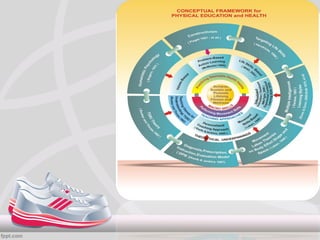
Trends in Teaching
Physical Education and
                Health
Physical Education: Description

    The Physical Education Curriculum under the K
to 12 Basic Education Program is anchored on the
tenet “Move to Learn and Learn to Move”. It
contributes to the development of fitness and
wellness among school-age children. The
program’s rich and challenging experiences
promote the development of active lifestyle which
is the key to achieving, sustaining and promoting
lifelong fitness.
Program Standard

The           learners      demonstrate
understanding of key concepts and
principles of health and fitness in
achieving, sustaining and promoting
lifelong fitness and wellness.
K to 12: Physical Education
                      Strands
1.Body Management
2.Movement Skills
3.Physical Fitness
4.Games and Sports
5.Rhythm and Dance
Body Management
Body Management includes body awareness,
space awareness, qualities and relationships
of movements and how they are used
dynamically in various physical activities.

Awareness of the body concepts enable us
the understand our physical self.
Movement Skills

Movement skills relate to fundamental
movement patterns and skills that form
the basis of all sport and fitness
activities.
Rhythm and Dance
Rhythm and dance offer an array of learning
experiences where the body is used as an
instrument of expression. This area includes
singing games, dance mixers, fundamental
rhythm, folk and foreign games, and creative
rhythms. Likewise, the learners learn to move
in time to music, adjust to different tempos
and move to different rhythmic patterns.
Physical Fitness

  Physical fitness includes fitness
assessment       through     testing and
recording and offers enhancement
activities that will develop and maintain
learners’ desired fitness level.
Games and Sports
Games and sports comprise fun games, low
organized games and lead-up games that
help achieve the development of correct
sports skills in preparation for active
participation in selected sports for recreation
and competition.
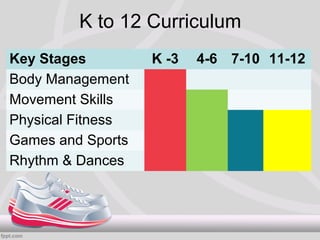
K to 12 Curriculum
Key Stages         K -3   4-6 7-10 11-12
Body Management
Movement Skills
Physical Fitness
Games and Sports
Rhythm & Dances
Health Education: Description
• Focuses on physical, mental, emotional, social,
moral and spiritual dimensions of health

• Enables the learners to acquire essential
knowledge, attitudes, and skills necessary to
promote good nutrition, prevent and control
diseases and substance use and abuse, reduce
health-related risk behaviors to prevent and
control injuries with the end in view of
maintaining and improving personal, family,
community, national and global health.
Health Education
                     Strands
1.Personal Health
2.Family Health
3.Community Health
4.National and Global Health
Issues and Concerns
PE and Sports Dichotomy

Use drugs to enhance
performance

Reproductive Health
Assumptions
1.The learning environment makes a
  difference.
2.Learning is based on associations.
3.Learning occurs in cultural and
  social contexts.
4.People learn in different ways.
5.People think about their own
  learning, and their feelings matter.
The learning environment
  makes a difference.

  Active, hands –on
learning and authentic
         tasks
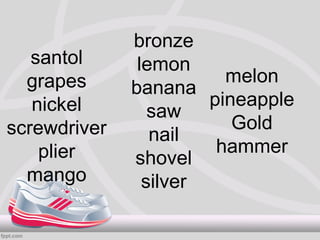
bronze
   santol      lemon
  grapes                 melon
              banana
   nickel              pineapple
                 saw
screwdriver               Gold
                 nail
    plier               hammer
              shovel
  mango         silver
Learning is based on
   associations.

 Link between prior
knowledge and new
     information
Learning occurs in cultural and
       social contexts.


     Learning together
People learn in different ways.


   Differentiate learning
People think about their own
 learning and their feelings
           matter.

 Learning to think about
        thinking
Assessment for Learning -
           Diagnostic
K-W-L
Pre-Test
Skills Check
Web/Concept Map
Misconception Check
Assessment as Learning –
             Formative
• Whole Group
  Hand Signals
  White Boards
  Misconception Check
  Quick Writes and Exit Cards
  Observations
Assessment as Learning –
              Formative
• Individuals
   Exit Card
   Weekly Letter
   Web/Concept Map
   One Minute Essay
   Question Box/Board
Assessment of Learning –
           Summative
• Six Facets of Understanding
     • Performance Tasks
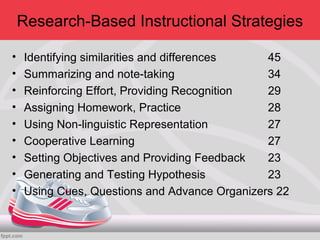
Research-Based Instructional Strategies

•   Identifying similarities and differences   45
•   Summarizing and note-taking                34
•   Reinforcing Effort, Providing Recognition  29
•   Assigning Homework, Practice               28
•   Using Non-linguistic Representation        27
•   Cooperative Learning                       27
•   Setting Objectives and Providing Feedback  23
•   Generating and Testing Hypothesis          23
•   Using Cues, Questions and Advance Organizers 22
Activity 1:
 Game
Comparing is the process of identifying
similarities and differences between and
among things or ideas.


Classifying is the process of grouping things
that are alike on the basis of their
characteristics


        Identifying Similarities and Differences
Creating Metaphors is the process of
identifying a general or basic patter in a
specific topic and then finding another topic
that appears to quite different but that has the
same pattern.

Creating Analogies is the process of
identifying relationships between pairs of
concepts- identifying relationships between
relationships
        Identifying Similarities and Differences
Activity 2:
Newspaper Work
Summarizing
      Delete some information , substitute some information
and keep some information.

      To effectively delete, substitute and keep information,
analyze the information at a fairly deep level.

Rule – Based Strategy
1.Delete trivial material that is unnecessary to understanding.
2.Delete redundant material.
3.Substitute superordinate terms for lists.
4.Select a sentence topic or invent one if it is missing.


               Summarizing and note-taking
Activity 3:
Dictation
Note Taking

     Informal Outline – uses indentation to indicate
major ideas and their related details.

       Webbing – uses the relative size circles to
indicate the importance of ideas and lines to indicate
relationships.

     Combination Notes – uses both informal and
webbing strategies.

            Summarizing and note-taking
Praise as Recognition

 Personalizing recognition

 Pause, Prompt and Praise

 Concrete symbols of recognition

The harder you try, the more successful you
                 become.

Reinforcing effort, Providing Recognition
1. Establish and communicate a homework policy.
  •   Place
  •   Schedule and time allotted for making the homework
  •   Parent involvement
  •   Level of difficulty
  •   Bedtime

2. Design a homework that clearly articulates the
   purpose and outcome.

3. Vary the approaches to providing feedback.

                    Assigning Homework and
                            Practice
1. Using creative graphic organizers
   • Concept
   • Event
   • Cause and Effect
   • Time - Sequence


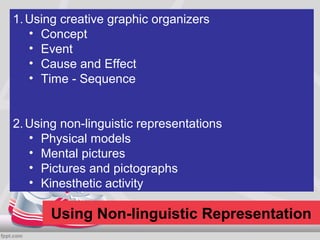
2. Using non-linguistic representations
   • Physical models
   • Mental pictures
   • Pictures and pictographs
   • Kinesthetic activity

       Using Non-linguistic Representation
Activity 4:
Paint Me
1.Positive interdependence

2.Face to face promotive interaction

3.Individual and group
  accountability

           Cooperative Learning
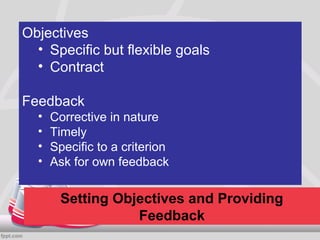
Objectives
  • Specific but flexible goals
  • Contract

Feedback
  •   Corrective in nature
  •   Timely
  •   Specific to a criterion
  •   Ask for own feedback


        Setting Objectives and Providing
                   Feedback
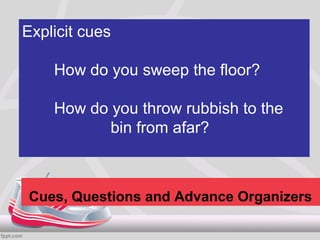
Explicit cues

    How do you sweep the floor?

    How do you throw rubbish to the
           bin from afar?


Cues, Questions and Advance Organizers
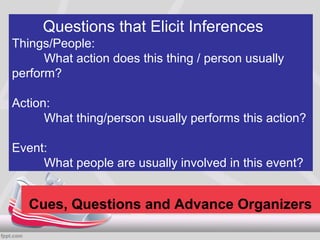
Questions that Elicit Inferences
Things/People:
      What action does this thing / person usually
perform?

Action:
      What thing/person usually performs this action?

Event:
     What people are usually involved in this event?


   Cues, Questions and Advance Organizers
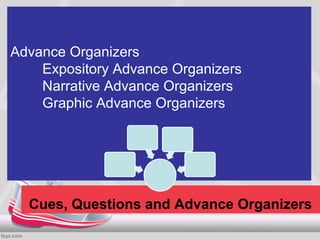
Advance Organizers
    Expository Advance Organizers
    Narrative Advance Organizers
    Graphic Advance Organizers


  Cues, Questions and Advance Organizers
Activity 5:
Organize your notes
Strategies in teaching peh

Strategies in teaching peh

  • 1.
    Trends in Teaching PhysicalEducation and Health
  • 3.
    Physical Education: Description The Physical Education Curriculum under the K to 12 Basic Education Program is anchored on the tenet “Move to Learn and Learn to Move”. It contributes to the development of fitness and wellness among school-age children. The program’s rich and challenging experiences promote the development of active lifestyle which is the key to achieving, sustaining and promoting lifelong fitness.
  • 4.
    Program Standard The learners demonstrate understanding of key concepts and principles of health and fitness in achieving, sustaining and promoting lifelong fitness and wellness.
  • 5.
    K to 12:Physical Education Strands 1.Body Management 2.Movement Skills 3.Physical Fitness 4.Games and Sports 5.Rhythm and Dance
  • 6.
    Body Management Body Managementincludes body awareness, space awareness, qualities and relationships of movements and how they are used dynamically in various physical activities. Awareness of the body concepts enable us the understand our physical self.
  • 7.
    Movement Skills Movement skillsrelate to fundamental movement patterns and skills that form the basis of all sport and fitness activities.
  • 8.
    Rhythm and Dance Rhythmand dance offer an array of learning experiences where the body is used as an instrument of expression. This area includes singing games, dance mixers, fundamental rhythm, folk and foreign games, and creative rhythms. Likewise, the learners learn to move in time to music, adjust to different tempos and move to different rhythmic patterns.
  • 9.
    Physical Fitness Physical fitness includes fitness assessment through testing and recording and offers enhancement activities that will develop and maintain learners’ desired fitness level.
  • 10.
    Games and Sports Gamesand sports comprise fun games, low organized games and lead-up games that help achieve the development of correct sports skills in preparation for active participation in selected sports for recreation and competition.
  • 11.
    K to 12Curriculum Key Stages K -3 4-6 7-10 11-12 Body Management Movement Skills Physical Fitness Games and Sports Rhythm & Dances
  • 12.
    Health Education: Description •Focuses on physical, mental, emotional, social, moral and spiritual dimensions of health • Enables the learners to acquire essential knowledge, attitudes, and skills necessary to promote good nutrition, prevent and control diseases and substance use and abuse, reduce health-related risk behaviors to prevent and control injuries with the end in view of maintaining and improving personal, family, community, national and global health.
  • 13.
    Health Education Strands 1.Personal Health 2.Family Health 3.Community Health 4.National and Global Health
  • 14.
    Issues and Concerns PEand Sports Dichotomy Use drugs to enhance performance Reproductive Health
  • 16.
    Assumptions 1.The learning environmentmakes a difference. 2.Learning is based on associations. 3.Learning occurs in cultural and social contexts. 4.People learn in different ways. 5.People think about their own learning, and their feelings matter.
  • 17.
    The learning environment makes a difference. Active, hands –on learning and authentic tasks
  • 18.
    bronze santol lemon grapes melon banana nickel pineapple saw screwdriver Gold nail plier hammer shovel mango silver
  • 19.
    Learning is basedon associations. Link between prior knowledge and new information
  • 20.
    Learning occurs incultural and social contexts. Learning together
  • 21.
    People learn indifferent ways. Differentiate learning
  • 22.
    People think abouttheir own learning and their feelings matter. Learning to think about thinking
  • 23.
    Assessment for Learning- Diagnostic K-W-L Pre-Test Skills Check Web/Concept Map Misconception Check
  • 24.
    Assessment as Learning– Formative • Whole Group Hand Signals White Boards Misconception Check Quick Writes and Exit Cards Observations
  • 25.
    Assessment as Learning– Formative • Individuals Exit Card Weekly Letter Web/Concept Map One Minute Essay Question Box/Board
  • 26.
    Assessment of Learning– Summative • Six Facets of Understanding • Performance Tasks
  • 28.
    Research-Based Instructional Strategies • Identifying similarities and differences 45 • Summarizing and note-taking 34 • Reinforcing Effort, Providing Recognition 29 • Assigning Homework, Practice 28 • Using Non-linguistic Representation 27 • Cooperative Learning 27 • Setting Objectives and Providing Feedback 23 • Generating and Testing Hypothesis 23 • Using Cues, Questions and Advance Organizers 22
  • 29.
  • 30.
    Comparing is theprocess of identifying similarities and differences between and among things or ideas. Classifying is the process of grouping things that are alike on the basis of their characteristics Identifying Similarities and Differences
  • 31.
    Creating Metaphors isthe process of identifying a general or basic patter in a specific topic and then finding another topic that appears to quite different but that has the same pattern. Creating Analogies is the process of identifying relationships between pairs of concepts- identifying relationships between relationships Identifying Similarities and Differences
  • 32.
  • 33.
    Summarizing Delete some information , substitute some information and keep some information. To effectively delete, substitute and keep information, analyze the information at a fairly deep level. Rule – Based Strategy 1.Delete trivial material that is unnecessary to understanding. 2.Delete redundant material. 3.Substitute superordinate terms for lists. 4.Select a sentence topic or invent one if it is missing. Summarizing and note-taking
  • 34.
  • 35.
    Note Taking Informal Outline – uses indentation to indicate major ideas and their related details. Webbing – uses the relative size circles to indicate the importance of ideas and lines to indicate relationships. Combination Notes – uses both informal and webbing strategies. Summarizing and note-taking
  • 36.
    Praise as Recognition Personalizing recognition Pause, Prompt and Praise Concrete symbols of recognition The harder you try, the more successful you become. Reinforcing effort, Providing Recognition
  • 37.
    1. Establish andcommunicate a homework policy. • Place • Schedule and time allotted for making the homework • Parent involvement • Level of difficulty • Bedtime 2. Design a homework that clearly articulates the purpose and outcome. 3. Vary the approaches to providing feedback. Assigning Homework and Practice
  • 38.
    1. Using creativegraphic organizers • Concept • Event • Cause and Effect • Time - Sequence 2. Using non-linguistic representations • Physical models • Mental pictures • Pictures and pictographs • Kinesthetic activity Using Non-linguistic Representation
  • 39.
  • 40.
    1.Positive interdependence 2.Face toface promotive interaction 3.Individual and group accountability Cooperative Learning
  • 41.
    Objectives •Specific but flexible goals • Contract Feedback • Corrective in nature • Timely • Specific to a criterion • Ask for own feedback Setting Objectives and Providing Feedback
  • 42.
    Explicit cues How do you sweep the floor? How do you throw rubbish to the bin from afar? Cues, Questions and Advance Organizers
  • 43.
    Questions that ElicitInferences Things/People: What action does this thing / person usually perform? Action: What thing/person usually performs this action? Event: What people are usually involved in this event? Cues, Questions and Advance Organizers
  • 44.
    Advance Organizers Expository Advance Organizers Narrative Advance Organizers Graphic Advance Organizers Cues, Questions and Advance Organizers
  • 45.