Business Law
Chapter 2: Ethics In Our Law
What is Ethics?
 What does ethics mean?
 Think of a situation where ethics would be

involved.
What is Ethics?
 Ethics is deciding what is right or wrong in

a reasoned, impartial manner

 Key elements:

impartial

decision, reasoned,
Ethics: Decision
 To involve ethics, a decision must affect

you or others in some significant way.

 There are many examples of decisions

that do not involve ethics.

 Give an example for a decision that

involves ethics, and one that does not.
Ethics: Reasoned
 The decision must be made objectively

without emotions.
 It is often very difficult to remove your
emotions from a decision.
 People generally get guidance about right
and wrong from their religion (Bible,
Koran, Torah, etc.) or the law.
Ethics: Impartial
 Impartiality is the idea that the same

ethical standards are applied to everyone.
 There should be a fairness involved when
dealing with ethics.
 We must balance our self-interest and
views with that of others.
What would you do?
You’re at a friend’s house for a party. While
having a great time dancing, you
accidentally knock over a porcelain picture
frame and it cracks. The frame looks old
and nobody saw you bump it.
What will you do about it?
How do you feel after making that decision?
What would you do?
 As you’re walking home from school you

notice a soccer ball left out on the field by
the gym class. You play soccer and your
ball is worn out so you pick up the ball
from the field and take it home.

Can you justify taking the ball?
What would you do?
Jack’s car was struck by a man who ran a stop
light. After surveying the damage, Jack sees
he’ll need a new left fender, head light assembly,
and a bumper. His left door is rusted out at the
bottom but was not damaged. He decides to hit
it with a hammer and say it was damaged in the
accident so he can get it replaced at no cost to
himself.
How will Jack justify this? Has he hurt anyone?
Behind all businesses, schools, and
organizations, there are people. When we
wrong an institution, the government or
any kind of organization, we injure or
wrong people. Someone will be affected
by your decision. Many people today
justify stealing or short changing their
work, their school, or our government.
Forms of Ethical Reasoning


Based on Consequences
–
–
–
–



Right and wrong is based on the results
Not based on morals or rules, but greater good
Positive consequences = right
Negative consequences = wrong

Based on Ethical Rules

– Acts are judged either right or wrong regardless of the
results



Both types of reasoning can be used in deciding
ethical questions, usually with the same result.
Consequence-based Reasoning
 An individual will examine possible

courses of action and their consequences.
After evaluating the consequences, a
person selects the action that results in
the best outcome.
 When deciding which action to take,
consideration is given to others involved.
 A person’s goals and values affect their
reasoning.
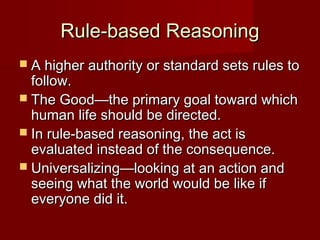
Rule-based Reasoning
 A higher authority or standard sets rules to

follow.
 The Good—the primary goal toward which
human life should be directed.
 In rule-based reasoning, the act is
evaluated instead of the consequence.
 Universalizing—looking at an action and
seeing what the world would be like if
everyone did it.
Moral Rights
 All human beings have dignity and worth

therefore they must be treated with
respect.
 Humans are unique because of their
potential for reasoning about right and
wrong.
 This means humans have moral rights.
Moral Rights
 Rightful claims on other people that flow

from each person’s status has a human
being.
Laws
 In this country, the people determine the

laws that bind them.

 Do you agree with the above statement?

Why or Why not?
 We elect our officials who, in turn, make

laws that are acceptable to the majority of
people they represent.
 ‘Majority rules’ is a popular statement that
means elected officials enact rules and
regulations that are acceptable by the
majority of voters.
 Majority rules is based on consequencebased ethics.
Civil Rights
 Personal, human rights are recognized

and guaranteed by our Constitution.
 Freedom of religion, speech, the press,
unreasonable searches and seizures,
speedy and just trial, vote, etc.
Read Law and the Internet p. 26
What’s Your Verdict?
 Read What’s Your Verdict?

p. 27

Is there any ethical justification for treating
Smyth and Brown so differently?
Obeying Laws
 Why do you obey laws and rules?

??
??
??
??
??
Why Obey Laws???
 Based on Ethical reasoning
 Integrity—the ability to do what is right

even in the face of temptation to do
otherwise
 Afraid of punishment/consequences
 To maintain Civil order
What’s Your Verdict? p. 28
 Is there ethical justification for Dr. King’s

actions?

 Under what circumstances would you

consider committing civil disobedience?
Are we ever justified in violating the law?
Yes!
 Any law that goes against basic human

rights, dignity, and common justice for all
may be deemed unethical.

 How do you change the law?
How to change the law
 Work within the system to make a change
 Write your local/state government official
 Vote
 Be informed and educate others
 Civil Disobedience
When is civil disobedience
allowed?
 Law goes against ethic reasoning
 No political means to change
 Disobedience is nonviolent
 The common good is enhanced above

one’s self interest
 Disobedience is public
 Offender is willing to accept the
punishment
Responsibilities of An American
Citizen
The duty to obey the law
The duty to respect the rights of others
The duty to inform yourself on political issues
The duty to vote in elections
The duty to serve on juries if called
The duty to serve and defend your country
The duty to assist agencies of law enforcement

Chapter 2: Ethics in Law

  • 1.
    Business Law Chapter 2:Ethics In Our Law
  • 2.
    What is Ethics? What does ethics mean?  Think of a situation where ethics would be involved.
  • 3.
    What is Ethics? Ethics is deciding what is right or wrong in a reasoned, impartial manner  Key elements: impartial decision, reasoned,
  • 4.
    Ethics: Decision  Toinvolve ethics, a decision must affect you or others in some significant way.  There are many examples of decisions that do not involve ethics.  Give an example for a decision that involves ethics, and one that does not.
  • 5.
    Ethics: Reasoned  Thedecision must be made objectively without emotions.  It is often very difficult to remove your emotions from a decision.  People generally get guidance about right and wrong from their religion (Bible, Koran, Torah, etc.) or the law.
  • 6.
    Ethics: Impartial  Impartialityis the idea that the same ethical standards are applied to everyone.  There should be a fairness involved when dealing with ethics.  We must balance our self-interest and views with that of others.
  • 7.
    What would youdo? You’re at a friend’s house for a party. While having a great time dancing, you accidentally knock over a porcelain picture frame and it cracks. The frame looks old and nobody saw you bump it. What will you do about it? How do you feel after making that decision?
  • 8.
    What would youdo?  As you’re walking home from school you notice a soccer ball left out on the field by the gym class. You play soccer and your ball is worn out so you pick up the ball from the field and take it home. Can you justify taking the ball?
  • 9.
    What would youdo? Jack’s car was struck by a man who ran a stop light. After surveying the damage, Jack sees he’ll need a new left fender, head light assembly, and a bumper. His left door is rusted out at the bottom but was not damaged. He decides to hit it with a hammer and say it was damaged in the accident so he can get it replaced at no cost to himself. How will Jack justify this? Has he hurt anyone?
  • 10.
    Behind all businesses,schools, and organizations, there are people. When we wrong an institution, the government or any kind of organization, we injure or wrong people. Someone will be affected by your decision. Many people today justify stealing or short changing their work, their school, or our government.
  • 11.
    Forms of EthicalReasoning  Based on Consequences – – – –  Right and wrong is based on the results Not based on morals or rules, but greater good Positive consequences = right Negative consequences = wrong Based on Ethical Rules – Acts are judged either right or wrong regardless of the results  Both types of reasoning can be used in deciding ethical questions, usually with the same result.
  • 12.
    Consequence-based Reasoning  Anindividual will examine possible courses of action and their consequences. After evaluating the consequences, a person selects the action that results in the best outcome.  When deciding which action to take, consideration is given to others involved.  A person’s goals and values affect their reasoning.
  • 13.
    Rule-based Reasoning  Ahigher authority or standard sets rules to follow.  The Good—the primary goal toward which human life should be directed.  In rule-based reasoning, the act is evaluated instead of the consequence.  Universalizing—looking at an action and seeing what the world would be like if everyone did it.
  • 14.
    Moral Rights  Allhuman beings have dignity and worth therefore they must be treated with respect.  Humans are unique because of their potential for reasoning about right and wrong.  This means humans have moral rights.
  • 15.
    Moral Rights  Rightfulclaims on other people that flow from each person’s status has a human being.
  • 16.
    Laws  In thiscountry, the people determine the laws that bind them.  Do you agree with the above statement? Why or Why not?
  • 17.
     We electour officials who, in turn, make laws that are acceptable to the majority of people they represent.  ‘Majority rules’ is a popular statement that means elected officials enact rules and regulations that are acceptable by the majority of voters.  Majority rules is based on consequencebased ethics.
  • 18.
    Civil Rights  Personal,human rights are recognized and guaranteed by our Constitution.  Freedom of religion, speech, the press, unreasonable searches and seizures, speedy and just trial, vote, etc. Read Law and the Internet p. 26
  • 19.
    What’s Your Verdict? Read What’s Your Verdict? p. 27 Is there any ethical justification for treating Smyth and Brown so differently?
  • 20.
    Obeying Laws  Whydo you obey laws and rules? ?? ?? ?? ?? ??
  • 21.
    Why Obey Laws??? Based on Ethical reasoning  Integrity—the ability to do what is right even in the face of temptation to do otherwise  Afraid of punishment/consequences  To maintain Civil order
  • 22.
    What’s Your Verdict?p. 28  Is there ethical justification for Dr. King’s actions?  Under what circumstances would you consider committing civil disobedience?
  • 23.
    Are we everjustified in violating the law?
  • 24.
    Yes!  Any lawthat goes against basic human rights, dignity, and common justice for all may be deemed unethical.  How do you change the law?
  • 25.
    How to changethe law  Work within the system to make a change  Write your local/state government official  Vote  Be informed and educate others  Civil Disobedience
  • 26.
    When is civildisobedience allowed?  Law goes against ethic reasoning  No political means to change  Disobedience is nonviolent  The common good is enhanced above one’s self interest  Disobedience is public  Offender is willing to accept the punishment
  • 27.
    Responsibilities of AnAmerican Citizen The duty to obey the law The duty to respect the rights of others The duty to inform yourself on political issues The duty to vote in elections The duty to serve on juries if called The duty to serve and defend your country The duty to assist agencies of law enforcement